REVIEW 1 major objections 3 minor 77 references
Oprema -- The Relay Computer of Carl Zeiss Jena
T0 review · 1 major / 3 minor · reviewed 2026-08-14 · deepseek-v4-flash
Pith's one-line read The Oprema relay computer was built in 14 months at Carl Zeiss Jena and became the first universal computer in the GDR.
desk verdict Solid archival reconstruction of the Oprema with a genuine correction and new technical detail; the abstract's 14-month timeline overstates what the body itself concedes. read the letter →
The pith
A machine-rendered reading of the paper's core claim, the machinery that carries it, and where it could break.
The reading
What carries the argument
The load-bearing source is Gerhard Lenski's handwritten work diary, 58 pages covering 5 April to 24 December 1954, which fixes the project's start, its weekly decisions, and the final completion push; its attribution to Lenski rests on handwriting, his role as head of physical design, and the testimony of a later team member. The second load-bearing document is Kortum's May 1958 report, which explicitly denies that any concrete Oprema design work was done while he and Kämmerer were detained in the Soviet Union; without that denial the designed-and-built-in-1954 claim loses its force. On the technical side, the central mechanism is the 3-phase pulse system with cam-operated contactors, which switches relay contacts only when no current flows, and the control sequences ('Führungsketten') that propagate an activation wave through chains of bistable latching relays to sequence instruction execution.
What would settle it
Finding a dated Oprema design document, such as a wiring diagram, an instruction-format sketch, or a relay count, from before 5 April 1954 in any surviving collection of the participants' papers would refute the claim that the design work began in Jena in 1954.
Extended reading notes
Core claim
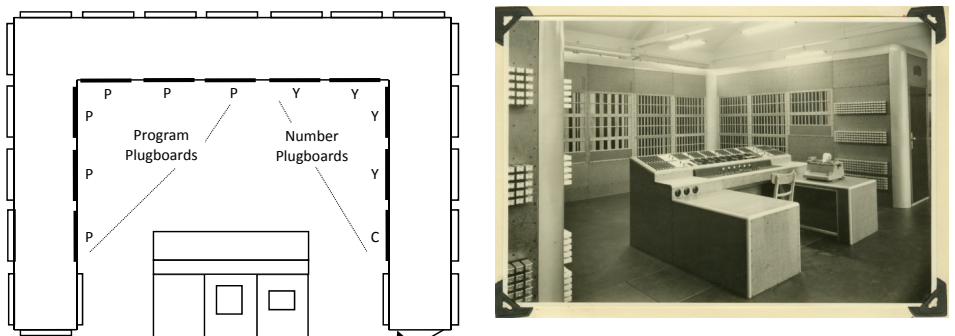
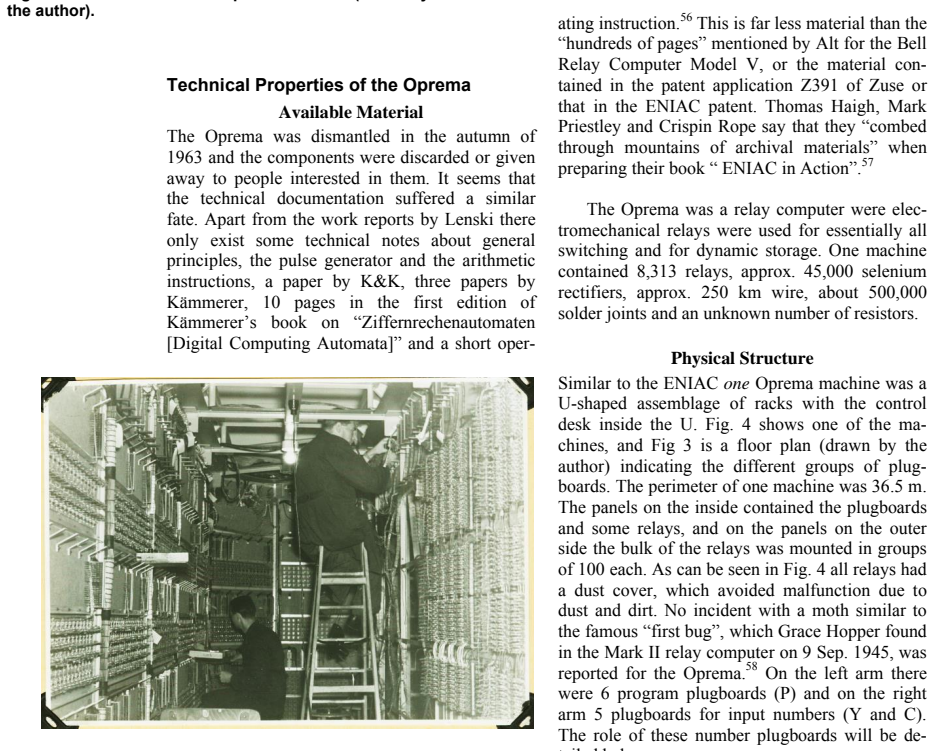
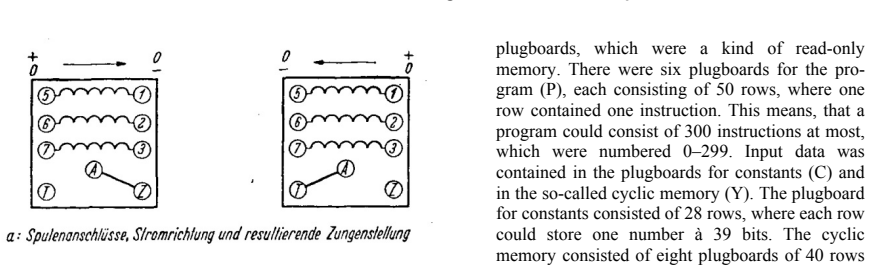
The central claim is that the Oprema was a genuine program-controlled relay computer, built as two identical machines, and that its design and construction were completed within roughly fourteen months. Each machine held 8,313 relays, about 45,000 selenium rectifiers, 250 km of wire, and an estimated 500,000 solder joints; programs of up to 300 instructions were wired onto plugboards, and data lived in plugboard constants, cyclic memories, and 32 relay registers. The instruction format was four-address and 27 bits long, and the number format was normalized decimal floating point in excess-3 BCD, with a 39th bit encoding zero, infinity, and indeterminate values, features that put the Oprema in the same family as Zuse's special-value floating point and, later, IEEE 754. The reconstruction is anchored by Lenski's work diary, which shows design work beginning on 5 April 1954, by the 17 May 1954 ministry meeting at which Kortum promised completion by the end of 1954, and by Kortum's May 1958 report denying that concrete plans were smuggled out of the Soviet Union. The paper concludes that the Oprema was the seventh universal computer in Germany, after the Z3, Z4, G1, Z5, ALWAC, and G2, and the first in the GDR.
Load-bearing premise
The 14-month timeline rests on Kortum's May 1958 statement that he and Kämmerer did no concrete Oprema design work in the Soviet Union, and on the attribution of the anonymous work diary to Gerhard Lenski as a complete daily record.
Editorial extensions
If this is right
- Programs of up to 300 instructions were wired into plugboards, yet the machine could still execute conditional and unconditional jumps and loops; Oprema was program-controlled without using an electronic stored program.
- The planned twin-machine checking mode, two machines running the same program and comparing results after each instruction, was never wired up because both machines worked reliably after debugging; the Oprema therefore always ran as two separate computers.
- Productive use rose from 64% of possible hours in 1956 to 88% in the first half of 1960, which supports the paper's picture of a relay machine that, once debugged, was dependable enough for production computing.
- At Carl Zeiss Jena, the share of lens-design samples that reached production rose from 7% in 1954 to 83% in 1957, a change the paper ties to the Oprema's ability to trace more rays and handle aspheric surfaces.
Reading between the lines
- A simulation of the Oprema's instruction set and cyclic-memory mechanism would let a modern reader measure how much of the 1955–1957 productivity jump came from the machine itself rather than from the team's growing experience; this test is not in the paper.
- The paper's rounding analysis suggests a hardware trick, roundNorm, which avoids the ripple-overflow adder needed by roundTiesToEven and could be worth revisiting in low-power designs where a full adder is expensive; this is an engineering consequence the paper does not draw.
- The Oprema's cyclic memories, which feed successive values through registers with jump sockets, can be read as an index-register mechanism shaped by ray-tracing workloads; a comparative study of early index mechanisms across relay and tube machines would place it in a broader lineage.
Signed reviews
Editorial analysis
A structured set of objections, weighed in public.
Referee Report
Summary. This paper is an archival history of the Oprema (Optikrechenmaschine), a relay computer developed at Carl Zeiss Jena (CZJ) in 1954–1955 under Wilhelm Kämmerer's technical leadership and Herbert Kortum's managerial sponsorship. The paper claims that the Oprema was the seventh universal computer in Germany and the first in the GDR; that it consisted of two identical machines, each containing 8,313 relays, roughly 45,000 selenium rectifiers and about 250 km of cable; and that machine-1 was designed and built in about 14 months, measured from the first entry of Gerhard Lenski's work diary (5 April 1954) to its ready-for-use date around mid-June 1955. It reconstructs the machine's plugboard-based program storage, its four-address 27-bit instruction format, its decimal floating-point arithmetic with special values for zero, infinity and indeterminate, and its arithmetic algorithms, including a distinctive rounding scheme. It also recounts the biographies of Kämmerer and Kortum, their work in the KoKor development lab, their seven years of detention in the Soviet Union, the approval of the project by minister Rau in May 1954, the machine's operational record from 1955 to 1963, and the historiographical debate over whether Kortum should count as a German computer pioneer.
Significance. If the reconstruction holds, the paper secures the Oprema's place in the chronology of German and GDR computing and provides the most detailed technical account of the machine available, while correcting at least one figure in the secondary literature (Cortada's 25,000-relay count for the two machines combined). The paper's main strength is its archival grounding: the central claims are anchored in specific primary sources, including Lenski's work diary, memos in the CZJ and Deutsches Museum archives, Kortum's May 1958 report, and Kämmerer's 1955–1960 technical publications. The author consistently flags attribution inferences, contradictions between sources, missing documents, and gaps in the technical record: the attribution of the anonymous work diary to Lenski is argued step by step; the tension between Helga Kämmerer's recollection of Oprema discussions on Gorodomlia and Kortum's 1958 denial is reported frankly; and the incompleteness of the anonymous arithmetic notes, and the contradiction in the rounding description in Kämmerer's 1960 book, are stated rather than concealed.
major comments (1)
- [Abstract; §Design and Construction of the Oprema] The abstract's headline timing claim is not fully supported by the paper's own body text. The abstract says that 'basic experiments, design and construction of machine-1 were all done, partly concurrently, in the remarkably short time of about 14 months,' without qualification. In the Design and Construction section, however, the author states that 'Kämmerer had already done some significant design work before April 1954, especially after his return to Jena on 21 November 1953' (supported by endnote 31), and the same section later concedes that 'there is no clear-cut method to determine such time periods.' The 14 1/3-month figure is computed from the first Lenski work-diary entry (5 April 1954) to mid-June 1955, and the text also records the alternative start date of 17 May 1954 (minister Rau's approval). The stress-test concern therefore lands in part: the abstract overstates what the body's own evidence supports, and the inconsistency is internal. The fix is local: the abstract should specify the interval being measured (e.g., 'from the start of the documented design-and-construction work in April 1954') and should acknowledge the earlier design work discussed in the body. The body's own discussion is already appropriately hedged and does not require substantive change.
minor comments (3)
- [§Operation and Use] The sentence 'During these weeks the machine was operated 13286 hours per week' contains a garbled figure; endnote 86 shows the intended comparison is between 136, 1360 and 1320 hours, so the main text should read approximately '132 hours per week' (or state the 1320-hour ten-week total) and the endnote should be reconciled with the corrected wording.
- [§Technical Properties, Reliability subsection] The isolated phrase 'on average almost 10 % unnoticed errors' appears as a dangling fragment immediately before Table 2; it should either be integrated into the preceding paragraph about Kämmerer's human-versus-machine experiment or deleted.
- [Throughout] Several typos and typesetting artifacts should be cleaned up: 'a relay computer were electromechanical relays' should be 'where'; 'the Havard Computation Laboratory' should be 'Harvard'; 'German Metereological Service' should be 'Meteorological'; 'who's now head of his own company' should be 'whose'; 'Seminumerical Algoritms' (endnote 30) should be 'Algorithms'; and 'GoldsƟne' (endnote 28) should be 'Goldstine' to match the spelling used elsewhere.
Circularity Check
No circular derivation: the paper is a historical reconstruction, and its two self-citations are not load-bearing.
full rationale
The paper makes no formal derivation, no numerical fit, and no prediction that could reduce by construction to an input. Its central claims about the Oprema's design, timeline, relay count, ranking as the seventh universal computer in Germany, and first computer in the GDR are grounded in primary archival sources: Lenski's work diary (UACZ, BACZ 27995), Kortum's May 1958 report, Kämmerer's reports, Zeiss archive materials, and contemporary records. The author cites two of his own earlier publications, in endnotes 33 and 93, but these support only peripheral details: the failed search for evidence that Bertele used Zuse's Z4, and a comparison of Z5 versus Oprema speeds. Neither is the basis for the paper's headline claims. The 14-month figure is presented as a rough estimate, and the paper explicitly acknowledges the ambiguity: 'there is no clear-cut method to determine such time periods' and notes that Kämmerer had done significant design work before April 1954. That is historical uncertainty, not circularity. No uniqueness theorem is imported, no ansatz is smuggled in via citation, and no known result is merely renamed. The analysis therefore finds no significant circularity; at most there are two minor self-citations that do not carry the central narrative.
Assumptions & free parameters
assumptions (3)
- domain assumption The cited archival documents, including the Lenski work diary, Kortum report, Schumann memos, and anonymous technical notes, are authentic and accurately transcribed.
- domain assumption Kortum's May 1958 statement that no concrete Oprema design work was done in the Soviet Union is truthful.
- domain assumption Kämmerer's 1960 book and the anonymous notes accurately describe the implemented arithmetic except where the paper identifies contradictions.
Cite this review
Pith. "Pith review of Oprema -- The Relay Computer of Carl Zeiss Jena." pith.science (2026). https://pith.science/paper/PAWJHFIV
@misc{pith2026190809549,
  author       = {Pith},
  title        = {Pith review of: Oprema -- The Relay Computer of Carl Zeiss Jena},
  year         = {2026},
  howpublished = {\url{https://pith.science/paper/PAWJHFIV}},
  note         = {Machine review of arXiv:1908.09549}
}
read the original abstract
The Oprema (Optikrechenmaschine = computer for optical calculations) was a relay computer whose development was initiated by Herbert Kortum and which was designed and built by a team under the leadership of Wilhelm Kaemmerer at Carl Zeiss Jena (CZJ) in 1954 and 1955. Basic experiments, design and construction of machine-1 were all done, partly concurrently, in the remarkably short time of about 14 months. Shortly after the electronic G 2 of Heinz Billing in Goettingen it was the 7th universal computer in Germany and the 1st in the GDR. The Oprema consisted of two identical machines. One machine consisted of about 8,300 relays, 45,000 selenium rectifiers and 250 km cable. The main reason for the construction of the Oprema was the computational needs of CZJ, which was the leading company for optics and precision mechanics in the GDR. During its lifetime (1955-1963) the Oprema was applied by CZJ and a number of other institutes and companies in the GDR. The paper presents new details of the Oprema project and of the arithmetic operations implemented in the Oprema. Additionally, it covers briefly the lives of the two protagonists, W. Kaemmerer and H. Kortum, and draws some comparisons with other early projects, namely Colossus, ASCC/Mark 1 and ENIAC. Finally, it discusses the question, whether Kortum is a German computer pioneer.
Figures

Figures from the paper (9 more)



Reference graph
Works this paper leans on
-
[1]
90 A. Jung, “5 Jahre “Oprema“”, p. 8, Appendix III. 91 G. R. Stibitz and E. Loveday, “The Relay Compu‐ ters of Bell Labs, Part Two“, Datamation (0011‐ 6963), vol. 13, no. 5, 1967, pp. 45‒49, here p
work page 1967
-
[2]
to assess the reliability of Oprema-1. It consisted of the computation of a polynome of 5 th degree for 151 argument values. Thes e calculations were done by Oprema-1 on the one side and by two experienced (human) computers, working inde- pendently, on the other side. The human comput- ers worked with paper, pencil and 8-digit Mer- cedes Euclid desk calcu...
work page 1956
-
[3]
318−321; on the cooling‐off period see e.g
23 Kämmerer,“Wilhelm Kämmerer “, pp. 318−321; on the cooling‐off period see e.g. Heinemann‐ Grüder and Wellmann, Die Spezialisten, pp. 46, 81−82 and Max Steenbeck, Impulse und Wir‐ kungen [Impulses and Effects], Verlag der Na‐ tion, Berlin [East; JW], 1977, p
work page 1977
-
[4]
was probably the fastest relay computer ever built
During these weeks the machine was operated 13286 hours per week: three shifts from Monday to Friday and two shifts on Saturday. During these 10 weeks 18 orders for optical systems had been completed in 1040 productive computing hours in total. In a separate table Kämmerer lists 21 orders with a total of 978 hours, which were billed to the customers with ...
work page 1958
-
[5]
Oprema, die programmgesteuerte Zwillings‐Rechenanlage des VEB Carl Zeiss Jena
42 W. Kämmerer and H. Kortum, “Oprema, die programmgesteuerte Zwillings‐Rechenanlage des VEB Carl Zeiss Jena”, p. 103; E. Mühlhausen, “Am Anfang war OPREMA . . .”, p. 35; E. Mühl‐ hausen, “OPREMA und ZRA 1”; I. O. Kerner, “OPREMA und ZRA 1 – die Rechenmaschinen der Firma Carl Zeiss Jena [OPREMA and ZRA 1 – The Computing Machines of the Carl Zeiss Com‐ pan...
work page 2006
-
[6]
On the other hand, the journal “El ectrical Engineering” in May 1954 reports that the ALWAC has been unveiled, without giving any date. Logistics Re- search was formed in 1952 by the Swedish indus- trialist Axel Lennart We nner-Gren, who had also founded the "Verkehrsbahn-Studiengesellschaft [Transit Railway Study Group]“ in Cologne- Fühlingen, Germany, i...
work page 1954
-
[7]
The ZRA 1 was produced in a small series of about 32 ma- chines in the years 1959 to
work page 1959
- [9]
Show all 77 references
-
[10]
ENIAC: Invention of a Computer
Aufl., p. 519 [Federal Department for All‐German Af‐ fairs, ed., SBZ from A to Z, German Federal Pu‐ blishing House, Bonn, 10th ed., 1966]. 35 T. P. Hughes, “ENIAC: Invention of a Computer”, Technikgeschichte (0040‐117X), vol. 42, no. 2, 1975, pp. 148−165, here pp. 156−157. 36...
1966
-
[11]
Der Einfluss von Paul Rudolph und Harry Zöllner auf die Entwicklung der Fotoobjektive [The influence of Paul Rudolph and Harry Zöllner on the development of pho‐ tagraphic lenses]
88 C. Hofmann, “Der Einfluss von Paul Rudolph und Harry Zöllner auf die Entwicklung der Fotoobjektive [The influence of Paul Rudolph and Harry Zöllner on the development of pho‐ tagraphic lenses]”, Jenaer Jahrbuch zur Technik‐ und Industriegeschichte, Band 10 [Jenaer Year‐ boo...
2007
-
[12]
11 G. Lenski, “Reisebericht – Fahrt mit LKW durch das amerikanisch besetzte Gebiet Deutschlands vom 7.10.45 bis 3.11.45 [Trip Report – Trip by Truck Through the US‐occupied Zone of Germa‐ ny from 7 Oct. 1945 to 3 Nov. 1945]“, Len/Stk 25.11.1945, UACZ, BACZ VA 006258 ff. 564−57...
1945
-
[13]
Konrad Zuse’s Leg‐ acy: The Architecture of the Z1 and Z3
63 E. Stiefel, “La machine a calculer «Z4» de l’École Polytechnique Fédérale a Zurich (Suisse) et sa application a la résolution d’une équation aux dérivées partielles de type elliptique [The calcu‐ lating machine «Z4» of the Federal Institute of Technology in Zurich (Switzerl...
1953
-
[15]
His concept has the date 16 March 1995 and lists 6 papers whose authors shoul d be he himself, Leh- mann or Mühlhausen
Jänike answered on 9 March 1995 and proposed that each of them should draw up a concept for a “Special Issue of the Journal Annals of the History of Computing“ on the “History of Computing in East Germany“. His concept has the date 16 March 1995 and lists 6 papers whose author...
1995
-
[16]
Kortum”; “Kurzchronik der Konstruktionsbüros (EBos), Konstruktionsbüro Kortum [Short Histo‐ ry of the Development Labs, Development Lab Kortum]
8 UACZ, BACZ, Namenskartei [Names catalogue]: “Kortum”; “Kurzchronik der Konstruktionsbüros (EBos), Konstruktionsbüro Kortum [Short Histo‐ ry of the Development Labs, Development Lab Kortum]”, UACZ, BACZ 16631. 9 H. Kortum, “Kreiselvisiere [Gyroscopic Sights]”, Lilienthal‐Gese...
1942
-
[17]
About the Author Jürgen F
For their assistance during my search for information and source material I also thank Helga Kämmerer, Jena, the elder daughter of Wilhelm Kämmerer; Klaus Lösche, Jena; Johannes Jänike (), Jena; Wolfgang Koch of Friedrich Schiller University Jena, who gave me one of the Oprem...
2008
-
[18]
guarantees
Kämmerer (3 rd from right) receives the Konrad Zuse Medal; Zuse second from right. Courtesy of GI Bonn. JFH Winkler Oprema – The Relay Computer of Carl Zeiss Jena 24 (On 17 May 1954 Kortum presented the Oprema project to minister Rau in Berlin (East), as men- tioned above.) 19...
1954
-
[25]
Forschung und Entwicklung bei Zeiss in der Zwischenkriegszeit [Research and Development at Zeiss in the Interwar Period]
7 W. Wimmer, “Forschung und Entwicklung bei Zeiss in der Zwischenkriegszeit [Research and Development at Zeiss in the Interwar Period]”, Jenaer Jahrbuch zur Technik‐ und Industrieges‐ chichte, Band 12 [Jenaer Yearbook on the Histo‐ ry of Technology and Industry, vol. 12], M. S...
2009
-
[27]
Genesis of the ENIAC
46 B. Randell, ed., The Origins of Digital Comput‐ ers, Third Ed., Springer, Berlin etc., 1982, 0‐387‐ 11319‐3, pp. 297, 353; J. G. Brainerd, “Genesis of the ENIAC”, Technology and Culture (0040‐ 165X), vol. 17, no. 3 (Jul., 1976), pp. 482‐488, here pp. 486, 487; A. W. Burks a...
1982
-
[30]
Mr. Williams, University of Calgary, Alberta, Kanada
of 1956 Kämmerer had only mentioned himself.121 Summing up, we may call Kortum a pioneer computer initiator, as John Ronald Womersley has JFH Winkler Oprema – The Relay Computer of Carl Zeiss Jena 25 been called by Brian E. Carpenter and Robert W. Doran.122 Conclusion Despite ...
1956
-
[32]
Oprema, die programmgesteuerte Zwillings‐Rechenanlage des VEB Carl Zeiss Je‐ na
30 LWD, 6 and 8 April 1954; W. Kämmerer and H. Kortum, “Oprema, die programmgesteuerte Zwillings‐Rechenanlage des VEB Carl Zeiss Je‐ na”; W. Kämmerer, “Die programmgesteuerte Rechenanlage „Oprema“ [The program‐ controlled computing device „Oprema“]“, MTW‐Mitteilungen, vol. III...
1954
-
[33]
Trip Report
1955, UACZ, BACZ No. 19570. 32 Ministerium für Maschinenbau [Ministry of Machine Building], Sekretariat des Ministers [Office of the Minister], Memo 19 May 1954; H. Kortum, “Trip Report”, 20 May 1954; H. Kor‐ tum, ”Kurze Zusammenfassung des Vortrages zur Oprema, gehalten vor M...
1955
-
[40]
Computing Room Oprema
The ZRA 1 was the second computer model developed and built by CZJ; about 33 ZRA 1 were produced. The “Computing Room Oprema” had been renamed “Computing Center” in 1959.85 It seems that after the Rechenraum Oprema had been founded there was still some debugging necessary. Käm...
1959
-
[43]
55 I. B. Cohen, Howard Aiken: Portrait of a Compu‐ ter Pioneer, The MIT Press, Cambridge & Lon‐ don, 1999, 0‐262‐03262‐7, p. 115; C. J. Bashe et al.: IBM’s Early Computers, pp. 26,
1999
-
[44]
Grundgedanken zur Konstruktion der Oprema [Basic Ideas on the Design of Oprema]
56 Anon.,” Allgemeine Prinzipien [Basic Princi‐ ples]”, 8 pages, Doc.‐No. 54‐3197, 8−19 June 1954, UACZ, BACZ 27995; Anon., “Grundgedanken zur Konstruktion der Oprema [Basic Ideas on the Design of Oprema]”, 9 pag‐ es, UACZ, BACZ 27995; W. Kämmerer, “Die Oprema: (Prinzip, Aufba...
1941
-
[46]
64 R. K. Richards, Arithmetic Operations in Digital Computers, Van Nostrand, Princeton et al., sixth printing, Aug. 1957, p
1957
-
[48]
Kämmerer, Ziffernrechenautomaten, pp
68 W. Kämmerer, Ziffernrechenautomaten, pp. 129‒130. 69 J. F. Reiser and D. E. Knuth, “Avoiding the drift in floating‐point addition“, Inf. Proc. Letters (0020‐0190) vol. 3, no. 3, 1975, pp. 84−87. 70 J. B. Scarborough, Numerical mathematical analysis, Oxford & IBH Publishing ...
1975
-
[51]
Dietzsch in November 2017; H
74 Drawing by E. Dietzsch in November 2017; H. Thiele, Carl Zeiss Jena, p. 14 (Flektogon), p. 37 (E. Dietzsch); E. Dietzsch, Die Entwicklungsge‐ schichte der Retrofokusobjektive vom Typ »Flektogon« [The History of the Development of the Retrofocus Lenses of the Type »Flektogon...
2017
-
[54]
5 Jahre “Oprema“ “, p. 1; H. Kortum, “Erfahrungs‐ und Rechenschaftsbericht
84 A. Jung, “5 Jahre “Oprema“ “, p. 1; H. Kortum, “Erfahrungs‐ und Rechenschaftsbericht”, pp. 95, 99; F. Straube, “Die Oprema und ihre Erfolge [The Oprema and its achievements]”, Der Scheinwerfer, 18 October 1955, UACZ, BACZ 22623; W. Kämmerer, “Ausführlicher Ab‐ schlußbericht”, p
1955
-
[55]
Zur Entwicklung der modernen Rechentechnik [The evolution of the modern computing technology]
85 H. Kortum, “Zur Entwicklung der modernen Rechentechnik [The evolution of the modern computing technology]”, Der Scheinwerfer, 11 June 1959; W. Mühlfriedel and E. Hellmuth, Carl Zeiss in Jena 1945 – 1990, p. 177; K. Mütze, Die Macht der Optik – Industriegeschichte Jenas 1846...
1959
-
[60]
Zuse, Konrad Zuses Werk [The Works of Konrad Zuse], DVD V
97 H. Zuse, Konrad Zuses Werk [The Works of Konrad Zuse], DVD V. 2.1.7 v. 28.1.2008, Konrad Zuse Multimedia‐Show, picture
2008
-
[62]
Mein Weg zum Computerpionier [My Way Becoming a Computer Pioneer]
2 W. Kämmerer, “Mein Weg zum Computerpionier [My Way Becoming a Computer Pioneer]”, un‐ published typescript, Jena, May 1990, pp. 2−3. 3 W. Kämmerer, “Lebenslauf [Curriculum Vitae]”, 19 April 1956, UAJ D 815 f. 5v; H. Kortum, “Gu‐ JFH Winkler Oprema – The Relay Computer of Car...
1990
-
[63]
[Heinz Bill‐ ing – The architect of the first German electron‐ ic computers (Part 1)]” , GWDG‐Nachrichten (0940‐4686), vol. 33, no. 4, 2010, pp. 9−36. 99 H. Zuse, Konrad Zuse Multimedia‐Show, picture 361; E. Stiefel, “La machine a calculer «Z4» ...“, p. 37; K. Zuse, The Comput...
2010
-
[64]
Konrad Zuse’s Legacy: The Architecture of the Z1 and Z3
[The inventor of the com‐ puter: Konrad Zuse (Part 1)]”, GWDG‐ Nachrichten, vol. 33, no. 1, 2010, pp. 6−20, here p. 19; Zuse KG, 25 Jahre Zuse [25 Years Zuse], Bad Hersfeld, 1961, p. 31; IFIP Newsletter vol. 11, no. 4, 1994, p. 3; R. Rojas, “Konrad Zuse’s Legacy: The Architect...
2010
-
[65]
The Binac
79 David A. Grier, When Computers Were Human, Princeton University Press, 2013, 9781400849369. 80 W. Kämmerer, “Ausführlicher Abschlußbericht “. 81 H. Rutishauser, A. Speiser and E. Stiefel, Pro‐ grammgesteuerte digitale Rechengeräte, Sect. 4.9; Harvard University, Computation...
2013
-
[66]
1946 to work in the Soviet Union]“, UACZ, BACZ 6730; F
19 “Verzeichnis der im Oktober 1946 nach der Sowjetunion verpflichteten Zeiss‐Mitarbeiter [List of the Zeiss personnel obliged in Oct. 1946 to work in the Soviet Union]“, UACZ, BACZ 6730; F. Ortlepp, Zeiss‐Chronik Band 3, p.612; E.‐H. Schmitz, Handbuch zur Geschichte der Optik...
1946
-
[67]
Low‐Cost Digital Computer for Engineering Use Unveiled
100 Office of Naval Research, A Survey of Automat‐ ic Digital Computers, 1953, pp. vi, 3; anon., “Low‐Cost Digital Computer for Engineering Use Unveiled”, Electrical Engineering (0095‐9197), vol. 73, no. 5, 1954, pp. 481−482; M. W. McMurran, ACHIEVING ACCURACY: A Legacy of Com...
1953
-
[68]
Unsere Nationalpreisträger 1955 [Our National Prize Winners]
107 anon., “Unsere Nationalpreisträger 1955 [Our National Prize Winners]”, Feingerätetechnik, vol. 4, no. 11, 1955, p
1955
-
[69]
Mein Weg zum Computerpionier
110 University Calendars of the Friedrich Schiller University, Jena, 1956−1968; W. Kämmerer, “Mein Weg zum Computerpionier”, p. 9,
1956
-
[70]
111 http://d‐nb.info/gnd/1019559446, retr. 9 May
-
[71]
Mein Weg zum Computerpion‐ ier
113 W. Kämmerer, “Mein Weg zum Computerpion‐ ier”, p. 9; https://www.leopoldina.org/de/mitglieder/mitg liederverzeichnis/member/4063/, retr. 16 May 2017; K. Zuse, The Computer – My Life, p. 21; F. Genser, Hommage an Konrad Zuse[Homage to Konrad Zuse], Superbrain Verlag, Düssel...
2017
-
[73]
Vom Wismut‐Schacht in den Hörsaal [From the Wismut Pit into the Lecture Hall]
115 Organization Chart, UACZ, BACZ 01169. 116 F. Genser, Hommage an Konrad Zuse, pp. 202‒209; J. Jänike and F. Genser, Die Ver‐ gangenheit der Zukunft: deutsche Computerpi‐ oniere [The Past of the Future: German Comput‐ er Pioneers], 2nd expanded ed., self‐published, Düsseldor...
1995
-
[74]
Digitale Informationsmaschinen (Re‐ chenautomaten) [Digital Information Machines (Computing Automata)]
118 On Lehmann and his works see e.g. N. J. Leh‐ mann, “Zur Geschichte des »Instituts für mas‐ chinelle Rechentechnik« …“ and http://d‐ nb.info/gnd/120148943, retr. 22 Aug 2017; Lehmann’s letter: J. Jänike and H. Kämmerer, Die Insel des Vergessens, pp. 209‒210 and DMA NL 183/2...
2017
-
[75]
122 B. E. Carpenter and R. W. Doran, “John Wo‐ mersley: Applied Mathematician and Pioneer of Modern Computing“, IEEE Ann. Hist. Comp., vol. 36, no. 2, 2014, pp. 60−70, here p
2014
-
[76]
OPREMA und ZRA 1
123 I. O. Kerner, “OPREMA und ZRA 1”, pp. 170−171; H. Adler, J. Bormann, W. Kämmerer, I. O. Kerner and N. J. Lehmann, Mathematische Maschinen [Mathematical Machines], H. Sachs, ed., Entwicklung der Mathematik in der DDR [Development of Mathematics in the GDR], vol. 4, VEB Deut...
1974
-
[103]
73 H. H. Aiken, ed., A Manual of Operation for the Automatic Sequence Controlled Calculator, Har‐ vard University Press, Cambridge, Mass., 1946, p
1946
-
[106]
Wilhelm Kämmerer“, pp. 326–329; UACZ, BACZ, Namenskartei: “Kortum
27 Kämmerer,“Wilhelm Kämmerer“, pp. 326–329; UACZ, BACZ, Namenskartei: “Kortum”. 28 Kämmerer, “Mein Weg zum Computerpionier”, p. 7; N. J. Lehmann, “Zur Geschichte des »Insti‐ tuts für maschinelle Rechentechnik« der Tech‐ nischen Hochschule/Technischen Universität JFH Winkler O...
1946
-
[125]
de Beauclair, Rechnen mit Maschinen [Com‐ puting With Machines], Friedr
72 W. de Beauclair, Rechnen mit Maschinen [Com‐ puting With Machines], Friedr. Vieweg & Sohn, Braunschweig, 1968, (https://archive.org/details/rechnenmitmaschid ebe), p
1968
-
[130]
Oprema …
77 W. Kämmerer and H. Kortum, “Oprema …”, p. 103; the report “A Survey of Automatic Digital JFH Winkler Oprema – The Relay Computer of Carl Zeiss Jena 31 Computers” of the Office of Naval Research, Washington, 1953, contains for several relay computers and electronic computers...
1953
-
[134]
Kreiselvisiere“, pp. 72−86; W. Kämmerer and H. Kortum, “Oprema …
94 H. Kortum, “Kreiselvisiere“, pp. 72−86; W. Kämmerer and H. Kortum, “Oprema …”, p.103; Kämmerer, “Mein Weg zum Computerpionier”, p. 7; H. Kortum,“Zur Entwicklung der modernen Rechentechnik”; M. Schramm, “Präzision als Leitbild? − Carl Zeiss und die deutsche Innovati‐ onskult...
1945
-
[154]
Lenski, “Arbeitsberichte [Work Reports]“, UACZ, BACZ 27995; E
29 G. Lenski, “Arbeitsberichte [Work Reports]“, UACZ, BACZ 27995; E. Mühlhausen, “Am An‐ fang war OPREMA . . . [In the Beginning was OPREMA . . .]“, rechentech‐ nik/datenverarbeitung (0300‐3450), vol. 24, no. 7, 1987, pp. 34−36; Jänike and Kämmerer, “Die Insel des Vergessens“, p
1987
-
[179]
“ , Look (0024‐ 6336), vol. 22, no. 3, 1958, p. 21; H. Kortum, “Kreiselvisiere
13 K. Schumann, “Aktenvermerk zu Flu‐ gzeugzielgeräten vom 31.10.1945 [Memo on aircraft sighting devices, 31 Oct. 1945]“, UACZ, BACZ 15272. It is interesting to learn that Soviet military personnel had back then the idea to fly to America. An even more direct remark is re‐ por...
1945
-
[186]
, Techno‐ logy and Culture (0040‐165X), vol. 17, no. 3 (Jul., 1976), pp. 482‐488, here p. 483; T. P. Hughes, “ENIAC
50 J. G. Brainerd, „Genesis of the ENIAC“, Techno‐ logy and Culture (0040‐165X), vol. 17, no. 3 (Jul., 1976), pp. 482‐488, here p. 483; T. P. Hughes, “ENIAC”, p. 153; A. W. Burks and A. R. Burks, “The ENIAC”, p. 331; R. Burks and A. W. Burks, The First Electronic Computer, pp....
1976
-
[201]
Rutishauser, A
49 H. Rutishauser, A. Speiser and E. Stiefel, Pro‐ grammgesteuerte digitale Rechengeräte (el‐ ektronische Rechenmaschinen) [Program‐ controlled Digital Computing Devices (Electronic Computers)], Birkhäuser Verlag, Basel, 1951; F. L. Alt, Review, MTAC vol. 6, no. 39, 1952, p
1951
-
[222]
Mein Weg zum Computerpionier
21 “Verzeichnis der im Oktober 1946 nach der Sowjetunion verpflichteten Zeiss‐Mitarbeiter“; Kämmerer, “Wilhelm Kämmerer “, p. 310; there are also authors who give a different time peri‐ od for the stay on Gorodomlia: arrival on 20 June 1953: Heinemann‐Grüder and Wellmann, Die ...
1946
-
[241]
Tube Failures in ENIAC
52 F. R. Michael, “Tube Failures in ENIAC”, Elec‐ tronics (0013‐5070), vol. 20, no. 10, 1947, pp. 116−119; T. H. Flowers, “The Design of Colos‐ sus”, p. 247; W. Kämmerer, Ziffernrechenauto‐ maten, p
1947
-
[245]
45 http://www‐ 03.ibm.com/ibm/history/exhibits/markI/markI_ chronology3.html, retr. 28 Aug. 2016; C. J. Bashe, L. R. Johnson, J. H. Palmer and E. W. Pugh, IBM’s Early Computers, The MIT Press, Cambridge and London, 1986, 0‐262‐02225‐7, p
2016
-
[257]
Babbage, „Of the Mathematical Powers of the Calculating Engine“, B
65 C. Babbage, „Of the Mathematical Powers of the Calculating Engine“, B. Randell, ed., The Or‐ igins of Digital Computers, pp. 19−54, here pp. 43−44; M. V. Wilkes, Babbage as a Computer Pioneer, The Babbage Memorial Meeting, 18 October 1971, British Computer Soc. & Royal Stat...
1971
-
[308]
24 Kämmerer,“Wilhelm Kämmerer “, p. 324; H. Kortum, “Erfahrungs‐ und Rechenschaftsbericht über die Lage der Forschung und Entwicklung im VEB Carl Zeiss Jena [Experience and Account of the Situation of Research and Development in the VEB Carl Zeiss Jena]”, May 1958, UACZ, BACZ ...
1958
-
[311]
Die programmgesteuerte Relais‐Zwillings‐Rechenanlage „Oprema“ des VEB Carl Zeiss Jena [The program‐controlled twin‐relay‐computer „Oprema“ of the VEB Carl Zeiss Jena]
105 W. Kämmerer, “Die programmgesteuerte Relais‐Zwillings‐Rechenanlage „Oprema“ des VEB Carl Zeiss Jena [The program‐controlled twin‐relay‐computer „Oprema“ of the VEB Carl Zeiss Jena]”, N. J. Lehmann (ed.), Aktuelle Probleme der Rechentechnik [Current Problems of Computationa...
1955
-
[324]
Jones, “Five 1951 BBC Broadcasts on Auto‐ matic Calculating Machines“, IEEE Annals Hist
26 A. Jones, “Five 1951 BBC Broadcasts on Auto‐ matic Calculating Machines“, IEEE Annals Hist. Comp. (1058‐6180), vol. 20, no. 2, 2004, pp. 3−15; http://downloads.bbc.co.uk/historyofthebbc/ 1940s.pdf, retr. 2015Aug13; H. Carpenter, The Envy of the World – Fifty Years of BBC Th...
1951
-
[364]
Nationalpreisträger Dr. Kortum zum Professor ernannt [National prize laureate Dr. Kortum appointed professor]
114 anon., “Nationalpreisträger Dr. Kortum zum Professor ernannt [National prize laureate Dr. Kortum appointed professor]”, Feingerätetech‐ nik, vol. 10, no. 4, 1961, pp. 180‒181; anon., “Gründung der Deutschen Meßtechnischen Ge‐ sellschaft [Formation of the German Association...
1961
-
[394]
Überblick über die Göttinger Entwicklungen, insbesondere die Anwendung der Maschinen G 1 und G 2
98 L. Biermann, “Überblick über die Göttinger Entwicklungen, insbesondere die Anwendung der Maschinen G 1 und G 2”, A. Walther and W. Hoffmann (eds.), Elektronische Rechenmaschi‐ nen und Informationsverarbeitung [Electronic Computing Machines and Information Pro‐ cessing], Nac...
1956
-
[403]
JFH Winkler Oprema – The Relay Computer of Carl Zeiss Jena 27 15 “Russische Kommission Juli 1945 – Oktober 1946 [Russian Commission July 1945 – October 1946]“, UACZ, BACZ 15272. 16 K. Schumann, “Aktenvermerk zu Flu‐ gzeugzielgeräten vom 2.11.1945 [Memo on air‐ craft sighting d...
1945
-
[501]
Mein Weg zum Computerpion‐ ier
108 W. Kämmerer, “Mein Weg zum Computerpion‐ ier”, pp, 8, 9; M. Judt, Der Innovationsprozeß Automatisierte Informationsverarbeitung in der DDR von Anfang der fünfziger bis Anfang der siebziger Jahre [The Innovation Process “Auto‐ matic Information Processing” in the GDR from t...
1989
-
[570]
Mühlfriedel and E
12 W. Mühlfriedel and E. Hellmuth, Carl Zeiss in Jena 1945 – 1990, [Carl Zeiss in Jena 1945 – 1990], Böhlau, Köln, Weimar, Wien, 2004, 3‐ 412‐11196‐1, p. 24; Jänike and Kämmerer, Die Insel des Vergessens, p
1945
-
[722]
124 For the letters of Jänike and Lehmann and Jänike’s concept see DMA NL 183/252; http://www.cips.ca/MichaelWilliams , retr. 11 Nov. 2018; J. W. Cortada, “Information Techno‐ logies in the German Democratic Republic (GDR), 1949–1989“, IEEE Ann. Hist. Comp., vol. 34, no. 2, 20...
2018
-
[868]
Kämmerer,“Wilhelm Kämmerer “, pp
20 H. Kämmerer,“Wilhelm Kämmerer “, pp. 303−305; U. Albrecht, A. Heinemann‐Grüder and A. Wellmann, Die Spezialisten – Deutsche Naturwissenschaftler und Techniker in der Sow‐ jetunion nach 1945 [The Specialists – German Scientists and Technicians in the Soviet Union after 1945]...
1945
-
[1953]
Die bei uns vorhandenen Röhren sind solchen Anforderungen noch nicht genügend gewachsen, … [The vacuum tubes availabe for us do not yet meet such requirements, …]
was slightly faster than the Oprema93: Z5 Oprema Addition 100 ms 120 ms Multiplication 400 ms 800 ms Division 750 ms 800 ms Square root 750 ms 1200 ms A second reason for the use of relays seems to be that K&K and CZJ as a whole were not familiar with electronics but rather wi...
1938
-
[1955]
Furthermore, Kämmerer di d an experiment in 1955 during the trial period (May to July
On one occasion almost all relays of Oprema-2 and the 2,000 relays in reserve had to be partially disassembled, readjusted and then reassembled, because a rivet of the armature had to be retightened. Furthermore, Kämmerer di d an experiment in 1955 during the trial period (May to July
1955
-
[1959]
program-controlled comput- ers
Kortum became the director of the newly created Central Institute for Automation (ZIA) in Jena and Kämmerer became his deput y. When ZIA in Jena was closed on 31 March 1961 Kämmerer became the director of a newly created satellite facility of the Institute of Mathematics of th...
1961
-
[1960]
On 1 Nov
When the institu te in Jena was closed on 31 March 1961, Kortum became the director of the newly created Forschungsstelle für Meßtechnik und Automatisierung (FMA) der Akademie der Wissenschaften [Research Center for Measure- ment Technology and Automation of the Academy of Sci...
1961
-
[1965]
In 1970 he was elected to the Leopoldina, one of the oldest exist- ing scientific academies. After reunification Kämmerer was awarded the Konrad Zuse Medal of the Gesellschaft für Informatik (German Infor- matics Society, GI), which was presented to him in Munich on 23 October...
1970
-
[1971]
Herbert Kortum died on 28 September 1979 shortly after his 72 nd birthday.114 Is Herbert Kortum a Computer Pioneer? In his work diary Lenski mentions Kortum several times: “1954.04.09 new room plan presented to Dr. Kortum … Kortum: the required space area is quite large, could...
1979
-
[1995]
Design and Construction
It was initiated, fi- nanced and edited by Genser and the texts of the biographies were written by Jänike.116 Johannes Jänike (1921 −2015) studied civil engineering at the Institute for Architecture and Civil Engineering in Weimar in the mid-1950s. During an excursion in 1954 ...
1921
-
[2007]
The Design of Colossus
44 T. H. Flowers, “The Design of Colossus”, Annals Hist. Computing (0164‐1239), vol. 5, no. 3, 1983, pp. 239─252, here p
1983
-
[2017]
112 http://d‐nb.info/457852976, retr. 9 May
-
[2018]
Einblicke – 150 Jahre Carl Zeiss [Insights – 150 Years Carl Zeiss]
37 Invitation to and other material about the Oprema Party, UACZ, BACZ 27995. 38 MDR (Mitteldeutscher Rundfunk [Broadcasting Service of Central Germany]), “Einblicke – 150 Jahre Carl Zeiss [Insights – 150 Years Carl Zeiss]”, 13 Nov. 1996, 20:15 (30 minutes), here position 17:4...
1946
Reviewed August 14, 2026 · model on record in the stance chip above.
Discussion (0). Continue with ORCID to comment.