REVIEW 4 major objections 4 minor 30 references
Topological states in the Hofstadter model on a honeycomb lattice
T0 review · 4 major / 4 minor · reviewed 2026-08-14 · deepseek-v4-flash
Pith's one-line read This paper claims that the chiral edge modes of the honeycomb Hofstadter model reduce to generalized Kitaev chains, which yields the Hall conductance for any magnetic flux and a universal interaction threshold U>4Δ for destroying the…
desk verdict Original numerics but a self-contradictory core: the zero-Chern-number topological insulator with chiral edge modes cannot be right, and the key mappings are unproven. read the letter →
The pith
A machine-rendered reading of the paper's core claim, the machinery that carries it, and where it could break.
The reading
What carries the argument
The workhorse is the generalized Kitaev chain: a one-dimensional lattice of Majorana operators $\chi_n$, $\gamma_n$ with Hamiltonian $i\tau/2 \sum (\chi_n \gamma_{n+\delta} \pm \chi_{n+\delta}\gamma_n)$ for the two chiralities. Its ground state carries two free Majorana zero modes at the boundaries when $|U/\tau|<4$, with a topological transition at $|U/\tau|=4$. The paper uses this chain as an effective low-energy description of each gap in the 2D spectrum, interpreting $\tau(\delta)$ as an effective hopping between zig-zag $\xi$-chains separated by $\delta$; the integer $\delta$ is then read off as the number of chiral edge modes in the gap. In the interacting case, the on-site Hubbard term is converted into a local four-Majorana interaction, and the Mattis-Nam exact solution fixes the phase boundary at $\kappa=U/\tau=4$.
What would settle it
A direct numerical diagonalization of the full interacting honeycomb Hofstadter Hamiltonian on a strip at half-filling, for flux $\phi=1/4$, should show zero-energy Majorana boundary states persisting up to $U=4\Delta$ and disappearing for $U>4\Delta$; if the edge modes survive beyond that ratio, or vanish well below it, the Kitaev-chain reduction is wrong. The same calculation should also show the bulk gap at $\epsilon=0$ opening only for $t>2^{1/4}$.
Extended reading notes
Core claim
On the author's own terms, the central result is that the low-energy physics inside each gap of the honeycomb Hofstadter spectrum forms an effective Kitaev chain: in the $t\to 0$ limit the energies of isolated zig-zag chains cross at discrete wave vectors, and tunneling between chains at distance $\delta$ generates a Majorana lattice with effective hopping $\tau(\delta)\simeq t^{\delta}$. For a gap at energy $\epsilon$, the number $\delta$ of gapless edge modes localized at a boundary sets the Hall conductance through the Diophantine equation $p C_\gamma = q s + \gamma$, the same counting law as on the square lattice. The paper further claims that at half-filling the isotropic point $t=1$ is gapless, while a gap opens for $t>2^{\phi}$, and that the resulting 2D topological insulator has zero Chern number but supports localized zero-energy Majorana states at the edges. When on-site Hubbard interaction is included, the effective Hamiltonian is diagonalized exactly through the Mattis-Nam chain, and the topological order survives only for $U<4\Delta$.
Load-bearing premise
The load-bearing premise is that each spectral gap of the 2D electron system is exactly described by a low-energy Kitaev chain of Majorana fermions, with the on-site Hubbard repulsion becoming the simple local four-Majorana term; if that reduction is not a controlled approximation, the derived $U>4\Delta$ criterion has no support.
Editorial extensions
If this is right
- Hall conductance can be assigned to every gap, including at irrational flux where the Brillouin zone and Berry curvature are not defined, by counting the number of edge modes $\delta$.
- At half-filling for flux $\phi=1/q$, the spectrum develops a topological gap only for $t>2^{1/q}$; below that value the center of the spectrum remains gapless.
- The 2D topological insulator at half-filling has vanishing Chern number yet supports protected zero-energy Majorana boundary states.
- For a wide class of 2D topological insulators with short-range repulsion, the chiral edge modes are destroyed once the on-site interaction exceeds $U>4\Delta$, and are stable for $U<4\Delta$.
- The sequence of gaps and their Hall conductances remain stable as $t$ is increased from 0 to 1, even though the actual gap widths change.
Reading between the lines
- If the Kitaev-chain reduction is exact, the same $\delta$-counting should reproduce the Hofstadter butterfly's Chern numbers on other bipartite lattices, making the honeycomb result a special case of a broader Majorana-chain correspondence.
- The $U=4\Delta$ threshold suggests a dimensionless universal bound for interaction stability of chiral topological insulators; it could be tested directly in cold-atom or photonic simulators by tuning $U/\Delta$ rather than relying on material-specific parameters.
- Because the gap opens at $t_c=2^{\phi}$, a two-terminal conductance measurement on a honeycomb sample at half-filling, varying the anisotropic hopping $t$, should show a sharp transition at that flux-tuned critical value.
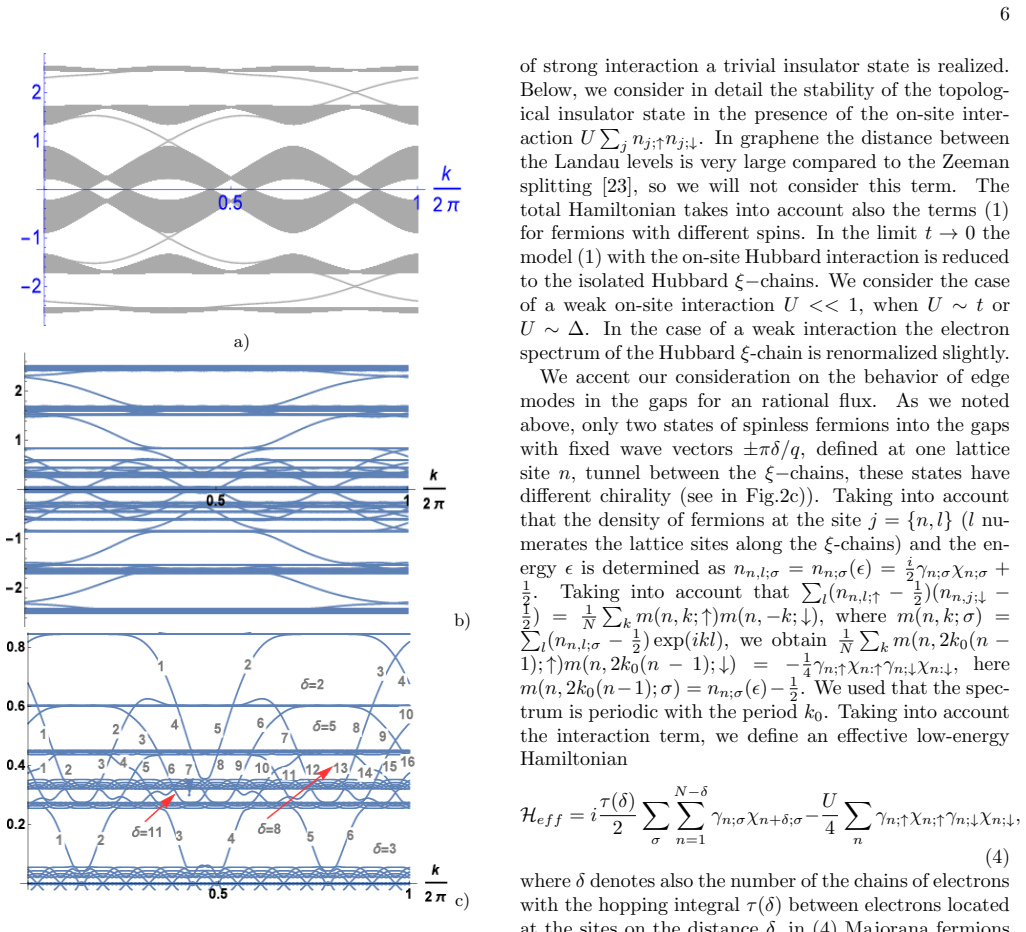
- The fine structure of subbands at irrational flux, with edge-mode counts $\delta=2,5,8,11,3,\dots$, may be observable as a sequence of Hall plateaus at the corresponding fillings, providing an experimental fingerprint of the mapping.
Signed reviews
Editorial analysis
A structured set of objections, weighed in public.
Referee Report
Summary. The paper studies the Hofstadter model on a honeycomb lattice with anisotropic nearest-neighbor hoppings (t_x = t, t_y = t_z = 1) in a stripe geometry, aiming to describe the chiral gapless edge modes in spectral gaps through a generalized Kitaev-chain formalism. It claims that this edge-mode description yields the Hall conductance for arbitrary rational and irrational magnetic fluxes, and that at half-filling a gap opens for t > t_c = 2^{1/q} (stated in the abstract as t_c = 2^φ), producing a '2D topological insulator state with zero Chern number' and zero-energy Majorana boundary states. For interacting electrons with on-site repulsion U, the paper further claims that the topological insulator is destroyed for U > 4Δ, based on the exact solution of the Mattis-Nam chain. The manuscript contains numerical spectra for rational and irrational fluxes, but the central analytic claims are presented heuristically.
Significance. If the results were correct, the paper would offer a practical edge-mode route to Hall conductances for arbitrary flux and a simple interaction-stability criterion, which would be of interest to the condensed-matter community. The numerical spectra for the anisotropic honeycomb Hofstadter model and the attempt to connect edge-mode counts to Chern numbers are potentially useful. However, the central claims rest on an unproven reduction of the two-dimensional model to decoupled one-dimensional Majorana chains, and the half-filling phase description contains an internal contradiction between zero Chern number and protected chiral edge modes. Because these issues affect the paper's main conclusions rather than mere presentation, the current manuscript does not provide a reliable basis for the claimed results.
major comments (4)
- [Topological structure of the spectrum (half-filling, t_c)] The paper's central half-filling claim is internally inconsistent. For φ=1/4 the text assigns the central subbands a combined Chern number 2 via the sequence {1,1,-3,2,-3,1,1}, and then states for t>t_c that 'the Chern number and the Hall conductance are zero' while still calling the state a '2D topological insulator with zero Chern number' characterized by zero-energy Majorana boundary states. For the free-fermion Hamiltonian (1) with conserved U(1) charge, the net number of chiral edge modes crossing a gap is fixed by the difference of the Chern numbers of the bands below and above the gap; a gapped phase with C=0 cannot support protected chiral edge modes. The text provides no symmetry protection other than U(1) for the zero-energy boundary states, and Hamiltonian (1) contains no pairing term, so the identification of these states as Majorana modes is not justified. This contradiction invalidates the t_c=2^{1/q} transition as stated.
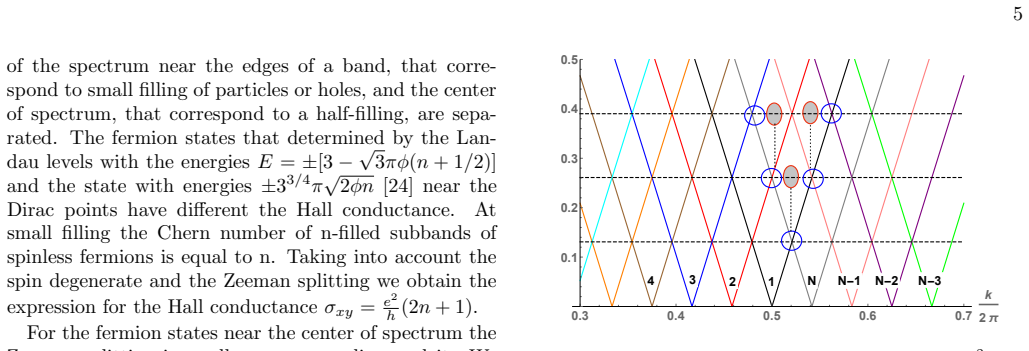
- [The Hofstadter model of interacting electrons, Eq. (4)] The mapping from the 2D Hubbard-Hofstadter Hamiltonian to the Mattis-Nam chain is asserted rather than derived. The text projects onto 'two states of spinless fermions into the gaps with fixed wave vectors ±πδ/q' and then writes the effective Hamiltonian (4) with the local interaction -U/4 Σ_n γ_{n↑}χ_{n↑}γ_{n↓}χ_{n↓}; it invokes the exact solution of Mattis and Nam [13] without showing that the bulk degrees of freedom decouple or that the parameters τ(δ) exhaust the low-energy couplings. The criterion U>4Δ for destruction of the topological insulator follows entirely from this reduction, so as it stands the interacting-phase claim is unsupported.
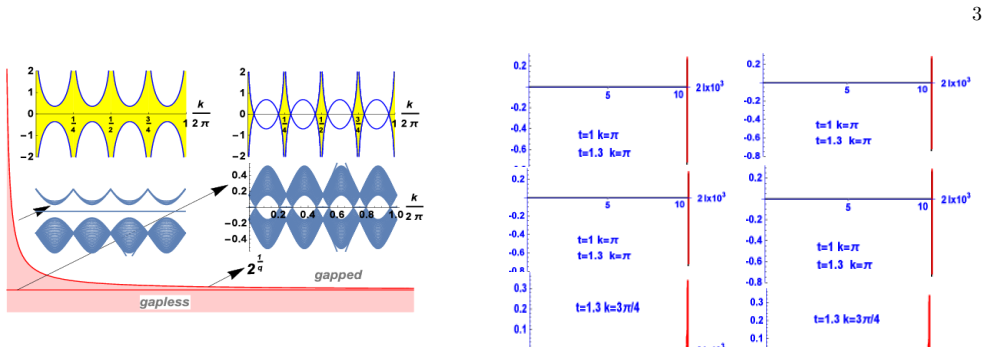
- [Topological structure of the spectrum, t_c paragraph] The critical value t_c=2^{1/q} is presented as a result of numerical spectra from Ref. [15] rather than as an analytic derivation: the text says 'From calculations of the spectra for an arbitrary rational flux φ=1/q it follows that t_c=2^{1/q} (numerical calculations ... were carried out in [15]).' If t_c is extracted from the same spectra whose topological character is being explained, the transition at exactly this value is a parameterization of numerical data. The paper needs either an independent derivation of t_c or an explicit disavowal that t_c=2^{1/q} is an analytic formula.
- [The irrational flux φ=1/√8] The Hall conductances assigned to the fine structure of the low-energy subband are obtained by reading off δ, the 'total number of gapless edge modes localized at a boundary,' from the numerical spectra (δ=2,5,9,8,6,11,3,...). These δ values are then equated to Chern numbers without an independent computation of the bulk Chern numbers for the approximating rational fluxes. This makes the edge-mode counting circular as a derivation of the Hall conductance and does not establish the claim that the topological numbers are conserved under irrational flux.
minor comments (4)
- [Abstract/Introduction] There are small typos: 'Hofstadler' should be 'Hofstadter' (Introduction and throughout), and 'power-low behavior' should be 'power-law behavior' (Introduction).
- [Topological structure of the spectrum] Expressions such as '∆ = |t| + 0(t²)' and 'τ(1) ≃ t' should use the notation O(t²) and consistent symbols; the dimensionless constant in τ(1) is never defined.
- [The Hofstadter model of interacting electrons] The transition from spinless fermions in the main model to spinful fermions in the interacting section is abrupt; the text says 'we will not consider this term' about Zeeman splitting but does not explicitly state whether spin degeneracy is included in Eq. (1) from the start. Please clarify.
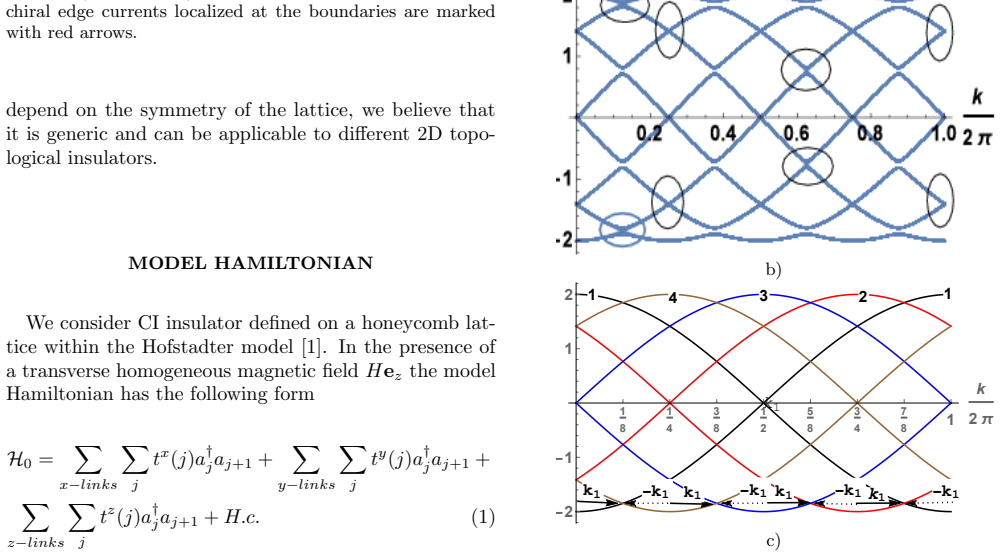
- [Topological structure of the spectrum, Fig. 2 caption] Figure 2's caption appears garbled ('1 1234 k1-k1k1-k1k1-k1k1'-type labels) and should be rewritten so that the numbered chains and the wave-vector labels are legible.
Circularity Check
The half-filling transition and the arbitrary-flux Hall conductance are read off the same numerical spectra they are claimed to derive; the Kitaev-chain formalism supplies labels, not independent calculation.
-
fitted input called prediction
[Section 'Topological structure of the spectrum', paragraph following Fig. 3]
"From calculations of the spectra for an arbitrary rational flux φ = 1/q it follows that tc = 2^{1/q} (numerical calculations of the spectra for different t were carried out in [15])."
The abstract presents t_c=2^φ as a central result ('At half-filling the gap in the center of the fermion spectrum opens for t>t_c=2^φ, a quantum phase transition ... is realized at t_c'). The body's only support is that the value 'follows' from numerical spectra in Ref. [15]; no derivation from the Kitaev-chain effective Hamiltonians (2)-(3) or from the Diophantine equations is given. The phase-transition threshold is therefore read off the same numerical data that the claimed derivation is supposed to predict, making the 'result' a parametrization of the input spectra rather than an independent calculation.
-
self definitional
[Section 'The irrational flux φ = 1/√8', discussion of the fine structure of the low-energy subband]
"We have considered all possible gaps in the fine structure of the low energy subband when δ changes from 1 to 11. The topological properties of the fine structure of the subband are conserved with an increase in the value of t, therefore it is fair to expect that the Hall conductance of each subband is determined by these values of δ."
δ is defined earlier in the same section as 'the number of gapless edge modes localized at a boundary of the sample', obtained by counting modes in the numerically computed spectrum (Fig. 6). The paper's stated method is 'computing the Hall conductance using a different approach, calculating the total number of gapless edge modes in the gap [12]'. Thus the Hall conductance is, by construction, the same integer δ counted from the numerical levels; the 'calculation' does not independently derive the conductance but restates the numerical edge-mode count. The output is equivalent to the input by the adopted bulk-boundary counting rule.
full rationale
The paper's announced method is to compute Hall conductance by counting gapless edge modes in numerically obtained spectra, citing Ref. [12]. Consequently, the Chern numbers and conductances reported for rational and irrational flux are the numerical edge-mode counts, not independent predictions. The central half-filling threshold t_c=2^{1/q} is likewise imported from numerical calculations in Ref. [15] and presented as a derived phase transition; no analytic derivation connects the Kitaev-chain effective Hamiltonians (2)-(3) to this threshold. The 'generalized Kitaev chain' rewriting is an exact Majorana decomposition of the complex-fermion hoppings and does not by itself produce either the threshold or the conductance values. The U>4Δ criterion is taken from the Mattis-Nam exact solution through an asserted mapping to Eq. (4); this is a derivation gap and a correctness risk rather than a circular reduction, so it is not scored as a circular step here. The paper's statement that a gapped state with zero Chern number can support protected chiral edge modes is internally inconsistent, but that is a physical contradiction rather than a circularity. On balance, two central quantitative outputs are numerical inputs relabeled as analytical results, giving partial circularity.
Assumptions & free parameters
free parameters (2)
- t_c =
2^{1/q} for φ = 1/q
- τ(δ) =
t^δ + O(t^{δ+1})
assumptions (3)
- ad hoc to paper The low-energy sector of the 2D Hofstadter model in each gap reduces to decoupled Kitaev-type chains of Majorana modes.
- ad hoc to paper The interacting Hamiltonian (4) maps exactly onto the Mattis-Nam chain solvable model.
- domain assumption Numerical spectra with N < q approximate an irrational flux to within 1/N.
invented entities (1)
-
Majorana zero energy states at the boundaries of a 2D normal (non-superconducting) fermion system
Cite this review
Pith. "Pith review of Topological states in the Hofstadter model on a honeycomb lattice." pith.science (2026). https://pith.science/paper/CRCMVTDU
@misc{pith2026190809601,
  author       = {Pith},
  title        = {Pith review of: Topological states in the Hofstadter model on a honeycomb lattice},
  year         = {2026},
  howpublished = {\url{https://pith.science/paper/CRCMVTDU}},
  note         = {Machine review of arXiv:1908.09601}
}
abstract
e provide a detailed analysis of a topological structure of a fermion spectrum in the Hofstadter model with different hopping integrals along the $x,y,z$-links ($t_x=t, t_y=t_z=1$), defined on a honeycomb lattice. We have shown that the chiral gapless edge modes are described in the framework of the generalized Kitaev chain formalism, which makes it possible to calculate the Hall conductance of subbands for different filling and an arbitrary magnetic flux $\phi$. At half-filling the gap in the center of the fermion spectrum opens for $t>t_c=2^{\phi}$, a quantum phase transition in the 2D-topological insulator state is realized at $t_c$. The phase state is characterized by zero energy Majorana states localized at the boundaries. Taking into account the on-site Coulomb repulsion $U$ (where $U<<1$), the criterion for the stability of a topological insulator state is calculated at $t<<1$, $t \sim U$. Thus, in the case of $ U > 4\Delta $, the topological insulator state, which is determined by chiral gapless edge modes in the gap $\Delta$, is destroyed.
Figures

Figures from the paper (2 more)
Reference graph
Works this paper leans on
-
[15]
I.I.Satija, Topology and self-similarity of the Hofstadter butterfly, arXiv:1408.1006 [cond-mat.dis-nn] (2014)
work page Pith review arXiv 2014
-
[13]
Chiral Majorana fermion liquid, J.Phys.Commun., 1 (2017), 051001
I.N.Karnaukhov, Chern insulator with large Chern num- bers. Chiral Majorana fermion liquid, J.Phys.Commun., 1 (2017), 051001. https://doi.org/10.1088/2399- 6528/aa9541
doi:10.1088/2399- 2017
-
[1]
https://doi.org/10.1103/PhysRevB.14.2239
D.Hofstadter, Energy levels and wave functions of Bloch electrons in rational and irrational mag- netic fields, Phys.Rev.B, 14 (1976), 2239-2249. https://doi.org/10.1103/PhysRevB.14.2239
-
[2]
These gaps are formed due to the hoppings of fermions between the next-nearest neighbor ξ-chains (see in Fig.2). The structure of the effective Hamiltonian, which defines the states of fermions in the gaps is the same, it is deter- mined as sum of two chains, defined on even and odd lattice sites H(ϵ) = iτ(2) 2 N−2∑ n=1 χnγn+2 + iτ(2) 2 N−3∑ n=2 χnγn+2, H(−ϵ...
-
[3]
Taking into account that ∑ l(nn,l;↑− 1 2)(nn,j;↓− 1
-
[4]
This case cor- responds to a simple butterfly landscape in which the Chern number is different for different gaps. Numeri- cal calculations of the fermion spectrum, obtained for a stripe geometry (see in Fig.1), are shown in Fig.2. 3 FIG. 3. (Color online) Phase diagram defined in the coordi- nates q,t for half-filling (anisotropic hopping integral t, mag- net...
-
[5]
= 1 N ∑ km(n,k ;↑)m(n,−k;↓), where m(n,k ;σ) =∑ l(nn,l;σ− 1
-
[6]
exp(ikl), we obtain 1 N ∑ km(n, 2k0(n− 1);↑)m(n, 2k0(n− 1);↓) = − 1 4γn;↑χn:↑γn;↓χn:↓, here m(n, 2k0(n−1);σ) =nn;σ(ϵ)− 1
Show all 30 references
-
[7]
We used that the spec- trum is periodic with the period k0. Taking into account the interaction term, we define an effective low-energy Hamiltonian Heff =iτ(δ) 2 ∑ σ N−δ∑ n=1 γn;σχn+δ;σ−U 4 ∑ n γn;↑χn;↑γn;↓χn;↓, (4) whereδ denotes also the number of the chains of electrons with ...
-
[8]
https://doi.org/10.1088/0022- 3719/18/22/004
I.Dana, Y.Avron and J.Zak, Quantised Hall conduc- tance in a perfect crystal, J.Phys.C: Solid State Phys., 18 (1985), L679-684. https://doi.org/10.1088/0022- 3719/18/22/004
1985 doi
-
[9]
https://doi.org/10.1007/s10955-014-0992-0
A.Agazzi, J.-P.Eckmann and G.M.Grafm, The colored Hofstadter butterfly for the honey- comb lattice, J.Stat.Phys., 156 (2014), 417-426. https://doi.org/10.1007/s10955-014-0992-0
2014 doi
-
[10]
https://doi.org/10.1088/1751- 8113/47/18/185202
J.E.Avron, O.Kenneth and G,Yehoshua, A study of the ambiguity in the solutions to the Diophantine equation for Chern numbers, J.Phys.A: Math.Theor., 47 (2014), 185202. https://doi.org/10.1088/1751- 8113/47/18/185202
2014 doi
-
[11]
72, (1994), 1890-1893
P.B.Wiegmann and A.V.Zabrodin, Bethe- ansatz for the Bloch electron in magnetic field, Phys.Rev.Lett. 72, (1994), 1890-1893. https://doi.org/10.1103/PhysRevLett.72.1890
1994 doi
-
[12]
Wu, Explicit solu- tions of the Bethe ansatz equations for Bloch electrons in a magmnetic field, Phys.Rev.Lett
Y.Hatsugai, M.Kohmoto and Y.-S. Wu, Explicit solu- tions of the Bethe ansatz equations for Bloch electrons in a magmnetic field, Phys.Rev.Lett. , 73 (1994), 1134-1137. https://doi.org/10.1103/PhysRevLett.73.1134
1994 doi
-
[14]
G.G.Naumis, Topological map of the Hofstadter but- terfly: Fine structure of Chern numbers and Van Hove singularities, Phys. Lett A. 380 (2016), 1772. https://doi.org/10.1016/j.physleta.2016.03.022
2016 doi
-
[16]
https://doi.org/10.1088/1751-8113/45/39/395305
M.Eliashvili, G.I.Japaridze and G.Tsitsishvili, The quantum group, Harper equation and the struc- ture of Bloch eigenstates on a honeycomb lat- tice, J.Phys.A:Math.Theor., 45 (2012), 395305. https://doi.org/10.1088/1751-8113/45/39/395305
2012 doi
-
[17]
https://doi.org/10.1016/j.physleta.2017.04.014
I.N.Karnaukhov, Spontaneous breaking of time- reversal symmetry in topological insulators, Physics Letters A, 381 (2017), 1967-1970. https://doi.org/10.1016/j.physleta.2017.04.014
2017 doi
-
[18]
J.C.Avila, H.Schulz-Baldes and C.Villegas- Blas,Topological invariants of edge states for periodic two-dimensional models, Math. Phys. Anal. Geom. , 16 (2013), 137-170. https://doi.org/10.1007/s11040-012- 9123-9
2013 doi
-
[19]
J.Math.Phys., 13 (1972), 1185-1189
D.C.Mattis and S.B.Nam, Exactly soluble model of in- teracting electrons. J.Math.Phys., 13 (1972), 1185-1189. https://doi.org/10.1063/1.1666120
1972 doi
-
[20]
https://doi.org/10.1016/j.aop.2005.10.005
A.Yu.Kitaev, Anyons in an exactly solved model and beyond, Annals of Physics, 321 (2006), 2-111. https://doi.org/10.1016/j.aop.2005.10.005
2006 doi
-
[21]
https://doi.org/10.1103/PhysRevB.78.235322
M.Sato, D.Tobe and M.Kohmoto, Hall conduc- tance, topological quantum phase transition, and the Diophantine equation on the honey- comb lattice, Phys.Rev.B, 78 (2008), 235322. https://doi.org/10.1103/PhysRevB.78.235322
2008 doi
-
[22]
https://doi.org/10.1070/1063-7869/44/10S/S29
A.Yu.Kitaev, Unpaired Majorana fermions in quantum wires, Phys.- Usp., 44 (2001), 131-136. https://doi.org/10.1070/1063-7869/44/10S/S29
2001 doi
-
[23]
I.N.Karnaukhov, Edge modes in the Hofstadter model of interacting electrons, Europhysics Letters, 124 (2018), 37002. https://doi.org/10.1209/0295-5075/124/37002, see also C.Malciu, L.Mazza, and C.Mora, 4 π and 8π dual Josephson effects induced by symmetry defects , arXiv:1901.0...
2018 arXiv
-
[24]
https://doi.org/10.1103/PhysRevB.89.205111
I.Dana, Topologically universal spectral hierarchies of quasiperiodic systems, Phys.Rev.B 89 (2014) 205111. https://doi.org/10.1103/PhysRevB.89.205111
2014 doi
-
[25]
https://doi.org/10.1103/PhysRevB.97.075137
G.Amit and I.Dana, Topological phase transitions from Harper to Fibonacci crystals, Phys.Rev.B, 97 (2018), 075137. https://doi.org/10.1103/PhysRevB.97.075137
2018 doi
-
[26]
https://doi.org/10.1142/S0217979206035448
B.A.Bernevig, T.L.Hughes, S.-C.Zhang, H.-D.Chen and C.Wu, Band collapse and the quantum Hall effect in graphene, Int.J.Mod.Phys.B, 20 (2006), 3257-3278. https://doi.org/10.1142/S0217979206035448
2006 doi
-
[27]
https://doi.org/10.1038/nature04233
K.S.Novoselov, A.K.Geim, S.V.Morozov, D.Jiang, M.I.Katsnelson, I.V.Grigorieva, S.V.Dubonos and A.A.Firsov, Two-dimensional gas of massless Dirac fermions in graphene, Nature, 438 (2005), 197-200. https://doi.org/10.1038/nature04233
2005 doi
-
[28]
https://doi.org/10.1038/nature04235 8
Y.Zhang, Y.W.Tan, H.L.Stormer and P.Y.Kim, Exper- imental observation of the quantum Hall effect and Berry’s phase in graphene, Nature, 438 (2005), 201-204. https://doi.org/10.1038/nature04235 8
2005 doi
-
[29]
95 (2005), 146801
V.P.Gusynin and S.G.Sharapov, Uncon- ventional integer quantum Hall effect in graphene, Phys.Rev.Lett. 95 (2005), 146801. https://doi.org/10.1103/PhysRevLett.95.146801
2005 doi
-
[30]
Y.Hatsuda, Perturbative/nonperturbative as- pects of Bloch electrons in a honeycomb lattice, arXiv:1712.04012v2 [hep-th] (2018)
2018 arXiv
Reviewed August 14, 2026 · model on record in the stance chip above.
Discussion (0). Continue with ORCID to comment.