REVIEW 1 major objections 1 minor 41 references
Tibial Implant Fixation in TKA Worth A Revision? -- How to Avoid Stress-Shielding Even for Stiff Metallic Implants
T0 review · 1 major / 1 minor · reviewed 2026-08-14 · deepseek-v4-flash
Pith's one-line read Finite-element simulations show that stress shielding of the tibia after total knee arthroplasty can be almost completely avoided even for stiff metallic implants, provided the stem-bone interface is allowed to slide with low friction.
desk verdict A plausible and clearly-described FE concept for avoiding tibial stress shielding, but the central 'almost complete' claim rests on a single axial load case and needs full-gait and experimental follow-up before it deserves to be stated so strongly. read the letter →
The pith
A machine-rendered reading of the paper's core claim, the machinery that carries it, and where it could break.
The reading
What carries the argument
The machinery is the load-partition identity $F_{\text{axial}} = F_{\text{axial,plate}} + F_{\text{axial,stem}}$ together with the percental strain energy density difference $SED^{\text{diff}} = (SED^{\text{post-TKA}} - SED^{\text{pre-TKA}})/SED^{\text{pre-TKA}}$. The plate-to-stem force decomposition ratio is the central diagnostic: when the plate transmits most of the axial force, SED reduction is small and proximal; when the stem transmits most, shielding is pronounced and extends distally. The enabling mechanism is a compliant stem-bone interface realized by sliding friction at low friction coefficient, which decouples the implant's high stiffness from bone loading.
What would settle it
Run the same implant geometry under a full gait load envelope, including anterior-posterior shear, varus-valgus moment, and muscle forces, with a low-friction stem; if the stem then transmits most of the axial force or the proximal-tibia SED drops substantially below pre-surgery levels, the central claim that sliding friction preserves proximal loading would be falsified.
Extended reading notes
Core claim
In the paper's own terms, the discovery is that stress shielding can be avoided even for a metallic implant despite the large implant-to-bone stiffness mismatch, if the stem-bone interface is sufficiently compliant in terms of sliding friction conditions. For a fully cemented stem, the plate-stem load share can be as low as 17:83 for CoCr, meaning the stem carries most of the axial force and proximal bone is shielded; with a smooth sliding stem at coefficient of friction 0.2 or 0.0, the balance flips so the plate carries the majority of the load. Consequently the post-surgery strain energy density reduction is confined to small proximal regions and modest magnitude. The paper further argues that this plate-based transfer mimics the natural pre-surgery force transmission through the resection plane, and that the standard geometry of plate-stem implants can be preserved.
Load-bearing premise
The simulations load the tibia with a single axial force and no shear, muscle, or ligament forces, so the predicted plate-dominated load transfer may not survive realistic gait loading.
Editorial extensions
If this is right
- A tibial implant with a smooth, low-friction stem surface should preserve proximal bone loading after total knee arthroplasty, making stress-shielding bone resorption unlikely, according to the simulations.
- For sliding friction conditions, implant material stiffness no longer controls stress shielding: a CoCr or titanium stem performs about as well as an all-polyethylene one, so surgeons need not choose a compliant material to protect bone.
- The plate-to-stem force ratio can serve as a design indicator in pre-clinical testing: an implant whose load share is plate-dominated under axial loading can be expected to show minimal SED loss in proximal tibia.
- The proposed concept keeps standard implant geometry and the cemented tray-bone interface, so the only surgical change is the stem surface finishing, such as a diamond-like carbon coating with low friction.
- Because the stem is no longer rigidly fixed, revision surgery would face less bone loss and no cemented stem to remove.
Reading between the lines
- If the same decoupling holds under multi-axial gait loads, the low-friction-stem principle could generalize to other intramedullary implants such as femoral or shoulder stems, where bending loads are larger; this is a testable extension the paper does not make.
- The paper's axial-only loading is the load-bearing premise; under shear and bending, a smooth stem may still engage bone through normal contact, so the plate-stem ratio could shift and the SED benefit could shrink.
- A polished stem may trade stress shielding for increased subsidence risk; the paper argues that debris-free micromotion is tolerable, but a long-term clinical study would be needed to confirm that primary stability is not compromised.
- The plate-stem ratio could be used as a fast surrogate in implant optimization, but only if it is validated against full gait simulations and experimental strain measurements.
Editorial analysis
A structured set of objections, weighed in public.
Referee Report
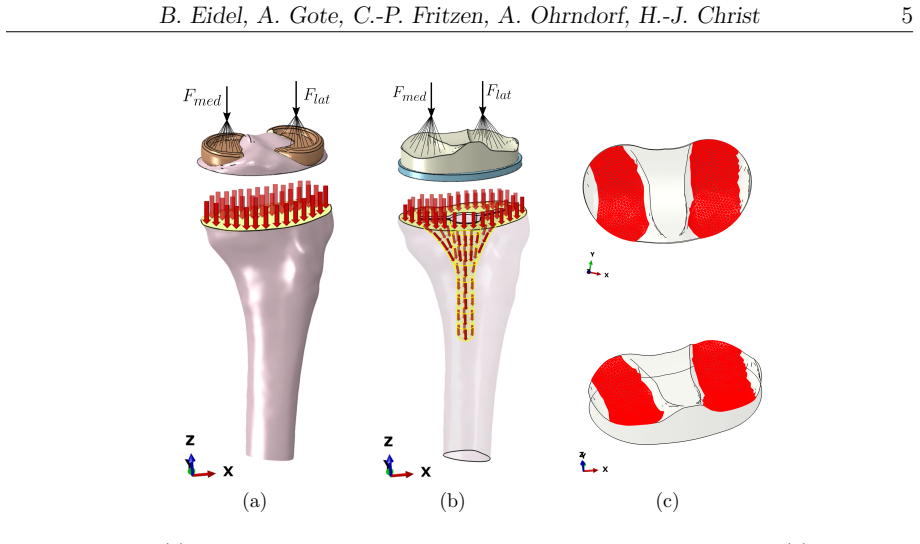
Summary. This manuscript reports finite element simulations of a tibial tray-and-stem implant in total knee arthroplasty, using a CT-derived heterogeneous model of a human tibia. The study varies stem extension length (5, 40, 75 mm), implant material (Ti, CoCr, all-PE), and implant-bone interface conditions (full cementation, surface cementation with osseointegration, and low-friction sliding contact with coefficients 0.2 and 0.0). Two output measures are used: the decomposition of the axial joint force into plate-mediated and stem-mediated parts (Eq. 5), and the percent change in strain energy density (SED) relative to the pre-surgery state (Eq. 7). The central claim is that, when the stem-bone interface is made compliant by sliding friction, the axial force is transmitted predominantly through the tibial plate, stress shielding is almost completely avoided even for stiff metallic implants, and the plate:stem force ratio is a reliable indicator of post-surgery SED changes. The proposed clinical realization is a smooth stem surface, e.g., a diamond-like carbon coating, combined with surface cementation of the baseplate.
Significance. If the central claim holds, the paper would be a valuable conceptual contribution: it challenges the common view that stress shielding in TKA is an inevitable consequence of implant-to-bone stiffness mismatch, and it proposes a mechanically explicit, surgically feasible modification of the stem-bone interface. The study has notable strengths: it uses CT-based heterogeneous bone properties, published material constants, a pre-surgery baseline for SED comparison, systematic parameter variation, and it makes the reconstructed bone model and finite element discretizations available as a supplement. The fracture-mechanical argument is internally consistent, and the force-decomposition metric is a useful explanatory device. However, the quantitative conclusion that stress shielding is 'almost completely' avoided rests on a single static axial load case and has no experimental or clinical validation; as a result, the significance is conditional on additional loading and validation evidence.
major comments (1)
- [Section 2.2.2 and Equation (4)] The manuscript would benefit from reporting the element count, element size, and the convergence behavior of the SED results. SED values in heterogeneous bone can be mesh-sensitive, especially at contact interfaces and stem tips, and no mesh-convergence information is given. Since the paper makes quantitative comparisons across configurations, a brief convergence statement would substantially increase confidence in the reported ratios and SED differences.
minor comments (1)
- [Abstract] The phrase 'implant-to-stem interface conditions' in the Abstract is imprecise; the paper actually varies the implant-bone interface, not a stem-to-implant interface. Please revise the wording.
Circularity Check
No significant circularity: the FE predictions and the plate:stem indicator are derived outputs, not fitted inputs.
full rationale
The load-bearing derivation is the CT-based finite element analysis itself. The tibia model, boundary conditions (Sec. 2.2.1), material properties (Sec. 2.2.2), interface variants (Sec. 2.2.3), and outcome metrics (Eqs. 5-7) are all stated independently of the conclusions. The plate:stem force decomposition is computed from the FE results rather than fitted to the SED outcomes, and the SED deviations are evaluated relative to the pre-surgery reference. The friction coefficient sweep is a parametric study, not a calibration of any parameter to the target stress-shielding result. The self-citation to Eidel et al. (2018) in Sec. 4.6 is an analogy and conceptual transfer; the paper does not rely on that citation as the proof of its tibial conclusions, but rather on the simulations reported here. The acknowledged limitations, e.g., a single axial load without shear, muscles, or ligaments (Sec. 4.5), affect external validity and clinical transferability, but they do not make the derivation circular. No equation, fitted parameter, or self-citation chain reduces the central claim to its inputs.
Assumptions & free parameters
free parameters (2)
- Friction coefficient for sliding interface (cof=0.2) =
0.2
- Friction coefficient for idealized smooth interface (cof=0.0) =
0.0
assumptions (5)
- domain assumption Bone is isotropic, linearly elastic with Poisson ratio 0.3
- domain assumption CT number to density and Young's modulus conversion (Rho et al. 1995) applies to this proximal tibia
- domain assumption SED deviation from pre-surgery state is a valid predictor of bone remodeling and stress shielding
- ad hoc to paper A single axial static load case (2x543 N) is sufficient to evaluate stress shielding
- ad hoc to paper Constant cement mantle thickness and perfect sticking at cement interfaces
Cite this review
Pith. "Pith review of Tibial Implant Fixation in TKA Worth A Revision? -- How to Avoid Stress-Shielding Even for Stiff Metallic Implants." pith.science (2026). https://pith.science/paper/RCB3J3MM
@misc{pith2026190809611,
  author       = {Pith},
  title        = {Pith review of: Tibial Implant Fixation in TKA Worth A Revision? -- How to Avoid Stress-Shielding Even for Stiff Metallic Implants},
  year         = {2026},
  howpublished = {\url{https://pith.science/paper/RCB3J3MM}},
  note         = {Machine review of arXiv:1908.09611}
}
read the original abstract
In total knee arthroplasty (TKA) force is transmitted into the tibia by a combined plate-stem device along with cemented or cementless stem fixation. The present work analyzes this force transmission in finite element simulations with the main aim to avoid reported postsurgical bone density reduction as a consequence of a reduced tibial bone loading. In the numerical analysis different implant materials, stem/extension lengths and implant-to-stem interface conditions are considered, from a stiff fully cemented fixation to sliding contact conditions with a low friction coefficient. The impact of these variations on bone loading changes are measured by (i) decomposing the total force into parts mediated by the plate and by the stem and by (ii) post-surgery strain energy density (SED) deviations. Based on a bionics-inspired perspective on how nature in pre-operative conditions carries out force transfer from the knee joint into the tibia, a modified implant-bone interface is suggested that alters force transmission towards physiological conditions while preserving the geometries of the standard plate-stem endoprosthesis design. The key aspect is that the axial force is predominantly transmitted through the plate into proximal bone which requires a compliant bone-stem interface as realized by sliding friction conditions at a low friction coefficient. These interface conditions avoid stress shielding almost completely, preserve pre-surgery bone loading such that bone resorption is not likely to occur.
Figures


Reference graph
Works this paper leans on
-
[1]
write newline
" write newline "" before.all 'output.state := FUNCTION n.dashify 't := "" t empty not t #1 #1 substring "-" = t #1 #2 substring "--" = not "--" * t #2 global.max substring 't := t #1 #1 substring "-" = "-" * t #2 global.max substring 't := while if t #1 #1 substring * t #2 global.max substring 't := if while FUNCTION word.in bbl.in ":" * " " * FUNCTION f...
-
[2]
P. F. Sharkey, P. M. Lichstein, C. Shen, A. T. Tokarski, J. Parvizi, Why are total knee arthroplasties failing today---has anything changed after 10 years?, J. Arthroplasty 29 (9) (2014) 1774--1778. http://dx.doi.org/10.1016/j.arth.2013.07.024 doi:10.1016/j.arth.2013.07.024
-
[3]
A. J. Carr, O. Robertsson, S. Graves, A. J. Price, N. K. Arden, A. Judge, D. J. Beard, Knee replacement, Lancet 379 (9823) (2012) 1331--1340. http://dx.doi.org/10.1016/S0140-6736(11)60752-6 doi:10.1016/S0140-6736(11)60752-6
-
[4]
J. Gallo, S. B. Goodman, Y. T. Konttinen, M. A. Wimmer, M. Holinka, Osteolysis around total knee arthroplasty: a review of pathogenetic mechanisms, Acta Biomater. 9 (9) (2013) 8046--8058. http://dx.doi.org/10.1016/j.actbio.2013.05.005 doi:10.1016/j.actbio.2013.05.005
-
[5]
J. R. Martin, C. D. Watts, D. L. Levy, R. H. Kim, Medial tibial stress shielding: A limitation of cobalt chromium tibial baseplates, J. Arthroplasty 32 (2) (2017) 558--562. http://dx.doi.org/10.1016/j.arth.2016.07.027 doi:10.1016/j.arth.2016.07.027
-
[6]
A. G. Au, V. James Raso , A. B. Liggins, A. Amirfazli, Contribution of loading conditions and material properties to stress shielding near the tibial component of total knee replacements, J. Biomech. 40 (6) (2007) 1410--1416. http://dx.doi.org/10.1016/j.jbiomech.2006.05.020 doi:10.1016/j.jbiomech.2006.05.020
-
[7]
Q.-H. Zhang, A. Cossey, J. Tong, Stress shielding in periprosthetic bone following a total knee replacement: Effects of implant material, design and alignment, Med. Eng. Phys. 38 (12) (2016) 1481--1488. http://dx.doi.org/10.1016/j.medengphy.2016.09.018 doi:10.1016/j.medengphy.2016.09.018
-
[8]
A. Completo, P. Talaia, F. Fonseca, J. A. Sim \ o es, Relationship of design features of stemmed tibial knee prosthesis with stress shielding and end-of-stem pain, Mater. Design 30 (4) (2009) 1391--1397. http://dx.doi.org/10.1016/j.matdes.2008.06.071 doi:10.1016/j.matdes.2008.06.071
Show all 41 references
-
[9]
C. E. H. Scott, L. C. Biant, The role of the design of tibial components and stems in knee replacement, J. Bone Joint Surg. Br. 94 (8) (2012) 1009--1015. http://dx.doi.org/10.1302/0301-620X.94B8.28289 doi:10.1302/0301-620X.94B8.28289
2012 doi
-
[10]
Innocenti, E
B. Innocenti, E. Truyens, L. Labey, P. Wong, J. Victor, J. Bellemans, Can medio-lateral baseplate position and load sharing induce asymptomatic local bone resorption of the proximal tibia? a finite element study, J. Orthop. Surg. Res. 4 (1) (2009) 26. http://dx.doi.org/10.1186...
2009 doi
-
[11]
D. T. Cawley, N. Kelly, J. P. McGarry, F. J. Shannon, Cementing techniques for the tibial component in primary total knee replacement, The Bone and Joint Journal 95-b (3) (2013) 295--300. http://dx.doi.org/10.1302/0301-620X.95B3 doi:10.1302/0301-620X.95B3
2013 doi
-
[12]
Vanlommel, J
J. Vanlommel, J. P. Luyckx, L. Labey, B. Innocenti, R. de Corte, J. Bellemans, Cementing the tibial component in total knee arthroplasty: which technique is the best?, J. Arthroplasty 26 (3) (2011) 492--496. http://dx.doi.org/10.1016/j.arth.2010.01.107 doi:10.1016/j.arth.2010.01.107
2011 doi
-
[13]
D. T. Cawley, N. Kelly, A. Simpkin, F. J. Shannon, J. P. McGarry, Full and surface tibial cementation in total knee arthroplasty: a biomechanical investigation of stress distribution and remodeling in the tibia, Clin. Biomech. 27 (4) (2012) 390--397. http://dx.doi.org/10.1016/...
2012 doi
-
[14]
U. J. Schlegel, N. E. Bishop, K. P \"u schel, M. M. Morlock, K. Nagel, Comparison of different cement application techniques for tibial component fixation in tka, Int. Orthop. 39 (1) (2015) 47--54. http://dx.doi.org/10.1007/s00264-014-2468-x doi:10.1007/s00264-014-2468-x
2015 doi
-
[15]
://mri.radiology.uiowa.edu/visible_human_datasets.html
University of Iowa Cerver College of Medicine Magnetic Resonance Research , The visible human project ct datasets https://mri.radiology.uiowa.edu/visible_human_datasets.html. ://mri.radiology.uiowa.edu/visible_human_datasets.html
-
[16]
://en.wikipedia.org/wiki/Visible_Human_Project
United States National Library of Medicine (NLM) , The visibile human project https://en.wikipedia.org/wiki/Visible_Human_Project. ://en.wikipedia.org/wiki/Visible_Human_Project
-
[17]
J. Y. Rho, M. C. Hobatho, R. B. Ashman, Relations of mechanical properties to density and ct numbers in human bone, Med. Eng. Phys. 17 (5) (1995) 347--355. http://dx.doi.org/10.1016/1350-4533(95)97314-F doi:10.1016/1350-4533(95)97314-F
1995 doi
-
[18]
Taddei, E
F. Taddei, E. Schileo, B. Helgason, L. Cristofolini, M. Viceconti, The material mapping strategy influences the accuracy of ct-based finite element models of bones: an evaluation against experimental measurements, Med. Eng. Phys. 29 (9) (2007) 973--979. http://dx.doi.org/10.10...
2007 doi
-
[19]
Viceconti, M
M. Viceconti, M. Casali, B. Massari, L. Cristofolini, S. Bassini, A. Toni, The 'standardized femur program' proposal for a reference geometry to be used for the creation of finite element models of the femur, J. Biomech. 29 (9) (1996) 1241
1996
-
[20]
Eidel, A
B. Eidel, A. Gote, A. Ohrndorf, H.-J. Christ, How can a short stem hip implant preserve the natural, pre-surgery force flow? a finite element analysis on a collar cortex compression concept (co4), Med. Eng. Phys. 58 (2018) 1--12. http://dx.doi.org/10.1016/j.medengphy.2018.04.0...
2018 doi
-
[21]
P. Damm, F. Graichen, A. Rohlmann, A. Bender, G. Bergmann, Total hip joint prosthesis for in vivo measurement of forces and moments, Med. Eng. Phys. 32 (1) (2010) 95--100. http://dx.doi.org/10.1016/j.medengphy.2009.10.003 doi:10.1016/j.medengphy.2009.10.003
2010 doi
-
[22]
M. M. Juszczyk, L. Cristofolini, M. Viceconti, The human proximal femur behaves linearly elastic up to failure under physiological loading conditions, J. Biomech. 44 (12) (2011) 2259--2266. http://dx.doi.org/10.1016/j.jbiomech.2011.05.038 doi:10.1016/j.jbiomech.2011.05.038
2011 doi
-
[23]
a \"a n \
L. Grassi, S. P. V \"a \"a n \"a nen, M. Ristinmaa, J. S. Jurvelin, H. Isaksson, How accurately can subject-specific finite element models predict strains and strength of human femora? investigation using full-field measurements, J. Biomech. 49 (5) (2016) 802--806. http://dx.d...
2016 doi
-
[24]
Schileo, L
E. Schileo, L. Balistreri, L. Grassi, L. Cristofolini, F. Taddei, To what extent can linear finite element models of human femora predict failure under stance and fall loading configurations?, J. Biomech. 47 (14) (2014) 3531--3538. http://dx.doi.org/10.1016/j.jbiomech.2014.08....
2014 doi
-
[25]
M. Long, H. J. Rack, Titanium alloys in total joint replacement--a materials science perspective, Biomaterials 19 (18) (1998) 1621--1639
1998
-
[26]
Huiskes, H
R. Huiskes, H. Weinans, B. van Rietbergen , The relationship between stress shielding and bone resorption around total hip stems and the effects of flexible materials, Clin. Orthop. Relat. R. (274) (1992) 124--134
1992
-
[27]
P. J. Ehrlich, L. E. Lanyon, Mechanical strain and bone cell function: a review, Osteoporosis Int. 13 (9) (2002) 688--700. http://dx.doi.org/10.1007/s001980200095 doi:10.1007/s001980200095
2002 doi
-
[28]
C. H. Turner, Three rules for bone adaptation to mechanical stimuli, Bone 23 (5) (1998) 399--407
1998
-
[29]
Ambrosi, G
D. Ambrosi, G. A. Ateshian, E. M. Arruda, S. C. Cowin, J. Dumais, A. Goriely, G. A. Holzapfel, J. D. Humphrey, R. Kemkemer, E. Kuhl, J. E. Olberding, L. A. Taber, K. Garikipati, Perspectives on biological growth and remodeling, J. Mech Phys. Solids 59 (4) (2011) 863--883. http...
2011 doi
-
[30]
Fraldi, L
M. Fraldi, L. Esposito, G. Perrella, A. Cutolo, S. C. Cowin, Topological optimization in hip prosthesis design, Biomech. Model. Mechan. 9 (4) (2010) 389--402. http://dx.doi.org/10.1007/s10237-009-0183-0 doi:10.1007/s10237-009-0183-0
2010 doi
-
[31]
Boyle, I
C. Boyle, I. Y. Kim, Comparison of different hip prosthesis shapes considering micro-level bone remodeling and stress-shielding criteria using three-dimensional design space topology optimization, J. Biomech. 44 (9) (2011) 1722--1728. http://dx.doi.org/10.1016/j.jbiomech.2011....
2011 doi
-
[32]
Gefen, Computational simulations of stress shielding and bone resorption around existing and computer-designed orthopaedic screws, Med
A. Gefen, Computational simulations of stress shielding and bone resorption around existing and computer-designed orthopaedic screws, Med. Biol. Eng. Comput. 40 (3) (2002) 311--322. http://dx.doi.org/10.1007/BF02344213 doi:10.1007/BF02344213
2002 doi
-
[33]
C. Ries, M. Heinichen, F. Dietrich, E. Jakubowitz, C. Sobau, C. Heisel, Short-keeled cemented tibial components show an increased risk for aseptic loosening, Clin. Orthop. Relat. R. 471 (3) (2013) 1008--1013. http://dx.doi.org/10.1007/s11999-012-2630-y doi:10.1007/s11999-012-2630-y
2013 doi
-
[34]
Robertson, Diamond-like amorphous carbon, Mat
J. Robertson, Diamond-like amorphous carbon, Mat. Sci. Eng. R. 37 (4-6) (2002) 129--281. http://dx.doi.org/10.1016/S0927-796X(02)00005-0 doi:10.1016/S0927-796X(02)00005-0
2002 doi
-
[35]
Grill, Tribology of diamondlike carbon and related materials: an updated review, Surface and Coatings Technology 94-95 (1997) 507--513
A. Grill, Tribology of diamondlike carbon and related materials: an updated review, Surface and Coatings Technology 94-95 (1997) 507--513. http://dx.doi.org/10.1016/S0257-8972(97)00458-1 doi:10.1016/S0257-8972(97)00458-1
1997 doi
-
[36]
C. R. Ramos-Saenz, P. A. Sundaram, N. Diffoot-Carlo, Tribological properties of ti-based alloys in a simulated bone-implant interface with ringer's solution at fretting contacts, J. Mech. Behav. Biomed. 3 (8) (2010) 549--558. http://dx.doi.org/10.1016/j.jmbbm.2010.06.006 doi:1...
2010 doi
-
[37]
Galloway, M
F. Galloway, M. Kahnt, H. Ramm, P. Worsley, S. Zachow, P. Nair, M. Taylor, A large scale finite element study of a cementless osseointegrated tibial tray, J. Biomech. 46 (11) (2013) 1900--1906. http://dx.doi.org/10.1016/j.jbiomech.2013.04.021 doi:10.1016/j.jbiomech.2013.04.021
2013 doi
-
[38]
Bergmann, A
G. Bergmann, A. Bender, F. Graichen, J. Dymke, A. Rohlmann, A. Trepczynski, M. O. Heller, I. Kutzner, Standardized loads acting in knee implants, PloS one 9 (1) (2014) e86035. http://dx.doi.org/10.1371/journal.pone.0086035 doi:10.1371/journal.pone.0086035
2014 doi
-
[39]
B. A. Knarr, J. S. Higginson, J. A. Zeni, Change in knee contact force with simulated change in body weight, Comput. Method. Biomec. 19 (3) (2016) 320--323. http://dx.doi.org/10.1080/10255842.2015.1018193 doi:10.1080/10255842.2015.1018193
2016
-
[40]
Taylor, P
M. Taylor, P. J. Prendergast, Four decades of finite element analysis of orthopaedic devices: where are we now and what are the opportunities?, J. Biomech. 48 (5) (2015) 767--778. http://dx.doi.org/10.1016/j.jbiomech.2014.12.019 doi:10.1016/j.jbiomech.2014.12.019
2015 doi
-
[41]
A. H. Huggler, H. A. C. Jacob, The development of the thrust plate prosthesis, in: E. W. Morscher (Ed.), Endoprosthetics, Springer Berlin Heidelberg , Berlin, Heidelberg, 1995, pp. 248--257. http://dx.doi.org/10.1007/978-3-642-79306-6 18 doi:10.1007/978-3-642-79306-6 18
1995 doi
Reviewed August 14, 2026 · model on record in the stance chip above.
Discussion (0). Continue with ORCID to comment.