REVIEW 3 major objections 6 minor 24 references
Carrier-envelope phase stabilization of an Er:Yb:glass laser via feed-forward technique
T0 review · 3 major / 6 minor · reviewed 2026-08-14 · deepseek-v4-flash
Pith's one-line read Feed-forward control stabilizes a 1.55 µm Er:Yb:glass laser's carrier-envelope phase to 3.5 mrad, or 2.9 as of timing jitter.
desk verdict Solid incremental record for feed-forward CEP stabilization, but the 2.9 as headline excludes the 0.1–1 Hz band and the long-term lock is manual — the paper is honest about both, the abstract is not. read the letter →
The pith
A machine-rendered reading of the paper's core claim, the machinery that carries it, and where it could break.
The reading
What carries the argument
The load-bearing element is the feed-forward chain built around the acousto-optic frequency shifter (AOFS). The measured carrier-envelope offset frequency $f_{\mathrm{CEO}}$ is not used to correct the cavity; it is added to a local-oscillator frequency $f_{\mathrm{LO}}$ and the sum drives the AOFS, which subtracts this drive from every comb line outside the cavity. The identity $f_{\mathrm{OOL}}=f_n-f_{\mathrm{AOFS}}=n f_{\mathrm{REP}}-f_{\mathrm{LO}}$ is what converts CEO stabilization into the stability of an RF reference. Supporting pieces are the f-2f self-referencing detection with amplifiers before the interferometer to raise the signal-to-noise ratio, and the SESAM mode-locked Er:Yb:glass oscillator, whose intrinsically low timing jitter the authors credit for the low phase noise.
What would settle it
Take two independent out-of-loop f-2f interferometers on the same stabilized beam and cross-correlate their phase-noise spectra; coherent 0.1–1 Hz noise would prove the low-frequency flicker is intrinsic and force the 20 as full-band number, while incoherent noise would justify the 3.5 mrad claim.
Extended reading notes
Core claim
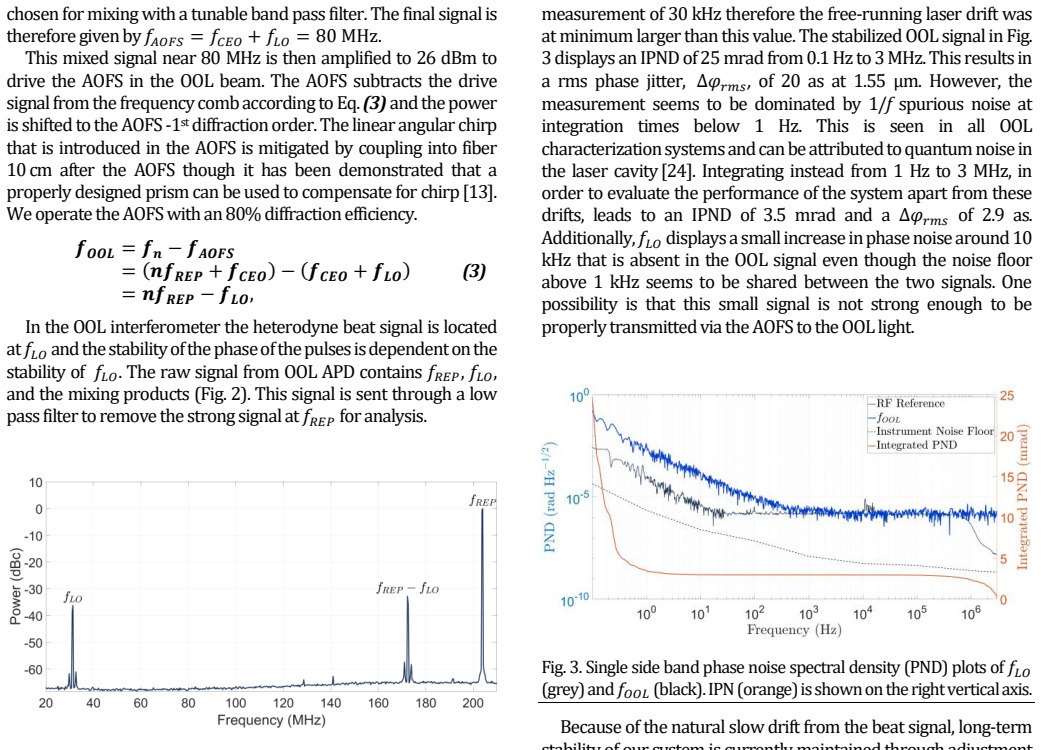
The paper's central claim is that the carrier-envelope phase of a soliton mode-locked Er:Yb:glass laser can be stabilized by feed-forward rather than by cavity feedback, and that this yields attosecond-level timing jitter at 1.55 µm. In the setup, the oscillator output is split: one arm is amplified, spectrally broadened to more than an octave in a highly nonlinear fiber, and sent into an f-2f interferometer whose carrier-envelope offset beat $f_{\mathrm{CEO}}$ is mixed with a reference comb derived from a 10 MHz rubidium clock, producing an 80 MHz drive $f_{\mathrm{AOFS}}=f_{\mathrm{CEO}}+f_{\mathrm{LO}}$. The other arm passes through an acousto-optic frequency shifter driven by this signal, so every comb line is shifted down and the out-of-loop offset becomes $f_{\mathrm{OOL}}=n f_{\mathrm{REP}}-f_{\mathrm{LO}}$: the CEP is then linked to the phase of a stable radio-frequency local oscillator instead of to the cavity. Out-of-loop phase-noise measurements give 3.5 mrad integrated phase noise (1 Hz–3 MHz), or 2.9 as rms timing jitter at 1.55 µm; including the 0.1–1 Hz band raises the integral to 20 as, which the authors attribute to known low-frequency flicker from quantum noise in the cavity rather than to a failure of the stabilization. An eight-hour record shows the out-of-loop beat staying locked with 0.16 Hz rms variance, with occasional manual pump-power adjustments to keep the acousto-optic shifter near its optimum.
Load-bearing premise
The headline 2.9 as figure rests on assuming that the added phase noise seen when integrating down to 0.1 Hz is spurious low-frequency flicker rather than real carrier-envelope noise; if that assumption is wrong, the full-band jitter is 20 as.
Editorial extensions
If this is right
- The CEO frequency of an Er:Yb:glass laser can be stabilized by feed-forward with out-of-loop integrated phase noise of 3.5 mrad from 1 Hz to 3 MHz.
- This corresponds to 2.9 as rms timing jitter at 1.55 µm, which the authors present as a substantial improvement over the prior 120 mrad feed-forward result for erbium lasers.
- Stabilization holds for at least eight hours, with 0.16 Hz rms drift of the out-of-loop beat relative to the rubidium-derived reference.
- Because the AOFS acts outside the cavity, short-term phase stabilization and long-term drift are decoupled; residual long-term drift is currently managed by occasional pump-power adjustments and could be automated with a slow feedback loop.
- The high signal-to-noise ratio from amplifying the signal before the f-2f interferometer is identified as a key enabler, together with the intrinsically low timing jitter of Er:Yb:glass lasers.
Reading between the lines
- Beyond the paper's claims, the feed-forward architecture is not specific to Er:Yb:glass: any SESAM mode-locked oscillator with a detectable CEO beat could use the same AOFS chain, so the demonstrated 3.5 mrad figure is a benchmark for the method rather than for this laser alone.
- Adding a slow pump-power feedback loop, which the authors name as future work, would likely suppress the 0.1–1 Hz drift and could bring the full-band integral down to the 3.5 mrad value; the present paper only relies on manual adjustments.
- For fiber timing networks, the stabilized comb's phase is set by an RF reference rather than by the cavity, so distributing the CEO-stabilized pulse train over long fiber links should preserve sub-10-attosecond timing at 1.55 µm; the paper does not test this propagation.
Signed reviews
Editorial analysis
A structured set of objections, weighed in public.
Referee Report
Summary. The manuscript reports carrier-envelope phase (CEP) stabilization of a SESAM mode-locked Er:Yb:glass laser at 1.55 µm using the feed-forward technique. The in-loop f-2f beat note drives an acousto-optic frequency shifter in the output beamline, and a separate out-of-loop f-2f interferometer is used to verify the stabilized signal. The authors report an integrated phase noise of 3.5 mrad (1 Hz–3 MHz), corresponding to 2.9 as rms timing jitter at 1.55 µm, and an eight-hour record of the stabilized frequency with 0.16 Hz rms deviation. The full 0.1 Hz–3 MHz integration gives 25 mrad (20 as), which the authors attribute to low-frequency 'spurious' noise and exclude from the headline claim.
Significance. If the headline result is accepted, this is a useful demonstration of feed-forward CEP stabilization on a telecom-wavelength solid-state laser, with an out-of-loop verification that is considerably stronger than an in-loop lock alone. The authors honestly report the full-band 0.1 Hz–3 MHz value in the body of the paper, and the experimental description is detailed and reproducible in structure. The out-of-loop measurement methodology and the use of a rubidium-derived reference are strengths. However, the central performance claim (2.9 as, single-digit attosecond stabilization) depends on excluding the 0.1–1 Hz band without a direct measurement in this work, and the 'eight-hour stabilization' statement in the abstract overstates what was actually demonstrated, as the text explains that the system required manual pump-power adjustments about every half hour. These are load-bearing issues for the claims as stated, though they are addressable by additional measurements or by reframing the claims.
major comments (3)
- [Fig. 3 and the paragraph beginning 'The stabilized OOL signal...'] The headline result, 3.5 mrad / 2.9 as, is obtained by integrating the phase noise only from 1 Hz to 3 MHz, excluding the 0.1–1 Hz band as 'spurious noise ... attributed to quantum noise in the laser cavity [24].' The manuscript offers no measurement that supports this exclusion; the only support is the citation to Ref. [24], and the cited origin (quantum noise in the laser cavity) describes a physically real, intrinsic noise source rather than a measurement artifact. If that band is intrinsic to the stabilized laser, the full-band jitter is 20 as, an order of magnitude larger, and the 'single-digit attosecond' claim fails. The authors should either provide a direct diagnostic (for example, a second out-of-loop detection arm, a coherence test between two OOL measurements, or a comparison of the disputed band with the in-loop error signal) or report the 0.1 Hz–3 MHz value as the headline and present the 1 Hz–3 MHz value as a conditional, band-limited performance metric.
- [Abstract and the paragraph beginning 'Because of the natural slow drift...'] The abstract's claim of 'long-term stabilization over a duration of eight hours' is not supported as stated. The body text explains that long-term stability is maintained by manual adjustment of the oscillator pump power approximately every half hour, and that each adjustment 'introduces large amounts of phase noise.' Figure 4 therefore documents an eight-hour frequency lock relative to f_LO with human intervention, not an autonomous CEP phase stabilization. Please revise the abstract and the interpretation to distinguish frequency locking from CEP phase stabilization, and state explicitly that the eight-hour record involved periodic manual pump adjustments.
- [Conclusion and comparison with Ref. [16]] The conclusion that the reported 3.5 mrad (1 Hz–3 MHz) is 'a significant improvement' over the 120 mrad (0.01 Hz–1 MHz) of Ref. [16] is not supported because the integration intervals are different, and the disputed low-frequency band is exactly where the two measurements differ most. To make the comparison meaningful, the authors should report phase noise integrated over the same frequency range as Ref. [16], or explicitly state that the comparison is band-limited and therefore not a like-for-like improvement.
minor comments (6)
- [Affiliations] Affiliation 1 contains a typo: 'SLAC National Acceleratory Laboratory' should be 'SLAC National Accelerator Laboratory.'
- [Introduction, second paragraph] The sentence 'may lead to to excess phase-noise' contains a duplicated word ('to to'); please correct it.
- [Reference 11] Reference 11 lists the author as 'T. W. Hksch'; this should be 'T. W. Hänsch.'
- [References (general)] The reference list appears both in a compact form and in a full form in the submitted text; please consolidate to a single list.
- [Fig. 3 and Eq. (4)] The abbreviation 'IPND' is used inconsistently (for example, 'IPND of 25 mrad' versus 'IPN at 3.5 mrad'); please define and use one abbreviation consistently.
- [Fig. 4 caption] The phrase '0.16 Hz rms variance' is not a standard statistical expression; please specify whether 0.16 Hz is the standard deviation of the frequency record over the eight-hour period.
Circularity Check
No significant circularity: the reported CEP jitter is a measured, band-limited integral, not a fitted or self-referential prediction.
full rationale
The central claim is an out-of-loop phase-noise measurement of a feed-forward-stabilized Er:Yb:glass laser, referenced to a rubidium clock. The derivation chain consists of standard f-2f beating (Eq. 2), AOFS frequency shifting (Eq. 3), and the conventional integrated phase-noise formula (Eq. 4). None of these equations is defined in terms of the reported 2.9 as or 3.5 mrad; those values are direct integrations of the measured single-sideband phase-noise density shown in Fig. 3. The only potentially questionable step is the decision to quote 3.5 mrad (1 Hz–3 MHz) rather than 25 mrad (0.1 Hz–3 MHz), justified by attributing the 0.1–1 Hz excess to quantum-noise flicker via Ref. [24], which includes co-author Steinmeyer. This is a self-citation, but it is not load-bearing in a circular sense: Ref. [24] is an independent published study on flicker noise in CEP stabilization, and the integration limits are explicitly disclosed in both the abstract and the text. The eight-hour 'long-term stabilization' claim is tempered in the text by the statement that drift is corrected by manual pump-power adjustment about every half hour; this is a limitation or robustness concern, not a circularity. Overall, the paper's headline result is a measured quantity, not a prediction derived from its own inputs, so no significant circularity is found.
Assumptions & free parameters
assumptions (4)
- standard math The f-2f self-referencing relation f_CEO = 2(n f_REP + f_CEO) - (2n f_REP + f_CEO) holds for the beat signal.
- domain assumption The acousto-optic frequency shifter subtracts the drive frequency f_AOFS from every comb line as f_OOL = f_n - f_AOFS.
- standard math The integrated phase noise recovered from single-sideband phase noise density via IPN = sqrt(2 * integral of 10^(L(f)/10) df) gives the rms CEP jitter.
- ad hoc to paper The low-frequency (0.1 to 1 Hz) phase noise is spurious and can be excluded from the headline jitter figure.
Cite this review
Pith. "Pith review of Carrier-envelope phase stabilization of an Er:Yb:glass laser via feed-forward technique." pith.science (2026). https://pith.science/paper/KYDP3RAQ
@misc{pith2026190809636,
  author       = {Pith},
  title        = {Pith review of: Carrier-envelope phase stabilization of an Er:Yb:glass laser via feed-forward technique},
  year         = {2026},
  howpublished = {\url{https://pith.science/paper/KYDP3RAQ}},
  note         = {Machine review of arXiv:1908.09636}
}
read the original abstract
Few-cycle pulsed laser technology highlights the need for control and stabilization of the carrier-envelope phase (CEP) for applications requiring shot-to-shot timing and phase consistency. This general requirement has been achieved successfully in a number of free space and fiber lasers via feedback and feed-forward methods. Expanding upon existing results, we demonstrate CEP stabilization through the feed-forward method applied to a SESAM mode-locked Er:Yb:glass laser at 1.55 um with a measured ultralow timing jitter of 2.9 as (1 Hz - 3 MHz) and long-term stabilization over a duration of eight hours. Single-digit attosecond stabilization at telecom wavelengths opens a new direction in applications requiring ultra-stable frequency and time precision such as high-resolution spectroscopy and fiber timing networks.
Figures

Reference graph
Works this paper leans on
-
[24]
On the origin of flicker noise in carrier-envelope phase stabilization,
Y. Song, F. Lücking, B. Borchers, and G. Steinmeyer, "On the origin of flicker noise in carrier-envelope phase stabilization," Opt. Lett. 39, 6989 (2014)
work page 2014
-
[16]
S. Kundermann and S. Lecomte, "Comparison of different carrier-envelope frequency stabilization methods for a high performance DPSSL frequency comb," in 2015 Joint Conference of the IEEE International Frequency Control Symposium & the European Frequency and Time Forum (IEEE, 2015), pp. 594–598
work page 2015
-
[1]
T. Udem, R. Holzwarth, and T. W. Hänsch, "Optical frequency metrology," Nature 416, 233–237 (2002)
work page 2002
-
[2]
Attosecond metrology: from electron capture to future signal processing,
F. Krausz and M. I. Stockman, "Attosecond metrology: from electron capture to future signal processing," Nat. Photonics 8, 205–213 (2014)
work page 2014
-
[3]
Isolated Single-Cycle Attosecond Pulses,
G. Sansone, E. Benedetti, F. Calegari, C. Vozzi, L. Avaldi, R. Flammini, L. Poletto, P. Villoresi, C. Altucci, R. Velotta, S. Stagira, S. De Silvestri, and M. Nisoli, "Isolated Single-Cycle Attosecond Pulses," Science (80-. ). 314, 443–446 (2006)
work page 2006
-
[4]
Controlling attosecond electron dynamics by phase-stabilized polarization gating,
I. J. Sola, E. Mével, L. Elouga, E. Constant, V. Strelkov, L. Poletto, P. Villoresi, E. Benedetti, J.-P. Caumes, S. Stagira, C. Vozzi, G. Sansone, and M. Nisoli, "Controlling attosecond electron dynamics by phase-stabilized polarization gating," Nat. Phys. 2, 319–322 (2006)
work page 2006
-
[5]
Carrier-Envelope Offset Phase-Locking With Attosecond Timing Jitter,
F. W. Helbing, G. Steinmeyer, and U. Keller, "Carrier-Envelope Offset Phase-Locking With Attosecond Timing Jitter," IEEE J. Sel. Top. Quantum Electron. 9, 1030–1040 (2003)
work page 2003
-
[6]
H. R. Telle, G. Steinmeyer, A. E. Dunlop, J. Stenger, D. H. Sutter, and U. Keller, "Carrier-envelope offset phase control: A novel concept for absolute optical frequency measurement and ultrashort pulse generation," Appl. Phys. B Lasers Opt. (1999)
work page 1999
Show all 24 references
-
[7]
Highly sensitive detection of the carrier-envelope phase evolution and offset of femtosecond mode-locked oscillators,
D. J. Jones, T. M. Fortier, and S. T. Cundiff, "Highly sensitive detection of the carrier-envelope phase evolution and offset of femtosecond mode-locked oscillators," J. Opt. Soc. Am. B 21, 1098–1103 (2004)
2004
-
[8]
Long-term carrier-envelope-phase stabilization of a femtosecond laser by the direct locking method,
J. Lee, Y. S. Lee, J. Park, T. J. Yu, and C. H. Nam, "Long-term carrier-envelope-phase stabilization of a femtosecond laser by the direct locking method," Opt. Express 16, 12624 (2008)
2008
-
[9]
Nonlinear Optics with Phase-Controlled Pulses in the Sub-Two-Cycle Regime,
U. Morgner, R. Ell, G. Metzler, T. R. Schibli, F. X. Kärtner, J. G. Fujimoto, H. A. Haus, and E. P. Ippen, "Nonlinear Optics with Phase-Controlled Pulses in the Sub-Two-Cycle Regime," Phys. Rev. Lett. 86, 5462–5465 (2001)
2001
-
[10]
Route to phase control of ultrashort light pulses,
L. Xu, T. W. Hänsch, C. Spielmann, A. Poppe, T. Brabec, and F. Krausz, "Route to phase control of ultrashort light pulses," Opt. Lett. 21, 2008 (1996)
1996
-
[11]
Reichert, R
J. Reichert, R. Holzwarth, T. Udem, and T. W. Hksch, Measuring the Frequency of Light with Mode-Locked Lasers ’ (1999), Vol. 172
1999
-
[12]
Direct frequency comb synthesis with arbitrary offset and shot-noise-limited phase noise,
S. Koke, C. Grebing, H. Frei, A. Anderson, A. Assion, and G. Steinmeyer, "Direct frequency comb synthesis with arbitrary offset and shot-noise-limited phase noise," Nat. Photonics 4, 462–465 (2010)
2010
-
[13]
Long-term carrier-envelope-phase-stable few-cycle pulses by use of the feed-forward method,
F. Lücking, A. Assion, A. Apolonski, F. Krausz, and G. Steinmeyer, "Long-term carrier-envelope-phase-stable few-cycle pulses by use of the feed-forward method," Opt. Lett. 37, 2076–2078 (2012)
2012
-
[14]
Excess carrier- envelope phase noise generation in saturable absorbers,
N. Raabe, T. Feng, M. Mero, H. Tian, Y. Song, W. Hänsel, R. Holzwarth, A. Sell, A. Zach, and G. Steinmeyer, "Excess carrier- envelope phase noise generation in saturable absorbers," Opt. Lett. 42, 1068–1071 (2017)
2017
-
[15]
Carrier-envelope offset stabilization of a GHz repetition rate femtosecond laser using opto-optical modulation of a SESAM,
S. Hakobyan, V. J. Wittwer, K. Gürel, A. S. Mayer, S. Schilt, and T. Südmeyer, "Carrier-envelope offset stabilization of a GHz repetition rate femtosecond laser using opto-optical modulation of a SESAM," Opt. Lett. 42, 4651–4654 (2017)
2017
-
[17]
Offset-free all-fiber frequency comb with an acousto-optic modulator and two f –2f interferometers,
K. Nakamura, S. Okubo, M. Schramm, K. Kashiwagi, and H. Inaba, "Offset-free all-fiber frequency comb with an acousto-optic modulator and two f –2f interferometers," Appl. Phys. Express 10, 072501 (2017)
2017
-
[18]
Nearly quantum-noise-limited timing jitter from miniature Er : Yb : glass lasers,
A. Schlatter, B. Rudin, S. C. Zeller, R. Paschotta, G. J. Spuhler, L. Krainer, N. Haverkamp, H. R. Telle, and U. Keller, "Nearly quantum-noise-limited timing jitter from miniature Er : Yb : glass lasers," Opt. Lett. 30, 1536–1538 (2005)
2005
-
[19]
Er^3+/Yb^3+-codoped phosphate glass for short-length high- gain fiber lasers and amplifiers,
F. Wang, F. Song, S. An, W. Wan, H. Guo, S. Liu, and J. Tian, "Er^3+/Yb^3+-codoped phosphate glass for short-length high- gain fiber lasers and amplifiers," Appl. Opt. 54, 1198–1205 (2015)
2015
-
[20]
Soliton mode-locked Er : Yb : glass laser,
G. J. Spühler, L. Krainer, E. Innerhofer, and R. Paschotta, "Soliton mode-locked Er : Yb : glass laser," Opt. Lett. 30, 263–265 (2005)
2005
-
[21]
Active f-to-2f interferometer for record-low jitter carrier- envelope phase locking,
R. Liao, H. Tian, T. Feng, Y. Song, M. Hu, and G. Steinmeyer, "Active f-to-2f interferometer for record-low jitter carrier- envelope phase locking," Opt. Lett. 44, 1060–1063 (2019)
2019
-
[22]
Handbook of Frequency Stability Analysis | NIST,
W. Riley and D. A. Howe, "Handbook of Frequency Stability Analysis | NIST," Spec. Publ. (NIST SP) - 1065 (2008)
2008
-
[23]
(IEEE, 1999)
IEEE Std 1139-1999 : IEEE Standard Definitions of Physical Quantities for Fundamental Frequency and Time Metrology - Random Instabilities. (IEEE, 1999)
1999
Reviewed August 14, 2026 · model on record in the stance chip above.
Discussion (0). Continue with ORCID to comment.