REVIEW 2 major objections 5 minor 71 references
Gravitational-wave follow-up with CTA after the detection of GRBs in the TeV energy domain
T0 review · 2 major / 5 minor · reviewed 2026-08-14 · deepseek-v4-flash
Pith's one-line read The paper argues that TeV-bright short GRBs like GRB 090510 would remain detectable by CTA for more than an hour after a neutron-star merger, which would make gravitational-wave follow-up far more forgiving of delayed response.
desk verdict Useful CTA follow-up planning numbers, but the headline 'over an hour' delay result rests on an unverified TeV extrapolation from a single short GRB. read the letter →
The pith
A machine-rendered reading of the paper's core claim, the machinery that carries it, and where it could break.
The reading
What carries the argument
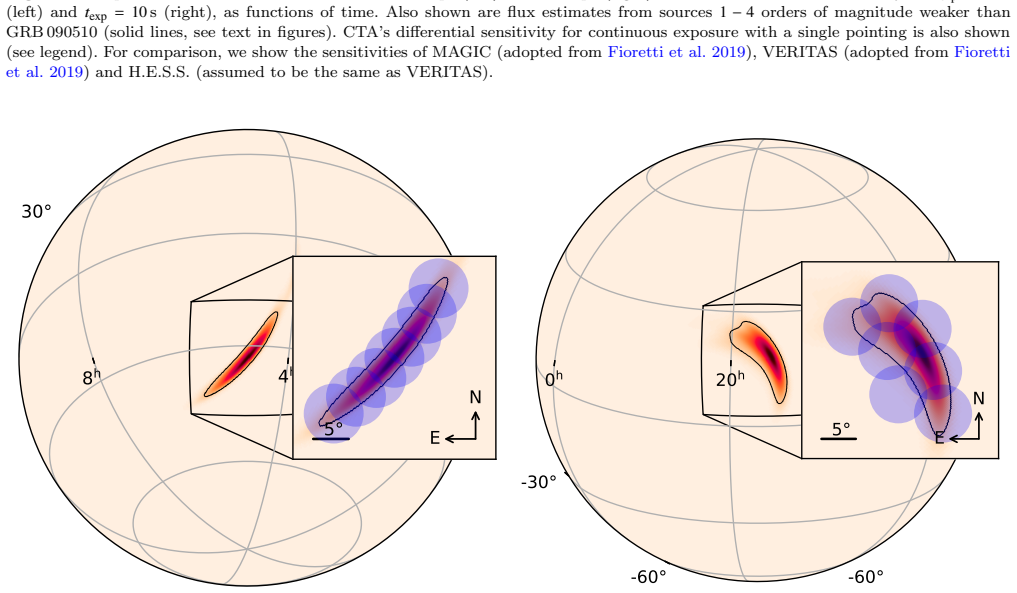
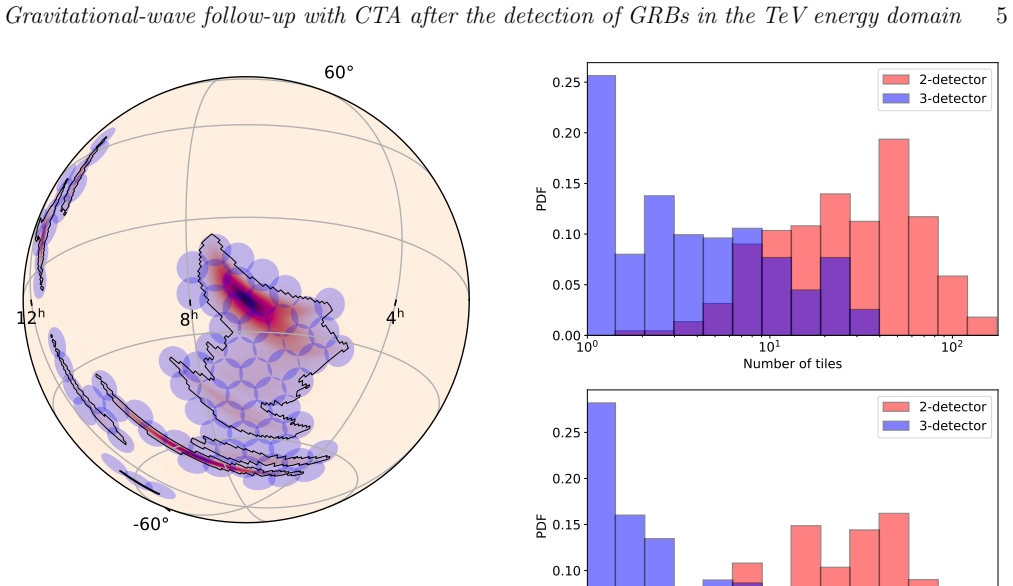
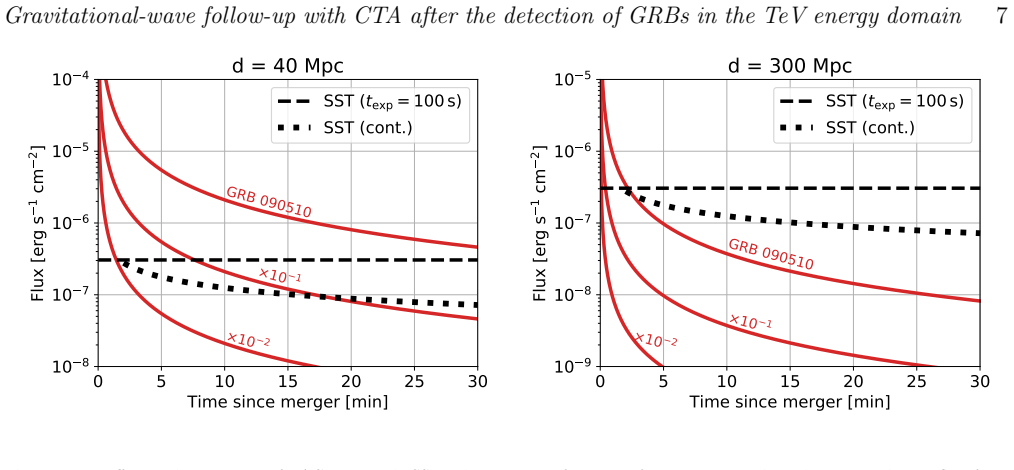
The load-bearing object is equation (1), a spectral flux-density model for short GRBs: $F = 6\times10^{-8}\,\mu{\rm Jy}\, (t/100\,{\rm s})^{-1.38}\,(E/1\,{\rm TeV})^{-1.25}\,(d_L/500\,{\rm Mpc})^{-2}$, built from Fermi-LAT observations of GRB 090510 with forward-shock temporal and spectral indices. The paper compares this model against CTA's differential sensitivity in the 0.6--1 TeV band to compute how long after the merger an event remains detectable, and it uses BAYESTAR-reconstructed localization skymaps with two tiling schemes, 'greedy' and 'honeycomb', to count the pointings needed to cover gravitational-wave error regions. The single-telescope sensitivity of FACT stands in for an individual CTA small-size telescope when assessing partial-array usefulness.
What would settle it
Measure the TeV spectrum of a short GRB at roughly 300--500 Mpc with a fast Cherenkov response: if its flux above 0.6 TeV is more than about $10^{-3}$ times fainter than equation (1) predicts, or if the spectrum cuts off below roughly 1 TeV, then GRB 090510-like TeV emission is not typical of short GRBs and CTA's more-than-an-hour delayed detection window would not apply.
Extended reading notes
Core claim
The paper's central claim is that very-high-energy gamma-ray emission from short GRBs associated with neutron-star mergers could be detected by CTA even if observations start more than an hour after the gravitational-wave trigger, provided the burst is as bright in TeV light as GRB 090510. For a burst one hundred times fainter, about twenty minutes of delay are still acceptable at 300 Mpc. The paper further finds that about 25% of three-detector mergers are localized well enough for a single small-telescope pointing to cover the 90% credible skymap, that following up all three-detector neutron-star mergers would cost 0.2 to 7 hours of CTA time per year, and that binary black-hole mergers require strong prioritization. A small number of small-size or medium-size telescopes, even at locations far from the main CTA sites, could probe nearby TeV counterparts, and continued operation of the existing H.E.S.S., MAGIC, and VERITAS arrays would widen the rapidly coverable sky.
Load-bearing premise
The argument assumes that short GRBs actually emit TeV radiation with luminosity and spectrum comparable to GRB 090510; no short GRB has yet been detected in the TeV band, and all three TeV GRBs known at the time are long-duration bursts.
Editorial extensions
If this is right
- CTA can keep observing a neutron-star merger localization for over an hour after a gravitational-wave alert without losing a bright TeV counterpart.
- About one in four three-detector events needs only a single small-telescope pointing, enabling deep exposures on the full 90% localization.
- Annual CTA follow-up of all three-detector neutron-star mergers fits in 0.2--7 hours per year, while two-detector events and most black-hole mergers require downselection.
- A partially built CTA, or a few small-size telescopes operating on their own, can already detect nearby TeV counterparts and extend the surveyable sky.
- Existing H.E.S.S., MAGIC, and VERITAS arrays remain scientifically useful for gravitational-wave follow-up even after CTA is complete.
Reading between the lines
- If short-GRB TeV emission is as luminous as GRB 090510, the same relaxed delay applies to neutron star--black hole mergers that produce short GRBs, and to sub-threshold gravitational-wave candidates, multiplying the number of follow-up opportunities.
- The delay argument implies that even telescopes with modest slewing speed or delayed alerts can contribute, so weather at the main CTA sites becomes less fatal to follow-up science.
- A null TeV detection in the first years of CTA operation would directly constrain the fraction of short GRBs that sustain GRB 090510-like TeV luminosity, turning the assumed template into a measured luminosity function.
- The geographic-sensitivity maps suggest an optimized small-telescope network placed to cover the LIGO/Virgo most-sensitive sky patches could act as a standalone TeV early-warning system while CTA is still under construction.
Signed reviews
Editorial analysis
A structured set of objections, weighed in public.
Referee Report
Summary. The paper argues that, following the recent TeV detections of long GRBs, CTA can play a central role in gravitational-wave follow-up if short GRBs emit TeV radiation comparable to GRB 090510. It introduces a single-power-law template for short-GRB TeV emission, compares it with CTA's differential sensitivity as a function of delay, simulates gravitational-wave skymaps with BAYESTAR to estimate the number of CTA pointings needed, computes annual follow-up time requirements for neutron star and black hole mergers, and argues that partial CTA configurations, distributed small-size telescopes, and continued operation of current IACTs would all be scientifically useful. The central conclusion is that CTA could detect a GRB 090510-like short GRB even if observations start more than an hour after the gravitational-wave event.
Significance. If the central conditional premise is granted, the paper provides a useful and transparent strategic framework: the flux-versus-sensitivity comparison is easy to check, the tiling simulations are concrete and reproducible in structure, and the proposal that a handful of low-cost SSTs at complementary geographic sites can add value is timely for CTA planning. The paper is a strategy study rather than a measurement paper, and its quantitative conclusions are explicitly conditional on an unverified short-GRB TeV template; future TeV observations of short GRBs will directly validate or invalidate that template. The work also gives a concrete prioritization scheme for CTA follow-up, which is a practical contribution to multi-messenger planning.
major comments (2)
- [Section 2, Eq. (1) and Section 7] The entire quantitative detectability claim, including the Section 7 statement that CTA 'could detect very-high-energy emission from short GRBs even if it starts observing with significant delay' and that the delay can be 'over an hour,' rests on extrapolating the Fermi-LAT GeV spectrum of GRB 090510 to TeV energies with a single photon index and no cutoff. No short GRB has yet been detected at TeV energies, and the three TeV GRBs named in the introduction (190114C, 180720B, 190829A) are long-duration events. The paper explicitly says 'we assume that emission follows this spectrum up to TeV energies,' and the conclusion is conditioned on 'if such TeV emission is typical,' so this is not an internal contradiction, but the assumption is load-bearing: Figure 1 shows that at 10^-4 of the 090510 flux the source is undetectable even with rapid pointed observations, and a steeper spectrum, a break below ~1 TeV, or a lower normalization would remove the central delayed-observation result. Please add external constraints or a sensitivity study over plausible spectral shapes and cutoffs, or re-frame the conclusion more prominently as contingent on an unverified template, including in the abstract. In addition, no uncertainties in alpha, beta, or the EBL attenuation are propagated through Eq. (1), so the plotted crossing times have no error bars.
- [Sections 3 and 7] The single-pointing coverage fraction for three-detector events is reported inconsistently: Section 3 says 'about 50% of skymaps for the 3-detector case can be covered by a single CTA pointing,' while Section 7 says 'About 25% of mergers detected with 3 gravitational-wave detectors will be sufficiently well-localized to have a single SST pointing cover the full 90% C.L. gravitational-wave skymap.' The reported median tile counts of 3–4 for the three-detector case in Section 3 are also difficult to reconcile with a 50% single-pointing fraction. This inconsistency matters because Section 4 uses the single-pointing selection criterion to estimate that 10–100 binary black hole events per year could be followed up with feasible time; please correct the number and ensure that the downstream prioritization estimates are based on the correct cumulative fraction from Fig. 4.
minor comments (5)
- [Section 2] The formula for the temporal decay index is printed as alpha = (2 - 3p)/4, which is negative for p = 2.5; the quoted value alpha ~ 1.38 corresponds to alpha = (3p - 2)/4, so the sign in the printed formula should be corrected.
- [Section 4] The lower end of the annual time estimate for three-detector neutron star mergers (0.2 h) does not obviously follow from the stated 20-600 yr^-1 rate, division by 3, 15% duty cycle, and 15 min per event, which gives about 0.25 h; please check the arithmetic.
- [Abstract and Section 6] 'Compliment' should be 'complement' in the abstract and in Section 6.
- [Figure 1] The caption phrase 'see text in figures' is vague; the scaling labels for the fainter flux curves should be defined in the caption or in the text.
- [Section 5, Figure 5] The legend says 'SST' while the text says the sensitivity is that of FACT, a single-SST telescope; please make the terminology consistent.
Circularity Check
No significant circularity: the hour-delay claim is a conditional sensitivity estimate from an external GRB 090510 template compared with CTA sensitivity.
full rationale
The central claim in Section 7, that CTA could detect very-high-energy emission from short GRBs even if observations begin more than an hour after a gravitational-wave detection, is not derived from CTA sensitivity or from the paper's own conclusions. It is computed from Eq. (1), an externally defined spectral template for GRB 090510 taken from De Pasquale et al. (2010) and extended to TeV energies, then compared with CTA's differential sensitivity in a forward calculation. The text explicitly labels the extension as an assumption: 'We assume that emission follows this spectrum up to TeV energies,' and the conclusion is explicitly conditional: 'If such TeV emission is typical, CTA will have ample opportunity...' No parameter is fitted to the target claim, no quantity is defined in terms of the result it is supposed to predict, and the pointing-count and follow-up-time estimates depend on independent simulations (BAYESTAR skymaps and CTA tiling assumptions) rather than on the detectability conclusion. The self-citations to Bartos et al. and related author-group papers appear mainly in the discussion of binary-black-hole counterparts and previous follow-up strategies, not in the derivation of the short-GRB detectability claim, so they are not load-bearing for the paper's principal numerical result. The paper's main vulnerability is the observationally unverified extrapolation of short-GRB TeV emission and its normalization; that is an assumption-dependence risk, not a circularity, and the paper itself flags the conditional nature of the conclusion.
Assumptions & free parameters
free parameters (8)
- Electron spectral index p =
2.5
- Flux normalization F0 =
6e-8 microJy at 100 s, 1 TeV, 500 Mpc
- CTA sensitivity boost factor =
1.5
- Exposure times texp =
10 s and 100 s
- Detection SNR thresholds =
network SNR 12, per-detector SNR 4
- Fraction of two- versus three-detector events =
55% / 45%
- Merger rates and detection ranges =
BNS 110-3840 Gpc^-3 yr^-1 at 325 Mpc; BBH 9.7-101 Gpc^-3 yr^-1 at 2.5 Gpc
- CTA duty cycle and slew times =
15%, 20 s initial, 5 s between pointings
assumptions (6)
- domain assumption Short GRBs associated with gravitational-wave mergers emit TeV light comparable to GRB 090510
- domain assumption External forward-shock model with p = 2.5 describes emission up to TeV energies
- domain assumption CTA differential sensitivity curves are reliable
- domain assumption BAYESTAR skymaps with LIGO/Virgo design sensitivities represent future localization accuracy
- domain assumption LIGO/Virgo direction-dependent sensitivity is correctly modeled
- domain assumption CMB attenuation factor of about 0.4 at 500 Mpc
Cite this review
Pith. "Pith review of Gravitational-wave follow-up with CTA after the detection of GRBs in the TeV energy domain." pith.science (2026). https://pith.science/paper/KF5HGFCP
@misc{pith2026190809832,
  author       = {Pith},
  title        = {Pith review of: Gravitational-wave follow-up with CTA after the detection of GRBs in the TeV energy domain},
  year         = {2026},
  howpublished = {\url{https://pith.science/paper/KF5HGFCP}},
  note         = {Machine review of arXiv:1908.09832}
}
read the original abstract
The recent discovery of TeV emission from gamma-ray bursts (GRBs) by the MAGIC and H.E.S.S. Cherenkov telescopes confirmed that emission from these transients can extend to very high energies. The TeV energy domain reaches the most sensitive band of the Cherenkov Telescope Array (CTA). This newly anticipated, improved sensitivity will enhance the prospects of gravitational-wave follow-up observations by CTA to probe particle acceleration and high-energy emission from binary black hole and neutron star mergers, and stellar core-collapse events. Here we discuss the implications of TeV emission on the most promising strategies of choice for the gravitational-wave follow-up effort for CTA and Cherenkov telescopes more broadly. We find that TeV emission (i) may allow more than an hour of delay between the gravitational-wave event and the start of CTA observations; (ii) enables the use of CTA's small size telescopes that have the largest fields of view. We characterize the number of pointings needed to find a counterpart. (iii) We compute the annual follow-up time requirements and find that prioritization will be needed. (iv) Even a few telescopes could detect sufficiently nearby counterparts, raising the possibility of adding a handful of small-size or medium-size telescopes to the network at diverse geographic locations taking into account the positions of CTA and the LIGO-Virgo-KAGRA network. (v) The continued operation of VERITAS/H.E.S.S./MAGIC would be a useful compliment to CTA's follow-up capabilities by increasing the sky area that can be rapidly covered, especially for directions above and 'below' the United States in which the present network of gravitational-wave detectors is more sensitive.
Figures

Figures from the paper (2 more)

Reference graph
Works this paper leans on
-
[1]
Aasi J., et al., 2015, @doi [Class. Quantum Grav.] 10.1088/0264-9381/32/7/074001 , https://ui.adsabs.harvard.edu/abs/2015CQGra..32g4001L 32, 074001
-
[2]
Abbott B., et al., 2005, @doi [ ] 10.1103/PhysRevD.72.042002 , https://ui.adsabs.harvard.edu/abs/2005PhRvD..72d2002A 72, 042002
-
[3]
Abbott B., et al., 2008a, @doi [Class. Quantum Grav] 10.1088/0264-9381/25/11/114051 , http://adsabs.harvard.edu/abs/2008CQGra..25k4051A 25, 114051
-
[4]
Abbott B., et al., 2008b, @doi [ ] 10.1086/587954 , https://ui.adsabs.harvard.edu/abs/2008ApJ...681.1419A 681, 1419
-
[5]
Abbott B. P., et al., 2017a, @doi [ ] 10.1103/PhysRevLett.119.161101 , https://ui.adsabs.harvard.edu/abs/2017PhRvL.119p1101A 119, 161101
-
[6]
Abbott B. P., et al., 2017b, @doi [ ] 10.1038/nature24471 , https://ui.adsabs.harvard.edu/abs/2017Natur.551...85A 551, 85
-
[7]
Abbott B. P., et al., 2017c, @doi [ ] 10.3847/2041-8213/aa91c9 , https://ui.adsabs.harvard.edu/abs/2017ApJ...848L..12A 848, L12
-
[8]
Abbott B. P., et al., 2017d, @doi [ ] 10.3847/2041-8213/aa920c , https://ui.adsabs.harvard.edu/abs/2017ApJ...848L..13A 848, L13
Show all 71 references
-
[9]
P., et al., 2018a, arXiv:1811.12907, https://ui.adsabs.harvard.edu/abs/2018arXiv181112907T
Abbott B. P., et al., 2018a, arXiv:1811.12907, https://ui.adsabs.harvard.edu/abs/2018arXiv181112907T
-
[10]
P., et al., 2018b, @doi [Living Reviews in Relativity] 10.1007/s41114-018-0012-9 , https://ui.adsabs.harvard.edu/abs/2018LRR....21....3A 21, 3
Abbott B. P., et al., 2018b, @doi [Living Reviews in Relativity] 10.1007/s41114-018-0012-9 , https://ui.adsabs.harvard.edu/abs/2018LRR....21....3A 21, 3
-
[11]
A., et al., 2009, @doi [ ] 10.1038/nature08574 , http://adsabs.harvard.edu/abs/2009Natur.462..331A 462, 331
Abdo A. A., et al., 2009, @doi [ ] 10.1038/nature08574 , http://adsabs.harvard.edu/abs/2009Natur.462..331A 462, 331
2009 doi
-
[12]
Quantum Grav.] 10.1088/0264-9381/32/2/024001 , https://ui.adsabs.harvard.edu/abs/2015CQGra..32b4001A 32, 024001
Acernese F., et al., 2015, @doi [Class. Quantum Grav.] 10.1088/0264-9381/32/2/024001 , https://ui.adsabs.harvard.edu/abs/2015CQGra..32b4001A 32, 024001
2015 doi
-
[13]
S., et al., 2019, Science with the Cherenkov Telescope Array , @doi 10.1142/10986
Acharya B. S., et al., 2019, Science with the Cherenkov Telescope Array , @doi 10.1142/10986
2019 doi
-
[14]
Acharyya A., et al., 2019, @doi [Astroparticle Physics] 10.1016/j.astropartphys.2019.04.001 , https://ui.adsabs.harvard.edu/abs/2019APh...111...35A 111, 35
2019 doi
-
[15]
Ackermann M., et al., 2010, @doi [ ] 10.1088/0004-637X/716/2/1178 , http://adsabs.harvard.edu/abs/2010ApJ...716.1178A 716, 1178
2010 doi
-
[16]
Ackermann M., et al., 2013, @doi [ ] 10.1088/0067-0049/209/1/11 , http://adsabs.harvard.edu/abs/2013ApJS..209...11A 209, 11
2013 doi
-
[17]
Ajello M., et al., 2018, @doi [ ] 10.3847/1538-4357/aac515 , https://ui.adsabs.harvard.edu/abs/2018ApJ...861...85A 861, 85
2018 doi
-
[18]
Ajello M., et al., 2019, @doi [ ] 10.3847/1538-4357/ab1d4e , 878, 52
2019 doi
-
[19]
Albert A., et al., 2017, @doi [ ] 10.3847/2041-8213/aa9aed , https://ui.adsabs.harvard.edu/abs/2017ApJ...850L..35A 850, L35
2017 doi
-
[20]
Aso Y., Michimura Y., Somiya K., Ando M., Miyakawa O., Sekiguchi T., Tatsumi D., Yamamoto H., 2013, @doi [Phys. Rev. D] 10.1103/PhysRevD.88.043007 , 88, 043007
2013 doi
-
[21]
Baixeras C., 2003, @doi [Nuclear Physics B Proceedings Supplements] 10.1016/S0920-5632(02)01910-2 , https://ui.adsabs.harvard.edu/abs/2003NuPhS.114..247B 114, 247
2003 doi
-
[22]
Baret B., et al., 2011, @doi [Astroparticle Physics] 10.1016/j.astropartphys.2011.04.001 , https://ui.adsabs.harvard.edu/abs/2011APh....35....1B 35, 1
2011 doi
-
[23]
Baret B., et al., 2012, @doi [ ] 10.1103/PhysRevD.85.103004 , https://ui.adsabs.harvard.edu/abs/2012PhRvD..85j3004B 85, 103004
2012 doi
-
[24]
Bartos I., Finley C., Corsi A., M \'a rka S., 2011, @doi [ ] 10.1103/PhysRevLett.107.251101 , https://ui.adsabs.harvard.edu/abs/2011PhRvL.107y1101B 107, 251101
2011 doi
-
[25]
Quantum Grav.] 10.1088/0264-9381/30/12/123001 , https://ui.adsabs.harvard.edu/abs/2013CQGra..30l3001B 30, 123001
Bartos I., Brady P., M \'a rka S., 2013a, @doi [Class. Quantum Grav.] 10.1088/0264-9381/30/12/123001 , https://ui.adsabs.harvard.edu/abs/2013CQGra..30l3001B 30, 123001
-
[26]
M., Hurley K., M \'a rka S., 2013b, @doi [ ] 10.1103/PhysRevLett.110.241101 , http://adsabs.harvard.edu/abs/2013PhRvL.110x1101B 110, 241101
Bartos I., Beloborodov A. M., Hurley K., M \'a rka S., 2013b, @doi [ ] 10.1103/PhysRevLett.110.241101 , http://adsabs.harvard.edu/abs/2013PhRvL.110x1101B 110, 241101
-
[27]
Bartos I., et al., 2014, @doi [ ] 10.1093/mnras/stu1205 , https://ui.adsabs.harvard.edu/abs/2014MNRAS.443..738B 443, 738
2014 doi
-
[28]
D., Stone N
Bartos I., Haiman Z., Marka Z., Metzger B. D., Stone N. C., Marka S., 2017a, @doi [Nature Communications] 10.1038/s41467-017-00851-7 , https://ui.adsabs.harvard.edu/abs/2017NatCo...8..831B 8, 831
-
[29]
Bartos I., Kocsis B., Haiman Z., M \'a rka S., 2017b, @doi [ ] 10.3847/1538-4357/835/2/165 , https://ui.adsabs.harvard.edu/abs/2017ApJ...835..165B 835, 165
-
[30]
Bartos I., Veske D., Keivani A., Marka Z., Countryman S., Blaufuss E., Finley C., Marka S., 2018a, arXiv:1810.11467, https://ui.adsabs.harvard.edu/abs/2018arXiv181011467B
-
[31]
Bartos I., et al., 2018b, @doi [ ] 10.1093/mnras/sty602 , https://ui.adsabs.harvard.edu/abs/2018MNRAS.477..639B 477, 639
-
[32]
J., M \'a rka S., 2011, @doi [Gen
Chassande-Mottin E., Hendry M., Sutton P. J., M \'a rka S., 2011, @doi [Gen. Rel. Gravit] 10.1007/s10714-010-1019-z , http://adsabs.harvard.edu/abs/2011GReGr..43..437C 43, 437
2011 doi
-
[33]
R., et al., 2019, @doi [ ] 10.1093/mnras/stz2072 , https://ui.adsabs.harvard.edu/abs/2019MNRAS.488.4459C 488, 4459
Corley K. R., et al., 2019, @doi [ ] 10.1093/mnras/stz2072 , https://ui.adsabs.harvard.edu/abs/2019MNRAS.488.4459C 488, 4459
2019 doi
-
[34]
Countryman S., et al., 2019, arXiv:1901.05486, https://ui.adsabs.harvard.edu/abs/2019arXiv190105486C
2019 arXiv
-
[35]
De Pasquale M., et al., 2010, @doi [ ] 10.1088/2041-8205/709/2/L146 , https://ui.adsabs.harvard.edu/abs/2010ApJ...709L.146D 709, L146
2010 doi
-
[36]
Dubus G., et al., 2013, @doi [Astroparticle Physics] 10.1016/j.astropartphys.2012.05.020 , https://ui.adsabs.harvard.edu/abs/2013APh....43..317D 43, 317
2013 doi
-
[37]
Fioretti V., et al., 2019, in ICRC2019
2019
-
[38]
Ghirlanda G., et al., 2019, @doi [Science] 10.1126/science.aau8815 , https://ui.adsabs.harvard.edu/abs/2019Sci...363..968G 363, 968
2019 doi
-
[40]
C., Madau P., Primack J
Gilmore R. C., Madau P., Primack J. R., Somerville R. S., Haardt F., 2009, @doi [ ] 10.1111/j.1365-2966.2009.15392.x , https://ui.adsabs.harvard.edu/abs/2009MNRAS.399.1694G 399, 1694
2009
-
[41]
Goldstein A., et al., 2017, @doi [ ] 10.3847/2041-8213/aa8f41 , https://ui.adsabs.harvard.edu/abs/2017ApJ...848L..14G 848, L14
2017 doi
-
[42]
Hassan T., et al., 2017, @doi [Astroparticle Physics] 10.1016/j.astropartphys.2017.05.001 , https://ui.adsabs.harvard.edu/abs/2017APh....93...76H 93, 76
2017 doi
-
[43]
A., et al., 2004, @doi [ ] 10.1016/j.newar.2003.12.004 , https://ui.adsabs.harvard.edu/abs/2004NewAR..48..331H 48, 331
Hinton J. A., et al., 2004, @doi [ ] 10.1016/j.newar.2003.12.004 , https://ui.adsabs.harvard.edu/abs/2004NewAR..48..331H 48, 331
2004 doi
-
[44]
A., Hofmann W., Rieger F., eds, American Institute of Physics Conference Series Vol
Holder J., et al., 2008, in Aharonian F. A., Hofmann W., Rieger F., eds, American Institute of Physics Conference Series Vol. 1085, American Institute of Physics Conference Series. pp 657--660 ( @eprint arXiv 0810.0474 ), @doi 10.1063/1.3076760
2008 arXiv
-
[45]
A., M\'arka S., Bender P
Hughes S. A., M\'arka S., Bender P. L., Hogan C. J., 2001, arXiv:astro-ph/0110349, https://ui.adsabs.harvard.edu/abs/2001astro.ph.10349H
2001 arXiv
-
[46]
Ilyer B., et al., 2011, LIGO-M1100296
2011
-
[47]
Ioka K., Nakamura T., 2001, @doi [ ] 10.1086/321717 , https://ui.adsabs.harvard.edu/abs/2001ApJ...554L.163I 554, L163
2001 doi
-
[48]
M., et al., 2017, @doi [Science] 10.1126/science.aap9455 , https://ui.adsabs.harvard.edu/abs/2017Sci...358.1559K 358, 1559
Kasliwal M. M., et al., 2017, @doi [Science] 10.1126/science.aap9455 , https://ui.adsabs.harvard.edu/abs/2017Sci...358.1559K 358, 1559
2017 doi
-
[49]
S., Murase K., Bartos I., Ioka K., Heng I
Kimura S. S., Murase K., Bartos I., Ioka K., Heng I. S., M \'e sz \'a ros P., 2018, @doi [ ] 10.1103/PhysRevD.98.043020 , https://ui.adsabs.harvard.edu/abs/2018PhRvD..98d3020K 98, 043020
2018 doi
-
[50]
Kumar P., Barniol Duran R., 2010, @doi [ ] 10.1111/j.1365-2966.2010.17274.x , https://ui.adsabs.harvard.edu/abs/2010MNRAS.409..226K 409, 226
2010
-
[51]
LIGO Scientific Collaboration 2018, LIGO-T1800133
2018
-
[52]
J., Lopez-Camara D., Cantiello M., Ciolfi R., Giacomazzo B., Workman J
Lazzati D., Perna R., Morsony B. J., Lopez-Camara D., Cantiello M., Ciolfi R., Giacomazzo B., Workman J. C., 2018, @doi [ ] 10.1103/PhysRevLett.120.241103 , https://ui.adsabs.harvard.edu/abs/2018PhRvL.120x1103L 120, 241103
2018 doi
-
[53]
Margutti R., et al., 2018, @doi [ ] 10.3847/2041-8213/aab2ad , https://ui.adsabs.harvard.edu/abs/2018ApJ...856L..18M 856, L18
2018 doi
-
[54]
Marka S., 2003, in Cruise M., Saulson P., eds, Society of Photo-Optical Instrumentation Engineers (SPIE) Conference Series Vol. 4856, . pp 222--229, @doi 10.1117/12.459091
2003 doi
-
[55]
M \'a rka S., et al., 2010, in Journal of Physics Conference Series. p. 012001, @doi 10.1088/1742-6596/243/1/012001
2010 doi
-
[56]
Quantum Grav] 10.1088/0264-9381/28/11/114013 , http://adsabs.harvard.edu/abs/2011CQGra..28k4013M 28, 114013
M \'a rka S., et al., 2011, @doi [Class. Quantum Grav] 10.1088/0264-9381/28/11/114013 , http://adsabs.harvard.edu/abs/2011CQGra..28k4013M 28, 114013
2011 doi
-
[57]
McKernan B., Ford K. E. S., Lyra W., Perets H. B., 2012, @doi [ ] 10.1111/j.1365-2966.2012.21486.x , https://ui.adsabs.harvard.edu/abs/2012MNRAS.425..460M 425, 460
2012
-
[58]
McKernan B., et al., 2019, arXiv:1907.03746, https://ui.adsabs.harvard.edu/abs/2019arXiv190703746M
2019 arXiv
-
[59]
M \'e sz \'a ros P., Gehrels N., 2012, @doi [Res. Astron. Astrophys.] 10.1088/1674-4527/12/8/012 , https://ui.adsabs.harvard.edu/abs/2012RAA....12.1139M 12, 1139
2012 doi
-
[60]
Mirzoyan R., Noda K., Moretti E., et al., 2019, GCN 23701
2019
-
[61]
Montaruli T., Pareschi G., Greenshaw T., 2015, arXiv:1508.06472, https://ui.adsabs.harvard.edu/abs/2015arXiv150806472M
2015 arXiv
-
[62]
P., et al., 2018, @doi [ ] 10.1038/s41586-018-0486-3 , https://ui.adsabs.harvard.edu/abs/2018Natur.561..355M 561, 355
Mooley K. P., et al., 2018, @doi [ ] 10.1038/s41586-018-0486-3 , https://ui.adsabs.harvard.edu/abs/2018Natur.561..355M 561, 355
2018 doi
-
[63]
Noethe M., et al., 2017, International Cosmic Ray Conference, https://ui.adsabs.harvard.edu/abs/2017ICRC...35..791N 35, 791
2017
-
[64]
Patricelli B., Stamerra A., Razzano M., Pian E., Cella G., 2018, @doi [ ] 10.1088/1475-7516/2018/05/056 , https://ui.adsabs.harvard.edu/abs/2018JCAP...05..056P 5, 056
2018 doi
-
[65]
Ruiz-Velasco 2019, 1st International CTA Symposium
2019
-
[66]
Schussler F., et al., 2019, GCN 25566
2019
-
[67]
Seglar-Arroyo M., et al., 2019, in 36th International Cosmic Ray Conference (ICRC2019). p. 790 ( @eprint arXiv 1908.08393 )
2019 arXiv
-
[68]
P., Price L
Singer L. P., Price L. R., 2016, @doi [ ] 10.1103/PhysRevD.93.024013 , https://ui.adsabs.harvard.edu/abs/2016PhRvD..93b4013S 93, 024013
2016 doi
-
[69]
C., Metzger B
Stone N. C., Metzger B. D., Haiman Z., 2017, @doi [ ] 10.1093/mnras/stw2260 , https://ui.adsabs.harvard.edu/abs/2017MNRAS.464..946S 464, 946
2017 doi
-
[70]
Yang Y., et al., 2019a, arXiv:1906.09281, https://ui.adsabs.harvard.edu/abs/2019arXiv190609281Y
1906 arXiv
-
[71]
C., M \'a rka S., 2019b, @doi [ ] 10.3847/1538-4357/ab16e3 , https://ui.adsabs.harvard.edu/abs/2019ApJ...876..122Y 876, 122
Yang Y., Bartos I., Haiman Z., Kocsis B., M \'a rka Z., Stone N. C., M \'a rka S., 2019b, @doi [ ] 10.3847/1538-4357/ab16e3 , https://ui.adsabs.harvard.edu/abs/2019ApJ...876..122Y 876, 122
-
[72]
write newline
" write newline "" before.all 'output.state := FUNCTION fin.entry write newline FUNCTION new.block output.state before.all = 'skip after.block 'output.state := if FUNCTION new.sentence output.state after.block = 'skip output.state before.all = 'skip after.sentence 'output.stat...
Reviewed August 14, 2026 · model on record in the stance chip above.
Discussion (0). Continue with ORCID to comment.