REVIEW 1 major objections 4 minor 1 cited by
The X-ray properties of $z>6$ quasars: no evident evolution of accretion physics in the first Gyr of the Universe
T0 review · 1 major / 4 minor · reviewed 2026-08-14 · deepseek-v4-flash
Pith's one-line read The first Gyr of quasar activity shows the same disk–corona structure seen at low redshift.
desk verdict A careful, credible extension of high-z quasar X-ray studies; the null result holds up, though the 2 keV extrapolation assumption deserves a clear caveat. read the letter →
The pith
A machine-rendered reading of the paper's core claim, the machinery that carries it, and where it could break.
The reading
What carries the argument
The load-bearing quantity is $\alpha_{\rm ox}=0.38\log(L_{\rm 2\,keV}/L_{2500})$, which collapses the UV-to-X-ray spectral slope into a single number. Comparing the $z>6$ values with the lower-redshift $\alpha_{\rm ox}$–$L_{2500}$ relation is what carries the no-evolution claim. Supporting machinery includes binomial no-source probabilities for source detection, probability-distribution photometry for converting counts to fluxes, and joint power-law spectral fits that yield the average photon index $\Gamma$, a probe of the disk–corona coupling.
What would settle it
Take the same 25 quasars and obtain spectra with enough counts to measure each photon index directly instead of assuming $\Gamma=2.0$; if the mean $\Gamma$ comes out above about 2.5, or if the measured $\alpha_{\rm ox}$ values move systematically off the lower-redshift relation, the no-evolution conclusion fails.
Extended reading notes
Core claim
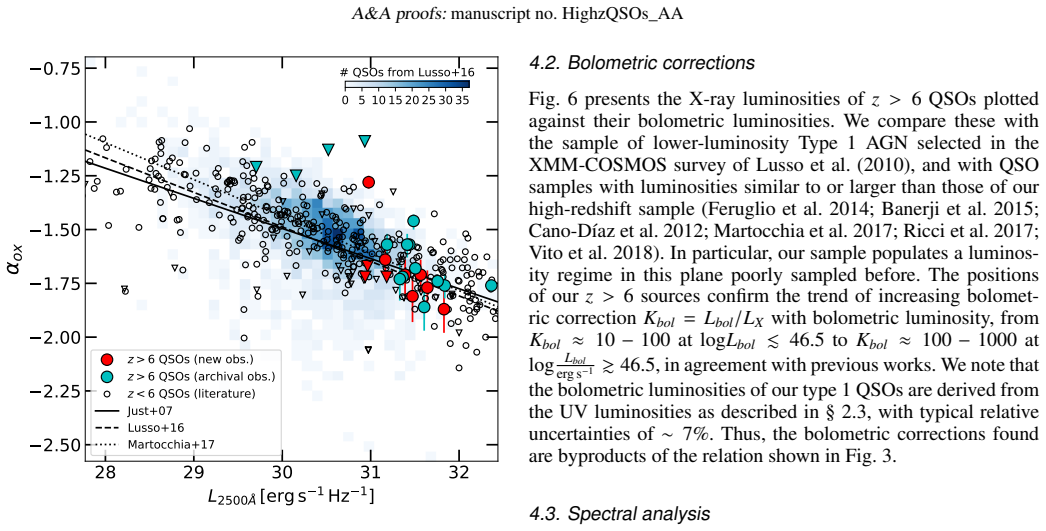
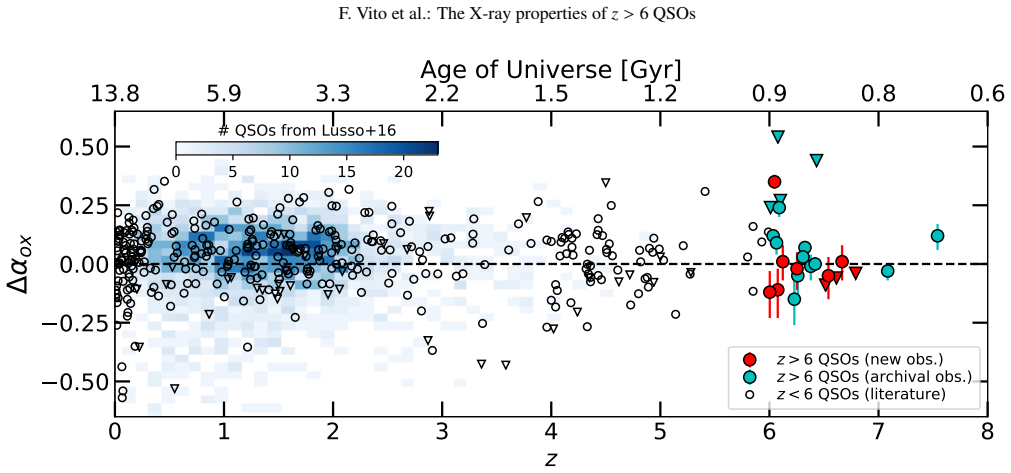
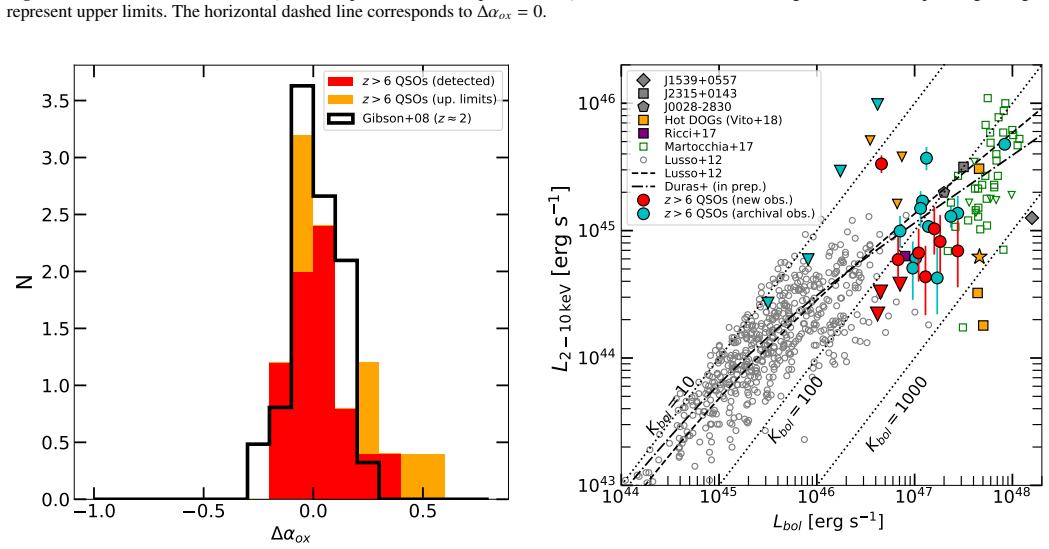
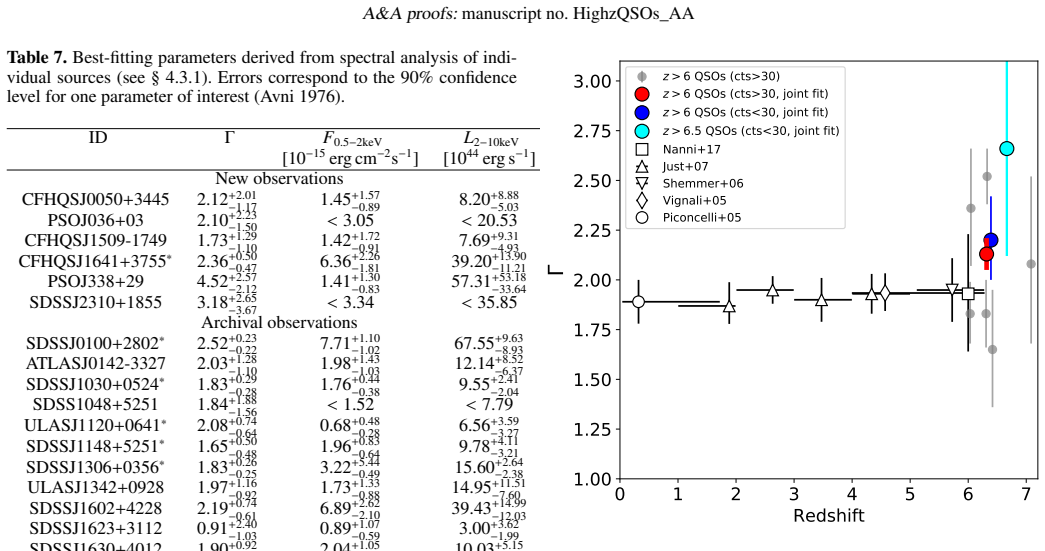
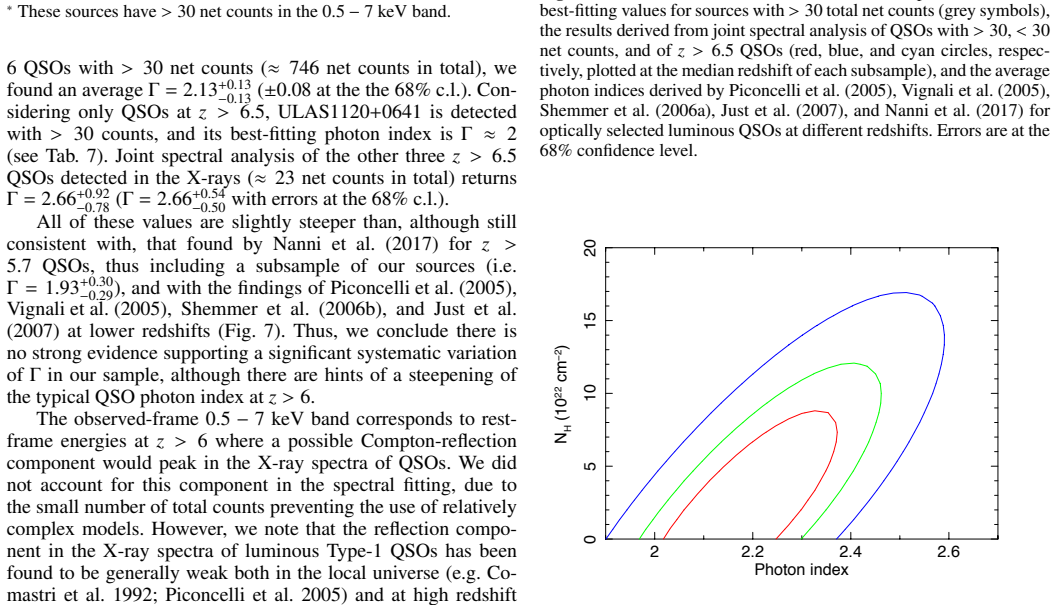
The central claim is that there is no substantial evolution of the inner accretion-disk/hot-corona structure in quasars from low redshift to $z>6$. Analysing new and archival X-ray observations of 25 quasars in the first Gyr, the authors find that the $\alpha_{\rm ox}$ distribution is statistically indistinguishable from the lower-redshift $\alpha_{\rm ox}$–$L_{2500}$ relation. Joint spectral fitting gives average photon indices $\Gamma=2.20^{+0.39}_{-0.34}$ and $\Gamma=2.13^{+0.13}_{-0.13}$ for the fainter and brighter subsamples, slightly steeper than but still consistent with typical $z=1$–$6$ quasars. The bolometric corrections also follow the same luminosity trend seen at low redshift, and the data hint at generally high Eddington ratios.
Load-bearing premise
Every X-ray luminosity and $\alpha_{\rm ox}$ value in the photometric analysis is computed assuming an intrinsic power-law photon index $\Gamma=2.0$; if the true $z>6$ spectra are systematically steeper, the derived luminosities shift and the match to lower-redshift relations could be partly artificial.
Editorial extensions
If this is right
- The $\alpha_{\rm ox}$–$L_{2500}$ relation can be treated as redshift-independent out to $z\approx7.5$, so X-ray fluxes of $z>8$ quasars can be predicted from their UV magnitudes when planning observations.
- Exposure-time estimates for future X-ray missions targeting quasars in the reionization epoch can rely on the local relation, as the paper explicitly notes.
- The high Eddington ratios hinted by the sample, if general, imply early massive black holes grew efficiently without changing their disk–corona geometry.
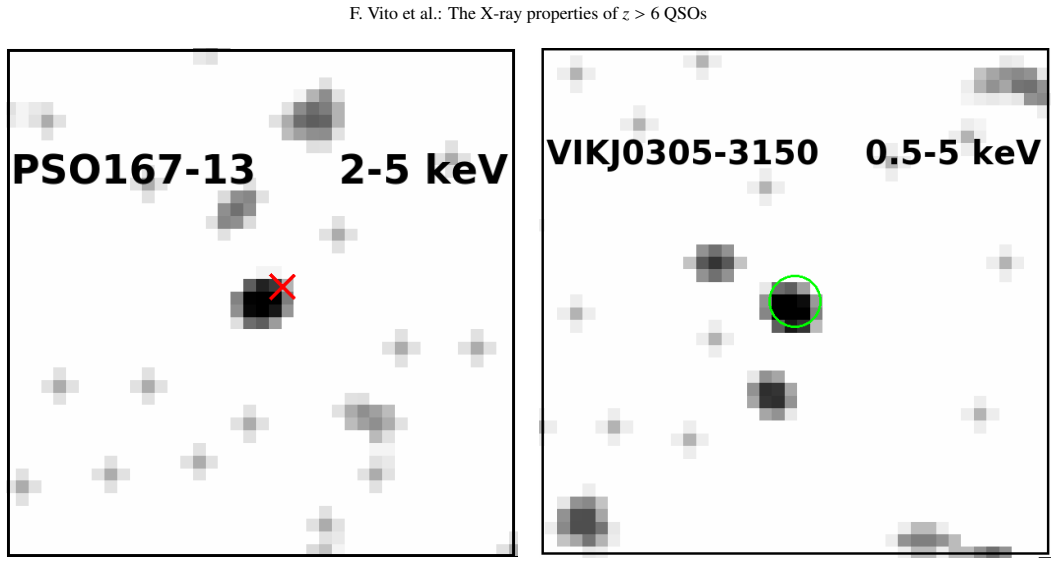
- The first heavily obscured quasar candidate at $z>6$, PSO167–13, suggests that some early accreting black holes are hidden from UV-selected samples and would be found only in X-ray surveys.
Reading between the lines
- Inference: If larger samples confirm the marginally steeper photon indices and high Eddington ratios, seed black-hole growth models that require sustained high accretion rates in the first Gyr would be favoured over models invoking a different accretion mode.
- Inference: Because the photometric analysis assumes $\Gamma=2.0$, the measured mean $\Gamma\approx2.13$ implies a small systematic shift in all $\alpha_{\rm ox}$ values; the null result is robust to that shift, but ruling out larger systematic steepening will require higher signal-to-noise spectra.
- Inference: The non-evolving $\alpha_{\rm ox}$ relation, if it holds at $z>6$, would extend the quasar standard-candle method into the first Gyr, a regime type Ia supernovae cannot reach; the paper cites this idea but does not itself derive cosmological constraints.
- Inference: If the obscured candidate is confirmed as Compton-thick, UV-selected $z>6$ quasar samples are biased towards unobscured sources, which would affect the interpretation of the $\alpha_{\rm ox}$ comparison.
Signed reviews
Editorial analysis
A structured set of objections, weighed in public.
Referee Report
Summary. The paper presents new Chandra observations of 10 z>6 quasars and combines them with archival X-ray data for 15 more, yielding a sample of 25 objects in the first Gyr of the Universe. It derives X-ray luminosities, α_ox values, bolometric corrections, hardness ratios, and photon indices from photometric and basic spectral analyses. The main results are that the α_ox distribution of z>6 QSOs is consistent with lower-redshift relations (Just et al. 2007; Lusso & Risaliti 2016), that K_bol increases with L_bol as at lower redshift, and that the mean photon index (Γ≈2.13–2.20) is slightly steeper than but consistent with z≈1–6 QSOs. The authors conclude that there is no substantial evolution of the inner accretion-disk/hot-corona structure in the first Gyr.
Significance. If the conclusion holds, this is an important observational constraint: it extends the LX–LUV relation and typical photon indices to the first Gyr, supports the use of QSOs as distance indicators to high redshift, and strengthens the case that the basic accretion-disk/corona configuration was already in place by z>6. The analysis is careful in several respects: detection significances use binomial no-source statistics, censored data are handled with ASURV, photometric results are cross-checked with spectral fits where photon statistics allow, and black-hole masses and bolometric luminosities are recalibrated homogeneously. The marginal detections and the systematic dependence on the assumed photon index are handled transparently, and the paper is appropriately cautious about the small sample size. The main weakness is that the photometric α_ox values depend on an extrapolation to rest-frame 2 keV that is not directly probed by the observations; this is acknowledged in the paper but the size of the resulting systematic is not quantified.
major comments (1)
- [Section 3.3 (Tables 3–4); Section 4.3] The photometric α_ox and L_2keV values are derived from observed 0.5–2 keV counts assuming an intrinsic power law with Γ=2.0, but at z>6 rest-frame 2 keV is redshifted below the soft-band edge and is therefore not directly measured. The hardness ratios and spectral fits in Section 4.3 constrain only rest-frame energies above roughly 3.5 keV, so they do not validate the continuum between rest 2 and 3.5 keV. A systematic slope error or an unmodeled soft excess in that interval would shift all z>6 α_ox values coherently relative to lower-redshift relations that are based on direct measurements of rest 2 keV; the paper itself notes the lack of direct probing in Section 3.3 and shows in Section 4.3.1 that the Γ=2.0 photometric assumption can disagree with the spectral fit in the case of PSOJ338+29. I request a quantitative sensitivity analysis: recompute α_ox and Δα_ox under the authors' measured average Γ values (e.g., 2.13 and 2.20) and under an alternative continuum with a soft-excess component normalized to the observed hardness ratios, and quote the resulting shifts against the intrinsic scatter of the reference relations. This is needed to bound the systematic uncertainty on the central null result.
minor comments (4)
- [Section 4.3.1] The sentence 'For two other sources, PSOJ036+03, SDSS1048+5251, and SDSSJ2310+1855' lists three objects and should say 'three'; in addition, 'SDSS1048+5251' appears inconsistent with the source name 'SDSSJ1048+4637' in Table 1 and Table 7.
- [Section 2.3] The text refers to 'SDSSJ0109−3047' when discussing the Mg II blueshift; the source in the sample is VIKJ0109−3047, so the acronym appears to be a typo.
- [Section 3.2] The expected number of false detections is written as '111×PB≈1', which is slightly confusing because PB is also used for the per-image no-source probability; stating the expected number as the sum of PB over all images and bands would be clearer.
- [Section 5] In the Conclusions, the expression 'log Lbol LL⊙' appears garbled; it should read 'log(L_bol/L_⊙)' or similar.
Circularity Check
No significant circularity: the z>6 comparison is made against external lower-redshift relations and independent spectral fits.
full rationale
The paper's central claims (no evolution of alpha_ox and Gamma) are tested against external baselines, not derived from fitted inputs. alpha_ox is computed from soft-band photometry under an explicitly stated Gamma=2.0 assumption; the comparison relations of Just et al. (2007) and Lusso & Risaliti (2016) are external fits that do not use the z>6 data, so the consistency test is not self-referential. The average photon indices are obtained from joint power-law fits with free photon index, independent of the Gamma=2.0 photometric assumption. Self-citations (Nanni et al. 2017, Nanni et al. 2018, Vito et al. 2019) provide data or prior measurements but are not load-bearing logical premises for the null result. The paper explicitly flags the Gamma=2.0 extrapolation and the fact that rest-frame 2 keV is not directly probed at z>6 (Section 3.3), which is a systematic uncertainty rather than circular reasoning. No equation in the paper reduces a derived quantity to its own input by construction.
Assumptions & free parameters
free parameters (2)
- Assumed intrinsic photon index for photometric conversions =
Gamma = 2.0
- Assumed UV continuum slope =
alpha = -0.3
assumptions (6)
- domain assumption X-ray spectra of z>6 QSOs are power laws with photon index Gamma=2.0 for photometric conversions
- domain assumption UV continuum is a power law with slope alpha=-0.3 from 1450 A to 2500 A
- domain assumption Mg II virial black-hole mass calibration of Vestergaard & Osmer (2009)
- domain assumption Bolometric luminosity from the Venemans et al. (2016) relation log L_bol = 4.553 + 0.911 log(lambda L_lambda(1450))
- standard math Standard flat LCDM cosmology (H0=67.7, Omega_m=0.307)
- domain assumption Radio-quiet selection ensures X-ray emission is dominated by the accretion-disk corona rather than a jet
Cite this review
Pith. "Pith review of The X-ray properties of $z>6$ quasars: no evident evolution of accretion physics in the first Gyr of the Universe." pith.science (2026). https://pith.science/paper/3UH64K6Z
@misc{pith2026190809849,
  author       = {Pith},
  title        = {Pith review of: The X-ray properties of $z>6$ quasars: no evident evolution of accretion physics in the first Gyr of the Universe},
  year         = {2026},
  howpublished = {\url{https://pith.science/paper/3UH64K6Z}},
  note         = {Machine review of arXiv:1908.09849}
}
abstract
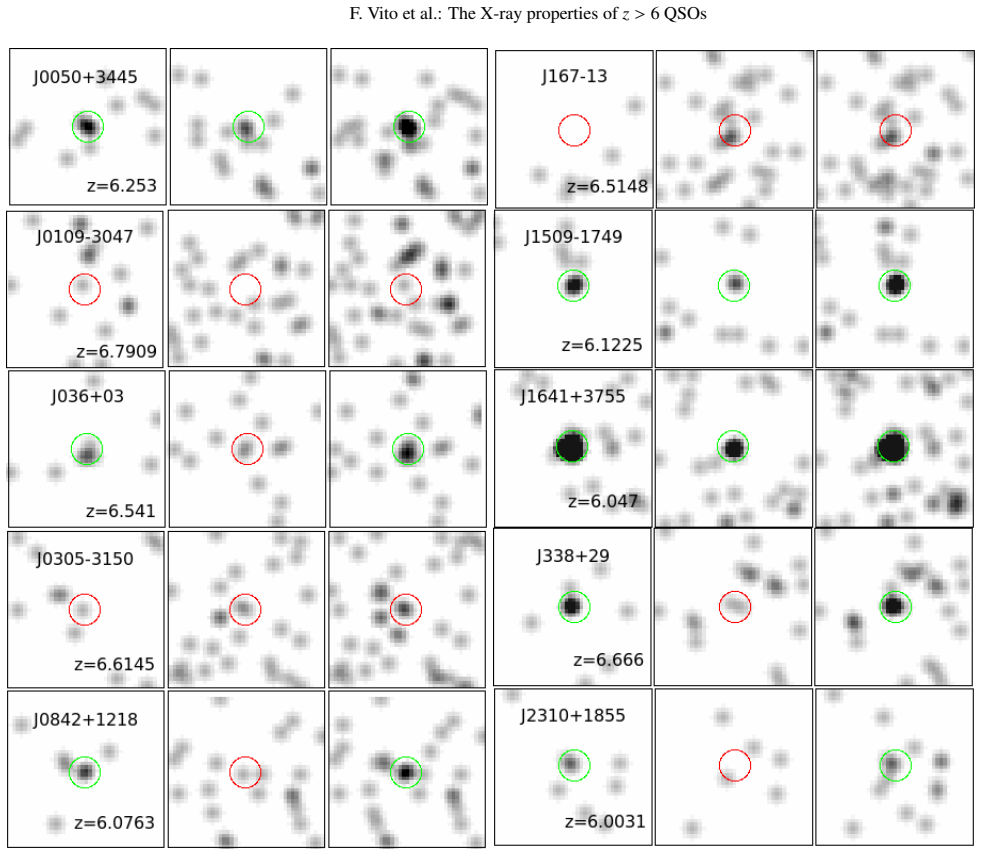
X-ray emission from QSOs has been used to assess SMBH accretion properties up to $z$~6. However, at $z>6$ only ~15 QSOs are covered by sensitive X-ray observations, preventing a statistically significant investigation of the X-ray properties of QSOs in the first Gyr of the Universe. We present new Chandra observations of 10 $z>6$ QSOs, selected to have virial black-hole mass estimates from Mg II line spectroscopy. Adding archival X-ray data for an additional 15 $z>6$ QSOs, we investigate the X-ray properties of the QSO population in the first Gyr of the Universe, focusing in particular on the $L_{UV}-L_{X}$ relation, which is traced by the $\alpha_{ox}$ parameter, and the shape of their X-ray spectra. We performed photometric analyses to derive estimates of the X-ray luminosities, and thus the $\alpha_{ox}$ values and bolometric corrections ($K_{bol}=L_{bol}/L_{X}$). We compared the resulting $\alpha_{ox}$ and $K_{bol}$ distributions with the results found for QSO samples at lower redshift. Finally, we performed a basic X-ray spectral analysis of the brightest $z>6$ QSOs to derive their individual photon indices, and joint spectral analysis of the whole sample to estimate the average photon index. We confirm a lack of significant evolution of $\alpha_{ox}$ with redshift, extending the results from previous works up to $z>6$, and the trend of an increasing bolometric correction with increasing luminosity found for QSOs at lower redshifts. The average power-law photon index of our sample ($\Gamma=2.20_{-0.34}^{+0.39}$ and $\Gamma=2.13_{-0.13}^{+0.13}$ for sources with $<30$ and $>30$ net counts, respectively) is slightly steeper than, but still consistent with, typical QSOs at $z=1-6$. All these results point toward a lack of substantial evolution of the inner accretion-disk/hot-corona structure in QSOs from low redshift to $z>6$. Our data hint at generally high Eddington ratios at $z>6$.
Figures

Figures from the paper (5 more)
Forward citations
Cited by 1 Pith paper
-
The most extreme high-z radio quasars in the eRASS:1 X-ray survey
The team confirmed 39 new high-redshift radio quasars and found that the number of X-ray-selected blazars at z>4 grows with redshift faster than a constant X-ray/radio ratio model, in broad agreement with the IC/CMB model.
Reference graph
Works this paper leans on
-
[1]
Arnaud, K. A. 1996, in Astronomical Society of the Pacific Conference Series, V ol. 101, Astronomical Data Analysis Software and Systems V , ed. G. H. Jacoby & J. Barnes, 17 Article number, page 14 of 15 F. Vito et al.: The X-ray properties of z> 6 QSOs
1996
-
[2]
1976, ApJ, 210, 642 Bañados, E., Connor, T., Stern, D., et al
Avni, Y . 1976, ApJ, 210, 642 Bañados, E., Connor, T., Stern, D., et al. 2018a, ApJ, 856, L25 Bañados, E., Decarli, R., Walter, F., et al. 2015a, ApJ, 805, L8 Bañados, E., Venemans, B. P., Decarli, R., et al. 2016, ApJS, 227, 11 Bañados, E., Venemans, B. P., Mazzucchelli, C., et al. 2018b, Nature, 553, 473 Bañados, E., Venemans, B. P., Morganson, E., et a...
1976
-
[3]
C., & McMahon, R
Banerji, M., Alaghband-Zadeh, S., Hewett, P. C., & McMahon, R. G. 2015, MN- RAS, 447, 3368
2015
-
[4]
H., White, R
Becker, R. H., White, R. L., & Helfand, D. J. 1995, ApJ, 450, 559
1995
-
[5]
Beloborodov, A. M. 2017, ApJ, 850, 141
2017
-
[6]
Brandt, W. N. & Alexander, D. M. 2015, A&A Rev., 23, 1
2015
-
[7]
N., Schneider, D
Brandt, W. N., Schneider, D. P., Fan, X., et al. 2002, ApJ, 569, L5
2002
-
[8]
Brandt, W. N. & Vito, F. 2017, Astronomische Nachrichten, 338, 241
2017
Show all 112 references
-
[9]
D., Mainieri, V ., et al
Brightman, M., Silverman, J. D., Mainieri, V ., et al. 2013, MNRAS, 433, 2485
2013
-
[10]
S., Feigelson, E
Broos, P. S., Feigelson, E. D., Townsley, L. K., et al. 2007, ApJS, 169, 353 Cano-Díaz, M., Maiolino, R., Marconi, A., et al. 2012, A&A, 537, L8
2007
-
[11]
C., Shanks, T., Chehade, B., et al
Carnall, A. C., Shanks, T., Chehade, B., et al. 2015, MNRAS, 451, L16
2015
-
[12]
1979, ApJ, 228, 939 Castelló-Mor, N., Kaspi, S., Netzer, H., et al
Cash, W. 1979, ApJ, 228, 939 Castelló-Mor, N., Kaspi, S., Netzer, H., et al. 2017, MNRAS, 467, 1209
1979
-
[13]
C., Shanks, T., et al
Chehade, B., Carnall, A. C., Shanks, T., et al. 2018, MNRAS, 478, 1649
2018
-
[14]
1992, ApJ, 384, 62
Comastri, A., Setti, G., Zamorani, G., et al. 1992, ApJ, 384, 62
1992
-
[15]
J., Cotton, W
Condon, J. J., Cotton, W. D., Greisen, E. W., et al. 1998, AJ, 115, 1693 De Rosa, G., Decarli, R., Walter, F., et al. 2011, ApJ, 739, 56 De Rosa, G., Venemans, B. P., Decarli, R., et al. 2014, ApJ, 790, 145
1998
-
[16]
P., et al
Decarli, R., Walter, F., Venemans, B. P., et al. 2018, ApJ, 854, 97
2018
-
[17]
M., Fan, X., Brandt, W
Diamond-Stanic, A. M., Fan, X., Brandt, W. N., et al. 2009, ApJ, 699, 782
2009
-
[18]
F., Richards, G
Fan, X., Hennawi, J. F., Richards, G. T., et al. 2004, AJ, 128, 515
2004
-
[19]
K., Lupton, R
Fan, X., Narayanan, V . K., Lupton, R. H., et al. 2001, AJ, 122, 2833
2001
-
[20]
A., Gunn, J
Fan, X., Strauss, M. A., Gunn, J. E., et al. 1999, ApJ, 526, L57
1999
-
[21]
A., Schneider, D
Fan, X., Strauss, M. A., Schneider, D. P., et al. 2003, AJ, 125, 1649
2003
-
[22]
2019, ApJ, 870, L11
Fan, X., Wang, F., Yang, J., et al. 2019, ApJ, 870, L11
2019
-
[23]
2013, MNRAS, 433, 648
Fanali, R., Caccianiga, A., Severgnini, P., et al. 2013, MNRAS, 433, 648
2013
-
[24]
2004, ApJ, 611, L13
Farrah, D., Priddey, R., Wilman, R., Haehnelt, M., & McMahon, R. 2004, ApJ, 611, L13
2004
-
[25]
Feigelson, E. D. & Nelson, P. I. 1985, ApJ, 293, 192
1985
-
[26]
2014, A&A, 565, A91
Feruglio, C., Bongiorno, A., Fiore, F., et al. 2014, A&A, 565, A91
2014
-
[27]
A., Rosner, R., & Vaiana, G
Galeev, A. A., Rosner, R., & Vaiana, G. S. 1979, ApJ, 229, 318
1979
-
[28]
C., Brandt, W
Gallagher, S. C., Brandt, W. N., Chartas, G., et al. 2006, ApJ, 644, 709
2006
-
[29]
C., et al
Gallerani, S., Zappacosta, L., Orofino, M. C., et al. 2017, MNRAS, 467, 3590
2017
-
[30]
Gibson, R. R. & Brandt, W. N. 2012, ApJ, 746, 54
2012
-
[31]
R., Brandt, W
Gibson, R. R., Brandt, W. N., & Schneider, D. P. 2008, ApJ, 685, 773
2008
-
[32]
R., Jiang, L., Brandt, W
Gibson, R. R., Jiang, L., Brandt, W. N., et al. 2009, ApJ, 692, 758
2009
-
[33]
& Maraschi, L
Haardt, F. & Maraschi, L. 1991, ApJ, 380, L51
1991
-
[34]
& Feigelson, E
Isobe, T. & Feigelson, E. D. 1990, in Bulletin of the American Astronomical
1990
-
[35]
2004, ApJ, 614, 69
Iwamuro, F., Kimura, M., Eto, S., et al. 2004, ApJ, 614, 69
2004
-
[36]
2008, AJ, 135, 1057
Jiang, L., Fan, X., Annis, J., et al. 2008, AJ, 135, 1057
2008
-
[37]
D., Fan, X., et al
Jiang, L., McGreer, I. D., Fan, X., et al. 2016, ApJ, 833, 222
2016
-
[38]
Jiang, Y .-F., Stone, J., & Davis, S. W. 2017, arXiv e-prints, arXiv:1709.02845
2017 arXiv
-
[39]
2012, MNRAS, 422, 3268
Jin, C., Ward, M., & Done, C. 2012, MNRAS, 422, 3268
2012
-
[40]
W., Brandt, W
Just, D. W., Brandt, W. N., Shemmer, O., et al. 2007, ApJ, 665, 1004
2007
-
[41]
Kalberla, P. M. W., Burton, W. B., Hartmann, D., et al. 2005, A&A, 440, 775
2005
-
[42]
I., Sramek, R., Schmidt, M., Sha ffer, D
Kellermann, K. I., Sramek, R., Schmidt, M., Sha ffer, D. B., & Green, R. 1989, AJ, 98, 1195
1989
-
[43]
D., Walter, F., Fan, X., et al
Kurk, J. D., Walter, F., Fan, X., et al. 2009, ApJ, 702, 833
2009
-
[44]
D., Walter, F., Fan, X., et al
Kurk, J. D., Walter, F., Fan, X., et al. 2007, ApJ, 669, 32
2007
-
[45]
P., Isobe, T., & Feigelson, E
Lavalley, M. P., Isobe, T., & Feigelson, E. D. 1992, in Bulletin of the American Astronomical Society, V ol. 24, 839–840
1992
-
[46]
N., Alexander, D
Luo, B., Brandt, W. N., Alexander, D. M., et al. 2014, ApJ, 794, 70
2014
-
[47]
N., Hall, P
Luo, B., Brandt, W. N., Hall, P. B., et al. 2015, ApJ, 805, 122
2015
-
[48]
D., et al
Lusso, E., Comastri, A., Simmons, B. D., et al. 2012, MNRAS, 425, 623
2012
-
[49]
2010, A&A, 512, A34
Lusso, E., Comastri, A., Vignali, C., et al. 2010, A&A, 512, A34
2010
-
[50]
& Risaliti, G
Lusso, E. & Risaliti, G. 2016, ApJ, 819, 154
2016
-
[51]
& Risaliti, G
Lusso, E. & Risaliti, G. 2017, A&A, 602, A79
2017
-
[52]
2012, A&A, 539, A48
Marchese, E., Della Ceca, R., Caccianiga, A., et al. 2012, A&A, 539, A48
2012
-
[53]
F., et al
Marlar, A., Shemmer, O., Anderson, S. F., et al. 2018, ApJ, 865, 92
2018
-
[54]
2017, A&A, 608, A51
Martocchia, S., Piconcelli, E., Zappacosta, L., et al. 2017, A&A, 608, A51
2017
-
[55]
2016, ApJ, 828, 26
Matsuoka, Y ., Onoue, M., Kashikawa, N., et al. 2016, ApJ, 828, 26
2016
-
[56]
2019, ApJ, 872, L2
Matsuoka, Y ., Onoue, M., Kashikawa, N., et al. 2019, ApJ, 872, L2
2019
-
[57]
P., et al
Mazzucchelli, C., Bañados, E., Venemans, B. P., et al. 2017, ApJ, 849, 91
2017
-
[58]
Meier, D. L. 2012, Black Hole Astrophysics: The Engine Paradigm
2012
-
[59]
A., Bosman, S
Meyer, R. A., Bosman, S. E. I., & Ellis, R. S. 2019, MNRAS, 487, 3305
2019
-
[60]
P., Brandt, W
Miller, B. P., Brandt, W. N., Schneider, D. P., et al. 2011, ApJ, 726, 20
2011
-
[61]
2005, in Society of Photo-Optical Instrumentation Engineers (SPIE) Conference Series, V ol
Moretti, A., Campana, S., Mineo, T., et al. 2005, in Society of Photo-Optical Instrumentation Engineers (SPIE) Conference Series, V ol. 5898, UV , X-Ray, and Gamma-Ray Space Instrumentation for Astronomy XIV , ed. O. H. W. Siegmund, 360–368
2005
-
[62]
J., Warren, S
Mortlock, D. J., Warren, S. J., Venemans, B. P., et al. 2011, Nature, 474, 616
2011
-
[63]
2018, A&A, 614, A121
Nanni, R., Gilli, R., Vignali, C., et al. 2018, A&A, 614, A121
2018
-
[64]
Nanni, R., Vignali, C., Gilli, R., Moretti, A., & Brand t, W. N. 2017, A&A, 603, A128
2017
-
[65]
N., Luo, B., et al
Ni, Q., Brandt, W. N., Luo, B., et al. 2018, MNRAS, 480, 5184
2018
-
[66]
J., Beelen, A., et al
Omont, A., Willott, C. J., Beelen, A., et al. 2013, A&A, 552, A43 Pâris, I., Petitjean, P., Aubourg, É., et al. 2018, A&A, 613, A51
2013
-
[67]
L., Siemiginowska, A., et al
Park, T., Kashyap, V . L., Siemiginowska, A., et al. 2006, ApJ, 652, 610
2006
-
[68]
2005, A&A, 432, 15 Planck Collaboration, Ade, P
Piconcelli, E., Jimenez-Bailón, E., Guainazzi, M., et al. 2005, A&A, 432, 15 Planck Collaboration, Ade, P. A. R., Aghanim, N., et al. 2016, A&A, 594
2005
-
[69]
M., Shemmer, O., Trakhtenbrot, B., et al
Plotkin, R. M., Shemmer, O., Trakhtenbrot, B., et al. 2015, ApJ, 805, 123
2015
-
[70]
G., Simcoe, R
Pons, E., McMahon, R. G., Simcoe, R. A., et al. 2019, MNRAS, 484, 5142
2019
-
[71]
L., Banerji, M., Becker, G
Reed, S. L., Banerji, M., Becker, G. D., et al. 2019, MNRAS, 487, 1874
2019
-
[72]
L., McMahon, R
Reed, S. L., McMahon, R. G., Martini, P., et al. 2017, MNRAS, 468, 4702
2017
-
[73]
J., Stern, D., et al
Ricci, C., Assef, R. J., Stern, D., et al. 2017, ApJ, 835, 105
2017
-
[74]
& Lusso, E
Risaliti, G. & Lusso, E. 2019, Nature Astronomy, 195
2019
-
[75]
2009, ApJ, 700, L6
Risaliti, G., Young, M., & Elvis, M. 2009, ApJ, 700, L6
2009
-
[76]
Selsing, J., Fynbo, J. P. U., Christensen, L., & Krogager, J. K. 2016, A&A, 585, A87
2016
-
[77]
N., Netzer, H., Maiolino, R., & Kaspi, S
Shemmer, O., Brandt, W. N., Netzer, H., Maiolino, R., & Kaspi, S. 2008, ApJ, 682, 81
2008
-
[78]
N., Paolillo, M., et al
Shemmer, O., Brandt, W. N., Paolillo, M., et al. 2017, ApJ, 848, 46
2017
-
[79]
N., Vignali, C., et al
Shemmer, O., Brandt, W. N., Vignali, C., et al. 2005, ApJ, 630, 729
2005
-
[80]
2013, Bulletin of the Astronomical Society of India, 41, 61
Shen, Y . 2013, Bulletin of the Astronomical Society of India, 41, 61
2013
-
[81]
N., Richards, G
Shen, Y ., Brandt, W. N., Richards, G. T., et al. 2016, ApJ, 831, 7
2016
-
[82]
& Kelly, B
Shen, Y . & Kelly, B. C. 2012, ApJ, 746, 169
2012
-
[83]
2019, ApJ, 873, 35
Shen, Y ., Wu, J., Jiang, L., et al. 2019, ApJ, 873, 35
2019
-
[84]
2006, MNRAS, 372, 741 Steffen, A
Simpson, C., Martínez-Sansigre, A., Rawlings, S., et al. 2006, MNRAS, 372, 741 Steffen, A. T., Strateva, I., Brandt, W. N., et al. 2006, AJ, 131, 2826
2006
-
[85]
2017, MNRAS, 466, 4568
Tang, J.-J., Goto, T., Ohyama, Y ., et al. 2017, MNRAS, 466, 4568
2017
-
[86]
2013, A&A, 550, A71 Vanden Berk, D
Vagnetti, F., Antonucci, M., & Trevese, D. 2013, A&A, 550, A71 Vanden Berk, D. E., Richards, G. T., Bauer, A., et al. 2001, AJ, 122, 549
2013
-
[87]
P., Bañados, E., Decarli, R., et al
Venemans, B. P., Bañados, E., Decarli, R., et al. 2015, ApJ, 801, L11
2015
-
[88]
P., Findlay, J
Venemans, B. P., Findlay, J. R., Sutherland, W. J., et al. 2013, ApJ, 779, 24
2013
-
[89]
P., McMahon, R
Venemans, B. P., McMahon, R. G., Walter, F., et al. 2012, ApJ, 751, L25
2012
-
[90]
P., Walter, F., Decarli, R., et al
Venemans, B. P., Walter, F., Decarli, R., et al. 2017, ApJ, 851, L8
2017
-
[91]
P., Walter, F., Zschaechner, L., et al
Venemans, B. P., Walter, F., Zschaechner, L., et al. 2016, ApJ, 816, 37
2016
-
[92]
& Osmer, P
Vestergaard, M. & Osmer, P. S. 2009, ApJ, 699, 800
2009
-
[93]
N., & Schneider, D
Vignali, C., Brandt, W. N., & Schneider, D. P. 2003, AJ, 125, 433
2003
-
[94]
N., Schneider, D
Vignali, C., Brandt, W. N., Schneider, D. P., & Kaspi, S. 2005, AJ, 129, 2519
2005
-
[95]
N., Bauer, F
Vito, F., Brandt, W. N., Bauer, F. E., et al. 2019, Astronomy and Astrophysics, 628, L6
2019
-
[96]
N., Stern, D., et al
Vito, F., Brandt, W. N., Stern, D., et al. 2018, MNRAS, 474, 4528
2018
-
[97]
2017, ApJ, 839, 27
Wang, F., Fan, X., Yang, J., et al. 2017, ApJ, 839, 27
2017
-
[98]
2018a, ArXiv e-prints, arXiv:1810.11926
Wang, F., Yang, J., Fan, X., et al. 2018a, ArXiv e-prints, arXiv:1810.11926
-
[99]
L., Neri, R., et al
Wang, R., Carilli, C. L., Neri, R., et al. 2010, ApJ, 714, 699
2010
-
[100]
L., et al
Wang, R., Wagg, J., Carilli, C. L., et al. 2013, ApJ, 773, 44
2013
-
[101]
L., et al
Wang, R., Wagg, J., Carilli, C. L., et al. 2011, ApJ, 739, L34
2011
-
[102]
2016, ApJ, 830, 53
Wang, R., Wu, X.-B., Neri, R., et al. 2016, ApJ, 830, 53
2016
-
[103]
C., Wu, K., Trimble, V ., et al
Weisskopf, M. C., Wu, K., Trimble, V ., et al. 2007, ApJ, 657, 1026
2007
-
[104]
J., Albert, L., Arzoumanian, D., et al
Willott, C. J., Albert, L., Arzoumanian, D., et al. 2010, AJ, 140, 546
2010
-
[105]
J., Bergeron, J., & Omont, A
Willott, C. J., Bergeron, J., & Omont, A. 2017, ApJ, 850, 108
2017
-
[106]
J., Delorme, P., Omont, A., et al
Willott, C. J., Delorme, P., Omont, A., et al. 2007, AJ, 134, 2435
2007
-
[107]
J., Delorme, P., Reylé, C., et al
Willott, C. J., Delorme, P., Reylé, C., et al. 2009, AJ, 137, 3541
2009
-
[108]
J., Omont, A., & Bergeron, J
Willott, C. J., Omont, A., & Bergeron, J. 2013, ApJ, 770, 13
2013
-
[109]
E., Agarwal, B., Bromm, V ., et al
Woods, T. E., Agarwal, B., Bromm, V ., et al. 2018, ArXiv e-prints, arXiv:1810.12310
2018 arXiv
-
[110]
N., Comins, M
Wu, J., Brandt, W. N., Comins, M. L., et al. 2010, ApJ, 724, 762
2010
-
[111]
2015, Nature, 518, 512
Wu, X.-B., Wang, F., Fan, X., et al. 2015, Nature, 518, 512
2015
-
[112]
2019, AJ, 157, 236 Article number, page 15 of 15
Yang, J., Wang, F., Fan, X., et al. 2019, AJ, 157, 236 Article number, page 15 of 15
2019
Reviewed August 14, 2026 · model on record in the stance chip above.
Discussion (0). Continue with ORCID to comment.