REVIEW 2 major objections 7 minor 8 references
Dark Matter searches towards the WLM dwarf irregular galaxy with H.E.S.S
T0 review · 2 major / 7 minor · reviewed 2026-08-14 · deepseek-v4-flash
Pith's one-line read After 19 hours of H.E.S.S. observations toward the dwarf irregular galaxy WLM, no significant gamma-ray excess is found, and the resulting 95% confidence upper limits on dark-matter annihilation reach about $10^{-20}$ cm$^3$ s$^{-1}$ for…
desk verdict First IACT search for DM in a dwarf irregular galaxy, with a clean null result and modest limits—but the J-factor nuisance treatment in Sec. 5 is not what it claims to be. read the letter →
The pith
A machine-rendered reading of the paper's core claim, the machinery that carries it, and where it could break.
The reading
What carries the argument
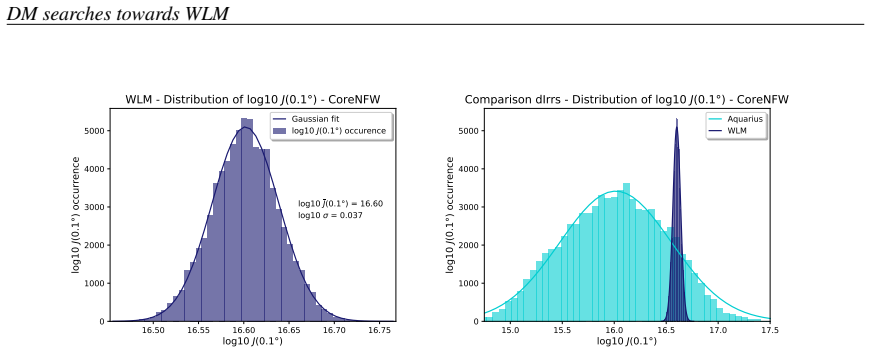
The argument runs on three pieces. First, the predicted gamma-ray flux from dark-matter annihilation is factorized as $\frac{1}{2}\frac{\langle\sigma v\rangle}{4\pi m_\chi^2}\frac{d\Phi^{\mathrm{PP}}}{dE}J$, where $J$ is the line-of-sight integral of the dark-matter density squared over the 0.1-degree region of interest. Second, WLM's dark-matter distribution is described by a coreNFW profile, defined as the NFW profile modified by a factor $f^n(r)$ that flattens the inner density below a core radius $r_c$; an MCMC fit to stellar kinematics yields $\log_{10}J = 16.6\pm0.037$, giving a precisely known normalization. Third, the statistical machinery is a Poisson likelihood for ON/OFF counts with a log-normal likelihood for $J$, and the 95% limits are obtained from the profile likelihood through the asymptotic condition $\mathrm{TS}=2.71$, using the scaling $\langle\sigma v\rangle_{95\%} = \langle\sigma v\rangle_0 \bar{J}/J_{\mathrm{unc}}$ to absorb the J-factor uncertainty.
What would settle it
Re-fit WLM's stellar and gas kinematics without the coreNFW assumption—for example with a cuspy NFW or tidally truncated profile—and recompute $\log_{10}J$; if the result moves outside $16.6\pm0.037$ by an amount larger than the quoted uncertainty, the reported limits scale proportionally and the claim that WLM has a precisely known J-factor fails.
Extended reading notes
Core claim
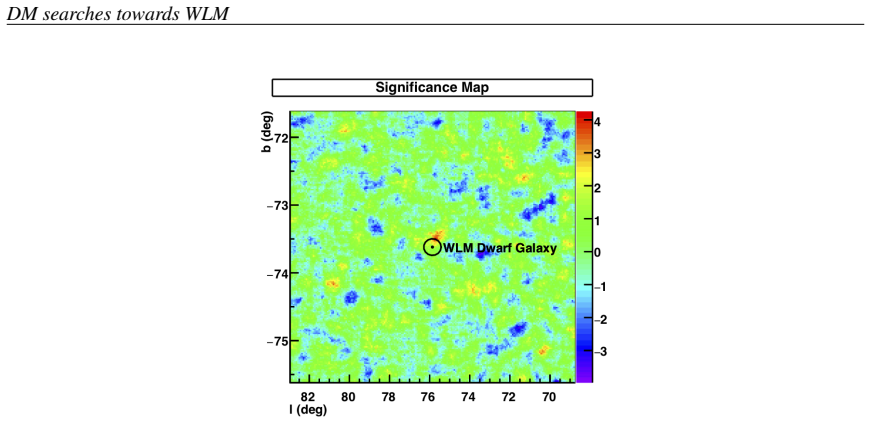
The paper's central result is a null detection: in 18.6 hours of live time toward WLM, the ON region contains 1677 events against an OFF-normalized background expectation, corresponding to a gamma-ray excess of 31.2 events with a significance of 0.7 $\sigma$. Treating the J-factor as a log-normal nuisance parameter with $\log_{10} J(\mathrm{GeV}^2\,\mathrm{cm}^{-5}) = 16.6 \pm 0.037$ from the coreNFW fit, the analysis sets 95% CL upper limits on $\langle\sigma v\rangle$ by a log-likelihood ratio test. At 1 TeV the observed limits reach $10^{-20}$ cm$^3$ s$^{-1}$ for $b\bar{b}$, $W^+W^-$, and $Z^+Z^-$ and $10^{-21}$ cm$^3$ s$^{-1}$ for $\tau^+\tau^-$, improving on the previous limits by a factor of 10 to almost 100. The authors conclude that dwarf irregular galaxies, observed for the first time with an IACT, are viable targets for indirect dark-matter searches.
Load-bearing premise
The limits rest on the assumption that WLM's dark-matter distribution is correctly given by the coreNFW profile fitted to its kinematics, with the quoted tiny uncertainty; if the inner profile is cuspier, tidally stripped, or otherwise different, the reported cross-section limits rescale by the same factor.
Editorial extensions
If this is right
- Dwarf irregular galaxies are now demonstrated to be viable dark-matter targets for imaging atmospheric Cherenkov telescopes, opening a new class of sources for the technique.
- The 95% confidence upper limits on $\langle\sigma v\rangle$ for WLM improve on the previous irregular-galaxy limits by a factor of 10 to almost 100 across the four annihilation channels.
- The $\tau^+\tau^-$ channel is the most constraining, reaching about $10^{-21}$ cm$^3$ s$^{-1}$ at a dark-matter mass of 1 TeV.
- Because the reported limits scale inversely with the J-factor, any future revision of WLM's dark-matter distribution directly rescales the constraints via the paper's Eq. (5.4).
Reading between the lines
- The same analysis chain could be applied to the other 35 known dwarf irregulars within 11 Mpc; a stacked analysis would improve sensitivity roughly as the square root of the number of galaxies, assuming comparable J-factor precision.
- If future stellar-kinematic data confirm the small J-factor uncertainty, dwarf irregulars could serve as a cross-check on dwarf spheroidal results, whose dark-matter distributions typically carry much larger systematic uncertainties.
- The non-detection at the $10^{-21}$ cm$^3$ s$^{-1}$ level in the leptonic channel remains above the canonical thermal-relic cross section, so the near-term payoff is methodological—demonstrating a low-background, well-calibrated target class—rather than a constraint on WIMP particle properties.
Signed reviews
Editorial analysis
A structured set of objections, weighed in public.
Referee Report
Summary. The paper reports the first imaging atmospheric Cherenkov telescope observations of the dwarf irregular galaxy WLM, carried out with H.E.S.S. for about 19 hours of live time in 2018. The analysis searches for a gamma-ray excess from dark matter annihilation, finds no significant excess (0.7 sigma), and derives 95% confidence level upper limits on the velocity-weighted annihilation cross section for the b-bbar, tau+tau-, W+W-, and Z+Z- channels. The limits reach about 1e-20 cm^3/s for the quark and boson channels and about 1e-21 cm^3/s for the tau+tau- channel at a dark matter mass of 1 TeV, improving on HAWC limits by an order of magnitude or more. The paper claims that the uncertainty on the J-factor is included as a log-normal nuisance parameter.
Significance. If the analysis is technically sound, this is a valuable first constraint on dark matter annihilation from a dwarf irregular galaxy, a new target class for ground-based gamma-ray indirect searches. The target selection is well motivated: WLM has a relatively high J-factor with a very small reported uncertainty (0.037 dex in log10 J), so the derived limits have a strong astrophysical normalization. The work uses standard H.E.S.S. multiple-OFF background estimation and a likelihood-ratio framework, and provides observed and expected limits with containment bands. The explicit statement of the non-detection and the comparison with HAWC limits are clear and useful. However, the treatment of the J-factor uncertainty as presented in Eqs. (5.3) and (5.4) is internally inconsistent and does not implement the claimed nuisance-parameter procedure, so the systematic coverage of the central result is not currently transparent.
major comments (2)
- [Section 5, Eqs. (5.3)–(5.4) and Section 6] The definition of J_unc as the value of J that maximizes Eq. (5.3) makes the J-factor correction nearly a tautology. Eq. (5.3) is a log-normal density in log10 J, so its maximum is at the mode, J_unc ≈ Jbar × 10^{-σ^2 ln 10}, which for σ = 0.037 differs from Jbar by less than 1%. Inserting this into Eq. (5.4) therefore rescales the limits by about 1%, which cannot account for the J-factor uncertainty in the way claimed in Section 6 ('the uncertainties on J as a nuisance parameter ... makes the derivation of the upper limits more conservative'). A correct profile-likelihood treatment would broaden the limits by a factor that depends on σ (roughly exp(k σ) for a one-sided 95% interval); the present equation does not do so. Please either present the full profile-likelihood calculation or revise the text to remove the claim that the J uncertainty is included in the quoted limits.
- [Section 3 and Eq. (5.4)] The analysis inherits the J-factor log10 J = 16.6 ± 0.037 from the coreNFW fit of Ref. [5], which assumes WLM is dark-matter-dominated at all radii and uses a specific density profile. Because the limits scale directly with J via Eq. (5.4), a different dark matter profile assumption (e.g., a cuspier profile) or the effects of tidal stripping would shift the limits by the corresponding factor. The paper does not discuss or propagate this systematic uncertainty. At minimum, a sentence acknowledging this limitation and quoting the resulting range of limits would be needed to support the claim of a small systematic error.
minor comments (7)
- [Section 4, Table 1 and Eq. (5.2)] The definition of α is ambiguous: the text says α renormalizes the OFF region to the ON region, and Eq. (5.2) uses α N_Bi as the mean of the OFF Poisson, but the reported value α = 16.24 would imply the OFF region has 16.24 times the exposure of the ON region. Please clarify the definition (ON/OFF versus OFF/ON) and make the formulas and table consistent.
- [Section 5, Eq. (5.3)] The normalization of the log-normal density is missing a factor of ln 10 if σ is the standard deviation in log10 J; as written, the integral of Eq. (5.3) over J is not equal to unity.
- [References] Reference [4] is malformed; it should read 'J. I. Read, G. Iorio, O. Agertz, et al.' rather than 'J. Read and I. Iorio, G., Agertz, et al.'.
- [Section 3 and Figure 1] The text states that the J-factor uncertainty is 'log10 J = 16.6 ± 0.037' but does not specify whether 0.037 is the standard deviation of the Gaussian fit in log10 J shown in Fig. 1. Please make this explicit.
- [Section 6] The expected limits and 1σ/2σ bands are derived from only 100 Poisson realizations; with such a small sample, the containment bands will have noticeable statistical fluctuations. A larger set of realizations would give smoother bands.
- [Section 2] The phrase 'at 1 Mpc from the Milky Way' is imprecise; WLM is a galaxy at a distance of about 1 Mpc from the Milky Way (or from Earth), and the sentence should be reworded.
- [Figure 1 caption] In the right panel, the label 'log10 = 0.037' is missing a subscript J; it should read 'log10 J = 0.037'.
Circularity Check
No circularity: the upper limits follow from observed counts and an external J-factor, and Eq. (5.4) is not an exact identity.
full rationale
The derivation chain is not circular. The J-factor is an external input from the independent coreNFW stellar-kinematics analysis of Read et al. [5], not fitted to the H.E.S.S. gamma-ray data. The observed counts in Table 1 are direct data products, and the upper limits in Sec. 6 follow from the Poisson likelihood ratio described in Sec. 5. The only step that might look self-referential is Eq. (5.4), where Junc is defined as the value maximizing Eq. (5.3). Taken literally, Eq. (5.3) has a 1/J Jacobian, so its mode is at log10 J = log10 Jbar - sigma^2 ln10, not at log10 Jbar; the rescaling in Eq. (5.4) is a constant factor 1.007 rather than unity. Thus the limits are not equal to their inputs by construction. The paper's statement that J uncertainties are included and make the limits more conservative is statistically weak, because Junc is a prior mode rather than a profiled nuisance value, so the J systematic is not fully propagated. However, this is a statistical-correctness issue, not a circular reduction. There are no load-bearing self-citations: Refs. [4], [5], [6], and [7] are external, and the comparison with HAWC [1] is an external benchmark. Therefore the circularity score is 0.
Assumptions & free parameters
assumptions (5)
- domain assumption WIMPs are Majorana particles, requiring a factor 1/2 in the annihilation flux formula.
- domain assumption The coreNFW profile of Ref. [5] accurately describes the dark matter distribution in WLM.
- domain assumption The annihilation spectra from Pythia as compiled in Ref. [2] are correct.
- domain assumption The log-normal distribution in Eq. (5.3) adequately describes the J-factor uncertainty.
- domain assumption The multiple-OFF method of Ref. [3] provides an unbiased background estimate.
Cite this review
Pith. "Pith review of Dark Matter searches towards the WLM dwarf irregular galaxy with H.E.S.S." pith.science (2026). https://pith.science/paper/63EQGLID
@misc{pith2026190810178,
  author       = {Pith},
  title        = {Pith review of: Dark Matter searches towards the WLM dwarf irregular galaxy with H.E.S.S},
  year         = {2026},
  howpublished = {\url{https://pith.science/paper/63EQGLID}},
  note         = {Machine review of arXiv:1908.10178}
}
read the original abstract
In the indirect dark matter (DM) detection framework, the DM particles would produce some signals by self-annihilating and creating standard model products such as gamma rays, which might be detected by ground-based telescopes. Dwarf irregular galaxies represent promising targets for the search for DM as they are assumed to be dark matter dominated systems at all radii. These dwarf irregular galaxies are rotationally supported with relatively simple kinematics which lead to small uncertainties on their dark matter distribution profiles. In 2018, the H.E.S.S. telescopes observed the irregular dwarf galaxy Wolf-Lundmark-Melotte (WLM) for a live time of 19 hours. These observations are the very first ones made by an imaging atmospheric Cherenkov telescope toward this kind of object. We search for a DM signal looking for an excess of gamma rays over the background in the direction of the WLM galaxy. We present the first results obtained on the velocity weighted cross section for DM self-annihilation as a function of DM particle mass.
Figures

Reference graph
Works this paper leans on
-
[5]
I., Iorio, G., Agertz, O., et al.\ 2016, , 462, 3628
Read, J. I., Iorio, G., Agertz, O., et al.\ 2016, , 462, 3628
work page 2016
-
[1]
S. H. Cadena et al. [HAWC Collaboration], PoS ICRC 2017 , 897 (2018) doi:10.22323/1.301.0897 [arXiv:1708.04642 [astro-ph.HE]]
work page Pith review arXiv 2018
-
[2]
M. Cirelli et al. , JCAP 1103 , 051 (2011) Erratum: [JCAP 1210 , E01 (2012)] doi:10.1088/1475-7516/2012/10/E01, 10.1088/1475-7516/2011/03/051 [arXiv:1012.4515 [hep-ph]]
arXiv 2011
- [3]
-
[4]
J. Read and I. Iorio, G., Agertz, et al. Mon.\ Not.\ Roy.\ Astron.\ Soc.\ 462 , 3628 (2016) doi:10.1093/mnras/stw1876 [arXiv:1601.05821v2 [astro-ph.GA]]
arXiv 2016
-
[6]
J. I. Read, M. G. Walker and P. Steger, Mon.\ Not.\ Roy.\ Astron.\ Soc.\ 484 , 1401 (2019) doi:10.1093/mnras/sty3404 [arXiv:1808.06634 [astro-ph.GA]]
arXiv 2019
- [7]
-
[8]
M. L. Ahnen et al. [MAGIC and Fermi-LAT Collaborations], JCAP 1602 , no. 02, 039 (2016) doi:10.1088/1475-7516/2016/02/039 [arXiv:1601.06590 [astro-ph.HE]]
arXiv 2016
Reviewed August 14, 2026 · model on record in the stance chip above.
Discussion (0). Continue with ORCID to comment.