REVIEW 5 minor 16 references
Powers of monomial ideals and the Ratliff-Rush operation
T0 review · 0 major / 5 minor · reviewed 2026-08-14 · deepseek-v4-flash
Pith's one-line read For m-primary monomial ideals obeying the box decomposition principle, the Ratliff–Rush closure equals the intersection of n one-dimensional stabilizations, and this yields an algorithm.
desk verdict New and sound formula for Ratliff-Rush closure of good monomial ideals; worth publishing after fixing a false converse in Section 9 and a wording slip in Proposition 10.6. read the letter →
The pith
A machine-rendered reading of the paper's core claim, the machinery that carries it, and where it could break.
The reading
What carries the argument
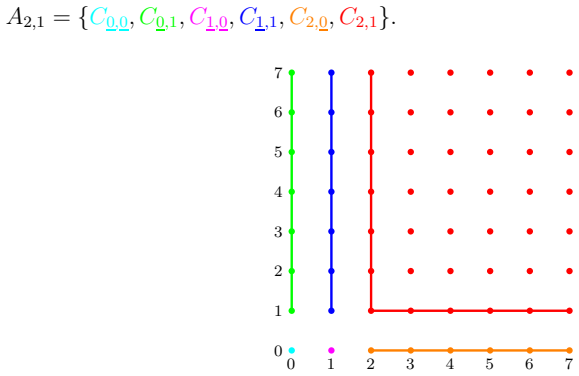
The machinery is the box decomposition principle together with the finite cone coloring it induces. A box $B_{a_1,\dots,a_n}$ is a product of intervals cut out by the corner exponents $d_i$; for a good ideal each minimal generator of $I^l$ falls in a box with $a_1+\cdots+a_n=l-1$, which forces the translated ideals $I_{a_1,\dots,a_n}=I^{l}:\langle\mu_1^{a_1}\cdots\mu_n^{a_n}\rangle$ to grow monotonically. Theorem 5.8 then gives a finite decomposition of $\mathbb{N}^n$ into cones on which $I_{a_1,\dots,a_n}$ is constant. This cone coloring is what reduces a potentially infinite family of colon ideals to finitely many regions, and it is the tool used to factor $\mu_i^Q$ out of large minimal generators in Lemma 6.1.
What would settle it
Compute the axis-stabilized intersection from Section 7 for every good ideal in a small search space, and compare it with the fully stabilized colon ideal $I^{N+1}:I^N$ for $N$ beyond the bound $L+nq-n+2$ used in Lemma 6.1; a single good ideal where the two differ would disprove the theorem.
Extended reading notes
Core claim
The paper’s central result is Theorem 6.2: if $I$ is a good $\mathfrak{m}$-primary monomial ideal, then $$\tilde I = I_{q_1,0,\dots,0}\cap I_{0,q_2,\dots,0}\cap \cdots \cap I_{0,\dots,0,q_n},$$ where $I_{0,\dots,q_i,\dots,0}$ is the stable ideal of the chain obtained by moving the box decomposition along the $i$-th coordinate axis. The proof shows that for large powers of $I$, every minimal generator can be factored by a pure power $\mu_i^{q_i}$ of one of the corner monomials $\mu_i=x_i^{d_i}$, so only the axis directions matter. Consequently the usual description of $\tilde I$ as a union of colon ideals $I^{k+1}:I^k$ over all $k$ is captured, for this class, by $n$ one-dimensional limits, each reached after finitely many steps.
Load-bearing premise
The load-bearing premise is that every ideal satisfying the box decomposition principle gives a finite cone coloring of $\mathbb{N}^n$ on which the ideals $I_{a_1,\dots,a_n}$ are constant (Theorem 5.8); if that structural stabilization fails, the axis-intersection formula for $\tilde I$ does not follow from the paper’s argument.
Editorial extensions
If this is right
- The Ratliff–Rush closure of any good ideal can be computed by stabilizing $n$ separate one-dimensional chains; by Remark 7.2 each chain stops as soon as two consecutive ideals coincide, so the computation is finite and explicit.
- The same computation works in both $\mathbb{K}[x_1,\dots,x_n]$ and the formal power series ring $\mathbb{K}[[x_1,\dots,x_n]]$, since all arguments are monomial and finitary.
- For a good ideal with coloring bound $L$, every power $I^k$ with $k\ge L+1$ is Ratliff–Rush (Proposition 10.9), giving a stabilization threshold in terms of the box coloring.
- An equigenerated $\mathfrak{m}$-primary monomial ideal is Freiman (its square has the minimal possible number of generators) exactly when it is very good, i.e. exactly when $I^2=I\langle\mu_1,\dots,\mu_n\rangle$; this is Theorem 11.2.
Reading between the lines
- The same axis-intersection formula could plausibly be tested on the larger class of ideals that satisfy only the necessary condition from Theorem 3.6; Section 9 supplies a finite test for goodness, so a computer search could locate where the formula first fails.
- Interpreting $I_{a_1,\dots,a_n}$ as a directional Newton-polyhedron slice suggests an extension beyond monomial ideals: replace boxes by filtrations and cones by normal fans, and the theorem would become a statement about asymptotic intersections of initial ideals.
- The equivalence between very good ideals and $I^2=I\langle\mu_1,\dots,\mu_n\rangle$ offers a fast algebraic certificate for the Freiman property that could be used to build new infinite families of ideals all of whose powers are Ratliff–Rush.
Signed reviews
Editorial analysis
A structured set of objections, weighed in public.
Referee Report
Summary. The paper studies m-primary monomial ideals in K[x1,...,xn] that satisfy a 'box decomposition principle' (called good ideals). For such an ideal I, with minimal corner generators µ_i = x_i^{d_i}, every minimal generator of I^l lies in a box B_a with |a| = l − 1, and the paper defines ideals I_a by dividing the monomials in B_a by µ^a. It proves a finite cone-decomposition theorem for the assignment a ↦ I_a (Theorem 5.8), then states the main result (Theorem 6.2): the Ratliff–Rush closure of I is the intersection of the one-dimensional stabilizations along the coordinate axes, I_{q1,0,...,0} ∩ ... ∩ I_{0,...,0,qn}. Section 7 turns this into an explicit algorithm for the axis stabilizations, with worked examples in Section 8. Section 9 discusses detection of good ideals, Section 10 studies powers of good ideals and introduces very good ideals, and Section 11 connects very good equigenerated ideals with Freiman ideals.
Significance. The main theorem is a clean structural reduction: instead of computing the full family of colon ideals (I^{k+1}:I^k), one computes n one-dimensional stabilizing ideals. If correct, this is a substantial practical and theoretical contribution to monomial ideal theory and to computational Ratliff–Rush closure. The proof is elementary and self-contained, with the cone-coloring/Lemma 6.1 machinery as the key step; I checked this step and the two inclusions of Theorem 6.2 and found them sound. The examples are helpful, and the connections to very good ideals and Freiman ideals are natural. The paper is generally well organized and readable.
minor comments (5)
- [Section 3, Theorem 3.7] The proof of the sufficient condition considers two factors that both satisfy the exponent lower bound, but corner generators have exponent sum 1, which is smaller than n/2 for n ≥ 3. The argument should first remove all corner factors (each corner contributes one unit to the box sum) and then apply the two-factor reduction to the remaining non-corner factors. The statement itself is correct, but the proof as written is incomplete.
- [Section 10, Propositions 10.5 and 10.6] The claim that the old box containing m1 is the unique old box is not always true when the non-corner generator has a zero exponent, because the point then lies on a box boundary. What the proof needs is the largest old box, which exists by the second bullet of Proposition 10.4; please replace 'unique' by 'largest' and adjust the reference accordingly.
- [Section 6, proof of Theorem 6.2] The containment I^{l+1}:I^l ⊆ I^{l+1}:⟨µ_1^l⟩ is correct because ⟨µ_1^l⟩ ⊆ I^l, but the proof should explicitly note that the quotients (I^{k+1}:I^k) form an increasing sequence, so that proving the containment for all l ≥ q controls the union defining the Ratliff–Rush closure. This is standard but currently implicit.
- [Section 9, one-extra-generator paragraph] The converse assertion that every monomial of the form µ^a m^k with k < K is a minimal generator is true, but it deserves a proof. If such a monomial were divisible by a product with fewer copies of m, then m^r would be divisible by r corner monomials for some r < K, contradicting the definition of K. As written, the claim is stated without justification.
- [Section 5, Theorem 5.8] The phrase 'for each color the set of points of this color forms a cone' should be clarified, since the recursive construction can in principle assign the same ideal value to several disjoint cones. One can always refine the coloring so that each cone is monochromatic; please state this explicitly or rephrase the condition.
Circularity Check
No circularity: Theorem 6.2 derives the Ratliff–Rush closure from an independent box/cone structure, with no fitted inputs and no load-bearing self-citation.
full rationale
The paper's central claim, Theorem 6.2, is not circular. The ideals I_{a_1,...,a_n} are defined directly from minimal generators of powers in boxes (Definition 4.2), and Proposition 4.4 identifies them with the principal colons I^{l+1}:⟨μ_1^{a_1}⋯μ_n^{a_n}⟩. The stabilization indices q_i are defined by the one-dimensional chains I_{t,0,...,0}, whose stabilization follows from Corollary 4.5 and Noetherianity, not from any property of the Ratliff–Rush closure itself. The forward inclusion in Theorem 6.2 uses the elementary fact that I^{l+1}:I^l ⊆ I^{l+1}:⟨μ_1^l⟩ together with the definition of q_1; the reverse inclusion uses Lemma 6.1, which is proved from the finite cone coloring of Theorem 5.8. That coloring is constructed by Noetherian stabilization of the ideals I_a and does not presuppose the theorem or the Ratliff–Rush closure. There are no fitted parameters later called predictions, no quantities defined in terms of the target result, and no self-citations at all. The cited characterizations of the Ratliff–Rush closure from [13] and [7] are motivational background, not inputs to the proof. Section 11 gives an independent proof of the Freiman equivalence rather than importing it as a black box. The peripheral unproven 'conversely' remark in Section 9 is a correctness concern, not a circularity, and it does not affect Theorem 6.2. Overall, the derivation is self-contained with respect to the claimed main result.
Assumptions & free parameters
assumptions (5)
- standard math R = K[x_1,...,x_n] is Noetherian and every monomial ideal has a unique minimal monomial generating set.
- domain assumption I is an m-primary monomial ideal with \mu_i = x_i^{d_i} among its minimal generators for positive integers d_1,...,d_n.
- domain assumption The known characterization of the Ratliff-Rush closure from [13] and [7] (unique largest ideal with the same powers, or positive depth of the associated graded ring) is correct.
- domain assumption Results proved in K[x_1,...,x_n] transfer to the power series ring K[[x_1,...,x_n]] in the claimed way.
- domain assumption For an m-primary ideal in an n-dimensional regular local ring, the analytic spread is n.
Cite this review
Pith. "Pith review of Powers of monomial ideals and the Ratliff-Rush operation." pith.science (2026). https://pith.science/paper/YIUMC7D7
@misc{pith2026190810185,
  author       = {Pith},
  title        = {Pith review of: Powers of monomial ideals and the Ratliff-Rush operation},
  year         = {2026},
  howpublished = {\url{https://pith.science/paper/YIUMC7D7}},
  note         = {Machine review of arXiv:1908.10185}
}
abstract
Powers of (monomial) ideals is a subject that still calls attraction in various ways. In this paper we present a nice presentation of high powers of ideals in a certain class in $\mathbb K[x_1, \ldots, x_n]$ and $\mathbb K[[x_1, \ldots, x_n]]$. As an interesting application it leads to an algorithm for computation of the Ratliff--Rush operation on ideals in that class. The Ratliff--Rush operation itself has several applications, for instance, if $I$ is a regular $\mathfrak m$-primary ideal in a local ring $(R,m)$, then the Ratliff--Rush associated ideal $\tilde I$ is the unique largest ideal containing $I$ and having the same Hilbert polynomial as $I$.
Figures


Reference graph
Works this paper leans on
-
[1]
I. Al-Ayyoub , An algorithm for computing the Ratliff–Rush closure , Journal of Algebra and its Applications, 8 (2009), pp. 521–532
work page 2009
-
[2]
I. Al-Ayyoub and O. Solaiman , Infinite families of Ratliff–Rush ideals , Interna- tional Journal of Algebra, 6 (2012), pp. 815–824
work page 2012
-
[3]
W. Decker, G.-M. Greuel, G. Pfister, and H. Sch ¨onemann, Sin- gular 4-1-2 — A computer algebra system for polynomial computatio ns. http://www.singular.uni-kl.de, 2019
work page 2019
-
[4]
Eliahou, J
S. Eliahou, J. Herzog, and M. M. Saem , Monomial ideals with tiny squares , Journal of Algebra, 514 (2018), pp. 99–112
2018
-
[5]
J. Elias , On the computation of the Ratliff–Rush closure , Journal of Symbolic Com- putation, 37 (2004), pp. 717–725. 24
work page 2004
-
[6]
W. Heinzer, B. Johnston, D. Lantz, and K. Shah , Coefficient ideals in and blowups of a commutative Noetherian domain , Journal of Algebra, 162 (1993), pp. 355–391
work page 1993
-
[7]
W. Heinzer, D. Lantz, and K. Shah , The Ratliff–Rush ideals in a Noetherian ring, Communications in algebra, 20 (1992), pp. 591–622
work page 1992
-
[8]
On the number of generators of powers of an ideal
J. Herzog, M. M. Saem, and N. Zamani , On the number of generators of powers of an ideal , arXiv preprint arXiv:1707.07302, (2017)
work page Pith review arXiv 2017
Show all 16 references
-
[9]
Herzog and G
J. Herzog and G. Zhu , Freiman ideals, Communications in Algebra, (2019), pp. 1– 17
2019
-
[10]
K ¨allstr¨om, Liftable derivations for generically separably algebraic morphisms of schemes, Transactions of the American Mathematical Society, 361 (2009) , pp
R. K ¨allstr¨om, Liftable derivations for generically separably algebraic morphisms of schemes, Transactions of the American Mathematical Society, 361 (2009) , pp. 495– 523
2009
-
[11]
T. J. Puthenpurakal , Bockstein cohomology of associated graded rings , Acta Mathematica Vietnamica, (2013), pp. 1–22
2013
-
[12]
V. C. Qui ˜nonez, Ratliff–Rush monomial ideals, algebraic and geometric comb ina- torics, Contemp. Math., 423 (2007), pp. 43–50
2007
-
[13]
L. J. Ratliff and D. E. Rush , Two notes on reductions of ideals , Indiana Univ. Math. J, 27 (1978), pp. 929–934
1978
-
[14]
M. E. Rossi and I. Swanson , Notes on the behavior of the Ratliff–Rush filtration , Comm. Algebra (Grenoble/Lyon, 2001), Contemp. Math., 331 (200 3), pp. 313–328
2001
-
[15]
M. E. Rossi, D. T. Trung, and N. V. Trung , Castelnuovo–Mumford regularity and Ratliff–Rush closure , Journal of Algebra, 504 (2018), pp. 568–586
2018
-
[16]
D. T. Trung , On the computation of Castelnuovo–Mumford regularity of th e Rees algebra and of the fiber ring , arXiv preprint arXiv:1904.07484v1, (2019). 25
2019 arXiv
Reviewed August 14, 2026 · model on record in the stance chip above.
Discussion (0). Continue with ORCID to comment.