REVIEW 2 major objections 4 minor 52 references
Nonlocal and local models for taxis in cell migration: a rigorous limit procedure
T0 review · 2 major / 4 minor · reviewed 2026-08-14 · deepseek-v4-flash
Pith's one-line read This paper proves that, as the sensing radius in nonlocal adhesion and chemotaxis models tends to zero, solutions of the nonlocal systems converge to solutions of the classical local haptotaxis and chemotaxis systems, provided the…
desk verdict Rigorous bridge between nonlocal and local taxis models with a genuinely new operator trick; the main theorem is plausible but the proof has two concrete holes that need patching. read the letter →
The pith
A machine-rendered reading of the paper's core claim, the machinery that carries it, and where it could break.
The reading
What carries the argument
The machinery is a pair of integral averaging operators. For a vector field $w$, $$T_r w(x) = \$int_0^{1}$ \frac{1}{|B_1|}\int_{B_1} (w(x+rsy)\cdot y)\,\frac{y}{|y|}\,F_r(r|y|)\,dy\,ds$$ and $$S_r w(x) = n\$int_0^{1}$ \frac{1}{|S_1|}\int_{S_1} (w(x+rsy)\cdot y)\,y\,dS_1(y)\,ds,$$ where $F_r$ is a smooth positive interaction kernel normalized so that $F_0(0)=n+1$. They carry the argument because they turn the adhesion velocity and the nonlocal gradient into averages of $\nabla u$, are self-adjoint on $L^2$, have norm bounds uniform in $r$, and converge strongly to the identity in $L^p$ as $r \to 0$. Those three facts, reformulation, boundedness, and strong convergence, produce the uniform a priori estimates and the passage to the limit in the nonlocal flux, which is the heart of Theorem 5.8.
What would settle it
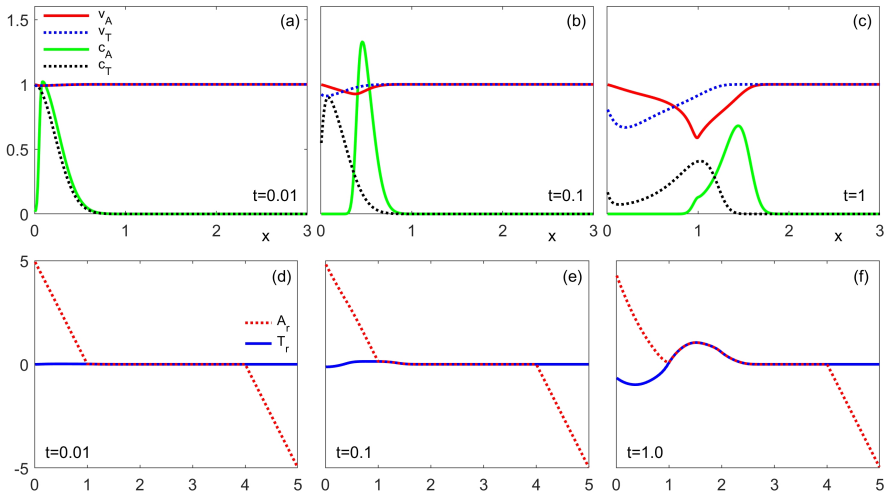
Take the one-dimensional setting of Example 3.3 ($\Omega=(-1,1)$, $F_r\equiv 2$, $u\equiv 1$) and compute numerically the $L^1$ norms of $A_r u$ and $T_r(\nabla u)$ on $\Omega$ as $r \to 0$: the example predicts $\|A_r u\|_{L^1}$ stays about $1$ while $\|T_r(\nabla u)\|_{L^1} \to 0$, which directly checks the boundary-layer gap. Independently of the theorem, one could also run the nonlocal system (5.1) with coefficients violating (5.7) and measure whether the $L^2$ distance between nonlocal and local solutions still tends to zero as $r \to 0$.
Extended reading notes
Core claim
The central claim is that the limit procedure works for a family of nonlocal models whose nonlocal terms are the averaging operators $T_r$ and $S_r$ applied to gradients, rather than the original operators $A_r$ and $\mathring{\nabla}_r$ applied to signal values. Inside the domain these are the same objects, $A_r u = T_r(\nabla u)$ and $\mathring{\nabla}_r u = S_r(\nabla u)$, but in a boundary layer they differ, and Example 3.3 shows that the original form can fail to converge in $L^1$ even when the signal is constant. Theorem 5.8 then asserts that, under a smallness condition tying cell sensitivity to diffusion, a sequence of nonlocal solutions with radii $r_m \to 0$ has a subsequence converging in $L^2(0,T;L^2(\Omega))$ to a weak-strong solution of the corresponding local haptotaxis or chemotaxis system. The proof obtains uniform-in-$r$ a priori estimates, uses the $L^p$ convergence of $T_r$ and $S_r$ to the identity to pass to the limit in the tactic flux, and closes with a compactness argument. On the paper's own terms, the discovery is that the correct object to average is the gradient of the signal-dependent quantity, not the quantity itself.
Load-bearing premise
The theorem depends on replacing the original nonlocal operators by gradient-averaging versions that agree with them only away from a boundary layer, and on the smallness condition $C_{11}<1$; if the boundary-layer modification is judged illegitimate, or if that smallness condition fails, the stated convergence is not proved.
Editorial extensions
If this is right
- For any sequence of sensing radii satisfying the smallness condition, the nonlocal systems admit global weak-strong solutions whose cell and tissue densities converge, up to a subsequence, to a solution of the local haptotaxis or chemotaxis system.
- Away from the boundary the new nonlocal operators coincide with the original adhesion velocity and nonlocal gradient, so the convergence result legitimizes the local model as the $r \to 0$ limit of finite-sensing models in the interior.
- In the numerical experiments the nonlocal formulation remains computable in parameter regimes where the local model's effective diffusion becomes negative and the local problem turns ill-posed, with the nonlocal solution destabilizing into aggregates whose wavelength shrinks as $r \to 0$.
- The same gradient-averaging reformulation treats adhesion and nonlocal chemotaxis in one framework and covers coefficients that depend on the solution itself, extending earlier analyses restricted to simpler settings.
Reading between the lines
- The line-segment averaging inside $T_r$ and $S_r$ suggests that cells in these models sense the gradient accumulated along a protrusion path rather than at its endpoint; if taken seriously as a modelling principle, it favours gradient-averaging formulations over endpoint-sampling ones in future data-driven models.
- Example 3.3 implies that the original nonlocal operators, when naively extended by zero outside the domain, can inject an artificial boundary tendency even for constant signals; a testable prediction is that boundary-confined cell populations should behave differently under the two formulations, as the 1D boundary simulations already show.
- The smallness condition $C_{11}<1$ links the convergence to a competition between tactic strength and diffusion; one could test numerically whether the $L^2$ distance to the local solution fails to vanish, or converges more slowly, as that condition is approached.
- The same averaging construction is likely to transfer to other integro-differential systems with comparable structure, such as multi-species or structured-population migration models, giving a recipe for proving local limits without high-order regularity.
Signed reviews
Editorial analysis
A structured set of objections, weighed in public.
Referee Report
Summary. The paper develops a rigorous limit procedure connecting nonlocal taxis/adhesion models to local haptotaxis/chemotaxis models as the sensing radius tends to zero. The key technical idea is to reformulate the classical nonlocal operators A_r and tilde-grad_r as integral operators T_r and S_r acting directly on gradients of signal-dependent quantities, proving L^p approximation of the identity for these operators. The authors prove global existence for the modified nonlocal system (5.1) under either Lipschitz or dissipative growth of the source terms, and establish existence of solutions and global weak-strong solutions. The main theorem, Theorem 5.8, asserts that under Assumptions 1.1, 5.1, 5.3, and 5.4(b), there exists a sequence r_m -> 0 such that solutions (c_{r_m}, v_{r_m}) of the nonlocal system converge in L^2 to a solution (c,v) of the local system (5.2). The paper also contains one-dimensional numerical simulations illustrating boundary-layer differences between the original and modified nonlocal operators, and convergence of nonlocal to local dynamics as r -> 0.
Significance. If the proof is completed, this is a valuable contribution: it provides the first rigorous convergence result for a broad class of nonlocal adhesion and nonlocal chemotaxis models with solution-dependent coefficients, and it gives a clean operator-theoretic explanation of why the modified operators are the right objects for the limit. The operator estimates in Section 3 (Lemmas 3.5 and 3.7) are carefully proved and include useful adjointness, norm-convergence, and Fourier-multiplier computations. The paper is also honest about the limitation that the convergence concerns the modified operators T_r and S_r, not the original boundary-layer-sensitive operators A_r and tilde-grad_r, and Example 3.3 demonstrates a genuine boundary-layer pathology of A_r. The numerical simulations are a useful illustration. The two gaps identified below affect the proof of the main theorem but appear repairable, so the central claim is not called into question beyond the need for revision.
major comments (2)
- [Section 5.4, proof of Theorem 5.8] The uniformity step in the proof of Theorem 5.8 is not valid as written. After choosing r_m so that sup_m ||R_{r_m}|| < 1/C11, the text says that 'Replacing ||R_r|| by C11 in C22(T, ||R_r||)' makes the constants independent of m. This replacement is backwards: C11 = C12C13/C5 satisfies C11 < 1, while ||R_{r_m}|| -> 1, so C11 is strictly smaller than ||R_{r_m}|| for all sufficiently large m. Unless C22 is known to be decreasing in its second argument—which the Gronwall-based estimates in Theorem 5.13 do not suggest—substituting C11 does not provide an upper bound for the uniform constants. The correct uniform substitution is sup_m ||R_{r_m}||, which is admitted to be < 1/C11. As written, the r-uniform estimates (5.40)-(5.47) are not established, and the compactness argument lacks a foundation. This is repairable by replacing C11 with sup_m ||R_{r_m}|| in C22 and making the monotonicity of C22 explicit.
- [Theorem 5.8 and Section 5.4] Theorem 5.8 is stated under Assumption 5.3, which allows either alternative (a) or (b), but the proof invokes Theorem 5.13, which is stated and proved only under Assumption 5.3(b). In the case of Assumption 5.3(a), Theorem 5.10 provides existence of weak-strong solutions for each fixed r satisfying Assumption 5.4(a), but it does not provide r-uniform a priori estimates of the type (5.40)-(5.47). Therefore the convergence proof as written does not cover the (a) branch of Assumption 5.3. The statement should either be restricted to Assumption 5.3(b), or a proof of r-uniform estimates should be supplied for case (a).
minor comments (4)
- [Abstract and Introduction] The abstract and introduction present the limit procedure as linking the nonlocal models (1.1) and (1.4) to local models, while Theorem 5.8 concerns the modified systems (5.1) with operators T_r and S_r. Although Sections 3 and 5 are explicit about this modification and Example 3.3 justifies it, the abstract should state this qualification to avoid overstating the scope.
- [Proof of Theorem 5.8] The proof of Theorem 5.8 uses 'standard arguments' and 'we omit these details' for several limit passages, including the convergence of the remaining nonlinear terms and boundary conditions. Given the otherwise detailed style, a brief summary of the compactness and limit argument for those terms would improve verifiability.
- [Lemma 3.5(iv)] The Fourier-multiplier argument in Lemma 3.5(iv) uses the convention that functions are extended by zero outside Omega; this convention is stated in Section 2, but it would help the reader if it were recalled explicitly at the point where the hat symbol is introduced in the proof.
- [Section 6] In Figures 3 and 4, the 'nonlocal model' simulations use the original formulation (1.1) rather than the modified formulation (5.1) with T_r. This is correct for the numerical comparison but should be stated explicitly in the captions to avoid confusion with the theoretical convergence result.
Circularity Check
No significant circularity: convergence is derived from a priori estimates and compactness, with the normalization and operator modification stated explicitly.
full rationale
The paper's central theorem (Theorem 5.8) asserts L^2 convergence of solutions of the nonlocal systems (5.1) to those of the local system (5.2) under Assumptions 1.1, 5.1, 5.3 and 5.4(b). The proof does not fit parameters to outputs or rename inputs as predictions. The key identity T0 = Id (and S0 = Id) follows from the explicit normalization F0(0) = n+1 (Assumption 1.1(ii), equations (3.3)-(3.4)), which is a transparent scaling assumption, not an instance of the target conclusion being inserted as an input. The convergence of solutions is obtained through uniform-in-r estimates (Theorem 5.13), the Lions-Aubin lemma, Banach-Alaoglu and compensated compactness; these are external standard tools. Self-citations (e.g., [11,19,29,30]) provide modeling context and are not used to justify the convergence claims; no 'uniqueness theorem' from the authors is invoked to rule out alternatives. The paper explicitly acknowledges that Theorem 5.8 concerns the modified operators T_r/S_r and not the original A_r/gradient-tilde_r near the boundary: Section 5 states that the modification 'affects the points in the boundary layer Omega z Omega_r, at the most', and Example 3.3 shows A_r u need not converge in L^1. The Discussion further states that the choice (3.2) 'is motivated above all from a mathematical viewpoint (as it enables a rigorous, well-justified passage to the limit)'. This is a disclosed scope limitation, not circularity: the theorem's statement matches the modified systems. A reviewer's concern about the proof's replacement of ||R_r|| by C11 in C22(·,·) is a possible correctness gap, not a circularity, since it concerns bounding constants rather than the conclusion being an input. Therefore no circularity is found.
Assumptions & free parameters
assumptions (7)
- domain assumption Assumptions 5.1: coefficient bounds and nonnegativity, e.g. C5 <= D_c <= C6, ∇g and ∇f_v in L∞, f_c(0,·) = 0, f_v(·,0) = 0.
- ad hoc to paper Assumption 5.4(b): C11 := C12 C13 / C5 < 1, with C12 = sup c|χ(c,v)|, C13 = sup |B_c g|.
- ad hoc to paper Assumption 1.1(ii): F0(0) = n+1 normalization for the interaction kernel F_r.
- ad hoc to paper The nonlocal operators A_r and ˚∇_r are replaced by T_r and S_r acting on gradients.
- domain assumption Assumption 5.3: f_c is either globally Lipschitz or satisfies a dissipative growth bound.
- standard math Standard PDE tools: Banach-Steinhaus, Lions-Aubin lemma, Leray-Schauder principle, Minty-Browder monotonicity, Gronwall, dominated convergence, Lions lemma.
- domain assumption Ω is a bounded smooth domain and functions are extended by zero outside Ω in the nonlocal operators.
Cite this review
Pith. "Pith review of Nonlocal and local models for taxis in cell migration: a rigorous limit procedure." pith.science (2026). https://pith.science/paper/XVLIGKLY
@misc{pith2026190810287,
  author       = {Pith},
  title        = {Pith review of: Nonlocal and local models for taxis in cell migration: a rigorous limit procedure},
  year         = {2026},
  howpublished = {\url{https://pith.science/paper/XVLIGKLY}},
  note         = {Machine review of arXiv:1908.10287}
}
read the original abstract
A rigorous limit procedure is presented which links nonlocal models involving adhesion or nonlocal chemotaxis to their local counterparts featuring haptotaxis and classical chemotaxis, respectively. It relies on a novel reformulation of the involved nonlocalities in terms of integral operators applied directly to the gradients of signal-dependent quantities. The proposed approach handles both model types in a unified way and extends the previous mathematical framework to settings that allow for general solution-dependent coefficient functions. The previous forms of nonlocal operators are compared with the new ones introduced in this paper and the advantages of the latter are highlighted by concrete examples. Numerical simulations in 1D provide an illustration of some of the theoretical findings.
Figures


Figures from the paper (2 more)


Reference graph
Works this paper leans on
- [29]
-
[1]
A. R. A. Anderson, M. A. J. Chaplain, E. L. Newman, R. J. C. Steele, and M. Thompson, A. Math- ematical modelling of tumour invasion and metastasis. Computational and mathematical methods in medicine, 2(2):129–154, 2000
work page 2000
-
[2]
N. J. Armstrong, K. J. Painter, and J. A. Sherratt. A continuum approach to modelling cell-cell adhesion. J. Theoret. Biol., 243(1):98–113, 2006
work page 2006
-
[3]
G. Bell. Models for the specific adhesion of cells to cells. Science, 200(4342):618–627, 1978
work page 1978
-
[4]
G. Bell, M. Dembo, and P. Bongrand. Cell adhesion. competition between nonspecific repulsion and specific bonding. Biophysical Journal, 45(6):1051 – 1064, 1984
work page 1984
-
[5]
N. Bellomo, A. Bellouquid, Y. Tao, and M. Winkler. Toward a mathematical theory of keller-segel models of pattern formation in biological tissues. Math. Models Meth. Appl. Sci. , 25(9):1663–1763, 2015
work page 2015
-
[6]
V. Bitsouni, D. Trucu, M. A. J. Chaplain, and R. Eftimie. Aggregation and travelling wave dynamics in a two-population model of cancer cell growth and invasion. Mathematical Medicine and Biology: A Journal of the IMA , 35(4):541–577, 01 2018
work page 2018
-
[7]
A. Buttensch¨ on and T. Hillen. Nonlocal adhesion models for microorganisms on bounded domains, preprint
Show all 52 references
-
[8]
Buttensch¨ on, T
A. Buttensch¨ on, T. Hillen, A. Gerisch, and K. J. Painter. A space-jump derivation for non-local models of cell-cell adhesion and non-local chemotaxis. J. Math. Biol. , 76(1-2):429–456, 2018. 30
2018
-
[9]
Carrillo, H
J. Carrillo, H. Murakawa, M. Sato, H. Togashi, and O. Trush. A population dynamics model of cell- cell adhesion incorporating population pressure and density saturation. J. Theor. Biol. , 474:14–24, 2019
2019
-
[10]
Chaplain, M
M. Chaplain, M. Lachowicz, Z. Szymanska, and D. Wrzosek. Mathematical modelling of cancer invasion: The importance of cell-cell adhesion and cell-matrix adhesion. Mathematical Models and Methods in Applied Sciences , 21(04):719–743, 2011
2011
-
[11]
L. Chen, K. Painter, C. Surulescu, and A. Zhigun. Mathematical models for cell migration: a nonlocal perspective, 2019
2019
-
[12]
R. B. Dickinson and R. T. Tranquillo. A stochastic model for adhesion-mediated cell random motility and haptotaxis. Journal of Mathematical Biology , 31(6):563–600, 1993
1993
-
[13]
DiMilla, K
P. DiMilla, K. Barbee, and D. Lauffenburger. Mathematical model for the effects of adhesion and mechanics on cell migration speed. Biophysical Journal, 60(1):15 – 37, 1991
1991
-
[14]
Domschke, D
P. Domschke, D. Trucu, A. Gerisch, and M. A. J. Chaplain. Mathematical modelling of cancer invasion: implications of cell adhesion variability for tumour infiltrative growth patterns. J. Theoret. Biol., 361:41–60, 2014
2014
-
[15]
Domschke, D
P. Domschke, D. Trucu, A. Gerisch, and M. A. J. Chaplain. Structured models of cell migration incorporating molecular binding processes. J. Math. Biol. , 75(6-7):1517–1561, 2017
2017
-
[16]
Dyson, S
J. Dyson, S. Gourley, and G. Webb. A non-local evolution equation model of cell-cell adhesion in higher dimensional space. Journal of biological dynamics , 7:68–87, 2013
2013
-
[17]
Dyson, S
J. Dyson, S. A. Gourley, R. Villella-Bressan, and G. F. Webb. Existence and asymptotic properties of solutions of a nonlocal evolution equation modeling cell-cell adhesion. SIAM J. Math. Anal. , 42(4):1784–1804, 2010
2010
-
[18]
R. Eftimie. Hyperbolic and Kinetic Models for Self-organised Biological Aggregations. A Modelling and Pattern Formation Approach. Springer, Cham, 2018
2018
-
[19]
Engwer, C
C. Engwer, C. Stinner, and C. Surulescu. On a structured multiscale model for acid-mediated tumor invasion: the effects of adhesion and proliferation. Math. Models Methods Appl. Sci. , 27(7):1355– 1390, 2017
2017
-
[20]
D. S. Eom and D. M. Parichy. A macrophage relay for long-distance signaling during postembryonic tissue remodeling. Science, 355(6331):1317–1320, 2017
2017
-
[21]
L. C. Evans. Weak convergence methods for nonlinear partial differential equations , volume 74 of CBMS Regional Conference Series in Mathematics . Published for the Conference Board of the Mathematical Sciences, Washington, DC; by the American Mathematical Society, Providence, RI, 1990
1990
-
[22]
Garcia and C
G. Garcia and C. Parent. Signal relay during chemotaxis. Journal of Microscopy , 231(3):529–534, 2008
2008
-
[23]
A. Gerisch. On the approximation and efficient evaluation of integral terms in PDE models of cell adhesion. IMA Journal of Numerical Analysis , 30(1):173–194, 01 2010
2010
-
[24]
Gerisch and M
A. Gerisch and M. A. J. Chaplain. Mathematical modelling of cancer cell invasion of tissue: local and non-local models and the effect of adhesion. J. Theoret. Biol., 250(4):684–704, 2008
2008
-
[25]
Gerisch and K
A. Gerisch and K. J. Painter. Mathematical modeling of cell adhesion and its applications to developmental biology and cancer invasion. 2010
2010
-
[26]
Gonz´ alez-M´ endez, I
L. Gonz´ alez-M´ endez, I. Seijo-Barandiar´ an, and I. Guerrero. Cytoneme-mediated cell-cell contacts for hedgehog reception. eLife, 6:e24045, 2017
2017
-
[27]
S. C. Gupta and Y.-Y. Mo. Abstract 168: Malat1 is crucial for epithelial-mesenchymal transition of breast cancer cells in acidic microenvironment. Cancer Research, 75(15 Supplement):168–168, 2015
2015
-
[28]
T. Hillen. A classification of spikes and plateaus. SIAM Rev., 49(1):35–51, 2007. 31
2007
-
[30]
Hillen, K
T. Hillen, K. Painter, and M. Winkler. Global solvability and explicit bounds for non-local adhesion models. European Journal of Applied Mathematics , 29(04):1–40, 2018
2018
-
[31]
N. I. Kavallaris and T. Suzuki. Non-local partial differential equations for engineering and biology , volume 31 of Mathematics for Industry (Tokyo). Springer, Cham, 2018. Mathematical modeling and analysis
2018
-
[32]
Kuusela and W
E. Kuusela and W. Alt. Continuum model of cell adhesion and migration. Journal of Mathematical Biology, 58(1):135, 2008
2008
-
[33]
Ladyzhenskaya, V
O. Ladyzhenskaya, V. Solonnikov, and N. Ural’tseva. Linear and quasi-linear equations of parabolic type. Translated from the Russian by S. Smith. Translations of Mathematical Monographs. 23. Providence, RI: American Mathematical Society (AMS). XI, 648 p. (1968)., 1968
1968
-
[34]
Lamalice, F
L. Lamalice, F. Le Boeuf, and J. Huot. Endothelial cell migration during angiogenesis. Circulation Research, 100:782 – 794, 2007
2007
-
[35]
J.-L. Lions. Quelques m´ ethodes de r´ esolution des probl` emes aux limites non lin´ eaires. Dunod, Gauthier-Villars, Paris, 1969
1969
-
[36]
Loy and L
N. Loy and L. Preziosi. Kinetic models with non-local sensing determining cell polarization and speed according to independent cues. arXiv:1906.11039, 2019
1906 arXiv
-
[37]
P. Lu, V. Weaver, and Z. Werb. The extracellular matrix: A dynamic niche in cancer progression. J. Cell Biol. , 196:395–406, 2012
2012
-
[38]
Murakawa and H
H. Murakawa and H. Togashi. Continuous models for cell-cell adhesion. Journal of Theoretical Biology, 374:1–12, 2015
2015
-
[39]
Othmer and T
H. Othmer and T. Hillen. The diffusion limit of transport equations ii: chemotaxis equations. SIAM J. Appl. Math. , 62:1122–1250, 2002
2002
-
[40]
K. J. Painter, N. J. Armstrong, and J. A. Sherratt. The impact of adhesion on cellular invasion processes in cancer and development. Journal of Theoretical Biology, 264(3):1057 – 1067, 2010
2010
-
[41]
Peppicelli, F
S. Peppicelli, F. Bianchini, E. Torre, and L. Calorini. Contribution of acidic melanoma cells under- going epithelial-to-mesenchymal transition to aggressiveness of non-acidic melanoma cells. Clinical & Experimental Metastasis , 31(4):423–433, Jan. 2014
2014
-
[42]
A. J. Perumpanani, J. A. Sherratt, J. Norbury, and H. M. Byrne. Biological inferences from a mathematical model for malignant invasion. Invasion Metastasis, 16(4-5):209–221, 1996
1996
-
[43]
Pickup, J
M. Pickup, J. Mouw, and V. Weaver. The extracellular matrix modulates the hallmarks of cancer. EMBO reports, 15:1243–1253, 2014
2014
-
[44]
Prieto-Garc´ ıa, C
E. Prieto-Garc´ ıa, C. V. D´ ıaz-Garc´ ıa, I. Garc´ ıa-Ruiz, and M. T. Agull´ o-Ortu˜ no. Epithelial-to- mesenchymal transition in tumor progression. Medical Oncology, 34(7), May 2017
2017
-
[45]
S´ aenz-de Santa-Mar´ ıa, C
I. S´ aenz-de Santa-Mar´ ıa, C. Bernardo-Casti˜ neira, E. Enciso, I. Garc´ ıa-Moreno, J. Chiara, C. Suarez, and M.-D. Chiara. Control of long-distance cell-to-cell communication and autophagosome transfer in squamous cell carcinoma via tunneling nanotubes. Oncotarget, 8:20939–...
2017
-
[46]
Sherratt, S
J. Sherratt, S. Gourley, N. Armstrong, and K. Painter. Boundedness of solutions of a non-local reaction-diffusion model for adhesion in cell aggregation and cancer invasion. European Journal of Applied Mathematics, 20(1):123–144, 2009
2009
-
[47]
R. E. Showalter. Monotone Operators in Banach Space and Nonlinear Partial Differential Equations, volume 49 of Mathematical Surveys and Monographs . American Mathematical Society, 1997
1997
-
[48]
R. Temam. Navier-Stokes equations: theory and numerical analysis , volume 343. American Mathe- matical Soc., 2001
2001
-
[49]
A. Uatay. Multiscale Mathematical Modeling of Cell Migration: From Single Cells to Populations . PhD thesis, TU Kaiserslautern, 2019. 32
2019
-
[50]
Ward and D
M. Ward and D. Hammer. A theoretical analysis for the effect of focal contact formation on cell- substrate attachment strength. Biophysical Journal, 64(3):936 – 959, 1993
1993
-
[51]
J. H. Wen, O. Choi, H. Taylor-Weiner, A. Fuhrmann, J. V. Karpiak, A. Almutairi, and A. J. Engler. Haptotaxis is cell type specific and limited by substrate adhesiveness. Cell Mol. Bioeng. , 8(4):530 – 542, 2015
2015
-
[52]
E. Zeidler. Nonlinear functional analysis and its applications. I . Springer-Verlag, New York, 1986. Fixed-point theorems, Translated from the German by Peter R. Wadsack. 33
1986
Reviewed August 14, 2026 · model on record in the stance chip above.
Discussion (0). Continue with ORCID to comment.