REVIEW 1 major objections 3 minor 9 references
Characterisation of the weak-star symmetric strong diameter 2 property in Lipschitz spaces
T0 review · 1 major / 3 minor · reviewed 2026-08-14 · deepseek-v4-flash
Pith's one-line read The weak-star symmetric strong diameter 2 property of a Lipschitz space is equivalent to a pure metric condition, the strong long trapezoid property.
desk verdict Genuinely new characterization of w*-SSD2P in Lipschitz spaces, with a minor but easily fixable gap in one estimate. read the letter →
The pith
A machine-rendered reading of the paper's core claim, the machinery that carries it, and where it could break.
The reading
What carries the argument
The proof runs through the duality F(M)*=Lip0(M), where F(M) is the Lipschitz-free space spanned by the evaluation functionals δ_m. Weak-star slices are defined by molecules (δ_x−δ_y)/d(x,y) and their finite linear combinations. In the direction (ii)→(i), the SLTP inequalities are used to build a common perturbation g: a tent function equal to r−d(·,u) on the ball B(u,r), equal to −s+d(·,v) on B(v,s), and 0 elsewhere, with r+s=(1−ε)²d(u,v). The two SLTP inequalities guarantee that for each slice one can choose a constant c_i so that the piecewise-defined function f_i—equal to h_i on the finite set N and to c_i on the two balls—satisfies ‖f_i±g‖≤1. The existence of such a c_i is the combinatorial heart; it is proved by controlling differences of h_i with distances to u and v through the SLTP inequalities.
What would settle it
Encode a small finite metric space M, verify that it satisfies the SLTP by checking all relevant finite subsets, and then test the w*-SSD2P in Lip0(M) as a finite linear feasibility problem; a metric space that passes the SLTP check but fails the ball-property check would disprove Theorem 2.1.
Extended reading notes
Core claim
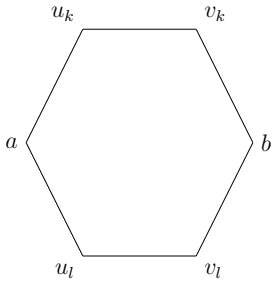
Theorem 2.1 states that for a pointed metric space M, the Lipschitz space Lip0(M) has the weak-star symmetric strong diameter 2 property (w*-SSD2P) if and only if M has the strong long trapezoid property (SLTP). The SLTP demands that for every finite subset N of M and every ε>0 there are distinct u,v∈M such that (1−ε)(d(x,y)+d(u,v))≤d(x,u)+d(y,v) for all x,y∈N, and also (1−ε)(2d(u,v)+d(x,y)+d(z,w))≤d(x,u)+d(y,u)+d(z,v)+d(w,v) for all x,y,z,w∈N. The first inequality is the long trapezoid property already known to characterise the weak-star strong diameter 2 property; the second inequality is the additional constraint imposed by symmetry. The paper then shows the two are genuinely different: Example 3.1 exhibits a metric space satisfying the long trapezoid property but not the SLTP, so its Lipschitz space has the weak-star strong diameter 2 property but not the symmetric variant. This resolves the question posed by Haller, Langemets, Lima, and Nadel.
Load-bearing premise
The proof of the 'if' direction relies on the unproved assertion that for the pair (u,v) supplied by the strong long trapezoid property, the quantity r0+s0 defined as half the minima of two expressions is at least (1−ε)d(u,v); if that inequality failed, the tent function g could not be constructed.
Editorial extensions
If this is right
- Every infinite subset of ℓ1, viewed as a metric space, has the SLTP; consequently its Lipschitz space has the weak-star symmetric strong diameter 2 property.
- Unbounded metric spaces and metric spaces with arbitrarily close distinct points also have the SLTP, by combining a known theorem with the new characterisation.
- The w*-SSD2P and the w*-SD2P are distinct for Lipschitz spaces, giving a negative answer to the open question in the literature.
- The two inequalities defining the SLTP are logically independent: one can satisfy the four-point inequality while failing the long trapezoid property, as Example 3.2 shows.
Reading between the lines
- The two-inequality form of the SLTP suggests a hierarchy of trapezoid-type metric properties parameterised by the number of points on each side; a similar characterisation might hold for finite families of arbitrary convex combinations of weak-star slices.
- The tent construction of the common perturbation g is a two-centre Lipschitz extension; analogous tent functions could characterise other symmetric diameter 2 properties in spaces built from metric data.
- Since the paper shows the symmetric property is strictly stronger in general, a natural extension is to identify classes of metric spaces—such as length spaces or geodesic spaces—where the two properties coincide; the ℓ1 example indicates many infinite spaces behave well.
Signed reviews
Editorial analysis
A structured set of objections, weighed in public.
Referee Report
Summary. The paper characterises the weak*-symmetric strong diameter 2 property (w*-SSD2P) of the Lipschitz space Lip0(M) over a pointed metric space M in terms of a new metric condition on M, called the strong long trapezoid property (SLTP; Definition 1.3). Theorem 2.1 establishes that Lip0(M) has the w*-SSD2P if and only if M has the SLTP. The author then uses this characterisation to show that the w*-SSD2P is strictly stronger than the weak*-strong diameter 2 property in Lipschitz spaces, by constructing a metric space satisfying the long trapezoid property but not the SLTP (Example 3.1), by showing that inequality (1.2) does not imply inequality (1.1) (Example 3.2), and by showing that every infinite subset of l1 has the SLTP (Example 3.3).
Significance. The main equivalence is a clean and useful metric characterisation of a dual diameter-2 property; it is proved in both directions with explicit inequalities and is largely self-contained, relying on standard duality F(M)* = Lip0(M) and the McShane extension theorem. The examples are explicit and verify the strictness between the two weak*-diameter-2 properties, answering [HLLN, Question 6.3]. The paper is written carefully and the main result appears correct; the only gap in the proof of the (ii) implies (i) direction is a missing one-line justification that is easily supplied.
major comments (1)
- [Section 2, proof of Theorem 2.1 (ii) implies (i)] After defining r0 and s0, the text asserts without proof that r0 + s0 >= (1 - epsilon) d(u,v). This inequality is load-bearing because it guarantees the existence of r,s >= 0 with r <= r0, s <= s0, and r + s = (1 - epsilon)^2 d(u,v), which is needed to construct g with norm at least (1 - epsilon)^2. The inequality is true: if (x*,y*) and (z*,w*) are pairs that attain the minima in r0 and s0, then applying (1.2) to these four points yields exactly 2r0 + 2s0 >= 2(1 - epsilon) d(u,v). The authors should include this derivation in the text, since the assertion is not immediate from the surrounding discussion.
minor comments (3)
- [Section 2, proof of Theorem 2.1 (ii) implies (i)] The phrase 'We may assume that r > 0' should be justified; for instance, if r0 = 0, one can swap u and v and interchange r and s, since at least one of r0, s0 is positive. Without such a remark, the assumption appears arbitrary.
- [Abstract and Definition 1.2] There are typesetting artifacts such as 'weak star' rendered as 'weak ˚' and the slice family written as 'tSiun'; these should be corrected to standard notation.
- [Example 3.3] The example relies on [HLLN, Theorem 5.6] for the unbounded and infimum-zero cases. Since the theorem is not stated, citing it is acceptable, but the authors might briefly indicate how it applies, or note that a direct verification can be supplied, to keep the example self-contained.
Circularity Check
No circularity: Theorem 2.1 is a self-contained metric characterization proved from the definitions; the one asserted estimate r0+s0 ≥ (1−ε)d(u,v) is an omitted verification, not a circular reduction.
full rationale
The central claim (Theorem 2.1, Lip0(M) has the weak-star symmetric strong diameter 2 property iff M has the strong long trapezoid property) is derived directly from Definition 1.2 and Definition 1.3. Direction (i)⇒(ii) starts from weak-star slices of the unit ball of Lip0(M), uses the assumed symmetric diameter 2 property to produce g and f_{x,y}, and then derives inequalities (1.1) and (1.2) by elementary estimates. Direction (ii)⇒(i) constructs g and the functions f_i explicitly from the SLTP inequalities and a norm-preserving extension argument. No parameter is fitted to the conclusion, and no input is renamed as a prediction. The only notable manuscript gap is in the proof of (ii)⇒(i) after defining r0 and s0: the text asserts "one has r0 ` s0 ě p1 ´ εqdpu, vq" and then uses this to choose r,s ≥ 0 with r+s = (1−ε)^2 d(u,v). The verification is omitted, and the assertion is load-bearing for the construction of g. However, this is not a circular step: it follows directly by applying inequality (1.2) to the pairs in N that attain the two minima, exactly as the reconstruction in the skeptic's reading shows. The citations to [PR, Theorem 3.1] and [HLLN, Theorem 5.6] are to external prior work rather than to the present author's own results, and they do not feed back into the proof of the main equivalence. Example 3.1 is a concrete metric-space construction verified directly by distance checks, and Example 3.2 checks the independence of (1.2) from (1.1) by explicit computations. Thus no circular step is present.
Assumptions & free parameters
assumptions (5)
- standard math Lip0(M)* is isometrically isomorphic to the Lipschitz-free space F(M) = span{delta_m : m in M}.
- standard math Every element of F(M) is a finite linear combination of evaluation functionals delta_m.
- standard math McShane extension theorem: every 1-Lipschitz function on a subset of a metric space extends to the whole space with the same Lipschitz constant.
- domain assumption The cited [HLLN, Theorem 5.6] implies that unbounded metric spaces and spaces with infimum of nonzero distances equal to 0 give the weak-star symmetric strong diameter 2 property in the corresponding Lipschitz space.
- domain assumption The cited [PR, Theorem 3.1] gives that F(M) has octahedral norm if and only if M has the long trapezoid property.
Cite this review
Pith. "Pith review of Characterisation of the weak-star symmetric strong diameter 2 property in Lipschitz spaces." pith.science (2026). https://pith.science/paper/LW2SPGKY
@misc{pith2026190810348,
  author       = {Pith},
  title        = {Pith review of: Characterisation of the weak-star symmetric strong diameter 2 property in Lipschitz spaces},
  year         = {2026},
  howpublished = {\url{https://pith.science/paper/LW2SPGKY}},
  note         = {Machine review of arXiv:1908.10348}
}
read the original abstract
We give a characterisation of the weak* symmetric strong diameter 2 property for Lipschitz function spaces in terms of a property of the corresponding metric space. Using this characterisation we show that the weak* symmetric strong diameter 2 property is different from the weak* strong diameter 2 property in Lipschitz spaces, thereby answering a question posed in a recent paper by Haller, Langemets, Lima, and Nadel.
Figures

Reference graph
Works this paper leans on
-
[1]
T. A. Abrahamsen, V. Lima, O. Nygaard. Remarks on diameter 2 properties. J. Convex Anal. 20 (2013), no. 2, 439--452
work page 2013
-
[2]
T. A. Abrahamsen, O. Nygaard, M. P\ o ldvere. New applications of extremely regular function spaces. Pacific J. Math. (to appear)
-
[3]
B. Cascales, R. Chiclana, L. C. Garc\' a-Lirola, M. Mart\' n, A. Rueda Zoca. On strongly norm attaining L ipschitz maps , J. Funct. Anal. 277 (2019), no. 6, 1677--1717
work page 2019
-
[4]
R. Deville. A dual characterisation of the existence of small combinations of slices. Bull. Austral. Math. Soc. 37 (1988), no. 1, 113--120
work page 1988
- [5]
- [6]
- [7]
-
[8]
Octahedral norms in duals and biduals of Lipschitz-free spaces
J. Langemets, A. Rueda Zoca. Dual and bidual octahedral norms in Lipschitz-free spaces. ArXiv:1905.09061 (2019)
work page Pith review arXiv 2019
Show all 9 references
-
[9]
Proch\'azka, A
A. Proch\'azka, A. Rueda Zoca. A characterisation of octahedrality in Lipschitz-free spaces. Ann. Inst. Fourier (Grenoble), 68 (2018), no. 2, 569--588
2018
Reviewed August 14, 2026 · model on record in the stance chip above.
Discussion (0). Continue with ORCID to comment.