REVIEW 4 major objections 6 minor 40 references
Novel Relay Selection Algorithms for Machine-to-Machine Communications with Static RF Interface Usage
T0 review · 4 major / 6 minor · reviewed 2026-08-14 · deepseek-v4-flash
Pith's one-line read Optimal M2M relay selection reduces to a k-cardinality assignment problem solvable by the Hungarian algorithm, and a distributed stable-matching variant stays within a few percent of that optimum.
desk verdict Competent application of kAP + deferred acceptance to M2M dual-RF relay selection; the central optimality proof holds for the stated worst-case interference model, but Algorithm 1 is underspecified when QBS > Ns and the abstract/body capacity gap numbers disagree. read the letter →
The pith
A machine-rendered reading of the paper's core claim, the machinery that carries it, and where it could break.
The reading
What carries the argument
The central object is the k-cardinality assignment problem (kAP): choose at most $k$ edges in a weighted bipartite graph to maximize total weight. The paper's machinery is a reduction from kAP to a standard assignment problem by adding dummy vertices and $A_{\text{value}}$-weighted edges, then applying the Hungarian algorithm (the standard polynomial-time algorithm for maximum-weight perfect matching in a bipartite graph); a short proof shows optimal solutions correspond bijectively between the two problems. For MRSA, the machinery is the deferred acceptance procedure, with sources as proposers, relays holding quota 1, and the base station holding quota $Q_{BS}$; stability and source-optimality follow from the standard matching-theory arguments. The static RF-interface assumption (WiFi for M2M, LTE to the base station, different bands) is what keeps the two-hop and direct capacities from interfering with one another in the model, so the edge weights can be fixed in advance.
What would settle it
Re-run the ORSA assignment in a simulator that, after a matching is chosen, recomputes each link's SINR using only the sources and relays that actually transmit simultaneously instead of using all sources as interferers; if some feasible matching other than ORSA's yields a higher total capacity under those recomputed weights, then ORSA's optimality for the real objective is refuted.
Extended reading notes
Core claim
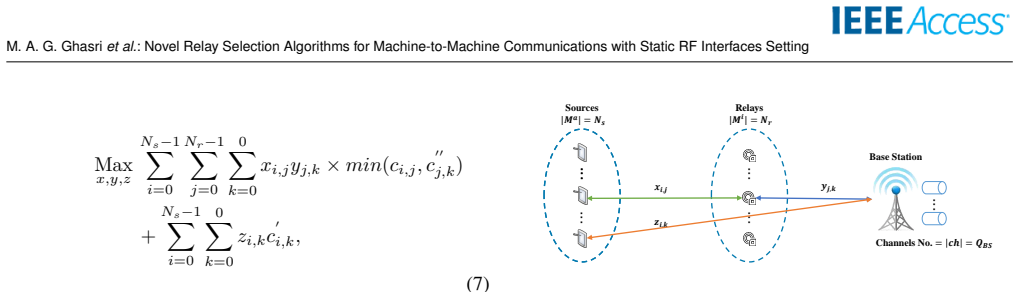
At the center is the observation that if every candidate link's capacity is treated as a fixed number before assignment, then selecting relays and direct connections under a base-station quota $Q_{BS}$ is exactly a maximum-weight matching problem with at most $Q_{BS}$ edges. ORSA builds a bipartite graph with sources on one side and relays plus $Q_{BS}$ copies of the base-station channel on the other; edge weights are $\min(C_{s,r}, C_{r,BS})$ for a two-hop path and $C_{s,BS}$ for direct access. To solve the k-cardinality assignment problem, the paper adds $(m-k)$ and $(n-k)$ dummy vertices on the two sides, assigns a very large weight $A_{\text{value}}$ to edges touching the dummies, and argues through Lemma 1 and Theorem 1 that in any optimal perfect matching exactly $k$ original edges survive and exactly $(m-k)+(n-k)$ big-weight edges are taken, so the optimal solution transfers back. MRSA, in contrast, has sources propose to relays or to the base station in order of capacity; each relay keeps at most one source and the base station keeps $Q_{BS}$ sources, and the deferred-acceptance logic yields a stable matching that is optimal for the proposing side. The simulation section reports ORSA at the top of all compared algorithms and MRSA close behind. A numerical inconsistency between the abstract and the body should be noted: the abstract says MRSA beats direct and random selection by about 15% and 98%, while the introduction and conclusion report 56% and 117%.
Load-bearing premise
The load-bearing premise is that each edge's capacity is a fixed number known before matching, computed under maximum-probable interference; in the real network, interference depends on which sources and relays actually transmit together, so the proof of ORSA's optimality applies to the surrogate fixed-weight graph rather than automatically to the live radio environment.
Editorial extensions
If this is right
- ORSA gives an exact optimum for the modeled problem: among all assignments respecting the one-relay-per-source and $Q_{BS}$-channel constraints, no other feasible selection can have higher total capacity.
- MRSA's matching is stable and, for every source, at least as good as any other stable matching achievable with the same players; in the simulated settings it stays within roughly 1–3% of ORSA's average capacity.
- Because the two RF interfaces use separate bands, source-relay WiFi transmissions and LTE links to the base station can proceed simultaneously without cross-interface interference, which is what makes the static setting a capacity win.
- The complexity figures matter for deployment: ORSA is $O((N_s+N_r)^3)$ centralized, MRSA is $O((N_s+N_r)^2)$ distributed, so the decentralized option scales better in dense cells.
- Adding more relays improves both algorithms' average capacity and reduces unmatched sources, while reducing LTE channels increases per-source capacity until the number of sources passes the channel count.
Reading between the lines
- The dummy-vertex transformation is a generic gadget: any 'choose at most k edges' bipartite allocation problem with capacity limits can be solved by the same reduction, so it may transfer beyond relay selection to other quota-constrained assignment tasks.
- If the fixed-weight decoupling breaks in a real deployment, an alternating loop — compute capacities under worst-case interference, match with ORSA, recompute interference for the actually selected transmitters, re-match — would be a natural testable extension; the paper itself does not explore it.
- The abstract/body discrepancy in the baseline gains (15%/98% vs 56%/117%) suggests that at least one of those sets of numbers needs verification before the quantitative claims are quoted externally.
Signed reviews
Editorial analysis
A structured set of objections, weighed in public.
Referee Report
Summary. The paper studies uplink relay selection in a single-cell M2M network in which active sources may send data directly to the base station over LTE or via idle relays, using WiFi for the source-to-relay hop and LTE for the relay-to-base-station hop. The base station has QBS LTE channels, and the goal is to assign sources to next hops so as to maximize total capacity. The paper proposes ORSA, a centralized algorithm that transforms the relay selection problem into a k-cardinality assignment problem and solves it with the Hungarian algorithm after adding dummy vertices, and MRSA, a distributed algorithm based on deferred acceptance. It proves the optimality of the kAP solver, claims that ORSA is optimal for the relay selection problem, and claims that MRSA produces a stable and source-optimal stable matching. Simulations in four scenarios compare ORSA and MRSA with direct transmission (WRSA) and random relay selection (RRSA).
Significance. If the central optimality claim held for the actual network, ORSA would be a useful centralized benchmark with O((Ns+Nr)^3) complexity, and MRSA would be a practical distributed alternative with stability guarantees and near-optimal average capacity when the number of channels is unrestricted. The paper is careful to provide proofs for the kAP transformation and for the stability of the matching, and it reports 1000-run simulations against two baselines with standard deviations. However, the optimality proof applies to a fixed-weight surrogate model with worst-case interference, and the claimed 'new' kAP solver appears to reproduce the known Volgenant transformation. The contribution is plausible and potentially useful, but the central claims need to be either restricted to the model actually solved or validated against the coupled interference behavior of the real network.
major comments (4)
- [§III-B2, Algorithm 1 Step 2] In the transformation in Section III-B2 and Algorithm 1 Step 2, the number of vertices added to the right side is Ns - QBS, which is negative whenever QBS > Ns. This case occurs in Scenarios 1-3 whenever Ns < 100 and in Scenario 4 whenever Ns < QBS, i.e., exactly in the simulations used for the 'no restriction' claims. The construction therefore needs a k' = min(QBS, Ns) correction or a separate handling of the unrestricted case, and the simulations must state which corrected version was actually run.
- [§II (Eq. (2)-(4)), §III-B] The optimality proof of Theorem 1 and the claim that ORSA 'provides an optimal solution for the relay selection problem' apply to a surrogate problem whose edge weights are fixed numbers. In Eq. (2), the WiFi SINR of every source-relay pair already contains interference from all other sources, regardless of which sources actually transmit on WiFi, and the text after Eq. (4) explicitly adopts 'maximum probable interference' and 'worst possible interference conditions.' In the actual network, the set of simultaneously transmitting WiFi sources is determined by the matching itself, so the optimal matching for the fixed-weight graph need not maximize, and may not even be optimal for, the true capacity objective. Please either restrict the optimality claim to the fixed-capacity model or add a validation against an exhaustive search or iterative SINR recomputation in a small network.
- [§III-A, Main Contributions] The manuscript claims a 'new solver' for the k-cardinality assignment problem, but the construction—add m-k dummy vertices to one side, n-k to the other, weight added-to-original edges with a large value, and solve the resulting standard assignment—is the same as the Volgenant transformation cited as [34]. The authors should either identify a substantive difference in construction, proof, or complexity, or revise the novelty claim and compare against [34] explicitly.
- [Abstract; §V-A; §VI] The quantitative near-optimality claim is internally inconsistent: the abstract states that MRSA is 'only about 1% lower' than ORSA, while Section V-A states 'at most 3% less' and the conclusion states 'about 3% higher'; no confidence intervals are given for either number. Please reconcile these statements and report the distribution or standard error of the ORSA-MRSA gap.
minor comments (6)
- [§V-A] The sentence 'the optimal allocation in ORSA has been able to increase the number of unmatched sources compared to MRSA' should read 'decrease'; ORSA has fewer unmatched sources, as Fig. 9 and the following sentence indicate.
- [§III-B3] The condition '0≤ 0j <Nr' contains a typo; it should be '0≤j<Nr'.
- [§II, Eq. (5)] The parentheses in PathLoss(i,j)(dB) = 10βlog10(d(i,j)/d0 are unbalanced; a closing parenthesis is missing.
- [§V-A, §V-B] The phrases 'average container' and 'the algorithms can be ordered as ... , .' appear to be typographical errors and should be corrected.
- [§V-A] The standard deviations reported for the four algorithms are said to 'verify' the results, but no confidence intervals or statistical tests are provided; consider adding error bars or confidence bands to the figures.
- [References] References [17] and [36] are incomplete ('C. R' and a website-only citation); they should be completed for reproducibility.
Circularity Check
No significant circularity: ORSA and MRSA are reductions to the Hungarian algorithm and deferred acceptance with no fitted parameters or load-bearing self-citations.
full rationale
The central claims are derived by reduction to external, independently established results. ORSA's optimality for the stated problem follows because the relay selection problem in Eq. (7) is transformed into a k-cardinality assignment problem in Section III-B, whose optimality is proved via the bijection in Theorem 1, and then solved by the Hungarian algorithm. The proof does not invoke any fitted constant or predicted quantity; the only parameters chosen, Avalue and k=QBS, are selected to make the transformation exact. MRSA's stability is justified by the deferred acceptance procedure from the external reference [30], with the proof in Appendix A carrying out the standard contradiction argument. The self-citations to co-author S. Bayat in [7] and [11] appear only as related-work background and are not load-bearing for the ORSA/MRSA claims. The paper's reliance on fixed edge weights computed under worst-case interference after Eq. (4) is a modeling assumption that limits transfer of the optimality result to the real interference-coupled network, but that is an external-validity and correctness concern, not a circular derivation: the mathematical solutions remain self-contained reductions to their stated optimization problems. Even if the kAP transformation is not entirely new, that is a novelty issue rather than circularity.
Assumptions & free parameters
assumptions (6)
- standard math The Hungarian algorithm solves the standard assignment problem optimally.
- standard math Deferred acceptance with strict preferences produces a stable and source-optimal stable matching.
- domain assumption Decode-and-forward two-hop capacity is min(C_s,r, C_r,BS).
- domain assumption WiFi and LTE bands do not interfere, and the LTE uplink receives no interference from other machines.
- ad hoc to paper WiFi SINR is computed with worst-case interference from all other sources, independent of the matching.
- domain assumption All machines have two RF interfaces, WiFi for M2M links and LTE for base station links, used statically.
Cite this review
Pith. "Pith review of Novel Relay Selection Algorithms for Machine-to-Machine Communications with Static RF Interface Usage." pith.science (2026). https://pith.science/paper/B7G34IEX
@misc{pith2026190810351,
  author       = {Pith},
  title        = {Pith review of: Novel Relay Selection Algorithms for Machine-to-Machine Communications with Static RF Interface Usage},
  year         = {2026},
  howpublished = {\url{https://pith.science/paper/B7G34IEX}},
  note         = {Machine review of arXiv:1908.10351}
}
read the original abstract
Machine-to-Machine (M2M) communications have been introduced to improve the communication capacity in dense wireless networks. One of the most important concerns for network designers is maintaining the high performance of the network when the quality of connections between sources and their destinations is poor. Thus the careful selection of relays between data sources and their destinations is a very important issue. The possibility of simultaneous use of different Radio Frequency (RF) interfaces for transmitting data, which communication devices are equipped with them, can increase the capacity of data transmission over the network. In this paper, two novel M2M relay selection algorithms are proposed, named as Optimal Relay Selection Algorithm (ORSA) and Matching based Relay Selection Algorithm (MRSA). ORSA is a centralized algorithm for the optimal selection of relays by transforming the main problem to a k-cardinality assignment problem that can be solved using the Hungarian algorithm. MRSA is a distributed algorithm that leverages concepts from matching theory to provide a stable solution for the relay selection problem. In both proposed algorithms static RF interfaces usage is applied to enable simultaneous use of different interfaces for data transmission. The simulations show that ORSA is optimally solving the relay selection problem. MRSA has an optimal stable result, that when there is no restriction on the number of channels, is only about 1% lower than ORSA. Besides, MRSA provides better results than direct transmission Without any Relay Selection Algorithm (WRSA) and Random Relay Selection Algorithm (RRSA), about 15% and 98%, respectively.
Figures


Figures from the paper (11 more)


Reference graph
Works this paper leans on
-
[34]
Solving the k-cardinality Assignment Problem by Trans- formation
A. V olgenant, “Solving the k-cardinality Assignment Problem by Trans- formation”, European Journal of Operational Research, V ol. 157, No. 2, pp. 322-331, September 2004
work page 2004
-
[35]
The k-cardinality Assignment Problem
M. Dell'Amico, S. Martellob, “The k-cardinality Assignment Problem”, Discrete Applied Mathematics, V ol. 76, No. 1-3, pp. 103-121, June 1997
work page 1997
-
[1]
V . L. Kalyani, D. Sharma, “IoT: Machine to Machine (M2M), Device to Device (D2D) Internet of Everything (IoE) and Human to Human (H2H): Future of Communication,” Journal of Management Engineering and Information Technology (JMEIT), V ol. 2, No. 6, December 2015
work page 2015
-
[2]
F. Ghavimi, H. Chen, “M2M Communications in 3GPP LTE/LTE-A Networks: Architectures, Service Requirements, Challenges, and Appli- cations,” IEEE Communications Surveys & Tutorials, V ol. 17, No. 2, pp. 525-549, Second Quarter 2015
work page 2015
-
[3]
M. Asshada, S. A. Khan, A. Kavak, Kerem Küçük, D. L. Msongaleli, “Cooperative Communications using Relay Nodes for Next-Generation Wireless Networks with Optimal Selection Techniques: A Review,” IEEJ Transactions on Electrical and Electronic Engineering, V ol. 14, No. 5, pp. 658-669, March 2019
work page 2019
-
[4]
Relay-Aided Multiple Access Scheme in Two-Point Joint Transmission,
Q. Zhou, Y . Ma, L. Bai, J. Choi, Y . Liang, “Relay-Aided Multiple Access Scheme in Two-Point Joint Transmission,”IEEE Transactions on Vehicu- lar Technology, V ol. 68, No. 6, pp. 5629-5641, June 2019
work page 2019
-
[5]
Decision-Tree-Based Relay Selection in Dualhop Wireless Communications,
X. Wang, “Decision-Tree-Based Relay Selection in Dualhop Wireless Communications,” IEEE Transactions on Vehicular Technology, V ol. 68, No. 6, pp. 6212-6216, June 2019
work page 2019
-
[6]
On Backhauling of Relay Enhanced Networks in LTE-Advanced
O. Bulakci, “On Backhauling of Relay Enhanced Networks in LTE- Advanced,” Department of Communications and Networking, Aalto Uni- versity, 2012, Online Access: https://arxiv.org/pdf/1202.0212 , Last Access Time: August 20, 2019
work page Pith review arXiv 2012
Show all 40 references
-
[7]
Cognitive Radio Relay Networks with Multiple Primary and Secondary Users: Distributed Stable Matching Algorithms for Spectrum Access,
S. Bayat, R. H. Y . Louie, Y . Li, B. Vucetic, “Cognitive Radio Relay Networks with Multiple Primary and Secondary Users: Distributed Stable Matching Algorithms for Spectrum Access,” IEEE International Confer- ence on Communications (ICC), Kyoto, Japan, June 2011
2011
-
[8]
Two-Stage Match- ing for Energy-Efficient Resource Management in D2D Cooperative Relay Communications
C. Xu, J. Feng, Z. Zhou, Z. Chang, Z. Han, S. Mumtaz, “Two-Stage Match- ing for Energy-Efficient Resource Management in D2D Cooperative Relay Communications”, IEEE Global Communications Conference, Singapore, Singapore, December 2017
2017
-
[9]
Distributed Satisfaction- Aware Relay Assignment: A Novel Matching-Game Approach,
D. Liu, Y . Xu, Y . Xu, C. Ding, K. Xu, Y . X, “Distributed Satisfaction- Aware Relay Assignment: A Novel Matching-Game Approach,”Transac- tion on Emerging Telecommunications Technologies , V ol. 27, No. 8, pp. 1087-1096, August 2016
2016
-
[10]
Game Theory for Wireless Communications and Networking
V . L. Kalyani, D. Sharma, “Game Theory for Wireless Communications and Networking”, CRCPress, 2011
2011
-
[11]
Matching Theory Applications in Wireless Communications,
S. Bayat, Y . Li, L. Song, and Z. Han, “Matching Theory Applications in Wireless Communications,” IEEE Signal Processing Magazine , V ol. 33, No. 6, pp. 103-122, November 2016
2016
-
[12]
Interference-Aware Relay Selection Scheme for Two-Hop Relay Networks with Multiple Source-Destination Pairs,
S. Zhou, J. Xu, Z. Niu, “Interference-Aware Relay Selection Scheme for Two-Hop Relay Networks with Multiple Source-Destination Pairs,”IEEE Transaction on Vehicular Technology, V ol. 62, No. 5, pp. 2327-2338, June 2013
2013
-
[13]
Cooperative Relay Selection for Load Balancing With Mobility in Hierarchical WSNs: A Multi-Armed Bandit Approach,
J. Zhang, J. Tang, F. Wang, “Cooperative Relay Selection for Load Balancing With Mobility in Hierarchical WSNs: A Multi-Armed Bandit Approach,”IEEE Access, V ol. 8, pp. 18110 - 18122, January 2020
2020
-
[14]
A Graph- Based Approach for Relay Selection and Resource Allocation in Cognitive Two-way Relay Networks,
A. Alizadeh, N. Forouzan, S. A. Ghorashi, S. M. S. Sadough, “A Graph- Based Approach for Relay Selection and Resource Allocation in Cognitive Two-way Relay Networks,”Wireless Advanced, London, UK, April 2011
2011
-
[15]
Optimal Channel and Relay Assignment in OFDM- Based Multi-Relay Multi-Pair Two-Way Communication Networks,
Y . Liu and M. Tao, “Optimal Channel and Relay Assignment in OFDM- Based Multi-Relay Multi-Pair Two-Way Communication Networks,” IEEE Transactions on Communications , V ol. 60, No. 2, pp. 317-321, February 2012
2012
-
[16]
An Iterative Hungarian Method to Joint Relay Selection and Resource Allocation for D2D Communications,
T. Kim, and M. Dong, “An Iterative Hungarian Method to Joint Relay Selection and Resource Allocation for D2D Communications,” IEEE Wireless Communications Letters, V ol. 3, No. 6, pp 625-628, December 2014
2014
-
[17]
Interference cancellation and Resource Allocation Approaches for Device-to-Device Communications,
C. R, “Interference cancellation and Resource Allocation Approaches for Device-to-Device Communications,” Ph.D. Thesis, Department IV , Trier University, Trier, Germany, July 2016
2016
-
[18]
Energy-Saving Scheduling in the 3GPP Narrowband Internet of Things (NB-IoT) Using Energy-Aware Machine-to-Machine Relays,
C. Y . Chen, A. C. S. Huang, S. Huang, J. Y . Chen, “Energy-Saving Scheduling in the 3GPP Narrowband Internet of Things (NB-IoT) Using Energy-Aware Machine-to-Machine Relays,” 27th Wireless and Optical Communication Conference (WOCC), Hualien, Taiwan, April 2018
2018
-
[19]
D2D Communications with Subchannel Reusing for Throughput-Guaranteed Relay Selection in LTE
S. J. Kao, S. Y . Luo, M. T. Kao, F. M. Chang, “D2D Communications with Subchannel Reusing for Throughput-Guaranteed Relay Selection in LTE”, International Journal of Communication Systems , V ol. 32, No. 6, April 2019
2019
-
[20]
Distributed Resource Allocation for D2D-Assisted Small Cell Networks With Heterogeneous Spectrum
Y . Liu, Y . Wang, R. Sun, Z. Miao, “Distributed Resource Allocation for D2D-Assisted Small Cell Networks With Heterogeneous Spectrum”,IEEE Access, V ol. 7, pp. 83900 - 83914, June 2019
2019
-
[21]
Parallel Opportunistic Routing in IoT Networks,
F. Singh, V . J K, C. S. R. Murthy, “Parallel Opportunistic Routing in IoT Networks,” IEEE Wireless Communications and Networking Conference (WCNC), Doha, Qatar, April 2016
2016
-
[22]
ARNC Multicasting of HDCP Data for Cooperative Mobile Devices with Dual Interfaces,
G. Hu, K. Xu, Y . Xu, “ARNC Multicasting of HDCP Data for Cooperative Mobile Devices with Dual Interfaces,”IEEE Communications Letters, V ol. 21, No. 11, pp. 2504 - 2507, Novamber 2017
2017
-
[23]
Performance Charac- terization of Machine-to-Machine Networks With Energy Harvesting and Social-Aware Relays,
S. Huang, Z. Wei, X. Yuan, Z. Feng, P. Zhang, “Performance Charac- terization of Machine-to-Machine Networks With Energy Harvesting and Social-Aware Relays,”IEEE Access, V ol. 5, No. 2017, pp. 13297 - 13307, July 2017
2017
-
[24]
A Survey on Buffer-Aided Relay Selection,
N. Nomikos, T. Charalambous, I. Krikidis, D. N. Skoutas, D. V ouyioukas, M. Johansson, C. Skianis, “A Survey on Buffer-Aided Relay Selection,” IEEE Communications Surveys & tutorials , V ol. 18, No. 2, pp. 1073 - 1097, Second Quarter 2016
2016
-
[25]
Interest-Aware Energy Collection & Resource Management in Machine to Machine Communi- cations,
E. E. Tsiropoulou, G. Mitsis, S. Papavassiliou, “Interest-Aware Energy Collection & Resource Management in Machine to Machine Communi- cations,” Ad Hoc Networks , V ol. 68, No. 2018, pp. 48 - 57, September 2017
2018
-
[26]
Interest, Energy and Physical-Aware Coalition Formation and Resource Allocation in Smart IoT Applications,
E. E. Tsiropoulou, S. T. Paruchuri, J. S. Baras, “Interest, Energy and Physical-Aware Coalition Formation and Resource Allocation in Smart IoT Applications,” 51st Annual Conference on Information Sciences and Systems (CISS), March 2017
2017
-
[27]
Relay Selection Based Clustering Techniques for High Density LTE Networks,
M. Hajjar, G. Aldabbagh, N. Dimitriou, M. Z. Win, “Relay Selection Based Clustering Techniques for High Density LTE Networks,” Wireless Networks, V ol. 25, No.5, pp. 2305 - 2314, July 2019
2019
-
[28]
Buffer-Aided Relay Selection With Equal-Weight Links in Cooperative Wireless Networks,
W. Raza, N. Javaid, H. Nasir, N. Alrajeh, N. Guizani, “Buffer-Aided Relay Selection With Equal-Weight Links in Cooperative Wireless Networks,” IEEE Communications Letters, V ol. 22, No. 1, pp. 133 - 136, January 2018
2018
-
[29]
Relaying and Radio Resource Partitioning for Machine-Type Communications in Cellular Networks,
U. Tefek, and T. J. Lim, “Relaying and Radio Resource Partitioning for Machine-Type Communications in Cellular Networks,” IEEE Transac- tions on Wireless Communications , V ol. 16, No. 2, pp. 1344 - 1356, February 2017
2017
-
[30]
College Admissions and the Stability of Mar- riage,
D. Gale, L. S. Shapley, “College Admissions and the Stability of Mar- riage,” The American Mathematical Monthly , V ol. 69, No. 1, pp. 9-15, January 1962
1962
-
[31]
Deadline-Aware Opportunistic Network Coding for Multi-Relay-Aided Single-Source Single-Destination Network,
G. Hu, K. Xu, Y . Xu, “Deadline-Aware Opportunistic Network Coding for Multi-Relay-Aided Single-Source Single-Destination Network,” IEEE Communications Letters, V ol. 21, No. 10, pp. 2282 - 2285, October 2017
2017
-
[32]
Relay Selection and Power Allo- cation for Device-to-Device Communication Underlaying Heterogeneous Cellular Networks,
J. Chang, Y . Ma, W. Cheng, X. Shen, “Relay Selection and Power Allo- cation for Device-to-Device Communication Underlaying Heterogeneous Cellular Networks,”2nd IEEE International Conference on Computer and Communications, Chengdu, China, October 2016
2016
-
[33]
Matching Problems with Additional Resource Con- straints
D. J. Thomas, “Matching Problems with Additional Resource Con- straints”, Ph.D. Thesis, Department IV , Trier University, Trier, Germany, pp. 69-71, October 2015. VOLUME x, 2020 19 M. A. G. Ghasri et al.: Novel Relay Selection Algorithms for Machine-to-Machine Communications w...
2015
-
[36]
The Dynamic Hungarian Algorithm for the Assignment Problem with Changing Costs
G. A. Mills-Tettey, A. Stentz, M. B. Dias,“The Dynamic Hungarian Algorithm for the Assignment Problem with Changing Costs”, 2007, Online Access: https://pdfs.semanticscholar.org/4980/ 1ee13208daf6dbd117646dfeb5d34d116b61.pdf, Last Access Time: July 30, 2019
2007
-
[37]
The Hungarian Method for the Assignment Problem
H. W. Kuhan, “The Hungarian Method for the Assignment Problem”, Naval Research Logistics Quarterly 2, pp. 83-97, March 1955
1955
-
[38]
Fast C++ Implementation of the Hungarian Algorithm
GitHub, “Fast C++ Implementation of the Hungarian Algorithm”, Online Access: https://github.com/jamespayor/ weighted-bipartite-perfect-matching, Last Access Time: February 24, 2019
2019
-
[39]
Survey on Synchronization Mechanisms in Machine-to-Machine Systems
I. Bojica, K. Nymoenb, “Survey on Synchronization Mechanisms in Machine-to-Machine Systems”, Engineering Applications of Artificial In- telligence, V ol. 45, pp. 361-375, October 2015
2015
-
[40]
Time Synchronization in 5G Wireless Edge: Requirements and Solutions for Critical-MTC
A. Mahmood, M. I. Ashraf, M. Gidlund, J. Torsner, J. Sachs, “Time Synchronization in 5G Wireless Edge: Requirements and Solutions for Critical-MTC”, IEEE Communications Magazine, V ol. 57, No. 12, pp. 45- 51, December 2019. MONIREH ALLAH GHOLI GHASRI received B.Sc. degree from...
2019
Reviewed August 14, 2026 · model on record in the stance chip above.
Discussion (0). Continue with ORCID to comment.