REVIEW 4 major objections 5 minor 30 references
Two-particle Correlation Functions in Cluster Perturbation Theory: Hubbard Spin Susceptibilities
T0 review · 4 major / 5 minor · reviewed 2026-08-14 · deepseek-v4-flash
Pith's one-line read Cluster perturbation theory is extended to spin susceptibilities: with a frequency-independent vertex approximation, small-cluster data yield a closed formula matching 1D Hubbard benchmarks at weak and strong coupling.
desk verdict New two-particle CPT implementation with honest benchmarks; the uncontrolled vertex ansatz is the real cost, but the paper earns referee time. read the letter →
The pith
A machine-rendered reading of the paper's core claim, the machinery that carries it, and where it could break.
The reading
What carries the argument
Two devices carry the argument. The first is the frequency-independent vertex approximation: the four-point vertex, the sum of two-particle scattering processes irreducible in the particle-hole channel, is replaced by a two-point vertex that depends only on the transfer frequency and is taken from the cluster, $\Gamma(i\nu,i\nu',i\omega) \approx \Gamma(i\omega) \approx \Gamma_c(i\omega)$. This collapses the rank-four Bethe-Salpeter equation into a Dyson-like two-leg equation and yields Eq. (9), the susceptibility analogue of the one-particle CPT equation. The second is the pseudoinverse construction of Appendix D, $\Gamma_c = \chi^+_{0,c}(\chi_c - \chi_{0,c})\chi^+_c$, which extracts the cluster vertex even though the cluster susceptibility $\chi_c$ has a zero eigenvalue at every frequency because the paramagnetic cluster preserves SU(2) symmetry. Together these convert a small-cluster exact diagonalization into a momentum-resolved spin response continuous in $q$.
What would settle it
Compute the full four-point vertex at two different internal fermionic frequencies for a fixed low transfer frequency $\omega$ on the half-filled one-dimensional Hubbard model at the largest cluster size available; if $\Gamma(i\nu,i\nu',i\omega)$ varies substantially with $\nu-\nu'$ inside the frequency window where $\mathrm{Im}\,\chi(q,\omega)$ carries spectral weight, the frequency-independent vertex assumption behind Eq. (9) is falsified precisely in the regime where the paper reports agreement.
Extended reading notes
Core claim
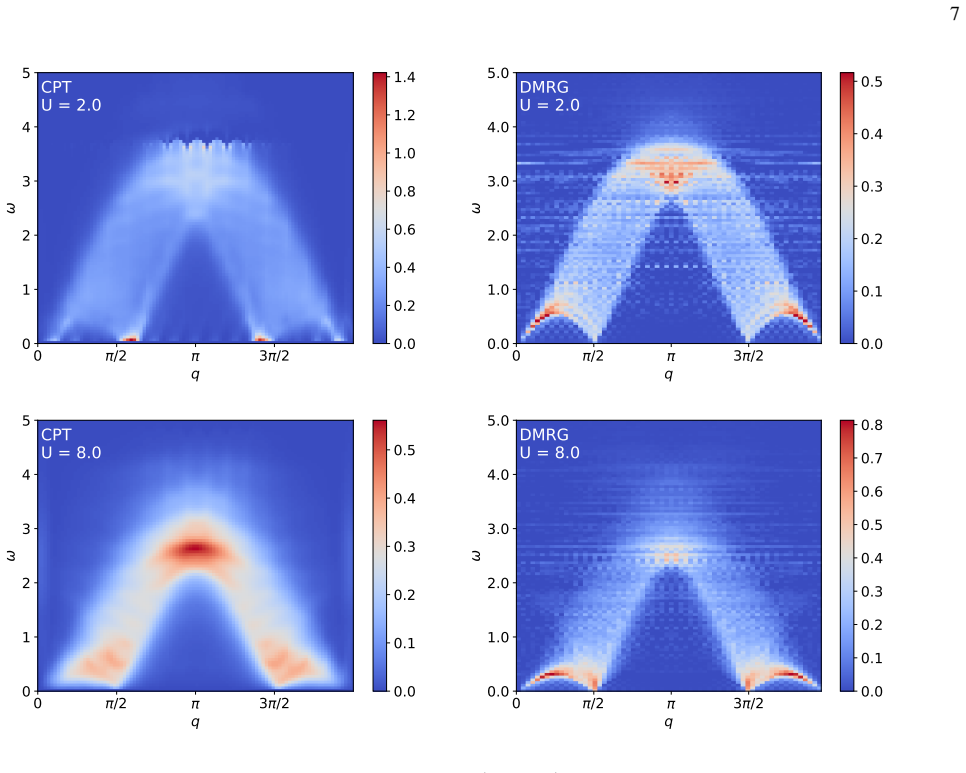
The paper claims that the one-particle CPT logic transfers directly to two-particle correlation functions. Starting from the Bethe-Salpeter equation for the generalized four-point susceptibility and neglecting the internal frequency dependence of the four-point vertex, $\Gamma(i\nu,i\nu',i\omega) \approx \Gamma(i\omega) \approx \Gamma_c(i\omega)$, the authors derive the central identity of the paper, Eq. (9): $\chi^{-1}_{\mathrm{CPT}}(\tilde{q},i\omega) = \chi^{-1}_{0,\mathrm{CPT}}(\tilde{q},i\omega) + \chi^{-1}_c(i\omega) - \chi^{-1}_{0,c}(i\omega)$, where $\chi_{0,\mathrm{CPT}}$ is the bare bubble built from the CPT Green's function and $\chi_c$, $\chi_{0,c}$ are exact cluster quantities. This is the two-particle analogue of the standard CPT Green's function equation $G^{-1}_{\mathrm{CPT}} = G^{-1}_0 + G^{-1}_c - G^{-1}_{0,c}$, and it reduces to the exact non-interacting and atomic-limit results just as the one-particle version does. Benchmarked at half filling on the one-dimensional Hubbard model with 16-site clusters against DMRG results for 64-site chains, the method is claimed to give close agreement with known results in the weak- and strong-coupling limits and reasonable agreement at intermediate $U$, while away from half filling the comparison deteriorates as the authors expect from enhanced charge fluctuations.
Load-bearing premise
The method assumes that the effective scattering interaction between two particles is the same at every energy and can be borrowed from a small cluster; if that interaction actually depends strongly on energy, the susceptibility formula has no controlled error.
Editorial extensions
If this is right
- A single small-cluster exact diagonalization yields a momentum- and frequency-resolved spin susceptibility, not just a single-particle spectrum, so parameter sweeps over $U$ and filling become cheap for Hubbard-type models.
- The computed $\chi(q,\omega)$ is directly comparable with experiment: inelastic neutron scattering on magnetic materials and optical analogues in ultracold-atom lattice systems measure essentially this response.
- The approximation is systematically improvable with cluster size, approaching the exact result as $L \to \infty$, and the residual gap at $q = \pi$ is shown to shrink with $1/L$.
- The method inherits CPT's domain of validity: it is expected to work in perturbative limits, while the paper cautions that regimes with strong entanglement, such as the two-dimensional Hubbard model at intermediate $U$, will need larger clusters or will be poorly described.
- The same scheme carries over to other two-particle correlation functions, provided each channel's leading correlation structure is reflected in the form factors of the vertex approximation.
Reading between the lines
- My inference: the decisive unbenchmarked step is the vertex approximation itself, so a direct computation of the internal-frequency dependence of $\Gamma$ in the magnetic particle-hole channel on the largest accessible cluster would reveal where Eq. (9) can be trusted more cheaply than full benchmarks.
- Because the pseudoinverse of a singular $\chi_c$ is not unique, different null-space choices could shift magnetic spectral weight; comparing Eq. (D1) with the paper's rejected $A(A+B)^{-1}B$ inversion route would quantify this sensitivity without invoking new physics.
- A natural testable extension is the two-dimensional Hubbard model at strong coupling, where the paper's own entanglement caveat suggests the frequency-independent vertex will break down first, and a controlled large-scale comparison there would bound the method's domain more sharply than the one-dimensional benchmarks do.
- The causality violations caused by pole mismatch point to a Lehmann representation of $\chi_{\mathrm{CPT}}$, which the paper flags as future work; that would remove the need for large broadening $\eta$ and make the method usable for sharper real-frequency features.
Editorial analysis
A structured set of objections, weighed in public.
Referee Report
Summary. The paper extends cluster perturbation theory (CPT) to two-particle correlation functions, focusing on the transverse spin susceptibility of the Hubbard model. The central result is Eq. (9), χ_CPT^{-1}(q,iω) = χ_{0,CPT}^{-1}(q,iω) + χ_c^{-1}(iω) − χ_{0,c}^{-1}(iω), derived under the assumption Eq. (8) that the four-point vertex is frequency-independent and equal to the cluster vertex, Γ(iν,iν',iω) ≈ Γ(iω) ≈ Γ_c(iω). The method is benchmarked against RPA-CPT for weak coupling, DMRG for intermediate coupling, and the Müller ansatz for strong coupling in the 1D Hubbard model at half filling, and against DMRG away from half filling. The appendices provide a Q-matrix representation for cluster correlation functions, a Lehmann representation for the CPT Green's function, the evaluation of the bubble diagram, the pseudoinverse construction of Γ_c in Eq. (D1), and an admission that the method violates causality for small broadening parameters.
Significance. If the central approximation is reliable, the paper offers an economically attractive route to momentum-resolved two-particle correlation functions, complementing single-particle CPT and enabling direct contact with neutron scattering and cold-atom experiments. The derivation of Eq. (9) from the Bethe-Salpeter equation is clean and the method is exact in the U=0 and t=0 limits and systematically improvable with cluster size. The manuscript is commendably transparent: it benchmarks against independent RPA, DMRG, and Müller results, discusses finite-size scaling, and explicitly states the causality and pole-mismatch limitations in Appendix E. The main weaknesses are that the vertex approximation is asserted rather than validated, the pseudoinverse choice for the singular cluster vertex is not tested against q=0 uniform susceptibility, and the benchmark comparisons are largely qualitative, so the abstract's claim of 'excellent approximations' is not quantitatively established.
major comments (4)
- [Section III, Eq. (8)] The four-point vertex approximation Γ(iν,iν',iω) ≈ Γ(iω) ≈ Γ_c(iω) is the load-bearing assumption of the entire method, but it is asserted rather than derived or quantitatively validated. The reference to Ref. 12 concerns a VCA calculation in a different context, and the paper does not provide any direct numerical evidence that the internal fermionic-frequency dependence of the magnetic particle-hole vertex is negligible for the 1D Hubbard model at the parameters tested. Since Eq. (9) follows exactly from this ansatz, the central claim rests on an uncontrolled approximation. I ask the authors to provide a concrete test, such as comparing the full frequency-dependent BSE result on a small cluster with the approximate vertex result, or at least plotting the four-point vertex's dependence on iν and iν' in the relevant regime.
- [Appendix D, Eq. (D1)] Because χ_c(iω) is singular for all ω due to SU(2) symmetry, Eq. (D1) defines Γ_c through pseudoinverses, which set the null-space component of χ_c to zero. The paper does not justify that this null-space component is irrelevant for the lattice susceptibility; in fact it can directly affect the q=0 uniform susceptibility, for which no benchmark is shown anywhere in the manuscript. The figures only compare regions near q=π and q=π/2. I request a comparison of χ(q=0,ω) against DMRG or another accurate method, or an explicit argument why the null-space choice cannot bias the q=0 result.
- [Appendix E] The manuscript admits that Eq. (9) violates causality for small broadening and that the numerical artifacts are alleviated by choosing a sufficiently large η (0.2 or 0.5 in the main figures). Since η is not a physical parameter, the apparent agreement with benchmarks is partly controlled by the choice of broadening. This is a load-bearing issue for the claim that the method provides quantitative spin susceptibilities. Please quantify the sensitivity of the benchmark comparisons to η, and either implement a causal Lehmann representation as suggested in the text or state clearly that the method is only reliable for broad features above a scale set by η.
- [Section IV, Figs. 3-5] The comparisons with RPA-CPT, DMRG, and the Müller ansatz are visual and qualitative, and the abstract's claim of 'excellent approximations' is not supported by quantitative error measures. In particular, the Müller comparison in Fig. 5 uses an intensity cutoff that normalizes the maximum of the Müller result to the CPT maximum, which weakens the benchmark. I ask for quantitative metrics such as integrated spectral weights, peak positions, peak widths, or a meaningful normalized difference, to substantiate the stated conclusions.
minor comments (5)
- [Section V] There is a typo: 'one-eigth' should be 'one-eighth' in the first paragraph of Section V.
- [Appendices A-B] The name 'Lehman' is used in several places, but the standard spelling is 'Lehmann'; please make the spelling consistent.
- [Appendix E] The sentence 'χ(q,ω)>0 for ω>0 and χ(q,ω)<0 for ω<0' should refer to the imaginary part of the retarded susceptibility, not the full complex function; please clarify the sign convention.
- [Fig. B8 caption] The caption states 'The white dots appear where ω<0', which is unclear; please describe what the white dots represent (likely numerical artifacts) and how the reader should distinguish them from physical spectral weight.
- [Introduction, Ref. 12] The paper says 'Following Ref. 12' for the two-particle CPT construction, but Ref. 12 is a VCA paper; please clarify the relationship between the present CPT derivation and the VCA approach of Brehm et al., and specify which steps are new here.
Circularity Check
No significant circularity: Eq. (9) is an independent approximation ansatz benchmarked against external methods.
full rationale
The central result, Eq. (9), follows the standard CPT logic: the lattice irreducible vertex is approximated by the cluster vertex in Eq. (8), the Bethe-Salpeter equations (7a,b) are solved, and the common vertex is eliminated. The inputs χ0,CPT, χc, and χ0,c are computed directly from the Hubbard model and exact diagonalization, not from the RPA, DMRG, or Müller benchmark results used for comparison. The frequency-independence assumption in Eqs. (6) and (8) is an uncontrolled ansatz, but an asserted approximation is a correctness or accuracy concern, not circularity, because it does not presuppose the predicted lattice susceptibility. The pseudoinverse step in Eq. (D1) is a numerical inversion prescription for a singular cluster susceptibility, not a fit to the target data. The only normalization noted in the paper, max[χMüller] = max[ImχCPT] in Fig. 5, is a display convention and does not enter the derivation. The paper's own stated limitations, such as pole mismatches, non-causal artifacts, and finite-size gaps, further indicate that the method was not constructed to reproduce the benchmarks by definition. No load-bearing step reduces by construction to its own inputs, and no self-citation carries the argument.
Assumptions & free parameters
free parameters (2)
- Broadening parameter η =
0.2, 0.5 (CPT); 0.05 (DMRG)
- Pseudoinverse singular-value threshold =
not stated
assumptions (5)
- domain assumption The one-particle self-energy is local on the cluster: Σ(k,iν) ≈ Σ_c(iν).
- ad hoc to paper The two-particle irreducible vertex is frequency-independent and cluster-local: Γ(iν,iν',iω) ≈ Γ(iω) ≈ Γ_c(iω).
- ad hoc to paper The exact cluster spin susceptibility χ_c is non-invertible due to SU(2) symmetry, and the pseudoinverse solution provides the correct Γ_c.
- domain assumption DMRG results on 64-site chains approximate the thermodynamic limit closely enough for benchmark comparison.
- domain assumption Analytic continuation by iω → ω+iη is valid for each term in Eq. (9) individually.
Cite this review
Pith. "Pith review of Two-particle Correlation Functions in Cluster Perturbation Theory: Hubbard Spin Susceptibilities." pith.science (2026). https://pith.science/paper/FNJ5KYNA
@misc{pith2026190810361,
  author       = {Pith},
  title        = {Pith review of: Two-particle Correlation Functions in Cluster Perturbation Theory: Hubbard Spin Susceptibilities},
  year         = {2026},
  howpublished = {\url{https://pith.science/paper/FNJ5KYNA}},
  note         = {Machine review of arXiv:1908.10361}
}
read the original abstract
Cluster Perturbation Theory (CPT) is a computationally economic method commonly used to estimate the momentum and energy resolved single-particle Green's function. It has been used extensively in direct comparisons with experiments that effectively measure the single-particle Green's function, e.g., angle-resolved photoemission spectroscopy. However, many experimental observables are given by two-particle correlation functions. CPT can be extended to compute two-particle correlation functions by approximately solving the Bethe-Salpeter equation. We implement this method and focus on the transverse spin-susceptibility, measurable via inelastic neutron scattering or with optical probes of atomic gases in optical lattices. We benchmark the method with the one-dimensional Fermi-Hubbard model at half filling by comparing with known results.
Figures


Figures from the paper (4 more)



Reference graph
Works this paper leans on
-
[1]
author author T. Maier , author M. Jarrell , author T. Pruschke , \ and\ author M. H. \ Hettler ,\ title title Quantum cluster theories , \ 10.1103/RevModPhys.77.1027 journal journal Rev. of Mod. Phys. \ volume 77 ,\ pages 1027 ( year 2005 ) NoStop
-
[2]
author author D. S \' e n \' e chal , author D. Perez , \ and\ author M. Pioro-Ladri \` e re ,\ title title Spectral Weight of the Hubbard Model through Cluster Perturbation Theory , \ 10.1103/PhysRevLett.84.522 journal journal Phys. Rev. Lett. \ volume 84 ,\ pages 522 ( year 2000 ) NoStop
-
[3]
author author D. S \' e n \' e chal , author D. Perez , \ and\ author D. Plouffe ,\ title title Cluster perturbation theory for Hubbard models , \ 10.1103/PhysRevB.66.075129 journal journal Phys. Rev. B \ volume 66 ,\ pages 075129 ( year 2002 ) NoStop
-
[4]
author author C. Gros \ and\ author R. Valent \' i ,\ title title Cluster expansion for the self-energy: A simple many-body method for interpreting the photoemission spectra of correlated Fermi systems , \ 10.1103/PhysRevB.48.418 journal journal Phys. Rev. B \ volume 48 ,\ pages 418 ( year 1993 ) NoStop
-
[5]
author author M. G. \ Zacher , author R. Eder , author E. Arrigoni , \ and\ author W. Hanke ,\ title title Evolution of the stripe phase as a function of doping from a theoretical analysis of angle-resolved photoemission data , \ 10.1103/PhysRevB.65.045109 journal journal Phys. Rev. B \ volume 65 ,\ pages 045109 ( year 2002 ) NoStop
-
[6]
author author D. S \' e n \' e chal ,\ title title Cluster Perturbation Theory , \ \ ( publisher Springer, Berlin, Heidelberg ,\ year 2012 )\ pp.\ pages 237--270 NoStop
work page 2012
-
[7]
author author A. Damascelli , author Z. Hussain , \ and\ author Z.-X. \ Shen ,\ title title Angle-resolved photoemission studies of the cuprate superconductors , \ 10.1103/RevModPhys.75.473 journal journal Rev. Mod. Phys. \ volume 75 ,\ pages 473 ( year 2003 ) NoStop
-
[8]
author author S. W. S. W. \ Lovesey ,\ https://inis.iaea.org/search/search.aspx?orig \_ q=RN:16036521 title Theory of neutron scattering from condensed matter \ ( publisher United Kingdom, Clarendon Press ,\ year 1984 ) NoStop
work page 1984
Show all 30 references
-
[9]
Dai ,\ title title Antiferromagnetic order and spin dynamics in iron-based superconductors , \ 10.1103/RevModPhys.87.855 journal journal Rev
author author P. Dai ,\ title title Antiferromagnetic order and spin dynamics in iron-based superconductors , \ 10.1103/RevModPhys.87.855 journal journal Rev. Mod. Phys. \ volume 87 ,\ pages 855 ( year 2015 ) NoStop
2015 doi
-
[10]
author author R. A. \ Hart , author P. M. \ Duarte , author T.-L. \ Yang , author X. Liu , author T. Paiva , author E. Khatami , author R. T. \ Scalettar , author N. Trivedi , author D. A. \ Huse , \ and\ author R. G. \ Hulet ,\ title title Observation of antiferromagnetic cor...
-
[11]
author author Y. F. \ Kung , author C. Bazin , author K. Wohlfeld , author Y. Wang , author C.-C. \ Chen , author C. J. \ Jia , author S. Johnston , author B. Moritz , author F. Mila , \ and\ author T. P. \ Devereaux ,\ title title Numerically exploring the 1D-2D dimensional c...
-
[12]
Brehm , author E
author author S. Brehm , author E. Arrigoni , author M. Aichhorn , \ and\ author W. Hanke ,\ title title Theory of two-particle excitations and the magnetic susceptibility in high- T_c cuprate superconductors , \ 10.1209/0295-5075/89/27005 journal journal Epl \ volume 89 ,\ pa...
-
[13]
author author E. H. \ Lieb \ and\ author F. Wu ,\ title title The one-dimensional Hubbard model: a reminiscence , \ 10.1016/S0378-4371(02)01785-5 journal journal Physica A: Statistical Mechanics and its Applications \ volume 321 ,\ pages 1 ( year 2003 ) NoStop
-
[14]
o hmann , author A. Kl \
author author F. H. L. \ Essler , author H. Frahm , author F. G \" o hmann , author A. Kl \" u mper , \ and\ author V. E. \ Korepin ,\ 10.1017/CBO9780511534843 title The One-Dimensional Hubbard Model \ ( publisher Cambridge University Press ,\ address Cambridge ,\ year 2005 )\...
-
[15]
author author S. R. \ White ,\ title title Density matrix formulation for quantum renormalization groups , \ 10.1103/PhysRevLett.69.2863 journal journal Phys. Rev. Lett. \ volume 69 ,\ pages 2863 ( year 1992 ) NoStop
1992 doi
-
[16]
author author S. R. \ White ,\ title title Density-matrix algorithms for quantum renormalization groups , \ 10.1103/PhysRevB.48.10345 journal journal Phys. Rev. B \ volume 48 ,\ pages 10345 ( year 1993 ) NoStop
1993 doi
-
[17]
M \" u ller , author H
author author G. M \" u ller , author H. Thomas , author H. Beck , \ and\ author J. C. \ Bonner ,\ title title Quantum spin dynamics of the antiferromagnetic linear chain in zero and nonzero magnetic field , \ 10.1103/PhysRevB.24.1429 journal journal Phys. Rev. B \ volume 24 ,...
-
[18]
Bougourzi \ and\ author M
author author A. Bougourzi \ and\ author M. Couture ,\ title title Exact two-spinon dynamical correlation function of the one-dimensional Heisenberg model , \ 10.1103/PhysRevB.54.R12669 journal journal Phys. Rev. B \ volume 54 ,\ pages R12669 ( year 1996 ) NoStop
-
[19]
Nocera \ and\ author G
author author A. Nocera \ and\ author G. Alvarez ,\ title title Spectral functions with the density matrix renormalization group: Krylov-space approach for correction vectors , \ 10.1103/PhysRevE.94.053308 journal journal Phys. Rev. E \ volume 94 ,\ pages 053308 ( year 2016 ) NoStop
-
[20]
Nocera , author N
author author A. Nocera , author N. D. \ Patel , author J. Fernandez-Baca , author E. Dagotto , \ and\ author G. Alvarez ,\ title title Magnetic excitation spectra of strongly correlated quasi-one-dimensional systems: Heisenberg versus Hubbard-like behavior , \ 10.1103/PhysRev...
-
[21]
Nocera , author F
author author A. Nocera , author F. H. \ Essler , \ and\ author A. E. \ Feiguin ,\ title title Finite-temperature dynamics of the Mott insulating Hubbard chain , \ 10.1103/PhysRevB.97.045146 journal journal Phys. Rev. B \ volume 97 ,\ pages 1 ( year 2018 ) NoStop
-
[22]
Filor \ and\ author T
author author S. Filor \ and\ author T. Pruschke ,\ title title Variational cluster approximation to the thermodynamics of quantum spin systems , \ 10.1088/1367-2630/16/6/063059 journal journal New Journal of Physics \ volume 16 ,\ pages 063059 ( year 2014 ) NoStop
-
[23]
author author M. J. \ Bhaseen , author F. H. L. \ Essler , \ and\ author A. Grage ,\ title title Itinerancy effects on spin correlations in one-dimensional Mott insulators , \ 10.1103/PhysRevB.71.020405 journal journal Phys. Rev. B \ volume 71 ,\ pages 020405 ( year 2005 ) NoStop
-
[24]
u ller , author A. H. \ Bougourzi , author A. Fledderjohann , \ and\ author K.-H. \ M \
author author M. Karbach , author G. M \" u ller , author A. H. \ Bougourzi , author A. Fledderjohann , \ and\ author K.-H. \ M \" u tter ,\ title title Two-spinon dynamic structure factor of the one-dimensional s=1/2 Heisenberg antiferromagnet , \ 10.1103/PhysRevB.55.12510 jo...
-
[25]
Meyer \ and\ author S
author author H. Meyer \ and\ author S. Pal ,\ title title A band‐Lanczos method for computing matrix elements of a resolvent , \ 10.1063/1.457438 journal journal The Journal of Chemical Physics \ volume 91 ,\ pages 6195 ( year 1989 ) NoStop
-
[26]
Knap , author E
author author M. Knap , author E. Arrigoni , \ and\ author W. von der Linden ,\ title title Benchmarking the variational cluster approach by means of the one-dimensional Bose-Hubbard model , \ 10.1103/PhysRevB.81.235122 journal journal Phys. Rev. B \ volume 81 ,\ pages 235122 ...
-
[27]
author author K. S. D. \ Beach , author R. J. \ Gooding , \ and\ author F. Marsiglio ,\ title title Reliable Pad \' e analytical continuation method based on a high-accuracy symbolic computation algorithm , \ 10.1103/PhysRevB.61.5147 journal journal Phys. Rev. B \ volume 61 ,\...
-
[28]
Lu , author M
author author Y. Lu , author M. H \" o ppner , author O. Gunnarsson , \ and\ author M. W. \ Haverkort ,\ title title Efficient real-frequency solver for dynamical mean-field theory , \ 10.1103/PhysRevB.90.085102 journal journal Phys. Rev. B \ volume 90 ,\ pages 085102 ( year 2...
-
[29]
author author K. A. \ Hallberg , author P. Horsch , \ and\ author G. Mart \' i nez ,\ title title Numerical renormalization-group study of the correlation functions of the antiferromagnetic spin-1/2 Heisenberg chain , \ 10.1103/PhysRevB.52.R719 journal journal Phys. Rev. B \ v...
-
[30]
Nishimoto \ and\ author M
author author S. Nishimoto \ and\ author M. Arikawa ,\ title title Dynamics in one-dimensional spin systems – density matrix renormalization group study , \ 10.1142/S0217979207043646 journal journal Int. J. Mod. Phys. B \ volume 21 ,\ pages 2262 ( year 2007 ) NoStop
Reviewed August 14, 2026 · model on record in the stance chip above.
Discussion (0). Continue with ORCID to comment.