REVIEW 5 minor 128 references
ALMA observations of fragmentation, sub-structure, and protostars in high-mass starless clump candidates
T0 review · 0 major / 5 minor · reviewed 2026-08-14 · deepseek-v4-flash
Pith's one-line read ALMA observations of twelve high-mass starless clump candidates show that fragmentation occurs at the thermal Jeans length and that 11 of 12 such clumps already contain low-luminosity protostars.
desk verdict A careful ALMA survey showing that supposedly quiescent massive clumps mostly already host low-mass protostars, with fragmentation at the thermal Jeans length; the deprojection assumption is soft but not load-bearing. read the letter →
The pith
A machine-rendered reading of the paper's core claim, the machinery that carries it, and where it could break.
The reading
What carries the argument
The load-bearing quantity is the thermal Jeans length $\lambda_{\mathrm{j,th}} = (\pi c_s^2 / G \rho_0)^{1/2}$, the minimum wavelength for gravitational fragmentation of a uniform isothermal medium; for these clumps it ranges from about 0.10 to 0.17 pc. The measurement chain is a dendrogram segmentation of the ALMA continuum maps that extracts 67 sub-structures, followed by Monte Carlo trials that assign plausible line-of-sight offsets to isolated sources and filament-like inclinations to branch-linked sources, yielding projection-corrected nearest-neighbor separation distributions that are then scaled by each clump's thermal Jeans length. This construction translates a two-dimensional image of clustered cores into a statistical statement about the intrinsic three-dimensional fragmentation scale.
What would settle it
Measure line-of-sight distances directly, for example by fitting dense-gas tracers such as NH3 or N2H+ emission to obtain velocities and solve for the three-dimensional distribution of the sub-structures in a few clumps. If the real line-of-sight spread is much larger than the assumed 0.15 pc Gaussian, or the filament inclinations differ from the Monte Carlo priors, the median $\delta_{\mathrm{nns}}/\lambda_{\mathrm{j,th}}$ will shift away from 0.82, and the ensemble may instead match the turbulent or cylindrical Jeans scale of roughly 3 $\lambda_{\mathrm{j,th}}$; that direct comparison would settle the claim.
Extended reading notes
Core claim
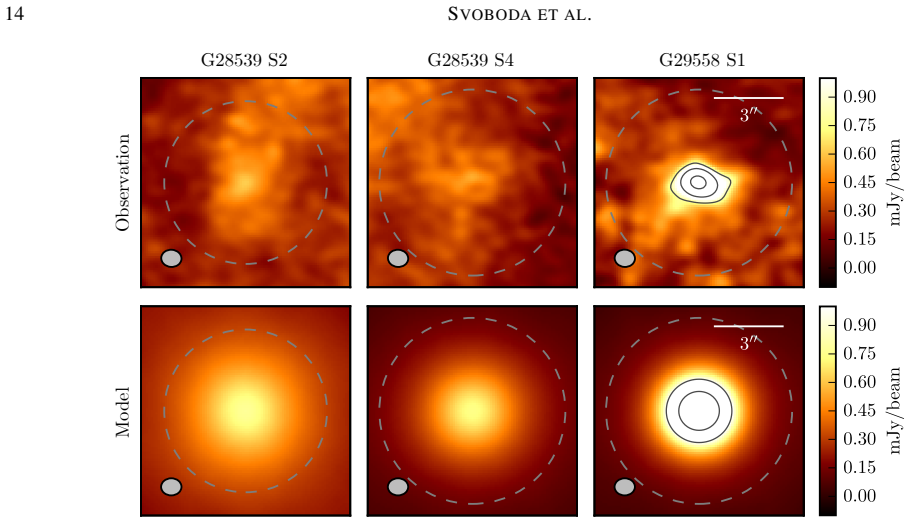
The paper's central claim is that fragmentation in high-mass starless clump candidates is controlled by the thermal Jeans length, not by turbulent or magnetic support. In the ALMA 1.3 mm maps, 67 dense sub-structures are extracted with a dendrogram; the nearest-neighbor separations, after Monte Carlo de-projection, have an ensemble median $\delta_{\mathrm{nns}}/\lambda_{\mathrm{j,th}} = 0.82$ with a (25,75) percentile interval of $0.52$–$1.25$, and 63.3% of separations fall below one thermal Jeans length. The same data show that 11 of the 12 clumps host embedded low- or intermediate-luminosity protostars, traced by 16 bipolar CO outflows and 4 SiO outflows, and that unresolved continuum sources are poorly fit by starless-core radiative-transfer models. Two resolved cores in G28539 are well fit as starless cores, one with a model mass near $29\,M_\odot$, leaving that clump as the only true starless candidate in the sample. The authors interpret the ensemble of results as evidence for hierarchical fragmentation in which the highest-density gas fragments thermally before high-mass protostars form.
Load-bearing premise
The entire fragmentation-scale conclusion depends on the assumed three-dimensional layout of the sources: isolated sources are modeled with a line-of-sight Gaussian spread of 0.15 pc and dendrogram-linked sources are modeled as filaments with a common inclination capped at a 0.6 pc deprojected length, so if the true geometry differs, the deprojected separations that match the Jeans length could be significantly biased.
Editorial extensions
If this is right
- If fragmentation is thermal, the initial spacing of massive protocluster cores is set by temperature and density alone, and the thermal Jeans mass of about $1\,M_\odot$ aligns naturally with the peak of the stellar initial mass function.
- Catalog-level 70 µm 'starless' classifications are not reliable: 11 of 12 such clumps show outflow or compact-source evidence of protostars, so any quiescence claim needs high-resolution millimeter follow-up.
- A 'low-mass first' formation route becomes plausible: initially low- to intermediate-mass protostars accrete from the surrounding clump, so high-mass stars need not begin as massive monolithic starless cores.
- The bimodal separation distribution and second-nearest-neighbor spacings near the Jeans length support hierarchical fragmentation, with clump-scale cylindrical fragmentation followed by core-scale thermal Jeans fragmentation.
- G28539, the sole remaining starless candidate, with its two well-fit high-mass starless core candidates, is the best current target for studying the pre-stellar initial conditions of a massive protocluster.
Reading between the lines
- If the assumed projection geometry is close to right, a testable extension is that dense-gas kinematics (e.g., from N2H+ or NH3) should show velocity structure coherent on the Jeans scale, allowing the Monte Carlo correction to be replaced by direct line-of-sight measurements.
- The frequent sub-Jeans separations could mean some pairs are still moving together during collapse or that projection correction underestimates clustered sources; comparing relative velocities of close pairs would distinguish contraction and merging from a static fragmented hierarchy.
- A similar survey of lower-mass or more distant 70-µm-dark clumps would test whether thermal-Jeans fragmentation is universal among massive starless clumps or only characteristic of the most massive, high-column-density subset studied here.
- If the outflow detection rate holds, a quantitative prediction is that roughly 90% of nominally starless massive clumps observed at this resolution and sensitivity will show low-luminosity protostars, shrinking the estimated population of genuinely quiescent massive clumps.
Signed reviews
Editorial analysis
A structured set of objections, weighed in public.
Referee Report
Summary. Svoboda et al. present ALMA 1.3 mm continuum and spectral line observations of 12 high-mass starless clump candidates (SCCs) selected from BGPS and IRDC surveys. They identify 67 dendrogram sub-structures, detect CO/SiO bipolar outflows toward 11 of 12 clumps, and compare selected continuum sources with RADMC-3D starless core models. The central fragmentation analysis measures nearest neighbor separations among the sub-structures, applies a Monte Carlo deprojection with explicit assumptions for isolated and grouped sources, and compares the results to the clump-average thermal Jeans length computed from ATLASGAL 870 μm flux densities with propagated uncertainties. The ensemble median projection-corrected separation is δ_nns/λ_j,th = 0.82 (25–75% percentile interval 0.52–1.25), and the CDF shows 63.3% of separations below one thermal Jeans length, supporting fragmentation at the thermal Jeans scale.
Significance. This is one of the first systematic ALMA surveys of high-mass starless clump candidates at ~3000 au resolution. If the result holds, it provides a robust observational constraint that fragmentation at the clump scale occurs near the thermal Jeans length rather than the turbulent or cylindrical Jeans scale, with implications for the initial conditions of high-mass star and cluster formation. The paper is careful in several respects: point-source completeness and model recovery are quantified, the Monte Carlo propagation of uncertainties in distances, dust temperatures, and densities is well described, the limitations of single-wavelength temperature assumptions and of the starless core model grid are stated explicitly, and the authors refrain from overinterpreting unresolved cores as definitively protostellar. The discovery of low-luminosity protostars in 11 of 12 supposed starless clumps is a significant empirical result that cautions against relying on MIR/FIR survey completeness for identifying truly quiescent clumps.
minor comments (5)
- [§2.4 and §5.1] The paper first reports 67 sub-structures in §2.4, but §5.1 gives 17 isolated and 49 grouped sources, which sum to 66. Since G23605 is excluded from the nearest-neighbor analysis, please state explicitly that 66 of the 67 sources are used, or correct the counts, so the ensemble statistics in Figure 13 can be verified.
- [§5.2 and §4.4] The sentence 'Replacing cs with cs,e_ff in Equation 5.2' appears to refer to Eq. (4) for the thermal Jeans length, not to a numbered Eq. (5.2); similarly, §4.4 refers to 'Equation 4.4' when comparing to Eq. (2). Please correct the equation cross-references.
- [§5.1] The deprojection scheme is explicitly labeled 'simple and imperfect'; because the numerical medians in Figure 13 depend on the assumed σ_z and D, a brief quantitative robustness check (e.g., varying σ_z and D over plausible ranges, in addition to the already-given uniform-sphere comparison) would help readers assess how sensitive the median δ_nns/λ_j,th is to the prior.
- [§7] In the conclusions, the statement 'sensitivity ( 50 µJy beam−1) sufficient...' contains a stray opening parenthesis and does not specify that this is the 1σ RMS noise level; please rephrase, e.g., 'with 1σ RMS sensitivity of ~50 µJy beam−1'.
- [§4.4] The phrase 'This ultimately provides a more conservative criteria for rejecting poor fits' is ambiguous: if the Bayesian likelihood is too stringent, the ∆χ²_r < 3 heuristic is presumably less stringent (more permissive). Please reword to avoid confusion.
Circularity Check
No significant circularity: the Jeans-length comparison is an independent external benchmark, not a fitted or self-referential result.
full rationale
The paper's central claim is that projection-corrected nearest-neighbor separations among dendrogram sub-structures are consistent with the clump-average thermal Jeans length. The Jeans length (Eq. 4) is computed from the isothermal sound speed and a volume density rho0 = 3Sigma/4R, where Sigma comes from ATLASGAL 870 micron fluxes in a 27 arcsec aperture (Eq. 5) and the authors sample Td = 12 +/- 2 K and distance DPDFs. This density input is independent of the ALMA 1.3 mm source positions used for the separations, so the comparison is not a fit or a definitional identity. The projected median separation (0.083 pc = 0.61 lambda_j,th) and the alternative uniform-sphere deprojection (0.153 pc = 1.13 lambda_j,th) bracket the claimed range, showing the Monte Carlo deprojection prior (sigma_z = 0.15 pc, D = 0.6 pc) is not load-bearing. Section 5.1 explicitly labels the correction 'simple and imperfect,' which is a modeling limitation, not circularity. The protostellar classification of unresolved cores is based on poor fits to starless models; the paper itself notes that more extreme starless models could fit (Section 4.4), and this inference does not feed back into the separation analysis. Self-citations (Svoboda et al. 2016; Traficante et al. 2015) supply the sample and clump properties but not the fragmentation-length conclusion. No equation reduces to its own input; no fitted parameter is renamed as a prediction. Therefore no circular steps are identified.
Assumptions & free parameters
free parameters (2)
- Projection correction sigma_z =
0.15 pc
- Grouped source maximum extent D =
0.6 pc
assumptions (4)
- domain assumption Grain opacity and dust-to-gas ratio: kappa(1.3 mm)=0.90 cm2/g, dust-to-gas mass ratio 1/110, mean molecular weight 2.33.
- domain assumption Starless cores are externally heated Plummer spheres (Eq. 1).
- domain assumption Dust temperature equals gas kinetic temperature, T_d = T_K = 12 K, for mass and Jeans length estimates.
- ad hoc to paper Line-of-sight projection correction scheme (Section 5.1).
Cite this review
Pith. "Pith review of ALMA observations of fragmentation, sub-structure, and protostars in high-mass starless clump candidates." pith.science (2026). https://pith.science/paper/UGV6TVPH
@misc{pith2026190810374,
  author       = {Pith},
  title        = {Pith review of: ALMA observations of fragmentation, sub-structure, and protostars in high-mass starless clump candidates},
  year         = {2026},
  howpublished = {\url{https://pith.science/paper/UGV6TVPH}},
  note         = {Machine review of arXiv:1908.10374}
}
abstract
(Abridged) The initial physical conditions of high-mass stars and protoclusters remain poorly characterized. To this end we present the first targeted ALMA 1.3mm continuum and spectral line survey towards high-mass starless clump candidates, selecting a sample of 12 of the most massive candidates ($400-4000\, M_\odot$) within 5 kpc. The joint 12+7m array maps have a high spatial resolution of $\sim 3000\, \mathrm{au}$ ($\sim 0.8^{\prime\prime}$) and have point source mass-completeness down to $\sim 0.3\, M_\odot$ at $6\sigma$ (or $1\sigma$ column density sensitivity of $1.1\times10^{22}\, \mathrm{cm^{-2}}$). We discover previously undetected signposts of low-luminosity star formation from CO (2-1) and SiO (5-4) bipolar outflows and other signatures towards 11 out of 12 clumps, showing that current MIR/FIR Galactic Plane surveys are incomplete to low- and intermediate-mass protostars ($\lesssim 50\, L_\odot$). We compare a subset of the observed cores with a suite of radiative transfer models of starless cores. We find a high-mass starless core candidate with a model-derived mass consistent with $29^{52}_{15}\, M_\odot$ when integrated over size scales of $2\times10^4\, \mathrm{au}$. Unresolved cores are poorly fit by starless core models, supporting the interpretation that they are protostellar even without detection of outflows. Substantial fragmentation is observed towards 10 out of 12 clumps. We extract sources from the maps using a dendrogram to study the characteristic fragmentation length scale. Nearest neighbor separations when corrected for projection are consistent with being equal to the clump average thermal Jeans length. Our findings support a hierarchical fragmentation process, where the highest density regions are not strongly supported against thermal gravitational fragmentation by turbulence or magnetic fields.
Figures


Figures from the paper (14 more)




Reference graph
Works this paper leans on
-
[1]
, " * write output.state after.block = add.period write newline
ENTRY address author booktitle chapter edition editor howpublished institution journal key month note number organization pages publisher school series title type volume year label extra.label sort.label short.list INTEGERS output.state before.all mid.sentence after.sentence after.block FUNCTION init.state.consts #0 'before.all := #1 'mid.sentence := #2 '...
-
[2]
write newline
" write newline "" before.all 'output.state := FUNCTION n.dashify 't := "" t empty not t #1 #1 substring "-" = t #1 #2 substring "--" = not "--" * t #2 global.max substring 't := t #1 #1 substring "-" = "-" * t #2 global.max substring 't := while if t #1 #1 substring * t #2 global.max substring 't := if while FUNCTION word.in bbl.in " " * FUNCTION format....
-
[3]
, " * write output.state after.block = add.period write newline
ENTRY address archivePrefix author booktitle chapter doi edition editor eprint howpublished institution journal key month number organization pages publisher school series title misctitle type volume year version url label extra.label sort.label short.list INTEGERS output.state before.all mid.sentence after.sentence after.block FUNCTION init.state.consts ...
-
[4]
write newline
" write newline "" before.all 'output.state := FUNCTION format.url url empty "" new.block "" url * "" * if FUNCTION format.eprint eprint empty "" archivePrefix empty "" archivePrefix "arXiv" = new.block " " eprint * " " * new.block " " eprint * " " * if if if FUNCTION format.doi doi empty "" " " doi * " " * if FUNCTION format.pid doi empty eprint empty ""...
-
[5]
- [1] #1 = = ^ ^ ^ .\!\!^ d .\!\!^ h .\!\!^ m .\!\!^ s .\!\!^ @mss
thebibliography [1] 20pt to REFERENCES 6pt =0pt 10pt plus 3pt =0pt =0pt =1pt plus 1pt =0pt =0pt -12pt =13pt plus 1pt =20pt =13pt plus 1pt \@M =10000 =-1.0em =0pt =0pt 0pt =0pt =1.0em @enumiv\@empty 10000 10000 `\.\@m \@noitemerr \@latex@warning Empty `thebibliography' environment \@ifnextchar \@reference \@latexerr Missing key on reference command Each re...
2019
-
[6]
, " * write output.state after.block = add.period write newline
ENTRY address author booktitle chapter edition editor howpublished institution journal key month note number organization pages publisher school series title type volume year label extra.label sort.label short.list INTEGERS output.state before.all mid.sentence after.sentence after.block FUNCTION init.state.consts #0 'before.all := #1 'mid.sentence := #2 '...
-
[7]
write newline
" write newline "" before.all 'output.state := FUNCTION n.dashify 't := "" t empty not t #1 #1 substring "-" = t #1 #2 substring "--" = not "--" * t #2 global.max substring 't := t #1 #1 substring "-" = "-" * t #2 global.max substring 't := while if t #1 #1 substring * t #2 global.max substring 't := if while FUNCTION word.in bbl.in " " * FUNCTION format....
-
[8]
Aguirre , J. E., Ginsburg , A. G., Dunham , M. K., et al. 2011, , 192, 4, 10.1088/0067-0049/192/1/4
Show all 128 references
-
[9]
2014, Protostars and Planets VI, 27, 10.2458/azu_uapress_9780816531240-ch002
Andr \'e , P., Di Francesco , J., Ward-Thompson , D., et al. 2014, Protostars and Planets VI, 27, 10.2458/azu_uapress_9780816531240-ch002
2014 doi
-
[10]
G., Shepherd , D., Gueth , F., et al
Arce , H. G., Shepherd , D., Gueth , F., et al. 2007, Protostars and Planets V, 245
2007
-
[11]
Barnard , E. E. 1907, , 25, 10.1086/141434
1907 doi
-
[12]
M., et al
Battersby , C., Bally , J., Jackson , J. M., et al. 2010, , 721, 222, 10.1088/0004-637X/721/1/222
2010 doi
-
[13]
2017, , 835, 263, 10.3847/1538-4357/835/2/263
Battersby , C., Bally , J., & Svoboda , B. 2017, , 835, 263, 10.3847/1538-4357/835/2/263
2017 doi
-
[14]
A., Churchwell , E., Babler , B
Benjamin , R. A., Churchwell , E., Babler , B. L., et al. 2003, , 115, 953, 10.1086/376696
2003 doi
-
[15]
A., & Tafalla , M
Bergin , E. A., & Tafalla , M. 2007, , 45, 339, 10.1146/annurev.astro.45.071206.100404
2007
-
[16]
B., McKee , C
Beuther , H., Churchwell , E. B., McKee , C. F., & Tan , J. C. 2007, Protostars and Planets V, 165
2007
-
[17]
E., Johnston , K., et al
Beuther , H., Ragan , S. E., Johnston , K., et al. 2015 a , , 584, A67, 10.1051/0004-6361/201527108
2015 doi
-
[18]
2015 b , , 581, A119, 10.1051/0004-6361/201526759
Beuther , H., Henning , T., Linz , H., et al. 2015 b , , 581, A119, 10.1051/0004-6361/201526759
2015 doi
-
[19]
C., Ahmadi , A., et al
Beuther , H., Mottram , J. C., Ahmadi , A., et al. 2018, ArXiv e-prints. 1805.01191
2018 arXiv
-
[20]
Black , J. H. 1994, in Astronomical Society of the Pacific Conference Series, Vol. 58, The First Symposium on the Infrared Cirrus and Diffuse Interstellar Clouds, ed. R. M. Cutri & W. B. Latter , 355
1994
-
[22]
Bonnor , W. B. 1956, , 116, 351, 10.1093/mnras/116.3.351
1956 doi
-
[23]
2016, , 819, 139, 10.3847/0004-637X/819/2/139
Busquet , G., Estalella , R., Palau , A., et al. 2016, , 819, 139, 10.3847/0004-637X/819/2/139
2016 doi
-
[24]
A., Clayton , G
Cardelli , J. A., Clayton , G. C., & Mathis , J. S. 1989, , 345, 245, 10.1086/167900
1989 doi
-
[25]
2015, , 584, A78, 10.1051/0004-6361/201525780
Carniani , S., Maiolino , R., De Zotti , G., et al. 2015, , 584, A78, 10.1051/0004-6361/201525780
2015 doi
-
[26]
T., Jackson , J
Chambers , E. T., Jackson , J. M., Rathborne , J. M., & Simon , R. 2009, , 181, 360, 10.1088/0067-0049/181/2/360
2009 doi
-
[27]
1953, , 118, 116, 10.1086/145732
Chandrasekhar , S., & Fermi , E. 1953, , 118, 116, 10.1086/145732
1953 doi
-
[28]
L., Meade , M
Churchwell , E., Babler , B. L., Meade , M. R., et al. 2009, , 121, 213, 10.1086/597811
2009 doi
-
[29]
S., et al
Contreras , Y., Schuller , F., Urquhart , J. S., et al. 2013, , 549, A45, 10.1051/0004-6361/201220155
2013 doi
-
[30]
S., Schuller , F., et al
Csengeri , T., Urquhart , J. S., Schuller , F., et al. 2014, , 565, A75, 10.1051/0004-6361/201322434
2014 doi
-
[31]
J., Brogan , C
Cyganowski , C. J., Brogan , C. L., Hunter , T. R., et al. 2017, , 468, 3694, 10.1093/mnras/stx043
2017 doi
-
[32]
J., Whitney , B
Cyganowski , C. J., Whitney , B. A., Holden , E., et al. 2008, , 136, 2391, 10.1088/0004-6256/136/6/2391
2008 doi
-
[33]
Draine , B. T. 1978, , 36, 595, 10.1086/190513
1978 doi
-
[34]
P., Juhasz , A., Pohl , A., et al
Dullemond , C. P., Juhasz , A., Pohl , A., et al. 2012, RADMC-3D: A multi-purpose radiative transfer tool , Astrophysics Source Code Library. 1202.015
2012
-
[35]
M., Stutz , A
Dunham , M. M., Stutz , A. M., Allen , L. E., et al. 2014, Protostars and Planets VI, 195, 10.2458/azu_uapress_9780816531240-ch009
2014 doi
-
[36]
J., et al
Dzib , S., Loinard , L., Mioduszewski , A. J., et al. 2010, , 718, 610, 10.1088/0004-637X/718/2/610
2010 doi
-
[37]
1955, , 37, 217
Ebert , R. 1955, , 37, 217
1955
-
[38]
J., Moore , T
Eden , D. J., Moore , T. J. T., Plume , R., et al. 2017, , 469, 2163, 10.1093/mnras/stx874
2017 doi
-
[39]
2017, , 471, 100, 10.1093/mnras/stx1357
Elia , D., Molinari , S., Schisano , E., et al. 2017, , 471, 100, 10.1093/mnras/stx1357
2017 doi
-
[40]
P., Rosolowsky , E., Glenn , J., et al
Ellsworth-Bowers , T. P., Rosolowsky , E., Glenn , J., et al. 2015, , 799, 29, 10.1088/0004-637X/799/1/29
2015 doi
-
[41]
L., Corder , S., Duch \^e ne , G., et al
Enoch , M. L., Corder , S., Duch \^e ne , G., et al. 2011, , 195, 21, 10.1088/0067-0049/195/2/21
2011 doi
-
[43]
2016 b , , 828, 100, 10.3847/0004-637X/828/2/100
---. 2016 b , , 828, 100, 10.3847/0004-637X/828/2/100
2016 doi
-
[44]
P., Cabrit , S., et al
Frank , A., Ray , T. P., Cabrit , S., et al. 2014, Protostars and Planets VI, 451, 10.2458/azu_uapress_9780816531240-ch020
2014 doi
-
[45]
K., Bourke , T
Friesen , R. K., Bourke , T. L., Di Francesco , J., Gutermuth , R., & Myers , P. C. 2016, , 833, 204, 10.3847/1538-4357/833/2/204
2016 doi
-
[46]
K., Pineda , J
Friesen , R. K., Pineda , J. E., co-PIs , et al. 2017, , 843, 63, 10.3847/1538-4357/aa6d58
2017 doi
-
[47]
2013, , 208, 14, 10.1088/0067-0049/208/2/14
Ginsburg , A., Glenn , J., Rosolowsky , E., et al. 2013, , 208, 14, 10.1088/0067-0049/208/2/14
2013 doi
-
[48]
2012, , 420, 1457, 10.1111/j.1365-2966.2011.20131.x
Hartmann , L., Ballesteros-Paredes , J., & Heitsch , F. 2012, , 420, 1457, 10.1111/j.1365-2966.2011.20131.x
2012
-
[49]
2013, , 769, L27, 10.1088/2041-8205/769/2/L27
Hatsukade , B., Ohta , K., Seko , A., Yabe , K., & Akiyama , M. 2013, , 769, L27, 10.1088/2041-8205/769/2/L27
2013 doi
-
[50]
2017, ArXiv e-prints
Hocuk , S., Szucs , L., Caselli , P., et al. 2017, ArXiv e-prints. 1704.02763
2017 arXiv
-
[51]
2009, , 691, 823, 10.1088/0004-637X/691/1/823
Hosokawa , T., & Omukai , K. 2009, , 691, 823, 10.1088/0004-637X/691/1/823
2009 doi
-
[52]
Hunter, J. D. 2007, Computing In Science & Engineering, 9, 90, 10.1109/MCSE.2007.55
2007 doi
-
[53]
D., Cyganowski , C
Ilee , J. D., Cyganowski , C. J., Nazari , P., et al. 2016, , 462, 4386, 10.1093/mnras/stw1912
2016 doi
-
[54]
Inutsuka , S.-I., & Miyama , S. M. 1992, , 388, 392, 10.1086/171162
1992 doi
-
[55]
M., Finn , S
Jackson , J. M., Finn , S. C., Chambers , E. T., Rathborne , J. M., & Simon , R. 2010, , 719, L185, 10.1088/2041-8205/719/2/L185
2010 doi
-
[56]
C., et al
Jim \'e nez-Serra , I., Caselli , P., Tan , J. C., et al. 2010, , 406, 187, 10.1111/j.1365-2966.2010.16698.x
2010
-
[57]
E., Henning , T., & Stutz , A
Kainulainen , J., Ragan , S. E., Henning , T., & Stutz , A. 2013, , 557, A120, 10.1051/0004-6361/201321760
2013 doi
-
[58]
M., Stanke , T., et al
Kainulainen , J., Stutz , A. M., Stanke , T., et al. 2017, , 600, A141, 10.1051/0004-6361/201628481
2017 doi
-
[59]
2010, , 723, L7, 10.1088/2041-8205/723/1/L7
Kauffmann , J., & Pillai , T. 2010, , 723, L7, 10.1088/2041-8205/723/1/L7
2010 doi
-
[60]
C., Caselli , P., et al
Kong , S., Tan , J. C., Caselli , P., et al. 2017, , 834, 193, 10.3847/1538-4357/834/2/193
2017 doi
-
[61]
2001, , 322, 231, 10.1046/j.1365-8711.2001.04022.x
Kroupa , P. 2001, , 322, 231, 10.1046/j.1365-8711.2001.04022.x
2001
-
[62]
Larson , R. B. 1985, , 214, 379, 10.1093/mnras/214.3.379
1985 doi
-
[63]
2005, , 359, 211, 10.1111/j.1365-2966.2005.08881.x
---. 2005, , 359, 211, 10.1111/j.1365-2966.2005.08881.x
2005
-
[64]
2016, , 592, A61, 10.1051/0004-6361/201525792
Lippok , N., Launhardt , R., Henning , T., et al. 2016, , 592, A61, 10.1051/0004-6361/201525792
2016 doi
-
[65]
2016, , 595, A122, 10.1051/0004-6361/201629077
Louvet , F., Motte , F., Gusdorf , A., et al. 2016, , 595, A122, 10.1051/0004-6361/201629077
2016 doi
-
[66]
2015, , 805, 171, 10.1088/0004-637X/805/2/171
Lu , X., Zhang , Q., Wang , K., & Gu , Q. 2015, , 805, 171, 10.1088/0004-637X/805/2/171
2015 doi
-
[67]
A., Peretto , N., et al
McGuire , C., Fuller , G. A., Peretto , N., et al. 2016, , 594, A118, 10.1051/0004-6361/201527062
2016 doi
-
[68]
F., & Ostriker , E
McKee , C. F., & Ostriker , E. C. 2007, , 45, 565, 10.1146/annurev.astro.45.051806.110602
2007 arXiv
- [69]
- [70]
-
[71]
2010, in Proceedings of the 9th Python in Science Conference, ed
McKinney, W. 2010, in Proceedings of the 9th Python in Science Conference, ed. S. van der Walt & J. Millman, 51 -- 56
2010
-
[72]
P., Waters , B., Schiebel , D., Young , W., & Golap , K
McMullin , J. P., Waters , B., Schiebel , D., Young , W., & Golap , K. 2007, in Astronomical Society of the Pacific Conference Series, Vol. 376, Astronomical Data Analysis Software and Systems XVI, ed. R. A. Shaw , F. Hill , & D. J. Bell , 127
2007
-
[73]
2010, , 122, 314, 10.1086/651314
Molinari , S., Swinyard , B., Bally , J., et al. 2010, , 122, 314, 10.1086/651314
2010 doi
-
[74]
2016, , 591, A149, 10.1051/0004-6361/201526380
Molinari , S., Schisano , E., Elia , D., et al. 2016, , 591, A149, 10.1051/0004-6361/201526380
2016 doi
-
[75]
2017, ArXiv e-prints
Motte , F., Bontemps , S., & Louvet , F. 2017, ArXiv e-prints. 1706.00118
2017 arXiv
-
[76]
u ller , H. S. P., Schl \
M \"u ller , H. S. P., Schl \"o der , F., Stutzki , J., & Winnewisser , G. 2005, Journal of Molecular Structure, 742, 215, 10.1016/j.molstruc.2005.01.027
2005 doi
-
[77]
Myers , P. C. 2017, , 838, 10, 10.3847/1538-4357/aa5fa8
2017 doi
-
[78]
1987, Progress of Theoretical Physics, 77, 635, 10.1143/PTP.77.635
Nagasawa , M. 1987, Progress of Theoretical Physics, 77, 635, 10.1143/PTP.77.635
1987 doi
-
[79]
2013, , 775, 88, 10.1088/0004-637X/775/2/88
Nguyen-Lu'o'ng , Q., Motte , F., Carlhoff , P., et al. 2013, , 775, 88, 10.1088/0004-637X/775/2/88
2013 doi
-
[80]
Oliphant, T. E. 2007, Computing in Science & Engineering, 9
2007
-
[81]
1994, , 291, 943
Ossenkopf , V., & Henning , T. 1994, , 291, 943
1994
- [82]
-
[83]
2015, , 453, 3785, 10.1093/mnras/stv1834
Palau , A., Ballesteros-Paredes , J., V \'a zquez-Semadeni , E., et al. 2015, , 453, 3785, 10.1093/mnras/stv1834
2015 doi
-
[84]
A., Roman-Zuniga , C
Palau , A., Zapata , L. A., Roman-Zuniga , C. G., et al. 2017, ArXiv e-prints. 1706.04623
2017 arXiv
-
[85]
Peretto , N., & Fuller , G. A. 2009, , 505, 405, 10.1051/0004-6361/200912127
2009 doi
-
[86]
P \'e rez, F., & Granger, B. E. 2007, Computing in Science & Engineering, 9
2007
-
[87]
S., & Mac Low , M.-M
Peters , T., Banerjee , R., Klessen , R. S., & Mac Low , M.-M. 2011, , 729, 72, 10.1088/0004-637X/729/1/72
2011 doi
-
[88]
S., et al
Peters , T., Banerjee , R., Klessen , R. S., et al. 2010 a , , 711, 1017, 10.1088/0004-637X/711/2/1017
2010 doi
-
[89]
S., Mac Low , M.-M., & Banerjee , R
Peters , T., Klessen , R. S., Mac Low , M.-M., & Banerjee , R. 2010 b , , 725, 134, 10.1088/0004-637X/725/1/134
2010 doi
-
[90]
Plummer , H. C. 1911, , 71, 460, 10.1093/mnras/71.5.460
1911 doi
-
[91]
C., Dunham , M
Pokhrel , R., Myers , P. C., Dunham , M. M., et al. 2018, , 853, 5, 10.3847/1538-4357/aaa240
2018 doi
-
[92]
J., Markwick-Kemper , A., & ALMA Working Group on Spectral Line Frequencies
Remijan , A. J., Markwick-Kemper , A., & ALMA Working Group on Spectral Line Frequencies . 2007, in American Astronomical Society Meeting Abstracts, Vol. 211, 132.11
2007
-
[93]
Robitaille , T. P. 2017, , 600, A11, 10.1051/0004-6361/201425486
2017 doi
-
[94]
P., Whitney , B
Robitaille , T. P., Whitney , B. A., Indebetouw , R., & Wood , K. 2007, , 169, 328, 10.1086/512039
2007 doi
-
[95]
2016, ArXiv e-prints
Rosero , V., Hofner , P., Claussen , M., et al. 2016, ArXiv e-prints. 1609.03269
2016 arXiv
-
[96]
K., Ginsburg , A., et al
Rosolowsky , E., Dunham , M. K., Ginsburg , A., et al. 2010, , 188, 123, 10.1088/0067-0049/188/1/123
2010 doi
-
[97]
W., Pineda , J
Rosolowsky , E. W., Pineda , J. E., Kauffmann , J., & Goodman , A. A. 2008, , 679, 1338, 10.1086/587685
2008 doi
-
[98]
M., Foster , J
Sanhueza , P., Jackson , J. M., Foster , J. B., et al. 2013, , 773, 123, 10.1088/0004-637X/773/2/123
2013 doi
-
[99]
M., Zhang , Q., et al
Sanhueza , P., Jackson , J. M., Zhang , Q., et al. 2017, , 841, 97, 10.3847/1538-4357/aa6ff8
2017 doi
-
[100]
W., Immer , K., et al
Sato , M., Wu , Y. W., Immer , K., et al. 2014, , 793, 72, 10.1088/0004-637X/793/2/72
2014 doi
-
[101]
M., Pineau des Forets , G., & Flower , D
Schilke , P., Walmsley , C. M., Pineau des Forets , G., & Flower , D. R. 1997, , 321, 293
1997
-
[102]
M., Contreras , Y., et al
Schuller , F., Menten , K. M., Contreras , Y., et al. 2009, , 504, 415, 10.1051/0004-6361/200811568
2009 doi
-
[103]
L., Claussen , M
Shirley , Y. L., Claussen , M. J., Bourke , T. L., Young , C. H., & Blake , G. A. 2007, , 667, 329, 10.1086/520570
2007 doi
-
[104]
L., Nordhaus , M
Shirley , Y. L., Nordhaus , M. K., Grcevich , J. M., et al. 2005, , 632, 982, 10.1086/431963
2005 doi
-
[105]
J., Glover , S
Smith , R. J., Glover , S. C. O., Klessen , R. S., & Fuller , G. A. 2016, , 455, 3640, 10.1093/mnras/stv2559
2016 doi
-
[106]
J., Longmore , S., & Bonnell , I
Smith , R. J., Longmore , S., & Bonnell , I. 2009, , 400, 1775, 10.1111/j.1365-2966.2009.15621.x
2009
-
[107]
E., Shirley , Y
Svoboda , B. E., Shirley , Y. L., Battersby , C., et al. 2016, , 822, 59, 10.3847/0004-637X/822/2/59
2016 doi
-
[108]
C., Beltr \'a n , M
Tan , J. C., Beltr \'a n , M. T., Caselli , P., et al. 2014, Protostars and Planets VI, 149, 10.2458/azu_uapress_9780816531240-ch007
2014 doi
-
[109]
C., Kong , S., Butler , M
Tan , J. C., Kong , S., Butler , M. J., Caselli , P., & Fontani , F. 2013, , 779, 96, 10.1088/0004-637X/779/2/96
2013 doi
-
[110]
C., Kong , S., Zhang , Y., et al
Tan , J. C., Kong , S., Zhang , Y., et al. 2016, , 821, L3, 10.3847/2041-8205/821/1/L3
2016 doi
-
[111]
S., Takahashi , S., Zapata , L
Teixeira , P. S., Takahashi , S., Zapata , L. A., & Ho , P. T. P. 2016, , 587, A47, 10.1051/0004-6361/201526807
2016 doi
-
[112]
M., Sip o cz , B
The Astropy Collaboration , Price-Whelan , A. M., Sip o cz , B. M., et al. 2018, , 156, 123, 10.3847/1538-3881/aabc4f
2018 doi
-
[113]
A., Billot , N., et al
Traficante , A., Fuller , G. A., Billot , N., et al. 2017, , 470, 3882, 10.1093/mnras/stx1375
2017 doi
-
[114]
A., Peretto , N., Pineda , J
Traficante , A., Fuller , G. A., Peretto , N., Pineda , J. E., & Molinari , S. 2015, , 451, 3089, 10.1093/mnras/stv1158
2015 doi
-
[115]
2013, , 549, A130, 10.1051/0004-6361/201219570
Veneziani , M., Elia , D., Noriega-Crespo , A., et al. 2013, , 549, A130, 10.1051/0004-6361/201219570
2013 doi
-
[116]
2012, , 745, L30, 10.1088/2041-8205/745/2/L30
Wang , K., Zhang , Q., Wu , Y., Li , H.-b., & Zhang , H. 2012, , 745, L30, 10.1088/2041-8205/745/2/L30
2012 doi
-
[117]
2011, , 735, 64, 10.1088/0004-637X/735/1/64
Wang , K., Zhang , Q., Wu , Y., & Zhang , H. 2011, , 735, 64, 10.1088/0004-637X/735/1/64
2011 doi
-
[118]
2014, , 439, 3275, 10.1093/mnras/stu127
Wang , K., Zhang , Q., Testi , L., et al. 2014, , 439, 3275, 10.1093/mnras/stu127
2014 doi
-
[119]
2010, , 709, 27, 10.1088/0004-637X/709/1/27
Wang , P., Li , Z.-Y., Abel , T., & Nakamura , F. 2010, , 709, 27, 10.1088/0004-637X/709/1/27
2010 doi
-
[120]
M., Jackson , J., & Wu , Y
Wang , Y., Zhang , Q., Rathborne , J. M., Jackson , J., & Wu , Y. 2006, , 651, L125, 10.1086/508939
2006 doi
- [121]
-
[122]
P., & Ward-Thompson , D
Whitworth , A. P., & Ward-Thompson , D. 2001, , 547, 317, 10.1086/318373
2001 doi
-
[123]
2012, , 544, A146, 10.1051/0004-6361/201118107
Wienen , M., Wyrowski , F., Schuller , F., et al. 2012, , 544, A146, 10.1051/0004-6361/201118107
2012 doi
-
[124]
P., de Geus , E
Williams , J. P., de Geus , E. J., & Blitz , L. 1994, , 428, 693, 10.1086/174279
1994 doi
- [125]
-
[126]
P., et al
Yuan , J., Wu , Y., Ellingsen , S. P., et al. 2017, , 231, 11, 10.3847/1538-4365/aa7204
2017 doi
-
[127]
2011, , 733, 26, 10.1088/0004-637X/733/1/26
Zhang , Q., & Wang , K. 2011, , 733, 26, 10.1088/0004-637X/733/1/26
2011 doi
-
[128]
2015, , 804, 141, 10.1088/0004-637X/804/2/141
Zhang , Q., Wang , K., Lu , X., & Jim \'e nez-Serra , I. 2015, , 804, 141, 10.1088/0004-637X/804/2/141
2015 doi
-
[129]
2009, , 696, 268, 10.1088/0004-637X/696/1/268
Zhang , Q., Wang , Y., Pillai , T., & Rathborne , J. 2009, , 696, 268, 10.1088/0004-637X/696/1/268
2009 doi
-
[130]
C., & Hosokawa , T
Zhang , Y., Tan , J. C., & Hosokawa , T. 2014, , 788, 166, 10.1088/0004-637X/788/2/166
2014 doi
Reviewed August 14, 2026 · model on record in the stance chip above.
Discussion (0). Continue with ORCID to comment.