REVIEW 2 major objections 4 minor 47 references
NuSTAR Discovery of Dead Quasar Engine in Arp 187
T0 review · 2 major / 4 minor · reviewed 2026-08-14 · deepseek-v4-flash
Pith's one-line read Using an 82,000-second NuSTAR observation, this paper establishes that Arp 187's supermassive black hole currently radiates below $10^{42.5}$ erg s$^{-1}$, at least a thousand times fainter than its quasar-era luminosity of about…
desk verdict Solid NuSTAR upper limit shows Arp 187's nucleus is currently inactive, but the dramatic >10^3 decline in <10^4 yr rests on an unexamined light-echo assumption for the NLR and needs a shock-excitation check. read the letter →
The pith
A machine-rendered reading of the paper's core claim, the machinery that carries it, and where it could break.
The reading
What carries the argument
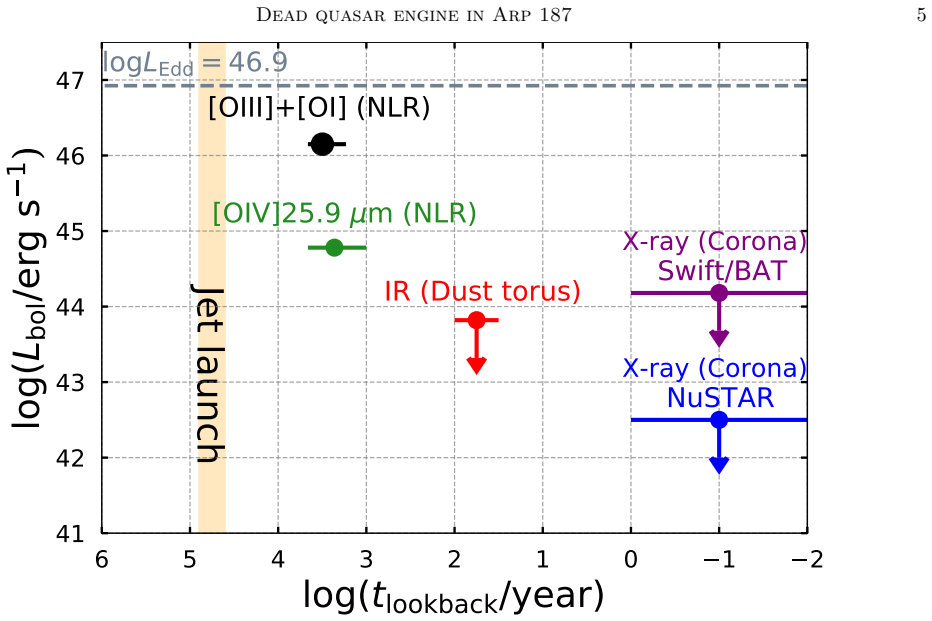
The load-bearing device is the multi-scale light echo of Arp 187. Each AGN indicator traces a different physical radius around the black hole, and light-travel time converts that radius into a look-back time, so different indicators stack into a long-baseline light curve spanning from $10^3$--$10^4$ years ago to today. The narrow line region, about 1 kpc in size, supplies the past anchor through its [O III] and [O I] line luminosities; the absent dusty torus and, especially, the NuSTAR hard X-ray upper limit supply the current anchor, because hard X-rays pierce even Compton-thick gas. The central comparison is between $L_{\rm bol} \simeq 10^{46}$ erg s$^{-1}$ from the NLR and $L_{\rm bol} < 10^{42.5}$ erg s$^{-1}$ from X-rays, a factor of more than $10^3$. A radiative-transfer torus model converts the X-ray count-rate upper limit into an intrinsic luminosity for the heavily obscured case, which keeps the conclusion nearly unchanged.
What would settle it
A clear detection of the Arp 187 nucleus in a deeper hard X-ray observation at $\log (L_{\rm 2-10\,keV}/{\rm erg\ s}^{-1}) > 41.2$ would falsify the inactive-engine claim, as would a Compton-scattered Fe K$\alpha$ line or hard continuum at the level of $L_{\rm bol} \gtrsim 10^{43}$ erg s$^{-1}$. Conversely, spatially resolved spectroscopy of the [O III] emission that attributes it to star-forming H II regions rather than AGN photoionization would remove the high past-luminosity anchor and with it the factor-of-$10^3$ decline.
Extended reading notes
Core claim
The central claim is that Arp 187, a merger remnant at $z=0.04$, has a central engine that is currently inactive. In an 82 ks NuSTAR pointing, the 3--50 keV spectrum of the nucleus shows no significant excess over background ($2.9\sigma$ at 3--8 keV and $1.5\sigma$ at 8--24 keV), giving a $3\sigma$ upper limit of $\log (L_{\rm 2-10\,keV}/{\rm erg\ s}^{-1}) < 41.2$ and, with a bolometric correction factor of 20, $\log (L_{\rm bol}/{\rm erg\ s}^{-1}) < 42.5$. The limit survives heavy obscuration: even a Compton-thick torus with $N_{\rm H} = 1.5\times 10^{24}$ cm$^{-2}$ raises the intrinsic upper bound only to $\log (L_{\rm 2-10\,keV}/{\rm erg\ s}^{-1}) = 41.75$, or $\log (L_{\rm bol}/{\rm erg\ s}^{-1}) = 43.05$, and the extreme $N_{\rm H} = 10^{25}$ cm$^{-2}$ case that would hide a brighter engine is argued to be inconsistent with the absence of reprocessed infrared emission in the Spitzer/IRS spectrum. Compared with the past luminosity of $L_{\rm bol} = 1.5\times 10^{46}$ erg s$^{-1}$ inferred from the narrow line region, this represents a decline by more than a factor of $10^3$ within less than $10^4$ years. The paper concludes that the accretion supply must have been shut off abruptly, requiring a burst-like accretion mechanism with a sharp outer disk boundary, and it discusses a tidal disruption of a giant molecular cloud and gas depletion by a nuclear starburst as two possible ways to produce such a boundary.
Load-bearing premise
The argument assumes that the bright narrow-line-region emission, calibrated to a past bolometric luminosity of about $10^{46}$ erg s$^{-1}$, really does come from an earlier quasar phase that ended $10^3$--$10^4$ years ago; if star formation powers those lines instead, or if the light-travel time to the kiloparsec-scale gas is not the right clock, the true decline could be much smaller and slower.
Editorial extensions
If this is right
- Arp 187's black hole is today radiating below $10^{42.5}$ erg s$^{-1}$, so its accretion rate must have dropped by more than a factor of $10^3$ within less than $10^4$ years.
- Because a gradual decrease of external gas supply cannot produce such a sharp drop, the accretion disk must have a sharp outer boundary, and the activity episode that built the NLR must have been burst-like rather than steady.
- A tidal disruption of a single star is excluded for Arp 187: with a black hole mass of $6.7\times10^8 M_\odot$, the required Eddington ratio and a jet/NLR age of $8\times10^4$ years are incompatible with the canonical $t^{-5/3}$ TDE decay.
- The remaining scenarios are tidal disruption of a giant molecular cloud of about $10^6 M_\odot$, which can feed the black hole at sub-Eddington level for roughly $4\times10^5$ years, and gas depletion by vigorous nuclear star formation after a merger-driven inflow.
- If Arp 187 is typical, the final phase of quasar activity may be a fast shutdown bounded by a clear accretion-disk edge, whereas smooth sub-critical accretion should fade over more than $10^4$ years.
Reading between the lines
- If this shutdown mode is common, surveys should catch far more quasars in the bright phase than in the dying phase, so the fraction of apparently 'dead' engines like Arp 187 could be used to measure how often black-hole growth ends abruptly rather than fading gradually.
- The molecular-cloud TDE scenario predicts a surviving reservoir of shocked, high-velocity molecular gas near the nucleus of Arp 187, which could be searched for with ALMA; the nuclear starburst scenario instead predicts a compact young stellar population within a few parsecs of the center.
- The method used here, pairing a hard X-ray upper limit with larger-scale light echoes, is a general way to find dying quasars in low-redshift galaxies and to set an upper bound on how long the dying phase lasts.
- A deeper Chandra or XMM-Newton observation could map any residual soft X-ray emission and test whether the serendipitous hard X-ray source near Arp 187 is unrelated, and whether any faint nuclear emission is compatible with star formation rather than accretion.
Signed reviews
Editorial analysis
A structured set of objections, weighed in public.
Referee Report
Summary. The paper reports a NuSTAR observation of the nearby galaxy Arp 187 and derives a 3-sigma upper limit on its current 2-10 keV luminosity of log L < 41.2 erg/s, corresponding to log Lbol < 42.5 with a bolometric correction factor of 20. The limit is robust to absorption up to Compton-thick levels, with log L2-10 < 41.8 and log Lbol < 43.1 for a torus model with NH = 1.5e24 cm^-2. Combined with the previously reported narrow-line-region luminosity log Lbol = 46.15, the authors conclude that the AGN luminosity has declined by more than a factor of 10^3 within less than 10^4 yr, making Arp 187 a 'dead quasar' with a rapidly shut-down accretion engine. They suggest burst-like accretion events such as the tidal disruption of a molecular cloud or a nuclear starburst as possible mechanisms.
Significance. Strengths: The X-ray reduction is careful and transparent: source/background extraction, SAA/tentacle screening choices, and alternative spectral assumptions are all tested, and the non-detection is quantified with multiple torus models (e-torus, MYTorus, Borus), giving a robust upper limit even under Compton-thick obscuration. The conclusion that the central engine is currently inactive is well supported and does not depend on the disputed light-echo interpretation. Weakness: the dramatic rapid-decline claim hinges on an unquantified assumption that the NLR emission is a pure photoionization light echo, which is not tested against the jet-shock excitation alternative. If this concern is addressed, the paper would constitute an important observational constraint on AGN death timescales and on burst-like accretion models; the current manuscript is not yet fully convincing on its headline claim.
major comments (2)
- [Section 3.2 / Figure 2] The factor-of->10^3 decline and the <10^4 yr timescale rest on treating the [O III]+[O I] line luminosity as a pure AGN photoionization light echo of a past quasar phase, with the look-back time set by the ~1 kpc NLR size. The manuscript itself reports 5 kpc radio lobes with a jet kinematic age of 8e4 yr (Section 1), and radio jets can shock-excite [O III] and [O I] with line ratios that mimic photoionized gas. No BPT diagnostic, spatially resolved line map, or quantitative shock-fraction estimate is provided. If a substantial part of the narrow-line flux is shock-excited, the anchor log Lbol = 46.15 from Ichikawa et al. (2019a) is not a valid past luminosity and the look-back time is unrelated to the NLR light-crossing time; the rapid-shutdown claim would lose its quantitative basis. The NuSTAR-based 'inactive central engine' statement is unaffected, but the headline 'most drastic decline' is not yet established. Please add a direct test of the photoionization-echo interpretation (e.g., a BPT diagnostic or a comparison of the observed [O I]/[O III] with shock models) or explicitly restrict the claims to the secure upper limits.
- [Section 3.2 / Abstract] The quoted decline by a factor of >10^3 compares a single anchor value, log Lbol = 46.15, with the 3-sigma upper limit log Lbol < 42.5; no uncertainty or systematic range is attached to the anchor value, and the bolometric correction factor of 20 (Vasudevan et al. 2009) is applied without discussion of its intrinsic scatter. Since the past luminosity is obtained from the [O III]+[O I] scaling, whose typical dispersion is ~0.3-0.5 dex, the actual minimum factor under plausible systematics could be notably closer to 10^3, or below it. Please quote a range of decline factors that accounts for these uncertainties, or state explicitly the conditions under which the >10^3 claim holds.
minor comments (4)
- [Section 1 vs Section 3.2] The past luminosity is given as 1.5e46 erg/s in Section 1 but as log Lbol = 46.15 in Section 3.2; please make the values consistent.
- [Section 2] The text contains 'tentable=no', which appears to be a typo for 'tentacle=no'.
- [Figure 2] The figure would benefit from an explicit arrow or limit marker for the NuSTAR point and a defined band representing the 10^3-4 yr look-back time of the NLR; the text states the look-back time but the figure does not display its uncertainty.
- [Section 3.1] The sentence 'the reprocessed infrared emission should be observed even in such highly obscured situation' is awkward; consider clarifying that such an obscured AGN would still contribute infrared continuum emission.
Circularity Check
No significant circularity: the NuSTAR upper limit is a directly measured photon-count constraint, and the past-luminosity anchor is adopted from independent prior multi-wavelength work, not fitted or defined in terms of the present claim.
full rationale
The paper's central new result is an observational upper bound on the current X-ray luminosity of Arp 187 from a NuSTAR nondetection. Section 2 derives the 3-sigma limit from the measured count rate: 'the 3σ upper limits of the 8–24 keV flux and luminosity are estimated to be 3.8×10^-14 erg cm^-2 s^-1 and 1.4×10^41 erg s^-1, equivalent to the 2–10 keV luminosity of 1.6×10^41 erg s^-1, corresponding to L_bol < 3.2×10^42 erg s^-1 with a bolometric correction factor of 20 (Vasudevan et al. 2009).' This is a standard spectral fit to observed counts, not a quantity constructed from the past luminosity. The past luminosity, log L_bol = 46.15, is taken from Ichikawa et al. (2019a), an earlier published analysis of independent narrow-line-region and mid-infrared data; the current paper does not fit or redefine that value. The decline factor of >10^3 is then simply the arithmetic ratio of an adopted past value and a measured present upper limit, so it is not a prediction forced by the same fitted inputs. The timescale of <10^4 yr likewise rests on the previously published NLR size and light-crossing argument, not on any parameter fitted here. Self-citations to the authors' prior work occur, but they are citations to external observational results with stated assumptions, not to an unverified uniqueness theorem or ansatz; the present X-ray measurement is the independent new evidence. Potential concerns about shock excitation contaminating the NLR luminosity, or about the assumed past luminosity anchor, would be scientific correctness risks rather than circularity under the stated rules. No equation in this paper reduces to another by construction, and no fitted parameter is renamed as a prediction. Therefore the paper is self-contained in the sense required for a circularity finding, and the appropriate score is 0.
Assumptions & free parameters
free parameters (3)
- Bolometric correction factor (k_bol) =
20
- Spectral parameters for upper limit (photon index and cutoff) =
Gamma=1.7, E_cut=360 keV
- Torus model parameters (NH, inclination, opening angle) =
NH=1.5e24 cm-2, i=70 deg, theta=60 deg
assumptions (4)
- domain assumption The narrow line region luminosity and size trace the past quasar luminosity of L_bol = 1.5e46 erg/s
- domain assumption The light crossing time of the ~1 kpc NLR places the bright phase 10^3 to 10^4 years ago
- domain assumption Standard bolometric correction factors and X-ray to L_bol scaling apply to Arp 187
- domain assumption Extreme obscuration of NH >= 1e25 cm-2 is excluded by the Spitzer/IRS non-detection of torus emission
Cite this review
Pith. "Pith review of NuSTAR Discovery of Dead Quasar Engine in Arp 187." pith.science (2026). https://pith.science/paper/VV5JAJAS
@misc{pith2026190810864,
  author       = {Pith},
  title        = {Pith review of: NuSTAR Discovery of Dead Quasar Engine in Arp 187},
  year         = {2026},
  howpublished = {\url{https://pith.science/paper/VV5JAJAS}},
  note         = {Machine review of arXiv:1908.10864}
}
abstract
Recent active galactic nucleus (AGN) and quasar surveys have revealed a population showing rapid AGN luminosity variability by a factor of $\sim10$. Here we present the most drastic AGN luminosity decline by a factor of $\gtrsim 10^{3}$ constrained by a NuSTAR X-ray observation of the nearby galaxy Arp 187, which is a promising "dead" quasar whose current activity seems quiet but whose past activity of $L_\mathrm{bol} \sim 10^{46}$ erg s$^{-1}$ is still observable at a large scale by its light echo. The obtained upper bound of the X-ray luminosity is $\log (L_{\rm 2-10 keV}/{\rm erg} {\rm s}^{-1}) < 41.2$, corresponding to $\log (L_\mathrm{bol}/{\rm erg} {\rm s}^{-1}) < 42.5$, indicating an inactive central engine. Even if a putative torus model with $N_\mathrm{H} \sim 1.5 \times 10^{24}$ cm$^{-2}$ is assumed, the strong upper-bound still holds with $\log (L_{\rm 2-10 keV}/{\rm erg} {\rm s}^{-1}) < 41.8$ or $\log (L_\mathrm{bol}/{\rm erg} {\rm s}^{-1}) < 43.1$. Given the expected size of the narrow line region, this luminosity decrease by a factor of $\gtrsim 10^3$ must have occurred within $\lesssim 10^4$ yr. This extremely rapid luminosity/accretion shutdown is puzzling and it requires one burst-like accretion mechanism producing a clear outer boundary for an accretion disk. We raise two possible scenarios realizing such an accretion mechanism: a mass accretion 1) by the tidal disruption of a molecular cloud and/or 2) by the gas depletion as a result of vigorous nuclear starformation after rapid mass inflow to the central engine.
Figures

Reference graph
Works this paper leans on
-
[1]
Asmus, D., Gandhi, P., H¨ onig, S. F., Smette, A., & Duschl, W. J. 2015, MNRAS, 454, 766, doi: 10.1093/mnras/stv1950
-
[2]
Ballantyne, D. R. 2008, ApJ, 685, 787, doi: 10.1086/591048 Balokovi´ c, M., Brightman, M., Harrison, F. A., et al. 2018, ApJ, 854, 42, doi: 10.3847/1538-4357/aaa7eb
doi:10.1086/591048 2008
-
[3]
Bennert, N., Falcke, H., Schulz, H., Wilson, A. S., & Wills, B. J. 2002, ApJL, 574, L105, doi: 10.1086/342420
doi:10.1086/342420 2002
-
[4]
2008, ApJ, 686, 948, doi: 10.1086/591513
Blitz, L. 2008, ApJ, 686, 948, doi: 10.1086/591513
doi:10.1086/591513 2008
-
[5]
Bonnell, I. A., & Rice, W. K. M. 2008, Science, 321, 1060, doi: 10.1126/science.1160653
-
[6]
Burtscher, L., Meisenheimer, K., Tristram, K. R. W., et al. 2013, A&A, 558, A149, doi: 10.1051/0004-6361/201321890
-
[7]
Dai, X., Kochanek, C. S., Chartas, G., et al. 2010, ApJ, 709, 278, doi: 10.1088/0004-637X/709/1/278
-
[8]
Forster, K., Harrison, F. A., Dodd, S. R., et al. 2014, in Society of Photo-Optical Instrumentation Engineers (SPIE) Conference Series, Vol. 9149, Proc. SPIE, 91490R
work page 2014
Show all 47 references
-
[9]
F., Hernquist, L., Cox, T
Hopkins, P. F., Hernquist, L., Cox, T. J., et al. 2006, ApJS, 163, 1, doi: 10.1086/499298
2006 doi
-
[10]
F., & Quataert, E
Hopkins, P. F., & Quataert, E. 2010, MNRAS, 407, 1529, doi: 10.1111/j.1365-2966.2010.17064.x
2010
-
[11]
2017, ApJ, 835, 74, doi: 10.3847/1538-4357/835/1/74
Ichikawa, K., Ricci, C., Ueda, Y., et al. 2017, ApJ, 835, 74, doi: 10.3847/1538-4357/835/1/74
2017 doi
-
[12]
2019a, ApJ, 870, 65, doi: 10.3847/1538-4357/aaf233
Ichikawa, K., Ueda, J., Bae, H.-J., et al. 2019a, ApJ, 870, 65, doi: 10.3847/1538-4357/aaf233
-
[13]
2016, PASJ, 68, 9, doi: 10.1093/pasj/psv112
Matsuoka, K. 2016, PASJ, 68, 9, doi: 10.1093/pasj/psv112
2016 doi
-
[14]
2012, ApJ, 754, 45, doi: 10.1088/0004-637X/754/1/45
Ichikawa, K., Ueda, Y., Terashima, Y., et al. 2012, ApJ, 754, 45, doi: 10.1088/0004-637X/754/1/45
2012 doi
-
[15]
2015, ApJ, 803, 57, doi: 10.1088/0004-637X/803/2/57
Ichikawa, K., Packham, C., Ramos Almeida, C., et al. 2015, ApJ, 803, 57, doi: 10.1088/0004-637X/803/2/57
2015 doi
-
[16]
2019b, ApJ, 870, 31, doi: 10.3847/1538-4357/aaef8f
Ichikawa, K., Ricci, C., Ueda, Y., et al. 2019b, ApJ, 870, 31, doi: 10.3847/1538-4357/aaef8f
-
[17]
2009, ApJ, 692, 608, doi: 10.1088/0004-637X/692/1/608
Ikeda, S., Awaki, H., & Terashima, Y. 2009, ApJ, 692, 608, doi: 10.1088/0004-637X/692/1/608
2009 doi
-
[18]
2016, ApJ, 828, 110, doi: 10.3847/0004-637X/828/2/110
Inayoshi, K., & Haiman, Z. 2016, ApJ, 828, 110, doi: 10.3847/0004-637X/828/2/110
2016 doi
-
[19]
Kawamuro, T., Schirmer, M., Turner, J. E. H., Davies, R. L., & Ichikawa, K. 2017, ApJ, 848, 42, doi: 10.3847/1538-4357/aa8e46
2017 doi
-
[20]
2016, ApJS, 225, 14, doi: 10.3847/0067-0049/225/1/14
Terashima, Y. 2016, ApJS, 225, 14, doi: 10.3847/0067-0049/225/1/14
2016 doi
-
[21]
C., Lintott, C
Keel, W. C., Lintott, C. J., Maksym, W. P., et al. 2017, ApJ, 835, 256, doi: 10.3847/1538-4357/835/2/256
2017 doi
-
[22]
2016, MNRAS, 456, L109, doi: 10.1093/mnrasl/slv186
King, A. 2016, MNRAS, 456, L109, doi: 10.1093/mnrasl/slv186
2016 doi
-
[23]
Kormendy, J., & Ho, L. C. 2013, ARA&A, 51, 511, doi: 10.1146/annurev-astro-082708-101811
2013 doi
-
[24]
B., Stern, D., Aird, J., et al
Lansbury, G. B., Stern, D., Aird, J., et al. 2017, ApJ, 836, 99, doi: 10.3847/1538-4357/836/1/99
2017 doi
-
[25]
2013, ApJ, 777, 133, doi: 10.1088/0004-637X/777/2/133
MacLeod, M., Ramirez-Ruiz, E., Grady, S., & Guillochon, J. 2013, ApJ, 777, 133, doi: 10.1088/0004-637X/777/2/133
2013 doi
-
[26]
2004, MNRAS, 351, 169, doi: 10.1111/j.1365-2966.2004.07765.x
Marconi, A., Risaliti, G., Gilli, R., et al. 2004, MNRAS, 351, 169, doi: 10.1111/j.1365-2966.2004.07765.x
2004
-
[27]
2004, in Coevolution of Black Holes and Galaxies, ed
Martini, P. 2004, in Coevolution of Black Holes and Galaxies, ed. L. C. Ho, 169
2004
-
[28]
2012, MNRAS, 419, 2095, doi: 10.1111/j.1365-2966.2011.19862.x
Mineo, S., Gilfanov, M., & Sunyaev, R. 2012, MNRAS, 419, 2095, doi: 10.1111/j.1365-2966.2011.19862.x
2012
-
[29]
W., Kochanek, C
Morgan, C. W., Kochanek, C. S., Morgan, N. D., & Falco, E. E. 2010, ApJ, 712, 1129, doi: 10.1088/0004-637X/712/2/1129
2010 doi
-
[30]
J., Warren, S
Mortlock, D. J., Warren, S. J., Venemans, B. P., et al. 2011, Nature, 474, 616, doi: 10.1038/nature10159
2011 doi
-
[31]
2009, MNRAS, 393, 838, doi: 10.1111/j.1365-2966.2008.13864.x
Natarajan, P., & Treister, E. 2009, MNRAS, 393, 838, doi: 10.1111/j.1365-2966.2008.13864.x
2009
-
[32]
2003, ApJL, 583, L5, doi: 10.1086/368012 O’Dea, C
Netzer, H. 2003, ApJL, 583, L5, doi: 10.1086/368012 O’Dea, C. P. 1998, PASP, 110, 493, doi: 10.1086/316162
2003 doi
-
[33]
B., et al
Oh, K., Koss, M., Markwardt, C. B., et al. 2018, ArXiv e-prints. https://arxiv.org/abs/1801.01882
2018 arXiv
-
[34]
Rees, M. J. 1988, Nature, 333, 523, doi: 10.1038/333523a0
1988 doi
-
[35]
J., et al
Ricci, C., Trakhtenbrot, B., Koss, M. J., et al. 2017, ApJS, 233, 17, doi: 10.3847/1538-4365/aa96ad Dead quasar engine in Arp 187 7
2017 doi
-
[36]
F., Schawinski, K., Trakhtenbrot, B., et al
Sartori, L. F., Schawinski, K., Trakhtenbrot, B., et al. 2018, MNRAS, 476, L34, doi: 10.1093/mnrasl/sly025
2018 doi
-
[37]
Schawinski, K., Koss, M., Berney, S., & Sartori, L. F. 2015, MNRAS, 451, 2517, doi: 10.1093/mnras/stv1136
2015 doi
-
[38]
2013, ApJ, 763, 60, doi: 10.1088/0004-637X/763/1/60
Winge, C. 2013, ApJ, 763, 60, doi: 10.1088/0004-637X/763/1/60
2013 doi
-
[39]
1982, MNRAS, 200, 115, doi: 10.1093/mnras/200.1.115
Soltan, A. 1982, MNRAS, 200, 115, doi: 10.1093/mnras/200.1.115
1982 doi
-
[40]
A., Quataert, E., & Murray, N
Thompson, T. A., Quataert, E., & Murray, N. 2005, ApJ, 630, 167, doi: 10.1086/431923
2005 doi
-
[41]
2014, ApJ, 788, 45, doi: 10.1088/0004-637X/788/1/45
Toba, Y., Oyabu, S., Matsuhara, H., et al. 2014, ApJ, 788, 45, doi: 10.1088/0004-637X/788/1/45
2014 doi
-
[42]
S., et al
Ueda, J., Iono, D., Yun, M. S., et al. 2014, ApJS, 214, 1, doi: 10.1088/0067-0049/214/1/1
2014 doi
-
[43]
2015, ApJ, 815, 1, doi: 10.1088/0004-637X/815/1/1
Ueda, Y., Hashimoto, Y., Ichikawa, K., et al. 2015, ApJ, 815, 1, doi: 10.1088/0004-637X/815/1/1
2015 doi
-
[44]
Fabian, A. C. 2009, MNRAS, 399, 1553, doi: 10.1111/j.1365-2966.2009.15371.x Villar-Mart´ ın, M., Cabrera-Lavers, A., Humphrey, A., et al. 2018, MNRAS, 474, 2302, doi: 10.1093/mnras/stx2911
2009
-
[45]
L., Greene, J
Wylezalek, D., Zakamska, N. L., Greene, J. E., et al. 2018, MNRAS, 474, 1499, doi: 10.1093/mnras/stx2784
2018 doi
-
[46]
C., Hainline, K
Yan, W., Hickox, R. C., Hainline, K. N., et al. 2019, ApJ, 870, 33, doi: 10.3847/1538-4357/aaeed4
2019 doi
-
[47]
2012, MNRAS, 423, 3360, doi: 10.1111/j.1365-2966.2012.21129.x
Yaqoob, T. 2012, MNRAS, 423, 3360, doi: 10.1111/j.1365-2966.2012.21129.x
2012
Reviewed August 14, 2026 · model on record in the stance chip above.
Discussion (0). Continue with ORCID to comment.