REVIEW 3 major objections 6 minor 36 references
Constrained Hybrid Monte Carlo algorithms for gauge-Higgs models
T0 review · 3 major / 6 minor · reviewed 2026-08-14 · deepseek-v4-flash
Pith's one-line read Measuring the constraint force itself, rather than a histogram of field values, resolves the full effective Higgs potential on the lattice at volume-independent precision.
desk verdict Solid methods paper: the Lagrange-multiplier observable is clean and the 4D implementation is verified, but the 5D gauge-link extension lacks the explicit reversibility check that would make the central claim airtight. read the letter →
The pith
A machine-rendered reading of the paper's core claim, the machinery that carries it, and where it could break.
The reading
What carries the argument
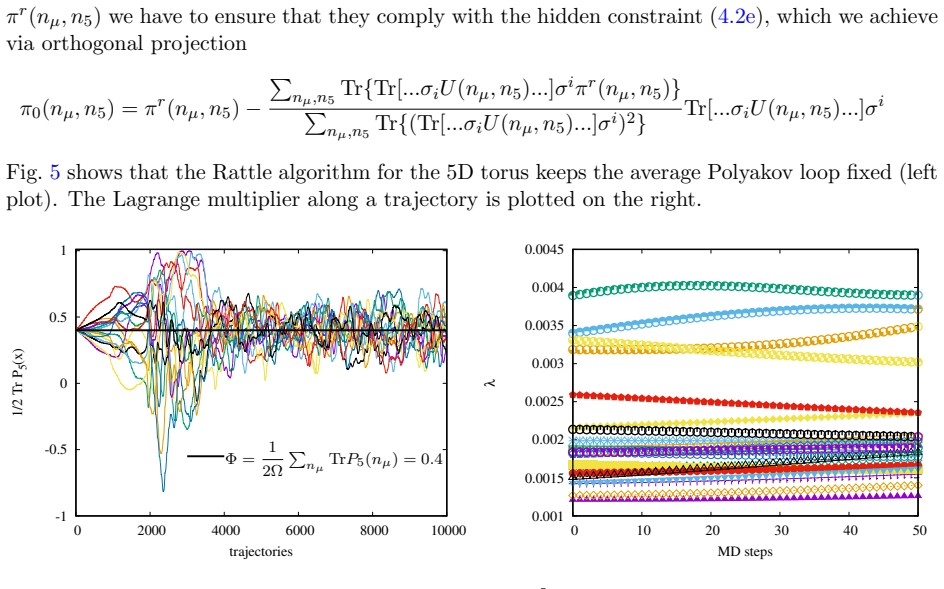
The load-bearing object is the Rattle algorithm, an extension of the leap-frog/St\"ormer-Verlet method that adds a half step for the momenta so that fields and momenta are available at the same integration time; this makes it possible to impose the hidden constraint and solve for the two Lagrange multipliers $\lambda^{(1)}$ and $\lambda^{(2)}$. For the 4D Abelian-Higgs model the constraint is the spatial average of $\phi^\dagger \phi$, and $\lambda^{(1)}$ can be written in closed form (taking the minus branch); for the 5D SU(2) torus and orbifold cases the constraint is built from Polyakov loops, and $\lambda^{(1)}$ is found by a Secant iteration seeded by a Taylor expansion of the exponential link update. The observable $U'_\Omega(\Phi) = -\langle\lambda^{(1)}\rangle_\Phi/\Omega$ carries the actual physics: $\lambda^{(1)}$ is the force that holds the Higgs observable fixed, and its average is the derivative of the potential. Auxiliary machinery includes orthogonal projection of the initial random momenta onto the hidden-constraint surface and a continuum-form rewriting of $\lambda^{(1)}$ that removes the dependence on the unphysical integration step size.
What would settle it
Run a single Rattle trajectory for the 5D torus model at $\beta_4 = \beta_5 = 1.66$ with the Polyakov-loop constraint, then reverse it step by step with stepsize $-h$; if the SU(2) link variables do not return to their initial values up to round-off, the constrained update is not reversible and the measured derivative $-\langle\lambda^{(1)}\rangle/\Omega$ would not be the derivative of a well-defined potential.
Extended reading notes
Core claim
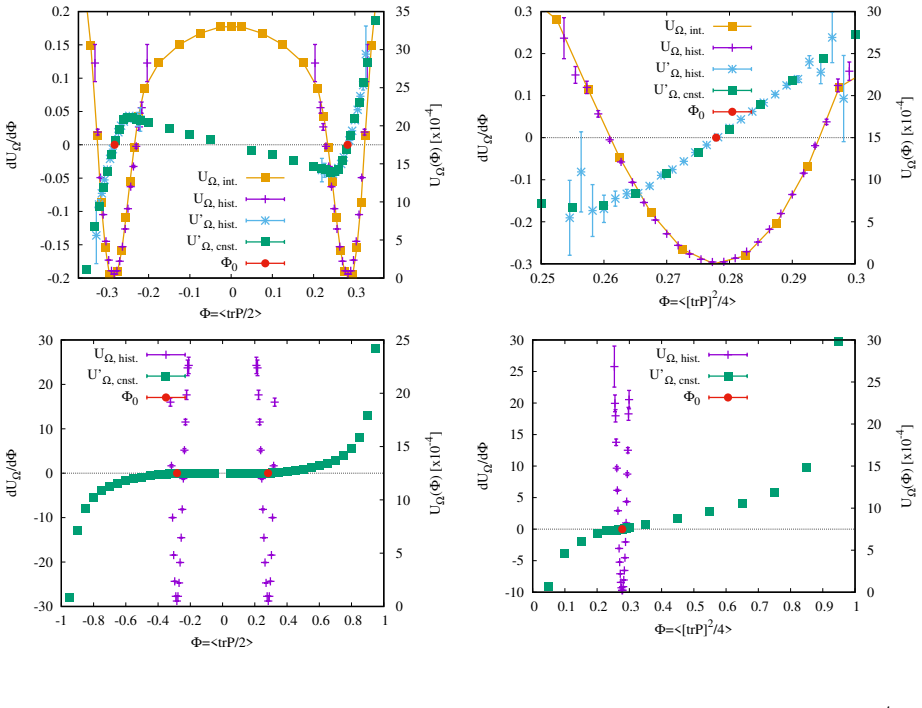
Starting from the constrained path integral, the paper derives $U'_\Omega(\Phi) = -\frac{1}{\Omega} \langle \lambda^{(1)} \rangle_\Phi$, where $\lambda^{(1)}$ is the Lagrange multiplier that holds the averaged Higgs field at value $\Phi$. The central discovery is that this identity can be used as an observable: during a constrained HMC simulation one measures the multiplier and obtains the derivative of the constraint effective potential directly, with no histogram binning and no need to fit a distribution. To make the identity usable for gauge theories, the authors extend the Rattle algorithm to constrained Hamiltonian systems whose equations of motion are non-canonical for SU(2) gauge links, solving for the multipliers at each molecular-dynamics step (first $\lambda^{(1)}$ from the constraint, then $\lambda^{(2)}$ from the hidden constraint). They demonstrate that the continuum limit in integration step size exists and that the resulting potentials reproduce the histogram result where the latter is available, while extending it over the full domain of the Higgs field and keeping errors roughly constant as the volume grows. They also verify the 4D result against the one-loop Higgs potential in unitary gauge, extracting Higgs masses consistent with two-point function determinations.
Load-bearing premise
Everything rests on the constrained molecular-dynamics update being exactly time-reversible in the five-dimensional gauge cases, but the paper demonstrates reversibility numerically only for the four-dimensional Abelian-Higgs model and relies on the general Rattle theory for the SU(2) updates.
Editorial extensions
If this is right
- In the 4D Abelian-Higgs model, the derivative of the constraint effective potential can be measured over the full range of the Higgs variable, including regions where the potential diverges ($\Phi \to 0$), whereas histograms only cover a neighbourhood of the expectation value.
- The statistical error of the derivative observable stays approximately constant as the lattice volume grows, so volume extrapolation to the infinite-volume effective potential becomes practical; the Higgs mass can then be read off from the curvature at the minimum.
- For the 5D SU(2) torus model the method reproduces the Mexican-hat form of the potential for the Polyakov-loop Higgs field and confirms the two degenerate minima of $\langle \operatorname{Tr} P \rangle$, which the histogram method cannot resolve.
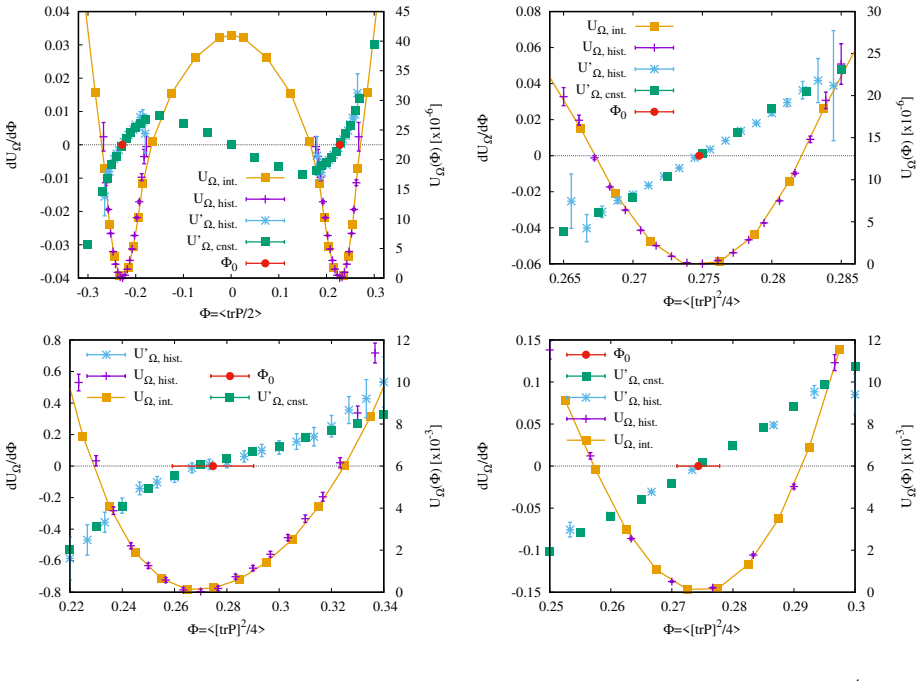
- For the 5D orbifold model, the constrained potential can be measured across the whole interval $-1 < \operatorname{Tr} P / 2 < 1$, giving access to the confining, Higgs, and hybrid phases from one observable.
- The same constrained algorithms can be applied to effective Polyakov loop actions, where individual Polyakov lines are constrained locally rather than globally, providing a route to finite-temperature and finite-density QCD effective potentials.
Reading between the lines
- Because the derivative is a local expectation value rather than a histogram slope, one could in principle join measurements from simulations at different $\Phi$ values into a continuous potential with controlled interpolation error; the paper does not itself perform such a reconstruction.
- The reversibility argument for the 5D non-canonical gauge-link updates is inherited from the general Rattle theory; an explicit numerical reversibility test on the torus or orbifold would settle whether the hidden constraint is preserved exactly there, and would be a natural companion check.
- A direct extension suggested by the method is to constrain other order parameters, such as topological charge or the density of a conserved current, and read off the corresponding effective potential from the same Lagrange-multiplier identity.
- If the volume-independence of the precision persists on larger lattices, the main cost of the method shifts to the Secant solve for the multiplier, making algorithmic tuning of that solve (or a closed-form approximation) the practical bottleneck; the paper does not analyze this scaling.
Signed reviews
Editorial analysis
A structured set of objections, weighed in public.
Referee Report
Summary. The paper develops constrained Hybrid Monte Carlo algorithms for gauge-Higgs models using an extension of the Rattle integrator to non-linear and gauge-field constraints. The central theoretical result is Eq. (2.5), which expresses the derivative of the constraint effective potential as the expectation value of the first Lagrange multiplier: U'_Ω(Φ) = -⟨λ^(1)⟩_Φ/Ω. The method is implemented for the 4D Abelian-Higgs model, where reversibility and det J = 1 are tested numerically, and effective potentials are compared against histogram results and a one-loop perturbative potential. The same framework is then adapted to 5D SU(2) gauge theory on the torus (with constraints on ⟨TrP⟩ and ⟨(TrP)^2⟩) and on the orbifold (constraint on ⟨TrP⟩), with first results for the constraint effective potentials. The paper claims, for the first time, a solution to constrained HMC for theories with gauge fields.
Significance. If the claims hold, the method is a notable technical advance: it allows precise determination of the constraint effective potential over the full range of the Higgs/Polyakov-loop variable, with statistical errors that do not grow with volume, unlike histogram methods. The derivation of Eq. (2.5) is clean and self-contained, and the 4D numerical tests (reversibility, det J = 1, h→0 limit, agreement with correlator masses) are convincing. The 5D extension to non-canonical gauge-link updates is novel and potentially important for gauge-Higgs unification and effective Polyakov-loop actions. However, the 5D results currently lack explicit reversibility and volume-preservation tests, and the one-loop comparison is partly self-fulfilling because m_H is fit. These issues are local and fixable rather than fatal.
major comments (3)
- [Secs. 4, 5 and Appendices A.2-A.4] The 5D Rattle updates for SU(2) gauge links are asserted to preserve time-reversibility and volume preservation by citing the general Rattle theory of Refs. [24,25]. The numerical tests reported in Sec. 3.1, however, cover only the 4D Abelian-Higgs model, whose updates are canonical. The 5D updates are non-canonical because the link update is multiplicative (U_{n+1} = exp(h π_{n+1/2}) U_n) and λ^(1) is solved by a Secant root-find on a transcendental equation (Sec. 4.2c and A.2.2c). The unqualified statement in Sec. 6 that the algorithms were 'numerically tested for time-reversibility and volume preservation' is therefore not supported for the 5D cases. Please add explicit reversibility and det J tests for the 5D torus (both constraints) and orbifold updates, or supply a proof that the Rattle geometric properties extend to the Lie-group update used here.
- [Sec. 3.3, Eq. (3.8), Table 1] The statement that the constraint effective potential agrees well with the one-loop Higgs potential is weakened by the fact that m_H is a fit parameter: the derivative U'_1loop(Φ) is fitted to the measured U'_Ω(Φ), so the agreement is partly self-fulfilling. The independent correlator masses m_H,R in Table 1 do provide support (e.g., m_H = 1.093(1) vs m_H,R = 1.099(21) for β=8, κ=0.166), but the paper does not quantify the fit quality or state the number of fit parameters and the Φ-range used. Please report χ²/dof, the fit range, and explicitly compare the fitted m_H with m_H,R for each parameter set.
- [Eq. (3.6c) and Sec. 4.2c] The choice of the minus sign in front of the square root in Eq. (3.6c) is justified only by the statement that 'during numerical simulations it turns out that only the − sign fulfills the constraint condition.' Because the Rattle map must be single-valued for reversibility, the branch ambiguity should be resolved analytically; the plus sign can in fact be excluded by the requirement of a finite h→0 limit, as follows from the expansion leading to Eq. (3.7). For the 5D Secant root-finding (Eq. 4.2c and A.2.2c), please comment on the uniqueness of the root and demonstrate that the selected root is the physical one, e.g., by a reversibility check on representative configurations.
minor comments (6)
- [Abstract and Sec. 5] The orbifold results use the constraint Φ = ⟨TrP/2⟩, which the authors themselves state is not the exact Higgs field H = (1/4Ω)∑Tr[P5−P5†,σ3]^2 (Sec. 5). Please say this explicitly in the abstract or conclusions, and avoid the phrase 'full domain of the Higgs variable' for the orbifold case.
- [Sec. 3.3] The text after Eq. (3.11) contains a typo: 'wich' should be 'which'.
- [Title page] The affiliation contains a typo: 'Comuter Science' should be 'Computer Science'.
- [Fig. 7 caption] The caption contains a typo: 'compcat phase' should be 'compact phase'.
- [Eq. (4.3) and A.2.4] The derivation of the initial guess for the Secant method is shown to O(h^2); please state the order of the truncation and report how the Secant iteration converges (typical number of iterations, achieved machine precision).
- [Table 2] The 4^4 row reports Φ0 = 1.122(8), which differs from the larger-volume values 1.132-1.133(1); the text says 'except for the smallest volume we don't see an effect.' Please clarify whether this is a finite-volume effect or a statistical fluctuation, and whether the quoted mH fit for 4^4 uses the same Φ-range as the other volumes.
Circularity Check
Central derivative identity Eq. (2.5) is self-contained, but the one-loop verification is weakened because mH is fit to the measured derivative.
-
fitted input called prediction
[Section 3.3, 'Comparison to the one-loop Higgs potential in unitary gauge', around Eq. (3.8), Fig. 4 and Tables 1-2.]
"via fitting the (bare) Higgs mass mH. We actually fit the derivative U′1loop(Φ)=V′1(Φ−Φ0) to our measured U′Ω(Φ), using the bare quartic coupling λ and Z-boson mass given by the quasi-classical perturbative relation mZ=√2κg2⟨ρ2⟩ [29] ... We find that the one-loop formula fits the constraint potential much better than the classical ansatz U0(Φ) =−m2HΦ2/2+λΦ4, while the histogram data cannot differentiate the one-loop corrections within their limited range of Φ."
The claimed one-loop verification is not an independent prediction: mH is fitted to the very derivative data being compared, so the one-loop curve is matched to U′Ω in the vicinity of Φ0 and the stated agreement is partially enforced by construction. The independent content is the functional shape outside the fitted region and the comparison of the extracted mH with the correlator mass mH,R in Table 1, which reduces but does not remove the fitted-input component. The central identity Eq. (2.5) itself is not circular.
full rationale
The core derivation is self-contained: Eq. (2.5) follows by differentiating the constrained path integral with respect to Φ, so U′Ω(Φ)=−⟨λ(1)⟩Φ/Ω is not an input to the method. The Rattle-based algorithms are supported by external references [24,25] and by internal consistency checks against histogram data and the volume-scaling Table 2. The only genuine reduction found is in Sec. 3.3, where the one-loop potential is compared after fitting mH to the measured derivative; this makes that comparison partially self-fulfilling, though the extracted mass is independently cross-checked against two-point-function fits. The 5D gauge-link Rattle updates lack an explicit reversibility test (the numerical reversibility check reported in Sec. 3.1 is for the 4D Abelian-Higgs case; Sec. 6 states the tests were done without specifying coverage), but that is an evidentiary gap, not circularity. Overall the central claim stands independently, with one localized fitted-input comparison.
Assumptions & free parameters
free parameters (1)
- m_H (fitted bare Higgs mass) =
1.093(1) for beta=8, kappa=0.166, lambda=0.15, 8^3x16
assumptions (4)
- domain assumption The constraint effective potential U_Omega(Phi) converges to the true effective potential in the infinite-volume limit.
- ad hoc to paper The Rattle algorithm for constrained Hamiltonian systems preserves symplecticity, time-reversibility and volume preservation when extended to the non-canonical gauge-field updates used here.
- standard math The composite constraint on the Higgs field (e.g., Eq. 3.3) and the hidden constraint (Eq. 3.4) are sufficient to fix the Lagrange multipliers at each step.
- ad hoc to paper Only the minus sign in Eq. (3.6c) fulfills the constraint, as observed numerically.
Cite this review
Pith. "Pith review of Constrained Hybrid Monte Carlo algorithms for gauge-Higgs models." pith.science (2026). https://pith.science/paper/X4XHXTO7
@misc{pith2026190810950,
  author       = {Pith},
  title        = {Pith review of: Constrained Hybrid Monte Carlo algorithms for gauge-Higgs models},
  year         = {2026},
  howpublished = {\url{https://pith.science/paper/X4XHXTO7}},
  note         = {Machine review of arXiv:1908.10950}
}
read the original abstract
We develop Hybrid Monte Carlo (HMC) algorithms for constrained Hamiltonian systems of gauge- Higgs models and introduce a new observable for the constraint effective Higgs potential. We use an extension of the so-called Rattle algorithm to general Hamiltonians for constrained systems, which we adapt to the 4D Abelian-Higgs model and the 5D SU(2) gauge theory on the torus and on the orbifold. The derivative of the potential is measured via the expectation value of the Lagrange multiplier for the constraint condition and allows a much more precise determination of the effective potential than conventional histogram methods. With the new method, we can access the potential over the full domain of the Higgs variable, while the histogram method is restricted to a short region around the expectation value of the Higgs field in unconstrained simulations, and the statistical precision does not deteriorate when the volume is increased. We further verify our results by comparing to the one-loop Higgs potential of the 4D Abelian-Higgs model in unitary gauge and find good agreement. To our knowledge, this is the first time this problem has been addressed for theories with gauge fields. The algorithm can also be used in four dimensions to study finite temperature and density transitions via effective Polyakov loop actions.
Figures


Figures from the paper (5 more)


Reference graph
Works this paper leans on
-
[1]
Broken Symmetry and the Mass of Gauge Vector Mesons,
F. Englert and R. Brout, “Broken Symmetry and the Mass of Gauge Vector Mesons,” Phys.Rev.Lett. 13 (1964) 321–323
work page 1964
-
[2]
Broken symmetries, massless particles and gauge fields,
P. W. Higgs, “Broken symmetries, massless particles and gauge fields,” Phys.Lett. 12 (1964) 132–133
work page 1964
-
[3]
A TLAS Collaboration Collaboration, G. Aad et al., “Observation of a new particle in the search for the Standard Model Higgs boson with the ATLAS detector at the LHC,” Phys.Lett. B716 (2012) 1–29, arXiv:1207.7214 [hep-ex]
arXiv 2012
-
[4]
Observation of a new boson at a mass of 125 GeV with the CMS experiment at the LHC,
CMS Collaboration Collaboration, S. Chatrchyan et al., “Observation of a new boson at a mass of 125 GeV with the CMS experiment at the LHC,” Phys.Lett. B716 (2012) 30–61, arXiv:1207.7235 [hep-ex]
arXiv 2012
-
[5]
A New Six-Dimensional Approach to the Weinberg-Salam Model,
N. Manton, “A New Six-Dimensional Approach to the Weinberg-Salam Model,” Nucl.Phys. B158 (1979) 141
work page 1979
-
[6]
Higgs’ Fields and the Determination of the Weinberg Angle,
D. Fairlie, “Higgs’ Fields and the Determination of the Weinberg Angle,” Phys.Lett. B82 (1979) 97
work page 1979
-
[7]
Dynamical Gauge Symmetry Breaking as the Casimir Effect,
Y. Hosotani, “Dynamical Gauge Symmetry Breaking as the Casimir Effect,” Phys.Lett. B129 (1983) 193
work page 1983
-
[8]
Non-perturbative definition of five-dimensional gauge theories on the R^4 x S^1/Z_2 orbifold
N. Irges and F. Knechtli, “Non-perturbative definition of five-dimensional gauge theories on the R4×S1/Z2 orbifold,” Nucl.Phys. B719 (2005) 121–139, arXiv:hep-lat/0411018 [hep-lat]
work page Pith review arXiv 2005
Show all 36 references
-
[9]
Gauge theories on a five-dimensional orbifold,
F. Knechtli, B. Bunk, and N. Irges, “Gauge theories on a five-dimensional orbifold,” PoS LA T2005(2006) 280, arXiv:hep-lat/0509071 [hep-lat]
2006 arXiv
-
[10]
Non-perturbative mass spectrum of an extra-dimensional orbifold,
N. Irges and F. Knechtli, “Non-perturbative mass spectrum of an extra-dimensional orbifold,” arXiv:hep-lat/0604006 [hep-lat]
-
[11]
Lattice gauge theory approach to spontaneous symmetry breaking from an extra dimension,
N. Irges and F. Knechtli, “Lattice gauge theory approach to spontaneous symmetry breaking from an extra dimension,” Nucl.Phys. B775 (2007) 283–311, arXiv:hep-lat/0609045 [hep-lat]
2007 arXiv
-
[12]
The Phase Structure of Discrete Abelian Spin and Gauge Systems,
S. Elitzur, R. B. Pearson, and J. Shigemitsu, “The Phase Structure of Discrete Abelian Spin and Gauge Systems,” Phys. Rev. D19 (1979) 3698
1979
-
[13]
Symmetry and Z (2) Orbifolding Approach in Five-dimensional Lattice Gauge Theory,
K. Ishiyama, M. Murata, H. So, and K. Takenaga, “Symmetry and Z (2) Orbifolding Approach in Five-dimensional Lattice Gauge Theory,” Prog. Theor. Phys. 123 (2010) 257–269, arXiv:0911.4555 [hep-lat]
2010 arXiv
-
[14]
Non-perturbative Gauge-Higgs Unification: Symmetries and Order Parameters,
N. Irges and F. Knechtli, “Non-perturbative Gauge-Higgs Unification: Symmetries and Order Parameters,” JHEP 1406 (2014) 070, arXiv:1312.3142 [hep-lat]
2014 arXiv
-
[15]
Mean-Field Gauge Interactions in Five Dimensions II. The Orbifold,
N. Irges, F. Knechtli, and K. Yoneyama, “Mean-Field Gauge Interactions in Five Dimensions II. The Orbifold,” Nucl.Phys. B865 (2012) 541–567, arXiv:1206.4907 [hep-lat]
2012 arXiv
-
[16]
Higgs mechanism near the 5d bulk phase transition,
N. Irges, F. Knechtli, and K. Yoneyama, “Higgs mechanism near the 5d bulk phase transition,” Phys.Lett. B722 (2013) 378–383, arXiv:1212.5514
2013 arXiv
-
[17]
Five-Dimensional Gauge-Higgs Unification: A Standard Model-Like Spectrum,
M. Alberti, N. Irges, F. Knechtli, and G. Moir, “Five-Dimensional Gauge-Higgs Unification: A Standard Model-Like Spectrum,” JHEP 09 (2015) 159, arXiv:1506.06035 [hep-lat]
2015 arXiv
-
[18]
Lines of Constant Physics in a Five-Dimensional Gauge-Higgs Unification Scenario,
M. Alberti, N. Irges, F. Knechtli, and G. Moir, “Lines of Constant Physics in a Five-Dimensional Gauge-Higgs Unification Scenario,” PoS LA TTICE2016(2016) 215, arXiv:1609.07004 [hep-lat]
2016 arXiv
-
[19]
Derivation of the Effective Potential,
R. Fukuda and E. Kyriakopoulos, “Derivation of the Effective Potential,” Nucl. Phys. B85 (1975) 354–364
1975
-
[20]
The Constraint Effective Potential,
L. O’Raifeartaigh, A. Wipf, and H. Yoneyama, “The Constraint Effective Potential,” Nucl. Phys. B271 (1986) 653–680
1986
-
[21]
Supercomputing the Effective Action,
J. Kuti and Y. Shen, “Supercomputing the Effective Action,” Phys. Rev. Lett. 60 (1988) 85
1988
-
[22]
Hybrid Monte Carlo,
S. Duane, A. D. Kennedy, B. J. Pendleton, and D. Roweth, “Hybrid Monte Carlo,” Phys. Lett. B195 (1987) 216–222
1987
-
[23]
Renormalization of the Abelian-Higgs model in the R ξ and Unitary gauges and the physicality of its scalar potential,
N. Irges and F. Koutroulis, “Renormalization of the Abelian-Higgs model in the R ξ and Unitary gauges and the physicality of its scalar potential,” Nucl. Phys. B924 (2017) 178–278, arXiv:1703.10369 [hep-ph]
2017 arXiv
-
[24]
Hairer, C
E. Hairer, C. Lubich, and G. Wanner, Geometric Numerical Integration. Structure-Preserving Algorithms for Ordinary Differential Equations. Springer, Berlin, 2nd ed. ed., 2006. https://www.springer.com/de/book/9783540306634
2006
-
[25]
Geometric numerical integration illustrated by the St¨ ormer-Verlet method,
E. Hairer, C. Lubich, and G. Wanner, “Geometric numerical integration illustrated by the St¨ ormer-Verlet method,” Acta Numerica 12 (2003) 399–450. http://www.math.kit.edu/ianm3/lehre/geonumint2009s/media/gni_by_stoermer-verlet.pdf
2003
-
[26]
Montvay and G
I. Montvay and G. Munster, Quantum fields on a lattice . Cambridge University Press, 1997. http://www.cambridge.org/uk/catalogue/catalogue.asp?isbn=0521404320
1997
-
[27]
New Higgs physics from the lattice,
Z. Fodor, K. Holland, J. Kuti, D. Nogradi, and C. Schroeder, “New Higgs physics from the lattice,” PoS LA TTICE2007(2007) 056, arXiv:0710.3151 [hep-lat] . 26
2007 arXiv
-
[28]
Constraint HMC algorithms for gauge-Higgs models,
R. H¨ ollwieser and F. Knechtli, “Constraint HMC algorithms for gauge-Higgs models,” PoS LA TTICE2018 (2018) 052, arXiv:1812.02045 [hep-lat]
2018 arXiv
-
[29]
Photon and Bosonium Masses in Scalar Lattice QED,
H. G. Evertz, K. Jansen, J. Jersak, C. B. Lang, and T. Neuhaus, “Photon and Bosonium Masses in Scalar Lattice QED,” Nucl. Phys. B285 (1987) 590–605
1987
-
[30]
A Study on the nonperturbative existence of Yang-Mills theories with large extra dimensions,
S. Ejiri, J. Kubo, and M. Murata, “A Study on the nonperturbative existence of Yang-Mills theories with large extra dimensions,” Phys.Rev. D62 (2000) 105025, arXiv:hep-ph/0006217 [hep-ph]
2000 arXiv
-
[31]
On the phase structure of five-dimensional SU(2) gauge theories with anisotropic couplings,
F. Knechtli, M. Luz, and A. Rago, “On the phase structure of five-dimensional SU(2) gauge theories with anisotropic couplings,” Nucl.Phys. B856 (2012) 74–94, arXiv:1110.4210 [hep-lat]
2012 arXiv
-
[32]
Extra-dimensional models on the lattice,
F. Knechtli and E. Rinaldi, “Extra-dimensional models on the lattice,” Int. J. Mod. Phys. A31 no. 22, (2016) 1643002, arXiv:1605.04341 [hep-lat]
2016 arXiv
-
[33]
The phase diagram of Yang-Mills theory with a compact extra dimension,
P. de Forcrand, A. Kurkela, and M. Panero, “The phase diagram of Yang-Mills theory with a compact extra dimension,” JHEP 1006 (2010) 050, arXiv:1003.4643 [hep-lat]
2010 arXiv
-
[34]
Numerical corrections to the strong coupling effective Polyakov-line action for finite T Yang-Mills theory,
G. Bergner, J. Langelage, and O. Philipsen, “Numerical corrections to the strong coupling effective Polyakov-line action for finite T Yang-Mills theory,” JHEP 11 (2015) 010, arXiv:1505.01021 [hep-lat]
2015 arXiv
-
[35]
Finite-density transition line for QCD with 695 MeV dynamical fermions,
J. Greensite, and R. H¨ ollwieser, “Finite-density transition line for QCD with 695 MeV dynamical fermions,” Phys. Rev. D97 no. 11, (2018) 114504, arXiv:1708.08031 [hep-lat]
2018 arXiv
-
[36]
Relative weights approach to SU(3) gauge theories with dynamical fermions at finite density,
J. Greensite, and R. H¨ ollwieser, “Relative weights approach to SU(3) gauge theories with dynamical fermions at finite density,” Phys. Rev. D94 no. 1, (2016) 014504, arXiv:1603.09654 [hep-lat] . 27
2016 arXiv
Reviewed August 14, 2026 · model on record in the stance chip above.
Discussion (0). Continue with ORCID to comment.