REVIEW 3 major objections 5 minor 165 references
On Efficient Data Transfers Across Geographically Dispersed Datacenters
T0 review · 3 major / 5 minor · reviewed 2026-08-14 · deepseek-v4-flash
Pith's one-line read Centralized traffic engineering can match global optimization in admitted traffic while cutting admission control time by three orders of magnitude.
desk verdict Solid heuristic work on inter-DC admission control and multicast; the BWR worst-case routing foundation has a conceded formal gap, but the main contributions survive. read the letter →
The pith
A machine-rendered reading of the paper's core claim, the machinery that carries it, and where it could break.
The reading
What carries the argument
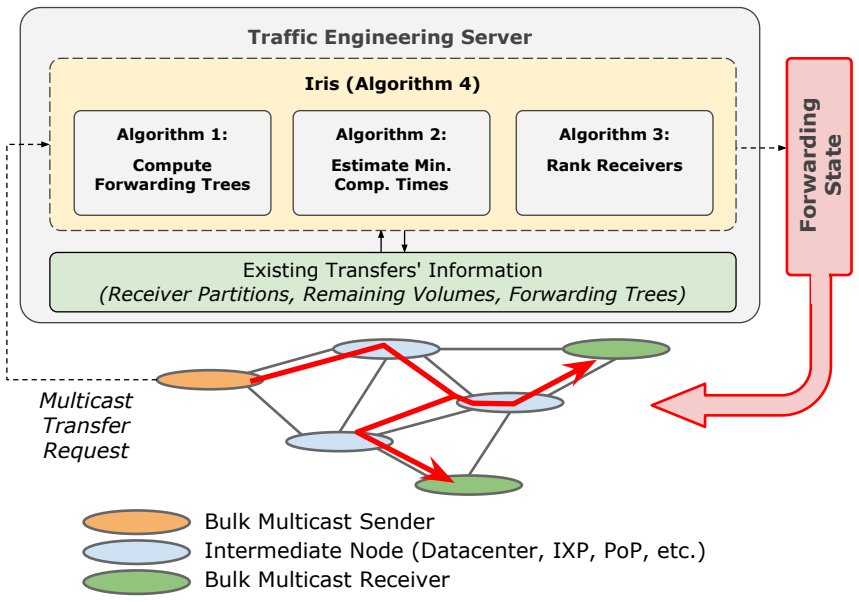
The load-aware cost metric is the load-bearing object. Each edge $e$ carries a cost $L_e + V$, where $L_e$ is the total volume of scheduled but not yet sent traffic on that edge and $V$ is the size of the incoming transfer; a path or tree is chosen by minimizing the sum of edge costs (via Dijkstra for single paths and GreedyFLAC for Steiner trees). Working with it is ALAP scheduling, which fills the timeline backward from each deadline, so that every admitted transfer occupies the latest possible timeslots and leaves earlier slots free. In Best Worst-case Routing the same idea appears in a different form: edge cost is the remaining data units of flows sharing the edge, and the selected path is the one minimizing the sum of competing data units. Together these turn a global mixed-integer problem into a shortest-path or Steiner-tree computation plus a small per-request allocation.
What would settle it
Build a small network with a source, a destination, and two candidate paths, where one path shares an edge with a large flow and the other shares edges with several smaller flows whose paths are mutually edge-disjoint. Compute Eq. 3.1 weights, then simulate the two choices under a work-conserving scheduler that adversarially delays the new flow; if the lower-weight path ever yields a larger actual worst-case completion time than the higher-weight path, the reduction in Proposition 1 is not exact.
Extended reading notes
Core claim
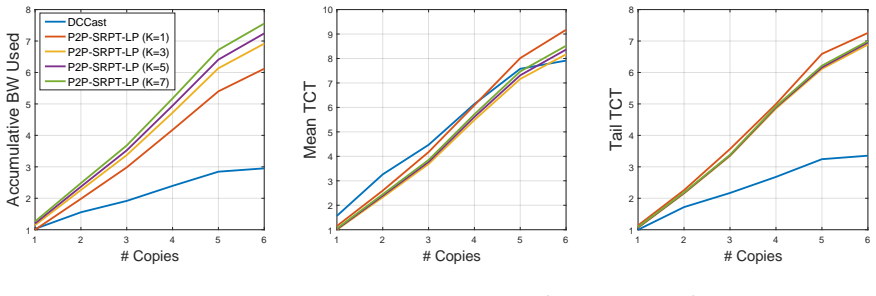
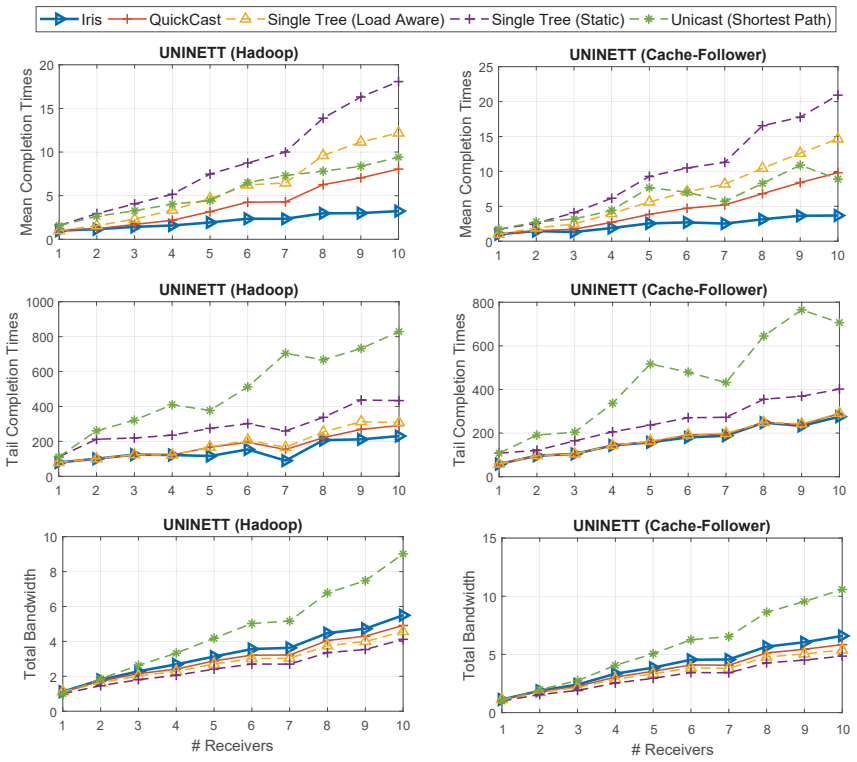
The core discovery is that two simple accounting rules capture most of the benefit of inter-datacenter optimization. First, the cost of routing a new transfer over a path can be written as the sum of remaining data units of all ongoing transfers that share an edge with that path, and minimizing this path weight (Best Worst-case Routing) approximately minimizes the worst-case completion time of the new transfer under any scheduling policy. Second, for deadline-constrained admission, allocating each transfer as late as possible leaves the maximum possible room for future arrivals, so a feasibility check only needs to inspect residual capacity on one candidate path rather than re-solving a global schedule. On the multicast side, the same load-plus-volume edge weights define a minimum-weight Steiner tree per transfer, and one tree per receiver group is enough to save bandwidth while keeping receivers synchronized. The dissertation reports that these heuristics match global LP-based admission within a few percent rejected traffic, speed up request processing by roughly three orders of magnitude, and cut multicast bandwidth and tail completion times by up to half as receiver count grows.
Load-bearing premise
The load-bearing premise is that the worst-case completion time of a new transfer equals the sum of remaining data units of all transfers sharing an edge with its candidate path, because edge-disjoint transfers are assumed unable to help each other; the dissertation itself notes this quantity may overshoot the true worst case.
Editorial extensions
If this is right
- Operators can run deadline-aware admission control centrally at millisecond-scale per request instead of solving a global LP on every arrival, with rejected traffic within about 4 percentage points of the best single-path baseline.
- Replicating an object from one datacenter to many can be done over one forwarding tree per transfer, roughly halving bandwidth consumption and tail completion time as the number of destinations grows.
- Two edge-disjoint parallel trees capture most of the multicast speedup; adding a third tree gives little further benefit and can hurt by consuming extra bandwidth.
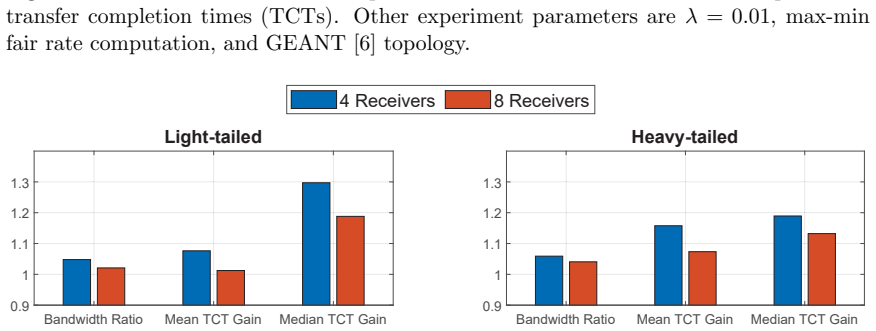
- Partitioning receivers by their access speed and giving each partition its own tree can speed up the fastest receivers by tens of times while barely increasing total capacity use.
- Application-specified mixed objectives for multicast can be encoded as receiver rankings and partition choices, meeting completion-time targets at about half the average receiver completion time.
Reading between the lines
- If the Eq. 3.1 worst-case bound overshoots, the routing gains attributed to worst-case minimization may actually come from load balancing; comparing BWRHF against a true minimal-completion-time scheduler on layered topologies would separate the effects.
- ALAP's no-rescheduling rule is a form of lazy scheduling; a testable extension is whether a bounded look-ahead admission policy that occasionally repacks the near future improves admission rates under bursty arrivals without losing the speed advantage.
- The load-plus-volume edge weight is reminiscent of shortest-remaining-processing-time queueing; it could be tested against other online convex-cost routing metrics on real inter-DC traffic traces to see whether the reported advantage holds outside synthetic workloads.
- The receiver-partitioning principle suggests a design rule: intentionally group slow receivers together so a single slow tree does not throttle fast ones, and use parallel trees only for the fast group; this could extend to coded multicast where overlapping partitions share some packets.
Signed reviews
Editorial analysis
A structured set of objections, weighed in public.
Referee Report
Summary. This dissertation develops centralized traffic-engineering algorithms for inter-datacenter networks. Chapter 3 introduces Best Worst-case Routing (BWR) and two heuristics, BWRH and BWRHF, which assign paths to long flows using the remaining data units of ongoing flows rather than instantaneous link utilization, claiming large reductions in mean and tail flow completion times. Chapter 4 addresses deadline-aware admission control: it proposes As-Late-As-Possible (ALAP) scheduling on a single path, then generalizes it to DCRoute, a load-aware single-path routing and admission scheme, and to MP-DCRoute with edge-disjoint multipath. Chapter 5 treats point-to-multipoint transfers, selecting load-aware Steiner trees in DCCast and adding deadline-aware admission control in DDCCast. The headline empirical claims are that DCRoute is about three orders of magnitude faster than PMC/SPMC while rejecting at most 4% more traffic, and that DCCast reduces bandwidth and tail completion times by up to 50% relative to P2P-SRPT-LP as the number of destinations grows.
Significance. If the empirical claims hold, the work makes a useful systems contribution: it shows that centralized deadline-aware admission control and multicast tree selection can run at practical speeds over inter-datacenter networks with only small admission-rate penalties. The strengths of the manuscript include a clean exchange argument for ALAP on a single path (Theorem 1, Section 4.2.3), evaluation against standard baselines (Amoeba, K-shortest paths, LP-based P2P schemes), use of multiple real WAN topologies, and a publicly available implementation of DCCast. The main formal weakness is in the BWR chapter: the reduction from worst-case completion time to the path-weight metric in Eq. (3.1) is not a correct characterization of worst-case completion time, as the manuscript itself concedes in Section 3.5.1. The DCRoute and DCCast simulation results are not directly invalidated by this issue, but the stated theoretical guarantee for BWR needs to be substantially reworded or replaced.
major comments (3)
- [Section 3.4.2 and Section 3.5.1 (Eq. 3.1, Proposition 1)] Proposition 1 is not established by the given reduction. Eq. (3.1) sums the remaining data units of every ongoing flow that shares at least one edge with the candidate path, but this quantity is an upper bound on the worst-case completion time, not the worst-case completion time itself: flows on edge-disjoint subpaths can transmit in parallel, and a flow that shares multiple edges with the path does not necessarily delay the new flow once per shared edge. The manuscript itself states in Section 3.5.1 that the computed quantity 'may overshoot, that is, the worst-case may be larger than necessary.' Consequently, minimizing Eq. (3.1) minimizes an upper bound, and the claim that BWR minimizes the worst-case completion time 'regardless of the scheduling policy' is formally unsupported. I recommend restating Proposition 1 as a claim about minimizing a load-based upper-bound metric, or supplying a correct derivation of the true worst-case completion time, and adjusting the strong conclusions in Section 3.6 accordingly.
- [Section 4.3.5 (Figures 4.6 and 4.7)] The headline claim that DCRoute rejects 'at most 4% more traffic' than all compared schemes is an empirical statement based on two synthetic settings: the GScale topology and random networks with 5 to 20 nodes. The figures report point values without confidence intervals or standard deviations, even though arrivals, demands, and deadlines are stochastic. Because the admission-rate gap is the load-bearing evidence for the 'almost identical performance' claim, the paper should report multiple independent runs, confidence intervals or box plots, and state explicitly that the 'at most 4%' bound is an observed maximum over these experiments rather than a general guarantee.
- [Section 5.2.5 (Figure 5.6)] The DCCast claim of 'up to 50% less' bandwidth and tail completion time relative to P2P-SRPT-LP is based on a single simulation configuration per data point, with no reported variance. Given that the comparison involves stochastic request arrivals and exponential transfer sizes, the plotted differences should be accompanied by error bars or a statistical assessment so that the reader can judge whether the 50% improvement is stable across random seeds and traffic instantiations.
minor comments (5)
- [Section 3.5.1, Running Time paragraph] The text says 'The maximum running time of Algorithm 1 was 17.88 milliseconds' in the BWRHF subsection; this should reference Algorithm 2, since the paragraph is describing BWRHF.
- [Figures 4.6 and 4.7] The axis labels render the arrival-rate symbol as 'Arrival Rate (6)' and '6 = 6.0' in the provided text; the LaTeX/PDF rendering of the lambda symbol should be fixed.
- [Section 3.4.5, BWRH optimality gap] The reported average optimality gap of less than 0.25% is computed only for small topologies and for scenarios with fewer than 20 ongoing flows (due to the branch-and-bound implementation); this scope limitation should be stated in the main text rather than only implied by the evaluation description.
- [Section 5.2.5, Evaluation setup] The DCCast simulations are described as running 'as many timeslots as needed' with the last arrival at 500; the stopping rule and the number of independent replications should be stated explicitly so that the normalized means and tails are reproducible.
- [Table 2.2] Several entries contain LaTeX artifacts such as 'Set⟨⟩' and 'EEEΨ⊂ EEG'; these should be cleaned up in the final typeset version.
Circularity Check
No significant circularity; the Eq. 3.1 overshoot admitted in Section 3.5.1 is a formal approximation gap, not a circular reduction.
full rationale
No significant circularity. The central contributions are evaluated against external baselines (MinHop, Min-Max Utilization, K-Shortest Paths, PMC/SPMC, Amoeba, and P2P-SRPT-LP) using standard synthetic workloads, and the proposed metrics and heuristics are defined independently of the reported outcomes. DCRoute's speed and admission-rate claims in Sections 4.3.4–4.3.5 and DCCast's bandwidth and completion-time improvements in Section 5.2.5 are not fitted parameters renamed as predictions; no parameter is calibrated to force a target result. The self-citations to the author's earlier papers describe the same algorithms and are not used as load-bearing external authority or as uniqueness theorems. The one formal weakness in the derivation chain is Proposition 1 (Section 3.4.2), where Problem 1 is reduced to Problem 2 by equating worst-case completion time with the sum of remaining data units on shared edges (Eq. 3.1). The dissertation itself concedes in Section 3.5.1 that this quantity 'may overshoot, that is, the worst-case may be larger than necessary' because edge-disjoint flows can transmit in parallel. That is an acknowledged approximation gap in the reduction, and it weakens the formal optimality claim of BWR, but it is not circular: Eq. 3.1 is an asserted upper bound, not a restatement of the definition of worst-case completion time, and the empirical FCT comparisons in Figures 3.4–3.12 stand independently of the proposition's formal validity. Therefore the circularity score is 0.
Assumptions & free parameters
free parameters (5)
- Epsilon in BWRHF edge weight (Algorithm 2) =
0 < epsilon << 1 (unspecified)
- K, number of parallel edge-disjoint paths in MP-DCRoute =
up to 2 to 3 paths in evaluation
- T, batching window for the BATCHING baseline in DCCast evaluation =
10, 50, 100 timeslots
- alpha, bandwidth priority weight in the Chapter 2 objective example =
0 < alpha << 1
- Load-aware cost assignment (Le + VRnew) for paths and Steiner trees =
sum of scheduled residual load plus new transfer volume
assumptions (6)
- domain assumption A logically centralized Traffic Engineering Server (TES) has complete visibility of transfer demands, link state, and forwarding state, and can enforce per-timeslot rates at all senders and install forwarding rules network-wide.
- domain assumption Zero propagation and queuing latency for long flows; one data unit traverses an edge per timeslot.
- ad hoc to paper The worst-case completion time of a new flow equals the sum of remaining data units of all flows that share at least one edge with the candidate path (Eq. 3.1).
- domain assumption Transfer arrivals are online with no knowledge of the future; evaluation uses Poisson arrivals with exponential/Pareto sizes and Facebook-style patterns.
- standard math GreedyFLAC returns near-optimal minimum-weight Steiner trees.
- standard math Problem 2 (minimum weight path with non-edge-decomposable weights) is NP-hard.
Cite this review
Pith. "Pith review of On Efficient Data Transfers Across Geographically Dispersed Datacenters." pith.science (2026). https://pith.science/paper/S5OMYVP5
@misc{pith2026190811131,
  author       = {Pith},
  title        = {Pith review of: On Efficient Data Transfers Across Geographically Dispersed Datacenters},
  year         = {2026},
  howpublished = {\url{https://pith.science/paper/S5OMYVP5}},
  note         = {Machine review of arXiv:1908.11131}
}
read the original abstract
As applications become more distributed to improve user experience and offer higher availability, businesses rely on geographically dispersed datacenters that host such applications more than ever. Dedicated inter-datacenter networks have been built that provide high visibility into the network status and flexible control over traffic forwarding to offer quality communication across the instances of applications hosted on many datacenters. These networks are relatively small, with tens to hundreds of nodes and are managed by the same organization that operates the datacenters which make centralized traffic engineering feasible. Using coordinated data transmission from the services and routing over the inter-datacenter network, one can optimize the network performance according to a variety of utility functions that take into account data transfer deadlines, network capacity consumption, and transfer completion times. In this dissertation, we study techniques and algorithms for fast and efficient data transfers across geographically dispersed datacenters over the inter-datacenter networks. We discuss different forms and properties of inter-datacenter transfers and present a generalized optimization framework to maximize an operator selected utility function. Next, in the several chapters that follow, we study, in detail, the problems of admission control for transfers with deadlines and inter-datacenter multicast transfers. For the admission control problem, our solutions offer significant speed up in the admission control process while offering almost identical performance in the total traffic admitted into the network. For the bulk multicasting problem, our techniques enable significant performance gain in receiver completion times with low computational complexity, which makes them highly applicable to inter-datacenter networks.
Figures


Figures from the paper (84 more)















Reference graph
Works this paper leans on
-
[1]
http://www.topology-zoo.org/files/Cogentco.gml
The internet topology zoo (cogent). http://www.topology-zoo.org/files/Cogentco.gml. visited on July 19, 2017
2017
-
[2]
B4: Experience with a globally-deployed software defined wan
Sushant Jain, Alok Kumar, et al. B4: Experience with a globally-deployed software defined wan. SIGCOMM, 43(4):3–14, 2013
2013
-
[3]
http://www.topology-zoo.org/files/Agis.gml
-
[4]
http://www.topology-zoo.org/files/Ans.gml
-
[5]
http://www.topology-zoo.org/files/AttMpls.gml
The internet topology zoo (att north america). http://www.topology-zoo.org/files/AttMpls.gml. visited on July 19, 2017
2017
-
[6]
http://www.topology-zoo.org/files/Geant2009.gml
The Internet Topology Zoo (GEANT). http://www.topology-zoo.org/files/Geant2009.gml
-
[7]
W. Xia, P. Zhao, Y. Wen, and H. Xie. A survey on data center networking (dcn): Infrastructure and operations. IEEE Communications Surveys Tutorials , 19(1):640–656, Firstquarter 2017
2017
-
[8]
Zhang, F
J. Zhang, F. R. Yu, S. Wang, T. Huang, Z. Liu, and Y. Liu. Load balancing in data center networks: A survey. IEEE Communications Surveys Tutorials , 20(3):2324–2352, thirdquarter 2018
2018
Show all 165 references
-
[9]
Google Cloud: Products and services
-
[10]
Directory of Azure Cloud Services
-
[12]
Arjun Roy, Hongyi Zeng, Jasmeet Bagga, George Porter, and Alex C. Snoeren. Inside the social network’s (datacenter) network. In SIGCOMM, pages 123–137. ACM, 2015
2015
-
[13]
Case study of scientific data processing on a cloud using hadoop
Chen Zhang, Hans De Sterck, Ashraf Aboulnaga, Haig Djambazian, and Rob Sladek. Case study of scientific data processing on a cloud using hadoop. In International Symposium on High Performance Computing Systems and Applications , pages 400–415. Springer, 2009
2009
-
[14]
https://cloud.google.com/compute/
Compute engine - iaas - google cloud platform. https://cloud.google.com/compute/
-
[15]
https://azure.microsoft.com/
Microsoft azure: Cloud computing platform & services. https://azure.microsoft.com/
-
[16]
https://aws.amazon.com/
Amazon web services (aws) - cloud computing services. https://aws.amazon.com/
-
[17]
Jupiter rising: A decade of clos topologies and centralized control in googles datacenter network
Arjun Singh, Joon Ong, Amit Agarwal, Glen Anderson, Ashby Armistead, Roy Bannon, Seb Boving, Gaurav Desai, Bob Felderman, Paulie Germano, Anand Kanagala, Jeff Provost, Jason Simmons, Eiichi Tanda, Jim Wanderer, Urs Hlzle, Stephen Stuart, and Amin Vahdat. Jupiter rising: A decad...
2015
-
[18]
Hamilton, Navendu Jain, Srikanth Kandula, Changhoon Kim, Parantap Lahiri, David A
Albert Greenberg, James R. Hamilton, Navendu Jain, Srikanth Kandula, Changhoon Kim, Parantap Lahiri, David A. Maltz, Parveen Patel, and Sudipta Sengupta. VL2: A Scalable and Flexible Data Center Network. Commun. ACM , 54(3):95–104, March 2011
2011
-
[19]
Network in Hyper-scale data centers - Facebook , 2015
Sriram Subramanian. Network in Hyper-scale data centers - Facebook , 2015
2015
-
[20]
Attaining the Promise and Avoiding the Pitfalls of TCP in the Datacenter
Glenn Judd. Attaining the Promise and Avoiding the Pitfalls of TCP in the Datacenter. 12th USENIX Symposium on Networked Systems Design and Implementation (NSDI 15) , pages 145–157, 2015
2015
-
[21]
Congestion Control for Large-Scale RDMA Deployments
Yibo Zhu, Haggai Eran, Daniel Firestone, Chuanxiong Guo, Marina Lipshteyn, Yehonatan Liron, Jitendra Padhye, Shachar Raindel, Mohamad Haj Yahia, and Ming Zhang. Congestion Control for Large-Scale RDMA Deployments. Proceedings of the 2015 ACM Conference on Special Interest Grou...
2015
-
[22]
Less is more: trading a little bandwidth for ultra-low latency in the data center
Mohammad Alizadeh, Abdul Kabbani, Tom Edsall, Balaji Prabhakar, Amin Vahdat, and Masato Yasuda. Less is more: trading a little bandwidth for ultra-low latency in the data center. Presented as part of the 9th USENIX Symposium on Networked Systems Design and Implementation (NSDI...
2012
-
[23]
A Scalable, Commodity Data Center Network Architecture
Mohammad Al-Fares, Alexander Loukissas, and Amin Vahdat. A Scalable, Commodity Data Center Network Architecture. Proceedings of the ACM SIGCOMM 2008 Conference on Data Communication , pages 63–74, 2008
2008
-
[24]
HyperX: topol- ogy, routing, and packaging of efficient large-scale networks
Jung Ho Ahn, Nathan Binkert, Al Davis, Moray McLaren, and Robert S Schreiber. HyperX: topol- ogy, routing, and packaging of efficient large-scale networks. Proceedings of the Conference on High Performance Computing Networking, Storage and Analysis , page 41, 2009
2009
-
[25]
Dcell: A Scalable and Fault-tolerant Network Structure for Data Centers
Chuanxiong Guo, Haitao Wu, Kun Tan, Lei Shi, Yongguang Zhang, and Songwu Lu. Dcell: A Scalable and Fault-tolerant Network Structure for Data Centers. SIGCOMM Comput. Commun. Rev., 38(4):75–86, August 2008
2008
-
[26]
On the data path performance of leaf-spine datacenter fabrics
Mohammad Alizadeh and Tom Edsall. On the data path performance of leaf-spine datacenter fabrics. 2013 IEEE 21st Annual Symposium on High-Performance Interconnects , pages 71–74, 2013
2013
-
[27]
Xpander: Towards Optimal- Performance Datacenters
Asaf Valadarsky, Gal Shahaf, Michael Dinitz, and Michael Schapira. Xpander: Towards Optimal- Performance Datacenters. Proceedings of the 12th International on Conference on emerging Networking EXperiments and Technologies, pages 205–219, 2016
2016
-
[28]
Introducing data center fabric, the next-generation Facebook data center network
-
[29]
Jellyfish: Networking data centers randomly
Ankit Singla, Chi-Yao Hong, Lucian Popa, and P Brighten Godfrey. Jellyfish: Networking data centers randomly. Presented as part of the 9th USENIX Symposium on Networked Systems Design and Implementation (NSDI 12) , pages 225–238, 2012
2012
-
[30]
A Study of Non-Blocking Switching Networks
Charles Clos. A Study of Non-Blocking Switching Networks. Bell Labs Technical Journal , 32(2):406– 424, 1953
1953
-
[31]
Cisco Global Cloud Index: Forecast and Methodology, 2015-2020 White Paper
2015
-
[32]
The Growth of eServices: Stats and Trends
-
[33]
How do users feel about video streaming quality on their TVs?
-
[34]
Cloud Technology Why Move Critical Workloads and Data Closer to Users?
-
[35]
Content Delivery Networks Move Closer to the Network Edge . 159
-
[36]
http://datacenterfrontier.com/ mapping-netflix-content-delivery-network/
Mapping netflix: Content delivery network spans 233 sites. http://datacenterfrontier.com/ mapping-netflix-content-delivery-network/ . visited on March 3, 2017
2017
-
[37]
How netflix works with isps around the globe to deliver a great viewing ex- perience
Ken Florance. How netflix works with isps around the globe to deliver a great viewing ex- perience. https://media.netflix.com/en/company-blog/how-netflix-works-with-isps-around- the-globe-to-deliver-a-great-viewing-experience , 2016
2016
-
[40]
Low latency geo-distributed data analytics
Qifan Pu, Ganesh Ananthanarayanan, Peter Bodik, Srikanth Kandula, Aditya Akella, Paramvir Bahl, and Ion Stoica. Low latency geo-distributed data analytics. ACM SIGCOMM Computer Communi- cation Review, 45(4):421–434, 2015
2015
-
[41]
http://www.level3.com/en/products/managed-dedicated-fiber/
Dark fiber network and pricing. http://www.level3.com/en/products/managed-dedicated-fiber/. visited on March 29, 2019
2019
-
[42]
https://azure.microsoft.com/en-us/ blog/how-microsoft-builds-its-fast-and-reliable-global-network/
How microsoft builds its fast and reliable global network. https://azure.microsoft.com/en-us/ blog/how-microsoft-builds-its-fast-and-reliable-global-network/ . visited on September 30, 2017
2017
-
[43]
https://code.facebook.com/posts/ 1782709872057497/building-express-backbone-facebook-s-new-long-haul-network/
Building express backbone: Facebooks new long-haul network. https://code.facebook.com/posts/ 1782709872057497/building-express-backbone-facebook-s-new-long-haul-network/ . visited on September 30, 2017
2017
-
[44]
Achieving high utilization with software- driven wan
Chi-Yao Hong, Srikanth Kandula, Ratul Mahajan, et al. Achieving high utilization with software- driven wan. In SIGCOMM, pages 15–26. ACM, 2013
2013
-
[45]
The prospect of inter-data-center optical networks
Xiaoxue Zhao, Vijay Vusirikala, Bikash Koley, Valey Kamalov, and Tad Hofmeister. The prospect of inter-data-center optical networks. IEEE Communications Magazine , 51(9):32–38, 2013
2013
-
[46]
Calendaring for wide area networks
Srikanth Kandula, Ishai Menache, Roy Schwartz, and Spandana Raj Babbula. Calendaring for wide area networks. SIGCOMM, 44(4):515–526, 2015
2015
-
[47]
Dynamic pricing and traffic engineering for timely inter-datacenter transfers
Virajith Jalaparti, Ivan Bliznets, Srikanth Kandula, Brendan Lucier, and Ishai Menache. Dynamic pricing and traffic engineering for timely inter-datacenter transfers. In SIGCOMM, pages 73–86. ACM, 2016
2016
-
[48]
The nature of data center traffic: measurements & analysis
Srikanth Kandula, Sudipta Sengupta, Albert Greenberg, Parveen Patel, and Ronnie Chaiken. The nature of data center traffic: measurements & analysis. Proceedings of the 9th ACM SIGCOMM conference on Internet measurement conference , pages 202–208, 2009
2009
-
[49]
Deadline-aware datacenter tcp (d2tcp)
Balajee Vamanan, Jahangir Hasan, and TN Vijaykumar. Deadline-aware datacenter tcp (d2tcp). SIGCOMM, 42(4):115–126, 2012
2012
-
[50]
Maltz, Jitendra Padhye, Parveen Patel, Balaji Prabhakar, Sudipta Sengupta, and Murari Sridharan
Mohammad Alizadeh, Albert Greenberg, David A. Maltz, Jitendra Padhye, Parveen Patel, Balaji Prabhakar, Sudipta Sengupta, and Murari Sridharan. Data Center TCP (DCTCP). SIGCOMM Comput. Commun. Rev. , 41(4):63–74, August 2010
2010
-
[51]
DeTail: reducing the flow completion time tail in datacenter networks
David Zats, Tathagata Das, Prashanth Mohan, Dhruba Borthakur, and Randy Katz. DeTail: reducing the flow completion time tail in datacenter networks. ACM SIGCOMM Computer Communication Review, 42(4):139–150, 2012. 160
2012
-
[52]
MapReduce: simplified data processing on large clusters
Jeffrey Dean and Sanjay Ghemawat. MapReduce: simplified data processing on large clusters. Com- munications of the ACM , 51(1):107–113, 2008
2008
-
[53]
Dryad: Distributed Data- parallel Programs from Sequential Building Blocks
Michael Isard, Mihai Budiu, Yuan Yu, Andrew Birrell, and Dennis Fetterly. Dryad: Distributed Data- parallel Programs from Sequential Building Blocks. SIGOPS Oper. Syst. Rev. , 41(3):59–72, March 2007
2007
-
[54]
Delay-tolerant bulk data transfers on the internet
Nikolaos Laoutaris, Georgios Smaragdakis, Rade Stanojevic, Pablo Rodriguez, and Ravi Sundaram. Delay-tolerant bulk data transfers on the internet. IEEE/ACM TON , 21(6), 2013
2013
-
[55]
Guaranteeing deadlines for inter-datacenter transfers
Hong Zhang, Kai Chen, Wei Bai, et al. Guaranteeing deadlines for inter-datacenter transfers. In EuroSys, page 20. ACM, 2015
2015
-
[56]
Jetway: Minimizing costs on inter-datacenter video traffic
Yuan Feng, Baochun Li, and Bo Li. Jetway: Minimizing costs on inter-datacenter video traffic. In ACM international conference on Multimedia , pages 259–268. ACM, 2012
2012
-
[57]
Optimizing bulk transfers with software-defined optical wan
Xin Jin, Yiran Li, Da Wei, Siming Li, Jie Gao, Lei Xu, Guangzhi Li, Wei Xu, and Jennifer Rexford. Optimizing bulk transfers with software-defined optical wan. In SIGCOMM, pages 87–100. ACM, 2016
2016
-
[58]
Scaling the Facebook data warehouse to 300 PB
-
[59]
Vivisecting youtube: An active measurement study
Vijay Kumar Adhikari, Sourabh Jain, Yingying Chen, and Zhi-Li Zhang. Vivisecting youtube: An active measurement study. In INFOCOM, pages 2521–2525. IEEE, 2012
2012
-
[60]
Active-Active for Multi-Regional Re- siliency
Meshenberg, Ruslan and Gopalani, Naresh and Kosewski, Luke. Active-Active for Multi-Regional Re- siliency. http://techblog.netflix.com/2013/12/active-active-for-multi-regional.html , 2013
2013
-
[61]
Ecoflow: An economical and deadline-driven inter- datacenter video flow scheduling system
Yuhua Lin, Haiying Shen, and Liuhua Chen. Ecoflow: An economical and deadline-driven inter- datacenter video flow scheduling system. In International conference on Multimedia , pages 1059–1062. ACM, 2015
2015
-
[62]
http://www.datastax.com/dev/blog/multi-datacenter- replication, 2012
Multi-datacenter replication in cassandra. http://www.datastax.com/dev/blog/multi-datacenter- replication, 2012
2012
-
[63]
https://azure.microsoft.com/en-us/blog/azure-sql-database-now-supports-powerful-geo- replication-features-on-all-service-tiers/ , 2016
Azure sql database now supports powerful geo-replication features for all service tiers. https://azure.microsoft.com/en-us/blog/azure-sql-database-now-supports-powerful-geo- replication-features-on-all-service-tiers/ , 2016
2016
-
[64]
Mesa: A geo-replicated online data warehouse for google’s advertising system
Ashish Gupta, Fan Yang, Jason Govig, Adam Kirsch, Kelvin Chan, Kevin Lai, Shuo Wu, Sandeep Dhoot, Abhilash Rajesh Kumar, Ankur Agiwal, Sanjay Bhansali, Mingsheng Hong, Jamie Cameron, Masood Siddiqi, David Jones, Jeff Shute, Andrey Gubarev, Shivakumar Venkataraman, and Divyakant...
2016
-
[65]
Mdcc: Multi-data center consistency
Tim Kraska, Gene Pang, Michael J Franklin, Samuel Madden, and Alan Fekete. Mdcc: Multi-data center consistency. In EuroSys, pages 113–126. ACM, 2013
2013
-
[66]
Experimental assessment of inter-datacenter multicast connectivity for ethernet services in flexgrid networks
Ll Gifre, F Paolucci, J Marhuenda, et al. Experimental assessment of inter-datacenter multicast connectivity for ethernet services in flexgrid networks. In ECOC, pages 1–3, 2014
2014
-
[67]
An overlay architecture of global inter-data center networking for fast content delivery
Yasuhiro Miyao. An overlay architecture of global inter-data center networking for fast content delivery. In ICC, pages 1–6. IEEE, 2011. 161
2011
-
[68]
Highly efficient data migration and backup for big data applications in elastic optical inter-data-center networks
Ping Lu, Liang Zhang, Xiahe Liu, Jingjing Yao, and Zuqing Zhu. Highly efficient data migration and backup for big data applications in elastic optical inter-data-center networks. IEEE Network , 29(5):36–42, 2015
2015
-
[69]
A first look at inter-data center traffic characteristics via yahoo! datasets
Yingying Chen, Sourabh Jain, Vijay Kumar Adhikari, Zhi-Li Zhang, and Kuai Xu. A first look at inter-data center traffic characteristics via yahoo! datasets. In INFOCOM, pages 1620–1628. IEEE, 2011
2011
-
[70]
Y. Wu, Z. Zhang, C. Wu, C. Guo, Z. Li, and F. C. M. Lau. Orchestrating bulk data transfers across geo-distributed datacenters. IEEE Transactions on Cloud Computing , PP(99):1–1, 2015
2015
-
[71]
Steiner tree problems
FK Hwang and Dana S Richards. Steiner tree problems. Networks, 22(1):55–89, 1992
1992
-
[72]
https://github.com/ mouton5000/DSTAlgoEvaluation
Evaluation of approximation algorithms for the directed steiner tree problem. https://github.com/ mouton5000/DSTAlgoEvaluation. visited on Apr 27, 2017
2017
-
[73]
Online deadline-aware bulk transfer over inter- datacenter wans
Long Luo, Hongfang Yu, Zilong Ye, and Xiaojiang Du. Online deadline-aware bulk transfer over inter- datacenter wans. In IEEE INFOCOM 2018-IEEE Conference on Computer Communications , pages 630–638. IEEE, 2018
2018
-
[74]
Bwe: Flexible, hierarchical bandwidth allocation for wan distributed computing
Alok Kumar, Sushant Jain, Uday Naik, et al. Bwe: Flexible, hierarchical bandwidth allocation for wan distributed computing. In SIGCOMM, pages 1–14, 2015
2015
-
[75]
Carousel: Scalable traffic shaping at end hosts
Ahmed Saeed, Nandita Dukkipati, Vytautas Valancius, Carlo Contavalli, Amin Vahdat, et al. Carousel: Scalable traffic shaping at end hosts. In Proceedings of the Conference of the ACM Special Interest Group on Data Communication , pages 404–417. ACM, 2017
2017
-
[76]
Software-defined networking
Nick McKeown. Software-defined networking. INFOCOM keynote talk , 17(2):30–32, 2009
2009
-
[77]
L. Luo, Z. Li, J. Wang, and H. Yu. Simplifying flow updates in software-defined networks using atoman. IEEE Access, 7:39083–39097, 2019
2019
-
[78]
Measuring control plane latency in sdn- enabled switches
Keqiang He, Junaid Khalid, Aaron Gember-Jacobson, et al. Measuring control plane latency in sdn- enabled switches. In SOSR, pages 25:1–25:6. ACM, 2015
2015
-
[79]
Kodialam, T
M. Kodialam, T. V. Lakshman, and S. Sengupta. Online multicast routing with bandwidth guarantees: a new approach using multicast network flow.IEEE/ACM Transactions on Networking, 11(4):676–686, 2003
2003
-
[80]
http://www.omnisecu.com/cisco-certified-network-associate-ccna/what-is-routing- metric-value.php
-
[81]
Fortz and M
B. Fortz and M. Thorup. Optimizing OSPF/IS-IS weights in a changing world. IEEE Journal on Selected Areas in Communications , 20(4):756–767, 2002
2002
-
[82]
Walking the Tightrope: Responsive Yet Stable Traffic Engineering
Srikanth Kandula et al. Walking the Tightrope: Responsive Yet Stable Traffic Engineering. SIG- COMM, 35(4):253–264, 2005
2005
-
[83]
Noormohammadpour, C
M. Noormohammadpour, C. S. Raghavendra, S. Rao, and S. Kandula. Dccast: Efficient point to multipoint transfers across datacenters. In HotCloud. USENIX Association, 2017
2017
-
[84]
Quick- cast: Fast and efficient inter-datacenter transfers using forwarding tree cohorts
Mohammad Noormohammadpour, Cauligi S Raghavendra, Srikanth Kandula, and Sriram Rao. Quick- cast: Fast and efficient inter-datacenter transfers using forwarding tree cohorts. In IEEE INFOCOM 2018-IEEE Conference on Computer Communications , pages 225–233. IEEE, 2018
2018
-
[85]
Data networks, 1987
Dimitri Bertsekas and Robert Gallager. Data networks, 1987. 162
1987
-
[86]
Finishing flows quickly with preemptive scheduling
Chi-Yao Hong, Matthew Caesar, and P Godfrey. Finishing flows quickly with preemptive scheduling. SIGCOMM, 42(4):127–138, 2012
2012
-
[87]
Noormohammadpour, C
M. Noormohammadpour, C. S. Raghavendra, S. Rao, and A. M. Madni. Rcd: Rapid close to deadline scheduling for datacenter networks. In World Automation Congress (WAC) , pages 1–6. IEEE, 2016
2016
-
[88]
Dcroute: Speeding up inter-datacenter traffic allocation while guaranteeing deadlines
Mohammad Noormohammadpour, Cauligi S Raghavendra, and Sriram Rao. Dcroute: Speeding up inter-datacenter traffic allocation while guaranteeing deadlines. In High Performance Computing, Data, and Analytics (HiPC) . IEEE, 2016
2016
-
[89]
Laor and L
M. Laor and L. Gendel. The effect of packet reordering in a backbone link on application throughput. IEEE Network , 16(5):28–36, Sep 2002
2002
-
[90]
Companies like facebook and google have multiple data centers. do these datacenters all store copies of the same information? https://www.quora.com/Companies-like-Facebook-and-Google-have- multiple-data-centers-Do-these-datacenters-all-store-copies-of-the-same-information . vi...
2017
-
[91]
visited on March 3, 2017
Where are the facebook servers located worldwide? https://www.quora.com/Where-are-the- Facebook-servers-located-worldwide . visited on March 3, 2017
2017
-
[92]
Holistic configuration management at facebook
Chunqiang Tang, Thawan Kooburat, Pradeep Venkatachalam, Akshay Chander, Zhe Wen, Aravind Narayanan, Patrick Dowell, and Robert Karl. Holistic configuration management at facebook. In Symposium on Operating Systems Principles , pages 328–343. ACM, 2015
2015
-
[93]
http://cloudbasic.net/documentation/geo-replication- active/
Geo-replication/multi-ar (active). http://cloudbasic.net/documentation/geo-replication- active/. visited on March 5, 2017
2017
-
[94]
https://docs.microsoft.com/en-us/azure/sql- database/sql-database-geo-replication-overview
Overview: Sql database active geo-replication. https://docs.microsoft.com/en-us/azure/sql- database/sql-database-geo-replication-overview . visited on March 5, 2017
2017
-
[95]
https://docs.oracle.com/cd/E20295 01/html/821- 1217/fpcoo.html#aalgm
Using replication across multiple data centers. https://docs.oracle.com/cd/E20295 01/html/821- 1217/fpcoo.html#aalgm. visited on March 11, 2017
2017
-
[96]
https://docs.oracle.com/cd/E28280 01/admin
Understanding oracle internet directory replication. https://docs.oracle.com/cd/E28280 01/admin. 1111/e10029/oid replic.htm#OIDAG2201. visited on March 11, 2017
2017
-
[97]
https://www.sumologic.com/blog-amazon-web-services/ aws-route-53-global-load-balancing/
Global load balancing using aws route 53. https://www.sumologic.com/blog-amazon-web-services/ aws-route-53-global-load-balancing/ . visited on March 14, 2017
2017
-
[98]
Dissecting video server selection strategies in the youtube cdn
Ruben Torres, Alessandro Finamore, Jin Ryong Kim, Marco Mellia, Maurizio M Munafo, and Sanjay Rao. Dissecting video server selection strategies in the youtube cdn. In ICDCS, pages 248–257. IEEE, 2011
2011
-
[99]
https://www.slideshare
How netflix leverages multiple regions to increase availability (arc305). https://www.slideshare. net/AmazonWebServices/arc305-28387146. visited on March 3, 2017
2017
-
[100]
Multiple bulk data transfers scheduling among datacenters
Yiwen Wang, Sen Su, et al. Multiple bulk data transfers scheduling among datacenters. Computer Networks, 68:123–137, 2014
2014
-
[101]
Ssnf: Shared datacenter mechanism for inter-datacenter bulk transfer
Yang Yu, Wang Rong, and Wang Zhijun. Ssnf: Shared datacenter mechanism for inter-datacenter bulk transfer. In International Conference on Advanced Cloud and Big Data (CBD) , pages 184–189. IEEE, 2014. 163
2014
-
[102]
Inter-datacenter bulk transfers with netstitcher
Nikolaos Laoutaris, Michael Sirivianos, Xiaoyuan Yang, and Pablo Rodriguez. Inter-datacenter bulk transfers with netstitcher. In SIGCOMM, pages 74–85. ACM, 2011
2011
-
[103]
Postcard: Minimizing costs on inter-datacenter traffic with store- and-forward
Yuan Feng, Baochun Li, and Bo Li. Postcard: Minimizing costs on inter-datacenter traffic with store- and-forward. In International Conference on Distributed Computing Systems Workshops , pages 43–50. IEEE, 2012
2012
-
[104]
Lowering inter-datacenter bandwidth costs via bulk data scheduling
Thyaga Nandagopal and Krishna PN Puttaswamy. Lowering inter-datacenter bandwidth costs via bulk data scheduling. In Cluster, Cloud and Grid Computing (CCGrid) , pages 244–251. IEEE, 2012
2012
-
[105]
On fast and coordinated data backup in geo- distributed optical inter-datacenter networks
Jingjing Yao, Ping Lu, Long Gong, and Zuqing Zhu. On fast and coordinated data backup in geo- distributed optical inter-datacenter networks. Journal of Lightwave Technology , 33(14):3005–3015, 2015
2015
-
[106]
Cotton, L
M. Cotton, L. Vegoda, and D. Meyer. IANA guidelines for IPv4 multicast address assignments. Internet Requests for Comments, 2010
2010
-
[107]
Liang and D
S. Liang and D. Cheriton. Tcp-smo: extending tcp to support medium-scale multicast applications. In Proceedings.Twenty-First Annual Joint Conference of the IEEE Computer and Communications Societies, volume 3, pages 1356–1365, 2002
2002
-
[108]
Nack-oriented reliable multicast (norm) transport protocol, 2009
Brian Adamson, Carsten Bormann, Mark Handley, and Joe Macker. Nack-oriented reliable multicast (norm) transport protocol, 2009
2009
-
[109]
Kodialam, T
M. Kodialam, T. V. Lakshman, and S. Sengupta. Online multicast routing with bandwidth guarantees: a new approach using multicast network flow.IEEE/ACM Transactions on Networking, 11(4):676–686, Aug 2003
2003
-
[110]
L. H. Huang, H. C. Hsu, S. H. Shen, D. N. Yang, and W. T. Chen. Multicast traffic engineering for software-defined networks. In INFOCOM, pages 1–9. IEEE, 2016
2016
-
[111]
Nagata, Y
A. Nagata, Y. Tsukiji, and M. Tsuru. Delivering a file by multipath-multicast on openflow networks. In International Conference on Intelligent Networking and Collaborative Systems , pages 835–840, 2013
2013
-
[112]
Ogawa, T
K. Ogawa, T. Iwamoto, and M. Tsuru. One-to-many file transfers using multipath-multicast with coding at source. In IEEE International Conference on High Performance Computing and Communi- cations, pages 687–694, 2016
2016
-
[113]
J. Cao, C. Guo, G. Lu, Y. Xiong, Y. Zheng, Y. Zhang, Y. Zhu, C. Chen, and Y. Tian. Datacast: A scalable and efficient reliable group data delivery service for data centers. IEEE Journal on Selected Areas in Communications , 31(12):2632–2645, 2013
2013
-
[114]
Avalanche: Data center multicast using software defined networking
Aakash Iyer, Praveen Kumar, and Vijay Mann. Avalanche: Data center multicast using software defined networking. In COMSNETS, pages 1–8. IEEE, 2014
2014
-
[115]
Mctcp: Congestion-aware and robust multicast tcp in software-defined networks
Tingwei Zhu, Fang Wang, Yu Hua, Dan Feng, et al. Mctcp: Congestion-aware and robust multicast tcp in software-defined networks. In International Symposium on Quality of Service , pages 1–10, June 2016
2016
-
[116]
D. Li, M. Xu, M. c. Zhao, C. Guo, Y. Zhang, and M. y. Wu. Rdcm: Reliable data center multicast. In 2011 Proceedings IEEE INFOCOM , pages 56–60, 2011
2011
-
[117]
Scalable application layer multicast
Suman Banerjee, Bobby Bhattacharjee, and Christopher Kommareddy. Scalable application layer multicast. In SIGCOMM, pages 205–217. ACM, 2002. 164
2002
-
[118]
Rodriguez, D
A. Rodriguez, D. Kostic, and A. Vahdat. Scalability in adaptive multi-metric overlays. In International Conference on Distributed Computing Systems , pages 112–121, 2004
2004
-
[119]
Hierarchy-aware distributed overlays in data centers using dc2
Karthik Nagaraj, Hitesh Khandelwal, Charles Killian, and Ramana Rao Kompella. Hierarchy-aware distributed overlays in data centers using dc2. In COMSNETS, pages 1–10. IEEE, 2012
2012
-
[120]
Splitstream: High-bandwidth multicast in cooperative environments
Miguel Castro, Peter Druschel, Anne-Marie Kermarrec, Animesh Nandi, Antony Rowstron, and Atul Singh. Splitstream: High-bandwidth multicast in cooperative environments. In SOSP, pages 298–313. ACM, 2003
2003
-
[121]
BDS: A Centralized Near-optimal Overlay Network for Inter-datacenter Data Replication
Yuchao Zhang, Junchen Jiang, Ke Xu, et al. BDS: A Centralized Near-optimal Overlay Network for Inter-datacenter Data Replication. In EuroSys, pages 10:1–10:14, 2018
2018
-
[122]
Jeacle and J
K. Jeacle and J. Crowcroft. Tcp-xm: unicast-enabled reliable multicast. In ICCCN, pages 145–150, 2005
2005
-
[123]
L. H. Lehman, S. J. Garland, and D. L. Tennenhouse. Active reliable multicast. In INFOCOM, volume 2, pages 581–589 vol.2, Mar 1998
1998
-
[124]
Comprehensive view of a live network coding p2p system
Christos Gkantsidis, John Miller, and Pablo Rodriguez. Comprehensive view of a live network coding p2p system. In IMC, pages 177–188. ACM, 2006
2006
-
[125]
Shokrollahi
A. Shokrollahi. Raptor codes. IEEE Transactions on Information Theory , 52(6):2551–2567, 2006
2006
-
[126]
Byers, Michael Luby, Michael Mitzenmacher, and Ashutosh Rege
John W. Byers, Michael Luby, Michael Mitzenmacher, and Ashutosh Rege. A digital fountain approach to reliable distribution of bulk data. In SIGCOMM, pages 56–67. ACM, 1998
1998
-
[127]
L. Rizzo. Pgmcc: A tcp-friendly single-rate multicast congestion control scheme. In SIGCOMM, 2000
2000
-
[128]
C. A. C. Marcondes, T. P. C. Santos, A. P. Godoy, C. C. Viel, and C. A. C. Teixeira. Castflow: Clean-slate multicast approach using in-advance path processing in programmable networks. In IEEE Symposium on Computers and Communications , pages 94–101, 2012
2012
-
[129]
J. Ge, H. Shen, E. Yuepeng, Y. Wu, and J. You. An openflow-based dynamic path adjustment algorithm for multicast spanning trees. In IEEE International Conference on Trust, Security and Privacy in Computing and Communications , pages 1478–1483, 2013
2013
-
[130]
Rosen, Andrew Dolganow, Tony Przygienda, and Sam Aldrin
IJsbrand Wijnands, Eric C. Rosen, Andrew Dolganow, Tony Przygienda, and Sam Aldrin. Multicast Using Bit Index Explicit Replication (BIER). RFC 8279, November 2017
2017
-
[131]
Hefeeda, A
M. Hefeeda, A. Habib, B. Botev, et al. Promise: Peer-to-peer media streaming using collectcast. In MULTIMEDIA, pages 45–54. ACM, 2003
2003
-
[132]
The bittorrent p2p file-sharing sys- tem: Measurements and analysis
Johan Pouwelse, Pawe lGarbacki, Dick Epema, and Henk Sips. The bittorrent p2p file-sharing sys- tem: Measurements and analysis. In Proceedings of the 4th International Conference on Peer-to-Peer Systems, IPTPS’05, pages 205–216, Berlin, Heidelberg, 2005. Springer-Verlag
2005
-
[133]
Sherwood, R
R. Sherwood, R. Braud, and B. Bhattacharjee. Slurpie: a cooperative bulk data transfer protocol. In INFOCOM, volume 2, pages 941–951, 2004
2004
-
[134]
Efficient algorithms for scheduling multiple bulk data transfers in inter-datacenter networks
Sen Su, Yiwen Wang, Sujuan Jiang, Kai Shuang, and Peng Xu. Efficient algorithms for scheduling multiple bulk data transfers in inter-datacenter networks. International Journal of Communication Systems, 27(12), 2014
2014
-
[135]
BDS: A Centralized Near-optimal Overlay Network for Inter-datacenter Data Replication
Yuchao Zhang, Junchen Jiang, Ke Xu, et al. BDS: A Centralized Near-optimal Overlay Network for Inter-datacenter Data Replication. In EuroSys, EuroSys ’18, pages 10:1–10:14, 2018. 165
2018
-
[136]
Noormohammadpour and C
M. Noormohammadpour and C. S. Raghavendra. DDCCast: Meeting Point to Multipoint Trans- fer Deadlines Across Datacenters using ALAP Scheduling Policy. Technical Report, Department of Computer Science, University of Southern California , Report No. 17-972, 2017
2017
-
[137]
S. Ji, S. Liu, and B. Li. Deadline-Aware Scheduling and Routing for Inter-Datacenter Multicast Transfers. In 2018 IEEE International Conference on Cloud Engineering (IC2E) , pages 124–133, 2018
2018
-
[138]
Deadline-guaranteed Point-to-Multipoint Bulk Transfers in Inter-Datacenter Networks
Long Luo, Hongfang Yu, and Zilong Ye. Deadline-guaranteed Point-to-Multipoint Bulk Transfers in Inter-Datacenter Networks. ICC, 2018
2018
-
[139]
Dartree: Deadline-aware multicast transfers in reconfigurable wide-area networks
Long Luo, Klaus-Tycho Foerster, Stefan Schmid, and Hongfang Yu. Dartree: Deadline-aware multicast transfers in reconfigurable wide-area networks. In 27th IEEE/ACM International Symposium on Quality of Service (IWQoS 2019) , June 2019
2019
-
[140]
Juggler: a practical reordering resilient network stack for datacenters
Yilong Geng, Vimalkumar Jeyakumar, et al. Juggler: a practical reordering resilient network stack for datacenters. In EuroSys, page 20. ACM, 2016
2016
-
[141]
How hard can it be? designing and implementing a deployable multipath tcp
Costin Raiciu, Christoph Paasch, et al. How hard can it be? designing and implementing a deployable multipath tcp. In NSDI, pages 29–29. USENIX Association, 2012
2012
-
[142]
Tighter bounds for graph steiner tree approximation
Gabriel Robins and Alexander Zelikovsky. Tighter bounds for graph steiner tree approximation. SIAM Journal on Discrete Mathematics , 19(1):122–134, 2005
2005
-
[143]
A Practical Greedy Approximation for the Directed Steiner Tree Problem, pages 200–215
Dimitri Watel and Marc-Antoine Weisser. A Practical Greedy Approximation for the Directed Steiner Tree Problem, pages 200–215. Springer International Publishing, Cham, 2014
2014
-
[144]
Is tail-optimal scheduling possible? Operations research, 60(5):1249– 1257, 2012
Adam Wierman and Bert Zwart. Is tail-optimal scheduling possible? Operations research, 60(5):1249– 1257, 2012
2012
-
[145]
Gurobi Optimization
Inc. Gurobi Optimization. Gurobi optimizer reference manual, 2016
2016
-
[146]
https://github
Adaptive tree selection for efficient point to multipoint transfers across datacenters. https://github. com/noormoha/DCCast
-
[147]
McKeown, T
N. McKeown, T. Anderson, et al. Openflow: Enabling innovation in campus networks. SIGCOMM, 38(2):69–74, 2008
2008
-
[148]
Openflow switch specification, version 1.3.1 (wire pro- tocol 0x04)
Ben Pfaff, Bob Lantz, Brandon Heller, et al. Openflow switch specification, version 1.3.1 (wire pro- tocol 0x04). https://www.opennetworking.org/images/stories/downloads/sdn-resources/onf- specifications/openflow/openflow-spec-v1.3.1.pdf, 2012
2012
-
[149]
S. H. Shen, L. H. Huang, D. N. Yang, and W. T. Chen. Reliable multicast routing for software-defined networks. In INFOCOM, pages 181–189, April 2015
2015
-
[150]
Clustering Methods, pages 321–352
Lior Rokach and Oded Maimon. Clustering Methods, pages 321–352. Springer US, 2005
2005
-
[151]
T. Lan, D. Kao, M. Chiang, and A. Sabharwal. An Axiomatic Theory of Fairness in Network Resource Allocation. In 2010 Proceedings IEEE INFOCOM , pages 1–9, 2010
2010
-
[152]
pFabric: Minimal Near-optimal Datacenter Transport
Mohammad Alizadeh, Shuang Yang, Milad Sharif, et al. pFabric: Minimal Near-optimal Datacenter Transport. SIGCOMM Comput. Commun. Rev. , 43(4):435–446, August 2013
2013
-
[153]
PIAS: Practical information-agnostic flow scheduling for data center networks
Wei Bai, Li Chen, Kai Chen, et al. PIAS: Practical information-agnostic flow scheduling for data center networks. Proceedings of the 13th ACM Workshop on Hot Topics in Networks , page 25, 2014. 166
2014
-
[154]
Y. Lu, G. Chen, L. Luo, et al. One more queue is enough: Minimizing flow completion time with explicit priority notification. INFOCOM, pages 1–9, 2017
2017
-
[155]
http://www.topology-zoo.org/files/Uninett2011.gml
The Internet Topology Zoo (UNINETT). http://www.topology-zoo.org/files/Uninett2011.gml
-
[156]
Openflow switch specification, version 1.1.0 implemented (wire protocol 0x02)
Ben Pfaff, Bob Lantz, Brandon Heller, et al. Openflow switch specification, version 1.1.0 implemented (wire protocol 0x02). http://archive.openflow.org/documents/openflow-spec-v1.1.0.pdf, 2011
2011
-
[157]
http://topology-zoo.org/dataset.html
The internet topology zoo (dataset). http://topology-zoo.org/dataset.html
-
[158]
https://www.cloudlab.us/
CloudLab. https://www.cloudlab.us/
-
[159]
https://www.nrl.navy.mil/itd/ncs/products/norm
NACK-Oriented Reliable Multicast (NORM). https://www.nrl.navy.mil/itd/ncs/products/norm
-
[160]
Youtube traffic characterization: A view from the edge
Phillipa Gill, Martin Arlitt, Zongpeng Li, and Anirban Mahanti. Youtube traffic characterization: A view from the edge. In Proceedings of the 7th ACM SIGCOMM Conference on Internet Measurement , IMC ’07, pages 15–28, New York, NY, USA, 2007. ACM
2007
-
[161]
OpenFlow Switch Specification Version 1.1.0 Implemented (Wire Protocol 0x02)
Ben Pfaff et al. OpenFlow Switch Specification Version 1.1.0 Implemented (Wire Protocol 0x02). http://archive.openflow.org/documents/openflow-spec-v1.1.0.pdf, 2011
2011
-
[162]
http://h20565.www2.hpe.com/hpsc/ doc/public/display?sp4ts.oid=5221896&docId=emr%5Fna-c04089449&docLocale=en%5FUS
HP 5920 & 5900 Switch Series OpenFlow Command Reference. http://h20565.www2.hpe.com/hpsc/ doc/public/display?sp4ts.oid=5221896&docId=emr%5Fna-c04089449&docLocale=en%5FUS
-
[163]
http://h20565.www2.hpe.com/hpsc/doc/ public/display?sp4ts.oid=7399420&docLocale=en%5FUS&docId=emr%5Fna-c04771714
HP 5130 EI Switch Series OpenFlow Configuration Guide. http://h20565.www2.hpe.com/hpsc/doc/ public/display?sp4ts.oid=7399420&docLocale=en%5FUS&docId=emr%5Fna-c04771714
-
[164]
http://h20564.www2
HP OpenFlow 1.3 Administrator Guide Wired Switches K/KA/KB/WB 15.15. http://h20564.www2. hpe.com/hpsc/doc/public/display?docId=c04217797&lang=en-us&cc=us
-
[165]
https://www.juniper
OpenFlow v1.3.1 Compliance Matrix for Devices Running Junos OS. https://www.juniper. net/documentation/en%5FUS/junos/topics/reference/general/junos-sdn-openflow-v1.3.1- compliance-matrix.html#table-openflow-compliance-matrix-group-types
-
[166]
http://enterprise.alcatel-lucent.com/ assets/documents/omniswitch-8-switch-management-guide.pdf
OmniSwitch AOS Release 8 Switch Management Guide. http://enterprise.alcatel-lucent.com/ assets/documents/omniswitch-8-switch-management-guide.pdf
-
[167]
http://www- 01.ibm.com/support/docview.wss?uid=isg3T7000679&aid=1
IBM System Networking RackSwitch G8264 Application Guide For Networking OS 7.9. http://www- 01.ibm.com/support/docview.wss?uid=isg3T7000679&aid=1
-
[168]
http://www.brocade.com/content/dam/common/documents/content-types/configuration- guide/nos-700-sdnguide.pdf
Network OS Software Defined Networking (SDN) Configuration Guide Supporting Network OS 7.0.0. http://www.brocade.com/content/dam/common/documents/content-types/configuration- guide/nos-700-sdnguide.pdf. 167
Reviewed August 14, 2026 · model on record in the stance chip above.
Discussion (0). Continue with ORCID to comment.