REVIEW 3 major objections 6 minor 35 references
Bright single-cycle terahertz source based on gas cells irradiated by two-color laser pulses
T0 review · 3 major / 6 minor · reviewed 2026-08-14 · deepseek-v4-flash
Pith's one-line read Small gas cells can turn two-color laser pulses into bright single-cycle terahertz sources, with per-electron emission several times higher than larger volumes.
desk verdict 2D PIC study shows smaller gas cells radiate more THz per electron, but the infinite-z geometry may be manufacturing the coherence; worth reviewing but needs 3D confirmation. read the letter →
The pith
A machine-rendered reading of the paper's core claim, the machinery that carries it, and where it could break.
The reading
What carries the argument
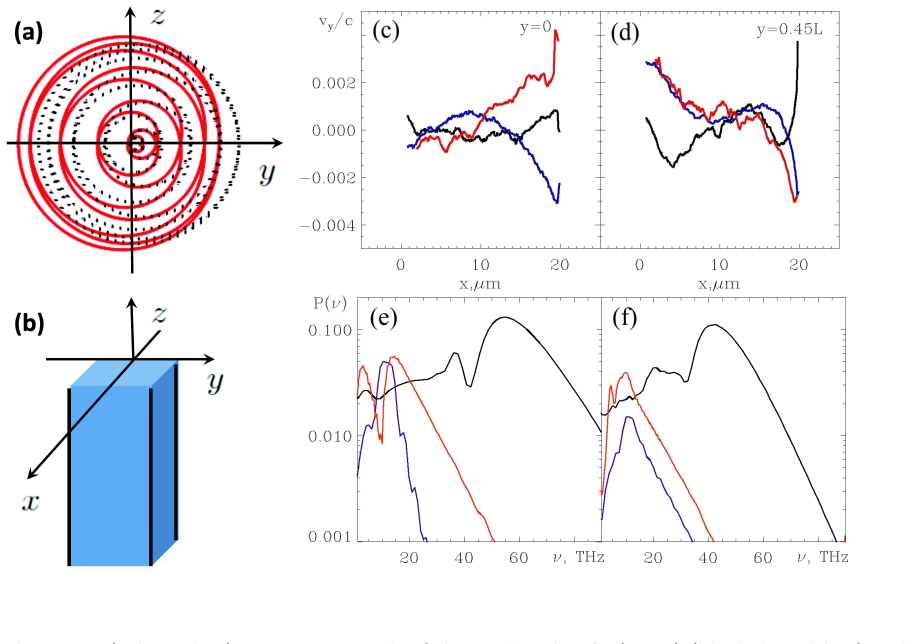
The argument is carried by a two-dimensional particle-in-cell simulation of a gas cell irradiated by a two-color circularly polarized pulse, with tunneling ionization included and the full electromagnetic field evolved self-consistently, so the back-reaction of emitted radiation on electron motion is captured. The key object is the nearly homogeneous plasma oscillation in the small cell: with the cell length $L$ comparable to or smaller than the plasma wavelength $\lambda_p$, ionization saturates quickly and the electron gas sloshes in phase, making the cell behave like a time-dependent capacitor with an almost uniform internal electric field. Radiation spectra and terahertz energies are extracted by averaging over the fast pump oscillations; the ionization energy loss is subtracted from the field through an effective ionization current, ensuring energy conservation.
What would settle it
Measure the terahertz pulse energy per electron from a 20-micrometer gas jet or cell and a 50-micrometer cell under identical two-color circularly polarized pumping at 0.8 micrometers and about 2 times $10^{15}$ W/$cm^{2}$, and check whether the smaller target emits 2.7 to 4.7 times more energy per electron as Table 1 predicts; a matched three-dimensional particle-in-cell simulation would independently test whether the quasi-isotropic dipole emission and the 10 MV/cm quasi-static field persist without the translation invariance along z.
Extended reading notes
Core claim
The central claim is that for a sufficiently small interaction volume ($L=20\,\mu$m), the plasma oscillation excited by asymmetric ionization is almost spatially homogeneous, so the electron gas oscillates as a whole dipole rather than as a superposition of standing plasma waves. This coherent dipole oscillation radiates a single-cycle terahertz pulse, and the paper's Table 1 shows that the smaller cell emits 2.7 to 4.7 times more energy per electron than the 50-micrometer cell at fixed density and wavelength. The same simulation shows quasi-static electric fields inside the cell reaching $E_m\approx 0.01$ to $0.013\,E_0$, i.e. about 8.6 to 11.6 MV/cm, lasting several hundred femtoseconds after the pump has left. The authors argue that this is why small emitters are more efficient: coherence maximizes both emission power and radiation damping, quickly converting collective electron energy into terahertz radiation.
Load-bearing premise
The load-bearing premise is that the two-dimensional simulation, which treats the cell as transparent and uniform along the third direction, correctly represents the coherent dipole oscillation that a real three-dimensional gas cell would support; if wall interactions, finite focusing, or non-uniform ionization break the phase-locking, the per-electron efficiency gain and the 10 MV/cm quasi-static field would not survive.
Editorial extensions
If this is right
- If the dipole-coherence regime holds, 10 to 20 micrometer gas jets, fibers, or tightly focused spots become viable geometries for bright, single-cycle terahertz sources that avoid crystal damage and can run at high repetition rates.
- Per-electron conversion efficiency increases as the interaction volume shrinks, so the paper predicts that replacing elongated filaments with small targets improves terahertz output per pump energy.
- The quasi-static fields above 10 MV/cm inside the cell are a resource in themselves, strong enough to bias plasma dynamics or to serve as a short-lived local field for pump-probe experiments in the few-hundred-femtosecond window.
- Longer mid-infrared pump wavelengths and higher gas densities should further raise the quasi-static field and terahertz emission, following the paper's scaling $E_m\sim\sqrt{n_e}\,\lambda$.
- A small three-dimensional plasma would emit almost isotropically in the polarization plane, including a backward terahertz component, consistent with tight-focusing observations.
Reading between the lines
- A systematic scan of cell length $L$ across the plasma wavelength $\lambda_p$ could map the coherence threshold: as $L$ grows from about $\lambda_p/2$ to several $\lambda_p$, the per-electron terahertz yield should drop from the coherent-dipole value to the filament value, a prediction not explicitly computed in the paper.
- The two-dimensional geometry likely overestimates the total radiated energy per electron because emission in the third direction changes the radiation damping balance; a three-dimensional particle-in-cell run would show whether the 2.7 to 4.7-fold advantage survives quantitatively.
- The same 'smaller emitter, more coherent radiation' principle may transfer to other collective radiators, such as laser-wakefield electron bunches or nanoplasmonic antennas, where radiation reaction is also amplified by the number of coherently radiating electrons.
Signed reviews
Editorial analysis
A structured set of objections, weighed in public.
Referee Report
Summary. The paper reports two-dimensional particle-in-cell (PIC) simulations of terahertz emission from small gas cells (20 and 50 micrometers) ionized by intense two-color circularly polarized laser pulses. The authors model the plasma self-consistently, including tunneling ionization, and compare cells of different sizes, gas densities, and laser wavelengths. Their central claim is that sufficiently small cells support an almost spatially homogeneous coherent dipole plasma oscillation, yielding a per-electron THz emission efficiency 2.7-4.7 times higher than in larger cells, while simultaneously generating quasi-static electric fields up to about 10 MV/cm inside the cell. The results are presented as relative THz energies in Table 1 and as field maps and velocity distributions in figures.
Significance. If the claims hold, the paper identifies a qualitatively new regime for ionization-based THz sources: sub-wavelength gas cells or thin gas jets acting as coherent dipole emitters with enhanced per-electron conversion and strong quasi-static near fields. The work uses a fully self-consistent PIC description with ionization and radiation back-reaction, and it makes falsifiable predictions that could be tested experimentally with gas cells or gas jets. A notable strength is that no quantities are fitted to reproduce the THz output; all parameters are fixed by the laser and target conditions. The quantitative significance is, however, limited by the two-dimensional geometry, the absence of absolute conversion efficiencies, and the lack of convergence or uncertainty estimates.
major comments (3)
- [Section 2, Eqs. (2)-(3), and Section 4, Table 1] The central physical claim of an almost spatially homogeneous coherent dipole oscillation is partly imposed by the 2D geometry: the input laser fields have no z dependence and the interaction volume is translation-invariant along z, so the plasma cannot develop any z-dependent dephasing or incoherence. The statement in Section 2 that "translation invariance along the z axis is not expected to introduce unphysical effects" is not supported by any simulation or estimate, and no run varies the cell length in z (only L=20 and 50 um in x and y are compared). Because the per-electron efficiency gain of 2.7-4.7x is derived from the 2D linear energy density in Table 1, the gain could be a consequence of the infinite-z line-source geometry rather than of the small lateral cell size. A 3D simulation of a finite-length cell, or at least an analytic estimate of the length scale over which z-coherence is lost, is required before this claim can be accepted.
- [Section 3, Figs. 1-2 and Table 1] No convergence study or error estimates are reported for the PIC parameters (Delta x = Delta y = lambda/40, Delta t = (2*pi/omega)/80, 64 macroparticles per cell). The main quantitative result, the 2.7-4.7x per-electron enhancement, is a ratio of THz energies computed from these simulations, and without a resolution or particle-number convergence check it is impossible to know whether the reported differences are physical or numerical. The paper should include a convergence test for at least one representative case and report the associated uncertainty.
- [Abstract and Section 4, Eq. (4)] The claim of a "remarkably efficient conversion" is not supported by any absolute conversion efficiency. Table 1 contains only THz energies normalized to the 50 um, n0=10^19 cm^-3 case, so the reader cannot determine what fraction of the laser energy or of the electron kinetic energy is converted to THz radiation. Please state an absolute efficiency or explicitly qualify all "efficiency" statements as relative to the 50 um cell within the 2D model.
minor comments (6)
- [Section 3, Figure 2 caption] The caption contains a typo: "Cuts of Ey alog the x-axis" should read "Cuts of Ey along the x-axis."
- [Section 4, Conclusion] The sentence "our main funding is the high relative efficiency" should read "our main finding is the high relative efficiency."
- [Section 4, Conclusion] The word "near-filed" should be "near-field."
- [Section 4, radiation-damping paragraph] The radiation-damping mechanism for the termination of THz emission is stated without supporting calculation, and the authors themselves write that a quantitative description "will be given elsewhere"; this should be explicitly framed as a hypothesis rather than a conclusion.
- [Section 2, Eqs. (2)-(3)] The phase shift alpha is adjusted to direct the net photoelectron momentum along y, but the actual numerical value of alpha used in the runs is not given; please provide it for reproducibility.
- [Section 3, Eq. (4) and Table 1] The integration region S in Eq. (4) is not precisely defined; please specify which directions and propagation times are included, in particular whether backward emission contributes to the tabulated THz energies.
Circularity Check
No significant circularity: all central results emerge from a self-consistent PIC simulation with externally fixed inputs.
full rationale
The paper's main claims—spatially homogeneous dipole plasma oscillation in small cells, quasi-static fields near 10 MV/cm, and higher per-electron THz conversion efficiency for smaller volumes—are obtained as emergent outputs of a particle-in-cell simulation. The input parameters (pulse amplitude E0 = 0.87 GV/cm, relative second-harmonic amplitude epsilon = 0.22, cell sizes L = 20 and 50 um, gas density, and wavelength) are fixed from experimental practice and do not encode the output THz energies or field strengths. The THz energy is computed from the simulated electric field via Eq. (4), and the per-electron efficiency gain is a simple ratio of simulated linear energy densities divided by the linear electron concentration; no parameter is fitted to reproduce the claimed efficiency. The citation of prior work by one of the authors, e.g. [21] for photoelectron momentum scalings and the phase-shift choice, is not load-bearing for the central simulation result and does not reduce the derivation to an assumption. The 2D translation-invariant geometry and the extrapolation to 3D emission are legitimate physical limitations and correctness risks, but they are not circular: the simulation would still produce some result independent of the claim it is used to support. Therefore the derivation chain is self-contained and no circular step can be exhibited.
Assumptions & free parameters
free parameters (2)
- Relative SH amplitude epsilon =
0.22
- Phase shift alpha between fundamental and SH =
not stated
assumptions (4)
- domain assumption Tunneling ionization rate from Refs. [28,29] accurately describes ionization in the strong-field regime.
- domain assumption Only single-electron ionization occurs; atoms become singly charged.
- domain assumption Electrons are created at rest at the position of the ion.
- domain assumption The 2D simulation is representative of a 3D geometry with translation invariance along z.
Cite this review
Pith. "Pith review of Bright single-cycle terahertz source based on gas cells irradiated by two-color laser pulses." pith.science (2026). https://pith.science/paper/Q4GAU6AC
@misc{pith2026190811136,
  author       = {Pith},
  title        = {Pith review of: Bright single-cycle terahertz source based on gas cells irradiated by two-color laser pulses},
  year         = {2026},
  howpublished = {\url{https://pith.science/paper/Q4GAU6AC}},
  note         = {Machine review of arXiv:1908.11136}
}
abstract
We study the excitation of electron currents in a transparent cell of sub-millimeter size filled by an atomic gas and illuminated by an intense two-color femtosecond laser pulse. The pulse consists of a strong fundamental component and its second harmonic of low intensity, both circularly polarized. We show that for sufficiently small $20\mu$m cells the plasma oscillation excited by asymmetric ionization is almost spatially homogeneous within the interaction volume. This coherent dipole plasma oscillation results in a remarkably efficient conversion of the electron energy into that of radiation emitted in the terahertz frequency domain. Simultaneously, strong quasi-static electric fields of maximal strength $E_m\simeq 10$MV/cm are shown to exist inside the cell during several hundred femtoseconds after the ionizing two-color laser pulse has gone.
Figures

Reference graph
Works this paper leans on
-
[1]
Pickwell E and Wallace V P 2006 J. Phys. D 39 R301
work page 2006
-
[2]
Dexheimer S L 2008 Terahertz Spectroscopy: Principles and Applications (New York: Taylor & Francis Group)
work page 2008
-
[3]
Lee Y-S 2009 Principles of Terahertz Science and Technology (New York: Springer)
work page 2009
-
[4]
Hafez H A, Chai X, Ibrahim A, Mondal S, F´ erachou D, Ropagnol X and Ozaki T 2016 J. Opt. 18 093004
work page 2016
-
[5]
Dhillon S D et al. 2017 J. Phys. D 50 043001
work page 2017
-
[6]
Yeh K-L, Hoffmann M C, Hebling J and Nelson K A 2007 Appl. Phys. Lett. 90 171121
work page 2007
- [7]
- [8]
Show all 35 references
-
[9]
Bartel T, Gaal P, Reimann K, Woerner M and Elsaesser T 2005 Opt. Lett. 30 2805
2005
-
[10]
Express 15 4577
Kim K Y, Glownia J H, Taylor A J and Rodriguez G 2007 Opt. Express 15 4577
2007
-
[11]
Silaev A A and Vvedenskii N V 2009 Phys. Rev. Lett. 102 115005
2009
-
[12]
Berg´ e L, Skupin S, K¨ ohler C, Babushkin I and Herrmann J 2013Phys. Rev. Lett. 110 073901
-
[13]
Kostin V A and Vvedenskii N V 2018 Phys. Rev. Lett. 120 065002
2018
-
[14]
You Y S, Oh T I and Kim K Y 2012 Phys. Rev. Lett. 109 183902
2012
-
[15]
Oh T I, Yoo Y J, You Y S and Kim K Y 2014 Appl. Phys. Lett. 105 041103
2014
-
[16]
2009 Phys
Dai J, Karpowicz N, and Zhang X.-C. 2009 Phys. Rev. Lett. 103 023001
2009
-
[17]
Wen H, and Lindenberg A M 2009 Phys. Rev. Lett. 103 023902
2009
-
[18]
2013 Phys
Clerici M et al. 2013 Phys. Rev. Lett. 110 253901
2013
-
[19]
Meng Ch, Chen W, Wang X, L¨ u Zh, Huang Y, Liu J, Zhang D, Zhao Z, and Yuan J 2016 Appl. Phys. Lett. 109, 131105
2016
-
[20]
Fedorov V Yu and Tzortzakis S 2018 Phys. Rev. A 97 063842
2018
-
[21]
Tulsky V A, Baghery M, Saalmann U and Popruzhenko S V 2018 Phys. Rev. A 98 053415
2018
-
[22]
Plasmas 16, 056706
Kim K Y 2009 Phys. Plasmas 16, 056706
2009
-
[23]
Kotelnikov I A, Borodin A V, Shkurinov A P 2011 J. Exp. Theor. Phys. 139 1081
2011
-
[24]
Johnson L A, Palastro J P, Antonsen T M, and Kim K Y 2013 Phys. Rev. A 88 063804
2013
-
[25]
Popruzhenko S V, Tulsky V A 2015 Phys. Rev. A 92, 033414
2015
-
[26]
Plasmas 5, 2727
Vshivkov V A, Naumova N M, Pegoraro F, and Bulanov S V 1998 Phys. Plasmas 5, 2727
1998
-
[27]
Liseykina T, Bauer D 2013 Phys. Rev. Lett. 110, 145003
2013
-
[28]
Popov V S 2004 Usp. Fiz. Nauk 147, 921 [2004 Phys. Usp. 47, 855]
2004
-
[29]
Popruzhenko S V 2014 J. Phys. B: At. Mol. Opt. Phys. 47 204001
2014
-
[30]
Rae S C and Burnett K 1992 Phys. Rev. A 46, 2077
1992
-
[31]
Plasmas 5, 4466
Mulser P, Cornolti F, and Bauer D 1998 Phys. Plasmas 5, 4466
1998
-
[32]
Plasmas 11, L69
Kemp A J, Sentoku Y, Cowan T, Fuchs J, and Ruhl H 2004 Phys. Plasmas 11, L69
2004
-
[33]
2018 Optica 5 1617
Thiele et al. 2018 Optica 5 1617
2018
-
[34]
Yang Y and Bozhevolnyi S 2019 Nanotechnology 30 204001
2019
-
[35]
Ushakov A A, Panov N A, Chizhov P A, Shipilo D E, Bukin V V, Savel’ev A B, Garnov S V and Kosareva O G 2019 Appl. Phys. Lett. 114, 081102
2019
Reviewed August 14, 2026 · model on record in the stance chip above.
Discussion (0). Continue with ORCID to comment.