REVIEW 2 major objections 6 minor 159 references
The supernova remnant population of the Small Magellanic Cloud
T0 review · 2 major / 6 minor · reviewed 2026-08-14 · deepseek-v4-flash
Pith's one-line read The Small Magellanic Cloud hosts about 4.7 core-collapse supernova remnants for every type Ia remnant, a ratio three times higher than in the Large Magellanic Cloud, implying that the galaxies' recent star formation histories set their…
desk verdict A careful SMC SNR census whose headline CC/Ia ratio depends on two environment-only classifications; the catalog and abundance results are worth engaging with despite that fragility. read the letter →
The pith
A machine-rendered reading of the paper's core claim, the machinery that carries it, and where it could break.
The reading
What carries the argument
The argument rests on a two-part hint system. A spectral hint on a 1–5 scale is assigned from X-ray ejecta abundance flags (high or low X/Fe ratios for O, Ne, Mg, Si) or from the presence of a pulsar or pulsar wind nebula; an environmental hint is assigned from $N_{\mathrm{OB}}$, the number of massive blue stars within 100 pc, combined with $r = \Psi_1 M_1/(\Psi_2 M_2 + \Psi_3 M_3)$, the expected core-collapse to type Ia ratio from the local star formation history and SN Ia delay-time distribution. The two hints are combined with a weight of 2 on the spectral hint, and final scores below 2.5 are labelled likely type Ia, above 3.5 likely core-collapse; the two undecided remnants provide the lower and upper limits on the ratio. The X-ray analysis is done by simultaneously fitting source and background spectra with the background explicitly modelled rather than subtracted, which is what allows faint extended remnants to be typed.
What would settle it
A deep X-ray survey of the SMC outskirts beyond about 1.5 degrees that finds several iron-rich type Ia remnants in old stellar fields would push the 14/3 count down toward the LMC ratio; the paper itself flags these outskirts as the main unknown.
Extended reading notes
Core claim
After removing six objects previously misclassified as SNRs and adding two newly confirmed remnants, the paper presents a final list of 21 confirmed and 2 candidate SNRs in the SMC. From a homogeneous X-ray spectral analysis of all 19 remnants with available data, it detects SN ejecta in 11 objects, finds no Fe K line even in the brightest and youngest remnant, and measures the hot ISM abundances of O, Ne, Mg, and Fe to lie between 0.1 and 0.2 solar. Combining spectral typing (ejecta abundance flags, pulsar/PWN detections) with a star-formation-based typing from the local massive-star count and reconstructed star formation history, it estimates $N_{\mathrm{CC}}/N_{\mathrm{Ia}} = 4.7$ (14/3), with range 2.8 (14/5) to 5.3 (16/3). This is about three times the LMC ratio of 1.35 from the same method, which the paper attributes to an enhanced star formation episode 0.5–1.5 Gyr ago in the LMC but not the SMC. It further reports that SMC remnants on average expand into a less dense and less disturbed medium, consistent with the galaxies' different morphologies.
Load-bearing premise
The headline number assumes that the typing rules for core-collapse versus type Ia remnants, calibrated on LMC remnants, transfer to the SMC, and that the survey has not missed type Ia remnants, especially in the poorly observed outer regions.
Editorial extensions
If this is right
- If the ratio is correct, the SMC's supernova type mix is set by its recent star formation history: the absence of a 0.5–1.5 Gyr burst suppresses type Ia production even though the SMC has old stars.
- Galactic SN Ia rates should not be inferred from stellar mass alone; the delay-time distribution plus recent star formation history matters, so galaxies with similar masses can differ in their core-collapse to type Ia ratio by a factor of about three.
- The 0.1–0.2 solar hot-gas abundances of O, Ne, Mg, and Fe, combined with ratios to stellar abundances, imply that SNR shocks partially destroy dust and return depleted elements to the gas phase.
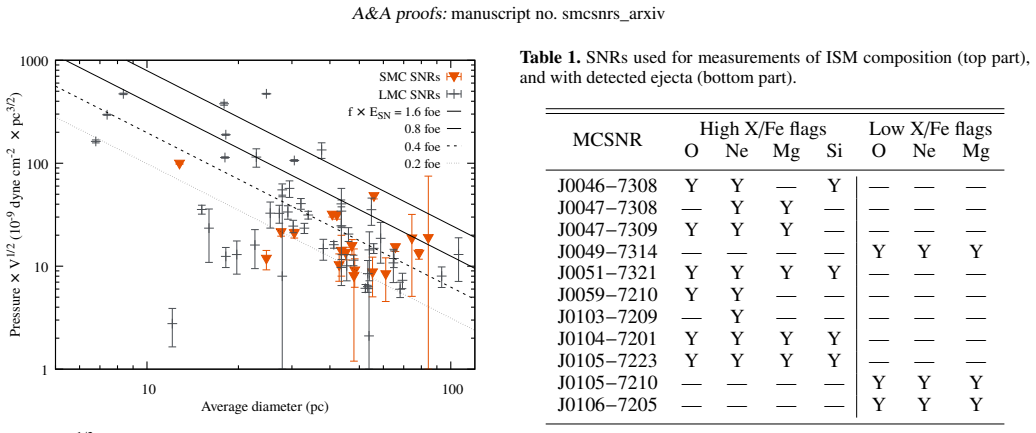
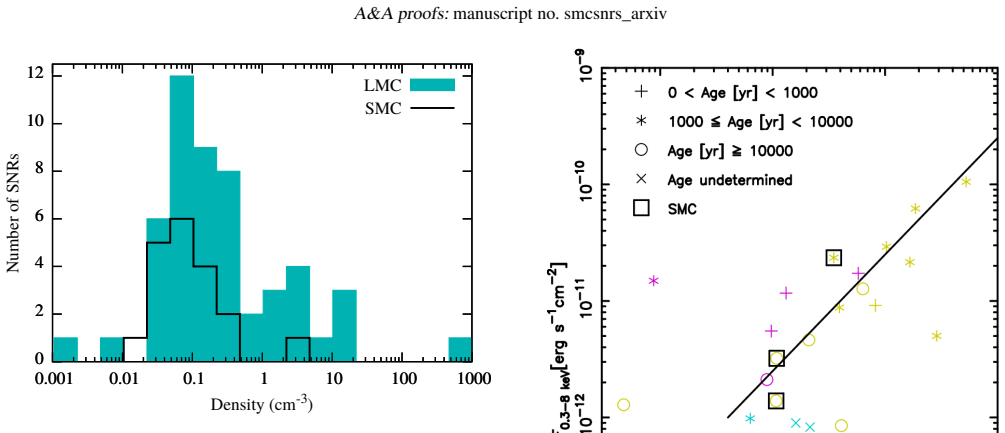
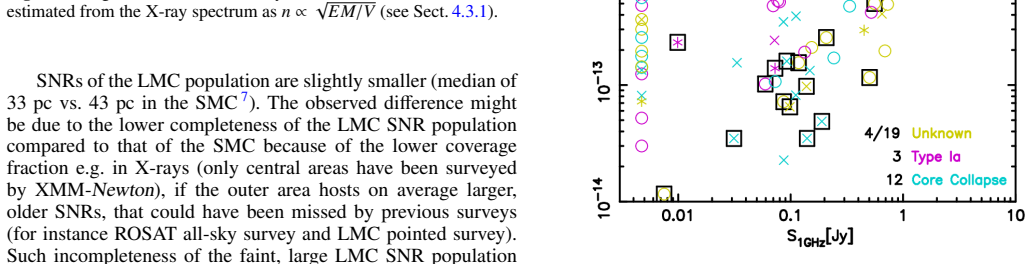
- The lower ambient densities in the SMC explain why its remnants are larger, more circular, and fainter in X-rays at a given radio flux than LMC remnants, a trend that should hold for other low-density dwarf galaxies.
- The cleaned sample means future population studies of SMC SNRs should use the 21 confirmed objects rather than older compilations that include the six rejected sources.
Reading between the lines
- If the central ratio holds, similarly low-mass, low-metallicity dwarf galaxies may be even more dominated by core-collapse supernovae than their stellar populations suggest; integrated type Ia rates in such galaxies would provide a direct test.
- The line-of-sight depth of the SMC means some core-collapse classifications based on projected massive-star counts could be wrong; using the X-ray absorption column as a depth proxy before typing could sharpen the ratio.
- The absence of Fe K emission in the youngest and brightest remnant supports models in which most iron is still unshocked; repeated X-ray observations over decades could catch the reverse shock reaching the iron and test ejecta stratification.
- The same two-hint typing method could be applied to SNR samples in other Local Group galaxies; if the SMC's low type Ia fraction is real, galaxies with intermediate-age star formation episodes should show higher type Ia fractions.
Editorial analysis
A structured set of objections, weighed in public.
Referee Report
Summary. The paper presents a multiwavelength census of the Small Magellanic Cloud supernova remnant population. Combining XMM-Newton spectral analysis, radio continuum data, MCELS imaging, and new WiFeS optical spectroscopy, the authors assemble a clean sample of 21 confirmed SNRs and 2 candidates, rejecting six previously catalogued objects. The homogeneous X-ray analysis searches for ejecta, detects no Fe K lines, and measures ISM abundances in eight SNRs. The headline result is NCC/NIa = 4.7 (14/3), with limits 2.8–5.3, about three times the LMC value of 1.35 obtained with the same method; the authors interpret this as evidence that the SMC lacks the intermediate-age star formation episode of the LMC. The paper also compares radio properties, sizes, morphologies, and line-of-sight depths of SMC and LMC SNRs.
Significance. If correct, the measured CC/Ia ratio is an important constraint on the SMC star formation history and on delay-time distributions, and the catalog itself will be a reference. The paper's strengths are the careful, homogeneous X-ray spectral reduction with explicit background modelling, the systematic checks on plasma models and abundance tables, the multiwavelength confirmation of new remnants, and the direct comparison with the LMC using the same pipeline. The main caveats are the small number statistics (14 CC vs 3 Ia) and the sensitivity of the headline ratio to environment-based typing, which the authors partly acknowledge but do not quantify.
major comments (2)
- [Sect. 4.7, Table A.1] The headline NCC/NIa = 4.7 (14/3) counts MCSNR J0052−7236 and J0103−7247 as core-collapse solely on the basis of the 'hint-SF' environment metric (NOB = 130 and 117, r = 1.60 and 1.76), while their X-ray spectra are fitted with ISM-like abundances (hint-spec = 3). The text itself warns that the SMC's large line-of-sight depth means NOB and r 'might not reflect the correct environment' and that classifying high-NOB–r SNRs as CC 'should be done with caution.' The quoted range 2.8–5.3 only reassigns the two undecided SNRs and does not cover the uncertainty in these two classifications; reclassifying them as Ia or unclassified changes the ratio to about 4.0 or 2.4 and weakens the LMC contrast. Please add an explicit robustness test that recomputes NCC/NIa under alternative assignments for all SNRs with hint-spec = 3 or with environment-only typing, and report the resulting range.
- [Sect. 4.7, Tables 4 and 5] The typing thresholds (NOB bin boundaries 80 and 115; r boundaries 0.6 and 1.5; final combined-hint cutoffs 2.5 and 3.5) are introduced as fixed, hand-set values transferred from the LMC analysis. The SMC SFH is acknowledged to be noisier, and the discriminatory power in the SMC is weaker (the average NOB of secure CC SNRs, 160±63, overlaps substantially with that of likely Ia, 92±22). Because the final counts are only 14 CC versus 3 Ia, small shifts in these thresholds could move one or two objects across the 'undecided' boundaries and materially change the headline ratio. Please provide a sensitivity analysis of the ratio to, e.g., ±20% variations in the thresholds, or otherwise quantify the robustness of the 4.7 value to the choice of cutoffs.
minor comments (6)
- [Sect. 3.2] The object name 'MCSNR J0040−7336' appears to be a typo for 'MCSNR J0041−7336' in the discussion of the diffuse emission background.
- [Sect. 4.6] The name 'MCSNR J0052−7237' is used in the first paragraph and in Table 1; the correct identifier is 'MCSNR J0052−7236'.
- [Sect. 4.7] In the third paragraph, 'dagnostic' should be 'diagnostic'.
- [Fig. B.1 caption] The caption refers to 'MCSNR J048−7319'; this should be 'MCSNR J0048−7319'.
- [Abstract and Sect. 5] The initial count of '19 confirmed and 4 candidate SNRs' versus the final '21 confirmed SNRs and 2 candidates' is explained in the text, but a brief sentence in the abstract would avoid apparent inconsistency for the casual reader.
- [Table A.3] The column header 'NH LMC' may confuse readers; it appears to denote the fitted SMC absorption column density in units of 10^21 cm^-2, not a quantity specific to the LMC.
Circularity Check
No material circularity: the SMC CC/Ia ratio and SNR classifications are a new application of a published method to independent multiwavelength data; the authors' self-citation of MHK16 is minor and not load-bearing.
-
other
[Sect. 4.7 (Tables 4 and 5); method adopted from MHK16]
"We covered the various methods of SNR typing in MHK16. We mostly use our X-ray spectral results ... or the detection of an associated (NS) or PWN. We then add secondary evidence based on the local stellar environment of SMC SNRs to tentatively type the rest of the sample, a method we explain in detail in MHK16."
The typing rubric and the LMC comparison ratio (1.35, 'measured by a similar method') are imported from the authors' own MHK16, so the SMC-versus-LMC contrast is not fully independent of the same group's earlier calibration. This is only a minor self-citation, however: the SMC spectral fits, NOB counts, and SFH-based r values are computed anew for this sample, the three Ia and the majority of CC classifications rest on X-ray ejecta or compact-object associations rather than on the MHK16 calibration, and no fitted parameter from this paper is recycled into the headline ratio.
full rationale
The derivation chain for the headline NCC/NIa = 4.7 (14/3) is a count of individually typed SNRs, not a fitted quantity. The spectral typing uses X-ray ejecta abundance flags and Fe K non-detections; the environment metric combines an external photometric catalogue (Zaritsky et al. 2002), an external SFH (Harris & Zaritsky 2004), and literature delay-time distributions (Maoz & Badenes 2010). Two SNRs (J0052-7236 and J0103-7247) are classed as CC through the NOB-r hint alone, and the paper explicitly cautions that 'classifying the high NOB–r SNRs as CC should be done with caution' because of SMC line-of-sight depth; this is a robustness/sensitivity concern about those two classifications, not a circular reuse of the measured ratio. The secure subsample (ejecta, PWN, BeXRB, Fe-rich Ia) already gives 12 CC and 3 Ia, so the central claim retains independent content. The main self-reference is the adoption of MHK16's method and the LMC benchmark value of 1.35, which is normal methodological continuity rather than load-bearing circularity.
Assumptions & free parameters
free parameters (3)
- NOB bin boundaries in Table 5 =
80 and 115
- r bin boundaries in Table 5 =
0.6 and 1.5
- hint-spec vs hint-SF weighting =
2:1
assumptions (5)
- domain assumption The X-ray spectra of SNRs are adequately described by collisional ionization equilibrium or non-equilibrium thermal plasma models (vpshock, vnei, vsedov) with abundances tied to a chosen solar abundance table.
- domain assumption The SMC distance is 60 kpc for all sources, with no line-of-sight depth applied to individual objects.
- domain assumption The delay-time distribution parameters for type Ia supernovae from Maoz & Badenes (2010) apply to the SMC and are used in Eq. 3 to compute r.
- ad hoc to paper The typing hints in Tables 4 and 5, calibrated on the LMC and projected stellar counts, track the true progenitor type of each SMC SNR.
- ad hoc to paper The detected and typed SMC SNR sample is representative of the true population, with no strong type-dependent incompleteness.
Cite this review
Pith. "Pith review of The supernova remnant population of the Small Magellanic Cloud." pith.science (2026). https://pith.science/paper/JGVJYHWH
@misc{pith2026190811234,
  author       = {Pith},
  title        = {Pith review of: The supernova remnant population of the Small Magellanic Cloud},
  year         = {2026},
  howpublished = {\url{https://pith.science/paper/JGVJYHWH}},
  note         = {Machine review of arXiv:1908.11234}
}
abstract
Aims: We present a comprehensive study of the supernova remnant (SNR) population of the Small Magellanic Cloud (SMC). We measure multiwavelength properties of the SMC SNRs and compare them to those of the Large Magellanic Cloud (LMC) population. Methods: This study combines the large dataset of XMM-Newton observations of the SMC, archival and recent radio continuum observations, an optical line emission survey, and new optical spectroscopic observations. We can thus build a complete and clean sample of 19 confirmed and 4 candidate SNRs. The homogeneous X-ray spectral analysis allows to search for SN ejecta and Fe K line emission, and to measure interstellar medium (ISM) abundances. We estimate the ratio of core-collapse to type Ia supernova rates of the SMC based on the X-ray properties and the local stellar environment of each SNR. Results : After the removal of unconfirmed or misclassified objects, and the addition of two newly confirmed SNRs based on multi-wavelength features, we present a final list of 21 confirmed SNRs and 2 candidates. While no Fe K line is detected even for the brightest and youngest SNR, we find X-ray evidence of SN ejecta in 11 SNRs. We estimate a ratio of 4.7$_{-1.9} ^{+0.6}$ core-collapse supernova to every type Ia SN, three times higher than in the LMC. The difference can be ascribed to the absence of the enhanced star formation episode in the SMC, which occurred in the LMC 0.5-1.5 Gyr ago. The hot-gas abundances of O, Ne, Mg, and Fe are 0.1-0.2 times solar. Their ratios with respect to SMC stellar abundances reflect the effects of dust depletion and partial dust destruction in SNR shocks. We find evidence that the ambient medium probed by SMC SNRs is less disturbed and less dense on average than in the LMC, consistent with the different morphologies of the two galaxies.
Figures


Figures from the paper (5 more)



Reference graph
Works this paper leans on
-
[1]
, " * write output.state after.block = add.period write newline
ENTRY address archiveprefix author booktitle chapter edition editor howpublished institution eprint journal key month note number organization pages publisher school series title type volume year label extra.label sort.label short.list INTEGERS output.state before.all mid.sentence after.sentence after.block FUNCTION init.state.consts #0 'before.all := #1 ...
-
[2]
write newline
" write newline "" before.all 'output.state := FUNCTION n.dashify 't := "" t empty not t #1 #1 substring "-" = t #1 #2 substring "--" = not "--" * t #2 global.max substring 't := t #1 #1 substring "-" = "-" * t #2 global.max substring 't := while if t #1 #1 substring * t #2 global.max substring 't := if while FUNCTION word.in bbl.in " " * FUNCTION format....
-
[3]
Alsaberi , R. Z. E., Maitra , C., Filipovi \'c , M. D., et al. 2019, , 486, 2507
2019
-
[4]
Alsabti , A. W. & Murdin , P. 2017, Handbook of Supernovae
2017
-
[5]
& Grevesse , N
Anders , E. & Grevesse , N. 1989, , 53, 197
1989
-
[6]
Arnaud , K. A. 1996, in Astronomical Society of the Pacific Conference Series, Vol. 101, Astronomical Data Analysis Software and Systems V, ed. G. H. Jacoby & J. Barnes , 17
1996
-
[7]
J., & Scott , P
Asplund , M., Grevesse , N., Sauval , A. J., & Scott , P. 2009, , 47, 481
2009
-
[8]
A., Badenes , C., et al
Auchettl , K., Lopez , L. A., Badenes , C., et al. 2019, , 871, 64
2019
Show all 159 references
-
[9]
Badenes , C., Maoz , D., & Draine , B. T. 2010, , 407, 1301
2010
-
[10]
& McCammon , D
Balucinska-Church , M. & McCammon , D. 1992, , 400, 699
1992
-
[11]
Baumgardt , H., Parmentier , G., Anders , P., & Grebel , E. K. 2013, , 430, 676
2013
-
[12]
J., Rossa , J., Weis , K., & Dennerl , K
Bomans , D. J., Rossa , J., Weis , K., & Dennerl , K. 2003, in IAU Symposium, Vol. 212, A Massive Star Odyssey: From Main Sequence to Supernova, ed. K. van der Hucht , A. Herrero , & C. Esteban , 637
2003
-
[13]
J., Hendrick , S
Borkowski , K. J., Hendrick , S. P., & Reynolds , S. P. 2006 a , , 652, 1259
2006
-
[14]
J., Williams , B
Borkowski , K. J., Williams , B. J., Reynolds , S. P., et al. 2006 b , , 642, L141
2006
-
[15]
2013, , 555, A1
Bouret , J.-C., Lanz , T., Martins , F., et al. 2013, , 555, A1
2013
-
[16]
M., Filipovi \'c , M
Bozzetto , L. M., Filipovi \'c , M. D., Vukoti \'c , B., et al. 2017, , 230, 2
2017
-
[17]
M., Kavanagh , P
Bozzetto , L. M., Kavanagh , P. J., Maggi , P., et al. 2014, , 439, 1110
2014
-
[18]
E., Reyes Navarro , F
Carlos Reyes , R. E., Reyes Navarro , F. A., Mel \'e ndez , J., Steiner , J., & Elizalde , F. 2015, , 51, 135
2015
-
[19]
& Limongi , M
Chieffi , A. & Limongi , M. 2017, , 836, 79
2017
-
[20]
& Wilcots , E
Chomiuk , L. & Wilcots , E. M. 2009, , 703, 370
2009
-
[21]
A., Tosi , M., et al
Cignoni , M., Cole , A. A., Tosi , M., et al. 2012, , 754, 130
2012
-
[22]
Cox , D. P. & Daltabuit , E. 1971, , 167, 113
1971
-
[23]
J., Filipovic , M
Crawford , E. J., Filipovic , M. D., de Horta , A. Y., et al. 2011, Serbian Astronomical Journal, 183, 95
2011
-
[24]
J., Filipovi \'c , M
Crawford , E. J., Filipovi \'c , M. D., McEntaffer , R. L., et al. 2014, , 148, 99
2014
-
[25]
& Molendi , S
De Luca , A. & Molendi , S. 2004, , 419, 837
2004
-
[26]
Dickey , J. M. & Lockman , F. J. 1990, , 28, 215
1990
-
[27]
2007, , 310, 255
Dopita , M., Hart , J., McGregor , P., et al. 2007, , 310, 255
2007
-
[28]
Dopita , M. A. 1979, Australian Journal of Physics, 32, 123
1979
-
[29]
A., Seitenzahl , I
Dopita , M. A., Seitenzahl , I. R., Sutherland , R. S., et al. 2019, , 157, 50
2019
-
[30]
A., Seitenzahl , I
Dopita , M. A., Seitenzahl , I. R., Sutherland , R. S., et al. 2016, , 826, 150
2016
-
[31]
A., Vogt , F
Dopita , M. A., Vogt , F. P. A., Sutherland , R. S., et al. 2018, , 237, 10
2018
-
[32]
Duin, R. P. W. 1976, IEEE Transactions on Computers, 1175
1976
-
[33]
& Tibshirani, R
Efron, B. & Tibshirani, R. J. 1994, An introduction to the bootstrap (CRC press)
1994
-
[34]
D., Bohlsen , T., Reid , W., et al
Filipovi \'c , M. D., Bohlsen , T., Reid , W., et al. 2002, , 335, 1085
2002
-
[35]
D., Haberl , F., Winkler , P
Filipovi \'c , M. D., Haberl , F., Winkler , P. F., et al. 2008, , 485, 63
2008
-
[36]
D., Haynes , R
Filipovic , M. D., Haynes , R. F., White , G. L., & Jones , P. A. 1998, , 130, 421
1998
-
[37]
D., Jones , P
Filipovic , M. D., Jones , P. A., White , G. L., et al. 1997, , 121, 321
1997
-
[38]
D., Payne , J
Filipovi \'c , M. D., Payne , J. L., Reid , W., et al. 2005, , 364, 217
2005
-
[39]
L., Morse , J
Finkelstein , S. L., Morse , J. A., Green , J. C., et al. 2006, , 641, 919
2006
-
[40]
2018, , 480, 2743
For , B.-Q., Staveley-Smith , L., Hurley-Walker , N., et al. 2018, , 480, 2743
2018
-
[41]
Galvin , T. J. & Filipovic , M. D. 2014, Serbian Astronomical Journal, 189, 15
2014
-
[42]
J., Filipovi \'c , M
Galvin , T. J., Filipovi \'c , M. D., Tothill , N. F. H., et al. 2014, , 353, 603
2014
-
[43]
F., Plucinsky , P
Garofali , K., Williams , B. F., Plucinsky , P. P., et al. 2017, , 472, 308
2017
-
[44]
C., & Hartigan , P
Ghavamian , P., Raymond , J., Smith , R. C., & Hartigan , P. 2001, , 547, 995
2001
-
[45]
B., et al
Graczyk , D., Pietrzy \'n ski , G., Thompson , I. B., et al. 2014, , 780, 59
2014
-
[46]
Green , D. A. 2019, arXiv e-prints, arXiv:1907.02638
2019 arXiv
-
[47]
V., Kniazev , A
Gvaramadze , V. V., Kniazev , A. Y., & Oskinova , L. M. 2019, , 485, L6
2019
-
[48]
D., Bozzetto , L
Haberl , F., Filipovi \'c , M. D., Bozzetto , L. M., et al. 2012 a , , 543, A154
2012
-
[49]
D., Pietsch , W., & Kahabka , P
Haberl , F., Filipovi \'c , M. D., Pietsch , W., & Kahabka , P. 2000, , 142, 41
2000
-
[50]
& Pietsch , W
Haberl , F. & Pietsch , W. 2004, , 414, 667
2004
-
[51]
2012 b , , 545, A128
Haberl , F., Sturm , R., Ballet , J., et al. 2012 b , , 545, A128
2012
-
[52]
D., Pietsch , W., & Crawford , E
Haberl , F., Sturm , R., Filipovi \'c , M. D., Pietsch , W., & Crawford , E. J. 2012 c , , 537, L1
2012
-
[53]
& Zaritsky , D
Harris , J. & Zaritsky , D. 2004, , 127, 1531
2004
-
[54]
& Zaritsky , D
Harris , J. & Zaritsky , D. 2009, , 138, 1243
2009
-
[55]
K., & Duffau , S
Haschke , R., Grebel , E. K., & Duffau , S. 2012, , 144, 107
2012
-
[56]
R., Lanz , T., & Hubeny , I
Heap , S. R., Lanz , T., & Hubeny , I. 2006, , 638, 409
2006
-
[57]
M., Guerrero , M
H \'e nault-Brunet , V., Oskinova , L. M., Guerrero , M. A., et al. 2012, , 420, L13
2012
-
[58]
P., Reynolds , S
Hendrick , S. P., Reynolds , S. P., & Borkowski , K. J. 2005, , 622, L117
2005
-
[59]
W., Howarth , I
Hilditch , R. W., Howarth , I. D., & Harries , T. J. 2005, , 357, 304
2005
-
[60]
P., Hayashi , I., & Koyama , K
Hughes , J. P., Hayashi , I., & Koyama , K. 1998, , 505, 732
1998
-
[61]
Hughes , J. P. & Smith , R. C. 1994, , 107, 1363
1994
-
[62]
2009, , 496, 841
Hunter , I., Brott , I., Langer , N., et al. 2009, , 496, 841
2009
-
[63]
1983, in IAU Symposium, Vol
Inoue , H., Koyama , K., & Tanaka , Y. 1983, in IAU Symposium, Vol. 101, Supernova Remnants and their X-ray Emission, ed. J. Danziger & P. Gorenstein , 535--540
1983
-
[64]
L., Campana , S., Covino , S., et al
Israel , G. L., Campana , S., Covino , S., et al. 2000, , 531, L131
2000
-
[65]
2011, , 415, 1366
Kapakos , E., Hatzidimitriou , D., & Soszy \'n ski , I. 2011, , 415, 1366
2011
-
[66]
J., Sasaki , M., Bozzetto , L
Kavanagh , P. J., Sasaki , M., Bozzetto , L. M., et al. 2016, , 586, A4
2016
-
[67]
A., Staveley-Smith , L., & Bessell , M
Kim , S., Dopita , M. A., Staveley-Smith , L., & Bessell , M. S. 1999, , 118, 2797
1999
-
[68]
Y., & Kim , H.-J
Koo , B.-C., Lee , J.-J., Jeong , I.-G., Seok , J. Y., & Kim , H.-J. 2016, , 821, 20
2016
-
[69]
V., et al
Koyama , K., Petre , R., Gotthelf , E. V., et al. 1995, , 378, 255
1995
-
[70]
Kuntz , K. D. & Snowden , S. L. 2008, , 478, 575
2008
-
[71]
M., Dufour , R
Kurt , C. M., Dufour , R. J., Garnett , D. R., et al. 1999, , 518, 246
1999
-
[72]
P., Slane , P
Lee , J.-J., Park , S., Hughes , J. P., Slane , P. O., & Burrows , D. N. 2011, , 731, L8
2011
-
[73]
& Schaerer , D
Lejeune , T. & Schaerer , D. 2001, , 366, 538
2001
-
[74]
2010, , 725, 842
Leonidaki , I., Zezas , A., & Boumis , P. 2010, , 725, 842
2010
-
[75]
2007, The Astrophysical Journal, 658, 1027
Leroy , A., Bolatto , A., Stanimirovic , S., et al. 2007, The Astrophysical Journal, 658, 1027
2007
-
[76]
& Nomoto , K
Leung , S.-C. & Nomoto , K. 2018, , 861, 143
2018
-
[77]
2003, , 591, 1220
Lodders , K. 2003, , 591, 1220
2003
-
[78]
S., Blair , W
Long , K. S., Blair , W. P., Winkler , P. F., et al. 2010, , 187, 495
2010
-
[79]
S., Kuntz , K
Long , K. S., Kuntz , K. D., Blair , W. P., et al. 2014, , 212, 21
2014
-
[80]
Lopez , L. A. 2014, in IAU Symposium, Vol. 296, Supernova Environmental Impacts, ed. A. Ray & R. A. McCray , 239--244
2014
-
[81]
A., Castro , D., Slane , P
Lopez , L. A., Castro , D., Slane , P. O., Ramirez-Ruiz , E., & Badenes , C. 2014, , 788, 5
2014
-
[82]
& Klessen , R
Mac Low , M.-M. & Klessen , R. S. 2004, Reviews of Modern Physics, 76, 125
2004
-
[83]
& Acero , F
Maggi , P. & Acero , F. 2017, , 597, A65
2017
-
[84]
J., et al
Maggi , P., Haberl , F., Kavanagh , P. J., et al. 2014, , 561, A76
2014
-
[85]
J., et al
Maggi , P., Haberl , F., Kavanagh , P. J., et al. 2016, , 585, A162
2016
-
[86]
D., et al
Maitra , C., Ballet , J., Filipovi \'c , M. D., et al. 2015, , 584, A41
2015
-
[87]
& Badenes , C
Maoz , D. & Badenes , C. 2010, , 407, 1314
2010
-
[88]
& Mannucci , F
Maoz , D. & Mannucci , F. 2012, , 29, 447
2012
-
[89]
& Kroupa , P
Maschberger , T. & Kroupa , P. 2011, , 411, 1495
2011
-
[90]
S., Ford , V
Mathewson , D. S., Ford , V. L., Dopita , M. A., et al. 1984, , 55, 189
1984
-
[91]
2012, ArXiv e-prints [ [arXiv] 1209.3114 ]
Merloni , A., Predehl , P., Becker , W., et al. 2012, ArXiv e-prints [ [arXiv] 1209.3114 ]
2012 arXiv
-
[92]
2014, , 438, 1067
Meschin , I., Gallart , C., Aparicio , A., et al. 2014, , 438, 1067
2014
-
[93]
C., White , G
Millar , W. C., White , G. L., & Filipovic , M. D. 2012, Serbian Astronomical Journal, 184, 19
2012
-
[94]
C., White , G
Millar , W. C., White , G. L., Filipovi \'c , M. D., et al. 2011, , 332, 221
2011
-
[95]
2006, , 448, 1247
Misanovic , Z., Pietsch , W., Haberl , F., et al. 2006, , 448, 1247
2006
-
[96]
2001, Publications of the Astronomical Society of Japan, 53, L45
Mizuno , N., Rubio , M., Mizuno , A., et al. 2001, Publications of the Astronomical Society of Japan, 53, L45
2001
-
[97]
2010, , 712, 1248
Muller , E., Ott , J., Hughes , A., et al. 2010, , 712, 1248
2010
-
[98]
No \"e l , N. E. D., Aparicio , A., Gallart , C., et al. 2009, , 705, 1260
2009
-
[99]
2013, , 51, 457
Nomoto , K., Kobayashi , C., & Tominaga , N. 2013, , 51, 457
2013
-
[100]
2010, , 520, A74
North , P., Gauderon , R., Barblan , F., & Royer , F. 2010, , 520, A74
2010
-
[101]
N., Filipovi \'c , M
O'Brien , A. N., Filipovi \'c , M. D., Crawford , E. J., et al. 2013, , 347, 159
2013
-
[102]
A., Filipovi \'c , M
Owen , R. A., Filipovi \'c , M. D., Ballet , J., et al. 2011, , 530, A132
2011
-
[103]
G., Schlegel , E
Pannuti , T. G., Schlegel , E. M., Filipovi \'c , M. D., et al. 2011, , 142, 20
2011
-
[104]
G., Swartz , D
Pannuti , T. G., Swartz , D. A., Laine , S., et al. 2015, , 150, 91
2015
-
[105]
P., Burrows , D
Park , S., Hughes , J. P., Burrows , D. N., et al. 2003, , 598, L95
2003
-
[106]
L., Filipovi \'c , M
Payne , J. L., Filipovi \'c , M. D., Pannuti , T. G., et al. 2004 a , , 425, 443
2004
-
[107]
L., Filipovi \'c , M
Payne , J. L., Filipovi \'c , M. D., Reid , W., et al. 2004 b , , 355, 44
2004
-
[108]
L., White , G
Payne , J. L., White , G. L., Filipovi \'c , M. D., & Pannuti , T. G. 2007, , 376, 1793
2007
-
[109]
A., Peimbert , A., Peimbert , M., & Ruiz , M
Pe \ n a-Guerrero , M. A., Peimbert , A., Peimbert , M., & Ruiz , M. T. 2012, , 746, 115
2012
-
[110]
Peimbert , M., Peimbert , A., & Ruiz , M. T. 2000, , 541, 688
2000
-
[111]
W., Oey , M
Pellegrini , E. W., Oey , M. S., Winkler , P. F., et al. 2012, , 755, 40
2012
-
[112]
2019, , 567, 200
Pietrzy \'n ski , G., Graczyk , D., Gallenne , A., et al. 2019, , 567, 200
2019
-
[113]
2005, , 434, 483
Pietsch , W., Freyberg , M., & Haberl , F. 2005, , 434, 483
2005
-
[114]
2004, , 426, 11
Pietsch , W., Misanovic , Z., Haberl , F., et al. 2004, , 426, 11
2004
-
[115]
P., Beardmore , A
Plucinsky , P. P., Beardmore , A. P., Foster , A., et al. 2017, , 597, A35
2017
-
[116]
A., Payne , J
Reid , W. A., Payne , J. L., Filipovi \'c , M. D., et al. 2006, , 367, 1379
2006
-
[117]
2002, , 564, 704
Rela \ n o , M., Peimbert , M., & Beckman , J. 2002, , 564, 704
2002
-
[118]
L., DeRoo , C., et al
Roper , Q., McEntaffer , R. L., DeRoo , C., et al. 2015, , 803, 106
2015
-
[119]
2015, , 449, 639
Rubele , S., Girardi , L., Kerber , L., et al. 2015, , 449, 639
2015
-
[120]
2012, , 537, A106
Rubele , S., Kerber , L., Girardi , L., et al. 2012, , 537, A106
2012
-
[121]
Russell , S. C. & Dopita , M. A. 1990, , 74, 93
1990
-
[122]
Russell , S. C. & Dopita , M. A. 1992, , 384, 508
1992
-
[123]
2019, The Astrophysical Journal, 881, 85
Sano , H., Matsumura , H., Yamane , Y., et al. 2019, The Astrophysical Journal, 881, 85
2019
-
[124]
2012, , 544, A144
Sasaki , M., Pietsch , W., Haberl , F., et al. 2012, , 544, A144
2012
-
[125]
N., et al
Schenck , A., Park , S., Burrows , D. N., et al. 2014, , 791, 50
2014
-
[126]
2016, , 151, 161
Schenck , A., Park , S., & Post , S. 2016, , 151, 161
2016
-
[127]
L., Madore , B
Scowcroft , V., Freedman , W. L., Madore , B. F., et al. 2016, , 816, 49
2016
-
[128]
1986, Density estimation for statistics and data analysis
Silverman, B. 1986, Density estimation for statistics and data analysis
1986
-
[129]
D., Dwek , E., & Jones , A
Slavin , J. D., Dwek , E., & Jones , A. P. 2015, , 803, 7
2015
-
[130]
M., Sault , R
Stanimirovic , S., Staveley-Smith , L., Dickey , J. M., Sault , R. J., & Snowden , S. L. 1999, , 302, 417
1999
-
[131]
Stanimirovi \'c , S., Staveley-Smith , L., & Jones , P. A. 2004, , 604, 176
2004
-
[132]
2011, , 534, A55
Stiele , H., Pietsch , W., Haberl , F., et al. 2011, , 534, A55
2011
-
[133]
A., & Filipovi \'c , M
Stupar , M., Parker , Q. A., & Filipovi \'c , M. D. 2008, , 390, 1037
2008
-
[134]
D., et al
Sturm , R., Dra s kovi \'c , D., Filipovi \'c , M. D., et al. 2013 a , , 558, A101
2013
-
[135]
M., et al
Sturm , R., Haberl , F., Oskinova , L. M., et al. 2013 b , , 556, A139
2013
-
[136]
at f\"ur Physik, Technische Universit\
Sturm , R. K. N. 2012, PhD thesis, Fakult\"at f\"ur Physik, Technische Universit\"at M\"unchen, Germany
2012
-
[137]
& Subramaniam , A
Subramanian , S. & Subramaniam , A. 2009, , 496, 399
2009
-
[138]
& Subramaniam , A
Subramanian , S. & Subramaniam , A. 2012, , 744, 128
2012
-
[139]
2010, , 62, 1239
Takeda , Y., Kambe , E., Sadakane , K., & Masada , S. 2010, , 62, 1239
2010
-
[140]
2016, , 68, S9
Takeuchi , Y., Yamaguchi , H., & Tamagawa , T. 2016, , 68, S9
2016
-
[141]
2001, , 372, 667
Testor , G. 2001, , 372, 667
2001
-
[142]
K., Eichler , M., Panov , I
Thielemann , F. K., Eichler , M., Panov , I. V., & Wehmeyer , B. 2017, Annual Review of Nuclear and Particle Science, 67, 253
2017
-
[143]
J., Bleeker , J
van der Heyden , K. J., Bleeker , J. A. M., & Kaastra , J. S. 2004, , 421, 1031
2004
-
[144]
2012, , 20, 49
Vink , J. 2012, , 20, 49
2012
-
[145]
R., Dolphin , A
Weisz , D. R., Dolphin , A. E., Skillman , E. D., et al. 2013, , 431, 364
2013
-
[146]
J., Borkowski , K
Williams , B. J., Borkowski , K. J., Reynolds , S. P., et al. 2006, , 652, L33
2006
-
[147]
2000, , 542, 914
Wilms , J., Allen , A., & McCray , R. 2000, , 542, 914
2000
-
[148]
F., Crawford , E
Wong , G. F., Crawford , E. J., Filipovic , M. D., et al. 2012 a , Serbian Astronomical Journal, 184, 93
2012
-
[149]
F., Filipovic , M
Wong , G. F., Filipovic , M. D., Crawford , E. J., et al. 2011 a , Serbian Astronomical Journal, 182, 43
2011
-
[150]
F., Filipovic , M
Wong , G. F., Filipovic , M. D., Crawford , E. J., et al. 2011 b , Serbian Astronomical Journal, 183, 103
2011
-
[151]
F., Filipovic , M
Wong , G. F., Filipovic , M. D., Crawford , E. J., et al. 2012 b , Serbian Astronomical Journal, 185, 53
2012
-
[152]
T., & M \"u ller , E
Wongwathanarat , A., Janka , H. T., & M \"u ller , E. 2013, , 552, A126
2013
-
[153]
J., Plucinsky , P
Xi , L., Gaetz , T. J., Plucinsky , P. P., Hughes , J. P., & Patnaude , D. J. 2019, , 874, 14
2019
-
[154]
2014, , 785, L27
Yamaguchi , H., Badenes , C., Petre , R., et al. 2014, , 785, L27
2014
-
[155]
2010, , 715, 412
Yamaguchi , H., Sawada , M., & Bamba , A. 2010, , 715, 412
2010
-
[156]
J., & Kennicutt , Jr., R
Ye , T., Turtle , A. J., & Kennicutt , Jr., R. C. 1991, , 249, 722
1991
-
[157]
S., Amy , S
Ye , T. S., Amy , S. W., Wang , Q. D., Ball , L., & Dickel , J. 1995, , 275, 1218
1995
-
[158]
D., Roper , Q., et al
Yew , M., Filipovi \'c , M. D., Roper , Q., et al. 2018, , 35, e015
2018
-
[159]
B., Grebel , E
Zaritsky , D., Harris , J., Thompson , I. B., Grebel , E. K., & Massey , P. 2002, , 123, 855
2002
Reviewed August 14, 2026 · model on record in the stance chip above.
Discussion (0). Continue with ORCID to comment.