REVIEW 1 major objections 4 minor 80 references
The Lubin-Tate Theory of Configuration Spaces: I
T0 review · 1 major / 4 minor · reviewed 2026-08-14 · deepseek-v4-flash
Pith's one-line read A convergent spectral sequence computes Morava E-theory of labeled configuration spaces, with its E2 page identified as the homology of a Hecke–Chevalley–Eilenberg complex.
desk verdict Genuinely new computational machinery for Morava E-homology of configuration spaces, but the main theorem rests on an unproved completion-to-isomorphism upgrade from the first author's thesis. read the letter →
The pith
A machine-rendered reading of the paper's core claim, the machinery that carries it, and where it could break.
The reading
What carries the argument
The load-bearing object is the Hecke Lie algebra $g(M;X) = E^{\wedge}_*(\mathrm{FreeLie}(\Sigma^{n-1}X)^{M_+})$, together with its Hecke–Chevalley–Eilenberg complex $CE_{Hu}$. A Hecke Lie algebra is a Lie algebra in $E_*$-modules equipped with an action of the ring of additive power operations, and $CE_{Hu}$ is the complex obtained by killing those operations in a derived fashion and then forming the derived abelianisation. The argument converts a stable equivalence between configuration spaces and the bar construction on a free spectral Lie algebra into an algebraic spectral sequence, using a theorem from the first author's thesis that identifies the completed E-homology of a free K(h)-local spectral Lie algebra with the free Hecke Lie algebra on its homotopy groups.
What would settle it
Compute the completed E-homology of $B_3(\mathbb{R}^3)$ at height 2 and p=3 by an independent method, such as a Gysin sequence for the symmetric group action or a direct Atiyah–Hirzebruch computation, and compare with the paper's prediction $E_* \oplus \Sigma^{-1}E_*/3$; a different torsion summand would falsify the spectral sequence's E2-page identification.
Extended reading notes
Core claim
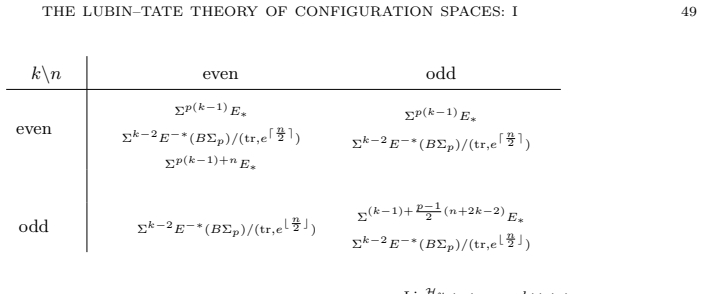
The paper's central claim is that for a framed n-manifold M and a spectrum X, whenever the completed E-homology Hecke Lie algebra $g(M;X)$ is finite and free in each weight, there is a convergent weighted spectral sequence $E^2_{s,t} \cong H_{s+1}(CE_{Hu}(g(M;X)))_{t-1}$ converging to $\bigoplus_{k\ge 0} E^{\wedge}_{s+t}(B_k(M;X))$, where $B_k(M;X)$ is the labeled unordered configuration space. Here $CE_{Hu}$ is a Hecke analogue of the Chevalley–Eilenberg complex: it first kills the additive operations in a derived fashion and then takes the derived abelianisation of the resulting Lie algebra. The authors apply this spectral sequence to compute the completed E-homology of the pth Snaith summand of $\Omega^n S^{n+k}$ for all n, k, and all heights, and the E-cohomology of the space of p unordered points in a punctured orientable surface. They read off the corresponding Morava K-theory groups and, by letting the height grow, prove that the integral homology of $B_p(S_{g,1})$ has no p-power torsion.
Load-bearing premise
The whole computation rests on an unproved theorem quoted from the first author's thesis: the completed E-homology of a free spectral Lie algebra is exactly the free Hecke Lie algebra on its homotopy groups, and the paper does not reprove it.
Editorial extensions
If this is right
- The E-theory of the pth weight summand of $\Omega^n S^{n+k}$ is now known explicitly for every n, k, and height h at odd primes, giving a concrete description of the weight p operations on $E_n$-algebras.
- For punctured orientable surfaces, the E-cohomology of $B_p(S_{g,1})$ is a direct sum of free $E_*$-modules with explicit ranks, so the E-theory of these configuration spaces is torsion-free.
- The same surface computation implies that the integral homology of $B_p(S_{g,1})$ has no p-power torsion, so its $\mathbb{F}_p$ Betti numbers coincide with its rational Betti numbers.
- At height 1 the spectral sequence recovers known p-adic K-theory computations, and as h tends to infinity it yields new $\mathbb{F}_p$-homology computations for configurations of p points on surfaces.
- The Morava K-theory groups read off from the spectral sequence show that the size of the weight p part of $K(h)_*(\Omega^n S^{n+1})$ depends on height for n at least 4, which runs against the pattern suggested by earlier conjectures.
Reading between the lines
- The same spectral sequence, with a more careful treatment of the coherent coalgebra structure, should extend to weights $p^i$ and could settle the full conjecture at all weights.
- The torsion summand of the form $E_*(B\Sigma_p)/(tr)$ suggests that weight p E-theory of configuration spaces is governed by the modular representation theory of the symmetric group, a connection the paper leaves mostly implicit.
- A direct testable extension is to apply the method to non-framed manifolds after incorporating tangential structure groups, following the authors' own stated future direction, and to compare the results against known rational Betti numbers.
- For explicit height 2 examples, the formulas give concrete answers such as the p=3 computation $E^{\wedge}_*(B_3(\mathbb{R}^{11})) \cong E_* \oplus \Sigma^{-1}E_*[\alpha]/(\alpha^4 - 6\alpha^2 + (h-9)\alpha - 3, \alpha^5)$, which could be checked independently through a direct analysis of Dyer–Lashof operations.
Signed reviews
Editorial analysis
A structured set of objections, weighed in public.
Referee Report
Summary. This paper develops a new method for computing the completed Morava E-homology of unordered configuration spaces of framed manifolds. The main structural result, Theorem 5.5, is a weighted spectral sequence converging to ⊕_k E^∧_{s+t}(B_k(M;X)), whose E2-page is identified with the homology of a Hecke–Chevalley–Eilenberg complex for an unshifted Hecke Lie algebra g(M;X). The construction combines Knudsen's stable splitting of configuration spaces (Theorem 5.1) with Brantner's description of the E-homology of free K(h)-local spectral Lie algebras in terms of Hecke Lie algebras (Theorem 4.20). Using this tool, the paper computes the E-theory of the weight-p Snaith summands of iterated loop spaces of spheres at arbitrary height (Theorem 6.10), derives the corresponding Morava K-theory groups (Theorem 6.19), and computes the E-theory and F_p-homology of configuration spaces of p points on punctured surfaces (Theorems 7.1 and 1.10). The paper also proves several foundational algebraic results, including the Chevalley–Eilenberg computation for flat Lie algebras (Theorem 3.13) and the existence of transferred model structures for Hecke Lie algebras.
Significance. If the identification of the E2-page is fully justified, the paper supplies a general and explicit computational tool for Morava E-theory of labeled configuration spaces, with applications to power operations on E_n-algebras and to longstanding conjectures of Ravenel. The paper is carefully written and contains complete proofs of the algebraic foundations in Sections 2–4, including the Chevalley–Eilenberg theorem for flat Lie algebras and the construction of the Hecke–Chevalley–Eilenberg complex. The derived computations are explicit and falsifiable, and they match independent results at height 1 (Langsetmo) and classical F_p results (Cohen). The main gap is the unproved upgrade from a completion isomorphism to an honest isomorphism in Corollary 4.21, which is the load-bearing bridge to the spectral sequence.
major comments (1)
- [Section 4.5, Corollary 4.21; used in Section 5.2, proof of Theorem 5.5] The E2-page identification of the Hecke spectral sequence rests on the assertion that the canonical map FreeLie_Hu(π_* M) → π_* FreeLE(L_K(h) M) is an isomorphism for M in the category of pointwise finite free positive-weight E-module spectra, whereas Theorem 4.20(2) only provides this isomorphism after completion. Corollary 4.21 is stated without proof, with only a reference to [Bra17, §4.4.2]. This upgrade is load-bearing: Theorem 5.5 applies it levelwise to replace the homotopy of the topological bar construction by the algebraic bar construction Bar(id, L_Hu, g(M;X)) and then by CE_Hu(g). The height-1 comparison in §6.1 gives indirect evidence but does not test cases in which the completed and uncompleted answers differ. I recommend adding a proof of Corollary 4.21, or at least a detailed account of the finiteness and naturality of the cotensor construction that yields the honest isomorphism.
minor comments (4)
- [Section 5.2, proof of Theorem 5.5] The expression "Bar•(LHu, ,LHu, g(M;X))" contains an extra comma, and the reference to "Proposition 4.21" should be "Corollary 4.21."
- [Section 6.1, proof of Theorem 6.1] In the discussion of the map E2_0,*(p,1,k) → E2_0,*(p,n,k) for n odd and k even, the map is written as multiplication by p^{n/2}, but n is odd in that case; the exponent should be floor(n/2) or the description of the induced map on the torsion subgroups should be clarified.
- [Section 7.1, Theorem 7.1(1)] The formula for E∗(Bp( ˙T ))) has an extra closing parenthesis; it should be E∗(Bp( ˙T )).
- [Remark 1.4] The expression "α 5" should presumably be "α^5"; the exponent is missing a caret.
Circularity Check
No significant circularity: the E2-page identification rests on cited prior theorems with independent content, and the derived computations are not fed back into the definitions.
full rationale
The derivation chain is: Knudsen's stable splitting (Theorem 5.1) expresses labeled configuration spaces as a bar construction on a free spectral Lie algebra; Brantner's Theorem 4.20 identifies the homotopy of free K(h)-local spectral Lie algebras with free Hecke Lie algebras up to completion, upgraded in Corollary 4.21 for finite-free positive-weight modules; the algebraic Chevalley–Eilenberg complex for Hecke Lie algebras is developed and proven self-contained in Sections 3–4; the spectral sequence of Theorem 5.5 assembles these inputs. None of these steps defines the target in terms of itself. The Hecke Lie algebra g(M;X) is a topological invariant (completed E-homology of a spectral Lie algebra), not a fitted parameter; the computed E2-pages are derived from the algebraic complex, and the outputs (Theorems 6.10 and 7.1) are not used to define the inputs. The heavy self-citations (Brantner's thesis for Theorem 4.20, Knudsen's paper for Theorem 5.1) are load-bearing, but they are parameter-free theorems with stated assumptions that do not include the configuration-space results, and they are partially calibrated externally by the height-1 comparison with Langsetmo and the F_p-homology match with Cohen. The main soft spot is the completion-to-isomorphism upgrade in Corollary 4.21, which is asserted rather than fully proved in this paper; that is a correctness or completeness concern, not a circularity, because the upgrade is not obtained by assuming the conclusion of Theorem 5.5 or by renaming an input. No fitted parameter is relabeled as a prediction, and no uniqueness theorem is imported to force a choice. The paper's internal algebraic development in Sections 2–4 is self-contained, so the central claim has independent content.
Assumptions & free parameters
assumptions (5)
- standard math The category of weighted graded modules over E_* admits transferred model structures on simplicial Lie algebras and Hecke Lie algebras.
- domain assumption Theorem 4.20 (Brantner): homotopy groups of free K(h)-local spectral Lie algebras are computed by free Hecke Lie algebras after completion.
- domain assumption Theorem 5.1 (Knudsen): stable equivalence between labeled configuration spaces and the bar construction on free spectral Lie algebras.
- domain assumption Manifolds considered (R^n and punctured orientable surfaces) are framed and stably split.
- domain assumption p is an odd prime and 2 is invertible in E_*, so divided powers and Lie algebra axioms behave classically.
invented entities (2)
-
Unshifted Hecke Lie algebra g^u
-
Hecke Chevalley-Eilenberg complex CE_Hu
Cite this review
Pith. "Pith review of The Lubin-Tate Theory of Configuration Spaces: I." pith.science (2026). https://pith.science/paper/JD3SFCO3
@misc{pith2026190811321,
  author       = {Pith},
  title        = {Pith review of: The Lubin-Tate Theory of Configuration Spaces: I},
  year         = {2026},
  howpublished = {\url{https://pith.science/paper/JD3SFCO3}},
  note         = {Machine review of arXiv:1908.11321}
}
abstract
We construct a spectral sequence converging to the Morava $E$-theory of unordered configuration spaces and identify its E$^2$-page as the homology of a Chevalley-Eilenberg-like complex for Hecke Lie algebras. Based on this, we compute the $E$-theory of the weight $p$ summands of iterated loop spaces of spheres (parametrising the weight $p$ operations on $\mathbb{E}_n$-algebras), as well as the $E$-theory of the configuration spaces of $p$ points on a punctured surface. We read off the corresponding Morava $K$-theory groups, which appear in a conjecture by Ravenel. Finally, we compute the $\mathbb{F}_p$-homology of the space of unordered configurations of $p$ particles on a punctured surface.
Figures
Reference graph
Works this paper leans on
-
[1]
O. Antol \' n Camarena. The mod 2 homology of free spectral L ie algebras . PhD thesis, Harvard University, 2015
work page 2015
-
[2]
D. Ayala and J. Francis. Factorization homology of topological manifolds. J. Topol. , 8:1045--1084, 2015
work page 2015
-
[3]
M. Barr. Cartan--Eilenberg cohomology and triples. J. Pure Appl. Algebra , 112:219--238, 1996
work page 1996
-
[4]
Rational cohomology of configuration spaces of surfaces
Carl-Friedrich B \"o digheimer and Fred Cohen. Rational cohomology of configuration spaces of surfaces. In Algebraic Topology and Transformation Groups , volume 1361 of Lecture Notes in Math. , pages 7--13. Springer, 1988
work page 1988
-
[5]
C.-F. B\" o digheimer, F. R. Cohen, and R. J. Milgram. Truncated symmetric products and configuration spaces. Math. Z. , 214(2):179--216, 1993
work page 1993
-
[6]
C.-F. B \"o digheimer, F. R. Cohen, and L. R. Taylor. On the homology of configuration spaces. Topology , 28:111--123, 1989
work page 1989
-
[7]
A. Beilinson and V. Drinfeld. Chiral Algebras . American Mathematical Society, 2004
work page 2004
-
[8]
A. K. Bousfield and D. M. Kan. Homotopy limits, completions and localizations . Lecture Notes in Mathematics, Vol. 304. Springer-Verlag, Berlin-New York, 1972
work page 1972
Show all 80 references
-
[9]
R. R. Bruner, J. P. May, J. E. McClure, and M. Steinberger. H ring spectra and their applications , volume 1176 of Lecture Notes in Mathematics . Springer-Verlag, Berlin, 1986
1986
-
[10]
B \" o digheimer
C.-F. B \" o digheimer. Stable splittings of mapping spaces. In Algebraic Topology , volume 1286 of Lecture Notes in Math. Springer, 1987
1987
-
[11]
A. K. Bousfield. Localization and periodicity in unstable homotopy theory. J. Amer. Math. Soc. , 7(4):831--873, 1994
1994
-
[12]
Behrens and C
M. Behrens and C. Rezk. Spectral algebra models of unstable v_n -periodic homotopy theory. arXiv preprint arXiv:1703.02186 , 2017
2017 arXiv
-
[13]
D. L. B. Brantner. The Lubin-Tate Theory of Spectral Lie Algebras . PhD thesis, Harvard University, 2017. Edited Version available at https://people.maths.ox.ac.uk/brantner/brantnerthesis.pdf https://people.maths.ox.ac.uk/brantner/brantnerthesis.pdf
2017
-
[14]
W. Browder. Homology operations and loop spaces. Illinois journal of mathematics , 4(3):347--357, 1960
1960
-
[15]
Chevalley and S
C. Chevalley and S. Eilenberg. Cohomology theory of Lie groups and Lie algebras . Trans. Amer. Math. Soc. , 1948
1948
-
[16]
M. Ching. Bar constructions for topological operads and the G oodwillie derivatives of the identity. Geom. Topol. , 9:833--933, 2005
2005
-
[17]
F. R. Cohen, T. J. Lada, and J. P. May. Homology of Iterated Loop Spaces . Number 533 in Lecture Notes in Math. Springer, 1976
1976
-
[18]
F. R. Cohen, J. P. May, and L. R. Taylor. Splitting of certain spaces CX . Math. Proc. Camb. Phil. Soc. , 84, 1978
1978
-
[19]
G. C. Drummond-Cole and B. Knudsen. Betti numbers of configuration spaces of surfaces. J. London Math. Soc. , 2017
2017
-
[20]
Dyer and R
E. Dyer and R. K. Lashof. Homology of iterated loop spaces. Amer. J. Math. , 84:35--88, 1962
1962
-
[21]
Non-additive functors, their derived functors, and the suspension homomorphism
Albrecht Dold and Dieter Puppe. Non-additive functors, their derived functors, and the suspension homomorphism. Proc. Nat. Acad. Sci. U.S.A. , 44:1065--1068, 1958
1958
-
[22]
P. I. Etingof, I. Frenkel, and A. A. Kirillov. Lectures on representation theory and Knizhnik--Zamolodchikov equations . American Mathematical Soc., 1998
1998
-
[23]
Fossum and H.-B
R. Fossum and H.-B. Foxby. The category of graded modules. Math. Scand. , 1974
1974
-
[24]
Francis and D
J. Francis and D. Gaitsgory. Chiral K oszul duality. Selecta Math. , 18(1):27--87, 2012
2012
-
[25]
Rational B etti numbers of configuration spaces
Yves F\'elix and Jean-Claude Thomas. Rational B etti numbers of configuration spaces. Topology Appl. , 102:139--149, 2000
2000
-
[26]
P. G. Goerss and M. J. Hopkins. Moduli spaces of commutative ring spectra. In Structured ring spectra , volume 315 of London Math. Soc. Lecture Note Ser. , pages 151--200. Cambridge Univ. Press, Cambridge, 2004
2004
-
[27]
P. G. Goerss and J. F. Jardine. Simplicial Homotopy Theory . Birkh \" a user, 2009
2009
-
[28]
S. Glasman. Day convolution for -categories. Mathematical Research Letters , 23(5):1369--1385, 2016
2016
-
[29]
Paul G. Goerss. Hopf rings, D ieudonn\' e modules, and E_* ^2S^3 . In Homotopy invariant algebraic structures ( B altimore, MD , 1998) , volume 239 of Contemp. Math. , pages 115--174. Amer. Math. Soc., Providence, RI, 1999
1998
-
[30]
Universal homotopy associative, homotopy commutative H -spaces and the EHP spectral sequence
Jelena Grbi\' c . Universal homotopy associative, homotopy commutative H -spaces and the EHP spectral sequence. Math. Proc. Cambridge Philos. Soc. , 140(3):377--400, 2006
2006
-
[31]
Model categories and simplicial methods
Paul Goerss and Kristen Schemmerhorn. Model categories and simplicial methods. In Interactions between homotopy theory and algebra , volume 436 of Contemp. Math. , pages 3--49. Amer. Math. Soc., Providence, RI, 2007
2007
-
[32]
Lie algebras and v\_n -periodic spaces
Gijs Heuts. Lie algebras and v\_n -periodic spaces. arXiv preprint arXiv:1803.06325 , 2018
2018 arXiv
-
[33]
P. J. Higgins. Baer invariants and the B irkhoff- W itt theorem. Journal of Algebra , 11:469--482, 1969
1969
-
[34]
Hopkins, N
M. Hopkins, N. Kuhn, and D. C. Ravenel. Generalized group characters and complex oriented cohomology theories. Journal of the American Mathematical Society , 13(3):553--594, 2000
2000
-
[35]
M. Hopkins. K(1) -local E_ -ring spectra. In Topological modular forms , volume 201 of Math. Surveys Monogr. , pages 287--302. Amer. Math. Soc., Providence, RI, 2014
2014
-
[36]
On the homology spectral sequence for topological hochschild homology
Thomas Hunter. On the homology spectral sequence for topological hochschild homology. Transactions of the American Mathematical Society , 348(10):3941--3953, 1996
1996
-
[37]
Johnson and J
N. Johnson and J. Noel. Lifting homotopy t-algebra maps to strict maps. Advances in Mathematics , 264:593--645, 2014
2014
-
[38]
Kudo and S
T. Kudo and S. Araki. Topology of H_n -spaces and H -squaring operations. Mem. Fac. Sci. Ky\=usy\=u Univ. Ser. A. , 10:85--120, 1956
1956
-
[39]
J. J. Kjaer. On the odd primary homology of free algebras over the spectral Li e operad. arXiv preprint arXiv:1608.06605 , 2016
2016 arXiv
-
[40]
B. Knudsen. Betti numbers and stability for configuration spaces via factorization homology. Alg. Geom. Topol. , 17(5):3137--3187, 2017
2017
-
[41]
B. Knudsen. Higher enveloping algebras. Geom. Topol. , 22(7):4013--4066, 2018
2018
-
[42]
Langsetmo
L. Langsetmo. The K -theory localization of loops on an odd sphere and applications. Topology , 32(3):577--585, 1993
1993
-
[43]
Langsetmo
L. Langsetmo. Further structure in K(1)_* ^kS^ 2n+1 . In Algebraic topology: new trends in localization and periodicity ( S ant F eliu de G u\' xols, 1994) , volume 136 of Progr. Math. , pages 235--240. Birkh \" a user, Basel, 1996
1994
-
[44]
Further structure in K(1)_* ^kS^ 2n+1
Lisa Langsetmo. Further structure in K(1)_* ^kS^ 2n+1 . In Algebraic topology: new trends in localization and periodicity ( S ant F eliu de G u\' xols, 1994) , volume 136 of Progr. Math. , pages 235--240. Birkh\" a user, Basel, 1996
1994
-
[45]
Ass de modules plats
Daniel Lazard. Ass de modules plats. C. R. Acad. Sci. Paris S\' e r. A-B , 269:A65--A67, 1969
1969
-
[46]
Longoni and P
R. Longoni and P. Salvatore. Configuration spaces are not homotopy invariant. Topology , 44:375--380, 2005
2005
-
[47]
J. Lurie. Higher algebra. Preprint, http://www.math.harvard.edu/ lurie/papers/higheralgebra.pdf, 2003
2003
-
[48]
S. Marsh. The M orava E -theories of finite general linear groups. arXiv preprint arXiv:1001.1949 , 2010
1949 arXiv
-
[49]
The cohomology of restricted lie algebras and of hopf algebras
J Peter May. The cohomology of restricted lie algebras and of hopf algebras. Journal of Algebra , 3(2):123--146, 1966
1966
-
[50]
J. G. Mayorquin. The mod 2 K -homology of ^3S^3X . Canad. J. Math. , 40(1):142--196, 1988
1988
-
[51]
McCleary
J. McCleary. A User's Guide to Spectral Sequences , volume 58 of Cambridge Studies in Advances Mathematics . Cambridge University Press, 2000
2000
-
[52]
D. McDuff. Configuration spaces of positive and negative particles. Topology , 14:91--107, 1975
1975
-
[53]
James Milgram and Peter L\" o ffler
R. James Milgram and Peter L\" o ffler. The structure of deleted symmetric products. In Braids ( S anta C ruz, CA , 1986) , volume 78 of Contemp. Math. , pages 415--424. Amer. Math. Soc., Providence, RI, 1988
1986
-
[54]
Mahowald and Douglas C
Mark E. Mahowald and Douglas C. Ravenel. Toward a global understanding of the homotopy groups of spheres. In The L efschetz centennial conference, P art II ( M exico C ity, 1984) , volume 58 of Contemp. Math. , pages 57--74. Amer. Math. Soc., Providence, RI, 1987
1984
-
[55]
On the K -theory of the K ahn- P riddy map
Haynes Miller and Victor Snaith. On the K -theory of the K ahn- P riddy map. J. London Math. Soc. (2) , 20(2):339--342, 1979
1979
-
[56]
K -theory and unstable homotopy groups
Mark Mahowald and Robert Thompson. K -theory and unstable homotopy groups. In Algebraic topology ( E vanston, IL , 1988) , volume 96 of Contemp. Math. , pages 273--279. Amer. Math. Soc., Providence, RI, 1989
1988
-
[57]
Thompson
Mark Mahowald and Robert D. Thompson. The K -theory localization of an unstable sphere. Topology , 31(1):133--141, 1992
1992
-
[58]
Neisendorfer
J. Neisendorfer. Algebraic Methods in Unstable Homotopy Theory . Cambridge University Press, 2010
2010
-
[59]
Stewart B. Priddy. Koszul resolutions. Trans. Amer. Math. Soc. , 152:39--60, 1970
1970
-
[60]
D. Quillen. On the (co-) homology of commutative rings. In Applications of C ategorical A lgebra ( P roc. S ympos. P ure M ath., V ol. XVII , N ew Y ork, 1968) , pages 65--87. Amer. Math. Soc., Providence, R.I., 1970
1968
-
[61]
D. C. Ravenel. The homology and M orava K -theory of ^2 SU (n) . Forum Math. , 5(1):1--21, 1993
1993
-
[62]
D. C. Ravenel. What we still don't know about loop spaces of spheres. Contemporary Mathematics , 220:275--292, 1998
1998
-
[63]
C. Rezk. Notes on the H opkins- M iller theorem. In Homotopy theory via algebraic geometry and group representations ( E vanston, IL , 1997) , volume 220 of Contemp. Math. , pages 313--366. Amer. Math. Soc., Providence, RI, 1998
1997
-
[64]
The units of a ring spectrum and a logarithmic cohomology operation
Charles Rezk. The units of a ring spectrum and a logarithmic cohomology operation. J. Amer. Math. Soc. , 19(4):969--1014, 2006
2006
-
[65]
C. Rezk. The congruence criterion for power operations in M orava E -theory. Homology Homotopy Appl. , 11(2):327--379, 2009
2009
-
[66]
C. Rezk. Rings of power operations for M orava E -theories are K oszul. arXiv preprint arXiv:1204.4831 , 2012
2012 arXiv
-
[67]
Lois polynomes et lois formelles en th \'e orie des modules
Norbert Roby. Lois polynomes et lois formelles en th \'e orie des modules. In Annales scientifiques de l' \'E cole Normale Sup \'e rieure , volume 80, pages 213--348, 1963
1963
-
[68]
Configuration operads, minimal models and rational curves
Paolo Salvatore. Configuration operads, minimal models and rational curves. PhD thesis, University of Oxford, 1998
1998
-
[69]
Salvatore
P. Salvatore. Configuration spaces with summable labels. In Cohomological Methods in Homotopy Theory , volume 196 of Progr. Math. Birkh \" a user, 2001
2001
-
[70]
Schiessl
C. Schiessl. Integral cohomology of configuration spaces of the sphere. arXiv:801.04273
-
[71]
J.-P. Serre. Homologie singuli \` e re des espaces fibr \' e s. Ann. of Math. (2) , 54(3):425--505, 1951
1951
-
[72]
Groupes d'homotopie et classes de groupes ab \'e liens
Jean-Pierre Serre. Groupes d'homotopie et classes de groupes ab \'e liens. Ann. of Math , 58(2):258--294, 1953
1953
-
[73]
V. P. Snaith. A stable decomposition of n S n X . J. London Math. Soc. (2) , 7:577--583, 1974
1974
-
[74]
N. P. Strickland. Morava E -theory of symmetric groups. Topology , 37(4):757--779, 1998
1998
-
[75]
A dual R othenberg- S teenrod spectral sequence
Dai Tamaki. A dual R othenberg- S teenrod spectral sequence. Topology , 33(4):631--662, 1994
1994
-
[76]
The fiber of iterated F reudenthal suspension and M orava K -theory of ^kS^ 2l+1
Dai Tamaki. The fiber of iterated F reudenthal suspension and M orava K -theory of ^kS^ 2l+1 . In Recent progress in homotopy theory ( B altimore, MD , 2000) , volume 293 of Contemp. Math. , pages 299--329. Amer. Math. Soc., Providence, RI, 2002
2000
-
[77]
Configuration spaces of algebraic varieties
Burt Totaro. Configuration spaces of algebraic varieties. Topology , 35(4):1057--1067, 1996
1996
-
[78]
Lambda-rings, binomial domains, and vector bundles over C P( )
Clarence Wilkerson. Lambda-rings, binomial domains, and vector bundles over C P( ) . Comm. Algebra , 10(3):311--328, 1982
1982
-
[79]
Yamaguchi
A. Yamaguchi. Morava K -theory of double loop spaces of spheres. Mathematische Zeitschrift , 199(4):511--523, 1988
1988
-
[80]
The power operation structure on M orava E -theory of height 2 at the prime 3
Yifei Zhu. The power operation structure on M orava E -theory of height 2 at the prime 3. Algebr. Geom. Topol. , 14(2):953--977, 2014
2014
Reviewed August 14, 2026 · model on record in the stance chip above.
Discussion (0). Continue with ORCID to comment.