REVIEW 2 major objections 4 minor 51 references
Raman response in the nematic phase of FeSe
T0 review · 2 major / 4 minor · reviewed 2026-08-14 · deepseek-v4-flash
Pith's one-line read The gap-like drop in FeSe's $B_{1g}$ Raman response comes from the Fermi pockets becoming nearly mono-orbital.
desk verdict A genuinely new mechanism for the B1g Raman drop in FeSe—orbital transmutation plus charge-conservation vertex corrections—with one main caveat: it presumes the bare eigenstate orbital composition, a condition the authors themselves flag. read the letter →
The pith
A machine-rendered reading of the paper's core claim, the machinery that carries it, and where it could break.
The reading
What carries the argument
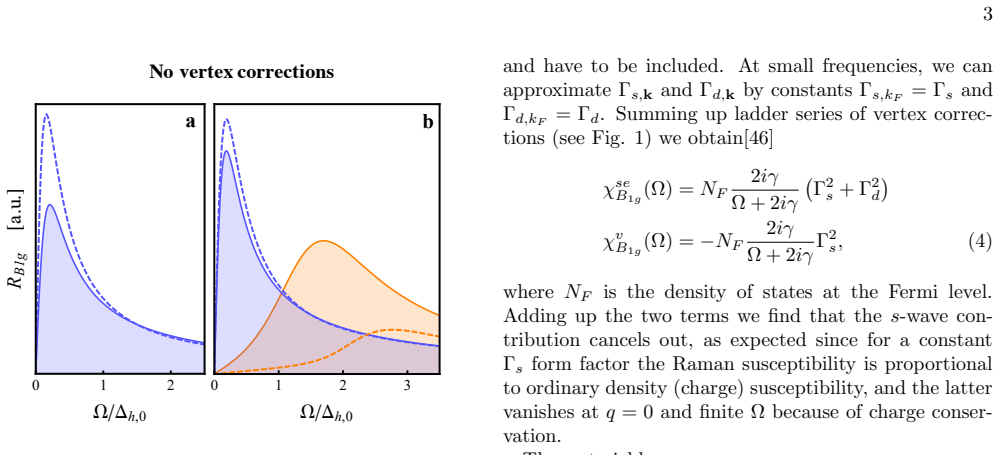
The load-bearing object is the orbital-to-band unitary transformation of the two-orbital Hamiltonian for the hole pockets at $\Gamma$, and in particular the angular average of $\cos 2\bar\theta_k$ -- the $B_{1g}$ Raman vertex in the band basis -- decomposed as $\cos 2\bar\theta_k = \Gamma_s + \Gamma_d\cos 2\theta$. In the tetragonal phase $\Gamma_s = 0$, and impurity vertex corrections vanish because $\int d\theta\, \cos 2\theta = 0$. In the nematic phase $\Gamma_s \neq 0$, and the ladder summation of vertex corrections cancels the $s$-wave piece, leaving $\chi_{B1g}(\Omega) = N_F \Gamma_d^2\, 2i\gamma/(\Omega + 2i\gamma)$. The suppression follows because $\Gamma_d \sim 1/\lambda_F$ once the pocket is nearly mono-orbital.
What would settle it
A decisive test is to compute $\Gamma_d^2(\Omega)$ from Eqs. (6)-(7) using independently measured $\Delta_h(T)$ and band parameters, and compare the depth and temperature dependence of the measured low-frequency $B_{1g}$ drop with the predicted $\Gamma_d^2$ scaling; the mechanism fails if the drop does not follow that scaling while the damping rate stays constant.
Extended reading notes
Core claim
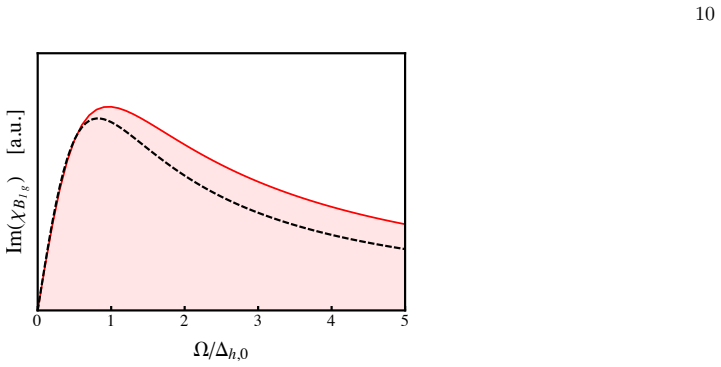
The paper's central claim is that the low-frequency suppression of $R_{B1g}(\Omega)$ below $T_n$ is not due to quasiparticle damping or to a gap but to the orbital transmutation of the pockets. In the tetragonal phase, the $B_{1g}$ Raman vertex in the band basis is proportional to $\cos 2\theta$; below $T_n$ it acquires an angle-independent component $\Gamma_s$ because the nematic order parameter $\Delta_h$ reorganizes the orbital weights $u_k^2$ and $|v_k|^2$. Writing $\cos 2\bar\theta_k = \Gamma_s + \Gamma_d\cos 2\theta$, the ladder vertex corrections cancel the $\Gamma_s$ part exactly, as charge conservation requires, and the full response becomes $R_{B1g}(\Omega) \propto \Gamma_d^2\, \Omega\gamma/[\Omega^2 + 4\gamma^2(1-U\Gamma_d^2/U_{cr})^2]$. At large $\lambda_F = \Delta_h/(b k_F^2)$, the outer hole pocket is almost pure $d_{xz}$, giving $\Gamma_s \approx -1$ and $\Gamma_d \sim 1/\lambda_F \ll 1$; hence the low-frequency intensity drops by $\Gamma_d^2$ and recovers only at $\Omega \gtrsim 2{-}3\Delta_h$, matching the measured gap-like behavior.
Load-bearing premise
The argument depends on the orbital mix on the pockets being set entirely by the two-orbital band Hamiltonian; if strong correlations renormalize the orbital weights so the outer hole pocket never becomes nearly mono-orbital, the predicted Raman suppression would not occur.
Editorial extensions
If this is right
- Below $T_n$ the low-frequency $B_{1g}$ Raman intensity scales as $\Gamma_d^2(\Omega)\, \Omega\gamma/[\Omega^2 + 4\gamma^2(1-U\Gamma_d^2/U_{cr})^2]$, so it can be strongly suppressed without any change in the damping rate $\gamma$ and without opening a quasiparticle gap.
- The suppression is confined to $\Omega \lesssim 2{-}3\Delta_h$; at larger frequencies the vertex returns to its tetragonal $d$-wave form and $R_{B1g}(\Omega)$ recovers its normal-metal value.
- The measured drop is therefore a bulk signature of the same orbital reconstruction observed by polarized ARPES, rather than evidence for a gap in a metal.
- The mechanism is generic to any nematic metal, but its strength is band-structure dependent; FeSe's unusually small Fermi energy makes $\lambda_F$ large, which is why the effect is so pronounced there.
- If the orbital-selective spectral-weight scenario is realized instead, the outer pocket would not become mono-orbital, the $B_{1g}$ vertex would keep its $d$-wave form, and no suppression is expected -- in disagreement with the data.
Reading between the lines
- A quantitative signature the paper leaves implicit: since $\Gamma_d \sim b k_F^2/\Delta_h$, the low-frequency Raman intensity should keep deepening roughly as $1/\Delta_h^2$ as $T$ falls below $T_n$, which can be checked against independently measured $\Delta_h(T)$.
- A testable extension is to measure the $B_{1g}$ Raman response in another nematic iron-based compound with larger Fermi pockets; the same logic predicts a much weaker or absent low-frequency suppression because $\Gamma_d$ stays of order one.
- An analogous calculation for other zero-momentum quadrupolar probes that acquire an angle-independent form-factor component under nematic order should show the same conservation-law cancellation, so the mechanism is not specific to Raman scattering.
Editorial analysis
A structured set of objections, weighed in public.
Referee Report
Summary. The paper addresses the observed rapid decrease of the low-frequency B1g Raman response in FeSe below the nematic transition at T_n ~ 85 K. The authors argue that this drop does not signal a gap, but rather a change in the orbital composition of the Fermi pockets: in the nematic phase the outer hole pocket becomes nearly mono-orbital (mostly dxz). The B1g Raman vertex, which in the tetragonal phase is purely d-wave (cos 2θ), acquires an angle-independent s-wave component in the band basis. Because the s-wave component of the Raman susceptibility is cancelled by impurity-scattering vertex corrections that enforce charge conservation, the remaining response is proportional to Γ_d^2, the squared d-wave part of the vertex, which becomes small as the pocket becomes mono-orbital. The authors support this with an analytical derivation (Eqs. (4)-(5)) and with numerical calculations using ARPES-derived band parameters, showing a gap-like suppression that recovers at higher frequencies. They also argue that the effect is inconsistent with orbital-selective spectral-weight scenarios.
Significance. If correct, the paper offers a new and falsifiable explanation for a long-standing puzzle in FeSe, connecting Raman spectroscopy to orbital reconstruction. The analytical derivation is transparent and the numerical implementation uses frequency-dependent vertices rather than a constant fit. The paper makes a concrete prediction: the suppression is controlled by Γ_d^2, and it would not occur if orbital-selective quasiparticle weights strongly renormalize the vertex. This gives a bulk spectroscopic test for orbital selectivity. The paper is clearly written and the main calculation is self-contained, with the supplementary providing the diagrammatic details.
major comments (2)
- [Summary and Discussion; §The Raman response in the nematic phase (Eq. (5))] The central prediction of a suppressed B1g response relies on the orbital content of the pockets being given by the non-interacting eigenvectors of Eq. (2), with no orbital-dependent quasiparticle weight renormalization. As the paper acknowledges in the Summary and Discussion, if the orbital-selective spectral-weight scenario of Refs. [11,19,48–50] is realized, the physical intraband vertex becomes Z_xz u_k^2 − Z_yz |v_k|^2 rather than u_k^2 − |v_k|^2, and the minority yz spectral weight need not be small even when the bare eigenvector is nearly pure xz. The statement that the orbital-selective scenario would leave the Raman response unchanged 'in disagreement with the data' is qualitative; to make the central claim robust, the authors should quantify how large the Z_yz/Z_xz anisotropy must be to eliminate the predicted Γ_d^2 suppression and discuss whether the polarized ARPES data of Refs. [14,16] constrain this anisotropy. Without this, the mechanism is conditional on a disputed renormalization.
- [Numerical calculations (Fig. 3) and Summary] The numerical R_B1g presented in Fig. 3 includes only the hole pockets at Γ; the electron pockets are dismissed with the remark that they can be analyzed along the same lines, but no calculation or estimate is provided. The measured B1g Raman response is the sum over all Fermi pockets, and if the electron-pocket contribution is not suppressed to the same degree, the total drop would be weaker than shown. Since the paper claims 'full agreement' with the experimental data of Refs. [22,24], the authors should either compute the electron-pocket contribution explicitly or provide a quantitative argument for its neglect (e.g., relative spectral weight or a similar mono-orbital suppression).
minor comments (4)
- [Introduction and Eq. (5)] The term 'gap-like' is used throughout, but Eq. (5) shows R_B1g(Ω) → 0 as Ω → 0 already in the tetragonal phase; the nematic effect is a suppression by Γ_d^2, not the appearance of a true excitation gap. A brief clarification in the introduction would avoid confusion.
- [Fig. 3] The recovery to the tetragonal value is shown as a function of Ω/Δ_h0, but no experimental data are overlaid. Given the claim of full agreement, plotting the data of Refs. [22,24] on the same axis would make the comparison quantitative.
- [Supplementary, Eq. (27) and surrounding text] The symbol 'Ø' appears in place of Ω in several places; this should be corrected to avoid ambiguity.
- [After Eq. (5)] The sentence 'The result can be straightforwardly extended to the case when the damping rate has both s-wave and d-wave components, γ_s and γ_d... γ = γ_s − γ_d' would benefit from a derivation, as the sign convention for γ_d is not obvious.
Circularity Check
No significant circularity: the suppression factor is computed from the model Hamiltonian and ARPES-derived parameters; the Raman gap-like drop is not used as input.
full rationale
The paper's central derivation is self-contained and non-circular. The drop factor Γ_d^2 in Eq. (5) follows from the band-basis B1g vertex cos2θ̄_k=(h3−Δh)/h(k) in Eq. (3), which is obtained by diagonalizing the two-orbital Hamiltonian (2). The nematic splitting Δ_h and band parameters (Table I) are constrained by ARPES band dispersions, not by the Raman data; Raman data enter only in the final qualitative comparison (Fig. 3 vs Refs. [22,24]). No parameter is fitted to the target R_B1g drop. The vertex-correction cancellation of the s-wave part is re-derived in the Supplemental Material via the ladder series (Eqs. (27)-(38)) using charge conservation, so it does not rest on self-citation. The self-citations used for the mono-orbital reconstruction premise (Refs. [8,20,21]) are supported by external polarized ARPES measurements (Refs. [14,16]). The manuscript explicitly flags its main limitation in the Summary and Discussion, in the paragraph beginning "To put our results in a broader context": under the orbital-selective spectral-weight scenario of Refs. [11,19,48-50], the outer pocket would not become mono-orbital, the vertex would retain d-wave form, and the drop would not occur. This is a conditional-robustness caveat, not circularity, because the model's assumptions do not include the target result. One editorial flag: the Supplemental Material, Section III, has a placeholder citation "[?]" after the Born approximation for γ; this is a missing-reference formatting issue, not a circular step. Overall, no prediction reduces by construction to a fitted input, so the circularity score is low.
Assumptions & free parameters
free parameters (6)
- Δ_h (nematic orbital splitting at Γ) =
15 meV at T≪T_n
- γ (impurity scattering rate) =
≈6 meV
- ϵ0 (band offset) =
0 meV (T≥T_n), -9 meV (T≪T_n)
- a = 1/(2m) (band curvature) =
263 meV
- b (d-wave hopping) =
182 meV
- η (spin-orbit coupling) =
10 meV
assumptions (6)
- domain assumption The low-energy hole pockets at Γ are described by the effective two-orbital Hamiltonian (2) with hopping integrals h0, h1, h3 and spin-orbit coupling η.
- domain assumption The nematic order is represented as an orbital splitting Δ_h τ_3 at Γ.
- domain assumption The B1g Raman vertex is proportional to τ_3 in the orbital basis.
- domain assumption The inner hole pocket lies below the Fermi level and its intraband contribution is negligible.
- domain assumption Impurity scattering provides the damping γ and is isotropic; vertex corrections are summed in the ladder approximation.
- ad hoc to paper The orbital content is given by non-interacting eigenstates of Eq. (2), without orbital-selective quasiparticle weight renormalization Z.
Cite this review
Pith. "Pith review of Raman response in the nematic phase of FeSe." pith.science (2026). https://pith.science/paper/BM2YEFDE
@misc{pith2026190811361,
  author       = {Pith},
  title        = {Pith review of: Raman response in the nematic phase of FeSe},
  year         = {2026},
  howpublished = {\url{https://pith.science/paper/BM2YEFDE}},
  note         = {Machine review of arXiv:1908.11361}
}
abstract
Raman experiments on bulk FeSe revealed that the low-frequency part of $B_{1g}$ Raman response $R_{B_{1g}}$, which probes nematic fluctuations, rapidly decreases below the nematic transition at $T_n \sim 85$K. Such behavior is usually associated with the gap opening and at a first glance is inconsistent with the fact that FeSe remains a metal below $T_n$, with sizable hole and electron pockets. We argue that the drop of $R_{B_{1g}}$ in a nematic metal comes about because the nematic order drastically changes the orbital content of the pockets and makes them nearly mono-orbital. In this situation $B_{1g}$ Raman response gets reduced by the same vertex corrections that enforce charge conservation. The reduction holds at low frequencies and gives rise to gap-like behavior of $R_{B_{1g}}$, in full agreement with the experimental data.
Figures


Figures from the paper (3 more)


Reference graph
Works this paper leans on
-
[1]
A. E. B¨ ohmer and A. Kreisel, Nematicity, magnetism and superconductivity in FeSe, Journal of Physics: Con- densed Matter 30, 023001 (2017)
work page 2017
-
[2]
(1), over all the relevant frequency range, despite the fact that Eq
agrees well with the analytical result, Eq. (1), over all the relevant frequency range, despite the fact that Eq. (1) has been obtained by expanding near the Fermi 4 0 1 2 3 4 5 Ω/Δh,0 RB1g [a.u.] � ��� � ��� � �/�� Δ�/Δ��� With vertex corrections Figure 3. Intraband Raman response from the outer hole pocket, obtained by including vertex corrections with ...
work page 2017
-
[3]
A. I. Coldea and M. D. Watson, The key ingredients of the electronic structure of fese, Annual Review of Con- densed Matter Physics 9, 125 (2018)
work page 2018
-
[4]
R. Fernandes and C. A., Low-energy microscopic mod- els for iron-based superconductors: a review, Rep. Prog. Phys. 80, 014503 (2017)
work page 2017
-
[5]
Gallais and I
Y. Gallais and I. Paul, Comptes Rendus Physique 17, 113 (2016)
2016
- [6]
-
[7]
M. D. Watson, T. K. Kim, A. A. Haghighirad, N. R. Davies, A. McCollam, A. Narayanan, S. F. Blake, Y. L. Chen, S. Ghannadzadeh, A. J. Schofield, M. Hoesch, C. Meingast, T. Wolf, and A. I. Coldea, Emergence of the nematic electronic state in fese, Phys. Rev. B 91, 155106 (2015)
work page 2015
-
[8]
M. D. Watson, T. K. Kim, L. C. Rhodes, M. Eschrig, M. Hoesch, A. A. Haghighirad, and A. I. Coldea, Evi- dence for unidirectional nematic bond ordering in fese, Phys. Rev. B 94, 201107 (2016)
work page 2016
Show all 51 references
-
[9]
Fanfarillo, J
L. Fanfarillo, J. Mansart, P. Toulemonde, H. Cercellier, P. Le F` evre, F. m. c. Bertran, B. Valenzuela, L. Benfatto, and V. Brouet, Orbital-dependent fermi surface shrinking as a fingerprint of nematicity in fese, Phys. Rev. B 94, 155138 (2016)
2016
-
[10]
M. D. Watson, A. A. Haghighirad, L. C. Rhodes, M. Hoesch, and T. K. Kim, Electronic anisotropies re- vealed by detwinned angle-resolved photo-emission spec- troscopy measurements of fese, New Journal of Physics 19, 103021 (2017)
2017
-
[11]
L. C. Rhodes, M. D. Watson, A. A. Haghighirad, M. Es- chrig, and T. K. Kim, Strongly enhanced temperature dependence of the chemical potential in fese, Phys. Rev. B 95, 195111 (2017)
2017
-
[12]
P. O. Sprau, A. Kostin, A. Kreisel, A. E. B¨ ohmer, V. Tau- four, P. C. Canfield, S. Mukherjee, P. J. Hirschfeld, B. M. Andersen, and J. C. S. Davis, Discovery of orbital- selective cooper pairing in fese, Science 357, 75 (2017)
2017
-
[13]
Fedorov, A
A. Fedorov, A. Yaresko, T. K. Kim, Y. Kushnirenko, E. Haubold, T. Wolf, M. Hoesch, A. Gruneis, B. Buech- ner, and S. V. Borisenko, Effect of nematic ordering on electronic structure of fese, Scientific Reports 6, 36834 (2017)
2017
-
[14]
Y. S. Kushnirenko, A. A. Kordyuk, A. V. Fedorov, E. Haubold, T. Wolf, B. B¨ uchner, and S. V. Borisenko, Anomalous temperature evolution of the electronic struc- ture of fese, Phys. Rev. B 96, 100504 (2017)
2017
-
[15]
L. C. Rhodes, M. D. Watson, A. A. Haghighirad, D. V. Evtushinsky, M. Eschrig, and T. K. Kim, Scaling of the superconducting gap with orbital character in fese, Phys. Rev. B 98, 180503 (2018)
2018
-
[16]
Hashimoto, Y
T. Hashimoto, Y. Ota, H. Q. Yamamoto, Y. Suzuki, T. Shimojima, S. Watanabe, C. Chen, S. Kasahara, Y. Matsuda, T. Shibauchi, K. Okazaki, and S. Shin, Su- perconducting gap anisotropy sensitive to nematic do- mains in fese, Nature Communications 9, 282 (2018)
2018
-
[17]
Liu et al
D. Liu et al. , Orbital origin of extremely anisotropic su- perconducting gap in nematic phase of fese superconduc- tor, Phys. Rev. X 8, 031033 (2018)
2018
- [18]
-
[19]
Huh and e
S. Huh and e. al., Lifted electron pocket and re- versed orbital occupancy imbalance in fese (2019), arXiv:1903.08360
2019 arXiv
-
[20]
Kreisel, B
A. Kreisel, B. M. Andersen, P. O. Sprau, A. Kostin, J. C. S. Davis, and P. J. Hirschfeld, Orbital selective pairing and gap structures of iron-based superconduc- tors, Phys. Rev. B 95, 174504 (2017)
2017
-
[21]
J. Kang, R. M. Fernandes, and A. Chubukov, Supercon- ductivity in fese: The role of nematic order, Phys. Rev. Lett. 120, 267001 (2018)
2018
-
[22]
Benfatto, B
L. Benfatto, B. Valenzuela, and L. Fanfarillo, Nematic pairing from orbital selective spin fluctuations in fese, npj Quantum Materials 3, 56 (2018)
2018
-
[23]
Massat, D
P. Massat, D. Farina, I. Paul, S. Karlsson, P. Stro- bel, P. Toulemonde, M.-A. M ˜A c©asson, M. Cazayous, A. Sacuto, S. Kasahara, T. Shibauchi, Y. Matsuda, and Y. Gallais, Charge-induced nematicity in fese, Proceed- ings of the National Academy of Sciences 113, 9177 (2016)
2016
-
[24]
V. K. Thorsmolle, M. Khodas, Z. P. Yin, C. Zhang, S. V. Carr, P. Dai, and G. Blumberg, Critical quadrupole fluc- tuations and collective modes in iron pnictide supercon- ductors, Phys. Rev. B 93, 054515 (2016)
2016
-
[25]
W. L. Zhang, S. F. Wu, S. Kasahara, T. Shibauchi, Y. Matsuda, and G. Blumberg, Stripe quadrupole order in the nematic phase of fe1−xsx, arXiv:1710.09892 (2017)
2017 arXiv
-
[26]
A. Baum, H. N. Ruiz, N. Lazarevic, Y. Wang, T. B˜A¶hm, R. Hosseinian Ahangharnejhad, P. Adelmann, T. Wolf, Z. V. Popovic, B. Moritz, T. P. Devereaux, and R. Hackl, Frustrated spin order and stripe fluctuations in fese, Communications Physics 2, 14 (2019)
2019
-
[28]
T. P. Devereaux and R. Hackl, Inelastic light scatter- ing from correlated electrons, Rev. Mod. Phys. 79, 175 (2007)
2007
-
[29]
M. V. Klein, Theory of raman scattering from leggett’s collective mode in a multiband superconductor: Appli- cation to mgb 2, Phys. Rev. B 82, 014507 (2010)
2010
-
[30]
Yamase and R
H. Yamase and R. Zeyher, Electronic raman scatter- ing from orbital nematic fluctuations, Phys. Rev. B 88, 125120 (2013)
2013
-
[31]
Tsuchiizu, Y
M. Tsuchiizu, Y. Ohno, S. Onari, and H. Kontani, 6 Orbital nematic instability in the two-orbital hubbard model: Renormalization-group + constrained rpa analy- sis, Phys. Rev. Lett. 111, 057003 (2013)
2013
-
[32]
Klein, S
A. Klein, S. Lederer, D. Chowdhury, E. Berg, and A. Chubukov, Dynamical susceptibility near a long- wavelength critical point with a nonconserved order pa- rameter, Phys. Rev. B 97, 155115 (2018)
2018
-
[33]
Klein, S
A. Klein, S. Lederer, D. Chowdhury, E. Berg, and A. Chubukov, Dynamical susceptibility of a near-critical nonconserved order parameter and quadrupole raman re- sponse in fe-based superconductors, Phys. Rev. B 98, 041101 (2018)
2018
-
[34]
Cea and L
T. Cea and L. Benfatto, Signature of the leggett mode in the A1g raman response: From mgb 2 to iron-based superconductors, Phys. Rev. B 94, 064512 (2016)
2016
-
[35]
Maiti, A
S. Maiti, A. V. Chubukov, and P. J. Hirschfeld, Conser- vation laws, vertex corrections, and screening in raman spectroscopy, Phys. Rev. B 96, 014503 (2017)
2017
-
[36]
Throughout this paper we use the notation B 1g
The relevant scattering geometry is B 1g in 1-Fe Brillouin zone and B 2g in 2-Fe Brillouin zone. Throughout this paper we use the notation B 1g
-
[37]
Karahasanovic, F
U. Karahasanovic, F. Kretzschmar, T. B¨ ohm, R. Hackl, I. Paul, Y. Gallais, and J. Schmalian, Manifestation of nematic degrees of freedom in the raman response func- tion of iron pnictides, Phys. Rev. B 92, 075134 (2015)
2015
-
[38]
(), by symmetry, there must exist a second hole band, constructed of dxz and dyz orbitals.However it has been experimentally established that the inner pocket sinks below the Fermi level already in the tetragonal phase
-
[39]
Hinojosa, J
A. Hinojosa, J. Cai, and A. V. Chubukov, Raman reso- nance in iron-based superconductors: The magnetic sce- nario, Phys. Rev. B 93, 075106 (2016)
2016
-
[40]
Such order has not been unambigiously detected in ARPES studies and we will not consider it
(), the system may also develop d-wave nematic order on the outer d xy pocket (refs). Such order has not been unambigiously detected in ARPES studies and we will not consider it
-
[41]
Onari, Y
S. Onari, Y. Yamakawa, and H. Kontani, Sign-reversing orbital polarization in the nematic phase of fese due to theC2 symmetry breaking in the self-energy, Phys. Rev. Lett. 116, 227001 (2016)
2016
-
[42]
G. Zala, B. N. Narozhny, and I. L. Aleiner, Interac- tion corrections at intermediate temperatures: Longitu- dinal conductivity and kinetic equation, Phys. Rev. B64, 214204 (2001)
2001
-
[43]
Cvetkovic and O
V. Cvetkovic and O. Vafek, Space group symmetry, spin- orbit coupling, and the low-energy effective hamiltonian for iron-based superconductors, Phys. Rev. B 88, 134510 (2013)
2013
-
[44]
Fanfarillo, L
L. Fanfarillo, L. Benfatto, and B. Valenzuela, Orbital mismatch boosting nematic instability in iron-based su- perconductors, Phys. Rev. B 97, 121109 (2018)
2018
-
[45]
A. V. Chubukov, M. Khodas, and R. M. Fernandes, Mag- netism, superconductivity, and spontaneous orbital order in iron-based superconductors: Which comes first and why?, Phys. Rev. X 6, 041045 (2016)
2016
-
[46]
R. M. Fernandes, A. V. Chubukov, and J. Schmalian, What drives nematic order in iron-based superconduc- tors?, Nature Physics 10, 97 (2014)
2014
-
[47]
See supplemental material
-
[48]
Blumberg, private communication
G. Blumberg, private communication
-
[49]
H. Hu, R. Yu, E. M. Nica, J.-X. Zhu, and Q. Si, Orbital- selective superconductivity in the nematic phase of fese, Phys. Rev. B 98, 220503 (2018)
2018
-
[50]
Kreisel, B
A. Kreisel, B. M. Andersen, and P. J. Hirschfeld, Itiner- ant approach to magnetic neutron scattering of fese: Ef- fect of orbital selectivity, Phys. Rev. B98, 214518 (2018)
2018
-
[51]
T. Chen, Y. Chen, A. Kreisel, X. Lu, A. Schneidewind, Y. Qiu, J. T. Park, T. G. Perring, J. R. Stewart, H. Cao, R. Zhang, Y. Li, Y. Rong, Y. Wei, B. M. Andersen, P. J. Hirschfeld, C. Broholm, and P. Dai, Anisotropic spin fluctuations in detwinned fese, Nature Materials 18, 709 (2019)
2019
-
[52]
BFQY9nUTa3zoEsqpp4W7MAi0nrI=
T. Devereaux and R. Hackl, Inelastic light scattering from correlated electrons, Rev. Mod. Phys. 79, 175 (2007). 7 Γ pocket T≥Tn (meV) T≪Tn (meV) ϵ0 0 -9 a 263 263 b 182 182 η 10 10 ∆h 0 15 Table I. Band parameters for the hole pockets at Γ in the nematic and in the tetragonal...
2007
Reviewed August 14, 2026 · model on record in the stance chip above.
Discussion (0). Continue with ORCID to comment.