REVIEW 3 major objections 4 minor 63 references
A Machine Learning Accelerator In-Memory for Energy Harvesting
T0 review · 3 major / 4 minor · reviewed 2026-08-14 · deepseek-v4-flash
Pith's one-line read This paper proposes an in-memory spintronic accelerator that can survive sudden power cuts with at most the last instruction repeated.
desk verdict MASTER earns serious referee time: per-instruction checkpointing via in-memory spintronics is a real idea for batteryless ML, but the correctness guarantee in Section 5.1 ignores input-side disturbance and is not yet established. read the letter →
The pith
A machine-rendered reading of the paper's core claim, the machinery that carries it, and where it could break.
The reading
What carries the argument
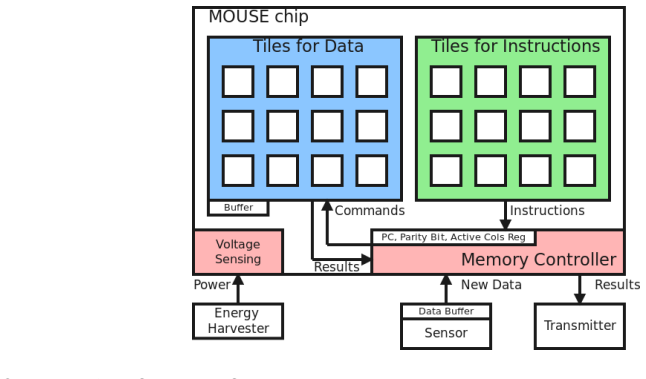
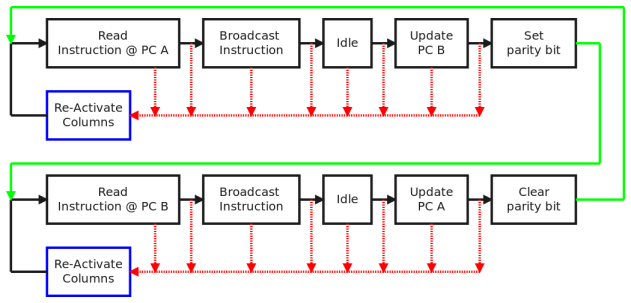
The mechanism that carries the argument is single-operation idempotence in MTJ logic. Each gate is a threshold operation in which current direction can switch the output MTJ to only one state, so repeating the gate after an interruption yields the same outcome as a single longer application; the only additional machinery is a duplicated non-volatile program counter with a parity bit and a non-volatile register holding the last activate-columns instruction. This combination turns checkpointing after every operation into an almost free by-product of non-volatile processing-in-memory.
What would settle it
Interrupt a real MTJ logic gate at random times during switching and then re-apply the intended voltage; if any trial leaves the output MTJ in an intermediate resistance state, flips it in the unintended direction, or fails to complete the switch after replay, the always-safe-shutdown claim is false. A concrete measurement would be a histogram of output resistance after interrupted-and-replayed operations across many random interruption times and input combinations.
Extended reading notes
Core claim
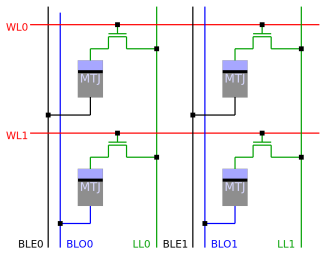
MASTER's central claim is that an accelerator built from magnetic tunnel junctions (MTJs) can guarantee correctness under arbitrary power interruptions for free, because each logic operation is itself a memory write. A logic gate is formed by two input MTJs in parallel driving a preset output MTJ; the output switches only in the direction allowed by current flow, so re-running an interrupted gate is equivalent to running it for a longer time. Correctness between instructions is maintained by a duplicated non-volatile program counter with a parity bit and a stored copy of the last activate-columns instruction. As a result, the design is always in a shutdown-safe state: power can be cut unexpectedly, and restart requires only re-issuing the column activation and resuming from the valid program counter.
Load-bearing premise
The load-bearing premise is that replaying any single interrupted logic operation always produces the same result as completing it once: current direction can only flip the output memory element one way, so a partial or reversed power transient cannot leave it in a wrong or ambiguous state.
Editorial extensions
If this is right
- An energy-harvesting device built on MASTER needs no explicit checkpointing pass; every operation is its own checkpoint, and an outage costs at most the re-execution of one instruction.
- Restart overhead is bounded by re-issuing one activate-columns instruction plus reading the program counter, keeping dead and restore energy small even at low duty cycles.
- Adding a spin-Hall-effect channel removes the need to preset output MTJs for logic operations, reducing both latency and per-restart energy.
- Binarizing inputs lets multiplication be replaced by AND gates, which cuts latency and energy by more than an order of magnitude for MNIST in the paper's simulations.
- Because idempotence is a property of the gate rather than the workload, the same architecture can run any program expressed as a sequence of threshold logic operations, not only SVMs.
Reading between the lines
- The same correctness argument should transfer to other non-volatile processing-in-memory technologies whose logic operations are directionally monotone, so the contribution may generalize beyond STT-MRAM.
- A natural next step, not taken in the paper, is extending per-instruction checkpointing to training or other input-dependent programs; the current proof relies on re-running the last instruction being harmless, which is not automatic once instructions depend on data.
- The reported backup, dead, and restore energies define a small optimization problem: choosing tile size or instruction-issue rate to minimize total intermittent energy for a given duty cycle. The paper does not solve it, but its model makes it straightforward.
Signed reviews
Editorial analysis
A structured set of objections, weighed in public.
Referee Report
Summary. This manuscript proposes MASTER, a processing-in-memory accelerator for SVM inference built from STT-MRAM (with an optional SHE-MTJ variant), targeting energy-harvesting systems. The key idea is that because all computation and storage are non-volatile, progress is saved after every instruction; the architecture needs only a program counter, a parity bit, and a record of the last column-activation instruction to restart correctly after an arbitrary power cut. The paper argues that re-executing the last interrupted instruction is idempotent, so the maximum penalty is repeating one instruction. It evaluates MNIST, binarized MNIST, HAR, and ADULT workloads against libSVM on a CPU and SONIC on an MSP430, reporting large energy and latency advantages, particularly for projected future MTJ parameters and the SHE configuration.
Significance. If the correctness argument were complete, MASTER would be an conceptually important demonstration that non-volatile processing-in-memory can essentially eliminate the overheads of intermittent computation: the checkpointing scheme is strikingly simple, and the energy model carefully separates backup, dead, and restore energy. The paper is also honest about its limitations, noting that a full CRAM array has not been fabricated and that the future-device parameters are projections. However, the central contribution is the per-instruction restart guarantee, and that guarantee rests on an idempotence argument in Section 5.1 that is not fully established. The quantitative performance claims are interesting but conditional on speculative device parameters, so the correctness gap is the load-bearing issue for the paper's main thesis.
major comments (3)
- [Section 5.1 / Table 1] The idempotence argument tracks only the output MTJ. In a logic operation, rows n1, n2, and m are in the same series current path (Section 2.3), so the input MTJs carry a substantial fraction of the operating current. When the output switches to its low-resistance state, the total series resistance drops and the current through the input MTJs rises. The Table 1 statement that re-execution is 'analogous to applying the voltage for a longer duration' therefore does not follow from the circuit model: the retry applies a larger current to the operands, and if that current is above threshold in a destabilizing direction, an input bit can be disturbed. The paper neither quantifies the input currents for the Table 2 resistance values nor shows that all input states remain below threshold, so the central claim that MASTER is 'always in a state which is safe to shut down in' is unverified. The same gap affects all gate types and the SHE variant.
- [Section 5.1 / Table 1] The four-case table assumes deterministic binary switching ('did not switch prior' versus 'did switch prior'). MTJ switching is a stochastic process, and a power cut during a switching event can leave the free layer in an intermediate state whose resistance is neither the P nor the AP value. Re-applying the instruction does not necessarily extend the original pulse, because the current depends on the partially switched resistance of the output and inputs. The statement that 'the direction of the current can only result in switching the output to 0' addresses the final direction but not the transient or partial state. The paper should provide a physical model of interrupted switching or a conservative argument that partial states deterministically resolve to the intended state.
- [Section 5.1 / Writes] For write operations, the paper claims that 'repeating a write is effectively writing the value twice.' This ignores the possibility that an interrupted write leaves the MTJ in an intermediate resistance state that is ambiguous for subsequent reads or for a subsequent logic operation if the write is the last instruction before the outage. Since the restart procedure re-issues only the last instruction, the correctness of write operations also needs a treatment of partial writes, not just the statement that a write is idempotent in the binary-state abstraction.
minor comments (4)
- [Section 6 / Performance model] The paper would benefit from explicitly stating how idle time is inserted to enforce the power budget, since the reported energy and latency numbers depend on the instruction issue rate and the assumed peripheral-circuit cost share.
- [Section 7 / Table 4] The text says libSVM is run on a 'supercomputing cluster' while the caption says it is implemented on an Intel Haswell E5-2680v3 processor; please clarify the exact experimental platform.
- [Section 9 / Conclusion] The conclusion contains a typo: 'is is a promising candidate' should be 'it is a promising candidate.'
- [References] References [13] and [14] appear to describe the same Capybara paper with the same title; please verify the citation entries and avoid duplication.
Circularity Check
No significant circularity: the per-instruction checkpointing claim is argued from MTJ switching physics in Section 5, not reduced to the cited CRAM/SHE work or to fitted results.
full rationale
The paper's central claim is that MASTER can be shut down at any point and restart with at most one repeated instruction. This is not taken as an input or defined into existence. Section 5.1 gives a four-case argument (Table 1) based on the directionality of MTJ switching: an interrupted AND gate either has not switched (repeating the gate supplies the missing switching pulse) or has already switched (current direction cannot reverse it), so re-execution is argued to be equivalent to a longer application of the same voltage. The claim is therefore a physical/architectural argument, not an equation that reduces to its assumptions. CRAM [10] and the SHE-MTJ work [65] are prior results by overlapping authors, and MASTER is built on them, but the correctness proof does not invoke those citations as the evidence; it is conducted in the manuscript against the circuit model. The energy and latency results are computed from stated device parameters (Table 2) and NVSIM models and are compared with external implementations (libSVM, SONIC), so they are not fitted inputs renamed as predictions. The paper itself notes that a full-scale CRAM array has not yet been built (Section 7). The reviewer's concern about current-induced disturbance of input MTJs or stochastic switching is a verification gap in the idempotence proof rather than a circular derivation: the argument may be incomplete or wrong, but it is not circular. No load-bearing step reduces by construction to its own input, so the appropriate circularity score is 0.
Assumptions & free parameters
free parameters (5)
- Future MTJ switching current =
3 uA (assumed, range to 1 uA noted)
- Future MTJ switching time =
1 ns
- Future MTJ P/AP resistances =
7.34 kOhm / 76.39 kOhm
- Peripheral-circuit cost share =
Same percentage as NVSIM reports
- Instruction issue rate =
Slowed to keep power within a couple hundred microwatts
assumptions (4)
- domain assumption Interrupted logic operations are idempotent
- domain assumption MTJ switching is strictly direction-dependent and cannot be reversed by re-applying the same gate bias
- domain assumption MASTER tiles behave as ideal STT-MRAM arrays with no read/write disturb or endurance failures
- domain assumption Energy harvesting power source is a 16 kHz square wave with a fixed duty cycle
Cite this review
Pith. "Pith review of A Machine Learning Accelerator In-Memory for Energy Harvesting." pith.science (2026). https://pith.science/paper/WXE6XF2U
@misc{pith2026190811373,
  author       = {Pith},
  title        = {Pith review of: A Machine Learning Accelerator In-Memory for Energy Harvesting},
  year         = {2026},
  howpublished = {\url{https://pith.science/paper/WXE6XF2U}},
  note         = {Machine review of arXiv:1908.11373}
}
read the original abstract
There is increasing demand to bring machine learning capabilities to low power devices. By integrating the computational power of machine learning with the deployment capabilities of low power devices, a number of new applications become possible. In some applications, such devices will not even have a battery, and must rely solely on energy harvesting techniques. This puts extreme constraints on the hardware, which must be energy efficient and capable of tolerating interruptions due to power outages. Here, as a representative example, we propose an in-memory support vector machine learning accelerator utilizing non-volatile spintronic memory. The combination of processing-in-memory and non-volatility provides a key advantage in that progress is effectively saved after every operation. This enables instant shut down and restart capabilities with minimal overhead. Additionally, the operations are highly energy efficient leading to low power consumption.
Figures


Figures from the paper (3 more)

Reference graph
Works this paper leans on
-
[1]
https://www.everspin.com/supportdocs/EMD3D256M08G1-150CBS1, 2019. Accessed: 2019-08-10
work page 2019
-
[2]
A public domain dataset for human activity recognition using smartphones
Davide Anguita, Alessandro Ghio, Luca Oneto, Xavier Parra, and Jorge Luis Reyes-Ortiz. A public domain dataset for human activity recognition using smartphones. In Esann, 2013
2013
-
[3]
Incremental checkpointing of program state to nvram for transiently-powered systems
Faycal Ait Aouda, Kevin Marquet, and Guillaume Salagnac. Incremental checkpointing of program state to nvram for transiently-powered systems. In 2014 9th International Symposium on Reconfigurable and Communication-Centric Systems-on-Chip (ReCoSoC), pages 1–4. IEEE, 2014
work page 2014
-
[4]
Graceful performance modulation for power-neutral transient computing systems
Domenico Balsamo, Anup Das, Alex S Weddell, Davide Brunelli, Bashir M Al-Hashimi, Geoff V Merrett, and Luca Benini. Graceful performance modulation for power-neutral transient computing systems. IEEE Transactions on Computer-Aided Design of Integrated Circuits and Systems , 35(5):738–749, 2016
work page 2016
-
[5]
Hibernus++: a self-calibrating and adaptive system for transiently-powered embedded devices
Domenico Balsamo, Alex S Weddell, Anup Das, Alberto Rodriguez Arreola, Davide Brunelli, Bashir M Al-Hashimi, Geoff V Merrett, and Luca Benini. Hibernus++: a self-calibrating and adaptive system for transiently-powered embedded devices. IEEE Transactions on Computer-Aided Design of Integrated Circuits and Systems , 35(12):1968– 1980, 2016. 18
work page 1968
-
[6]
Hi- bernus: Sustaining computation during intermittent supply for energy-harvesting systems
Domenico Balsamo, Alex S Weddell, Geoff V Merrett, Bashir M Al-Hashimi, Davide Brunelli, and Luca Benini. Hi- bernus: Sustaining computation during intermittent supply for energy-harvesting systems. IEEE Embedded Systems Letters, 7(1):15–18, 2014
work page 2014
-
[7]
Peripheral state persistence for transiently-powered systems
Gautier Berthou, Tristan Delizy, Kevin Marquet, Tanguy Risset, and Guillaume Salagnac. Peripheral state persistence for transiently-powered systems. In 2017 Global Internet of Things Summit (GIoTS) , pages 1–6. IEEE, 2017
work page 2017
-
[8]
Next generation micro-power systems
Anantha P Chandrakasan, Denis C Daly, Joyce Kwong, and Yogesh K Ramadass. Next generation micro-power systems. In 2008 IEEE Symposium on VLSI Circuits , pages 2–5. IEEE, 2008
work page 2008
Show all 63 references
-
[9]
Libsvm: A library for support vector machines
Chih-Chung Chang and Chih-Jen Lin. Libsvm: A library for support vector machines. ACM transactions on intelligent systems and technology (TIST) , 2(3):27, 2011
2011
-
[10]
Efficient in-memory processing using spintronics
Zamshed Chowdhury, Jonathan D Harms, S Karen Khatamifard, Masoud Zabihi, Yang Lv, Andrew P Lyle, Sachin S Sapatnekar, Ulya R Karpuzcu, and Jian-Ping Wang. Efficient in-memory processing using spintronics. IEEE Computer Architecture Letters, 17(1):42–46, 2017
2017
-
[11]
Chain: tasks and channels for reliable intermittent programs
Alexei Colin and Brandon Lucia. Chain: tasks and channels for reliable intermittent programs. In ACM SIGPLAN Notices, volume 51, pages 514–530. ACM, 2016
2016
-
[12]
Termination checking and task decomposition for task-based intermittent programs
Alexei Colin and Brandon Lucia. Termination checking and task decomposition for task-based intermittent programs. In Proceedings of the 27th International Conference on Compiler Construction , pages 116–127. ACM, 2018
2018
-
[14]
A reconfigurable energy storage architecture for energy-harvesting devices
Alexei Colin, Emily Ruppel, and Brandon Lucia. A reconfigurable energy storage architecture for energy-harvesting devices. In ACM SIGPLAN Notices , volume 53, pages 767–781. ACM, 2018
2018
-
[15]
Xnor neural engine: A hardware accelerator ip for 21.6-fj/op binary neural network inference
Francesco Conti, Pasquale Davide Schiavone, and Luca Benini. Xnor neural engine: A hardware accelerator ip for 21.6-fj/op binary neural network inference. IEEE Transactions on Computer-Aided Design of Integrated Circuits and Systems, 37(11):2940–2951, 2018
2018
-
[16]
Binarized neural networks: Training deep neural networks with weights and activations constrained to+ 1 or-1
Matthieu Courbariaux, Itay Hubara, Daniel Soudry, Ran El-Yaniv, and Yoshua Bengio. Binarized neural networks: Training deep neural networks with weights and activations constrained to+ 1 or-1. arXiv preprint arXiv:1602.02830, 2016
2016 arXiv
-
[17]
Spin transfer switching in dual mgo magnetic tunnel junctions
Zhitao Diao, Alex Panchula, Yunfei Ding, Mahendra Pakala, Shengyuan Wang, Zhanjie Li, Dmytro Apalkov, Hideyasu Nagai, Alexander Driskill-Smith, Lien-Chang Wang, et al. Spin transfer switching in dual mgo magnetic tunnel junctions. Applied Physics Letters , 90(13):132508, 2007
2007
-
[18]
Circuit and microarchitecture evaluation of 3d stacking magnetic ram (mram) as a universal memory replacement
Xiangyu Dong, Xiaoxia Wu, Guangyu Sun, Yuan Xie, Helen Li, and Yiran Chen. Circuit and microarchitecture evaluation of 3d stacking magnetic ram (mram) as a universal memory replacement. In 2008 45th ACM/IEEE Design Automation Conference , pages 554–559. IEEE, 2008
2008
-
[19]
Nvsim: A circuit-level performance, energy, and area model for emerging nonvolatile memory
Xiangyu Dong, Cong Xu, Yuan Xie, and Norman P Jouppi. Nvsim: A circuit-level performance, energy, and area model for emerging nonvolatile memory. IEEE Transactions on Computer-Aided Design of Integrated Circuits and Systems, 31(7):994–1007, 2012
2012
-
[20]
Tunable damping, saturation magnetization, and exchange stiffness of half-heusler nimnsb thin films
Philipp D¨ urrenfeld, Felicitas Gerhard, Jonathan Chico, Randy K Dumas, Mojtaba Ranjbar, Anders Bergman, Lars Bergqvist, Anna Delin, Charles Gould, Laurens W Molenkamp, et al. Tunable damping, saturation magnetization, and exchange stiffness of half-heusler nimnsb thin films. Ph...
2015
-
[21]
Neural cache: Bit-serial in-cache acceleration of deep neural networks
Charles Eckert, Xiaowei Wang, Jingcheng Wang, Arun Subramaniyan, Ravi Iyer, Dennis Sylvester, David Blaauw, and Reetuparna Das. Neural cache: Bit-serial in-cache acceleration of deep neural networks. In Proceedings of the 45th Annual International Symposium on Computer Archite...
2018
-
[22]
The what’s next intermittent computing architec- ture
Karthik Ganesan, Joshua San Miguel, and Natalie Enright Jerger. The what’s next intermittent computing architec- ture. In 2019 IEEE International Symposium on High Performance Computer Architecture (HPCA) , pages 211–223. IEEE, 2019
2019
-
[23]
Intermittent deep neural network inference, 2018
Graham Gobieski, Nathan Beckmann, and Brandon Lucia. Intermittent deep neural network inference, 2018
2018
-
[24]
Intelligence beyond the edge: Inference on intermittent embedded systems
Graham Gobieski, Brandon Lucia, and Nathan Beckmann. Intelligence beyond the edge: Inference on intermittent embedded systems. In Proceedings of the Twenty-Fourth International Conference on Architectural Support for Programming Languages and Operating Systems , pages 199–213....
2019
-
[25]
Guest editorial deep learning in medical imaging: Overview and future promise of an exciting new technique
Hayit Greenspan, Bram Van Ginneken, and Ronald M Summers. Guest editorial deep learning in medical imaging: Overview and future promise of an exciting new technique. IEEE Transactions on Medical Imaging, 35(5):1153–1159, 2016
2016
-
[26]
Amulet: An energy-efficient, multi-application wearable platform
Josiah Hester, Travis Peters, Tianlong Yun, Ronald Peterson, Joseph Skinner, Bhargav Golla, Kevin Storer, Steven Hearndon, Kevin Freeman, Sarah Lord, et al. Amulet: An energy-efficient, multi-application wearable platform. In Proceedings of the 14th ACM Conference on Embedded Ne...
2016
-
[27]
Tragedy of the coulombs: Federating energy storage for tiny, intermittently-powered sensors
Josiah Hester, Lanny Sitanayah, and Jacob Sorber. Tragedy of the coulombs: Federating energy storage for tiny, intermittently-powered sensors. In Proceedings of the 13th ACM Conference on Embedded Networked Sensor Systems, pages 5–16. ACM, 2015
2015
-
[28]
Flicker: Rapid prototyping for the batteryless internet-of-things
Josiah Hester and Jacob Sorber. Flicker: Rapid prototyping for the batteryless internet-of-things. In Proceedings of the 15th ACM Conference on Embedded Network Sensor Systems , page 19. ACM, 2017
2017
-
[29]
Timely execution on intermittently powered batteryless sensors
Josiah Hester, Kevin Storer, and Jacob Sorber. Timely execution on intermittently powered batteryless sensors. In Proceedings of the 15th ACM Conference on Embedded Network Sensor Systems , page 17. ACM, 2017
2017
-
[30]
Clank: Architectural support for intermittent computation
Matthew Hicks. Clank: Architectural support for intermittent computation. In 2017 ACM/IEEE 44th Annual International Symposium on Computer Architecture (ISCA) , pages 228–240. IEEE, 2017
2017
-
[31]
Stt-mram with double magnetic tunnel junctions
G Hu, JH Lee, JJ Nowak, JZ Sun, J Harms, A Annunziata, S Brown, W Chen, YH Kim, G Lauer, et al. Stt-mram with double magnetic tunnel junctions. In 2015 IEEE International Electron Devices Meeting (IEDM) , pages 26–3. IEEE, 2015
2015
-
[32]
Quickrecall: A low overhead hw/sw approach for enabling computations across power cycles in transiently powered computers
Hrishikesh Jayakumar, Arnab Raha, and Vijay Raghunathan. Quickrecall: A low overhead hw/sw approach for enabling computations across power cycles in transiently powered computers. In 2014 27th International Conference on VLSI Design and 2014 13th International Conference on Em...
2014
-
[33]
Ambient rf energy-harvesting technologies for self-sustainable standalone wireless sensor platforms
Sangkil Kim, Rushi Vyas, Jo Bito, Kyriaki Niotaki, Ana Collado, Apostolos Georgiadis, and Manos M Tentzeris. Ambient rf energy-harvesting technologies for self-sustainable standalone wireless sensor platforms. Proceedings of the IEEE, 102(11):1649–1666, 2014
2014
-
[34]
Scaling up the accuracy of naive-bayes classifiers: A decision-tree hybrid
Ron Kohavi. Scaling up the accuracy of naive-bayes classifiers: A decision-tree hybrid. In Kdd, volume 96, pages 202–207. Citeseer, 1996. 20
1996
-
[35]
Gradient-based learning applied to document recognition
Yann LeCun, L´ eon Bottou, Yoshua Bengio, Patrick Haffner, et al. Gradient-based learning applied to document recognition. Proceedings of the IEEE , 86(11):2278–2324, 1998
1998
-
[36]
Pinatubo: A processing-in-memory architecture for bulk bitwise operations in emerging non-volatile memories
Shuangchen Li, Cong Xu, Qiaosha Zou, Jishen Zhao, Yu Lu, and Yuan Xie. Pinatubo: A processing-in-memory architecture for bulk bitwise operations in emerging non-volatile memories. In Proceedings of the 53rd Annual Design Automation Conference, page 173. ACM, 2016
2016
-
[37]
Pudiannao: A polyvalent machine learning accelerator
Daofu Liu, Tianshi Chen, Shaoli Liu, Jinhong Zhou, Shengyuan Zhou, Olivier Teman, Xiaobing Feng, Xuehai Zhou, and Yunji Chen. Pudiannao: A polyvalent machine learning accelerator. In ACM SIGARCH Computer Architecture News, volume 43, pages 369–381. ACM, 2015
2015
-
[38]
Lightweight hardware support for transparent consistency-aware checkpointing in intermittent energy-harvesting systems
Qingrui Liu and Changhee Jung. Lightweight hardware support for transparent consistency-aware checkpointing in intermittent energy-harvesting systems. In 2016 5th Non-Volatile Memory Systems and Applications Symposium (NVMSA), pages 1–6. IEEE, 2016
2016
-
[39]
Ambient energy harvesting nonvolatile processors: from circuit to system
Yongpan Liu, Zewei Li, Hehe Li, Yiqun Wang, Xueqing Li, Kaisheng Ma, Shuangchen Li, Meng-Fan Chang, Sampson John, Yuan Xie, et al. Ambient energy harvesting nonvolatile processors: from circuit to system. In Proceedings of the 52nd Annual Design Automation Conference , page 15...
2015
-
[40]
A simpler, safer programming and execution model for intermittent systems
Brandon Lucia and Benjamin Ransford. A simpler, safer programming and execution model for intermittent systems. In ACM SIGPLAN Notices , volume 50, pages 575–585. ACM, 2015
2015
-
[41]
Using sleep states to maximize the active time of transient computing systems
Giedrius Lukosevicius, Alberto Rodriguez Arreola, and Alex S Weddell. Using sleep states to maximize the active time of transient computing systems. In Proceedings of the Fifth ACM International Workshop on Energy Harvesting and Energy-Neutral Sensing Systems , pages 31–36. ACM, 2017
2017
-
[42]
Incidental computing on iot nonvolatile processors
Kaisheng Ma, Xueqing Li, Jinyang Li, Yongpan Liu, Yuan Xie, Jack Sampson, Mahmut Taylan Kandemir, and Vijaykrishnan Narayanan. Incidental computing on iot nonvolatile processors. In 2017 50th Annual IEEE/ACM International Symposium on Microarchitecture (MICRO) , pages 204–218....
2017
-
[43]
Architecture exploration for ambient energy harvesting nonvolatile processors
Kaisheng Ma, Yang Zheng, Shuangchen Li, Karthik Swaminathan, Xueqing Li, Yongpan Liu, Jack Sampson, Yuan Xie, and Vijaykrishnan Narayanan. Architecture exploration for ambient energy harvesting nonvolatile processors. In 2015 IEEE 21st International Symposium on High Performan...
2015
-
[44]
Alpaca: intermittent execution without checkpoints
Kiwan Maeng, Alexei Colin, and Brandon Lucia. Alpaca: intermittent execution without checkpoints. Proceedings of the ACM on Programming Languages , 1(OOPSLA):96, 2017
2017
-
[45]
Adaptive dynamic checkpointing for safe efficient intermittent computing
Kiwan Maeng and Brandon Lucia. Adaptive dynamic checkpointing for safe efficient intermittent computing. In 13th{USENIX} Symposium on Operating Systems Design and Implementation ({OSDI} 18), pages 129–144, 2018
2018
-
[46]
Intelligent buildings of the future: Cyberaware, deep learning powered, and human interacting
Milos Manic, Kasun Amarasinghe, Juan J Rodriguez-Andina, and Craig Rieger. Intelligent buildings of the future: Cyberaware, deep learning powered, and human interacting. IEEE Industrial Electronics Magazine , 10(4):32–49, 2016
2016
-
[47]
Low damping constant for co 2 feal heusler alloy films and its correlation with density of states
S Mizukami, D Watanabe, M Oogane, Y Ando, Y Miura, M Shirai, and T Miyazaki. Low damping constant for co 2 feal heusler alloy films and its correlation with density of states. Journal of Applied Physics , 105(7):07D306, 2009
2009
-
[48]
R: A Language and Environment for Statistical Computing
R Core Team. R: A Language and Environment for Statistical Computing . R Foundation for Statistical Computing, Vienna, Austria, 2016. 21
2016
-
[49]
Mementos: system support for long-running computation on rfid-scale devices
Benjamin Ransford, Jacob Sorber, and Kevin Fu. Mementos: system support for long-running computation on rfid-scale devices. In ACM SIGARCH Computer Architecture News , volume 39, pages 159–170. ACM, 2011
2011
-
[50]
Transactional concurrency control for intermittent, energy-harvesting computing systems
Emily Ruppel and Brandon Lucia. Transactional concurrency control for intermittent, energy-harvesting computing systems. In Proceedings of the 40th ACM SIGPLAN Conference on Programming Language Design and Implemen- tation, pages 1085–1100. ACM, 2019
2019
-
[52]
Sub-3 ns pulse with sub-100 µa switching of 1x–2x nm perpendicular mtj for high-performance embedded stt-mram towards sub-20 nm cmos
Daisuke Saida, Saori Kashiwada, Megumi Yakabe, Tadaomi Daibou, Naoki Hase, Miyoshi Fukumoto, Shinji Miwa, Yoshishige Suzuki, Hiroki Noguchi, Shinobu Fujita, et al. Sub-3 ns pulse with sub-100 µa switching of 1x–2x nm perpendicular mtj for high-performance embedded stt-mram tow...
2016
-
[53]
Design of an rfid-based battery-free programmable sensing platform
Alanson P Sample, Daniel J Yeager, Pauline S Powledge, Alexander V Mamishev, and Joshua R Smith. Design of an rfid-based battery-free programmable sensing platform. IEEE transactions on instrumentation and measurement , 57(11):2608–2615, 2008
2008
-
[54]
The eh model: Early design space exploration of intermittent processor architectures
Joshua San Miguel, Karthik Ganesan, Mario Badr, Chunqiu Xia, Rose Li, Hsuan Hsiao, and Natalie Enright Jerger. The eh model: Early design space exploration of intermittent processor architectures. In 2018 51st Annual IEEE/ACM International Symposium on Microarchitecture (MICRO...
2018
-
[55]
Properties of magnetic tunnel junctions with a mgo/cofeb/ta/cofeb/mgo recording structure down to junction diameter of 11 nm
H Sato, ECI Enobio, M Yamanouchi, S Ikeda, S Fukami, S Kanai, F Matsukura, and H Ohno. Properties of magnetic tunnel junctions with a mgo/cofeb/ta/cofeb/mgo recording structure down to junction diameter of 11 nm. Applied Physics Letters, 105(6):062403, 2014
2014
-
[56]
Ambit: In-memory accelerator for bulk bitwise oper- ations using commodity dram technology
Vivek Seshadri, Donghyuk Lee, Thomas Mullins, Hasan Hassan, Amirali Boroumand, Jeremie Kim, Michael A Kozuch, Onur Mutlu, Phillip B Gibbons, and Todd C Mowry. Ambit: In-memory accelerator for bulk bitwise oper- ations using commodity dram technology. In Proceedings of the 50th...
2017
-
[57]
A 462gops/j rram-based nonvolatile intelligent processor for energy harvesting ioe system featuring nonvolatile logics and processing-in-memory
Fang Su, Wei-Hao Chen, Lixue Xia, Chieh-Pu Lo, Tianqi Tang, Zhibo Wang, Kuo-Hsiang Hsu, Ming Cheng, Jun- Yi Li, Yuan Xie, et al. A 462gops/j rram-based nonvolatile intelligent processor for energy harvesting ioe system featuring nonvolatile logics and processing-in-memory. In ...
2017
-
[58]
Fully parallel rram synaptic array for implementing binary neural network with (+ 1,- 1) weights and (+ 1, 0) neurons
Xiaoyu Sun, Xiaochen Peng, Pai-Yu Chen, Rui Liu, Jae-sun Seo, and Shimeng Yu. Fully parallel rram synaptic array for implementing binary neural network with (+ 1,- 1) weights and (+ 1, 0) neurons. In Proceedings of the 23rd Asia and South Pacific Design Automation Conference , ...
2018
-
[59]
Binary convolutional neural network on rram
Tianqi Tang, Lixue Xia, Boxun Li, Yu Wang, and Huazhong Yang. Binary convolutional neural network on rram. In Design Automation Conference (ASP-DAC), 2017 22nd Asia and South Pacific , pages 782–787. IEEE, 2017
2017
-
[60]
Accessed: 2019- 06-02
https://archive.ics.uci.edu/ml/datasets/human+activity+recognition+using+smartphones, 2019. Accessed: 2019- 06-02. 22
2019
-
[61]
Intermittent computation without hardware support or programmer intervention
Joel Van Der Woude and Matthew Hicks. Intermittent computation without hardware support or programmer intervention. In 12th{USENIX} Symposium on Operating Systems Design and Implementation ({OSDI} 16), pages 17–32, 2016
2016
-
[62]
Magnetic tunnel junction based integrated logics and computational circuits
Jian-Ping Wang, Mahdi Jamaliz, Angeline Klemm Smith, and Zhengyang Zhao. Magnetic tunnel junction based integrated logics and computational circuits. Nanomagnetic and Spintronic Devices for Energy-Efficient Memory and Computing, page 133, 2016
2016
-
[63]
Switched by input: power efficient structure for rram-based convolutional neural network
Lixue Xia, Tianqi Tang, Wenqin Huangfu, Ming Cheng, Xiling Yin, Boxun Li, Yu Wang, and Huazhong Yang. Switched by input: power efficient structure for rram-based convolutional neural network. In Proceedings of the 53rd Annual Design Automation Conference , page 125. ACM, 2016
2016
-
[64]
Binary neural network with 16 mb rram macro chip for classification and online training
Shimeng Yu, Zhiwei Li, Pai-Yu Chen, Huaqiang Wu, Bin Gao, Deli Wang, Wei Wu, and He Qian. Binary neural network with 16 mb rram macro chip for classification and online training. In Electron Devices Meeting (IEDM), 2016 IEEE International , pages 16–2. IEEE, 2016
2016
-
[65]
Using spin-hall mtjs to build an energy-efficient in-memory computation platform
Masoud Zabihi, Zhengyang Zhao, DC Mahendra, Zamshed I Chowdhury, Salonik Resch, Thomas Peterson, Ulya R Karpuzcu, Jian-Ping Wang, and Sachin S Sapatnekar. Using spin-hall mtjs to build an energy-efficient in-memory computation platform. In 20th International Symposium on Quality...
2019
Reviewed August 14, 2026 · model on record in the stance chip above.
Discussion (0). Continue with ORCID to comment.