REVIEW 1 major objections 4 minor 86 references
The impact of AGN feedback on galaxy intrinsic alignments in the Horizon simulations
T0 review · 1 major / 4 minor · reviewed 2026-08-14 · deepseek-v4-flash
Pith's one-line read AGN feedback leaves the weak-lensing alignment signal intact
desk verdict A careful twin-simulation comparison showing AGN feedback changes galaxy position-shape alignments but not the density-shape signal used for lensing contamination; the main claim rests on one shape definition and one simulation volume, but the matched-galaxy analysis is a real advance. read the letter →
The pith
A machine-rendered reading of the paper's core claim, the machinery that carries it, and where it could break.
The reading
What carries the argument
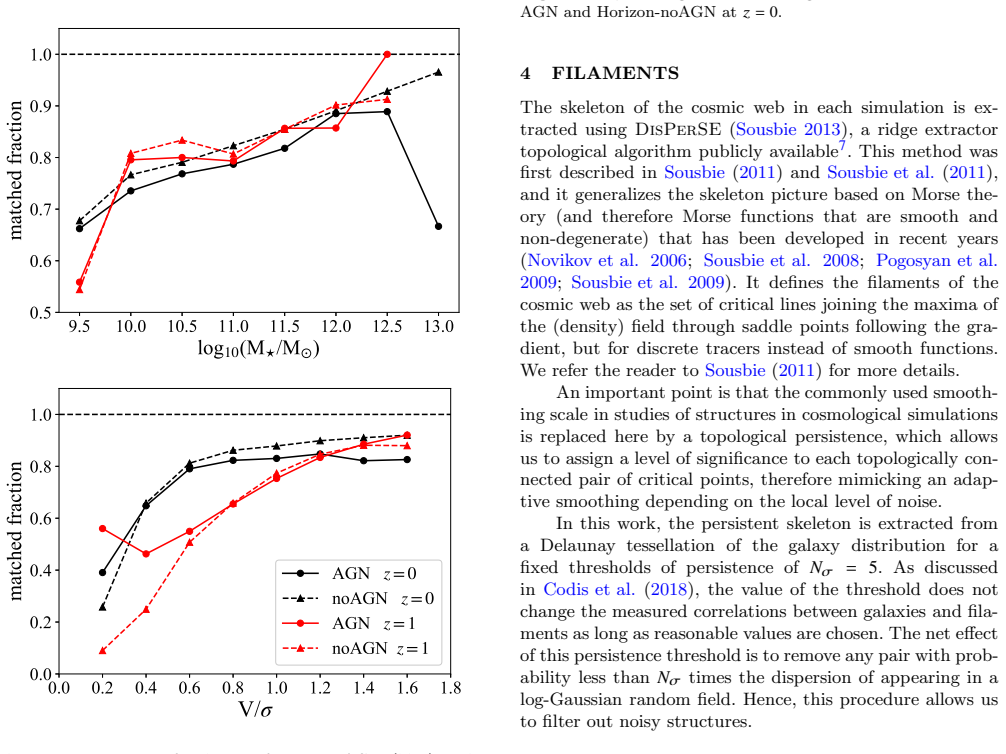
The comparison rests on twin cosmological hydrodynamical runs of the Horizon simulation that share identical initial conditions and sub-grid recipes, differing only in the presence of AGN feedback, implemented as a thermal quasar mode and a kinetic radio mode. Galaxy shapes are measured from inertia tensors of stellar particles, with reliable shapes requiring more than 300 particles, and alignments are quantified by the three-dimensional orientation-direction correlation $\eta_e(r)$ and by the projected correlations $w_{g+}$ and $w_{\delta+}$. A galaxy-matching procedure pairs objects across the two runs to separate selection effects from genuine orientation changes, while filament extraction with a persistence-based skeleton provides the structure used for spin-filament alignments. Applying the same statistics to matched and unmatched samples is what lets the paper attribute differences either to population composition or to alignment changes.
What would settle it
Take the same twin-simulation setup, raise the quasar-mode efficiency to a substantially higher value, and re-measure $r_p \times w_{\delta+}(r_p)$ for all galaxies with more than 300 stellar particles at $z=0$; if the projected shape-density correlation shifts by more than the error bars at $r_p \approx 1$ to $10$ Mpc, the claim that AGN feedback leaves the weak-lensing contamination unchanged fails beyond this one calibration.
Extended reading notes
Core claim
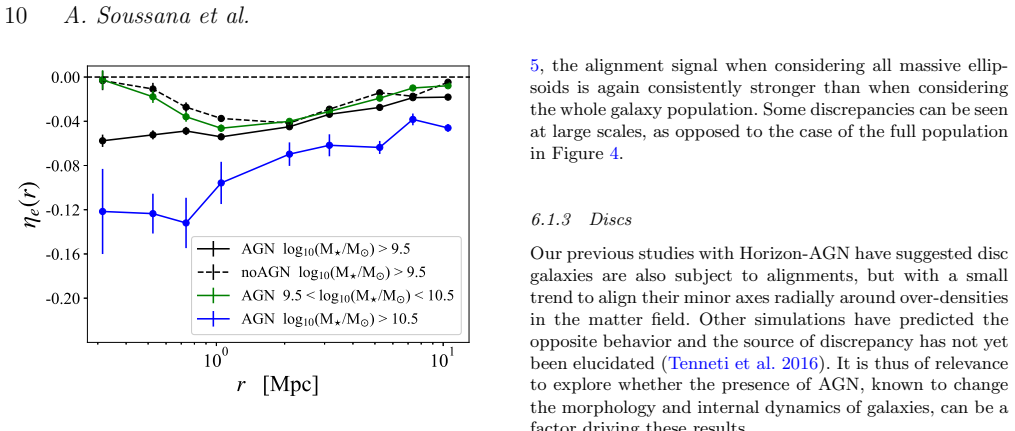
Within the Horizon simulation suite, the projected alignment of all resolved galaxy shapes with respect to the matter density field ($w_{\delta+}$) is unaffected by AGN feedback at $z=0$ and $z=1$, so the predicted contamination to weak lensing is unchanged. By contrast, the projected correlation of shapes around galaxy positions ($w_{g+}$) is significantly enhanced in the AGN run, with the difference driven by high-mass ellipsoids that exist in Horizon-AGN but are absent or more rotation-supported in the noAGN run. When galaxies are matched across the two simulations, the shape-position correlation is still stronger in the AGN run, showing that AGN feedback changes galaxy orientations themselves, not only the sample selection. Spin alignments around filaments are stronger in the AGN run, but matched twins show the same orientation statistics, indicating that the stronger signal comes from a larger abundance of massive pressure-supported galaxies rather than from a change in how those galaxies orient.
Load-bearing premise
The conclusions depend on the Horizon-AGN sub-grid AGN feedback model, with quasar-mode efficiency $\epsilon_q=0.15$, being representative of real AGN feedback; if true AGN feedback is stronger or differently calibrated, the alignment signals and the apparent robustness of $w_{\delta+}$ could change.
Editorial extensions
If this is right
- The projected shape-density correlation $w_{\delta+}$ can be treated as insensitive to AGN feedback in models of weak-lensing contamination, at least for this simulation family.
- Modelling of galaxy position-shape correlations $w_{g+}$ from hydrodynamical simulations should account for AGN feedback, particularly at small scales and for high-mass ellipsoids.
- Observational position-shape alignment measurements may indirectly constrain AGN feedback strength once population selection effects are separated.
- The mass-dependent spin-filament transition is weaker without AGN feedback, suggesting the spin flip of massive galaxies is partly a population-driven feedback effect.
- Cross-correlations of ellipsoids around discs show that AGN feedback dampens alignments at $r<0.8$ Mpc and amplifies them at $r>0.8$ Mpc, a pattern reproduced in projection.
Reading between the lines
- A stronger AGN prescription than the one calibrated in Horizon-AGN could plausibly alter $w_{\delta+}$; rerunning the twin comparison with varied feedback efficiency would show whether the GI robustness is general or specific to this calibration.
- Because AGN feedback changes $w_{g+}$ at small scales, future lensing surveys measuring galaxy-galaxy alignments could in principle use the small-scale signal to discriminate between feedback models.
- The matched noAGN twins of massive AGN galaxies also lie above the same mass threshold, so the perpendicular spin-filament orientation of massive galaxies appears to be inherited from sample selection; an observational test would measure spin-filament alignment among massive quenched galaxies selected by their star-formation state.
- The choice of inertia tensor changes the amplitude of radial and tangential alignments but not which run dominates, so the qualitative AGN comparison may hold for other shape-weighting schemes, though quantitative predictions for lensing should be checked with luminosity-weighted shapes.
Editorial analysis
A structured set of objections, weighed in public.
Referee Report
Summary. This paper investigates whether AGN feedback alters the intrinsic alignments of galaxies by comparing two Horizon simulations that are identical except for the presence of the AGN feedback implementation. The authors measure 3D orientation–separation and spin–separation correlations, projected position–shape correlations (wg+) and shape–density correlations (wδ+), and spin alignments with filaments, at z=0 and z=1, for the full galaxy population, for high-mass ellipsoids, for discs, and for a matched 'twin' sample across the two runs. The main reported findings are that wδ+ for the full population is robust to AGN feedback, that wg+ and ηe around galaxy positions are enhanced by AGN, and that stronger spin–filament alignments in Horizon-AGN arise from the increased abundance of massive pressure-supported galaxies rather than from a change in how the same galaxies orient.
Significance. If the conclusions hold, the paper provides a useful step toward understanding how baryonic feedback processes affect intrinsic alignments, a key contaminant for weak lensing surveys. The analysis design is a genuine strength: the twin-run setup controls for initial conditions and numerical scheme, the matched-galaxy comparison isolates population changes from orientation changes, and the error estimates from eight sub-boxes are a reasonable internal consistency check. The paper is also honest about its limitations, noting the dependence on the sub-grid AGN prescription and the need for survey-like galaxy selections. The main weakness is that the headline wδ+ robustness claim, which is the basis for the weak-lensing contamination statement, is currently tied to a single shape definition and needs an additional test before the abstract's claim is fully supported.
major comments (1)
- [Sec. 6.1.1, Fig. 4 (bottom-right); Sec. 3.1; Appendix A]
minor comments (4)
- [References] The reference list contains apparent duplicates: Tenneti et al. 2015a and 2015b are both MNRAS 448, 3522, and Hirata et al. 2007a and 2007b are both MNRAS 381, 1197. These should be merged or clearly distinguished.
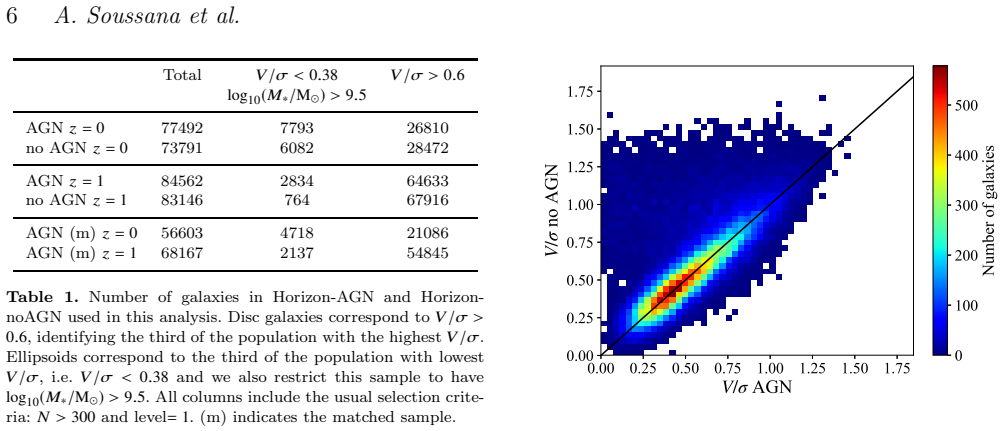
- [Sec. 3.2] The V/σ thresholds used for the ellipsoid and disc samples are defined at z=0 and then applied at z=1, which strongly affects sample sizes at z=1 (Table 1). The authors should explicitly justify this choice and discuss its impact on the z=1 comparisons, especially for high-mass ellipsoids where the noAGN sample is extremely sparse.
- [Fig. 11] The y-axis label '1⋆ξ' is unclear; the caption mentions a probability distribution function re-scaled by the total number of objects times bin size, so the label should state the exact normalized quantity.
- [Sec. 5.2] The density-field tracers are described as unbiased, but they consist of a sub-sample of stars, black holes, gas and dark matter particles. This mixture is not automatically an unbiased tracer of the total matter field; the paper should state more precisely in what sense the 10% convergence test of Chisari et al. (2015) establishes unbiasedness for the alignment statistics used here.
Circularity Check
No significant circularity: the paper is a controlled twin-simulation comparison whose central claims are direct measured differences, not fitted quantities recycled as predictions.
full rationale
The paper's load-bearing results are comparisons between Horizon-AGN and Horizon-noAGN, which share initial conditions, volume, and sub-grid prescriptions except for AGN feedback. No alignment statistic is used to calibrate the AGN model: the quasar-mode efficiency in Eq. (2) is calibrated to low-redshift black hole scaling relations, an independent input, and the alignments are then measured. The matched-galaxy analysis is a decomposition of selection effects versus orientation changes, not a parameter fitted to the output being claimed. The headline statements about wδ+ robustness and wg+ sensitivity are direct measurements of correlation functions defined in Eqs. (7), (9) and (12), so they are not equal by construction to any input. Appendix A explicitly checks that the simple versus reduced inertia tensor choice does not change which simulation dominates the cross-correlation signals, and the absence of a reduced-tensor wδ+ test is an acknowledged limitation rather than circularity. Self-citations to Dubois et al. (2014, 2016), Chisari et al. (2015), Peirani et al. (2017) and Codis et al. (2018) supply the simulation suite, shape definitions, and prior filament results, but the present comparison is independently executed with the same analysis pipeline on both runs; no uniqueness theorem or ansatz is imported to forbid alternatives. The spin-filament conclusion is supported by the measured abundance difference and by the matched-sample comparison, not by re-deriving the prior result. No fitted input is renamed as a prediction, and no derivation step reduces to its own inputs by the paper's own equations.
Assumptions & free parameters
free parameters (4)
- V/sigma sample thresholds =
V/sigma < 0.38 for ellipsoids; V/sigma > 0.6 for discs
- Stellar particle threshold for reliable shapes =
N > 300
- Filament persistence threshold =
N_sigma = 5
- Quasar-mode AGN feedback efficiency =
epsilon_q = 0.15
assumptions (5)
- domain assumption Identical initial conditions and identical sub-grid recipes except for the presence of AGN feedback isolate the causal effect of AGN on alignments.
- domain assumption The Horizon-AGN sub-grid model is a faithful enough representation of galaxy formation and AGN feedback for conclusions to carry outside the simulation.
- domain assumption Error bars computed from eight sub-boxes of one simulation volume capture the relevant statistical uncertainty.
- domain assumption DisPerSE ridge extraction with persistence threshold N_sigma=5 yields the cosmic web filaments used for spin alignment measurements.
- domain assumption The galaxy matching procedure from Peirani et al. 2017 and Beckmann et al. 2017 correctly identifies the same physical galaxies across the twin runs.
Cite this review
Pith. "Pith review of The impact of AGN feedback on galaxy intrinsic alignments in the Horizon simulations." pith.science (2026). https://pith.science/paper/3PVLB6EJ
@misc{pith2026190811665,
  author       = {Pith},
  title        = {Pith review of: The impact of AGN feedback on galaxy intrinsic alignments in the Horizon simulations},
  year         = {2026},
  howpublished = {\url{https://pith.science/paper/3PVLB6EJ}},
  note         = {Machine review of arXiv:1908.11665}
}
read the original abstract
The intrinsic correlations of galaxy shapes and orientations across the large-scale structure of the Universe are a known contaminant to weak gravitational lensing. They are known to be dependent on galaxy properties, such as their mass and morphologies. The complex interplay between alignments and the physical processes that drive galaxy evolution remains vastly unexplored. We assess the sensitivity of intrinsic alignments (shapes and angular momenta) to Active Galactic Nuclei -AGN- feedback by comparing galaxy alignment in twin runs of the cosmological hydrodynamical Horizon simulation, which do and do not include AGN feedback respectively. We measure intrinsic alignments in three dimensions and in projection at z=0 and z=1. We find that the projected alignment signal of all galaxies with resolved shapes with respect to the density field in the simulation is robust to AGN feedback, thus giving similar predictions for contamination to weak lensing. The relative alignment of galaxy shapes around galaxy positions is however significantly impacted, especially when considering high-mass ellipsoids. Using a sample of galaxy "twins" across simulations, we determine that AGN changes both the galaxy selection and their actual alignments. Finally, we measure the alignments of angular momenta of galaxies with their nearest filament. Overall, these are more significant in the presence of AGN as a result of the higher abundance of massive pressure-supported galaxies.
Figures

Figures from the paper (8 more)




Reference graph
Works this paper leans on
-
[1]
Aihara H., et al., 2018, @doi [ ] 10.1093/pasj/psx066 , https://ui.adsabs.harvard.edu/abs/2018PASJ...70S...4A 70, S4
-
[3]
A., van de Weygaert R., Jones B
Arag \' o n-Calvo M. A., van de Weygaert R., Jones B. J. T., van der Hulst J. M., 2007, @doi [The Astrophysical Journal] 10.1086/511633 , 655, L5
doi:10.1086/511633 2007
-
[5]
Bailin J., Steinmetz M., 2005, @doi [ ] 10.1086/430397 , https://ui.adsabs.harvard.edu/abs/2005ApJ...627..647B 627, 647
doi:10.1086/430397 2005
-
[6]
Bartelmann M., 2010, @doi [Classical and Quantum Gravity] 10.1088/0264-9381/27/23/233001 , http://ukads.nottingham.ac.uk/abs/2010CQGra..27w3001B 27, 233001
-
[7]
Beckmann R. S., et al., 2017, @doi [ ] 10.1093/mnras/stx1831 , https://ui.adsabs.harvard.edu/abs/2017MNRAS.472..949B 472, 949
-
[8]
The evolution of galaxy intrinsic alignments in the MassiveBlack II universe
Bhowmick A. K., Chen Y., Tenneti A., Di Matteo T., Mandelbaum R., 2019, arXiv e-prints, https://ui.adsabs.harvard.edu/abs/2019arXiv190500906B p. arXiv:1905.00906
work page Pith review arXiv 2019
-
[9]
Blazek J., McQuinn M., Seljak U., 2011, @doi [ ] 10.1088/1475-7516/2011/05/010 , https://ui.adsabs.harvard.edu/abs/2011JCAP...05..010B 2011, 010
-
[10]
Bridle S., King L., 2007, @doi [New Journal of Physics] 10.1088/1367-2630/9/12/444 , https://ui.adsabs.harvard.edu/abs/2007NJPh....9..444B 9, 444
Show all 86 references
-
[11]
L., Taylor A
Brown M. L., Taylor A. N., Hambly N. C., Dye S., 2002, @doi [ ] 10.1046/j.1365-8711.2002.05354.x , http://ukads.nottingham.ac.uk/abs/2002MNRAS.333..501B 333, 501
2002
-
[13]
D., 2001b, @doi [Monthly Notices of the Royal Astronomical Society] 10.1046/j.1365-8711.2001.04105.x , 320, L7
Catelan P., Kamionkowski M., Blandford R. D., 2001b, @doi [Monthly Notices of the Royal Astronomical Society] 10.1046/j.1365-8711.2001.04105.x , 320, L7
2001
-
[14]
Cattaneo A., et al., 2009, @doi [ ] 10.1038/nature08135 , https://ui.adsabs.harvard.edu/abs/2009Natur.460..213C 460, 213
2009 doi
-
[15]
Chen Y.-C., Ho S., Blazek J., He S., Mandelbaum R., Melchior P., Singh S., 2019, @doi [ ] 10.1093/mnras/stz539 , https://ui.adsabs.harvard.edu/abs/2019MNRAS.485.2492C 485, 2492
2019 doi
-
[16]
Chisari N., et al., 2015, @doi [ ] 10.1093/mnras/stv2154 , https://ui.adsabs.harvard.edu/abs/2015MNRAS.454.2736C 454, 2736
2015 doi
-
[17]
Chisari N., et al., 2016, @doi [ ] 10.1093/mnras/stw1409 , https://ui.adsabs.harvard.edu/abs/2016MNRAS.461.2702C 461, 2702
2016 doi
-
[18]
E., et al., 2017, @doi [ ] 10.1093/mnras/stx1998 , https://ui.adsabs.harvard.edu/abs/2017MNRAS.472.1163C 472, 1163
Chisari N. E., et al., 2017, @doi [ ] 10.1093/mnras/stx1998 , https://ui.adsabs.harvard.edu/abs/2017MNRAS.472.1163C 472, 1163
2017 doi
-
[19]
E., et al., 2018, @doi [ ] 10.1093/mnras/sty2093 , https://ui.adsabs.harvard.edu/abs/2018MNRAS.480.3962C 480, 3962
Chisari N. E., et al., 2018, @doi [ ] 10.1093/mnras/sty2093 , https://ui.adsabs.harvard.edu/abs/2018MNRAS.480.3962C 480, 3962
2018 doi
-
[20]
E., et al., 2019, arXiv e-prints, https://ui.adsabs.harvard.edu/abs/2019arXiv190506082C p
Chisari N. E., et al., 2019, arXiv e-prints, https://ui.adsabs.harvard.edu/abs/2019arXiv190506082C p. arXiv:1905.06082
2019 arXiv
-
[21]
P., Johansson P
Choi E., Naab T., Ostriker J. P., Johansson P. H., Moster B. P., 2014, @doi [ ] 10.1093/mnras/stu874 , https://ui.adsabs.harvard.edu/abs/2014MNRAS.442..440C 442, 440
2014 doi
-
[22]
S., Ostriker J
Choi E., Somerville R. S., Ostriker J. P., Naab T., Hirschmann M., 2018, @doi [ ] 10.3847/1538-4357/aae076 , https://ui.adsabs.harvard.edu/abs/2018ApJ...866...91C 866, 91
2018 doi
-
[24]
Codis S., et al., 2015a, @doi [ ] 10.1093/mnras/stv231 , http://adsabs.harvard.edu/abs/2015MNRAS.448.3391C 448, 3391
-
[25]
Codis S., Pichon C., Pogosyan D., 2015b, @doi [ ] 10.1093/mnras/stv1570 , http://adsabs.harvard.edu/abs/2015MNRAS.452.3369C 452, 3369
-
[26]
E., Vibert D., Dubois Y., Pichon C., Devriendt J., 2018, @doi [ ] 10.1093/mnras/sty2567 , https://ui.adsabs.harvard.edu/abs/2018MNRAS.481.4753C 481, 4753
Codis S., Jindal A., Chisari N. E., Vibert D., Dubois Y., Pichon C., Devriendt J., 2018, @doi [ ] 10.1093/mnras/sty2567 , https://ui.adsabs.harvard.edu/abs/2018MNRAS.481.4753C 481, 4753
2018 doi
-
[27]
A., Schaye J., Trayford J
Correa C. A., Schaye J., Trayford J. W., 2019, @doi [ ] 10.1093/mnras/stz295 , https://ui.adsabs.harvard.edu/abs/2019MNRAS.484.4401C 484, 4401
2019 doi
-
[28]
Dark Energy Survey Collaboration et al., 2016, @doi [ ] 10.1093/mnras/stw641 , https://ui.adsabs.harvard.edu/abs/2016MNRAS.460.1270D 460, 1270
2016 doi
-
[29]
Di Matteo T., Springel V., Hernquist L., 2005, @doi [ ] 10.1038/nature03335 , https://ui.adsabs.harvard.edu/abs/2005Natur.433..604D 433, 604
2005 doi
-
[32]
Dubois Y., Gavazzi R., Peirani S., Silk J., 2013, @doi [Monthly Notices of the Royal Astronomical Society] 10.1093/mnras/stt997 , 433, 3297
2013 doi
-
[33]
Dubois Y., et al., 2014, @doi [ ] 10.1093/mnras/stu1227 , https://ui.adsabs.harvard.edu/abs/2014MNRAS.444.1453D 444, 1453
2014 doi
-
[34]
Dubois Y., Peirani S., Pichon C., Devriendt J., Gavazzi R., Welker C., Volonteri M., 2016, @doi [ ] 10.1093/mnras/stw2265 , https://ui.adsabs.harvard.edu/abs/2016MNRAS.463.3948D 463, 3948
2016 doi
-
[35]
C., 2012, @doi [ ] 10.1146/annurev-astro-081811-125521 , http://adsabs.harvard.edu/abs/2012ARA
Fabian A. C., 2012, @doi [ ] 10.1146/annurev-astro-081811-125521 , http://adsabs.harvard.edu/abs/2012ARA
2012 doi
-
[36]
Flin P., Godlowski W., 1986, @doi [ ] 10.1093/mnras/222.3.525 , https://ui.adsabs.harvard.edu/abs/1986MNRAS.222..525F 222, 525
1986 doi
-
[37]
Flin P., Godlowski W., 1990, Soviet Astronomy Letters, https://ui.adsabs.harvard.edu/abs/1990SvAL...16..209F 16, 209
1990
-
[38]
M., Hernquist L., Vogelsberger M., Snyder G
Genel S., Fall S. M., Hernquist L., Vogelsberger M., Snyder G. F., Rodriguez-Gomez V., Sijacki D., Springel V., 2015, @doi [ ] 10.1088/2041-8205/804/2/L40 , https://ui.adsabs.harvard.edu/abs/2015ApJ...804L..40G 804, L40
2015 doi
-
[39]
arXiv:1905.00370
Georgiou C., et al., 2019a, arXiv e-prints, https://ui.adsabs.harvard.edu/abs/2019arXiv190500370G p. arXiv:1905.00370
1905 arXiv
-
[40]
Georgiou C., et al., 2019b, @doi [ ] 10.1051/0004-6361/201834219 , https://ui.adsabs.harvard.edu/abs/2019A&A...622A..90G 622, A90
-
[41]
M., Best P
Heckman T. M., Best P. N., 2014, @doi [ ] 10.1146/annurev-astro-081913-035722 , https://ui.adsabs.harvard.edu/abs/2014ARA&A..52..589H 52, 589
2014 doi
-
[42]
Heymans C., et al., 2013, @doi [ ] 10.1093/mnras/stt601 , http://ukads.nottingham.ac.uk/abs/2013MNRAS.432.2433H 432, 2433
2013 doi
-
[43]
Hilbert S., Xu D., Schneider P., Springel V., Vogelsberger M., Hernquist L., 2017, @doi [ ] 10.1093/mnras/stx482 , https://ui.adsabs.harvard.edu/abs/2017MNRAS.468..790H 468, 790
2017 doi
-
[44]
M., Seljak U., 2004, @doi [ ] 10.1103/PhysRevD.70.063526 , https://ui.adsabs.harvard.edu/abs/2004PhRvD..70f3526H 70, 063526
Hirata C. M., Seljak U., 2004, @doi [ ] 10.1103/PhysRevD.70.063526 , https://ui.adsabs.harvard.edu/abs/2004PhRvD..70f3526H 70, 063526
2004 doi
-
[45]
M., Seljak U., 2010, @doi [ ] 10.1103/PhysRevD.82.049901 , http://ukads.nottingham.ac.uk/abs/2010PhRvD..82d9901H 82, 049901
Hirata C. M., Seljak U., 2010, @doi [ ] 10.1103/PhysRevD.82.049901 , http://ukads.nottingham.ac.uk/abs/2010PhRvD..82d9901H 82, 049901
2010 doi
-
[47]
M., Mandelbaum R., Ishak M., Seljak U., Nichol R., Pimbblet K
Hirata C. M., Mandelbaum R., Ishak M., Seljak U., Nichol R., Pimbblet K. A., Ross N. P., Wake D., 2007a, @doi [ ] 10.1111/j.1365-2966.2007.12312.x , http://ukads.nottingham.ac.uk/abs/2007MNRAS.381.1197H 381, 1197
2007
-
[48]
F., Hernquist L., Cox T
Hopkins P. F., Hernquist L., Cox T. J., Robertson B., Springel V., 2006, @doi [ ] 10.1086/499493 , https://ui.adsabs.harvard.edu/abs/2006ApJS..163...50H 163, 50
2006 doi
-
[49]
Hui L., Zhang J., 2002, arXiv e-prints, https://ui.adsabs.harvard.edu/abs/2002astro.ph..5512H pp astro--ph/0205512
2002
-
[50]
Ivezi \'c Z ., et al., 2019, @doi [ ] 10.3847/1538-4357/ab042c , https://ui.adsabs.harvard.edu/abs/2019ApJ...873..111I 873, 111
2019 doi
-
[51]
M., Fischer P., Smith D., Jain B., Tyson J
Jarvis M., Bernstein G. M., Fischer P., Smith D., Jain B., Tyson J. A., Wittman D., 2003, @doi [ ] 10.1086/367799 , https://ui.adsabs.harvard.edu/abs/2003AJ....125.1014J 125, 1014
2003 doi
-
[52]
B., Bridle S
Joachimi B., Mandelbaum R., Abdalla F. B., Bridle S. L., 2011, @doi [ ] 10.1051/0004-6361/201015621 , http://ukads.nottingham.ac.uk/abs/2011A
2011 doi
-
[53]
Johnston H., et al., 2019, @doi [ ] 10.1051/0004-6361/201834714 , https://ui.adsabs.harvard.edu/abs/2019A&A...624A..30J 624, A30
2019 doi
-
[54]
Jones B. J. T., van de Weygaert R., Aragón-Calvo M. A., 2010, @doi [Monthly Notices of the Royal Astronomical Society] 10.1111/j.1365-2966.2010.17202.x , 408, 897
2010
-
[55]
Kaviraj S., et al., 2017, @doi [ ] 10.1093/mnras/stx126 , https://ui.adsabs.harvard.edu/abs/2017MNRAS.467.4739K 467, 4739
2017 doi
-
[56]
Khandai N., Di Matteo T., Croft R., Wilkins S., Feng Y., Tucker E., DeGraf C., Liu M.-S., 2015, @doi [ ] 10.1093/mnras/stv627 , https://ui.adsabs.harvard.edu/abs/2015MNRAS.450.1349K 450, 1349
2015 doi
-
[57]
Kirk D., Rassat A., Host O., Bridle S., 2012, @doi [ ] 10.1111/j.1365-2966.2012.21099.x , http://ukads.nottingham.ac.uk/abs/2012MNRAS.424.1647K 424, 1647
2012
-
[58]
Komatsu E., et al., 2011, @doi [ ] 10.1088/0067-0049/192/2/18 , https://ui.adsabs.harvard.edu/abs/2011ApJS..192...18K 192, 18
2011 doi
-
[59]
arXiv:1906.01623
Kraljic K., Dave R., Pichon C., 2019, arXiv e-prints, https://ui.adsabs.harvard.edu/abs/2019arXiv190601623K p. arXiv:1906.01623
2019 arXiv
-
[61]
Laureijs R., et al., 2011, arXiv e-prints, https://ui.adsabs.harvard.edu/abs/2011arXiv1110.3193L
2011 arXiv
-
[62]
Lee J., Pen U.-L., 2008, @doi [ ] 10.1086/588646 , https://ui.adsabs.harvard.edu/abs/2008ApJ...681..798L 681, 798
2008 doi
-
[63]
P., Faltenbacher A., Wang J., 2013, @doi [ ] 10.1088/2041-8205/770/1/L12 , http://adsabs.harvard.edu/abs/2013ApJ...770L..12L 770, L12
Li C., Jing Y. P., Faltenbacher A., Wang J., 2013, @doi [ ] 10.1088/2041-8205/770/1/L12 , http://adsabs.harvard.edu/abs/2013ApJ...770L..12L 770, L12
2013 doi
-
[66]
F., Abadi M
Navarro J. F., Abadi M. G., Steinmetz M., 2004, @doi [ ] 10.1086/424902 , https://ui.adsabs.harvard.edu/abs/2004ApJ...613L..41N 613, L41
2004 doi
-
[68]
Omma H., Binney J., Bryan G., Slyz A., 2004, @doi [ ] 10.1111/j.1365-2966.2004.07382.x , https://ui.adsabs.harvard.edu/abs/2004MNRAS.348.1105O 348, 1105
2004
-
[70]
Peirani S., et al., 2017, @doi [ ] 10.1093/mnras/stx2099 , https://ui.adsabs.harvard.edu/abs/2017MNRAS.472.2153P 472, 2153
2017 doi
-
[71]
Pen U.-L., Lee J., Seljak U., 2000, @doi [ ] 10.1086/317273 , https://ui.adsabs.harvard.edu/abs/2000ApJ...543L.107P 543, L107
2000 doi
-
[72]
F., Sousbie T., Colombi S., 2009, @doi [ ] 10.1111/j.1365-2966.2009.14753.x , http://cdsads.u-strasbg.fr/abs/2009MNRAS.396..635P 396, 635
Pogosyan D., Pichon C., Gay C., Prunet S., Cardoso J. F., Sousbie T., Colombi S., 2009, @doi [ ] 10.1111/j.1365-2966.2009.14753.x , http://cdsads.u-strasbg.fr/abs/2009MNRAS.396..635P 396, 635
2009
-
[73]
arXiv:1811.06989
Samuroff S., et al., 2018, arXiv e-prints, https://ui.adsabs.harvard.edu/abs/2018arXiv181106989S p. arXiv:1811.06989
2018 arXiv
-
[74]
I., Sunyaev R
Shakura N. I., Sunyaev R. A., 1973, , https://ui.adsabs.harvard.edu/abs/1973A
1973
-
[75]
Singh S., Mandelbaum R., 2016, @doi [ ] 10.1093/mnras/stw144 , https://ui.adsabs.harvard.edu/abs/2016MNRAS.457.2301S 457, 2301
2016 doi
-
[77]
Singh S., Mandelbaum R., More S., 2015b, @doi [ ] 10.1093/mnras/stv778 , http://cdsads.u-strasbg.fr/abs/2015MNRAS.450.2195S 450, 2195
-
[78]
Slosar A., White M., 2009, @doi [Journal of Cosmology and Astro-Particle Physics] 10.1088/1475-7516/2009/06/009 , https://ui.adsabs.harvard.edu/abs/2009JCAP...06..009S 2009, 009
2009 doi
-
[81]
Sousbie T., 2013, preprint, http://adsabs.harvard.edu/abs/2013arXiv1302.6221S ( @eprint arXiv 1302.6221 )
2013 arXiv
-
[82]
Sousbie T., Pichon C., Colombi S., Pogosyan D., 2008, , 383, 1655
2008
-
[83]
Sousbie T., Colombi S., Pichon C., 2009, @doi [ ] 10.1111/j.1365-2966.2008.14244.x , http://cdsads.u-strasbg.fr/abs/2009MNRAS.393..457S 393, 457
2009
-
[84]
Sousbie T., Pichon C., Kawahara H., 2011, @doi [ ] 10.1111/j.1365-2966.2011.18395.x , https://ui.adsabs.harvard.edu/abs/2011MNRAS.414..384S 414, 384
2011
-
[85]
Springel V., Di Matteo T., Hernquist L., 2005, @doi [ ] 10.1111/j.1365-2966.2005.09238.x , https://ui.adsabs.harvard.edu/abs/2005MNRAS.361..776S 361, 776
2005
-
[86]
I., 2013, @doi [Astrophys
Tempel E., Libeskind N. I., 2013, @doi [Astrophys. J.] 10.1088/2041-8205/775/2/L42 , 775, L42
2013 doi
-
[87]
Tenneti A., Mandelbaum R., Di Matteo T., Feng Y., Khandai N., 2014, @doi [ ] 10.1093/mnras/stu586 , https://ui.adsabs.harvard.edu/abs/2014MNRAS.441..470T 441, 470
2014 doi
-
[89]
Tenneti A., Singh S., Mandelbaum R., di Matteo T., Feng Y., Khandai N., 2015b, @doi [ ] 10.1093/mnras/stv272 , https://ui.adsabs.harvard.edu/abs/2015MNRAS.448.3522T 448, 3522
-
[90]
Tenneti A., Mandelbaum R., Di Matteo T., 2016, @doi [ ] 10.1093/mnras/stw1823 , https://ui.adsabs.harvard.edu/abs/2016MNRAS.462.2668T 462, 2668
2016 doi
-
[91]
Y., Feng Y., 2017, @doi [ ] 10.3847/1538-4357/834/2/169 , https://ui.adsabs.harvard.edu/abs/2017ApJ...834..169T 834, 169
Tenneti A., Gnedin N. Y., Feng Y., 2017, @doi [ ] 10.3847/1538-4357/834/2/169 , https://ui.adsabs.harvard.edu/abs/2017ApJ...834..169T 834, 169
2017 doi
-
[92]
Teyssier R., 2002, @doi [ ] 10.1051/0004-6361:20011817 , https://ui.adsabs.harvard.edu/abs/2002A
2002 doi
-
[93]
E., Lewis G
Trowland H. E., Lewis G. F., Bland-Hawthorn J., 2013, @doi [ ] 10.1088/0004-637X/762/2/72 , https://ui.adsabs.harvard.edu/abs/2013ApJ...762...72T 762, 72
2013 doi
-
[94]
G., 2006, @doi [ ] 10.1086/503548 , https://ui.adsabs.harvard.edu/abs/2006ApJ...640L.111T 640, L111
Trujillo I., Carretero C., Patiri S. G., 2006, @doi [ ] 10.1086/503548 , https://ui.adsabs.harvard.edu/abs/2006ApJ...640L.111T 640, L111
2006 doi
-
[95]
Varela J., Betancort-Rijo J., Trujillo I., Ricciardelli E., 2012, @doi [ ] 10.1088/0004-637X/744/2/82 , https://ui.adsabs.harvard.edu/abs/2012ApJ...744...82V 744, 82
2012 doi
-
[96]
Velliscig M., et al., 2015a, @doi [ ] 10.1093/mnras/stv1690 , https://ui.adsabs.harvard.edu/abs/2015MNRAS.453..721V 453, 721
-
[97]
Velliscig M., et al., 2015b, @doi [ ] 10.1093/mnras/stv2198 , https://ui.adsabs.harvard.edu/abs/2015MNRAS.454.3328V 454, 3328
-
[98]
Volonteri M., Dubois Y., Pichon C., Devriendt J., 2016, @doi [ ] 10.1093/mnras/stw1123 , https://ui.adsabs.harvard.edu/abs/2016MNRAS.460.2979V 460, 2979
2016 doi
-
[99]
Wang P., Kang X., 2017, @doi [Monthly Notices of the Royal Astronomical Society] 10.1093/mnras/stx2466 , 473, 1562
2017 doi
-
[100]
Weinberger R., et al., 2017, @doi [ ] 10.1093/mnras/stw2944 , https://ui.adsabs.harvard.edu/abs/2017MNRAS.465.3291W 465, 3291
2017 doi
-
[101]
Welker C., Devriendt J., Dubois Y., Pichon C., Peirani S., 2014, @doi [ ] 10.1093/mnrasl/slu106 , https://ui.adsabs.harvard.edu/abs/2014MNRAS.445L..46W 445, L46
2014 doi
-
[102]
de Jong J. T. A., et al., 2013, The Messenger, https://ui.adsabs.harvard.edu/abs/2013Msngr.154...44D 154, 44
2013
Reviewed August 14, 2026 · model on record in the stance chip above.
Discussion (0). Continue with ORCID to comment.