REVIEW 3 major objections 4 minor 1 cited by
Leggett collective excitations in a two-band Fermi superfluid at finite temperatures
T0 review · 3 major / 4 minor · reviewed 2026-08-14 · deepseek-v4-flash
Pith's one-line read At finite temperature, a two-band Fermi superfluid's Leggett mode either crosses the pair-breaking edge and survives as a damped mode (in the BEC regime) or avoids crossing and produces a second damped root (far from BEC).
desk verdict Finite-temperature two-band Leggett modes: the BEC survival prediction is plausible, but the analytic-continuation sheet selection needs a quantitative check before the damping results are taken to the bank. read the letter →
The pith
A machine-rendered reading of the paper's core claim, the machinery that carries it, and where it could break.
The reading
What carries the argument
The central object is the inverse Gaussian pair-fluctuation propagator for two bands, a 4×4 matrix in the space of the two bands and their particle–hole partners whose determinant vanishes at collective-mode poles. Because the determinant evaluated on the real axis has branch cuts but no complex roots, the authors use the standard continuation f^(R)(z)=f(z)−2πi ρ_f(z) for Im z<0, built from the spectral function on the real axis; the pair-breaking edges split the frequency plane into windows, and each pole solution is associated with one window. This analytic continuation is what converts the search for eigenfrequencies into a calculation that yields both frequency and damping factor self-consistently, beyond a perturbative imaginary part computed at a real frequency.
What would settle it
Measure the pair spectral response of a two-band Fermi gas while tuning band detuning and temperature. In the BEC regime the paper predicts a Leggett peak whose frequency crosses the pair-breaking edge and remains visible as a damped mode; far from BEC it predicts an avoided crossing and a separate damped peak above the edge. Directly comparing the continued-pole predictions with the observed response peaks—or with a numerical response calculation that does not use the branch-cut continuation—would settle whether the predicted complex roots are physical.
Extended reading notes
Core claim
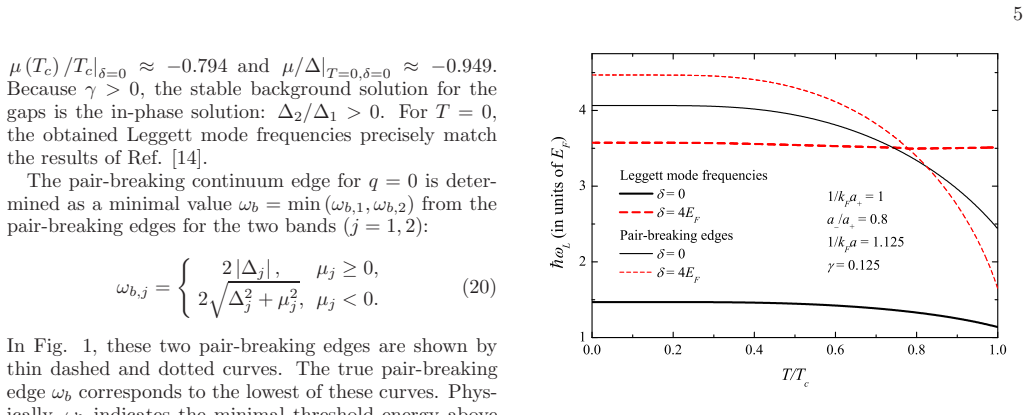
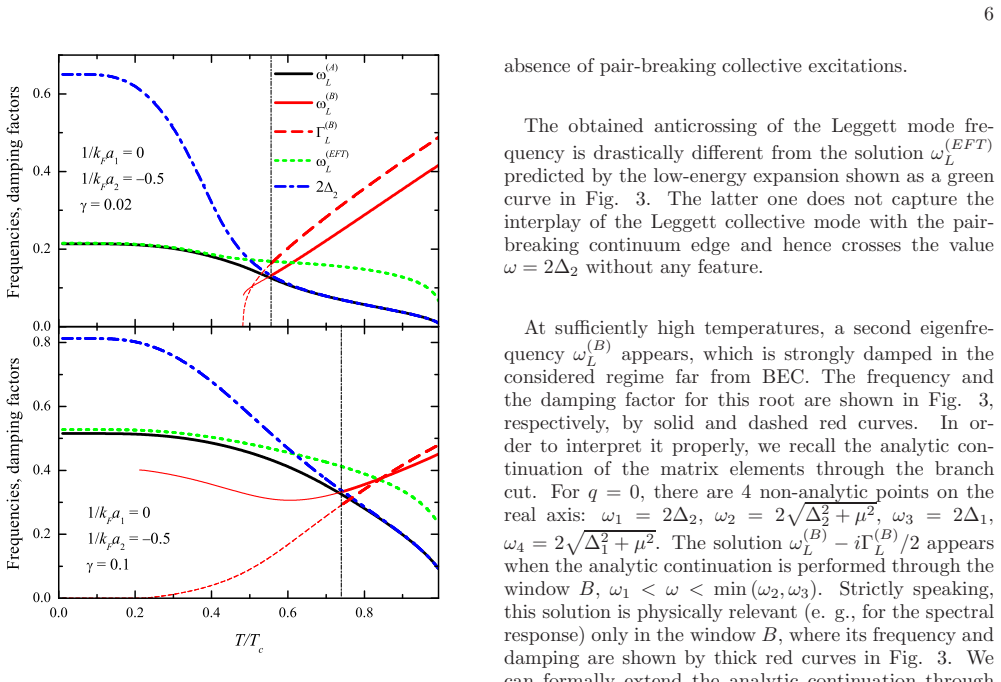
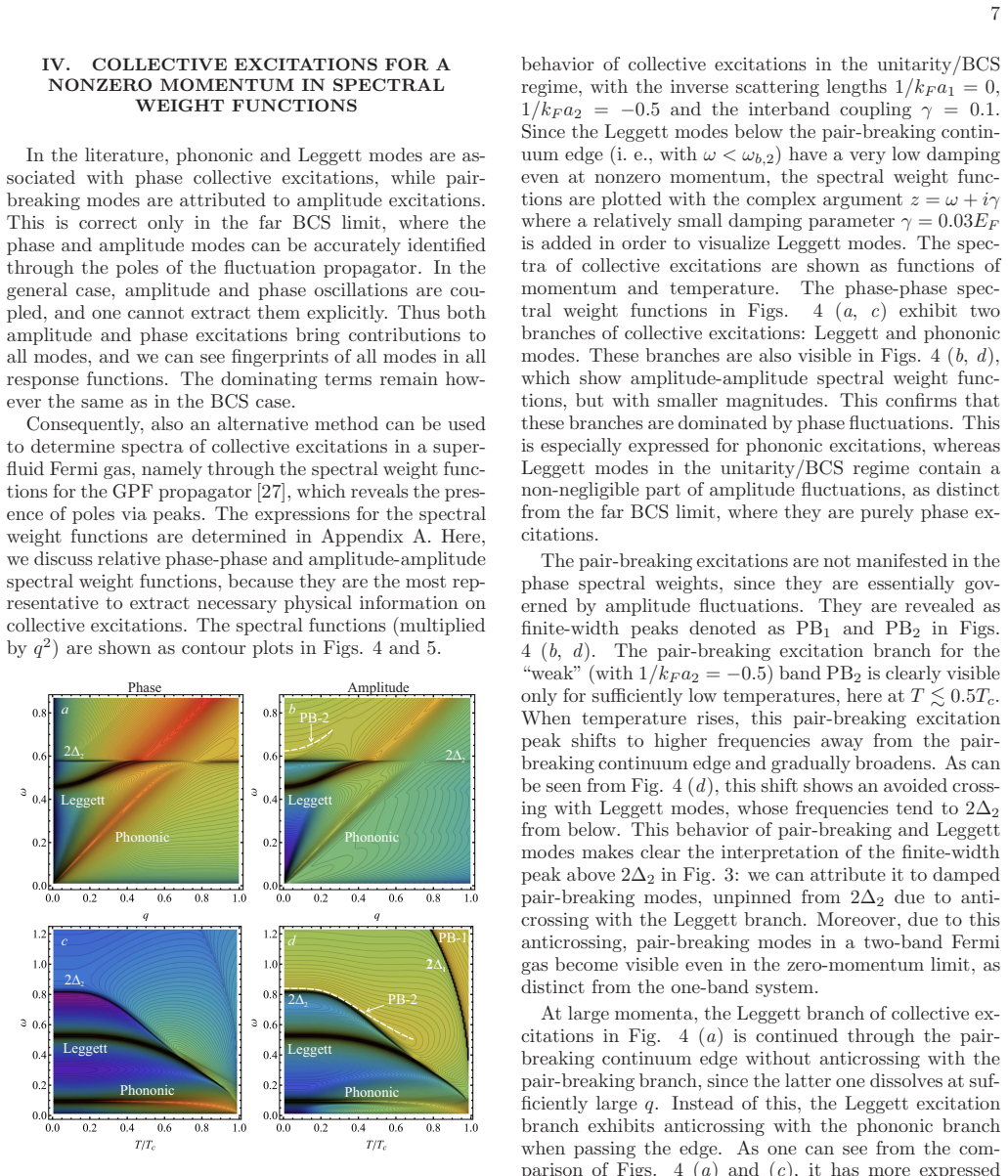
Within the Gaussian pair fluctuation approximation, the paper establishes that the Leggett mode's interaction with the pair-breaking continuum depends on the chemical potentials of the two bands, not just on the Josephson coupling. In the BEC regime, where both chemical potentials are negative and pair-breaking collective branches are absent, the Leggett frequency grows with detuning and crosses the lower pair-breaking continuum edge essentially without feature; the pole acquires a damping factor but the mode does not vanish. In the unitarity/BCS-type regime, the Leggett frequency rises toward 2Δ2 with temperature but never crosses it: the approach to the edge is an avoided crossing with the pair-breaking branch, and at sufficiently high temperature a separate, damped solution appears in the window between the two pair-breaking edges. The same calculation also yields spectral weight functions showing that Leggett and phononic branches are predominantly phase fluctuations, while the pair-breaking branches are amplitude-like, and that Leggett modes carry a non-negligible amplitude component away from the BCS limit.
Load-bearing premise
The calculation assumes that continuing the fluctuation propagator through the branch cut in the complex frequency plane is the correct way to identify damped collective modes; if the continuation lands on the wrong side of the cut, the frequencies and damping factors it produces could be mathematical artifacts rather than physical excitations.
Editorial extensions
If this is right
- In the BEC regime the Leggett mode should be observable near T_c: its frequency does not vanish at the transition, and above the pair-breaking edge it survives as a damped mode with a finite spectral weight.
- Far from BEC, effective-field-theory predictions that cross the pair-breaking edge without structure are unreliable; the full solution shows an avoided crossing instead.
- A two-band Fermi superfluid can host up to four collective branches—phononic, Leggett, and two pair-breaking branches—and the pair-breaking branches can appear at zero momentum only through their anticrossing with the Leggett mode.
- The spectral weight functions show that 'phase' and 'amplitude' labels are only approximate away from the BCS limit, with Leggett modes containing an amplitude component and the branch above the continuum edge mixing with phononic character.
Reading between the lines
- Inference: the finite-T_c survival of the Leggett mode predicts a specific experimental signature in the pair or density response of a two-band gas near an orbital Feshbach resonance: a peak that tunes continuously through the pair-breaking threshold as detuning is increased.
- Inference: because pair-breaking branches become visible at q=0 through anticrossing with Leggett modes, a two-band gas could be used to observe amplitude-like excitations that are dark in one-band systems.
- Inference: the Gaussian pair fluctuation damping omits three- and four-phonon anharmonic processes, so at low temperatures the predicted damping factors are plausibly lower bounds; including those processes would likely broaden the same peaks.
- Inference: the same semianalytic continuation could be applied to a BCS-type multiband superconductor model to predict Leggett-mode frequencies and damping in materials similar to MgB2, something the paper notes as a possible reformulation.
Signed reviews
Editorial analysis
A structured set of objections, weighed in public.
Referee Report
Summary. The manuscript extends the Gaussian pair fluctuation (GPF) approach to a two-band Fermi superfluid at finite temperature and computes the Leggett collective mode spectrum in the long-wavelength limit. The authors write the two-band inverse GPF propagator explicitly (Eqs. (12)-(14)), solve the coupled gap equations (Eq. (8)), and use the Nozières analytic continuation of Eq. (19) to obtain complex poles of the fluctuation propagator, thereby determining both eigenfrequencies and damping factors. Their central results are two qualitatively different regimes: in the BEC regime, the Leggett mode frequency smoothly crosses the pair-breaking continuum edge and acquires a small damping, whereas far from the BEC regime the Leggett mode undergoes an avoided crossing with the pair-breaking edge and a second, strongly damped root appears. The mode assignment is supported by phase-phase and amplitude-amplitude spectral weight contours in Section IV, and the results are compared with the low-frequency effective field theory of Ref. [18]. The paper explicitly acknowledges that the mean-field equation of state is inaccurate near T_c and that anharmonic processes beyond GPF are omitted.
Significance. If the complex-pole identification is correct, this is a useful and timely advance: it provides finite-temperature frequencies and damping rates for Leggett modes beyond the low-energy expansion, which is necessary when the mode energy approaches the pair-breaking continuum. The calculation is transparent and internally consistent: the GPF action, the gap equations, and the analytic continuation are explicit, and the T=0 limit reproduces earlier results. The work also makes falsifiable predictions for cold-atom experiments near orbital Feshbach resonances and in the BCS-BEC crossover. The main risk is not circularity or fitted parameters but the physical interpretation of the analytic continuation: the paper itself states that the uncontinued determinant has no complex roots, so all damped-mode predictions rest on the sheet-selection prescription of Eq. (19).
major comments (3)
- [III, Eqs. (17)-(19); Fig. 3] The damped-mode results are load-bearing and depend entirely on the analytic continuation f^{(R)}(z)=f(z)-2πiρ_f(z) for Im z<0. The paper explicitly states that the uncontinued determinant has no complex roots; the roots are created by this branch-cut prescription. Since the determinant has four non-analytic points (2Δ_j and 2√(Δ_j²+μ_j²)), the continuation can select different Riemann sheets depending on which window is used, and the text later concedes that the second solution is strictly physically relevant only inside window B. The manuscript does not verify that the complex roots are poles of the physical retarded response rather than artifacts of this sheet choice. I request a quantitative check: compute the retarded spectral weight functions from Appendix A (for example χ_pp^(±) and χ_aa^(±)) on the real frequency axis for the same parameters as in Figs. 1-3 and show that the complex roots coincide with peaks in both frequency and width, at least inside each window. The contour plots in Section IV are qualitative and do not close this gap. Without such a check, the central predictions—the BEC Leggett mode crossing the pair-breaking edge and the second damped root far from BEC—are not fully established.
- [III, Eq. (20) and Fig. 2] The conclusion that in the BEC regime the Leggett frequency remains finite as T→T_c is obtained from mean-field background parameters. The authors acknowledge that the mean-field equation of state is not justified near T_c and argue that T/T_c scaling preserves crossings and anticrossings. That argument does not by itself fix the quantitative value of the frequency at T_c, which is a prominent result in the conclusions. I recommend testing robustness with a fluctuation-corrected equation of state in at least one representative BEC case, or explicitly stating that the finite value at T_c is a mean-field-level prediction whose quantitative magnitude could change when fluctuations are included.
- [III, paragraph on the second root; Fig. 3] The second root ω_L^(B)-iΓ_L^(B)/2 is described as 'strictly speaking' physically relevant only inside window B, yet the text uses its formal continuation outside that window to conclude that 'the second root appears at lower temperatures starting from a finite ω_L^(B) with zero damping' and to build the avoided-crossing narrative. This extrapolates beyond the regime where the solution is claimed to be physical. Either restrict the claims to window B or provide evidence that the formal continuation corresponds to a resonance in the retarded response, as requested in the first major comment.
minor comments (4)
- [I, Introduction] The word 'reprersents' should be 'represents'.
- [III, near Eq. (19)] The phrase 'lower semi-panel' should read 'lower half-plane'.
- [Appendix A, Eq. (A20)] The definition \tilde{Q}^{(2)} = \tilde{Q}^{(2)} + κ Δ_1/Δ_2 I uses the same symbol on both sides; presumably the left-hand side is \tilde{Q}^{(2)} built from Q^{(2)}, so the notation should be corrected to avoid an apparent self-referential definition.
- [IV, Figs. 4 and 5] The contour plots would be easier to assess with an explicit color scale and clearly labeled peak positions, especially since the text refers to specific branches (Leggett, phononic, PB-1, PB-2) that are not all marked in every panel.
Circularity Check
No significant circularity: the two-band GPF calculation is self-contained and benchmarked externally; self-citations are methodological, not definitional.
full rationale
The central new results—Leggett mode frequencies and damping factors at finite temperature—are obtained by solving the explicit determinant equation det M2b(q,z)=0 with the analytically continued GPF propagator. The matrix elements in Eqs. (13) and (14) are written out in the paper, and the two-band GPF structure in Eq. (12) is presented explicitly, so the calculation does not reduce to a fitted parameter or to a renamed input. No parameter in the paper is adjusted to reproduce the predicted mode spectra; the input parameters are scattering lengths, detuning, and temperature, and the outputs are roots of a dispersion equation. The self-citations to Refs. [18,19,20] supply the GPF effective-action formalism and the Nozieres-type analytic continuation method, but these are not invoked as uniqueness theorems and are not used to assert that a particular root must exist. Instead, the continuation rule Eq. (19) is stated, and the roots are computed from it; whether that continuation is physically correct is a correctness or validity question, not a circularity. The paper also provides independent grounding: the effective bosonic action is stated to coincide with that of Ref. [14] starting from a different fermionic model, and the zero-temperature Leggett frequencies are reported to precisely match Ref. [14]. The matrix elements are traced to standard one-band GPF expressions [23-25], and the pair-breaking edge and window structure are defined operationally rather than imposed as the desired answer. Thus no load-bearing step reduces, by construction or by self-citation, to its own inputs.
Assumptions & free parameters
free parameters (3)
- Intraband scattering lengths a1, a2 (or a+, a-) =
1/k_F a+ = 1, a-/a+ = 0.8 in Figs. 1-2; 1/a1 = 0, 1/a2 = -0.5 in Fig. 3
- Interband Josephson coupling gamma =
gamma = 0.125 (Figs. 1-2); gamma = 0.02 and 0.1 (Fig. 3)
- Band offset detuning delta =
0 to 4 E_F
assumptions (5)
- domain assumption The two-band Fermi gas is described by the action (1)-(5) with only intraband pairing and Josephson interband coupling; cross-band Cooper pairing is excluded.
- domain assumption Gaussian pair fluctuations: the effective action is truncated at quadratic order in the fluctuation fields (Eq. (10)); higher-order anharmonic fluctuation processes are neglected.
- domain assumption The analytic continuation of the fluctuation propagator through the branch cut (Eq. (19)) yields the physical complex poles of collective modes.
- domain assumption The mean-field equation of state, rescaled by T/T_c, gives an adequate qualitative description of the Leggett modes.
- standard math Standard many-body techniques: Hubbard-Stratonovich transformation, BCS mean-field gap equations, and renormalization of contact interactions via scattering lengths.
Cite this review
Pith. "Pith review of Leggett collective excitations in a two-band Fermi superfluid at finite temperatures." pith.science (2026). https://pith.science/paper/X64TAGHQ
@misc{pith2026190811795,
  author       = {Pith},
  title        = {Pith review of: Leggett collective excitations in a two-band Fermi superfluid at finite temperatures},
  year         = {2026},
  howpublished = {\url{https://pith.science/paper/X64TAGHQ}},
  note         = {Machine review of arXiv:1908.11795}
}
read the original abstract
The Leggett collective excitations for a two-band Fermi gas with s-wave pairing and Josephson interband coupling in the BCS-BEC crossover at finite temperatures are investigated within the Gaussian pair fluctuation approach. Eigenfrequencies and damping factors for Leggett modes are determined in a nonperturbative way, using the analytic continuation of the fluctuation propagator through a branch cut in the complex frequency plane, as in Phys. Rev. Lett. 122, 093403 (2019). The treatment is performed beyond the low-energy expansion, which is necessary when the collective excitation energy reaches the pair-breaking continuum edge. The results are applied in particular to cold atomic gases at the orbital Feshbach resonance and in a regime far from BEC, which can be relevant for future experiments.
Figures

Figures from the paper (2 more)

Forward citations
Cited by 1 Pith paper
-
Damping of the Anderson-Bogolyubov mode by spin and mass imbalance in Fermi mixtures
In spin- and mass-imbalanced Fermi superfluids, Anderson-Bogolyubov sound modes acquire Landau damping at zero temperature once the Fermi-surface mismatch exceeds a threshold set by the mass ratio and the superfluid gap.
Reference graph
Works this paper leans on
-
[18]
Y.-C. Zhang, S. Ding, and S. Zhang, “ Collective modes in a two-band superfluid of ultracold alkaline-earth-metal atoms close to an orbital Feshbach resonance ”, Phys. Rev. A 95, 041603(R) (2017)
work page 2017
-
[1]
38, µ/ ∆1|T =0,δ =0 ≈ 0. 777, µ/ ∆2|T =0,δ =0 ≈ 1. 59 for γ = 0. 1 (panel b). The obtained solutions are compared with the Leggett mode frequency ω (EF T ) L obtained using the low-frequency expansion of the effective action [18] and with the energy of the pair-breaking continuum edge 2∆2. At low temperatures T ≪Tc, only one root of the dis- 6 /s48/s46/s48...
work page 2020
-
[2]
Observation of Leggett’s Collective Mode in a Multiband MgB 2 Superconductor
G. Blumberg, A. Mialitsin, B. S. Dennis, M. V. Klein, N. D. Zhigadlo, and J. Karpinski, “ Observation of Leggett’s Collective Mode in a Multiband MgB 2 Superconductor”, Phys. Rev. Lett. 99, 227002 (2007)
work page 2007
-
[3]
Evidence for a two-band behavior of MgB 2 from point-contact and tunneling spectroscopy
Ya. G. Ponomarev, S. A. Kuzmichev, M. G. Mikheev, M. V. Sudakova, S. N. Tchesnokov, N. Z. Timergaleev, A. V. Yarigin, E. G. Maksimov, S. I. Krasnosvobodt- sev, A.V.Varlashkin, M. A. Hein, G.M¨ uller, H. Piel, L. G. Sevastyanova, O. V. Kravchenko, K. P. Burdina, and B. M. Bulychev, “ Evidence for a two-band behavior of MgB 2 from point-contact and tunnelin...
work page 2004
-
[4]
An even more clear identification of different modes is possible using spectral weight functions for total and relative amplitude and phase responses. These spectral weight functions are determined using the inverse GPF propagator in the basis of the amplitude and phase field coordinates. The inverse GPF propagator for a one-band system is determined as in R...
-
[5]
Number-Phase Fluctuations in Two-Band Superconductors
A. J. Leggett, “ Number-Phase Fluctuations in Two-Band Superconductors”, Progr. Theor. Phys. 36, 901 (1966)
work page 1966
-
[6]
BCS-BEC crossover of collective excitations in two-band superfluids
M. Iskin and C. A. R. S´ a de Melo, “ BCS-BEC crossover of collective excitations in two-band superfluids ”, Phys. Rev. B 72, 024512 (2005)
work page 2005
-
[7]
Two-band superflu- idity from the BCS to the BEC limit
M. Iskin and C. A. R. S´ a de Melo, “ Two-band superflu- idity from the BCS to the BEC limit ”, Phys. Rev. B 74, 144517 (2006)
work page 2006
Show all 33 references
-
[8]
Leggett mode con- trolled by light pulses
F. Giorgianni, T. Cea, C. Vicario, C. P. Hauri, W. K. Withanage, X Xi and L. Benfatto, “ Leggett mode con- trolled by light pulses ”, Nature Phys. 15, 341 (2019)
2019
-
[9]
Theoret- ical analysis of two-gap superconductivity of magnesium diborides and iron pnictides in the generalized α model
E. G. Maksimov, A. E. Karakozov, B. P. Gorshunov, Ya. G. Ponomarev, E. S. Zhukova, and M. Dressel, “ Theoret- ical analysis of two-gap superconductivity of magnesium diborides and iron pnictides in the generalized α model”, JETP 115, 252 (2012)
2012
-
[10]
Observation of an Orbital Interaction-Induced Feshbach Resonance in 173Yb
M. H¨ ofer, L. Riegger, F. Scazza, C. Hofrichter, D. R. Fernandes, M. M. Parish, J. Levinsen, I. Bloch, and S. F¨ olling, “Observation of an Orbital Interaction-Induced Feshbach Resonance in 173Yb”, Phys. Rev. Lett. 115, 265302 (2015)
2015
-
[11]
Two-band superfluidity and intrinsic Joseph- son effect in alkaline-earth-metal Fermi gases across an orbital Feshbach resonance
M. Iskin, “ Two-band superfluidity and intrinsic Joseph- son effect in alkaline-earth-metal Fermi gases across an orbital Feshbach resonance ”, Phys. Rev. A 94, 011604 (2016)
2016
-
[12]
Orbital Feshbach Resonance in Alkali-Earth Atoms
R. Zhang, Y. Cheng, H. Zhai, and P. Zhang, “ Orbital Feshbach Resonance in Alkali-Earth Atoms ”, Phys. Rev. Lett. 115, 135301 (2015)
2015
-
[13]
The work [14] reprersents an alternative method exploiting the density- density response function
at zero temperature, solving the Gaussian pair fluc- tuation propagator for undamped modes. The work [14] reprersents an alternative method exploiting the density- density response function. In the recent work [17], the massive Leggett mode and gapless phonon mode of the two-ba...
-
[14]
Strongly Interacting Gas of Two-Electron Fermions at an Orbital Feshbach Resonance
G. Pagano, M. Mancini, G. Cappellini, L. Livi, C. Sias, J. Catani, M. Inguscio, and L. Fallani, “ Strongly Interacting Gas of Two-Electron Fermions at an Orbital Feshbach Resonance”, Phys. Rev. Lett. 115, 265301 (2015)
2015
-
[15]
Enhanced critical temperature, pairing fluctuation effects, and BCS- BEC crossover in a two-band Fermi gas
H. Tajima, Y. Yerin, A. Perali, and P. Pieri, “ Enhanced critical temperature, pairing fluctuation effects, and BCS- BEC crossover in a two-band Fermi gas ”, Phys. Rev. B 99, 180503(R) (2019)
2019
-
[16]
Two-band description of resonant superfluidity in atomic Fermi gases
L. He, H. Hu, and X.-J. Liu, “ Two-band description of resonant superfluidity in atomic Fermi gases ”, Phys. Rev. A 91, 023622 (2015)
2015
-
[17]
Strongly correlated Fermi superfluid near an orbital Fes- hbach resonance: Stability, equation of state, and Leggett mode
L. He, J. Wang, S.-G. Peng, X.-J. Liu, and H. Hu, “Strongly correlated Fermi superfluid near an orbital Fes- hbach resonance: Stability, equation of state, and Leggett mode”, Phys. Rev. A 94, 043624 (2016)
2016
-
[19]
Pair-breaking collective branch in BCS superconduc- tors and superfluid Fermi gases
H. Kurkjian, S. N. Klimin, J. Tempere, and Y. Castin, “Pair-breaking collective branch in BCS superconduc- tors and superfluid Fermi gases ”, Phys. Rev. Lett. 122, 093403 (2019)
2019
-
[20]
Coexis- tence of giant Cooper pairs with a bosonic condensate and anomalous behavior of energy gaps in the BCS-BEC crossover of a two-band superfluid Fermi gas
Y. Yerin, H. Tajima, P. Pieri, and A. Perali, “ Coexis- tence of giant Cooper pairs with a bosonic condensate and anomalous behavior of energy gaps in the BCS-BEC crossover of a two-band superfluid Fermi gas ”, Phys. Rev. B 100, 104528 (2019)
2019
-
[21]
Strongly interact- ing Sarma superfluid near orbital Feshbach resonances
P. Zou, L. He, X.-J. Liu, and H. Hu, “ Strongly interact- ing Sarma superfluid near orbital Feshbach resonances ”, Phys. Rev. A 97, 043616 (2018)
2018
-
[22]
Finite temperature effective field theory and two- band superfluidity in Fermi gases
S. N. Klimin, J. Tempere, G. Lombardi, and J. T. De- vreese, “ Finite temperature effective field theory and two- band superfluidity in Fermi gases ”, Eur. Phys. Journal B 88, 122 (2015)
2015
-
[23]
BCS to Bose crossover: Broken-symmetry state
J. R. Engelbrecht, M. Randeria, and C. A. R. S´ a de Melo, “BCS to Bose crossover: Broken-symmetry state ”, Phys. Rev. B 55, 15153 (1997)
1997
-
[24]
Phononic collective excitations in superfluid Fermi gases at nonzero temperatures
S. N. Klimin, J. Tempere, and H. Kurkjian,“ Phononic collective excitations in superfluid Fermi gases at nonzero temperatures”, arXiv:1811.07796 (2019)
2019 arXiv
-
[25]
Le probleme a N corps: propri´ et´ es g´ en´ erales des gaz de fermions
P. Nozi` eres, “Le probleme a N corps: propri´ et´ es g´ en´ erales des gaz de fermions ” (Dunod, Paris, 1963)
1963
-
[26]
Crossover from BCS to Bose superconductivity: Tran- sition temperature and time-dependent Ginzburg-Landau theory
C. A. R. S´ a de Melo, M. Randeria, and J.R. Engelbrecht, “Crossover from BCS to Bose superconductivity: Tran- sition temperature and time-dependent Ginzburg-Landau theory”, Phys. Rev. Lett. 71, 3202 (1993)
1993
-
[27]
Observability of Higgs mode in a system without Lorentz invariance
X. Han, B. Liu, and J. Hu, “ Observability of Higgs mode in a system without Lorentz invariance ”, Phys. Rev. A 94, 033608 (2016)
2016
-
[28]
Quan- tum fluctuations in the superfluid state of the BCS-BEC crossover
R. B. Diener, R. Sensarma, and M. Randeria, “ Quan- tum fluctuations in the superfluid state of the BCS-BEC crossover”, Phys. Rev. A 77, 023626 (2008)
2008
-
[29]
Phase separation in imbalanced fermion superfluids beyond the mean-field approximation
J. Tempere, S. N. Klimin, and J. T. Devreese, “ Phase separation in imbalanced fermion superfluids beyond the mean-field approximation ”, Phys. Rev. A 78, 023626 (2008)
2008
-
[30]
Random-Phase Approximation in the Theory of Superconductivity
P. W. Anderson, “ Random-Phase Approximation in the Theory of Superconductivity ”, Phys. Rev. 112, 1900 (1958)
1958
-
[31]
(A8) Analytically continuing the Matsubara frequencies to 10 the complex z plane, we determine the spectral weight functions for the total and relative responses, χ (±) (q,z ) = 1 π Im ⟨( ¯ϕ (1) q,n ± ¯ϕ (2) q,n )( ϕ (1) q,n ±ϕ (2) q,n )⟩ ⏐ ⏐ ⏐ iΩ n→z , (A9) which are expresse...
-
[32]
Tuning Feshbach res- onances in cold atomic gases with interchannel coupling
T.-S. Deng, W. Zhang, and W. Yi, “ Tuning Feshbach res- onances in cold atomic gases with interchannel coupling ”, Phys. Rev. A 96, 050701(R) (2017)
2017
-
[33]
Dynamic struc- ture factor of a superfluid Fermi gas
A. Minguzzi, G. Ferrari, and Y. Castin, “ Dynamic struc- ture factor of a superfluid Fermi gas ”, Eur. Phys. Journal D, 17, 49 (2001)
2001
Reviewed August 14, 2026 · model on record in the stance chip above.
Discussion (0). Continue with ORCID to comment.