REVIEW 3 major objections 6 minor 56 references
Making Communities Show Respect for Order
T0 review · 3 major / 6 minor · reviewed 2026-08-14 · deepseek-v4-flash
Pith's one-line read The paper defines siblinarity, a modularity-like score that partitions a directed acyclic graph into antichain communities of nodes with unusually high neighbour overlap.
desk verdict A genuinely new and useful DAG community detection method that respects partial orders; the null-model choice is the main weak spot, but the empirical results carry the case. read the letter →
The pith
A machine-rendered reading of the paper's core claim, the machinery that carries it, and where it could break.
The reading
What carries the argument
An antichain partition and the siblinarity objective $$S(A)=\sum_{A\in\mathcal A}\sum_{n\in A}\sum_{m\in A\setminus n}\left(\tilde A_{nm}-\frac{\kappa_n\kappa_m}{W}\right),$$ with $\kappa_n=\sum_m \tilde A_{nm}$ and $W=\sum_{n,m}\tilde A_{nm}$. The matrix $\tilde A$ counts two-step walks on the DAG—one step forward and one back for successor overlap, one back and one forward for predecessor overlap—so its off-diagonal entries are common-neighbour counts. The subtracted term is the configuration-model expectation of that overlap on the derived graph, and the antichain constraint forbids any directed path between nodes in the same community. Maximising $S(A)$ under that constraint is what lets the algorithm turn 'no path between members' from a prohibition into the organising principle; a resolution parameter $\lambda$ scales the null term, interpolating between small communities of very similar nodes and layer-like partitions.
What would settle it
Generate a planted-field citation DAG and shuffle field labels among nodes with identical degree sequences, then run the siblinarity optimisation; if the communities still show near-minimal topic diversity, the apparent topical coherence is an artefact of the null model rather than evidence that the method finds similar nodes.
Extended reading notes
Core claim
The central claim is that a good community in a DAG is an antichain of similar nodes, and that such communities can be found by optimising a modularity-like quantity rather than by layering or by ordinary community detection. The quantity, siblinarity, compares, for every pair of nodes in a community, the observed overlap of their neighbourhoods with the overlap expected from a configuration model built on the derived 'second-neighbour' graph whose adjacency matrix is $\tilde A = A A^{\mathrm T}$ for successor overlap or $A^{\mathrm T} A$ for predecessor overlap. Because the partition is required to be an antichain, no two nodes in a community are connected by a directed path, so the DAG's partial order is respected by construction, while the similarity term ensures the community is not merely a layer but a set of genuinely comparable nodes. On planted-field citation models the siblinarity communities have near-minimal topic diversity, on real citation data they group papers of similar age and topic, and on a food web they group competing species that share prey.
Load-bearing premise
The load-bearing premise is that the configuration-model formula $\kappa_n\kappa_m/W$, applied to the derived second-neighbour graph, gives the correct expected neighbourhood overlap for nodes in a DAG, so that any excess overlap above it counts as genuine similarity.
Editorial extensions
If this is right
- In citation networks, siblinarity communities group papers published close in time and within the same topic, so they offer a fairer baseline for comparing citation impact than communities that span many publication dates.
- In food webs, the method clusters species at the same trophic level that compete for the same prey rather than mixing predators with their prey, giving an ecological interpretation distinct from standard modularity.
- Because the partition must be an antichain, siblinarity communities are guaranteed to respect the partial order of a DAG, a property that ordinary community detection, even on the undirected version of the graph, does not provide.
- The resolution parameter allows the same algorithm to reproduce, at one extreme, small communities of highly similar nodes and, at the other, layer-like partitions close to traditional height or depth layering.
- On a citation network with known topic labels, siblinarity communities show much lower topic diversity than height-based layers, confirming that the neighbourhood-overlap term, not the antichain constraint alone, is what produces topical coherence.
Reading between the lines
- A natural testable extension is to apply siblinarity to DAGs where node similarity is also known from independent metadata not used in the construction, such as author teams or software functionality; high agreement would support the claim that common-neighbour overlap captures semantic similarity rather than degree effects alone.
- Because the antichain constraint is defined only by absence of a path, the same objective can be used on directed graphs with few cycles, suggesting a route to fixing 'bad' backward citations by merging the two antichain communities that a bad link separates.
- If the null model is replaced by an ensemble of random DAGs with the same degree sequence, the siblinarity of a partition could be turned into a statistical z-score, giving a principled way to choose the resolution parameter $\lambda$ without scanning it manually.
Signed reviews
Editorial analysis
A structured set of objections, weighed in public.
Referee Report
Summary. The paper proposes "siblinarity", a quality function for partitions of a DAG into antichains. For each community, it sums over node pairs the number of common successors (or predecessors) minus the configuration-model expectation computed on the derived two-step graph (Eq. 5). Maximizing this function with a Louvain-style heuristic is claimed to yield antichain communities whose nodes are both order-incomparable and topically similar. The method is tested on a space-time lattice model, a Price model with planted fields, the Florida Bay food web, the hep-th citation graph, and the Cora citation network. Comparisons with height/depth layering and with modularity communities show that the siblinarity partitions are smaller and more homogeneous in field/topic while respecting the partial order.
Significance. If the method works as described, it is a useful addition to the small literature on DAG-aware clustering: it treats the absence of a directed path as a signal rather than a nuisance, and it transposes bibliometric similarity into a community-detection objective. The paper is commendably concrete: code and data are released in a Figshare repository, and Appendix B fully enumerates all antichain partitions of a small graph, which helps the reader see exactly what the objective rewards. I found no circularity in the use of field labels or publication dates; they enter only in post-hoc validation. The main reservations are (i) the Louvain coarse-graining does not preserve the stated objective, (ii) the null model is chosen by analogy with modularity rather than derived from a DAG ensemble despite the authors' own Eq. (A6), and (iii) the diversity validations are not size-controlled. These issues are addressable, so the contribution is potentially significant, but the present version overstates the support for the central claim.
major comments (3)
- [Section 2.4 and Appendix C, Eq. (C28)] The second Louvain phase optimizes a different function from S(A) of Eq. (5). When two antichain communities A_a and A_b are merged, the contribution to the original siblinarity is the sum over pairs (n in A_a, m in A_b) of (AA^T)_{nm} minus the corresponding null term. In the coarse-grained graph H of Eq. (C28), however, the two-step entry (HH^T)_{ab} equals the sum over successor communities c of (sum over n in A_a, s in c of A_{ns})(sum over m in A_b, t in c of A_{mt}), which includes products of edges to distinct successors s and t whenever s and t lie in the same community c. This is not equal to the original sum over common successors. Consequently, merges decided at later levels need not increase S(A) on the original DAG, and the final partition need not be a local optimum of the stated objective. Please either prove that the coarse-graining preserves S(A), compute Delta-S for candidate merges directly from the original graph, or benchmark the heuristic against exact optimization on small instances. The worked example in Appendix B checks the exact objective on one small graph but does not test the Louvain phase itself.
- [Section 2.3, Eq. (5), and Appendix A, Eq. (A6)] The null model used in Eq. (5) is the configuration model on the derived two-step graph ~G, not a null model for the original DAG. In Appendix A the authors derive the DAG-configuration expectation E(|N(n)∩N(m)|) ≈ ((⟨k_in²⟩−1) k_out(n) k_out(m)) / (⟨k_in⟩ |E|) and then state "we chose not to do so" without giving a reason. These two baselines are not equivalent: the former subtracts a product of two-step strengths, while the latter weights shared neighbours by their in-degree. Because the optimal antichain partition depends on which baseline is subtracted, the empirical claims about "similar nodes" are conditional on an under-justified modeling choice. The paper should either justify the configuration-model-on-~G choice or show that the main findings are robust to using the DAG null of Eq. (A6), and ideally to a resolution-parameter sweep that keeps the mean community size fixed.
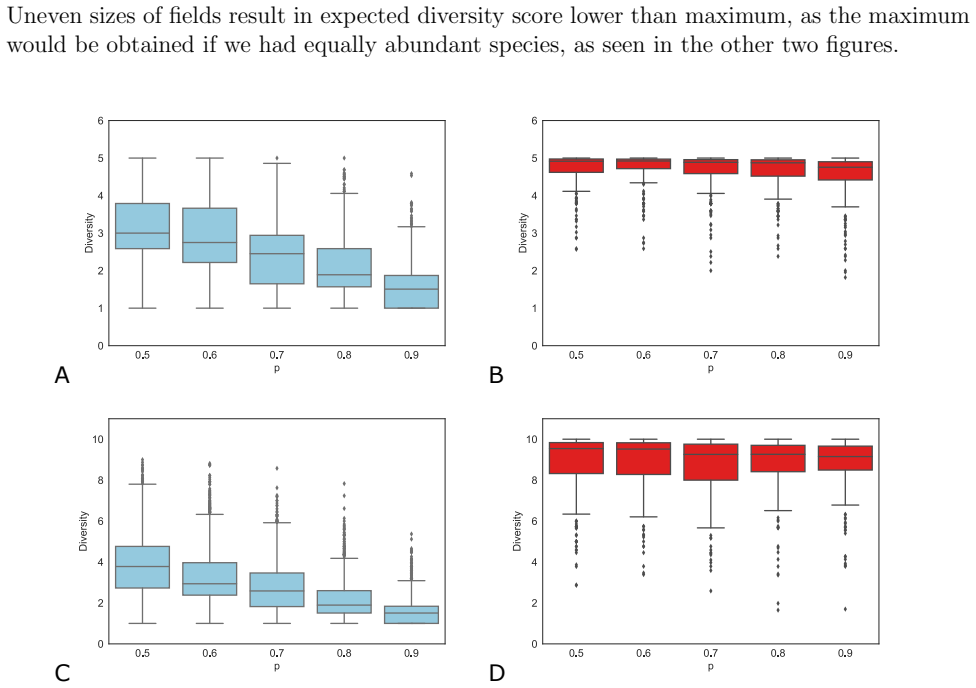
- [Section 4.2, Figs. 4-5, and Section 4.4, Fig. 8] The diversity comparison is confounded by community size. Height and depth antichains are much larger than siblinarity communities, and Shannon diversity of a label distribution tends to increase as more nodes are drawn from a heterogeneous mixture. To support the claim that siblinarity finds same-field or same-topic nodes, the paper needs a size-controlled baseline, for example random antichain partitions with the same community-size distribution, or a plot of diversity as a function of |A|. Fig. 8's restriction to antichains of at least five nodes is a step in the right direction, but Figs. 4-5 do not include such a control and no size-matched baseline is provided anywhere. If the size-matched comparison still shows lower diversity for siblinarity communities, that would substantially strengthen the paper.
minor comments (6)
- [Section 2.1 and Appendix A] The term "weakly connected" is used to mean "there is a directed path in either direction", whereas standard weak connectivity ignores edge direction; consider using "comparable" or "connected by a directed path" instead.
- [Eq. (5) and Eq. (A7)] The self-loop entries of ~A are excluded from the pair sum but are included in κ_n and W; the effect of this choice on the null model should be discussed more explicitly than the brief dismissal of the non-backtracking alternative.
- [Section 4.2, Fig. 4] The Fig. 4 caption calls the parameter "intraconnectivity probability p" while the text defines φ for the same quantity; the notation should be unified.
- [Section 4.4] For the Cora analysis, report the number and size distribution of siblinarity antichains, including singleton counts, so the reader can assess the size confound directly.
- [Appendix H] Showing that the S(A) value is stable across runs does not demonstrate that the partitions are stable; consider reporting an adjusted Rand index or normalized mutual information between the partitions found in different runs.
- [Fig. 6] Several axis labels in Fig. 6 appear as garbled sequences such as "/uni00000013"; the figure should be regenerated with readable labels.
Circularity Check
No circularity: the siblinarity objective and its empirical validation are self-contained, with field labels used only post hoc.
full rationale
The paper's central derivation is self-contained. Siblinarity is defined directly from the DAG adjacency matrix A through the derived second-neighbour matrix à = AAᵀ (or AᵀA), with a configuration-model null applied to that derived graph (Eq. 5; Appendix A). The antichain constraint is explicitly imposed in the optimization procedure (Section 2.4 and Appendix C), so order-respect is a design property of the algorithm, not a separately predicted outcome. Field labels and topic labels appear only in post-hoc validation: the Price model with subject fields (Section 3.2), the cora topics (Section 4.4), and the Florida Bay species groups (Section 4.3) are not used in the siblinarity objective. The paper derives a DAG-configuration null in Eq. (A6) and then chooses instead the modularity-style null on the derived graph; this is a modelling choice and a potential correctness concern, but it is not circular because the null is not fitted to the validation labels. The paper also explicitly credits modularity [29] and bibliometric similarity measures, so the method is not a disguised renaming of an established result. The self-citations present (e.g., [40,41]) are background references concerning citation-network order and are not load-bearing for the siblinarity derivation or its validation.
Assumptions & free parameters
free parameters (1)
- λ (resolution parameter) =
1 (default)
assumptions (4)
- domain assumption Configuration model on derived second-neighbor graph \tilde A is a valid null model for expected neighborhood overlap.
- domain assumption Real networks can be made into DAGs by removing a small fraction of edges without losing the relevant structure.
- domain assumption Common-neighbor overlap is an appropriate measure of node similarity for antichain communities.
- domain assumption Louvain-style greedy optimisation with coarse-graining finds a good approximation to the siblinarity maximum.
Cite this review
Pith. "Pith review of Making Communities Show Respect for Order." pith.science (2026). https://pith.science/paper/BABEHUHS
@misc{pith2026190811818,
  author       = {Pith},
  title        = {Pith review of: Making Communities Show Respect for Order},
  year         = {2026},
  howpublished = {\url{https://pith.science/paper/BABEHUHS}},
  note         = {Machine review of arXiv:1908.11818}
}
read the original abstract
In this work we give a community detection algorithm in which the communities both respects the intrinsic order of a directed acyclic graph and also finds similar nodes. We take inspiration from classic similarity measures of bibliometrics, used to assess how similar two publications are, based on their relative citation patterns. We study the algorithm's performance and antichain properties in artificial models and in real networks, such as citation graphs and food webs. We show how well this partitioning algorithm distinguishes and groups together nodes of the same origin (in a citation network, the origin is a topic or a research field). We make the comparison between our partitioning algorithm and standard hierarchical layering tools as well as community detection methods. We show that our algorithm produces different communities from standard layering algorithms.
Figures


Figures from the paper (5 more)


Reference graph
Works this paper leans on
-
[1]
Karrer, B., Newman, M.E.J.: Random acyclic networks. Phys. Rev. Lett. 102, 128701 (2009). doi:10.1103/PhysRevLett.102.128701
-
[2]
What is the dimension of citation space?
Clough, J.R., Evans, T.S.: What is the dimension of citation space? Physica A 448, 235–247 (2016). doi: 10.1016/j.physa.2015.12.053. arXiv:1408.1274
work page Pith review arXiv 2016
-
[3]
Journal of Complex Networks 2, 419–430 (2014)
Carstens, C.: A uniform random graph model for directed acyclic networks and its effect on motif-finding. Journal of Complex Networks 2, 419–430 (2014). doi:10.1093/comnet/cnu028
-
[4]
Embedding Graphs in Lorentzian Spacetime
Clough, J.R., Evans, T.S.: Embedding graphs in lorentzian spacetime. PLoS ONE 12(11), 0187301 (2017). doi: 10.1371/journal.pone.0187301. 1602.03103
work page Pith review arXiv 2017
-
[5]
Physics Reports 486(3-5), 75–174 (2010)
Fortunato, S.: Community detection in graphs. Physics Reports 486(3-5), 75–174 (2010). arXiv:0906.0612v2
arXiv 2010
-
[6]
ACM computing surveys (CSUR) 31(3), 264–323 (1999)
Jain, A.K., Murty, M.N., Flynn, P.J.: Data clustering: a review. ACM computing surveys (CSUR) 31(3), 264–323 (1999)
work page 1999
-
[7]
Boyack, K.W., Klavans, R.: Co-citation analysis, bibliographic coupling, and direct cita- tion: Which citation approach represents the research front most accurately? Journal of the American Society for Information Science and Technology 61(12), 2389–2404 (2010). doi:10.1002/asi.21419
-
[8]
American documentation 14(1), 10–25 (1963)
Kessler, M.M.: Bibliographic coupling between scientific papers. American documentation 14(1), 10–25 (1963)
work page 1963
Show all 56 references
-
[9]
Journal of Documentation 20(4), 236–236 (1964)
Martyn, J.: Bibliographic coupling. Journal of Documentation 20(4), 236–236 (1964)
1964
-
[10]
Journal of the American Society for Information Science 24(4), 265–269 (1973)
Small, H.: Co-citation in the scientific literature: A new measure of the relationship between two documents. Journal of the American Society for Information Science 24(4), 265–269 (1973)
1973
-
[11]
Science Studies 4(1), 17–40 (1974)
Small, H., Griffith, B.C.: The structure of scientific literatures i: Identifying and graphing specialties. Science Studies 4(1), 17–40 (1974)
1974
-
[12]
In: Proceedings of the 14th International Conference on Extending Database Technology - EDBT/ICDT ’11
Satuluri, V., Parthasarathy, S.: Symmetrizations for clustering directed graphs. In: Proceedings of the 14th International Conference on Extending Database Technology - EDBT/ICDT ’11. ACM Press, New York, NY, USA (2011)
2011
-
[13]
The European Physical Journal B 59(1), 75–83 (2007)
Leicht, E.A., Clarkson, G., Shedden, K., Newman, M.E.J.: Large-scale structure of time evolving citation networks. The European Physical Journal B 59(1), 75–83 (2007)
2007
-
[14]
Procedia - Social and Behavioral Sciences 4, 26–37 (2010)
II, M.J.B., Katz, D.M., Zelner, J.L.: On the stability of community detection algorithms on longitudinal citation data. Procedia - Social and Behavioral Sciences 4, 26–37 (2010)
2010
-
[15]
The European Physical Journal B 88(8) (2015)
Speidel, L., Takaguchi, T., Masuda, N.: Community detection in directed acyclic graphs. The European Physical Journal B 88(8) (2015)
2015
-
[16]
Journal of Parallel and Distributed Computing 16(4), 276–291 (1992) 24
Gerasoulis, A., Yang, T.: A comparison of clustering heuristics for scheduling directed acyclic graphs on multiprocessors. Journal of Parallel and Distributed Computing 16(4), 276–291 (1992) 24
1992
-
[17]
IEEE Transactions on Systems, Man, and Cybernetics 11(2), 109–125 (1981)
Sugiyama, K., Tagawa, S., Toda, M.: Methods for visual understanding of hierarchical system structures. IEEE Transactions on Systems, Man, and Cybernetics 11(2), 109–125 (1981)
1981
-
[18]
The American Mathematical Monthly 78(8), 876–877 (1971)
Mirsky, L.: A dual of dilworth’s decomposition theorem. The American Mathematical Monthly 78(8), 876–877 (1971)
1971
-
[19]
In: 2013 Interna- tional Conference on Computational and Information Sciences, pp
Tang, H., Hu, Z.: Network simplex algorithm for DAG layering. In: 2013 Interna- tional Conference on Computational and Information Sciences, pp. 1525–1528 (2013). doi:10.1109/iccis.2013.401
2013 doi
-
[20]
IEEE Transactions on Software Engineering 19(3), 214–230 (1993)
Gansner, E.R., Koutsofios, E., North, S.C., Vo, K.-P.: A technique for drawing directed graphs. IEEE Transactions on Software Engineering 19(3), 214–230 (1993)
1993
-
[21]
Discrete Applied Mathematics 154(5), 848–860 (2006)
Nikolov, N.S.., Tarassov, A.: Graph layering by promotion of nodes. Discrete Applied Mathematics 154(5), 848–860 (2006)
2006
-
[22]
In: Goodrich, M.T., Kobourov, S.G
Healy, P., Nikolov, N.S.: A branch-and-cut approach to the directed acyclic graph layering problem. In: Goodrich, M.T., Kobourov, S.G. (eds.) Graph Drawing, pp. 98–109. Springer, Berlin, Heidelberg (2002)
2002
-
[23]
In: Tamassia, R
Healy, P., Nikolov, N.: Hierarchical drawing algorithms. In: Tamassia, R. (ed.) Handbook of Graph Drawing and Visualization, pp. 409–454. CRC Press, Florida (2013). Chap. 13
2013
-
[24]
Making Communities Show Re- spect for Order
Vasiliauskaite, V., Evans, T.S.: Data for “Making Communities Show Re- spect for Order” Paper. doi: 10.6084/m9.figshare.9725159. https://figshare.com/s/ 3ecc2bd6919a64916f44
-
[25]
Oxford University Press, Oxford (2010)
Newman, M.: Networks: An Introduction. Oxford University Press, Oxford (2010)
2010
-
[26]
New Phytologist 11(2), 37–50 (1912)
Jaccard, P.: The distribution of the flora in the alpine zone. New Phytologist 11(2), 37–50 (1912). doi:10.1111/j.1469-8137.1912.tb05611.x
1912
-
[27]
Proceedings of the National Academy of Sciences 103(23), 8577–8582 (2006)
Newman, M.E.J.: Modularity and community structure in networks. Proceedings of the National Academy of Sciences 103(23), 8577–8582 (2006). doi:10.1073/pnas.0601602103
2006 doi
-
[28]
Science advances 2(5), 1600028 (2016)
Xu, J., Wickramarathne, T.L., Chawla, N.V.: Representing higher-order dependencies in networks. Science advances 2(5), 1600028 (2016). doi: 10.1126/sciadv.1600028
2016 doi
-
[29]
Newman, M.E.J., Girvan, M.: Finding and evaluating community structure in networks. Phys. Rev. E 69(2), 026113 (2004)
2004
-
[30]
Reichardt, J., Bornholdt, S.: Statistical mechanics of community detection. Phys. Rev. E 74(1), 016110 (2006)
2006
-
[31]
Journal of Statistical Mechanics: Theory and Experiment 2008(10), 10008 (2008)
Blondel, V.D., Guillaume, J.-L., Lambiotte, R., Lefebvre, E.: Fast unfolding of communi- ties in large networks. Journal of Statistical Mechanics: Theory and Experiment 2008(10), 10008 (2008)
2008
-
[32]
J.Amer.Soc.Inform.Sci
Price, D.J.d.S.: A general theory of bibliometric and other cumulative advantage processes. J.Amer.Soc.Inform.Sci. 27, 292–306 (1976) 25
1976
-
[33]
Annual Report to the United States Geological Service Biological Resources Division
Ulanowicz, R., Bondavalli, C., S Egnotovich, M.: Network analysis of trophic dynamics in South Florida ecosystem, fy 97: The florida bay ecosystem. Annual Report to the United States Geological Service Biological Resources Division. Ref. No. [UMCES]CBL (1998)
1998
-
[34]
Science 353(6295), 163–166 (2016)
Benson, A.R., Gleich, D.F., Leskovec, J.: Higher-order organization of complex networks. Science 353(6295), 163–166 (2016). arXiv:1612.08447
2016 arXiv
-
[35]
In: Proceedings of the 2017 ACM on Web Science Conference - WebSci ’17
Sun, J., Ajwani, D., Nicholson, P.K., Sala, A., Parthasarathy, S.: Breaking cycles in noisy hierarchies. In: Proceedings of the 2017 ACM on Web Science Conference - WebSci ’17. ACM Press, New York (2017)
2017
-
[36]
https://www.cs.cornell.edu/projects/kddcup/datasets.html (2003)
KDD cup: Datasets. https://www.cs.cornell.edu/projects/kddcup/datasets.html (2003)
2003
-
[37]
In: Proceedings of the 20th International Conference on Machine Learning, pp
Lu, Q., Getoor, L.: Link-based classification. In: Proceedings of the 20th International Conference on Machine Learning, pp. 496–503 (2003)
2003
-
[38]
AI Magazine 29(3), 93 (2008)
Sen, P., Namata, G., Bilgic, M., Getoor, L., Galligher, B., Eliassi-Rad, T.: Collective classification in network data. AI Magazine 29(3), 93 (2008)
2008
-
[39]
Oikos 113(2), 363–375 (2006)
Jost, L.: Entropy and diversity. Oikos 113(2), 363–375 (2006)
2006
-
[40]
Journal of Complex Networks 3(2), 189–203 (2014)
Clough, J.R., Gollings, J., Loach, T.V., Evans, T.S.: Transitive reduction of citation networks. Journal of Complex Networks 3(2), 189–203 (2014)
2014
-
[41]
Scientific Reports (2020, to appear)
Evans, T.S., Calmon, L., Vasiliauskaite, V.: Longest Path in the Price Model. Scientific Reports (2020, to appear). arXiv:1903.03667
2020 arXiv
-
[42]
PNAS 104, 36– 41 (2007)
Fortunato, S., Barthelemy, M.: Resolution limit in community detection. PNAS 104, 36– 41 (2007). doi: 10.1073/pnas.0605965104
2007 doi
-
[43]
PLoS ONE 7(2), 32210 (2012)
Schaub, M.T., Delvenne, J.-C., Yaliraki, S.N., Barahona, M.: Markov dynamics as a zooming lens for multiscale community detection: non clique-like communities and the field-of-view limit. PLoS ONE 7(2), 32210 (2012). doi: 10.1371/journal.pone.0032210
2012 doi
-
[44]
IEEE Transactions on Network Science and Engineering 1(2), 76–90 (2014)
Lambiotte, R., Delvenne, J.-C., Barahona, M.: Random walks, markov processes and the multiscale modular organization of complex networks. IEEE Transactions on Network Science and Engineering 1(2), 76–90 (2014). doi: 10.1109/tnse.2015.2391998
2014
-
[45]
Science Advances 3(5), 1602548 (2017)
Peel, L., Larremore, D.B., Clauset, A.: The ground truth about metadata and community detection in networks. Science Advances 3(5), 1602548 (2017). doi:10.1126/sciadv.1602548
2017 doi
-
[46]
Scientometrics 111(2), 981–998 (2017)
Gl¨ aser, J., Gl¨ anzel, W., Scharnhorst, A.: Same data — different results? towards a com- parative approach to the identification of thematic structures in science. Scientometrics 111(2), 981–998 (2017). doi: 10.1007/s11192-017-2296-z
2017 doi
-
[47]
Scientometrics 111(2), 1223–1224 (2017) 26
Boyack, K., Gl¨ anzel, W., Gl¨ aser, J., Havemann, F., Scharnhorst, A., Thijs, B., van Eck, N.J., Velden, T., Waltmann, L.: Topic identification challenge. Scientometrics 111(2), 1223–1224 (2017) 26
2017
-
[48]
In: Proceedings of the 15th International Society of Scientometrics and Informetrics Conference, pp
Haustein, S., Bowman, T.D., Costas, R.: When is an article actually published? an analysis of online availability, publication, and indexation dates. In: Proceedings of the 15th International Society of Scientometrics and Informetrics Conference, pp. 1170–1179 (2015). arXiv:1505.00796
2015 arXiv
-
[49]
In: Proceedings of the 20th International Conference on World Wide Web, pp
Gupte, M., Shankar, P., Li, J., Muthukrishnan, S., Iftode, L.: Finding hierarchy in directed online social networks. In: Proceedings of the 20th International Conference on World Wide Web, pp. 557–566 (2011). ACM
2011
-
[50]
Data Mining and Knowledge Discovery 31(3), 702–738 (2017)
Tatti, N.: Tiers for peers: a practical algorithm for discovering hierarchy in weighted networks. Data Mining and Knowledge Discovery 31(3), 702–738 (2017)
2017
-
[51]
PLOS ONE 13(2), 1–25 (2018)
Letizia, E., Barucca, P., Lillo, F.: Resolution of ranking hierarchies in directed networks. PLOS ONE 13(2), 1–25 (2018)
2018
-
[52]
Scientific Reports 9(1) (2019)
Traag, V.A., Waltman, L., van Eck, N.J.: From louvain to leiden: guaranteeing well-connected communities. Scientific Reports 9(1) (2019). doi:10.1038/s41598-019-41695-z
2019 doi
-
[53]
https://en.wikipedia.org/wiki/Family_tree_of_the_Greek_gods
Wikipedia: Family tree of the Greek gods. https://en.wikipedia.org/wiki/Family_tree_of_the_Greek_gods
-
[54]
https://www.python.org/
Python Software Foundation: Python programming language. https://www.python.org/
-
[55]
Python Packaging Authority (PyPA): Python Package Index (PyPI).https://pypi.org/
-
[56]
siblinarity antichains
Naik, V.: pipdeptree. https://github.com/naiquevin/pipdeptree 27 Appendix A Siblinarity antichain partition We require a function which measures the quality of our partition of the set of nodes into our “siblinarity antichains”. There are two main aspects to such a function: i...
2019
Reviewed August 14, 2026 · model on record in the stance chip above.
Discussion (0). Continue with ORCID to comment.