REVIEW 2 major objections 5 minor 63 references
Describing correlated observations of neutrino and gamma ray flares from the blazar TXS 0506+056 with proton blazar model
T0 review · 2 major / 5 minor · reviewed 2026-08-14 · deepseek-v4-flash
Pith's one-line read The paper claims that the same proton–proton collisions inside the jet of TXS 0506+056 produce both its gamma-ray flare and the IceCube-170922A neutrino, with the target protons supplied by charge neutrality.
desk verdict A viable but fragile hadronuclear channel for TXS 0506+056; the charge-neutrality target density hinges on χ_e within a factor of five of the threshold. read the letter →
The pith
A machine-rendered reading of the paper's core claim, the machinery that carries it, and where it could break.
The reading
What carries the argument
The central object is the charge-neutrality condition for the jet plasma, $n_H = n'_e - n'_p$, with $n'_e = n'_{e,h}/\chi_e$; it converts the observed synchrotron-emitting electron population into a dense sea of cold protons. The pp interaction emissivity of Kelner et al. (2006), together with electromagnetic cascades from $\gamma\gamma$ absorption and pair injection, then generates both the high-energy gamma-ray bump and the neutrino flux from the same accelerated proton spectrum.
What would settle it
A decisive test would be a simultaneous gamma-ray and neutrino observation of a similar BL Lac flare: if the measured muon-neutrino event rate in IceCube deviates from the predicted $N_{\nu_\mu}\approx 1$ per 0.5 yr by more than the uncertainties for a given Fermi-LAT/MAGIC spectrum, the charge-neutrality target density would be ruled out. A measurement of $\chi_e$ for this source from the synchrotron-to-Compton luminosity ratio would settle the key assumption directly.
Extended reading notes
Core claim
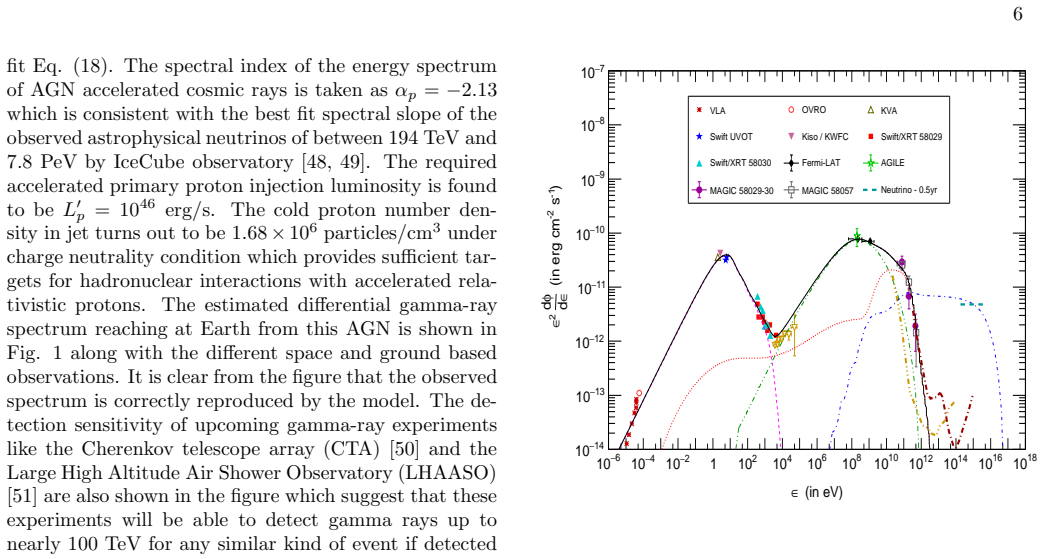
Within the proton blazar framework, the authors establish that charge neutrality of the jet fixes the number density of cold target protons to $n_H = 1.68\times10^6$ cm$^{-3}$ once the relativistic electron population (with acceleration efficiency $\chi_e\approx 10^{-3}$) is known. Shock-accelerated protons with a $\gamma_p^{-2.13}$ spectrum and maximum energy $E'_{p,\max}=10$ PeV interacting with these targets reproduce the Fermi-LAT and MAGIC gamma-ray spectrum, and the same interaction, with no additional free parameters, produces a muon-neutrino flux corresponding to $N_{\nu_\mu}\approx 1.0$ event in 0.5 yr, consistent with IceCube-170922A. The total jet power is $L_{\rm jet}\approx 1.3\times10^{49}$ erg/s, mildly above the Eddington luminosity for a $\sim10^{10}\,M_\odot$ black hole, which the authors argue is acceptable for an outburst.
Load-bearing premise
The result depends on assuming the electron acceleration efficiency is $\chi_e\approx 10^{-3}$; if electrons are accelerated more efficiently, or if the jet is pair dominated, the cold proton target density drops sharply and matching the gamma-ray flux would require an implausibly high proton power.
Editorial extensions
If this is right
- The same pp interaction that reproduces the gamma-ray spectrum yields the observed IceCube-170922A event rate without adding free parameters, so the two signals are tied one-to-one in this model.
- No external photon fields or dense clouds near the black hole are needed; the jet's own charge-neutrality cold protons provide the target, which fits the lack of broad-line emission in BL Lacs.
- The required maximum proton energy is about 10 PeV in the jet frame (one order below the cosmic-ray ankle, ~2e17 eV in the observer frame), so the source is a plausible but not extreme cosmic-ray accelerator.
- Upcoming Cherenkov Telescope Array and LHAASO observations of similar flares should detect gamma rays up to ~100 TeV, providing a direct test of the pp + cascade spectrum.
- The same hadronic mechanism can explain the quiescent gamma-ray state with a softer proton spectrum and lower maximum energy, producing a smaller but nonzero neutrino rate.
Reading between the lines
- A direct test: for a given gamma-ray flare amplitude, the model predicts the neutrino rate; stacking many BL Lac flares in IceCube and Fermi-LAT data would measure whether the pp target density inferred from charge neutrality is universal or source-specific.
- The same charge-neutrality argument could be applied to other broad-line-free BL Lacs, predicting their neutrino rates from their measured SEDs without invoking external photon fields or clouds.
- If future observations show a neutrino flare with no accompanying gamma-ray flare (as seen for TXS 0506+056 in 2014–2015), the pp picture would require the target density to persist while the accelerated proton luminosity varies independently of the electron component.
Signed reviews
Editorial analysis
A structured set of objections, weighed in public.
Referee Report
Summary. The paper proposes a proton blazar model for the blazar TXS 0506+056, in which cold, non-relativistic protons present in the jet to satisfy charge neutrality provide the target matter for pp interactions with shock-accelerated protons. The model uses a one-zone blob with a broken power-law electron distribution for synchrotron and inverse-Compton emission, and a power-law proton distribution whose pp interactions produce gamma rays (via neutral-pion decay and cascades) and neutrinos. With parameters listed in Table I, the authors reproduce the multi-wavelength SED from radio to VHE gamma rays and compute an expected IceCube muon-neutrino event count of about 1.0 in 0.5 yr, consistent with the observed IceCube-170922A event. The paper also discusses the jet power budget and contrasts the scenario with cloud-in-jet or pγ models.
Significance. If the central claim holds, this is a useful consistency check showing that a standard electron-proton jet with charge neutrality can simultaneously account for the observed SED and the IceCube-170922A neutrino without invoking an external target cloud. The neutrino event rate is computed from the same parameters used for the gamma-ray fit (no additional parameter is tuned to the neutrino), which is a strength. The radiative calculations are standard and the numerical results are presented in a reproducible way. However, the model's significance is limited by the large number of free parameters in Table I and by the sensitivity of the pp target density to the assumed electron acceleration efficiency, as detailed below. The paper does not provide uncertainties or a robustness scan, so the consistency is indicative rather than demonstrative.
major comments (2)
- [§II (after Eq. 2) and §III (n_H derivation)]
- [§III (jet power discussion)]
minor comments (5)
- [§III and Table I (spectral index sign)]
- [Fig. 1 caption]
- [References [29] and [41]]
- [§III (goodness of fit)]
- [§IV (quiescent state)]
Circularity Check
No significant circularity: the neutrino flux is a consistency check tied to the same pp normalization as the gamma-ray fit, and the self-citations are not load-bearing.
full rationale
The paper does not fit any parameter to the IceCube neutrino event; L'_p and the cold-proton density n_H are adjusted to reproduce the EM SED, and the neutrino flux is then evaluated from the same pp emissivity via Eq. (19). This is a multimessenger consistency check rather than an independent prediction, and the paper is transparent about it ('no additional adjustable parameters were available', Section III). There is no self-definitional reduction: n_H follows from charge neutrality and the assumed electron acceleration efficiency chi_e, not from the neutrino data; the gamma-ray 'reproduction' is a fit, while the abstract claims the model 'can describe consistently' rather than independently predict. The self-citations (refs. [36] and [38]) accompany standard references such as Kelner et al. (2006) and Sahakyan (2018) and are used for the emissivity formula and a plausibility statement, so they are not load-bearing. No uniqueness theorem is imported, and no known result is merely renamed. The robustness concern about chi_e is a parameter-sensitivity issue, not circularity.
Assumptions & free parameters
free parameters (14)
- Doppler factor δ =
20
- Bulk Lorentz factor Γ_j =
10.4
- Viewing angle θ =
10 deg (assumed)
- Blob radius R'_b =
2.2e16 cm
- Magnetic field B' =
0.38 G
- Electron spectral index below break α1 =
1.71
- Electron spectral index above break α2 =
4.3
- Break Lorentz factor γ'_b =
8.5e3
- Maximum electron Lorentz factor γ'_e,max =
1.5e5
- Electron kinetic power L'_e =
2.3e42 erg/s
- Proton spectral index α_p =
-2.13
- Maximum proton energy E'_p,max =
1e16 eV
- Proton kinetic power L'_p =
1e46 erg/s
- Electron acceleration efficiency χ_e =
1e-3
assumptions (6)
- domain assumption The jet is a normal electron-proton plasma rather than a pair plasma.
- domain assumption Charge neutrality holds in the jet, so cold proton density equals total electron density minus hot protons.
- domain assumption Electron acceleration efficiency χ_e ≈ 10^-3.
- domain assumption The same one-zone blob produces the synchrotron, IC, pp gamma-ray and neutrino emission.
- standard math Kelner et al. (2006) pp interaction spectra are accurate at the relevant energies.
- standard math The FRC model for EBL absorption is correct.
Cite this review
Pith. "Pith review of Describing correlated observations of neutrino and gamma ray flares from the blazar TXS 0506+056 with proton blazar model." pith.science (2026). https://pith.science/paper/RCF4AD4K
@misc{pith2026190811849,
  author       = {Pith},
  title        = {Pith review of: Describing correlated observations of neutrino and gamma ray flares from the blazar TXS 0506+056 with proton blazar model},
  year         = {2026},
  howpublished = {\url{https://pith.science/paper/RCF4AD4K}},
  note         = {Machine review of arXiv:1908.11849}
}
read the original abstract
Recent detection of the neutrino event, IceCube-170922A by IceCube observatory from the Blazar TXS 0506+056 in the state of enhanced gamma ray emission indicates for acceleration of cosmic rays in the blazar jet. The non-detection of the broadline emission in the optical spectrum of TXS 0506+056 and other BL Lac objects suggests that external photons emissions are weak and hence photo-meson (p-gamma) interaction may not be a favored mechanism for high energy neutrino production. The lack of broadline signatures also creates doubt about the presence of a high density cloud in the vicinity of the super-massive black hole (SMBH) of TXS 0506+056 and consequently raised question on hadronuclear (pp) interaction interpretation like relativistic jet meets with high density cloud. Here we demonstrate that non-relativistic protons in the proton blazar model, those come into existence under charge neutrality condition of the blazar jet, offer sufficient target matter for pp-interaction with shock accelerated protons and consequently the model can describe consistently the observed high energy gamma rays and neutrino signal from the blazar TXS 0506+056.
Figures
Reference graph
Works this paper leans on
-
[1]
The IceCube Collaboration et al., Science 361, eaat1378 (2018)
2018
-
[2]
3 × 1042 nH (in cm −3) 1. 68 × 106 α p − 2. 13 E′ p,max (in eV) 1016 L′ p (in erg/s) 1046 Lk jet (in erg/s) 1048 Nν µ 1.007 The VHE gamma-ray flux from the blazar is found to be variable i.e, increasing by a factor of up to ∼ 6 within one day from low state (quiescent state) to the flaring state. The flux variability found mainly in high energy component but...
work page 2014
-
[3]
Ansoldi et al., Astrophys
S. Ansoldi et al., Astrophys. J. 863, L10 (2018)
2018
-
[4]
IceCube Collaboration et al., Science 361, 147 (2018), arXiv:1807.08794
arXiv 2018
-
[5]
Keivani et al., Astrophys.J
A. Keivani et al., Astrophys.J. 864, 84 (2018)
2018
-
[6]
Y. T. Tanaka, S. Buson, D. Kocevski, The Astronomer’s Telegram 10791 (2017)
work page 2017
-
[7]
S. Gao, A. Fedynitch, W. Winter, and M. Pohl, Nature Astronomy 3,88 (2019), arXiv:1807.04275
arXiv 2019
- [8]
Show all 63 references
-
[9]
Liu et al., ArXiv e-prints (2018), arXiv:1807.05113
R. Liu et al., ArXiv e-prints (2018), arXiv:1807.05113
2018 arXiv
-
[10]
Cerruti, A
M. Cerruti, A. Zech, C. Boisson, G. Emery, S. Inoue and J.-P. Lenain, Mon. Not. R. Astron. Soc. 483, L12 (2019)
2019
-
[11]
Aharonian, New Astronomy 5, 377 (2000)
F.A. Aharonian, New Astronomy 5, 377 (2000)
2000
-
[12]
Sahakyan, Astrophys
N. Sahakyan, Astrophys. J., 866, 109 (2018)
2018
-
[13]
A. Dar & A. Laor, Astrophys. J., 478, L5 (1997)
1997
-
[14]
Morrison, D
P. Morrison, D. Roberts & A. Sadun, ApJ, 280, 483 (1984)
1984
-
[15]
Kino & F
M. Kino & F. Takahara, Mon. Not. R. Astron. Soc. 349, 336 (2004)
2004
-
[16]
Hirotani, Astrophys
K. Hirotani, Astrophys. J. 619, 73 (2005)
2005
-
[17]
Rawlings, and R.Saunders, Nature, 349, 138 (1991)
S. Rawlings, and R.Saunders, Nature, 349, 138 (1991)
1991
-
[18]
Celotti and A.C
A. Celotti and A.C. Fabian, Mon. Not. R. Astron. Soc. 264, 228 (1993)
1993
-
[19]
Protheroe and A
R.J. Protheroe and A. Mucke, ASP Conference Series, vol. 250, (2001)
2001
-
[20]
Ghisellini et al., Mon
G. Ghisellini et al., Mon. Not. R. Astron. Soc. 402, 497 (2010)
2010
-
[21]
F. A. Aharonian, M. V. Barkov and D. Khangulyan, As- trophys. J. 841, 61, (2017)
2017
-
[22]
M¨ucke and R.J
A. M¨ucke and R.J. Protheroe, Astroparticle Physics 15, 121 (2001)
2001
-
[23]
Katarzy´ nski, H.Sol, and A
K. Katarzy´ nski, H.Sol, and A. Kus, A&A 367, 809 (2001)
2001
-
[24]
Petropoulou and A
M. Petropoulou and A. Mastichiadis, Mon. Not. R. As- tron. Soc. 447, 36 (2015)
2015
-
[25]
A. M. Bykov & P. M´ esz´ aros, Astrophys. J. 461, L37 (1996)
1996
-
[26]
B¨ottcher, A
M. B¨ottcher, A. Reimer, K. Sweeney, and A. Prakash, Astrophys. J. 768, 54 (2013)
2013
-
[27]
Vazza, D
F. Vazza, D. Eckert, M. Br¨ uggen and B. Huber, Mon. Not. R. Astron. Soc. 451, 2198 (2015)
2015
-
[28]
J., 627, 861, (2005)
David Eichler & Eli Waxman, Astrophys. J., 627, 861, (2005)
2005
-
[29]
Inoue & F
S. Inoue & F. Takahara, Astrophys. J., 463, 555 (1996)
1996
-
[30]
G. R. Blumenthal & R. J. Gould, Rev. Mod. Phys., 42, 237 (1970)
1970
-
[31]
C. D. Dermer and R. Schlickeiser, Astrophys. J., 575, 66 7 (2002)
2002
-
[32]
F. C. Jones, Phys. Rev., 167, 1159 (1968)
1968
-
[33]
M. A. Malkov and L. O. Drury, Rep. Prog. Phys. 64, 429 (2001)
2001
-
[34]
A. M. Atoyan, C. D. Dermer, Astrophys. J. 586, 79 (2003)
2003
-
[35]
L. A. Anchordoqui, J. F. Beacom, H. Goldberg, S. Palomares-Ruiz, and T. J. Weiler, Phys. Rev. D 75, 063001 (2007)
2007
-
[36]
Cerruti, A
M. Cerruti, A. Zech, C. Boisson and S. Inoue, Mon. Not. R. Astron. Soc. 448, 910 (2015)
2015
-
[37]
S. R. Kelner, F. A. Aharonian, and V. V. Bugayov, Phys. Rev. D 74, 034018 (2006)
2006
-
[38]
Banik, B
P. Banik, B. Bijay, S. K. Sarkar, and A. Bhadra, Phys. Rev. D 95, 063014 (2017a)
2017
-
[39]
F. A. Aharonian, D. Khangulyan & L. Costamante, Mon. Not. R. Astron. Soc. 387, 1206 (2008)
2008
-
[40]
Prabir Banik and Arunava Bhadra, Phys. Rev. D 95, 123014 (2017b)
2017
-
[41]
Inoue, F
S. Inoue, F. Takahara, Astrophys. J. 463, 555 (1996)
1996
-
[42]
F. A. Aharonian, A. M. Atoian& A. M. Nagapetian, As- trofizika 19, 323 (1983)
1983
-
[43]
http://www.astro.unipd.it/background/
-
[44]
Franceschini, G
A. Franceschini, G. Rodighiero, and M. Vaccari, Astron . Astrophys. 487, 837 (2008)
2008
-
[45]
M. G. Aartsen, M. Ackermann, J. Adams et al., Astro- phys. J. 796, 109 (2014)
2014
-
[46]
Ackermann et al., Astrophys
M. Ackermann et al., Astrophys. J. 810, 14 (2015)
2015
-
[47]
Paiano, R
S. Paiano, R. Falomo, A. Treves & R. Scarpa, ApJL 854, L32 (2018)
2018
-
[48]
Mirzoyan, Astronomers Telegram, 10817, 1 (2017)
R. Mirzoyan, Astronomers Telegram, 10817, 1 (2017)
2017
-
[49]
M. G. Aartsen, Astrophysical J., 833, 3 (2016)
2016
-
[50]
Halzen, Nature Physics, 13, 232 (2017)
F. Halzen, Nature Physics, 13, 232 (2017)
2017
-
[51]
High energy neutrinos are produced together with gamma rays in pp interactions
are also shown in the figure which suggest that these experiments will be able to detect gamma rays up to nearly 100 TeV for any similar kind of event if detected in future and thereby will be able to provide a better understanding of the emission processes. High energy neutrin...
-
[52]
Ong, PoS, ICRC2017 1071 (2017)
R.A. Ong, PoS, ICRC2017 1071 (2017)
2017
-
[53]
Liu, for the LHAASO Collaboration, PoS, ICRC2017 424 (2017)
C. Liu, for the LHAASO Collaboration, PoS, ICRC2017 424 (2017)
2017
-
[54]
Ghisellini, L
G. Ghisellini, L. Foschini, M. Volonteri, G. Ghirlanda , F. Haardt, D. Burlon4 and F. Tavecchio, Mon. Not. R. Astron. Soc.399,L24 (2009)
2009
-
[55]
Sadowski & R
A. Sadowski & R. Narayan, Mon. Not. R. Astron. Soc. 453, 3213 (2015)
2015
-
[56]
Padovani, P
P. Padovani, P. Giommi, E. Resconi, T. Glauch, B. Ar- sioli, N. Sahakyan, and M. Huber, Mon. Not. R. Astron. Soc. 480, 192 (2018)
2018
-
[57]
Albert et al., Mon
A. Albert et al., Mon. Not. R. Astron. Soc. 482, 184 (2019)
2019
-
[58]
Maraschi, G
L. Maraschi, G. Ghisellini, A. Celotti, Astrophys. J., 397, L5 (1992)
1992
-
[59]
S. D. Bloom, A. P. Marscher, Astrophys. J., 461, 657 (1996)
1996
-
[60]
Mastichiadis, J
A. Mastichiadis, J. G. Kirk, A&A, 320, 19 (1997)
1997
-
[61]
C. D. Dermer, R. Schlickeiser, A. Mastichiadis, A&A, 256, L27 (1992)
1992
-
[62]
C. D. Dermer, R. Schlickeiser, Astrophys. J., 416, 458 9 (1993)
1993
-
[63]
M. V. Barkov, V. Bosch-Ramon and F. A. Aharonian, Astrophys. J. 755, 170 (2012)
2012
Reviewed August 14, 2026 · model on record in the stance chip above.
Discussion (0). Continue with ORCID to comment.