REVIEW 3 major objections 6 minor 49 references
MOD: Minimally Ordered Durable Datastructures for Persistent Memory
T0 review · 3 major / 6 minor · reviewed 2026-08-14 · deepseek-v4-flash
Pith's one-line read The paper proposes MOD datastructures that make failure-atomic persistent-memory updates cost one ordering point per operation, outperforming general-purpose transactions on real hardware.
desk verdict MOD gives the persistent-memory community a genuinely useful middle ground between hand-crafted datastructures and PM-STM, measured on real Optane hardware, but the failure-atomicity story has a load-bearing gap around the allocator's own crash consistency. read the letter →
The pith
A machine-rendered reading of the paper's core claim, the machinery that carries it, and where it could break.
The reading
What carries the argument
Functional Shadowing: each update writes a new version entirely out of place, flushing dirty cachelines with unordered cacheline-flush instructions and no fences; a single ordering point then makes the shadow durable before an 8-byte atomic pointer write swaps in the new root. Structural sharing, borrowed from purely functional datastructures, keeps the shadow small by reusing untouched sub-trees. The Commit step comes in three forms—single, siblings, and unrelated—so the common cases keep exactly one ordering point per failure-atomic section.
What would settle it
A fault-injection campaign that crashes a MOD workload at every instruction boundary during an update and then runs recovery, marking every reachable node, would settle the central claim: if recovery frees any reachable node or retains any unreachable block, failure-atomicity fails.
Extended reading notes
Core claim
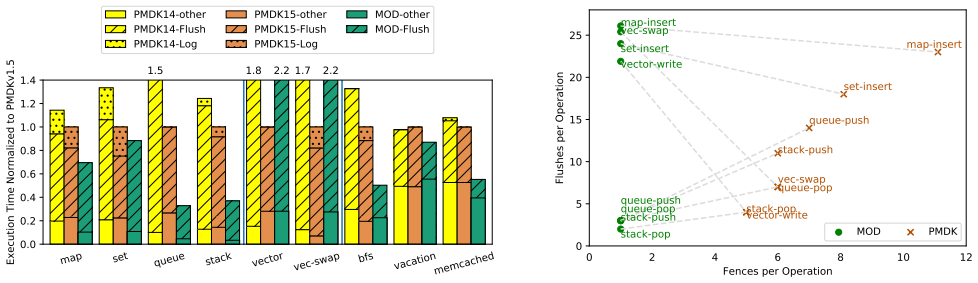
The central claim is that the dominant cost of failure-atomic updates to persistent memory is ordering, not write volume, and that this cost can be reduced to a single fence per operation. MOD datastructures implement every update as an out-of-place write: a new "shadow" version of the datastructure is built from freshly allocated nodes, reusing untouched sub-trees of the old version through structural sharing. Because the shadow shares no persistent pointers with the old version, its dirty cachelines can be flushed in any order with no logging, and one ordering point before an atomic 8-byte pointer swap makes the new version durable and atomically replaces the old. The paper shows on real persistent-memory hardware that this design improves map, set, stack, and queue microbenchmarks by 40 percent and application benchmarks by 38 percent relative to the state-of-the-art transactional baseline, while vector workloads are slower. It also presents a recipe for turning existing purely functional datastructures into MOD datastructures and a composition interface that commits multi-structure updates with one ordering point in the common cases.
Load-bearing premise
Failure-atomicity holds only if the persistent allocator's internal bookkeeping survives crashes consistently and its recovery pass frees exactly the unreachable blocks — an assumption the paper borrows from an off-the-shelf allocator without analyzing its crash behavior.
Editorial extensions
If this is right
- Failure recovery no longer needs log replay: after a crash the latest committed root pointer still identifies a consistent durable version, and uncommitted shadows are garbage.
- Pointer-based containers gain roughly 40 percent over the transactional baseline on current hardware, and whole applications gain about 36-38 percent.
- A single ordering point per operation suffices for one datastructure or for multiple datastructures under a common parent; only unrelated datastructures need a short transaction.
- Any existing purely functional datastructure can be converted into a recoverable MOD datastructure by allocating its state in persistent memory and flushing modified cachelines without ordering.
- The benefit does not extend to array-like containers: MOD's vector is slower because the tree-based functional layout sacrifices dense memory.
Reading between the lines
- A fault-injection crash study, which the paper does not report, is the natural next test: crash at different points inside allocation and commit and check that no reachable node is reclaimed and no unreachable block survives.
- MOD's advantage should widen on hardware with higher flush latency and narrow if future hardware makes ordering points cheap; the paper's Amdahl-style latency model suggests the scaling curve.
- Trying the recipe on other functional collections, such as priority queues, tries, or ropes, would show how far the one-fence design generalizes, with the vector slowdown warning that dense layouts may not fit.
- The volatile reference-count reset assumes single-parent sharing in the surviving version; datastructures that share a subtree among multiple parents in one version would need a different reclamation rule.
Signed reviews
Editorial analysis
A structured set of objections, weighed in public.
Referee Report
Summary. The paper proposes Minimally Ordered Durable (MOD) datastructures, a C++ library of persistent datastructures (map, set, stack, queue, vector) that use functional shadowing with structural sharing to provide failure-atomic updates while minimizing ordering points. The design has a Basic interface for single updates and a Composition interface for multi-update FASEs, with one sfence per FASE in the common case. The authors evaluate on real Intel Optane hardware against PMDK v1.5, reporting average speedups of 43% for pointer-based microbenchmarks and 36% for application benchmarks, while honestly disclosing vector slowdowns. The paper also contributes a recipe for porting existing functional datastructures, a recovery scheme based on reference counting and a recovery garbage collector, an automated testing framework, and an analytical model for flush latency.
Significance. If the design is correct, MOD offers a practical middle ground between hand-crafted persistent datastructures and general-purpose PM-STM, and the real-hardware evaluation demonstrates that reducing ordering constraints is a effective strategy. The paper also provides a credible recipe for constructing additional recoverable datastructures and releases an implementation, both of which are useful to the community. However, the central failure-atomicity claim depends on an unverified assumption about the crash consistency of the underlying allocator, and the correctness argument contains an ambiguity about where reference counts are stored. These issues must be resolved before the headline claims can be accepted.
major comments (3)
- [4.2, 5.3] The failure-atomicity claim of the abstract and Section 1 depends on the persistent heap remaining recoverable after a crash, but the paper uses the off-the-shelf nvm_malloc allocator without analyzing its crash behavior. Section 5.3 states that recovery garbage collection can reclaim 'any unmarked data remaining in the persistent heap,' but this is only sound if nvm_malloc's block headers, free lists, and allocation state are themselves crash-consistent. A crash during a malloc/free can leave metadata inconsistent, making the heap untraversable and invalidating the mark-sweep recovery. Please add a fault-injection test of the allocator, a crash-consistency argument, or a modification of the allocator to make its metadata failure-atomic; as written, the central guarantee is unverified.
- [5.2, 5.3, 5.4] There is an internal inconsistency in the correctness argument. Section 5.2 and Section 5.4 require that all PM writes outside Commit be restricted to newly allocated data, but Section 5.3 describes reference counting in which 'we increment reference counts of nodes that are reused on an update operation.' If these reference counts are stored in PM nodes, an update writes to pre-existing persistent data, violating the invariant. If reference counts are kept in volatile memory, the paper should state this explicitly and explain how recovery reconstructs them; if they are in PM but are exempt from flushing and reset on crash, the invariant in Section 5.4 needs to be amended to exclude refcount fields. Please clarify and make the testing framework consistent with the storage location of reference counts.
- [5.4, 6] The paper's verification of failure atomicity is limited to trace-based invariant checking on successful runs; there is no crash-injection test that powers off the machine mid-FASE and checks that recovery restores a consistent version. Since the central claim concerns behavior on crashes, please add such a test (at least a kill -9 or power-loss simulation) for all datastructures and for the allocator, and report the recovery outcomes.
minor comments (6)
- [Abstract, Section 1] The abstract reports 40%/38% microbenchmark/application speedups, while Section 1 reports 43%/36%; please reconcile these numbers and the 'hurts vector by 122%' phrasing with Figure 9.
- [Table 3] Table 3 reports that MOD vector consumes 131x memory at 2M elements versus 1M, which is surprising for a structural-sharing implementation; please explain or correct this value.
- [Section 3] The analytical model in Section 3 (listed as a contribution) is an Amdahl's law curve fit with a fitted parallel fraction f=0.82 rather than a mechanistic model; the text already acknowledges the hardware is a black box, so consider describing this as a descriptive fit, not an analytical model.
- [Section 6.1] Section 6.1 should report the number of runs and variance for the timing experiments; without repeated runs it is unclear whether the 43%/36% differences are within noise.
- [References] Reference [45] contains typos ('Stroage' should be 'Storage') and the venue is 'FAST' rather than 'FASE'.
- [Section 1] The introduction says the implementation is released, but no repository URL is provided; please include one.
Circularity Check
No significant circularity: MOD's performance claims are direct measurements and the only named analytical model is explicitly a fit, not an independent prediction.
full rationale
The central claims (one ordering point, failure-atomic updates, 40%/38% speedups) are supported by design arguments and by direct empirical comparison with PMDK v1.5 on Optane hardware, not by a derivation from the paper's own outputs. The Functional Shadowing technique is adapted from shadow paging and functional datastructures with cited external foundations, and the correctness argument in Section 5.2 is a structural invariant rather than a self-referential assumption. The one candidate for circularity, the Section 3 'Analytical Model of Flush Latencies', is explicitly labeled 'an Amdahl's law fit using the Karp-Flatt metric' with f=0.82 and an 18% serial component; the paper does not use that fitted curve to predict any benchmark result or to justify the MOD performance numbers, which are measured. The recovery/garbage-collection discussion assumes crash-consistent allocator metadata from nvm_malloc without analysis, but that is a correctness risk, not a case of a derivation reducing to its own inputs. Self-citations such as WHISPER [34] appear only as workload/background sources and are not load-bearing for the MOD design or its measured speedups. Overall, no circular step is present.
Assumptions & free parameters
free parameters (1)
- Amdahl parallel fraction f =
0.82
assumptions (4)
- domain assumption clwb and sfence semantics on x86 match the order model described: clwb commits instantly and flushes in the background, sfence waits for in-flight flushes, and 8-byte aligned stores are atomic.
- domain assumption A crash can leave allocator state and persistent heaps in a state where post-crash mark-sweep garbage collection from datastructure roots is sound and complete.
- domain assumption In a single surviving version of a MOD datastructure, every reachable internal node has exactly one parent, so resetting all reference counts to 1 during recovery is correct.
- domain assumption The measured behavior of engineering-sample Optane DCPMM (flush concurrency curve) is representative of production persistent memory.
Cite this review
Pith. "Pith review of MOD: Minimally Ordered Durable Datastructures for Persistent Memory." pith.science (2026). https://pith.science/paper/GMTJX653
@misc{pith2026190811850,
  author       = {Pith},
  title        = {Pith review of: MOD: Minimally Ordered Durable Datastructures for Persistent Memory},
  year         = {2026},
  howpublished = {\url{https://pith.science/paper/GMTJX653}},
  note         = {Machine review of arXiv:1908.11850}
}
read the original abstract
Persistent Memory (PM) makes possible recoverable applications that can preserve application progress across system reboots and power failures. Actual recoverability requires careful ordering of cacheline flushes, currently done in two extreme ways. On one hand, expert programmers have reasoned deeply about consistency and durability to create applications centered on a single custom-crafted durable datastructure. On the other hand, less-expert programmers have used software transaction memory (STM) to make atomic one or more updates, albeit at a significant performance cost due largely to ordered log updates. In this work, we propose the middle ground of composable persistent datastructures called Minimally Ordered Durable (MOD) datastructures. MOD is a C++ library of several datastructures---currently, map, set, stack, queue and vector--- that often perform better than STM and yet are relatively easy to use. They allow multiple updates to one or more datastructures to be atomic with respect to failure. Moreover, we provide a recipe to create more recoverable datastructures. MOD is motivated by our analysis of real Intel Optane PM hardware showing that allowing unordered, overlapping flushes significantly improves performance. MOD reduces ordering by adapting existing techniques for out-of-place updates (like shadow paging) with space-reducing structural sharing (from functional programming). MOD exposes a Basic interface for single updates and a Composition interface for atomically performing multiple updates. Relative to the state-of-the-art Intel PMDK v1.5 STM, MOD improves map, set, stack, queue microbenchmark performance by 40%, and speeds up application benchmark performance by 38%.
Figures


Figures from the paper (7 more)



Reference graph
Works this paper leans on
-
[1]
Gene M. Amdahl. Validity of the single processor approach to achiev- ing large scale computing capabilities. In Proceedings of the April 18-20, 1967, Spring Joint Computer Conference (AFIPS), 1967
work page 1967
-
[2]
nvm malloc: Memory allocation for nvram
Tim Berning. nvm malloc: Memory allocation for nvram. https: //github.com/hyrise/nvm_malloc, 2017
work page 2017
-
[3]
The parsec benchmark suite: Characterization and architectural im- plications
Christian Bienia, Sanjeev Kumar, Jaswinder Pal Singh, and Kai Li. The parsec benchmark suite: Characterization and architectural im- plications. In Proceedings of the 17th International Conference on Parallel Architectures and Compilation Techniques (PACT), 2008
work page 2008
-
[4]
Caulfield, Joel Coburn, Todor Mollov, Arup De, Ameen Akel, Jiahua He, Arun Jagatheesan, Rajesh K
Adrian M. Caulfield, Joel Coburn, Todor Mollov, Arup De, Ameen Akel, Jiahua He, Arun Jagatheesan, Rajesh K. Gupta, Allan Snavely, and Steven Swanson. Understanding the impact of emerging non- volatile memories on high-performance, io-intensive computing. In Proceedings of the 2010 ACM/IEEE International Conference for High Performance Computing, Networking...
work page 2010
-
[5]
Dhruva R. Chakrabarti, Hans-J. Boehm, and Kumud Bhandari. Atlas: Leveraging locks for non-volatile memory consistency. In Proceed- ings of the 2014 ACM International Conference on Object Oriented Programming Systems Languages & Applications (OOPSLA), 2014
work page 2014
-
[6]
Persistent b+-trees in non-volatile main memory
Shimin Chen and Qin Jin. Persistent b+-trees in non-volatile main memory. Proceedings of the VLDB Endowment, 8, February 2015
work page 2015
-
[7]
Joel Coburn, Adrian M. Caulfield, Ameen Akel, Laura M. Grupp, Ra- jesh K. Gupta, Ranjit Jhala, and Steven Swanson. NV-Heaps: Making Persistent Objects Fast and Safe with Next-generation, Non-volatile Memories. In Proceedings of the 16th International Conference on Architectural Support for Programming Languages and Operating Systems, 2011
work page 2011
-
[8]
Nightingale, Christopher Frost, Engin Ipek, Benjamin Lee, Doug Burger, and Derrick Coetzee
Jeremy Condit, Edmund B. Nightingale, Christopher Frost, Engin Ipek, Benjamin Lee, Doug Burger, and Derrick Coetzee. Better i/o through byte-addressable, persistent memory. In Proceedings of the ACM SIGOPS 22Nd Symposium on Operating Systems Principles (SOSP), 2009
work page 2009
Show all 49 references
-
[9]
Two more approaches to persistent-memory writes
Jonathan Corbet. Two more approaches to persistent-memory writes. https://lwn.net/Articles/731706/, 2017
2017
-
[10]
Romulus: Effi- cient algorithms for persistent transactional memory
Andreia Correia, Pascal Felber, and Pedro Ramalhete. Romulus: Effi- cient algorithms for persistent transactional memory. In Proceedings of the 30th on Symposium on Parallelism in Algorithms and Architectures (SPAA), 2018
2018
-
[11]
Containers library
cppreference. Containers library. https://en.cppreference.com/ w/cpp/container, 2018
2018
-
[12]
The university of florida sparse matrix collection
Tim Davis. The university of florida sparse matrix collection. http: //www.cise.ufl.edu/research/sparse/matrices
-
[13]
Driscoll, Neil Sarnak, Daniel D
James R. Driscoll, Neil Sarnak, Daniel D. Sleator, and Robert E. Tarjan. Making data structures persistent. Journal of Computer and System Sciences, 38, 1989
1989
-
[14]
E. R. Giles, K. Doshi, and P. Varman. Softwrap: A lightweight frame- work for transactional support of storage class memory. In 2015 31st Symposium on Mass Storage Systems and Technologies (MSST), 2015
2015
-
[15]
The recovery manager of the system r database manager
Jim Gray, Paul McJones, Mike Blasgen, Bruce Lindsay, Raymond Lorie, Tom Price, Franco Putzolu, and Irving Traiger. The recovery manager of the system r database manager. ACM Computing Surveys (CUSR), 13, June 1981
1981
-
[16]
Intel optane dc persistent memory operating modes explained
Alper Ilkbahar. Intel optane dc persistent memory operating modes explained. https://itpeernetwork.intel.com/intel-optane- dc-persistent-memory-operating-modes/ , 2018
2018
-
[17]
New release of pmdk
Intel. New release of pmdk. https://pmem.io/2018/10/22/ release-1-5.html
2018
-
[18]
Persistent memory development kit
Intel. Persistent memory development kit. http://pmem.io/pmdk
-
[19]
Pmdk issues: introduce hybrid transactions
Intel. Pmdk issues: introduce hybrid transactions. https://github. com/pmem/pmdk/pull/2716
-
[20]
Intel optane dc persistent memory readies for widespread deploy- ment
Intel. Intel optane dc persistent memory readies for widespread deploy- ment. https://newsroom.intel.com/news/intel-optane-dc- persistent-memory-readies-widespread-deployment , 2018
2018
-
[21]
Intel optane dc persistent memory
Intel. Intel optane dc persistent memory. https: //www.intel.com/content/www/us/en/architecture- and-technology/optane-dc-persistent-memory.html , 2019
2019
-
[22]
Failure-atomic persistent memory updates via justdo logging
Joseph Izraelevitz, Terence Kelly, and Aasheesh Kolli. Failure-atomic persistent memory updates via justdo logging. In Proceedings of the Twenty-First International Conference on Architectural Support for Programming Languages and Operating Systems (ASPLOS), 2016
2016
-
[23]
Dulloor, Jishen Zhao, and Steven Swanson
Joseph Izraelevitz, Jian Yang, Lu Zhang, Juno Kim, Xiao Liu, Amir- saman Memaripour, Yun Joon Soh, Zixuan Wang, Yi Xu, Subra- manya R. Dulloor, Jishen Zhao, and Steven Swanson. Basic per- formance measurements of the intel optane DC persistent memory module. arXiv preprint, 2019
2019
-
[24]
Ef- ficient persist barriers for multicores
Arpit Joshi, Vijay Nagarajan, Marcelo Cintra, and Stratis Viglas. Ef- ficient persist barriers for multicores. In Proceedings of the 48th International Symposium on Microarchitecture (MICRO), 2015
2015
-
[25]
Karp and Horace P
Alan H. Karp and Horace P. Flatt. Measuring parallel processor perfor- mance. Communications of the ACM (CACM), 33, May 1990
1990
-
[26]
Chen, Satish Narayanasamy, and Thomas F
Aasheesh Kolli, Vaibhav Gogte, Ali Saidi, Stephan Diestelhorst, Pe- ter M. Chen, Satish Narayanasamy, and Thomas F. Wenisch. Language- level persistency. In Proceedings of the 44th Annual International Symposium on Computer Architecture (ISCA), 2017
2017
-
[27]
Chen, and Thomas F
Aasheesh Kolli, Steven Pelley, Ali Saidi, Peter M. Chen, and Thomas F. Wenisch. High-performance transactions for persistent memories. In Proceedings of the Twenty-First International Conference on Archi- tectural Support for Programming Languages and Operating Systems (ASPLOS), 2016
2016
-
[28]
Chen, and Thomas F
Aasheesh Kolli, Jeff Rosen, Stephan Diestelhorst, Ali Saidi, Steven Pelley, Sihang Liu, Peter M. Chen, and Thomas F. Wenisch. Dele- gated persist ordering. In The 49th Annual IEEE/ACM International Symposium on Microarchitecture (MICRO), 2016
2016
-
[29]
Vetter, Gabriel Marin, Collin McCurdy, Cristian Cira, Zhuo Liu, and Weikuan Yu
Dong Li, Jeffrey S. Vetter, Gabriel Marin, Collin McCurdy, Cristian Cira, Zhuo Liu, and Weikuan Yu. Identifying opportunities for byte- addressable non-volatile memory in extreme-scale scientific applica- tions. In Proceedings of the 2012 IEEE 26th International Parallel and Di...
2012
-
[30]
Dudetm: Building durable transactions with decoupling for persistent memory
Mengxing Liu, Mingxing Zhang, Kang Chen, Xuehai Qian, Yongwei Wu, Weimin Zheng, and Jinglei Ren. Dudetm: Building durable transactions with decoupling for persistent memory. In Proceedings of the Twenty-Second International Conference on Architectural Support for Programming L...
2017
-
[31]
Q. Liu, J. Izraelevitz, S. K. Lee, M. L. Scott, S. H. Noh, and C. Jung. ido: Compiler-directed failure atomicity for nonvolatile memory. In 2018 51st Annual IEEE/ACM International Symposium on Microarchi- tecture (MICRO), 2018
2018
-
[32]
Pmtest: A fast and flexible testing framework for persistent memory programs
Sihang Liu, Yizhou Wei, Jishen Zhao, Aasheesh Kolli, and Samira Khan. Pmtest: A fast and flexible testing framework for persistent memory programs. In Proceedings of the Twenty-Fourth International Conference on Architectural Support for Programming Languages and Operating Syst...
2019
-
[33]
Raymond A. Lorie. Physical integrity in a large segmented database. ACM Transactions on Database Systems (TODS), 2, March 1977
1977
-
[34]
Nalli, S
S. Nalli, S. Haria, M. D. Hill, M. M. Swift, H. V olos, and K. Keeton. An analysis of persistent memory use with whisper. In Proceedings of the Twenty-Second International Conference on Architectural Support for Programming Languages and Operating Systems (ASPLOS), 2017
2017
-
[35]
Morrey III, Dhruva R
Faisal Nawab, Joseph Izraelevitz, Terence Kelly, Charles B. Morrey III, Dhruva R. Chakrabarti, and Michael L. Scott. Dalí: A Periodically Persistent Hash Map. In 31st International Symposium on Distributed Computing (DISC), 2017
2017
-
[36]
M. A. Ogleari, E. L. Miller, and J. Zhao. Steal but no force: Effi- cient hardware undo+redo logging for persistent memory systems. In 2018 IEEE International Symposium on High Performance Computer Architecture (HPCA), 2018
2018
-
[37]
Purely Functional Data Structures
Chris Okasaki. Purely Functional Data Structures . PhD thesis, Carnegie Mellon University, 1998
1998
-
[38]
Chen, and Thomas F
Steven Pelley, Peter M. Chen, and Thomas F. Wenisch. Memory persistency. In Proceeding of the 41st Annual International Symposium on Computer Architecuture (ISCA), 2014
2014
-
[39]
Persistence for the masses: Rrb-vectors in a systems language
Juan Pedro Bolívar Puente. Persistence for the masses: Rrb-vectors in a systems language. Proceedings of the ACM on Programming Languages, 1, September 2017
2017
-
[40]
Proteus: A flexible and fast software supported hardware log- ging approach for nvm
Seunghee Shin, Satish Kumar Tirukkovalluri, James Tuck, and Yan Solihin. Proteus: A flexible and fast software supported hardware log- ging approach for nvm. In Proceedings of the 50th Annual IEEE/ACM International Symposium on Microarchitecture (MICRO), 2017
2017
-
[41]
Hiding the long latency of persist barriers using speculative execution
Seunghee Shin, James Tuck, and Yan Solihin. Hiding the long latency of persist barriers using speculative execution. In Proceedings of the 44th Annual International Symposium on Computer Architecture (ISCA), 2017
2017
-
[42]
Efficient Immutable Collections
Michael Steindorfer. Efficient Immutable Collections . PhD thesis, University of Amsterdam, 2017. 12
2017
-
[43]
Steindorfer and Jurgen J
Michael J. Steindorfer and Jurgen J. Vinju. Optimizing hash-array mapped tries for fast and lean immutable jvm collections. In Pro- ceedings of the 2015 ACM SIGPLAN International Conference on Object-Oriented Programming, Systems, Languages, and Applications (OOPSLA), 2015
2015
-
[44]
Rrb vec- tor: A practical general purpose immutable sequence
Nicolas Stucki, Tiark Rompf, Vlad Ureche, and Phil Bagwell. Rrb vec- tor: A practical general purpose immutable sequence. In Proceedings of the 20th ACM SIGPLAN International Conference on Functional Programming (ICFP), 2015
2015
-
[45]
Campbell
Shivaram Venkataraman, Niraj Tolia, Parthasarathy Ranganathan, and Roy H. Campbell. Consistent and durable data structures for non- volatile byte-addressable memory. In Proceedings of the 9th USENIX Conference on File and Stroage Technologies (FASE), 2011
2011
-
[46]
Intel memory latency checker v3.6
Vish Viswanathan. Intel memory latency checker v3.6. https://software.intel.com/en-us/articles/intelr- memory-latency-checker , December 2018
2018
-
[47]
V olos, A
H. V olos, A. J. Tack, and M. M. Swift. Mnemosyne: Lightweight persistent memory. In Proceedings of the Sixteenth International Conference on Architectural Support for Programming Languages and Operating Systems (ASPLOS), 2011
2011
-
[48]
Dax: Page cache bypass for filesystems on memory storage
Matthew Wilcox. Dax: Page cache bypass for filesystems on memory storage. https://lwn.net/Articles/618064/, 2014
2014
-
[49]
Nv-tree: Reducing consistency cost for nvm-based single level systems
Jun Yang, Qingsong Wei, Cheng Chen, Chundong Wang, Khai Leong Yong, and Bingsheng He. Nv-tree: Reducing consistency cost for nvm-based single level systems. In Proceedings of the 13th USENIX Conference on File and Storage Technologies (FAST), 2015. 13
2015
Reviewed August 14, 2026 · model on record in the stance chip above.
Discussion (0). Continue with ORCID to comment.