REVIEW 4 major objections 5 minor 46 references
Physical modelling of galaxy clusters and Bayesian inference in astrophysics
T0 review · 4 major / 5 minor · reviewed 2026-08-14 · deepseek-v4-flash
Pith's one-line read The thesis claims that AMI interferometric Sunyaev-Zel'dovich mass estimates for 54 Planck-detected clusters are systematically lower than Planck's catalogue values, with the residual offset larger than simulation-based noise biases.
desk verdict A serious PhD thesis with genuinely new AMI mass estimates and a plausible new sampler; the central AMI-Planck offset is real but its interpretation is underdetermined because the simulations share the same pressure-profile model. read the letter →
The pith
A machine-rendered reading of the paper's core claim, the machinery that carries it, and where it could break.
The reading
What carries the argument
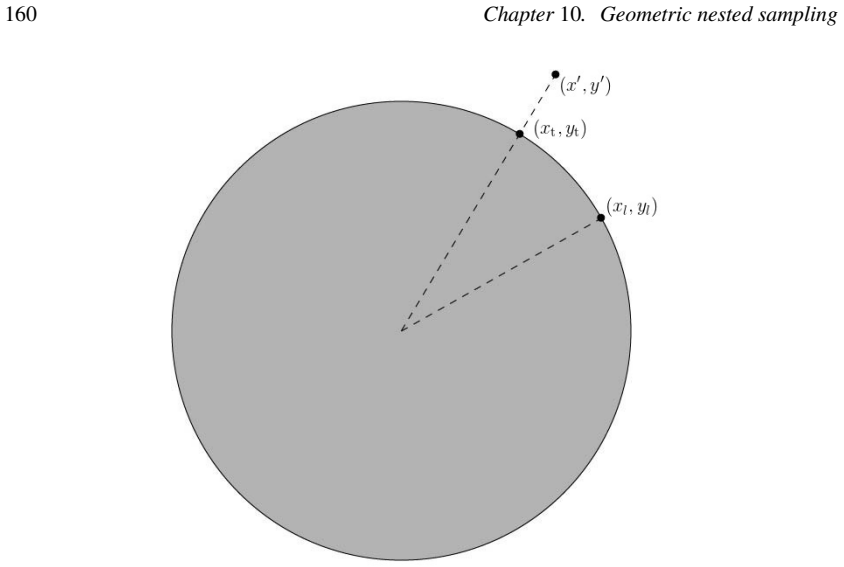
The load-bearing object is the physical cluster model: a spherically symmetric cluster in hydrostatic equilibrium, with dark matter following an NFW profile and gas pressure following a generalised-NFW profile whose slopes are fixed to universal values. Given inputs $M(r_{200})$, $f_{\mathrm{gas}}(r_{200})$, and redshift, the hydrostatic equilibrium equation $dP_g/dr = -\rho_g GM(r)/r^2$ together with the NFW mass integral determines the gas density and pressure normalisation, giving a predicted Comptonisation pattern that is Fourier-transformed into AMI visibilities. The same machinery, with an Einasto dark-matter profile replacing NFW, produces the alternative model tested on cluster A611 and on simulations. For the Planck side, the PowellSnakes detection algorithm supplies the two-dimensional $Y$--$\theta_p$ posteriors that are sliced with a scaling-relation function to obtain the catalogue masses. The geometric nested sampler works by maintaining a set of active points and proposing new points that satisfy the current likelihood constraint using geometric transformations of the parameter domain.
What would settle it
Take the same 54 clusters and measure their masses with weak-lensing shear and X-ray hydrostatic analysis; if the independent masses track Planck's slicing-function values rather than AMI's, the AMI physical model is biased low, while if they track AMI's values, the Planck scaling-relation calibration is biased high. A sharper test is to simulate clusters with a realistic, non-universal pressure profile and analyse them with the fixed-slope physical model: reproducing the observed 37-of-54 offset would pin the discrepancy on the universal-profile assumption.
Extended reading notes
Core claim
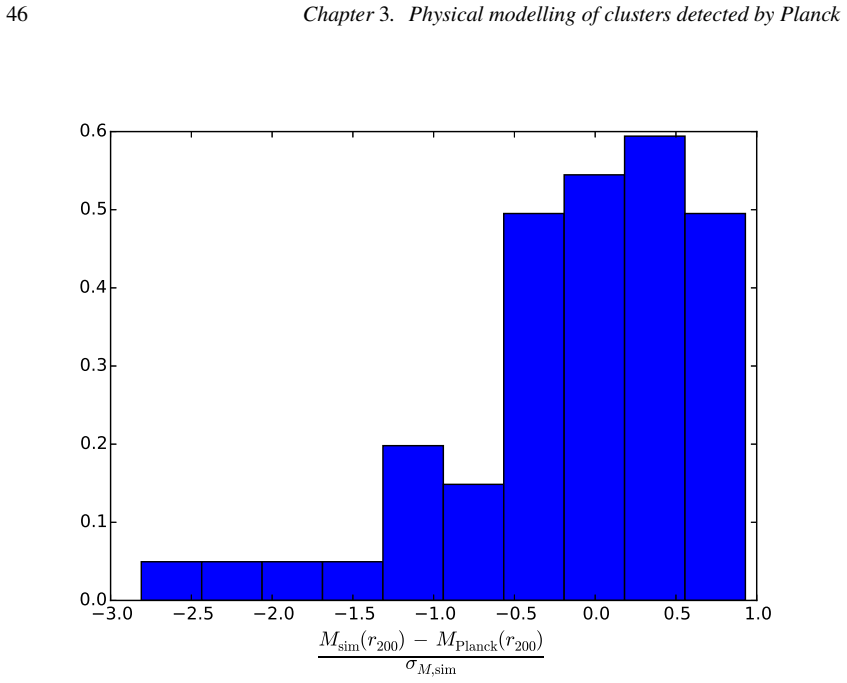
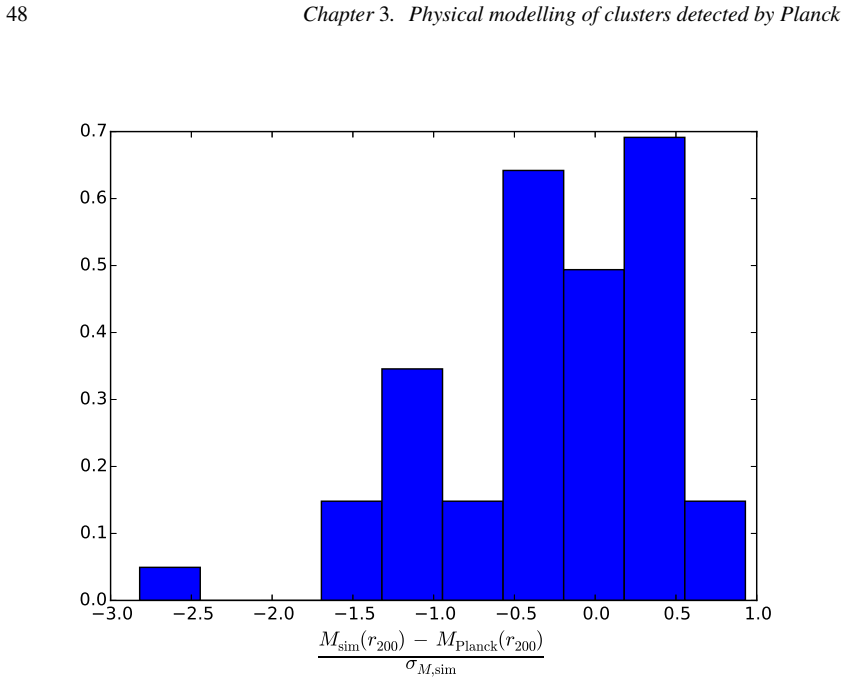
The central claim is that standard Planck mass estimates for the 54-cluster sample are systematically higher than interferometric AMI mass estimates, and that the difference is not fully explained by instrumental noise, CMB contamination, or radio-source environments. The paper reports that AMI $M(r_{500})$ is lower than the PSZ2 slicing-function mass in 37 of 54 clusters and lower than the marginalised PSZ2 mass in 45 of 54; the slicing-function value, which folds in X-ray information, is the closer of the two Planck estimates to the AMI result. Simulations show that when clusters are generated with the same model used in the inference and only instrumental noise is present, 51 of 54 clusters recover the input mass within one standard deviation, but adding confusion noise, primordial CMB, and the actual LA-measured source environments leaves 16 of 54 outside that range, and the recovered-mass distributions become negatively skewed. The thesis therefore attributes the remaining real-data discrepancy to a systematic difference between AMI and Planck data and/or the cluster models, and identifies the fixed 'universal' GNFW pressure profile as a plausible source of model error. A separate contribution is the geometric nested sampler, an adaptation of Metropolis-Hastings nested sampling that exploits the geometry of the parameter domain to satisfy likelihood constraints and is compared with established samplers.
Load-bearing premise
The AMI mass estimates and the Planck comparison both rest on the assumption that every cluster is spherically symmetric, in hydrostatic equilibrium, has a gas mass fraction much less than unity, and follows the universal generalised-NFW pressure profile with fixed slope parameters; if real clusters deviate from that profile, the AMI masses are biased and the apparent Planck-AMI offset is partly a model artefact.
Editorial extensions
If this is right
- If the systematic offset is real, cosmological analyses that use Planck PSZ2 masses and the $Y$--$M$ scaling relation should be re-examined, since cluster masses would be overestimated relative to interferometric measurements.
- The slicing-function masses, which incorporate X-ray information, agree with AMI better than the marginalised masses, supporting the use of external calibration in Planck mass estimation.
- Simulations including confusion noise, CMB, and realistic radio-source environments show negative mass bias, so pipeline validation that omits these components will understate systematic errors.
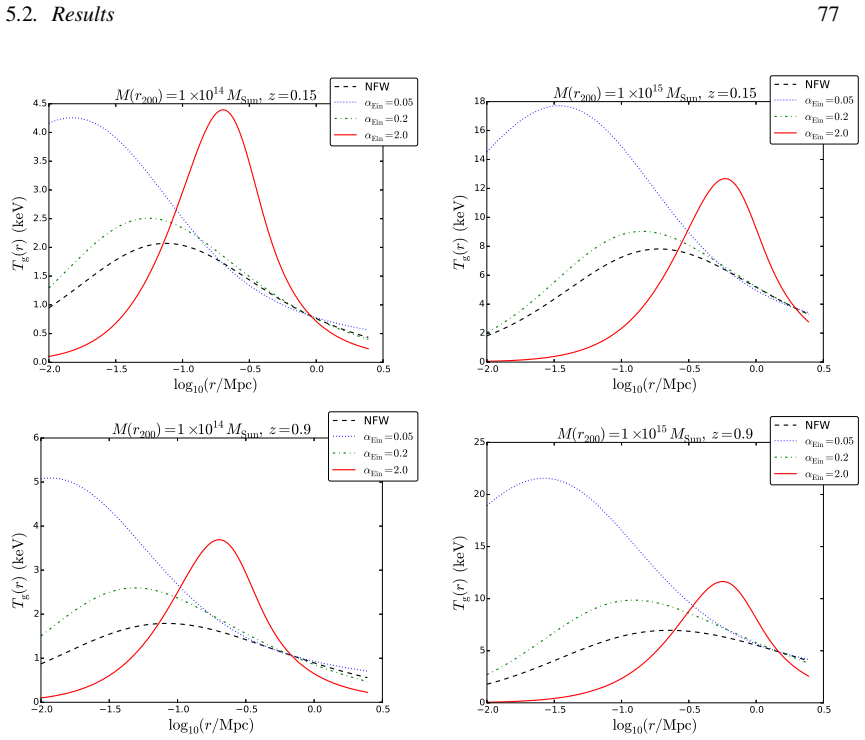
- The Einasto dark-matter model recovers input masses better than NFW in 15 of 16 simulations, implying that the assumed dark-matter profile shape contributes to mass-estimate offsets.
- The joint AMI-Planck likelihood analysis, while prevented from using hyperparameters by the likelihood-ratio normalisation issue, provides a framework for simultaneous fitting of the two datasets.
Reading between the lines
- If the offset is mostly model error rather than instrumental difference, then independent mass calibrators such as weak-lensing shear or X-ray hydrostatic masses on the same 54 clusters would be expected to land nearer the AMI values than the Planck slicing-function values; the thesis does not perform this test.
- The negative bias seen in the realistic simulations implies that even the AMI masses may be biased low, so the true Planck-minus-AMI offset could be larger than the 37-of-54 and 45-of-54 counts suggest.
- Fixing the GNFW slope parameters to universal values is the most consequential assumption; releasing them as free parameters in the same physical model would provide a direct test of whether profile deviations produce the observed offset.
- The geometric nested sampler's geometry-based proposals may extend naturally to other problems with correlated or curved parameter spaces, such as gravitational-wave parameter estimation with degenerate masses, though the thesis only demonstrates a single black-hole-merger model.
Signed reviews
Editorial analysis
A structured set of objections, weighed in public.
Referee Report
Summary. This PhD thesis presents Bayesian inference applied to Sunyaev-Zel'dovich observations of galaxy clusters. The central empirical study compares AMI interferometric mass estimates with two Planck PSZ2/PwS mass estimates for a sample of 54 clusters, finding that AMI masses are lower than the Planck slicing-function masses in 37 of 54 cases and lower than the marginalised Planck masses in 45 of 54 cases. The thesis then uses AMI simulations with Planck-derived input masses to quantify the bias of the AMI pipeline. It further compares a physical cluster model (NFW dark matter plus GNFW gas) with two observational models using parameter estimates, an Earth mover's distance metric, and Bayesian evidences; introduces an Einasto dark-matter variant of the physical model; explores relaxations of the fgas assumption and inclusion of non-thermal pressure; develops a joint AMI-Planck likelihood analysis; and finally presents a new nested-sampling algorithm, the geometric nested sampler, with applications to toy models and gravitational-wave signals.
Significance. If the AMI-Planck mass offset is real, it would have implications for Planck cluster cosmology and for SZ-based mass calibration. The thesis contains substantial and useful work: a carefully selected 54-cluster sample, explicit discussion of selection biases, a large simulation campaign, a new metric-based model comparison, and a new sampling algorithm tested on several problems. The thesis is also unusually candid about its limitations, including the possibility that the universal GNFW pressure profile is not accurate and the fact that some enhanced models are only exploratory. However, the main quantitative claims in Chapters 3 and 5 are not yet fully supported, because the simulations and the Planck mass inputs share the same GNFW model assumptions and because the Einasto simulation conclusions rest on posterior-mean comparisons despite large systematic offsets.
major comments (4)
- [§3.7, §3.8 (with §2.4.3 and §3.4.1)] The simulation calibration in §3.7 injects clusters built from the same physical model that is then used for inference: the GNFW pressure profile with slopes fixed to Arnaud et al. (2010), fgas = 0.13, and input masses derived from the PSZ2 slicing function, which itself assumes the same GNFW profile family and Arnaud scaling relations (§3.4.1, Eqs. 3.2–3.5). The measured medians (−0.24 to −0.34 σ in cases 1–4) therefore calibrate the inference pipeline under the assumed model, but do not calibrate the realism of that model. The last bullet of §3.8 is carefully worded ('AMI & Planck data and / or the cluster models'), but the quantitative conclusion that the simulations do not fully accommodate the discrepancy—and the associated 37/54 and 45/54 comparisons in §3.6—still presuppose that the universal GNFW profile is accurate. The thesis itself cites Perrott et al. (2015) in §2.4.3 for the possibility that pressure profiles deviate from the universal profile. This is a genuine calibration loop for the central claim; it should be addressed by adding model-mismatch simulations with perturbed pressure-profile slopes or realistic scatter, or by anchoring masses to X-ray/lensing data, and by reporting how the 37/54 and 45/54 counts change under such perturbations.
- [§5.2.2.2 and Table C.1] The Einasto simulation analysis is reported as showing that the Einasto model recovers the input mass better than the NFW model in 15 of 16 cases, but the same results show that only 2 of 16 Einasto analyses recover the input mass within three standard deviations, and that the Einasto model beats NFW even on NFW-generated data in 3 of 4 cases. The thesis attributes the poor recovery to pixelation, u-v binning, and nested-sampling error underestimation (§5.2.2.2). If those error underestimations are present, the posterior-mean comparison is not a valid measure of model performance. The conclusion in §5.3 therefore overstates what the simulations establish: the Einasto model may be more flexible, but the systematic offsets need to be modelled and corrected before one can claim improved mass recovery.
- [§4.2.2, §4.3.4.3, §4.4] The comparison between the physical model (PM) and observational model II (OM II) is partially circular because OM II's priors on Ytot and θp are computed from PM calculations (§4.2.2), inheriting PM's assumptions of hydrostatic equilibrium and fgas much less than unity. Consequently the evidence ratios in §4.3.4.3 and the conclusion in §4.4 that PM is preferred over OM II for 43 of 54 clusters are not independent tests of the two models. The thesis acknowledges this in §4.2.2, but the interpretation should be downgraded from model comparison to an internal-consistency check, or OM II should be given priors derived from independent X-ray or Planck data.
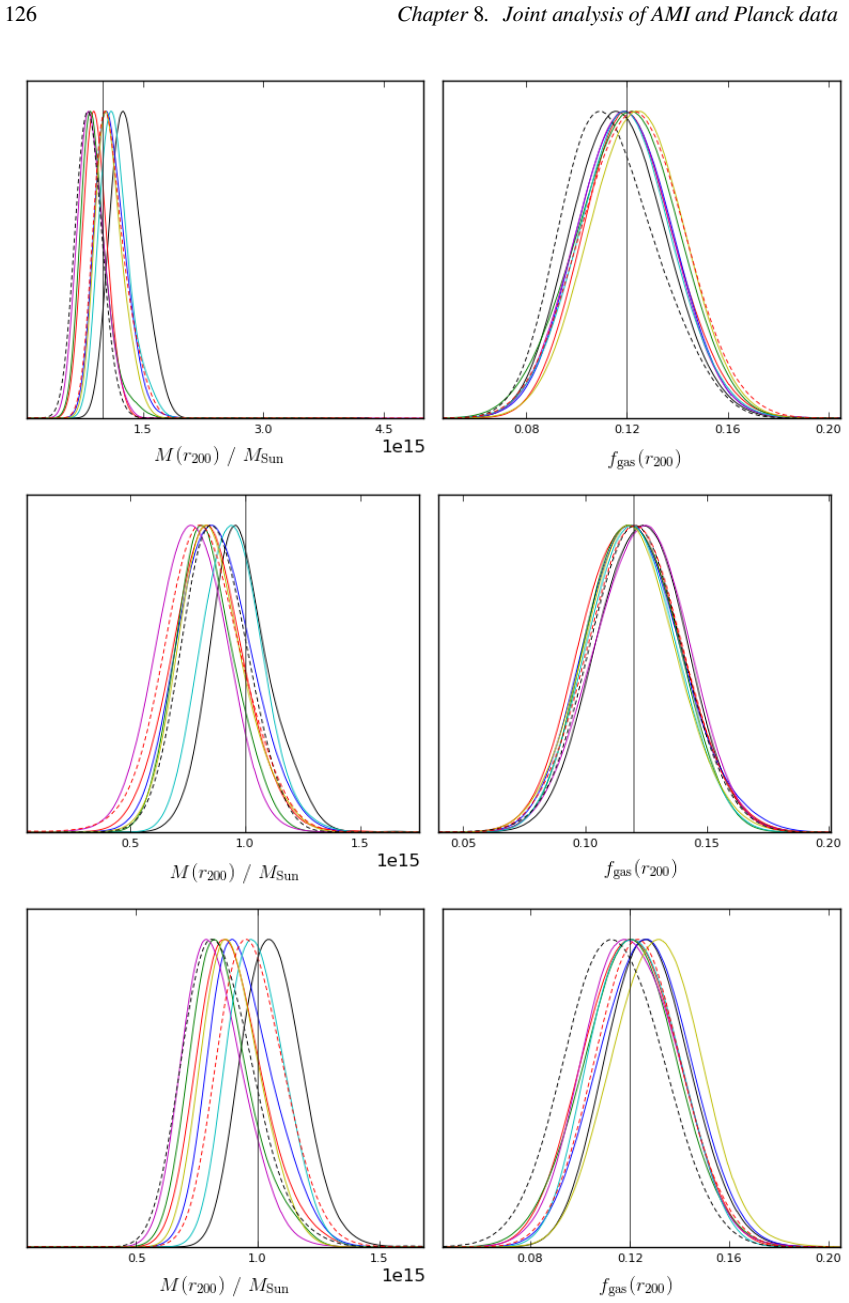
- [§8.2.2, §8.5–8.6] The joint AMI-Planck analysis is presented as a method for combining independent datasets, but §8.2.2 shows that the likelihood-hyperparameter approach cannot be used with the PwS likelihood ratio, so the analysis is forced to set α1 = α2 = 1. This means the joint likelihood gives equal weight to the two instruments' noise models even when their systematic uncertainties are poorly known; the joint posterior widths and evidence ratios in §8.5–8.6 are therefore optimistic if either likelihood is mis-specified. The text should either implement a properly normalised PwS likelihood or explicitly frame the equal-weight product as a preliminary consistency check rather than the final joint-analysis method.
minor comments (5)
- [§2.4.3] The sentence 'For values For values r/rp ≫ 1' contains a duplicated phrase and should be corrected.
- [§8.2.2] The text refers to 'MP02' when discussing the toy model of Hobson et al. (2002), but the same method is elsewhere called 'MH02'; the notation should be made consistent.
- [§5.1.0.2] The two sets of Arnaud et al. GNFW parameters (a = 1.0620, b = 5.4807, c = 0.3292 and a = 1.0510, b = 5.4905, c = 0.3081) are quoted in the text without a summary table; a small table would reduce the risk of confusion.
- [§3.6] Figures 3.6 and 3.7 use row number as the x-axis for clarity, but because row number is monotonic in redshift, the visual impression depends on the cluster ordering; adding redshift ticks or plotting directly against z would improve interpretability.
- [§3.8] The first bullet of the conclusions says 'We have made observations' in a single-author thesis; 'I have made observations' would be more consistent with the rest of the text.
Circularity Check
Central AMI-Planck mass comparison is independent of the model loop; only the PM-derived OM II prior creates a self-referential model comparison, and the thesis explicitly acknowledges the closed-loop simulations.
-
self definitional
[Section 4.2.2 (Observational model II); used in the PM vs OM II comparison of Section 4.3.4.3]
"From the z and M(r200) priors of the PM and for fgas(r200) = 0.13, upper and lower bounds on Ytot and θp are calculated using the PM. ... Note that in using the PM calculations to calculate the prior limits, we have made the assumptions underlying the PM that OM I is not subject to (i.e. hydrostatic equilibrium up to radius r200 and fgas is much less than unity up to the same radius)."
OM II is not an independent observational model: its prior support in (Ytot, θp) is computed from the physical model PM and from PM's assumptions. Therefore the later finding that PM and OM II often agree (no conclusive preference in 51 clusters) is partly an artefact of construction: the OM II prior was generated by mapping PM's parameter space through the PM calculations. The PM-vs-OM I comparison is not affected in this way, but the PM-vs-OM II comparison cannot be read as an independent validation of the physical model. The thesis acknowledges the shared assumptions, which limits the severity of the circularity.
full rationale
The thesis's central empirical result is the direct comparison of AMI-derived M(r500) with two PSZ2 mass estimates for the same 54 real clusters (Section 3.6). That comparison does not reduce to a fit: the AMI estimates come from a Bayesian analysis of real interferometric data, and the PSZ2 values are external catalogue entries produced by the Planck PwS pipeline. The conclusion in Section 3.8 is carefully hedged as 'a systematic difference between the AMI & Planck data and / or the cluster models', so it does not claim to have isolated a model-independent offset. The simulations in Section 3.7 do use the same physical model both to generate and to analyse clusters, and the thesis explicitly says 'inferring results from data which was created using the same model used in the inference would be more accurate than results from data taken from two different telescopes, which use different models in their inference.' This is an acknowledged closed-loop self-consistency check, not a hidden prediction passed off as independent. It measures pipeline bias under the assumed model, and the caveat that real pressure profiles may deviate from the universal GNFW form is raised in Section 2.4.3 via Perrott et al. (2015). The only genuine construction-dependent step is the OM II prior in Section 4.2.2, which is derived from the PM and then compared with the PM; this is a partial circularity in a model-comparison chapter, not in the central mass-offset claim. No load-bearing self-citation chain or uniqueness-import argument appears. The paper is substantially self-contained against external Planck catalogue values and external Arnaud et al. (2010) profile parameters, so the circularity score is low.
Assumptions & free parameters
free parameters (5)
- GNFW pressure slope parameters (a, b, c) and c500 =
a=1.0620, b=5.4807, c=0.3292, c500=1.156 (Ch 2-4); a=1.0510, b=5.4905, c=0.3081, c500=1.177 (Ch 5)
- NFW concentration-mass relation parameters =
c200 = 5.26/(1+z) (M/1e14 h^-1 Msun)^-0.1
- Einasto concentration-mass relation parameters j(z), k(z) =
j(z)=0.459+0.518 exp(-0.49 z^1.303), k(z)=-0.13+0.029 z
- Non-thermal pressure coefficient beta =
5.658e-36 Mpc^2 s^-2
- Planck Y-M and theta-M scaling relations =
Y-M slope 1.79, normalization 10^-0.19, bias (1-b)=0.80
assumptions (8)
- domain assumption Clusters are spherically symmetric
- domain assumption Hydrostatic equilibrium up to r200
- domain assumption Gas mass fraction is much less than unity up to r200, so M is approximately Mdm
- domain assumption ICM behaves as an ideal gas
- domain assumption GNFW profile describes the electron pressure
- domain assumption NFW/Einasto profiles describe dark matter density
- standard math AMI visibilities have Gaussian likelihood
- domain assumption AMI and Planck data are independent in the joint analysis
Cite this review
Pith. "Pith review of Physical modelling of galaxy clusters and Bayesian inference in astrophysics." pith.science (2026). https://pith.science/paper/IYCZVY5O
@misc{pith2026190900029,
  author       = {Pith},
  title        = {Pith review of: Physical modelling of galaxy clusters and Bayesian inference in astrophysics},
  year         = {2026},
  howpublished = {\url{https://pith.science/paper/IYCZVY5O}},
  note         = {Machine review of arXiv:1909.00029}
}
read the original abstract
I compare the mass values obtained with data taken from the Arcminute Microkelvin Imager (AMI) radio interferometer system and from the Planck satellite. The former of these uses a Bayesian analysis pipeline that parameterises a cluster in terms of its physical quantities, and models the dark matter \& baryonic components of a cluster using Navarro-Frenk-White (NFW) and generalised-NFW profiles respectively. I also analyse simulated AMI data with input values based on PwS mass estimates. I then compare three cluster models using AMI data for the 54 cluster sample. The two observational models considered only model the gas content of the cluster. To compare the physical and observational models I consider their posterior parameter estimates, including the calculation of a metric defined between two probability distributions. The models' fit to the cluster data is evaluated by looking at the Bayesian evidence values. Improvements to the physical modelling of galaxy clusters are then considered, either by relaxing some of the assumptions underlying the physical model, or by introducing a new profile for the dark matter component of clusters. The final part of the cluster analysis work focuses on Bayesian analysis using a joint likelihood function of data from both AMI and the Planck satellite simultaneously. Finally, a new Bayesian inference algorithm based on nested sampling is presented. The algorithm, named the "geometric nested sampler", is an adaption of the Metropolis-Hastings nested sampler and makes use of the geometrical interpretation of sets of parameters to sample from their domains efficiently. The geometric nested sampler is tested on several toy models as well as a model representing the emission of gravitational waves from binary black hole mergers.
Figures


Figures from the paper (72 more)











Reference graph
Works this paper leans on
-
[1]
Chevallier,M.,Polarski,D.2001.AcceleratingUniverseswithScalingDarkMatter.International Journal of Modern Physics D 10,
work page 2001
-
[3]
Monthly Notices of the Royal Astronomical Society 279,
Haehnelt,M.G.,Tegmark,M.1996.UsingtheKinematicSunyaev-Zeldovicheffecttodetermine the peculiar velocities of clusters of galaxies.. Monthly Notices of the Royal Astronomical Society 279,
work page 1996
-
[10]
The Astrophysical Journal 650,
Kravtsov,A.V.,Vikhlinin,A.,Nagai,D.2006.ANewRobustLow-ScatterX-RayMassIndicator for Clusters of Galaxies. The Astrophysical Journal 650,
work page 2006
-
[12]
Battaglia, N., Bond, J.R., Pfrommer, C., Sievers, J.L.2012.OntheClusterPhysicsofSunyaev- Zel’dovich and X-Ray Surveys. I. The Influence of Feedback, Non-thermal Pressure, and Cluster Shapes on Y-M Scaling Relations. The Astrophysical Journal 758,
work page 2012
-
[13]
Why does the Metropolis-Hastings procedure satisfy the detailed balance criterion?
208 References Hauser K. 2013 "Why does the Metropolis-Hastings procedure satisfy the detailed balance criterion?" URL: http://people.duke.edu/~kh269/teaching/notes/ MetropolisExplanation.pdf Herranz,D.,and6colleagues2002.FilteringtechniquesforthedetectionofSunyaev-Zel’dovich clusters <br/> in multifrequency maps. Monthly Notices of the Royal Astron...
work page 2013
-
[17]
Nyquist,H.1928.ThermalAgitationofElectricChargeinConductors.PhysicalReview32,110. Olamaie, M., Hobson, M. P., Grainge, K. J. B
work page 1928
-
[18]
KompaneetsA.S. 1957 Theestablishmentofthermalequilibriumbetweenquantaandelectrons Soviet Physics JETP, 4, 730 Korngut,P.M.,and8colleagues2011.MUSTANGHighAngularResolutionSunyaev-Zel’dovich Effect Imaging of Substructure in Four Galaxy Clusters. The Astrophysical Journal 734,
work page 1957
-
[19]
Monthly Notices of the Royal Astronomical Society 335,
Hobson,M.P.,Bridle,S.L.,Lahav,O.2002.Combiningcosmologicaldatasets: hyperparameters and Bayesian evidence. Monthly Notices of the Royal Astronomical Society 335,
work page 2002
Show all 46 references
-
[20]
Monthly Notices of the Royal Astronomical Society 489, 3135, DOI:https://doi.org/10.1093/mnras/stz2341
Physical modelling of galaxy References 209 cluster Sunyaev-Zel’dovich data using Einasto dark matter profiles. Monthly Notices of the Royal Astronomical Society 489, 3135, DOI:https://doi.org/10.1093/mnras/stz2341. Javid, K., and 7 colleagues
-
[21]
Monthly Notices of the Royal Astronomical Society 483, 3529, DOI:https://doi
Physical modelling of galaxy clusters detected by the Planck satellite. Monthly Notices of the Royal Astronomical Society 483, 3529, DOI:https://doi. org/10.1093/mnras/sty3115. Javid,K.Geometricnestedsampling: samplingfromdistributionsdefinedonnon-trivialgeomet- ries. Journal o...
-
[30]
The Astrophysical Journal 731,
The Atacama Cosmology Telescope: Extragalactic Sources at 148 GHz in the 2008 Survey. The Astrophysical Journal 731,
2008
-
[33]
Navarro,J.F.,Frenk,C.S.,White,S.D.M.1995.SimulationsofX-rayclusters.MonthlyNotices of the Royal Astronomical Society 275,
Nagai,D.,Lau,E.T.2011.GasClumpingintheOutskirtsof ΛCDMClusters.TheAstrophysical Journal 731, L10. Navarro,J.F.,Frenk,C.S.,White,S.D.M.1995.SimulationsofX-rayclusters.MonthlyNotices of the Royal Astronomical Society 275,
2011
-
[36]
Monthly Notices of the Royal Astronomical Society 486, 2116, DOI:https://doi
Sunyaev-Zel’dovich profile fitting with joint AMI-Planck analysis. Monthly Notices of the Royal Astronomical Society 486, 2116, DOI:https://doi. org/10.1093/mnras/stz826. Petrov,L.,Kovalev,Y.Y.,Fomalont,E.B.,Gordon,D.2008.TheSixthVLBACalibratorSurvey: References 213 VCS6. The As...
2008 doi
-
[41]
Journal of Cosmology and Astro-Particle Physics 2016,
Comparison of weak lensing by NFW and Einasto halos and systematic errors. Journal of Cosmology and Astro-Particle Physics 2016,
2016
-
[42]
arXiv e- prints arXiv:1101.5590
Sunyaev-Zel’dovich observations of LoCuSS clusters with the Arcminute Microkelvin Imager: high X-ray luminosity sample. arXiv e- prints arXiv:1101.5590. Silk, J
-
[44]
Journal of Cosmology and Astro- Particle Physics 2006,
Seljak,U.,Slosar,A.,McDonald,P.2006.CosmologicalparametersfromcombiningtheLyman- α forest with CMB, galaxy clustering and SN constraints. Journal of Cosmology and Astro- Particle Physics 2006,
2006
-
[45]
VizieR Online Data Catalog J/MNRAS/379/1442
VizieR Online Data Catalog: Multifrequency observations of 9C sources (Waldram+, 2007). VizieR Online Data Catalog J/MNRAS/379/1442. Watson,R.A.,and25colleagues2003.FirstresultsfromtheVerySmallArray-I.Observational methods. Monthly Notices of the Royal Astronomical Society 341,
2007
-
[46]
arXiv e-prints astro-ph/0111069
Concentrations and Assembly Histories of Dark Matter Halos. arXiv e-prints astro-ph/0111069. Weisskopf, M. C., Brinkman, B., Canizares, C., Garmire, G., Murray, S., Van Speybroeck, L. P
-
[97]
Living Reviews in Relativity 17,
Blanchet, L.2014.GravitationalRadiationfromPost-NewtonianSourcesandInspirallingCom- pact Binaries. Living Reviews in Relativity 17,
2014
-
[245]
Monthly Notices of the References 207 Royal Astronomical Society 395,
George,M.R.,Fabian,A.C.,Sanders,J.S.,Young,A.J.,Russell,H.R.2009.X-rayobservations of the galaxy cluster PKS0745-191: to the virial radius, and beyond. Monthly Notices of the References 207 Royal Astronomical Society 395,
2009
-
[256]
Astronomy and Computing 5,
Ma,Y.-Z.,Berndsen,A.2014.Howtocombinecorrelateddatasets-ABayesianhyperparameter matrix method. Astronomy and Computing 5,
2014
-
[449]
Astrophysics Source Code Library ascl:1109.006
Feroz,F.,Hobson,M.P.,Bridges,M.2011.MultiNest: EfficientandRobustBayesianInference. Astrophysics Source Code Library ascl:1109.006. Feroz, F., Hobson, M. P., Bridges, M
2011
-
[539]
Monthly Notices of the Royal Astronomical Society 450,
Rozo,E.,Rykoff,E.S.,Bartlett,J.G.,Melin,J.-B.2015.redMaPPer-III.Adetailedcomparison of the Planck 2013 and SDSS DR8 redMaPPer cluster catalogues. Monthly Notices of the Royal Astronomical Society 450,
2015
-
[569]
Hu, W., Kravtsov, A
Hoshino, A., and 16 colleagues 2010.X-Ray Temperature and MassMeasurements to the Virial RadiusofAbell1413withSuzaku.PublicationsoftheAstronomicalSocietyofJapan62,371. Hu, W., Kravtsov, A. V
2010
-
[575]
International Journal of Modern Physics D 23, 1430007-98
Brunetti,G.,Jones,T.W.2014.CosmicRaysinGalaxyClustersandTheirNonthermalEmission. International Journal of Modern Physics D 23, 1430007-98. References 205 Carlstrom, J. E., Holder, G. P., Reese, E. D
2014
-
[580]
Effects on the Sunyaev-Zel’dovich effect and the X-ray emission
Pfrommer,C.,Enßlin,T.A.,Springel,V.,Jubelgas,M.,Dolag,K.2007.Simulatingcosmicrays in clusters of galaxies - I. Effects on the Sunyaev-Zel’dovich effect and the X-ray emission. Monthly Notices of the Royal Astronomical Society 378,
2007
-
[594]
The Astrophysical Journal 668,
Nagai,D.,Kravtsov,A.V.,Vikhlinin,A.2007.EffectsofGalaxyFormationonThermodynamics of the Intracluster Medium. The Astrophysical Journal 668,
2007
-
[611]
X-ray and strong lensing analyses
II. X-ray and strong lensing analyses. Astronomy and Astrophysics 528, A73. Dutton,A.A.,Macciò,A.V.2014.ColddarkmatterhaloesinthePlanckera: evolutionofstruc- tural parameters for Einasto and NFW profiles. Monthly Notices of the Royal Astronomical Society 441,
2014
-
[643]
Carvalho,P.,Rocha,G.,Hobson,M.P.2009.AfastBayesianapproachtodiscreteobjectdetection inastronomicaldatasets-PowellSnakesI.MonthlyNoticesoftheRoyalAstronomicalSociety 393,
2009
-
[657]
Space Science Reviews 177,
Giodini,S.,Lovisari,L.,Pointecouteau,E.,Ettori,S.,Reiprich,T.H.,Hoekstra,H.2013.Scaling Relations for Galaxy Clusters: Properties and Evolution. Space Science Reviews 177,
2013
-
[702]
The Astrophysical Journal 502,
Itoh,N.,Kohyama,Y.,Nozawa,S.1998.RelativisticCorrectionstotheSunyaev-ZeldovichEffect for Clusters of Galaxies. The Astrophysical Journal 502,
1998
-
[1057]
Monthly Notices of the Royal Astronomical Society 475, 5677, DOI:https://doi
Hickish,J.,and20colleagues2018.AdigitalcorrelatorupgradefortheArcminuteMicroKelvin Imager. Monthly Notices of the Royal Astronomical Society 475, 5677, DOI:https://doi. org/10.1093/mnras/sty074. Higson, E., Handley, W., Hobson, M., Lasenby, A
-
[1450]
Nozawa,S.,Itoh,N.,Kohyama,Y.1998.RelativisticCorrectionstotheSunyaev-ZeldovichEffect for Clusters of Galaxies. II. Inclusion of Peculiar Velocities. The Astrophysical Journal 508,
1998
-
[1759]
The Astrophysical Journal 456,
Markevitch,M.,Mushotzky,R.,Inoue,H.,Yamashita,K.,Furuzawa,A.,Tawara,Y.1996.Abell 2163: Temperature, Mass, and Hydrostatic Equilibrium. The Astrophysical Journal 456,
1996
-
[1992]
The Astro- physical Journal 396, L13
Interpretation of the Cosmic Microwave Background Radiation Anisotropy Detected by the COBE Differential Microwave Radiometer. The Astro- physical Journal 396, L13. Voit,G.M.2005.Tracingcosmicevolutionwithclustersofgalaxies.ReviewsofModernPhysics 77,
2005
-
[2001]
Image and Video Retrieval: 4th International Conference, CIVR 2005, 251-
The earth mover’s distance is the mallows distance: Some insights from statistics. Image and Video Retrieval: 4th International Conference, CIVR 2005, 251-
2005
-
[2002]
Cambridge University Press
Information theory, inference & learning algorithms. Cambridge University Press. Mantz, A., Allen, S.W., Ebeling, H., Rapetti, D.2008.Newconstraintsondarkenergyfromthe observed growth of the most X-ray luminous galaxy clusters. Monthly Notices of the Royal Astronomical Society 387,
2008
-
[2006]
arXiv e-prints astro- ph/0604069
The Scientific Programme of Planck. arXiv e-prints astro- ph/0604069. Thompson R. A., Moran J., Swenson G. W
-
[2007]
URL:https://warwick.ac.uk/fac/ sci/statistics/staff/academic-research/johansen/teaching/mcm-2007.pdf Kawaharada, M., and 9 colleagues
Monte Carlo Methods. URL:https://warwick.ac.uk/fac/ sci/statistics/staff/academic-research/johansen/teaching/mcm-2007.pdf Kawaharada, M., and 9 colleagues
2007
-
[2008]
arXiv e-prints arXiv:0801.3887
Properties of Nested Sampling. arXiv e-prints arXiv:0801.3887. Corless, V. L., King, L. J., Clowe, D
-
[2011]
The Astrophysical Journal 737,
The Atacama Cosmology Telescope: Sunyaev- Zel’dovich-Selected Galaxy Clusters at 148 GHz in the 2008 Survey. The Astrophysical Journal 737,
2008
-
[2014]
Planck 2013 results. XX. Cosmology from Sunyaev-Zeldovich cluster counts. Astronomy and Astrophysics 571, A20. PlanckCollaboration,and275colleagues2014.Planck2013results.XXIX.ThePlanckcatalogue of Sunyaev-Zeldovich sources. Astronomy and Astrophysics 571, A29. Planck Collabora...
2013
-
[2016]
arXiv e-prints arXiv:1608.04388
Mass modeling of galaxy clusters: quantifying hydrostatic bias and contribution from non-thermal pressure. arXiv e-prints arXiv:1608.04388. Martizzi, D., Mohammed, I., Teyssier, R., Moore, B
-
[2018]
arXiv e-prints arXiv:1805.01968, DOI:https://doi.org/10.17863/CAM.38865
Comparison of physical and observational galaxy cluster modelling. arXiv e-prints arXiv:1805.01968, DOI:https://doi.org/10.17863/CAM.38865. Javid, K
-
[2019]
arXiv e-prints arXiv:1905.09110, DOI:https://doi.org/10.5281/zenodo.3627542
Nested sampling on non-trivial geometries. arXiv e-prints arXiv:1905.09110, DOI:https://doi.org/10.5281/zenodo.3627542. Javid, K., Perrott, Y. C., Rumsey, C., Saunders, R. D. E
1905 arXiv
-
[4384]
Monthly Notices of the Royal Astronomical Society 450, L61
Handley,W.J.,Hobson,M.P.,Lasenby,A.N.2015.polychord: nestedsamplingforcosmology.. Monthly Notices of the Royal Astronomical Society 450, L61. Handley W. J
2015
Reviewed August 14, 2026 · model on record in the stance chip above.
Discussion (0). Continue with ORCID to comment.