REVIEW 2 major objections 5 minor 1 cited by
Characterizing magnetic field morphologies in three Serpens protostellar cores with ALMA
T0 review · 2 major / 5 minor · reviewed 2026-08-14 · deepseek-v4-flash
Pith's one-line read This paper argues that millimeter polarization along protostellar outflow cavity walls cannot be explained by radiative alignment of 0.1-micron interstellar dust; the aligned grains must have grown beyond 10 microns.
desk verdict New 40–50 au ALMA polarization maps are a solid, citable dataset, but the >10 µm grain-growth claim in cavity walls is not nailed down until the projection geometry is quantified. read the letter →
The pith
A machine-rendered reading of the paper's core claim, the machinery that carries it, and where it could break.
The reading
What carries the argument
The machinery is the radiative alignment torque (RAT) mechanism, in which an anisotropic radiation field spins up dust grains that then precess into alignment with the magnetic field; the polarization angle is rotated by 90 degrees to infer the field. The load-bearing step is the penetration-depth calculation: using published dust opacities, the authors compute how far photons of each wavelength can travel into the wall before optical depth reaches unity. Because RATs are most efficient for photons whose wavelength is comparable to the grain size, the observed 200 au polarized layer can only be explained if grains as large as 10 microns exist to be spun by mid- and far-infrared photons. They also use spectral-index and brightness-temperature measurements to rule out self-scattering and k-RAT alignment, where grains align with the radiation field rather than the magnetic field, as the dominant polarization mechanism in the inner cores.
What would settle it
Measure the true thickness of the polarized wall in a nearly edge-on Class 0 outflow: if the wall is a projection and the physical penetration depth is under roughly 10 au, then 0.1-micron grains suffice and the >10 micron claim fails; if the wall remains about 200 au thick after correcting for projection, the large-grain scenario is confirmed.
Extended reading notes
Core claim
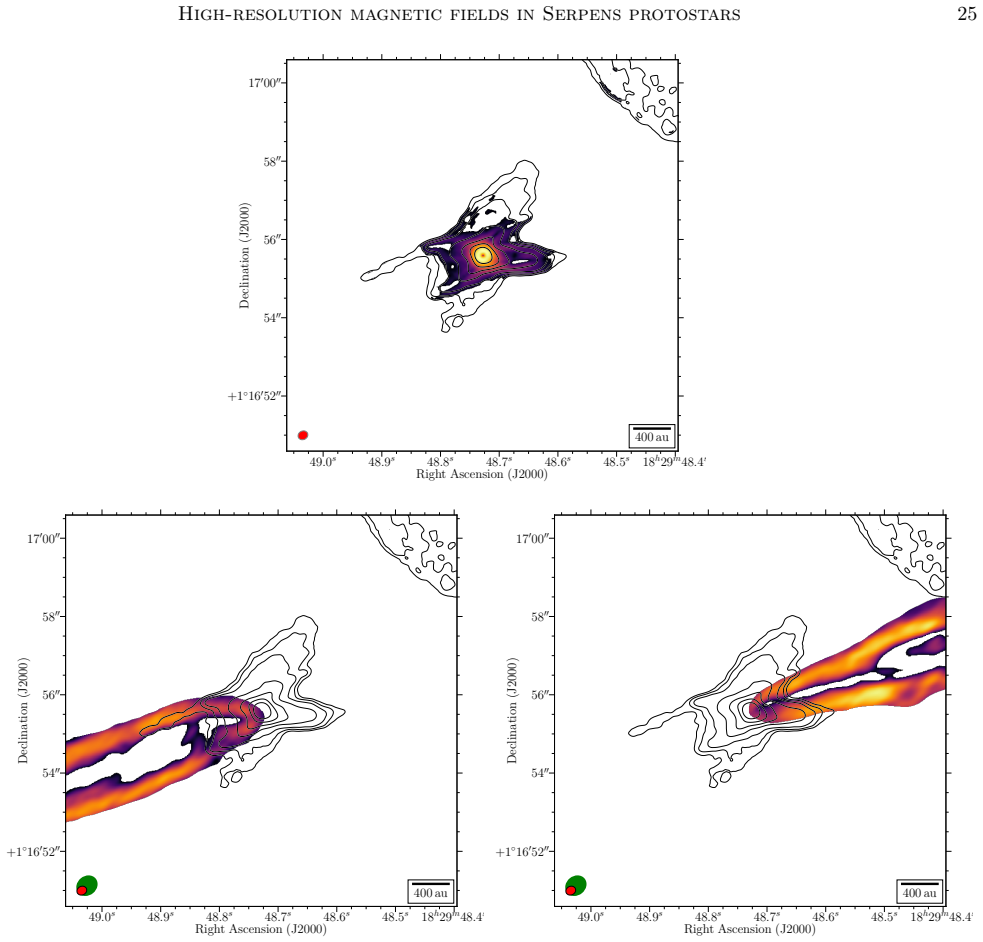
On its own terms, the paper's discovery is that the observed polarized millimeter emission from the walls of the outflow cavities of Serpens Emb 8(N) requires a population of aligned dust grains larger than 10 micrometers at 500 to 1000 au scales in Class 0 envelopes. Using standard dust opacities, the authors estimate that UV and short-wavelength photons between 1 and 10 micrometers can penetrate only 1 to 35 au into the cavity walls, yet the polarized layer is observed to be roughly 200 au thick. Since radiative torques spin grains most efficiently when the photon wavelength is comparable to the grain size, such deep alignment requires grains of order 10 micrometers or larger. In addition, the polarization maps toward SMM1-a show a poloidal magnetic field at the base of the bipolar outflow, with the highly polarized emission aligned with the extremely high-velocity redshifted jet; two polarized filaments to the south are interpreted as an outflow cavity wall and a possible accretion streamer.
Load-bearing premise
The argument rests on the assumption that the 200 to 300 au polarized layer seen along the cavity wall is a physically thick slab of dust; if it is instead a thin curved wall projected on the sky, ultraviolet photons could reach all the grains and ordinary 0.1-micron interstellar dust would explain the polarization without invoking grain growth.
Editorial extensions
If this is right
- The inner roughly 200 au magnetic fields of SMM1-a and Emb 8(N) are poloidal and aligned with the bipolar outflow axis, with no toroidal component detected.
- The molecular tracers anticorrelate with polarization: C18O and 13CS appear where dust is polarized, while DCO+ appears where it is not, identifying cold dense gas as a poor-alignment zone.
- If the thick-wall interpretation stands, Class 0 envelopes at 500 to 1000 au must contain grains above 10 micrometers, which is far larger than the 0.1-micron interstellar dust population.
- The polarization asymmetry at the base of the redshifted jet in SMM1-a indicates that mechanical alignment torques may augment radiative torques near fast jets.
Reading between the lines
- If outflow activity transports large grains outward, as proposed in the paper's discussion, the same process could seed the outer envelope with material processed near the protostar, linking cavity walls to the composition of future planet-forming disks.
- A direct observational extension would be to re-observe the same cavity walls at longer millimeter wavelengths: if grains larger than 10 micrometers are responsible, the polarization fraction should remain high, whereas self-scattering or k-RAT alignment would produce a different wavelength dependence.
- Quantifying the projection effect the authors flag would settle the large-grain claim; a nearly edge-on outflow cavity or a kinematic measure of the wall's true depth would show whether the 200 au thickness is real or inflated.
- The same RAT penetration-depth logic applied to the similar polarized walls of BHR 71 and B335 would indicate whether the large-grain requirement is a general feature of Class 0 outflows or specific to Serpens.
Signed reviews
Editorial analysis
A structured set of objections, weighed in public.
Referee Report
Summary. This paper presents ALMA 870 μm dust polarization observations of three Class 0 protostars in Serpens Main (SMM1, Emb 8(N), Emb 8) at spatial resolutions of roughly 40–150 au, together with CO and dense-gas tracer maps. The main observational results are: (i) Emb 8(N) shows high polarization fractions, up to ~36%, along the outflow cavity walls with the inferred magnetic field running along the walls; (ii) SMM1-a shows a poloidal magnetic field in its inner ~200 au and two polarized filaments to the south, one interpreted as a redshifted cavity wall and one as a possible accretion streamer; and (iii) Emb 8 shows less outflow-correlated polarization. Based on a penetration-depth calculation in Section 4.4, the authors propose that RAT alignment in the Emb 8(N) cavity walls requires grains larger than 10 μm at ~500–1000 au scales, because UV and 10 μm photons penetrate only ~1–35 au into the walls while the polarized layer appears 200–300 au thick.
Significance. The observational material is valuable and generally carefully reduced: self-calibration, polarized-intensity debiasing, noise thresholds, and beam matching across dataset combinations are clearly described, and the maps are made available. The poloidal-field detection, the depolarization zones, and the molecular-line correlations are interesting observational results that stand independently of the grain-growth interpretation. If the >10 μm grain-growth claim were established, it would be an important constraint on early dust evolution in Class 0 envelopes. However, the claim is not yet established, because the conversion from the observed apparent width of the polarized layer to a physical penetration depth is not justified, as detailed below.
major comments (2)
- [§4.4, Eqs. (5)–(7)] The central claim that grains in the Emb 8(N) cavity walls must be larger than 10 μm is not established because the observed 200–300 au width of the polarized layer is used as if it were the physical thickness of the wall. The authors acknowledge in the same section that projection of a curved cavity wall will inflate the apparent thickness, but they do not quantify the inflation. For a paraboloidal shell of true thickness δ, the projected width can be hundreds of au while the line-of-sight path through the wall is much longer than δ; the column density from Eq. (6) is an average over that path and does not constrain the column density along the wall normal. If δ is only a few au, the normal-direction column could fall below the A_V ≈ 1 threshold (10^21–10^22 cm^-2) that the authors adopt, and ordinary 0.1 μm grains could be aligned by UV photons. The relevant comparison is between the computed penetration depth and the true physical thickness, not the projected width; the projection caveat therefore cuts against the paper's main conclusion and must be quantified before the >10 μm grain-growth claim can be accepted.
- [§4.4, footnote 6 and Eq. (7)] The gas densities used in Eq. (7) appear to be derived by dividing the aperture-averaged column density from Eq. (6) by a path length comparable to the 200 au aperture diameter; if so, the penetration-depth calculation presupposes the thick-wall geometry it is meant to test. The manuscript does not state the assumed path length or the resulting uncertainty. An independent estimate of the wall density, or a radiative-transfer model that includes the cavity geometry, is needed to break the degeneracy between physical thickness, line-of-sight path length, and density.
minor comments (5)
- [Figure 7 caption] The caption states 'The peak polarized intensity is 203 mJy beam^-1', but Figure 5 gives the peak polarized intensity as 6.28 mJy beam^-1 and the peak total intensity as 203 mJy beam^-1; this appears to be a typographical error.
- [§4.1] There is a duplicated word in 'the high (∼20%) polarization fractions observed observed by Planck'; please correct.
- [§4.1.2] The phrase 'the self-scattering effect is expecting to be the dominant polarization pattern' should read 'is expected to be'.
- [Abstract and §4.4] The abstract states that the aligned grains are at '<500 au scales', while the quantitative calculation in §4.4 is for a 200 au aperture centered at 600 au from the protostar; please clarify which spatial scales are actually being constrained.
- [§4.4, Eq. (5)] The mass derivation uses an opacity quoted at 1 mm (κ = 2.74 cm^2 g^-1) while the observations are at 870 μm; please justify the opacity choice or use the value appropriate to 870 μm.
Circularity Check
Penetration-depth argument is self-contained, but the key thick-wall assumption is imported from an in-prep self-citation by overlapping authors, and the projection caveat is acknowledged but not quantified.
-
self citation load bearing
[Section 4.4, after Eq. (7)]
"Hull et al. conclude that this scenario of a 'thick' layer of aligned dust grains in BHR 71 is more likely than the scenario where the polarization is produced by an extremely thin layer of grains aligned only by UV/optical photons. However, even given the likelihood of the thick-wall scenario, the numbers we calculate above are still an upper limit to the penetration depth. This is because the 'thick' wall we see will have its thickness increased, at least to a small degree, by the projection of the curved cavity wall onto the plane of the sky."
The paper's headline inference—that >10 µm grains are present in the Emb 8(N) cavity walls—requires interpreting the observed 200–300 au polarized band as a physically thick layer. The only external justification for preferring the thick-layer interpretation over a thin curved wall projected on the sky is the conclusion of Hull et al. (2019), an in-prep manuscript by overlapping authors (Hull, Le Gouellec, and Girart are all authors of the present work). The calculation in Eqs. (5)–(7) only shows that UV cannot penetrate a layer with the observed line-of-sight column if that layer is physically ~300 au thick; it does not measure the physical thickness along the wall normal.
full rationale
The core derivation is self-contained: polarization fractions and angles are measured directly from ALMA Stokes I/Q/U data, the spectral index is fitted to visibilities, and the penetration-depth argument uses Eqs. (5)–(7) with adopted distance, temperature, and Ossenkopf & Henning (1994) opacities. None of these equations contains the >10 µm conclusion as an input, and no fitted parameter is renamed as a prediction. The grain-growth claim is a conditional inference: if the polarized band is a physically thick (~300 au) wall, then UV/optical photons are extincted within ~1–35 au, so only longer-wavelength photons can align grains there, and RAT theory then requires grains larger than ~10 µm. The weakest link is the geometric assumption, which the authors acknowledge is an upper limit because of projection of the curved cavity wall onto the plane of the sky. That is a robustness caveat, not circularity. The one circularity-relevant feature is that the preference for the thick-wall scenario is imported from Hull et al. (2019), an in-prep paper by overlapping authors, rather than quantified in the present work. This self-citation is load-bearing for the headline claim, but it does not make the derivation equivalent to its inputs: the poloidal-field morphology, depolarization zones, and molecular-line correlations are observational results that stand independently of the grain-size inference. Score 4 reflects one load-bearing self-citation while the central derivation retains independent content.
Assumptions & free parameters
free parameters (4)
- Dust temperature Td in mass derivation =
20 K (with 100 K used as an alternative)
- Spectral index alpha of inner cores =
SMM1-a: 2.39 +/- 0.02; Emb 8(N): 3.04 +/- 0.04; Emb 8: 3.36 +/- 0.01
- Source inclination of SMM1-a =
50 degrees (from Yildiz et al. 2015, with +/- 30 degrees uncertainty)
- Gradient thresholds in HRO analysis =
>1/100 (peak minus rms) for CO moment 0; >1/1000 (peak minus rms) for dust continuum
assumptions (6)
- domain assumption Dust polarization traces the plane-of-sky magnetic field via B-RAT alignment
- domain assumption RAT theory: photons with wavelength comparable to grain size dominate alignment
- domain assumption Ossenkopf & Henning (1994) opacities and a gas-to-dust ratio of 100 apply to the Serpens cavity walls
- domain assumption Distance to Serpens Main is 436 pc
- domain assumption UV radiation is fully extincted at Av about 1, corresponding to N_H 1e21 to 1e22 cm^-2
- domain assumption CCH and c-C3H2 emission trace UV-irradiated cavity walls
Cite this review
Pith. "Pith review of Characterizing magnetic field morphologies in three Serpens protostellar cores with ALMA." pith.science (2026). https://pith.science/paper/MAAHCFBB
@misc{pith2026190900046,
  author       = {Pith},
  title        = {Pith review of: Characterizing magnetic field morphologies in three Serpens protostellar cores with ALMA},
  year         = {2026},
  howpublished = {\url{https://pith.science/paper/MAAHCFBB}},
  note         = {Machine review of arXiv:1909.00046}
}
read the original abstract
With the aim of characterizing the dynamical processes involved in the formation of young protostars, we present high angular resolution ALMA dust polarization observations of the Class 0 protostellar cores Serpens SMM1, Emb 8(N), and Emb 8. With spatial resolutions ranging from 150 to 40 au at 870 {\mu}m, we find unexpectedly high values of the polarization fraction along the outflow cavity walls in Serpens Emb8(N). We use 3 mm and 1 mm molecular tracers to investigate outflow and dense gas properties and their correlation with the polarization. These observations allow us to investigate the physical processes involved in the Radiative Alignment Torques (RATs) acting on dust grains along the outflow cavity walls, which experience irradiation from accretion processes and outflow shocks. The inner core of SMM1-a presents a polarization pattern with a poloidal magnetic field at the bases of the two lobes of the bipolar outflow. To the south of SMM1-a we see two polarized filaments, one of which seems to trace the redshifted outflow cavity wall. The other may be an accretion streamer of material infalling onto the central protostar. We propose that the polarized emission we see at millimeter wavelengths along the irradiated cavity walls can be reconciled with the expectations of RAT theory if the aligned grains present at '<' 500 au scales in Class 0 envelopes have grown larger than the 0.1 {\mu}m size of ISM dust grains. Our observations allow us to constrain the star-forming sources magnetic field morphologies within the central cores, along the outflow cavity walls, and in possible accretion streamers.
Figures


Figures from the paper (18 more)



Forward citations
Cited by 1 Pith paper
-
ALMA observations of Magnetic Fields in the Massive Star-forming Region IRAS 18360-0537
An ordered hourglass B-field in IRAS 18360-0537 lies perpendicular to the outflow/rotation axis and is reshaped by rotation, outflow cavity walls, and accretion rather than pure magnetic regulation.
Reference graph
Works this paper leans on
-
[1]
E., Szűcs, L., et al
Agurto-Gangas, C., Pineda, J. E., Szűcs, L., et al. 2019, A&A, 623, A147
2019
-
[2]
O., Franco, G
Alves, F. O., Franco, G. A. P., & Girart, J. M. 2008, A&A, 486, L13
2008
-
[3]
O., Girart, J
Alves, F. O., Girart, J. M., Padovani, M., et al. 2018, A&A, 616, A56
2018
-
[4]
Andersson, B.-G., Lazarian, A., & Vaillancourt, J. E. 2015, ARA&A, 53, 501 André, P., Di Francesco, J., Ward-Thompson, D., et al. 2014, in Protostars and Planets VI, ed. H. Beuther, R. S. Klessen, C. P. Dullemond, & T. Henning, 27 André, P., Ward-Thompson, D., & Barsony, M. 2000, Protostars and Planets IV, 59
2015
-
[5]
G., & Sargent, A
Arce, H. G., & Sargent, A. I. 2006, ApJ, 646, 1070
2006
-
[6]
G., Shepherd, D., Gueth, F., et al
Arce, H. G., Shepherd, D., Gueth, F., et al. 2007, in Protostars and Planets V, ed. B. Reipurth, D. Jewitt, & K. Keil, 245 Astropy Collaboration, Price-Whelan, A. M., Sipőcz, B. M., et al. 2018, AJ, 156, 123
2007
-
[7]
M., Padovani, M., et al
Bacciotti, F., Girart, J. M., Padovani, M., et al. 2018, ApJL, 865, L12
2018
-
[8]
2016, ARA&A, 54, 491
Bally, J. 2016, ARA&A, 54, 491
2016
Show all 130 references
-
[9]
O., Bruderer, S., van Dishoeck, E
Benz, A. O., Bruderer, S., van Dishoeck, E. F., et al. 2016, A&A, 590, A105
2016
-
[10]
A., Du, F., Cleeves, L
Bergin, E. A., Du, F., Cleeves, L. I., et al. 2016, ApJ, 831, 101
2016
-
[11]
J., Chepurnov, A., Lazarian, A., & Kim, J
Bethell, T. J., Chepurnov, A., Lazarian, A., & Kim, J. 2007, ApJ, 663, 1055
2007
-
[12]
C., Savage, B
Bohlin, R. C., Savage, B. D., & Drake, J. F. 1978, ApJ, 224, 132
1978
-
[13]
2017, A&A, 604, A52
Bracco, A., Palmeirim, P., André, P., et al. 2017, A&A, 604, A52
2017
-
[14]
2016, A&A, 588, A129 Chacón-Tanarro, A., Caselli, P., Bizzocchi, L., et al
Brauer, R., Wolf, S., & Reissl, S. 2016, A&A, 588, A129 Chacón-Tanarro, A., Caselli, P., Bizzocchi, L., et al. 2017, A&A, 606, A142
2016
-
[15]
W., & Tobin, J
Chiang, H.-F., Looney, L. W., & Tobin, J. J. 2012, ApJ, 756, 168
2012
-
[16]
G., Harris, R
Cox, E. G., Harris, R. J., Looney, L. W., et al. 2018, ApJ, 855, 92
2018
-
[17]
R., Pilleri, P., et al
Cuadrado, S., Goicoechea, J. R., Pilleri, P., et al. 2015, A&A, 575, A82
2015
-
[18]
Ray, T. P. 2000, ApJL, 530, L115
2000
-
[19]
Dent, W. R. F., Pinte, C., Cortes, P. C., et al. 2019, MNRAS, 482, L29
2019
-
[20]
2014, A&A, 563, A28
Bergin, E. 2014, A&A, 563, A28
2014
-
[21]
2010, A&A, 523, A29
Dionatos, O., Nisini, B., Codella, C., & Giannini, T. 2010, A&A, 523, A29
2010
-
[22]
Dishoeck, E. F. 2015, MNRAS, 451, 3836
2015
-
[23]
L., Peretto, N., & Fuller, G
Duarte-Cabral, A., Dobbs, C. L., Peretto, N., & Fuller, G. A. 2011, A&A, 528, A50
2011
-
[24]
A., Peretto, N., et al
Duarte-Cabral, A., Fuller, G. A., Peretto, N., et al. 2010, A&A, 519, A27
2010
-
[25]
M., Allen, L
Dunham, M. M., Allen, L. E., II, N. J. E., et al. 2015, The Astrophysical Journal Supplement Series, 220, 11
2015
-
[26]
L., Evans, II, N
Enoch, M. L., Evans, II, N. J., Sargent, A. I., & Glenn, J. 2009, ApJ, 692, 973
2009
-
[27]
L., Corder, S., Duchêne, G., et al
Enoch, M. L., Corder, S., Duchêne, G., et al. 2011, ApJS, 195, 21
2011
-
[28]
P., Cabrit, S., et al
Frank, A., Ray, T. P., Cabrit, S., et al. 2014, in Protostars and Planets VI, ed. H. Beuther, R. S. Klessen, C. P. Dullemond, & T. Henning (Tucson, Arizona: University of Arizona Press), 451–474
2014
-
[29]
Frau, P., Galli, D., & Girart, J. M. 2011, A&A, 535, A44
2011
-
[30]
M., et al
Galametz, M., Maury, A., Girart, J. M., et al. 2018, A&A, 616, A139
2018
-
[31]
Galli, D., & Shu, F. H. 1993, ApJ, 417, 220
1993
-
[32]
M., Rao, R., & Marrone, D
Girart, J. M., Rao, R., & Marrone, D. P. 2006, Science, 313, 812
2006
-
[33]
M., Viti, S., Estalella, R., & Williams, D
Girart, J. M., Viti, S., Estalella, R., & Williams, D. A. 2005, A&A, 439, 601
2005
-
[34]
M., Fernández-López, M., Li, Z
Girart, J. M., Fernández-López, M., Li, Z. Y., et al. 2018, ApJ, 856, L27
2018
-
[35]
R., Cernicharo, J., Karska, A., et al
Goicoechea, J. R., Cernicharo, J., Karska, A., et al. 2012, A&A, 548, A77
2012
-
[36]
1952, MNRAS, 112, 215
Gold, T. 1952, MNRAS, 112, 215
1952
-
[37]
2018, A&A, 610, A16 Guzmán, V
Guillet, V., Fanciullo, L., Verstraete, L., et al. 2018, A&A, 610, A16 Guzmán, V. V., Pety, J., Goicoechea, J. R., et al. 2015, ApJL, 800, L33
2018
-
[38]
J., Cox, E
Harris, R. J., Cox, E. G., Looney, L. W., et al. 2018, ApJ, 861, 91
2018
-
[39]
Harsono, D., Bjerkeli, P., van der Wiel, M. H. D., et al. 2018, Nature Astronomy, 2, 646
2018
-
[40]
2009, A&A, 506, L29
Hennebelle, P., & Ciardi, A. 2009, A&A, 506, L29
2009
-
[41]
2016, ApJL, 830, L8
Hennebelle, P., Commerçon, B., Chabrier, G., & Marchand, P. 2016, ApJL, 830, L8
2016
-
[42]
2018, ApJ, 852, 129
Hoang, T., Cho, J., & Lazarian, A. 2018, ApJ, 852, 129
2018
-
[43]
2016, ApJ, 831, 159
Hoang, T., & Lazarian, A. 2016, ApJ, 831, 159
2016
-
[44]
Hoang, T., & Tram, L. N. 2019, arXiv e-prints, arXiv:1902.06438
2019 arXiv
-
[45]
N., Lee, H., & Ahn, S.-H
Hoang, T., Tram, L. N., Lee, H., & Ahn, S.-H. 2019, Nature Astronomy, 319
2019
-
[46]
2019, ApJ, 871, 100
Hsieh, T.-H., Hirano, N., Belloche, A., et al. 2019, ApJ, 871, 100
2019
-
[47]
2017, AJ, 153, 173
Hsieh, T.-H., Lai, S.-P., & Belloche, A. 2017, AJ, 153, 173
2017
-
[48]
M., Cleeves, L
Huang, J., Andrews, S. M., Cleeves, L. I., et al. 2018, ApJ, 852, 122
2018
-
[49]
Hull, C. L. H., Le Gouellec, V. J. M., Girart, J. M., & Tobin, J. J. 2019, ApJ, in prep
2019
-
[50]
Hull, C. L. H., & Plambeck, R. L. 2015, Journal of Astronomical Instrumentation, 4, 1550005
2015
-
[51]
Hull, C. L. H., & Zhang, Q. 2019, Frontiers in Astronomy and Space Sciences, 6, 3
2019
-
[52]
Hull, C. L. H., Plambeck, R. L., Kwon, W., et al. 2014, ApJS, 213, 13
2014
-
[53]
Hull, C. L. H., Girart, J. M., Kristensen, L. E., et al. 2016, ApJL, 823, L27
2016
-
[54]
Hull, C. L. H., Yang, H., Li, Z.-Y., et al. 2018, ApJ, 860, 82
2018
-
[55]
2016, ApJ, 830, L37
Imai, M., Sakai, N., Oya, Y., et al. 2016, ApJ, 830, L37
2016
-
[56]
K., Jørgensen, J
Jacobsen, S. K., Jørgensen, J. K., Di Francesco, J., et al. 2018, arXiv e-prints, arXiv:1809.00390 Jørgensen, J. K., Bourke, T. L., Nguyen Luong, Q., & Takakuwa, S. 2011, A&A, 534, A100 Jørgensen, J. K., Schöier, F. L., & van Dishoeck, E. F. 2004, A&A, 416, 603 Jørgensen, J. K...
2018 arXiv
-
[57]
J., Kristensen, L
Karska, A., Kaufman, M. J., Kristensen, L. E., et al. 2018, ApJS, 235, 30
2018
-
[58]
H., Qi, C., Gorti, U., et al
Kastner, J. H., Qi, C., Gorti, U., et al. 2015, ApJ, 806, 75
2015
-
[59]
N., & Tomisaka, K
Kataoka, A., Machida, M. N., & Tomisaka, K. 2012, ApJ, 761, 40 22 Le Gouellec et al
2012
-
[60]
2017, ApJL, 844, L5
Kataoka, A., Tsukagoshi, T., Pohl, A., et al. 2017, ApJL, 844, L5
2017
-
[61]
2015, ApJ, 809, 78
Kataoka, A., Muto, T., Momose, M., et al. 2015, ApJ, 809, 78
2015
-
[62]
2016, ApJL, 831, L12 Kauffmann, J., Bertoldi, F., Bourke, T
Kataoka, A., Tsukagoshi, T., Momose, M., et al. 2016, ApJL, 831, L12 Kauffmann, J., Bertoldi, F., Bourke, T. L., Evans, II, N. J., & Lee, C. W. 2008, A&A, 487, 993
2016
-
[63]
M., Tang, Y.-W., Ho, P
Koch, P. M., Tang, Y.-W., Ho, P. T. P., et al. 2018, ApJ, 855, 39 Kölligan, A., & Kuiper, R. 2018, A&A, 620, A182
2018
-
[64]
E., & Dunham, M
Kristensen, L. E., & Dunham, M. M. 2018, A&A, 618, A158
2018
-
[65]
E., Gusdorf, A., Mottram, J
Kristensen, L. E., Gusdorf, A., Mottram, J. C., et al. 2017, A&A, 601, L4
2017
-
[66]
E., Klaassen, P
Kristensen, L. E., Klaassen, P. D., Mottram, J. C., Schmalzl, M., & Hogerheijde, M. R. 2013, A&A, 549, L6
2013
-
[67]
E., van Dishoeck, E
Kristensen, L. E., van Dishoeck, E. F., van Kempen, T. A., et al. 2010, A&A, 516, A57
2010
-
[68]
E., van Dishoeck, E
Kristensen, L. E., van Dishoeck, E. F., Bergin, E. A., et al. 2012, A&A, 542, A8
2012
-
[69]
W., Tobin, J
Kwon, W., Stephens, I. W., Tobin, J. J., et al. 2019, ApJ, 879, 25
2019
-
[70]
2005, in American Institute of Physics Conference
Lazarian, A. 2005, in American Institute of Physics Conference
2005
-
[71]
Lazarian, A. 2007, J. Quant. Spec. Radiat. Transf., 106, 225
2007
-
[72]
2007, MNRAS, 378, 910
Lazarian, A., & Hoang, T. 2007, MNRAS, 378, 910
2007
-
[73]
2018, Nature Communications, 9, 4636
Lee, C.-F., Hwang, H.-C., Ching, T.-C., et al. 2018, Nature Communications, 9, 4636
2018
-
[74]
2016, The Astrophysical Journal, 826, 213
Lee, C.-F., Hwang, H.-C., & Li, Z.-Y. 2016, The Astrophysical Journal, 826, 213
2016
-
[75]
Lee, J. W. Y., Hull, C. L. H., & Offner, S. S. R. 2017, ApJ, 834, 201
2017
-
[76]
2012, ApJ, 761, 171
Lee, K., Looney, L., Johnstone, D., & Tobin, J. 2012, ApJ, 761, 171
2012
-
[77]
I., Fernández-López, M., Storm, S., et al
Lee, K. I., Fernández-López, M., Storm, S., et al. 2014, ApJ, 797, 76
2014
-
[78]
Lee, S., Lee, J.-E., & Bergin, E. A. 2015, The Astrophysical Journal Supplement Series, 217, 30
2015
-
[79]
K., et al
Li, H.-B., Goodman, A., Sridharan, T. K., et al. 2014, Protostars and Planets VI, 101
2014
-
[80]
2017, A&A, 607, A74
Liu, Y., Henning, T., Carrasco-González, C., et al. 2017, A&A, 607, A74
2017
-
[81]
N., Matsumoto, T., Hanawa, T., & Tomisaka, K
Machida, M. N., Matsumoto, T., Hanawa, T., & Tomisaka, K. 2005, MNRAS, 362, 382 —. 2006, ApJ, 645, 1227 Martí-Vidal, I., Vlemmings, W. H. T., Muller, S., & Casey, S. 2014, A&A, 563, A136
2005
-
[82]
C., McPhee, C
Matthews, B. C., McPhee, C. A., Fissel, L. M., & Curran, R. L. 2009, ApJS, 182, 143
2009
-
[83]
J., Belloche, A., André, P., et al
Maury, A. J., Belloche, A., André, P., et al. 2014, A&A, 563, L2
2014
-
[84]
J., Girart, J
Maury, A. J., Girart, J. M., Zhang, Q., et al. 2018, MNRAS, 477, 2760
2018
-
[85]
J., André, P., Testi, L., et al
Maury, A. J., André, P., Testi, L., et al. 2019, A&A, 621, A76
2019
-
[86]
P., Waters, B., Schiebel, D., Young, W., & Golap, K
McMullin, J. P., Waters, B., Schiebel, D., Young, W., & Golap, K. 2007, in Astronomical Society of the Pacific Conference Series, Vol. 376, Astronomical Data Analysis Software and Systems XVI, ed. R. A. Shaw, F. Hill, & D. J. Bell, 127
2007
-
[87]
C., Kristensen, L
Mottram, J. C., Kristensen, L. E., van Dishoeck, E. F., et al. 2014, A&A, 572, A21
2014
-
[88]
C., van Dishoeck, E
Mottram, J. C., van Dishoeck, E. F., Kristensen, L. E., et al. 2017, A&A, 600, A99
2017
-
[89]
M., Bruderer, S., van Dishoeck, E
Murillo, N. M., Bruderer, S., van Dishoeck, E. F., et al. 2015, A&A, 579, A114
2015
-
[90]
M., van Dishoeck, E
Murillo, N. M., van Dishoeck, E. F., van der Wiel, M. H. D., et al. 2018, A&A, 617, A120
2018
-
[91]
2016, ApJ, 824, 132 Öberg, K
Nagai, H., Nakanishi, K., Paladino, R., et al. 2016, ApJ, 824, 132 Öberg, K. I., van der Marel, N., Kristensen, L. E., & van Dishoeck, E. F. 2011, ApJ, 740, 14 Offner, S. S. R., & Chaban, J. 2017, ApJ, 847, 104 Offner, S. S. R., Dunham, M. M., Lee, K. I., Arce, H. G., &
2016
-
[92]
Fielding, D. B. 2016, ApJL, 827, L11
2016
-
[93]
2014, ApJ, 796, 131
Ohashi, N., Saigo, K., Aso, Y., et al. 2014, ApJ, 796, 131
2014
-
[94]
2018, ApJ, 864, 81 Ortiz-León, G
Ohashi, S., Kataoka, A., Nagai, H., et al. 2018, ApJ, 864, 81 Ortiz-León, G. N., Dzib, S. A., Kounkel, M. A., et al. 2017, ApJ, 834, 143
2018
-
[95]
1994, A&A, 291, 943
Ossenkopf, V., & Henning, T. 1994, A&A, 291, 943
1994
-
[96]
2012, A&A, 538, A2
Panoglou, D., Cabrit, S., Pineau Des Forêts, G., et al. 2012, A&A, 538, A2
2012
-
[97]
2017, ApJ, 846, 122
Pattle, K., Ward-Thompson, D., Berry, D., et al. 2017, ApJ, 846, 122
2017
-
[98]
2009, A&A, 502, 833 Pérez, L
Pelkonen, V.-M., Juvela, M., & Padoan, P. 2009, A&A, 502, 833 Pérez, L. M., Carpenter, J. M., Chandler, C. J., et al. 2012, ApJL, 760, L17 Pérez, L. M., Chandler, C. J., Isella, A., et al. 2015, ApJ, 813, 41 Planck Collaboration, Ade, P. A. R., Aghanim, N., et al. 2016, A&A, 586, A136
2009
-
[99]
E., Ouyed, R., Fendt, C., & Brandenburg, A
Pudritz, R. E., Ouyed, R., Fendt, C., & Brandenburg, A. 2007, Protostars and Planets V, 277
2007
-
[100]
E., Rogers, C
Pudritz, R. E., Rogers, C. S., & Ouyed, R. 2006, MNRAS, 365, 1131
2006
-
[101]
P., & Clarke, D
Ramsey, J. P., & Clarke, D. A. 2019, MNRAS, 484, 2364
2019
-
[102]
M., Lai, S.-P., & Marrone, D
Rao, R., Girart, J. M., Lai, S.-P., & Marrone, D. P. 2014, ApJL, 780, L6
2014
-
[103]
Reissl, S., Seifried, D., Wolf, S., Banerjee, R., & Klessen, R. S. 2017, A&A, 603, A71
2017
-
[104]
2012, APLpy: Astronomical Plotting Library in Python, Astrophysics Source Code Library, ascl:1208.017 Rodríguez-Kamenetzky, A., Carrasco-González, C., Araudo, A., et al
Robitaille, T., & Bressert, E. 2012, APLpy: Astronomical Plotting Library in Python, Astrophysics Source Code Library, ascl:1208.017 Rodríguez-Kamenetzky, A., Carrasco-González, C., Araudo, A., et al. 2016, ApJ, 818, 27
2012
-
[105]
I., Stutz, A
Sadavoy, S. I., Stutz, A. M., Schnee, S., et al. 2016, A&A, 588, A30
2016
-
[106]
2019, ApJ, 872, 196
Sahu, D., Liu, S.-Y., Su, Y.-N., et al. 2019, ApJ, 872, 196
2019
-
[107]
M., Looney, L
Segura-Cox, D. M., Looney, L. W., Stephens, I. W., et al. 2015, ApJL, 798, L2
2015
-
[108]
E., & Klessen, R
Seifried, D., Banerjee, R., Pudritz, R. E., & Klessen, R. S. 2015, MNRAS, 446, 2776
2015
-
[109]
R., Mundy, L
Spaans, M., Hogerheijde, M. R., Mundy, L. G., & van Dishoeck, E. F. 1995, ApJ, 455, L167 Stäuber, P., Doty, S. D., van Dishoeck, E. F., & Benz, A. O. 2005, A&A, 440, 949 Stäuber, P., Doty, S. D., van Dishoeck, E. F., Jørgensen, J. K., &
1995
-
[110]
Benz, A. O. 2004, A&A, 425, 577
2004
-
[111]
W., Looney, L
Stephens, I. W., Looney, L. W., Kwon, W., et al. 2013, ApJL, 769, L15
2013
-
[112]
W., Yang, H., Li, Z.-Y., et al
Stephens, I. W., Yang, H., Li, Z.-Y., et al. 2017, ApJ, 851, 55
2017
-
[113]
N., Tomisaka, K., et al
Takahashi, S., Machida, M. N., Tomisaka, K., et al. 2019, ApJ, 872, 70
2019
-
[114]
2017, ApJ, 839, 56
Tazaki, R., Lazarian, A., & Nomura, H. 2017, ApJ, 839, 56
2017
-
[115]
2016, A&A, 588, A53
Tazzari, M., Testi, L., Ercolano, B., et al. 2016, A&A, 588, A53
2016
-
[116]
2014, Protostars and Planets VI, 339
Testi, L., Birnstiel, T., Ricci, L., et al. 2014, Protostars and Planets VI, 339
2014
-
[117]
J., Hartmann, L., Looney, L
Tobin, J. J., Hartmann, L., Looney, L. W., & Chiang, H.-F. 2010, ApJ, 712, 1010
2010
-
[118]
2013, A&A, 558, A64 Tychoniec, Ł., Hull, C
Trotta, F., Testi, L., Natta, A., Isella, A., & Ricci, L. 2013, A&A, 558, A64 Tychoniec, Ł., Hull, C. L. H., Kristensen, L. E., et al. 2019, Astronomy and Astrophysics, in prep. Tychoniec, Ł., Hull, C. L. H., Tobin, J. J., & van Dishoeck, E. F. 2018, in IAU Symposium, Vol. 332...
2013
-
[119]
Vaillancourt, J. E. 2006, PASP, 118, 1340 Väisälä, M. S., Shang, H., Krasnopolsky, R., et al. 2019, ApJ, 873, 114
2006
-
[120]
2019, arXiv e-prints, arXiv:1907.10945 van Kempen, T
Valdivia, V., Maury, A., Brauer, R., et al. 2019, arXiv e-prints, arXiv:1907.10945 van Kempen, T. A., Wilner, D., & Gurwell, M. 2009, ApJL, 706, L22
2019 arXiv
-
[121]
D., & Thompson, T
Velusamy, T., Langer, W. D., & Thompson, T. 2014, ApJ, 783, 6
2014
-
[122]
A., & Jørgensen, J
Visser, R., Bergin, E. A., & Jørgensen, J. K. 2015, A&A, 577, A102
2015
-
[123]
E., Bruderer, S., et al
Visser, R., Kristensen, L. E., Bruderer, S., et al. 2012, A&A, 537, A55
2012
-
[124]
J., Nomura, H., et al
Walsh, C., Millar, T. J., Nomura, H., et al. 2014, A&A, 563, A33
2014
-
[125]
Wong, Y. H. V., Hirashita, H., & Li, Z.-Y. 2016, PASJ, 68, 67
2016
-
[126]
2018, Frontiers in Astronomy and Space Sciences, 5, 39
Wurster, J., & Li, Z.-Y. 2018, Frontiers in Astronomy and Space Sciences, 5, 39
2018
-
[127]
W., Girart, J
Yang, H., Li, Z.-Y., Looney, L. W., Girart, J. M., & Stephens, I. W. 2017, MNRAS, 472, 373
2017
-
[128]
W., Kataoka, A., & Looney, L
Yang, H., Li, Z.-Y., Stephens, I. W., Kataoka, A., & Looney, L. 2019, MNRAS, 483, 2371
2019
-
[129]
M., Takakuwa, S., et al
Yen, H.-W., Koch, P. M., Takakuwa, S., et al. 2015, ApJ, 799, 193
2015
-
[130]
T., et al
Yen, H.-W., Zhao, B., Hsieh, I. T., et al. 2019, ApJ, 871, 243 Yıldız, U. A., Kristensen, L. E., van Dishoeck, E. F., et al. 2012, A&A, 542, A86 —. 2015, A&A, 576, A109 High-resolution magnetic fields in Serpens protostars 23 APPENDIX A. SCHEME OF THE SMM1 CORE 18h29m49.6s49.8...
2019
Reviewed August 14, 2026 · model on record in the stance chip above.
Discussion (0). Continue with ORCID to comment.