REVIEW 3 major objections 4 minor 40 references
Gamma-rays and positrons from Colliding Wind Binaries
T0 review · 3 major / 4 minor · reviewed 2026-08-14 · deepseek-v4-flash
Pith's one-line read Eta Carinae's hard gamma rays are made by proton collisions.
desk verdict A readable summary of the authors' hadronic model for Eta Carinae and a preview of a gamma-gamma opacity study, but the new results are only referenced and the model faces an unexplained null at the 2014.5 periastron. read the letter →
The pith
A machine-rendered reading of the paper's core claim, the machinery that carries it, and where it could break.
The reading
What carries the argument
The load-bearing machinery is a grid of adaptive cells from the 3D hydrodynamic simulation [20], which models the interacting winds of Eta Carinae at each orbital phase. In every cell the authors balance the characteristic diffusive-shock-acceleration time against synchrotron, inverse-Compton and bremsstrahlung cooling to obtain the local shock velocity, mechanical luminosity and maximum particle energy, then sum the cell emissivities to build light curves and spectra. The hadronic branch rides on neutral-pion decay, $pp\to\pi^0\to 2\gamma$, with a proton acceleration efficiency of about $2.4\%$. The opacity mechanism is $\gamma$-$\gamma$ pair production in the anisotropic UV field, whose cross-section peaks at $\xi=E_\gamma k_B T/(m_e c^2)^2\simeq 1.4$ for head-on and $\xi\simeq 30$ for tail-in collisions; the orbital phase controls which geometry the photons traverse along the line of sight, producing the predicted strong absorption modulation.
What would settle it
A CTA campaign across a full orbit that sees no reappearance of the hard component at periastron, or no shift of the gamma-gamma absorption cutoff peak across the predicted factor of more than 20 in energy, would falsify the hadronic-plus-opacity model; likewise, a 1-100 MeV instrument detecting inverse-Compton emission far stronger than the secondary-lepton prediction would rule out purely hadronic acceleration.
Extended reading notes
Core claim
The paper's central claim is that the orbital variability of Eta Carinae from X-rays to very-high-energy gamma rays is the summed emission of shock-accelerated particles computed cell by cell in a 3D hydrodynamic simulation of the colliding winds, and that the hard component above $\sim 10\,\mathrm{GeV}$ is uniquely hadronic. In this picture, the low-energy ($0.3$-$10\,\mathrm{GeV}$) light curve is inverse-Compton emission from accelerated electrons tracking the orbital motion, while neutral-pion decay from protons carrying about $2.4\%$ of the shock mechanical energy produces the hard component, with proton energies approaching $10^{15}\,\mathrm{eV}$ at periastron. Because the gamma rays must cross the anisotropic ultraviolet photon fields of both stars, the observed spectrum is a convolution of the intrinsic particle cutoff and $\gamma$-$\gamma$ absorption whose strength changes by a factor of about 40 and whose absorption peak shifts by more than a factor of 20 as the line of sight swings from tail-in to head-on collisions. The paper predicts that CTA, with its sensitivity for short exposures, will detect these modulations on few-day timescales above $30\,\mathrm{GeV}$, disentangling the intrinsic proton cutoff from opacity and fixing the geometry, magnetic-field configuration, and the flux of relativistic protons and positrons released into the interstellar medium.
Load-bearing premise
The entire calculation assumes the 3D hydrodynamic simulation [20] correctly gives the location, shape, and density of the shocked gas at every orbital phase, including the temporary 'reverse bubble cavity' that doubles the shock area for about a tenth of the orbit; if that simulated wind-collision geometry is wrong, the matched light curves and CTA predictions built on it are not reliable.
Editorial extensions
If this is right
- The hard component above $\sim 10\,\mathrm{GeV}$ requires a hadronic (neutral-pion decay) contribution; leptonic inverse-Compton emission alone cannot explain the 2009 periastron very-high-energy spectrum.
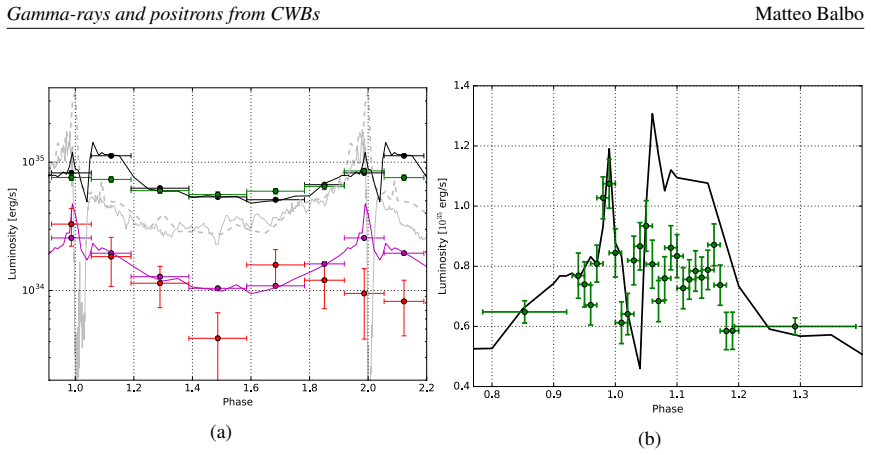
- With about $2.4\%$ of the shock mechanical energy going into proton acceleration, the predicted pion-decay light curve matches Fermi-LAT observations from periastron 2009 through apastron 2012.
- Protons can be accelerated to nearly $10^{15}\,\mathrm{eV}$ at periastron, close to the cosmic-ray knee, and colliding-wind binaries can sustain this acceleration over much of their lives, injecting up to $10^{48}$-$10^{49}$ erg of cosmic-ray energy.
- The $\gamma$-$\gamma$ absorption varies by roughly a factor of 40 in intensity and more than a factor of 20 in peak energy around periastron; CTA should detect these modulations as flux variability on timescales of a few days above $30\,\mathrm{GeV}$.
- An instrument sensitive in the 1-100 MeV band could discriminate the lepto-hadronic model from a purely hadronic one by measuring the strength of the inverse-Compton component.
Reading between the lines
- The paper focuses on one binary; a natural extension is to ask whether the same cell-by-cell recipe and $2.4\%$ efficiency, applied to the population of colliding-wind binaries, contributes a measurable fraction of the Galactic cosmic rays near the knee, since these systems stay active much longer than supernova remnants.
- The 2014.5 periastron did not reproduce the hard component seen in 2009, so the 'reverse bubble cavity' that doubles the shock area may be stochastic; repeated CTA periastron campaigns would turn that shock instability into a measurable quantity rather than a nuisance parameter.
- A sharper test than total flux would be the phase lag between periastron passage and the shift of the $\gamma$-$\gamma$ cutoff energy: that lag is set by the binary orientation and UV field geometry, so timing it would determine the line-of-sight geometry independently of the spectral normalization.
Signed reviews
Editorial analysis
A structured set of objections, weighed in public.
Referee Report
Summary. The paper argues that the gamma-ray emission of Eta Carinae, the first non-compact gamma-ray binary, arises in the colliding winds of the LBV primary and its hot companion: a low-energy (0.3-10 GeV) inverse-Compton component from accelerated electrons and a hard (>10 GeV) pion-decay component from accelerated protons. The authors use the 3D hydrodynamic simulations of Parkin et al. to compute, in each adaptive cell, the shock velocity, mechanical power, and maximum particle energy, balancing acceleration with radiative cooling. They report that a 2.4% proton acceleration efficiency reproduces the observed hard-component variability from periastron 2009 to apastron 2012, and that gamma-gamma absorption in the anisotropic UV field, with head-on versus tail-in collisions, modulates the hard emission by a factor of about 40 in intensity and more than 20 in peak energy. They conclude that CTA should detect these variations on timescales of a few days, disentangling the intrinsic particle cutoff from opacity and constraining the system geometry, magnetic field, and cosmic-ray injection.
Significance. If correct, the hadronic interpretation would establish Eta Carinae as a PeV-scale particle accelerator in a colliding-wind binary, with implications for cosmic-ray injection from massive-star winds. The paper's strengths are its explicit coupling of the 3D hydrodynamical grid to particle acceleration and cooling, its separate calculation of anisotropic gamma-gamma opacity with orientation-dependent head-on/tail-in collisions, and its concrete, falsifiable CTA predictions. The CTA simulations and the factor-40 opacity variation are useful forward-modeling results. However, the central evidential claim is not yet robust: the hard component's non-reappearance at the 2014.5 periastron is acknowledged but not explained, and the match relies on fitted acceleration efficiencies and on one specific hydrodynamical grid.
major comments (3)
- [Section 3, Fig. 2a] The claim that the >10 GeV hard component 'could be explained uniquely with a hadronic contribution' and that a 2.4% proton efficiency reproduces the 2009-2012 variability is not supported by the full dataset, because the paper itself states that 'in the following 2014.5 periastron passage the hard component did not show up again, remaining at a flux level compatible with the apastron.' Since the model is orbit-dependent, this is a predictive failure that should have produced a reappearing hard component at 2014.5. No physical mechanism (e.g., changes in wind parameters, clumpiness, acceleration efficiency, or shock geometry) is offered to reconcile the null. The 'reproduces the variability pattern' claim is therefore based on a single cycle and should be explicitly reframed as a post-diction of one event, or accompanied by a quantitative model for why the 2014.5 periastron behaved differently.
- [Section 3, Fig. 2] The agreement with the observed light curves is obtained by normalizing the electron and proton acceleration efficiencies (f_e and f_p, with f_p ~ 2.4%) and by choosing a surface magnetic field in the range 0.4-1 kG. These are free parameters of the model, and no degeneracy study, uncertainty estimate, or sensitivity analysis is presented. The text says the LE light curve is reproduced 'very well' and that the hard component 'could well reproduce' the variability, but without quantified uncertainties on f_p, f_e, and B, the reader cannot judge whether the 2014.5 null is a 1-sigma fluctuation, a 5-sigma contradiction, or something in between. Please provide error bars or at least a demonstration that the conclusions are stable across the allowed range of these parameters.
- [Section 3, paragraph on reverse bubble cavity] The LE light-curve match, including the post-periastron peak, depends crucially on the 'reverse bubble cavity' in the Parkin et al. hydrodynamical simulation, which roughly doubles the shock area for about a tenth of the orbit. The authors acknowledge that 'this secondary peak... could in reality collapse' because the details of magnetic field geometry, radiation transfer, and hydrodynamics are uncertain. Since the entire cell-by-cell particle acceleration calculation inherits the accuracy of this hydro grid, the central claim would be considerably strengthened by testing the sensitivity of the predicted light curves and spectra to plausible variations of the grid, such as including radiative cooling, clumping, or the difference between the Orbit-RD and Orbit-IA simulations. Without such tests, the agreement could be an artifact of the chosen simulation.
minor comments (4)
- [Abstract] The sentence 'These relativistic particles subsequently dissipates non-thermal radiation' has a subject-verb agreement error and is semantically imprecise; the particles radiate non-thermal emission rather than dissipating radiation.
- [Section 3, caption of Fig. 3] In the text accompanying Fig. 3, 'a an arbitrary spectrum' should read 'an arbitrary spectrum.' Please also state the assumed exposure time and the version of the CTA instrument response clearly in the caption.
- [Section 2] There are several typographical inconsistencies: '10∼ 40 M⊙' and '10 49.7 ergs' lack proper spacing and exponent formatting; 'Observations by Sir John Herschel [10], confirmed' contains an errant comma. These should be cleaned up.
- [References [38] and [40]] References [38] and [40] are cited as 'in preparation' and 'submitted,' respectively, yet they are used to support quantitative claims (the dashed variability curve in Fig. 4 and the detailed prospects for CTA observations). For the published record, either provide the actual evidence in this paper or cite the available data with a clear indication that the claims are preliminary.
Circularity Check
The light-curve normalization is set by fitted acceleration efficiencies and the hadronic-uniqueness claim leans on the authors' prior work, but the orbital variability pattern and the gamma-gamma opacity calculation retain independent content.
-
fitted input called prediction
[Section 3, paragraph beginning 'The hard component above & 10 GeV...' (discussion of Fig. 2).]
"Assuming that∼ 2.4% of the mechanical energy goes into proton acceleration, γ-rays emitted by π0 decay could well reproduce the variability pattern from periastron 2009 toward apastron 2012."
The 2.4% efficiency is a normalization input, not a derived prediction: it is the fraction chosen so that the hadronic π0-decay flux matches the observed high-energy light curve. The absolute flux level of the 'reproduced' variability is therefore fixed by construction. The orbital phase dependence is not forced, because it follows from the Parkin et al. hydrodynamical grid and the computed maximum energies, so the circularity is only partial; the temporal pattern remains an independent model output.
-
self citation load bearing
[Section 4, first paragraph.]
"The clear presence of an hard component around periastron 2009 above & 10 GeV can hardly be explained invoking a leptonic scenario [26]."
Reference [26] is Balbo & Walter (2017), the authors' own previous paper. The present paper's central 'uniquely hadronic' conclusion for the >10 GeV component leans on this self-citation to exclude leptonic emission. The in-text reasoning, that IC-cooled electron spectra cut off around a few GeV, is a summary of that same prior modeling. If the prior model already incorporates the same hydro grid and acceleration-efficiency choices, the citation does not provide independent external support for the uniqueness claim. This is load-bearing for the hadronic interpretation, though not definitionally circular because the gamma-gamma opacity calculation is independent.
full rationale
The paper's derivation chain is mostly self-contained when benchmarked against the external Parkin et al. hydrodynamical simulation and standard radiation formulae. The 0.3-10 GeV and >10 GeV light-curve normalizations are set by electron and proton acceleration efficiencies, with the paper explicitly stating 2.4% for protons, so matching the observed flux level is partly by construction. The orbital variability shape, however, follows from the phase-dependent hydro grid and the maximum-energy computation, not from the fitted normalization, so the 'reproduced variability pattern' is not entirely forced. The gamma-gamma absorption study in Section 4, including the head-on versus tail-in collision geometry and the factor of about 40 intensity variation, is an independent physical calculation that does not reduce to the fitted efficiencies. The hadronic-uniqueness claim for the >10 GeV component does rely on the authors' own 2017 paper, a load-bearing self-citation, but the text also summarizes the leptonic cutoff argument, giving the claim some in-paper content. The acknowledged non-reappearance of the hard component at the 2014.5 periastron is a serious predictive failure that weakens the variability claim, but it is a correctness risk rather than evidence of circularity. Overall, one fitted normalization and one load-bearing self-citation, with substantial independent content, justify a score of 4.
Assumptions & free parameters
free parameters (3)
- Proton acceleration efficiency f_p =
~2.4% of shock mechanical power
- Electron acceleration efficiency f_e =
not quoted; described as 'slightly smaller' than the proton efficiency
- Surface magnetic field B =
0.4-1 kG, reducible with amplification
assumptions (5)
- domain assumption Diffusive shock acceleration operates at the wind shocks and produces power-law spectra of electrons and protons.
- domain assumption The companion star is a non-observed O-type or Wolf-Rayet star with the adopted wind parameters (mass-loss rate ~1e-5 solar masses/year, terminal velocity ~3000 km/s).
- domain assumption The 3D hydrodynamic simulation of Parkin et al. (2011) correctly describes the geometry and density of the shocked gas at all orbital phases.
- ad hoc to paper The fraction of shock mechanical energy going into particle acceleration is constant in space and time.
- domain assumption The observed gamma-ray and X-ray emission is dominated by the wind collision region and contains no contribution from a compact object.
Cite this review
Pith. "Pith review of Gamma-rays and positrons from Colliding Wind Binaries." pith.science (2026). https://pith.science/paper/D66IQC4W
@misc{pith2026190900793,
  author       = {Pith},
  title        = {Pith review of: Gamma-rays and positrons from Colliding Wind Binaries},
  year         = {2026},
  howpublished = {\url{https://pith.science/paper/D66IQC4W}},
  note         = {Machine review of arXiv:1909.00793}
}
abstract
The $\eta$ Carinae binary system is the first $\gamma$-ray binary ever observed which does not contain a compact object. The dense wind of the primary star shocks against the fast light wind coming from the companion star, creating the conditions to accelerate particles up to relativistic energies via Fermi mechanisms. These relativistic particles subsequently dissipates non-thermal radiation. Fermi-LAT and H.E.S.S. detection of $\eta$ Carinae confirm such hypotheses. Hydrodynamic simulations provide a convincing match to the observations if a few percent of the wind mechanical energy dissipated in the shock goes into particle acceleration. The intrinsic $\pi^0$ decay spectrum is a complex convolution of the maximum energy, luminosity, particle drift and obscuration. Accelerated particles cool down mainly via inverse-Compton, synchrotron radiation, and photo-pion production. High-energy $\gamma$-rays interact also with the pool of anisotropic UV photons emitted by both luminous stars, creating $e^\pm$ pairs and strongly modifying the observed spectrum. Quick variations of the optical depth are expected along the orbit, due to changes in shape, position, and gas density of the shocked region. Various CTA simulations confirm that flux variabilities down to few days timescale could be detected above 30 GeV. These variations will disentangle the intrinsic particle spectral cut off from that related to $\gamma$-$\gamma$ opacity and determine the flux of relativistic protons and positrons injected in the interstellar medium, the geometry of the colliding wind region and the magnetic field configuration, as well as the geometrical orientation of the binary system. CTA will also enlighten the nature of the high-energy component, the mechanisms and the percentage of kinetic energy channelled into particle acceleration.
Figures


Figures from the paper (1 more)

Reference graph
Works this paper leans on
- [38]
-
[40]
M. Chernyakova, D. Malyshev, A. Paizis, N. La Palombara, M. Balbo, R. Walter et al., Prospects for observations of non-transient γ-ray binaries with Cherenkov Telescope Array., . 10
-
[1]
D. C. Abbott and P. S. Conti, Wolf-rayet stars., Annual Review of Astronomy and Astrophysics 25 (1987) 113
work page 1987
-
[2]
P. S. Conti, Mass loss in early-type stars., Annual Review of Astronomy and Astrophysics 16 (1978) 371
work page 1978
-
[3]
M. De Becker, Non-thermal emission processes in massive binaries, Astronomy and Astrophysics Review 14 (2007) 171 [0709.4220]
arXiv 2007
-
[4]
D. Eichler and V . Usov, Particle Acceleration and Nonthermal Radio Emission in Binaries of Early-Type Stars, Astrophysical Journal 402 (1993) 271
work page 1993
-
[5]
D. C. Abbott, J. H. Beiging, E. Churchwell and A. V . Torres,Radio Emission from Galactic Wolf-Rayet Stars and the Structure of Wolf-Rayet Winds, Astrophysical Journal 303 (1986) 239
work page 1986
-
[6]
Catalogue of particle-accelerating colliding-wind binaries
M. De Becker and F. Raucq, Catalogue of particle-accelerating colliding-wind binaries, Astronomy and Astrophysics 558 (2013) A28 [1308.3149]
work page Pith review arXiv 2013
Show all 40 references
-
[7]
D. J. Hillier, K. Davidson, K. Ishibashi and T. Gull, On the Nature of the Central Source in η Carinae, Astrophysical Journal 553 (2001) 837
2001
-
[8]
R. M. Humphreys, K. Davidson and N. Smith, η Carinae’s Second Eruption and the Light Curves of the η Carinae Variables, Publications of the Astronomical Society of the Pacific 111 (1999) 1124
1999
-
[9]
Davidson and R
K. Davidson and R. M. Humphreys, Eta Carinae and Its Environment, Annual Review of Astronomy and Astrophysics 35 (1997) 1
1997
-
[10]
Smith and D
N. Smith and D. J. Frew, A revised historical light curve of Eta Carinae and the timing of close periastron encounters, Monthly Notices of the RAS 415 (2011) 2009 [1010.3719]
2011 arXiv
-
[11]
H. L. Gomez, C. Vlahakis, C. M. Stretch, L. Dunne, S. A. Eales, A. Beelen et al., Submillimetre variability of Eta Carinae: cool dust within the outer ejecta, Monthly Notices of the RAS 401 (2010) L48 [0911.0176]
2010 arXiv
-
[12]
Smith, R
N. Smith, R. D. Gehrz, P. M. Hinz, W. F. Hoffmann, J. L. Hora, E. E. Mamajek et al., Mass and Kinetic Energy of the Homunculus Nebula around η Carinae, Astronomical Journal 125 (2003) 1458
2003
-
[13]
Damineli, The 5.52 Year Cycle of Eta Carinae, Astrophysical Journal 460 (1996) L49
A. Damineli, The 5.52 Year Cycle of Eta Carinae, Astrophysical Journal 460 (1996) L49. 4I used the South_z40_50h IRF. 8 Gamma-rays and positrons from CWBs Matteo Balbo
1996
-
[14]
Davidson, The Physical Nature of η Carinae, in The Fate of the Most Massive Stars, R
K. Davidson, The Physical Nature of η Carinae, in The Fate of the Most Massive Stars, R. Humphreys and K. Stanek, eds., vol. 332 of Astronomical Society of the Pacific Conference Series, p. 103, Sep, 2005
2005
-
[15]
J. H. Groh, D. J. Hillier, T. I. Madura and G. Weigelt, On the influence of the companion star in Eta Carinae: 2D radiative transfer modelling of the ultraviolet and optical spectra, Monthly Notices of the RAS 423 (2012) 1623 [1204.1963]
2012 arXiv
-
[16]
J. M. Pittard and M. F. Corcoran, In hot pursuit of the hidden companion of eta Carinae: An X-ray determination of the wind parameters, Astronomy and Astrophysics 383 (2002) 636 [astro-ph/0201105]
2002 arXiv
-
[17]
H. V . Bradt, R. E. Rothschild and J. H. Swank, X-ray timing explorer mission, Astronomy and Astrophysics Supplement Series 97 (1993) 355
1993
-
[18]
Damineli, D
A. Damineli, D. J. Hillier, M. F. Corcoran, O. Stahl, R. S. Levenhagen, N. V . Leister et al.,The periodicity of the η Carinae events, Monthly Notices of the RAS 384 (2008) 1649 [0711.4250]
2008 arXiv
-
[19]
A. T. Okazaki, S. P. Owocki, C. M. P. Russell and M. F. Corcoran, Modelling the RXTE light curve of η Carinae from a 3D SPH simulation of its binary wind collision, Monthly Notices of the RAS 388 (2008) L39 [0805.1794]
2008 arXiv
-
[20]
E. R. Parkin, J. M. Pittard, M. F. Corcoran and K. Hamaguchi, Spiraling Out of Control: Three-dimensional Hydrodynamical Modeling of the Colliding Winds in η Carinae, Astrophysical Journal 726 (2011) 105 [1011.0778]
2011 arXiv
-
[21]
I. R. Stevens, J. M. Blondin and A. M. T. Pollock, Colliding Winds from Early-Type Stars in Binary Systems, Astrophysical Journal 386 (1992) 265
1992
-
[22]
M. F. Corcoran, K. Hamaguchi, J. K. Liburd, D. Morris, T. R. Gull, T. I. Madura et al., The X-ray Lightcurve of the Supermassive star eta Carinae, 1996–2014, arXiv e-prints (2015) arXiv:1507.07961 [1507.07961]
2015 arXiv
-
[23]
Dgani, R
R. Dgani, R. Walder and H. Nussbaumer, Stability analysis of colliding winds in a double star system., Astronomy and Astrophysics 267 (1993) 155
1993
-
[24]
Folini and R
D. Folini and R. Walder, 3D Hydrodynamical Simulations of Colliding Wind Binaries: Theory Confronts Observations, Astrophysics and Space Science 274 (2000) 189
2000
-
[25]
Leyder, R
J.-C. Leyder, R. Walter and G. Rauw, Hard X-ray emission from η Carinae, Astronomy and Astrophysics 477 (2008) L29 [0712.1491]
2008 arXiv
-
[26]
Balbo and R
M. Balbo and R. Walter, Fermi acceleration along the orbit of η Carinae, Astronomy and Astrophysics 603 (2017) A111 [1705.02706]
2017 arXiv
-
[27]
Leser, S
E. Leser, S. Ohm, M. Füßling, M. de Naurois, K. Egberts, P. Bordas et al., First Results of Eta Carinae Observations with H.E.S.S. II, International Cosmic Ray Conference 301 (2017) 717 [1708.01033]
2017 arXiv
-
[28]
Reimer, M
A. Reimer, M. Pohl and O. Reimer, Nonthermal High-Energy Emission from Colliding Winds of Massive Stars, Astrophysical Journal 644 (2006) 1118 [astro-ph/0510701]
2006 arXiv
-
[29]
Panagiotou and R
C. Panagiotou and R. Walter, The environment of the wind-wind collision region ofη Carinae, Astronomy and Astrophysics 610 (2018) A37 [1712.01382]
2018 arXiv
-
[30]
Falceta-Gonçalves and Z
D. Falceta-Gonçalves and Z. Abraham, MHD numerical simulations of colliding winds in massive binary systems - I. Thermal versus non-thermal radio emission, Monthly Notices of the RAS 423 (2012) 1562 [1203.5093]. 9 Gamma-rays and positrons from CWBs Matteo Balbo
2012 arXiv
-
[31]
Kowal, E
G. Kowal, E. M. de Gouveia Dal Pino and A. Lazarian, Magnetohydrodynamic Simulations of Reconnection and Particle Acceleration: Three-dimensional Effects, Astrophysical Journal 735 (2011) 102 [1103.2984]
2011 arXiv
-
[32]
Kowal, A
G. Kowal, A. Lazarian, E. T. Vishniac and K. Otmianowska-Mazur, Numerical Tests of Fast Reconnection in Weakly Stochastic Magnetic Fields, Astrophysical Journal 700 (2009) 63 [0903.2052]
2009 arXiv
-
[33]
J. Park, D. Caprioli and A. Spitkovsky, Simultaneous Acceleration of Protons and Electrons at Nonrelativistic Quasiparallel Collisionless Shocks, Physical Review Letters 114 (2015) 085003 [1412.0672]
2015 arXiv
-
[34]
S. Ohm, V . Zabalza, J. A. Hinton and E. R. Parkin, On the origin of γ-ray emission in η Carina, Monthly Notices of the RAS 449 (2015) L132 [1502.04056]
2015 arXiv
-
[35]
Reitberger, O
K. Reitberger, O. Reimer, A. Reimer, M. Werner, K. Egberts and H. Takahashi, Gamma-ray follow-up studies on η Carinae, Astronomy and Astrophysics 544 (2012) A98 [1203.4939]
2012 arXiv
-
[36]
V oisin, F
G. V oisin, F. Mottez and S. Bonazzola,Electron-positron pair production by gamma-rays in an anisotropic flux of soft photons, and application to pulsar polar caps, Monthly Notices of the RAS 474 (2018) 1436 [1710.04021]
2018 arXiv
-
[37]
T. I. Madura, T. R. Gull, S. P. Owocki, J. H. Groh, A. T. Okazaki and C. M. P. Russell,Constraining the absolute orientation of η Carinae’s binary orbit: a 3D dynamical model for the broad [Fe III] emission, Monthly Notices of the RAS 420 (2012) 2064 [1111.2226]
2012 arXiv
-
[39]
S. Funk, J. A. Hinton and CTA Consortium, Comparison of Fermi-LAT and CTA in the region between 10-100 GeV, Astroparticle Physics 43 (2013) 348 [1205.0832]
2013 arXiv
Reviewed August 14, 2026 · model on record in the stance chip above.
Discussion (0). Continue with ORCID to comment.