REVIEW 3 major objections 4 minor 2 cited by
Letter of Intent for the LUXE Experiment
T0 review · 3 major / 4 minor · reviewed 2026-08-14 · deepseek-v4-flash
Pith's one-line read LUXE is a proposed experiment to collide the 17.5 GeV electron beam of the European XFEL, or photons produced from it, with laser pulses of up to 300 TW, reaching a quantum parameter above 3 and aiming to open the non-perturbative regime…
desk verdict A serious, well-motivated LoI for a strong-field QED experiment, with the expected gaps for a proposal: no new physics result, an unvalidated background-suppression target, and an unfinished draft section. read the letter →
The pith
A machine-rendered reading of the paper's core claim, the machinery that carries it, and where it could break.
The reading
What carries the argument
The load-bearing objects are two dimensionless ratios: $\xi = eE_L/(m_e\omega_L)$, the laser intensity parameter that counts how many laser photons effectively participate, and $\chi_i = \xi\,\eta_i$, the quantum parameter that measures the laser field in the particle's rest frame in units of the Schwinger critical field $E_{\mathrm{cr}}=m_e^2/e$. The experiment is built around scanning $\xi$ at fixed electron energy, with $\chi_e$ reaching about 3.3 for 17.5 GeV electrons in a 300 TW, 3 $\mu$m focus. The signature to be measured is a bend in the rate-versus-intensity curve, from $\xi^{2n_*}$ to $\chi e^{-8/(3\chi)}$, and the technical apparatus—bunch extraction from the XFEL, shot-by-shot laser intensity tagging, and a dipole spectrometer with silicon pixel, calorimeter and Cherenkov detectors—exists to make that rate measurement at signal levels down to $10^{-2}$ per shot.
What would settle it
A clean falsification would be a high-precision positron-rate scan over $\xi$ at 17.5 GeV showing a single power law from the lowest point to $\xi\approx 16$ with no measurable bend toward exponential behaviour; the paper's central claim stands or falls on whether the bend appears where predicted.
Extended reading notes
Core claim
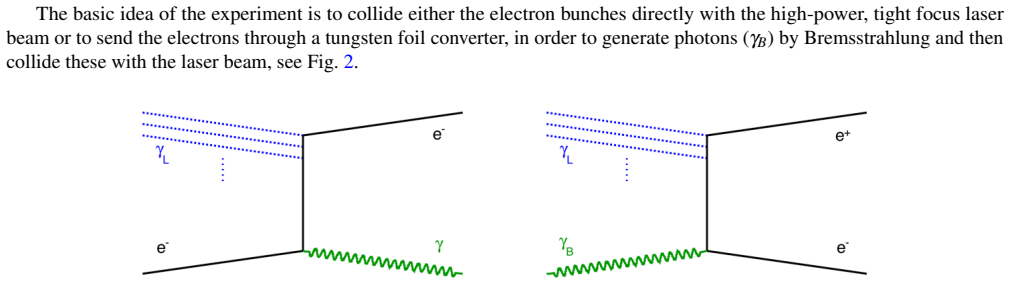
The core claim is that a single experiment can map the transition to non-perturbative strong-field QED by scanning the laser intensity parameter $\xi$ while measuring nonlinear Compton scattering, nonlinear Breit-Wheeler pair production, and trident production. The predicted rates switch from the multiphoton power law $P\propto \xi^{2n_*}$ to the non-analytic form $P\propto \chi_\gamma e^{-8/(3\chi_\gamma)}$, and LUXE is designed to resolve that bend and extract the exponent to about 10% precision. In the photon-laser mode, the positron yield is projected to rise from about $7\times 10^{-3}$ to 350 per shot across the intensity scan, providing a direct experimental handle on vacuum pair production without needing a static field at the Schwinger critical value.
Load-bearing premise
The load-bearing premise is that detector backgrounds from stray particles can be suppressed below 0.1 positrons per laser shot, because the low-intensity end of the measurement uses signal rates as small as 0.01 events per shot.
Editorial extensions
If this is right
- A successful measurement of the rate bend would provide the first direct experimental evidence in QED of a non-perturbative regime at small coupling, a phenomenon previously seen experimentally only in strongly coupled theories such as QCD.
- It would test Schwinger's predicted non-analytic dependence of pair production on field strength, extracting the exponent of the exponential rate to about 10%.
- It would separate one-step from two-step trident production by comparing the measured positron signal with the two-step prediction, settling whether the older Weizsäcker-Williams estimate was reliable.
- It would give a laboratory probe of vacuum properties relevant to astrophysical settings and could search for new scalar or photon self-interactions beyond the Standard Model.
- If backgrounds can be held at 0.1 positrons per laser shot, the projected 5–10% precision at low $\xi$ makes the full scan meaningful; if backgrounds reach one event per shot, the low-intensity points degrade to roughly 40% uncertainty.
Reading between the lines
- A natural extension not developed in the letter is to repeat the same $\xi$ scan at two electron energies, such as 14 GeV and 17.5 GeV: since $\chi$ scales with electron energy while $\xi$ does not, agreement of the normalized rate curves in $\chi$ would confirm that the quantum parameter is the true ruling variable, while disagreement would expose pulse-shape or beam systematic effects.
- The experiment could be extended to a pure photon-photon scattering mode with the electron beam absent, where the Standard Model Heisenberg-Euler signal is tiny and any measurable excess would point to axion-like particles or other new physics; the letter notes the BSM sensitivity but does not quantify a discovery reach for such a mode.
- The same infrastructure could be turned into a more direct quantum-radiation-reaction measurement by reconstructing the full electron energy loss across the interaction, not just counting positrons; the letter lists radiation reaction as an early-phase goal but not as a primary precision observable.
- The shot-by-shot intensity tagging scheme, if it reaches its stated 0.1% goal, would allow the experiment to bin data by actual laser intensity rather than by nominal setting, effectively turning laser intensity fluctuations from a systematic into a measured handle.
Editorial analysis
A structured set of objections, weighed in public.
Referee Report
Summary. This Letter of Intent proposes the LUXE experiment at the European XFEL, which would collide the high-energy electron beam, or bremsstrahlung photons derived from it, with a high-power Ti:sapphire laser (30–300 TW). The physics goal is to study strong-field QED in the non-perturbative regime: nonlinear Compton scattering, nonlinear Breit-Wheeler pair production, and trident production, with planned access to laser intensity parameters up to ξ ≈ 16 and quantum parameters up to χ ≈ 3, well beyond the SLAC E144 experiment. The manuscript describes the accelerator extraction scheme, laser specifications and diagnostics, detector concepts based on silicon pixel trackers, calorimeters, and Cherenkov counters, as well as a schedule. It presents Monte Carlo based projections for positron rates versus ξ and claims statistical precision better than 5% per measurement point with systematic uncertainties at a similar level.
Significance. If the projected performance is met, LUXE would provide the first controlled exploration of all-order, small-coupling non-perturbative QED, directly testing the predicted transition from power-law scaling in ξ to the exponential non-perturbative regime. The proposal is notably well grounded experimentally: it builds on the E144 measurements, reuses mature detector technologies (ALPIDE, LumiCal, and Cherenkov prototypes) with existing test-beam results, and makes concrete falsifiable predictions for rate scalings. The technical integration with the European XFEL infrastructure is described in realistic detail. However, the central quantitative claim of 5–10% precision measurements across the full ξ range is not yet supported by an error budget; two load-bearing feasibility items—the secondary positron background suppression and the in-situ peak-field calibration—remain unvalidated or incomplete in the manuscript.
major comments (3)
- [Sec. 2.3] The low-ξ portion of the physics program depends on an unvalidated background suppression goal. The text states that fewer than 20 secondary positrons with E > 1 GeV per 1.5×10^9 beam electrons enter the detector acceptance and that it is 'anticipated that they can be rejected based on precision tracking information', with the 'goal' of reducing this to less than 0.1 positrons per laser shot. No tracking rejection algorithm, expected efficiency, or systematic validation is presented for the required factor of more than 200 suppression. This matters because Table 5 lists the expected γB–laser positron rate at ξ = 1.2 as 1×10^-2 per shot and Table 4 lists the e–laser positron rate at ξ = 0.26 as below 0.01 per shot, and the text itself states that at a background of 1 event per shot the 0.01-rate measurement degrades to 40% precision. The claimed 5–10% precision across the power-law-to-exponential transition therefore rests on an unverified background assumption.
- [Sec. 4.4] The section on determining the peak electric field in focus is not in a reviewable state: it contains duplicated draft text, placeholder instructions such as 'insert picture with kinematics of the Compton scattering and explanations', and an unedited derivation of the Compton-edge calibration method in Eqs. (11)–(14) with undefined notation. Since the ξ-scale of every rate projection depends on the absolute in-focus field calibration, the statements that 'an absolute calibration of better than 5%' is achievable in the early phase and that 0.1% absolute accuracy appears realistic are not supported by the manuscript as presented.
- [Sec. 1 and Sec. 4.6] The claimed 5% systematic uncertainty is not backed by an error budget. The Executive Summary states that statistical precision will be better than 5% and that 'systematic uncertainties are expected to be at a similar level', while Sec. 4.6 assumes that the peak achievable intensity is 'no more than 40% of the theoretical value' without assigning an uncertainty to this in-focus energy fraction or to the pulse duration and focal-spot FWHM that enter ξ. These quantities propagate directly into every predicted rate and into the comparison with theory; a quantitative sensitivity analysis or covariance budget is needed before the precision claim can be assessed.
minor comments (4)
- [Sec. 7] The conclusions state that LUXE 'has the potential to pioneer an new regime of quantum physics'; 'an new' should read 'a new'.
- [Sec. 6] The schedule entry '2025-2027: Commissioning an data taking with 300 TW laser' contains a typo; 'an' should be 'and'.
- [Table 3] The row 'Dimensionless peak intensity, ξ2' appears to be missing the entry for the 30 TW, 8 µm column (values 6.2 and 16 are shown for the two 300 TW columns); please clarify the intended entries.
- [Fig. 10 caption] The caption states 'No uncertainties are shown' while the text says the statistical precision is expected to be 'between about 10% at low ξ and ≪1% at high ξ'; adding the corresponding uncertainty bands or error bars would make the projection more interpretable, even if preliminary.
Circularity Check
No significant circularity: LUXE's sensitivity projections use external, parameter-free strong-field QED rates; the overlapping-authorship citations are contextual and not the source of the predicted scaling.
full rationale
The projection chain is: define ξ and χ; adopt standard strong-field QED rates (Ritus asymptotic form, Volkov-dressed Compton and Breit-Wheeler rates); generate events with a Monte Carlo calculation 'similar to those described in Refs. [27,48]'; pass the events through a detector simulation; and arrive at the rate tables and scaling curves. For circularity, the predicted rate-versus-ξ scaling would have to be imposed by the experimental inputs, or by a self-citation that is itself the unverified conclusion. Neither occurs here. The rates are parameter-free functions of ξ and χ with no parameter fitted to LUXE data, and the strong-field QED machinery is benchmarked against SLAC E144 observations of nonlinear Compton scattering and multiphoton Breit-Wheeler pair production, so it is externally falsifiable rather than defined in terms of the target measurement. Refs. [27,48] do have overlapping authors, but they are used as event-generator sources, not as uniqueness theorems or authority-based constraints that forbid alternatives. The ξ value for the physics plots is not obtained by fitting the pair-production rate: Sec. 2.3 states that the average ξ is calculated from the known pulse shape and energy, and Sec. 4.4 adds independent cross-calibration concepts including PTB traceable standards and classical ponderomotive scattering. The Compton-edge-shift cross-check uses the same mass-shift formula as one of the physics observables, but this is a calibration cross-check, not the derivation of the power-law-to-exponential prediction. Two manuscript caveats should be flagged as completeness or feasibility risks rather than circularity: Sec. 4.4 is an unfinished draft containing 'insert picture with kinematics...' placeholders that leaves the ξ-calibration claim partially unsupported, and Sec. 2.3's goal of suppressing background to below 0.1 positrons per laser shot is an explicitly stated target, with the paper itself quantifying the 40% precision degradation if the background reaches 1 event per shot. Neither caveat reduces the claimed scientific result to its inputs, so the circularity burden remains low.
Assumptions & free parameters
free parameters (5)
- In-focus laser energy fraction =
40%
- Laser pulse duration =
30 fs
- Laser focal spot FWHM =
8 µm (phases A and B), 3 µm (phase C)
- Electron bunch charge and energy =
0.25 nC at 17.5 GeV
- Background suppression target =
<0.1 positrons per laser shot
assumptions (4)
- domain assumption Standard strong-field QED rates for nonlinear Compton, Breit-Wheeler, and trident processes in intense laser fields.
- domain assumption The European XFEL will provide beam parameters as specified, including up to 17.5 GeV, 1.5e9 electrons per bunch, and 10 Hz trains.
- domain assumption GEANT4 and FLUKA simulations reliably model backgrounds and detector response for the proposed geometry.
- domain assumption The laser shot-to-shot intensity can be tagged to sub-0.1% precision and cross-calibrated to 5% absolute accuracy.
Cite this review
Pith. "Pith review of Letter of Intent for the LUXE Experiment." pith.science (2026). https://pith.science/paper/SLR5JWP7
@misc{pith2026190900860,
  author       = {Pith},
  title        = {Pith review of: Letter of Intent for the LUXE Experiment},
  year         = {2026},
  howpublished = {\url{https://pith.science/paper/SLR5JWP7}},
  note         = {Machine review of arXiv:1909.00860}
}
read the original abstract
This Letter of Intent describes LUXE (Laser Und XFEL Experiment), an experiment that aims to use the high-quality and high-energy electron beam of the European XFEL and a powerful laser. The scientific objective of the experiment is to study quantum electrodynamics processes in the regime of strong fields. High-energy electrons, accelerated by the European XFEL linear accelerator, and high-energy photons, produced via Bremsstrahlung of those beam electrons, colliding with a laser beam shall experience an electric field up to three times larger than the Schwinger critical field (the field at which the vacuum itself is expected to become unstable and spark with spontaneous creation of electron-positron pairs) and access a new regime of quantum physics. The processes to be investigated, which include nonlinear Compton scattering and nonlinear Breit-Wheeler pair production, are relevant to a variety of phenomena in Nature, e.g. in the areas of astrophysics and collider physics and complement recent results in atomic physics. The setup requires in particular the extraction of a minute fraction of the electron bunches from the European XFEL accelerator, the installation of a powerful laser with sophisticated diagnostics, and an array of precision detectors optimised to measure electrons, positrons and photons. Physics sensitivity projections based on simulations are also provided.
Figures


Figures from the paper (24 more)



Forward citations
Cited by 2 Pith papers
-
Searching for long-lived ALPs with a laser-assisted optical dump
A laser-assisted optical dump could probe ALP-electron couplings down to ~10^-6 (10^-7) GeV^-1 with 16.5 (125) GeV electron beams, and when both couplings are present the Primakoff process improves the electron-coupli...
-
Soft photon approximation in a laser field: applications
Soft-photon factors with exact phase treatment give O(ω/ε)-accurate multi-photon Compton amplitudes in a laser field, outperforming classical theory and enabling efficient N-photon calculations.
Reference graph
Works this paper leans on
-
[1]
Consequences of Dirac’s theory of positrons
W. Heisenberg and H. Euler, “Consequences of Dirac’s theory of positrons”,Z. Phys. 98 (1936), no. 11-12, 714–732, arXiv:physics/0605038
arXiv 1936
-
[2]
On Gauge Invariance and Vacuum Polarization
J. Schwinger, “On Gauge Invariance and Vacuum Polarization”, Phys. Rev. 82 (1951), no. 3, 664–679
work page 1951
-
[3]
Observation of nonlinear effects in Compton scattering
E144 Collaboration, “Observation of nonlinear effects in Compton scattering”, Phys. Rev. Lett. 76 (1996) 3116–3119
work page 1996
-
[4]
Positron production in multi - photon light by light scattering
D. L. Burke et al., “Positron production in multi - photon light by light scattering”, Phys. Rev. Lett. 79 (1997) 1626–1629
work page 1997
-
[5]
T. Brabec, “Strong Field Laser Physics”, Springer Series on Optical Sciences 134 (2009)
work page 2009
-
[6]
New Measurement of the Electron Magnetic Moment Using a One-Electron Quantum Cyclotron
B. C. Odom, D. Hanneke, B. D’Urso, and G. Gabrielse, “New Measurement of the Electron Magnetic Moment Using a One-Electron Quantum Cyclotron”, Phys. Rev. Lett. 97 (2006) 030801. [Erratum: Phys. Rev. Lett.99,039902(2007)]
work page 2006
-
[7]
New Determination of the Fine Structure Constant from the Electron g Value and QED
G. Gabrielse et al., “New Determination of the Fine Structure Constant from the Electron g Value and QED”, Phys. Rev. Lett. 97 (2006) 030802. [Erratum: Phys. Rev. Lett.99,039902(2007)]
work page 2006
-
[8]
S. V olkov, “New method of computing the contributions of graphs without lepton loops to the electron anomalous magnetic moment in QED”, Phys. Rev. D96 (2017), no. 9, 096018, arXiv:1705.05800
arXiv 2017
Show all 69 references
-
[9]
The Muon (g-2) Theory Value: Present and Future
T. Blum et al., “The Muon (g-2) Theory Value: Present and Future”,arXiv:1311.2198
-
[10]
The Muon g-2 in Progress
F. Jegerlehner, “The Muon g-2 in Progress”, Acta Phys. Polon. B49 (2018) 1157, arXiv:1804.07409
2018 arXiv
-
[11]
Muon (g-2) Technical Design Report
Muon g-2 Collaboration, “Muon (g-2) Technical Design Report”,arXiv:1501.06858
-
[12]
An X-ray pulsar with a superstrong magnetic field in the soft gamma-ray repeater SGR 1806-20
C. Kouveliotou et al., “An X-ray pulsar with a superstrong magnetic field in the soft gamma-ray repeater SGR 1806-20.”, Nature 393 (1998) 235–237
1998
-
[13]
End Effects in Quantum Beamstrahlung
M. Bell and J. S. Bell, “End Effects in Quantum Beamstrahlung”, Part. Accel. 24 (1988) 1. [,1(1987)]
1988
-
[14]
Quantum Beamstrahlung: Prospects for a Photon-photon Collider
R. Blankenbecler and S. D. Drell, “Quantum Beamstrahlung: Prospects for a Photon-photon Collider”, Phys. Rev. Lett. 61 (1988) 2324. [Erratum: Phys. Rev. Lett.62,116(1989)]
1988
-
[15]
On energy levels in systems withZ > 137
I. Pomeranchuk and Y . Smorodinsky, “On energy levels in systems withZ > 137”, J. Phys. USSR 9 (1945) 97
1945
-
[16]
Proposal for experimental studies of nonlinear quantum electrodynamics
K. T. McDonald, “Proposal for experimental studies of nonlinear quantum electrodynamics”,
-
[17]
Exploring high-intensity QED at ELI
T. Heinzl and A. Ilderton, “Exploring high-intensity QED at ELI”, Eur. Phys. J. D55 (2009) 359–364, arXiv:0811.1960
2009 arXiv
-
[18]
Compression of amplified chirped optical pulses
D. Strickland and G. Mourou, “Compression of amplified chirped optical pulses”, Opt. Commun. 55 (1985), no. 6, 447–449. [Erratum: Opt. Commun.56,219(1985)]
1985
-
[19]
New Strong-Field QED Effects at ELI: Nonperturbative Vacuum Pair Production
G. V . Dunne, “New Strong-Field QED Effects at ELI: Nonperturbative Vacuum Pair Production”,Eur. Phys. J. D55 (2009) 327–340, arXiv:0812.3163
2009 arXiv
-
[20]
Extremely high-intensity laser interactions with fundamental quantum systems
A. Di Piazza, C. Muller, K. Z. Hatsagortsyan, and C. H. Keitel, “Extremely high-intensity laser interactions with fundamental quantum systems”, Rev. Mod. Phys. 84 (2012) 1177, arXiv:1111.3886. 31/33
2012 arXiv
-
[21]
Experimental evidence of radiation reaction in the collision of a high-intensity laser pulse with a laser-wakefield accelerated electron beam
J. M. Cole et al., “Experimental evidence of radiation reaction in the collision of a high-intensity laser pulse with a laser-wakefield accelerated electron beam”, Phys. Rev. X8 (2018), no. 1, 011020, arXiv:1707.06821
2018 arXiv
-
[22]
Experimental Signatures of the Quantum Nature of Radiation Reaction in the Field of an Ultraintense Laser
K. Poder et al., “Experimental Signatures of the Quantum Nature of Radiation Reaction in the Field of an Ultraintense Laser”, Phys. Rev. X8 (2018), no. 3, 031004, arXiv:1709.01861
2018 arXiv
-
[23]
Extreme Light Infrastructure - Nuclear Physics (ELI-NP) European Research Centre
N. V . Zamfir, “Extreme Light Infrastructure - Nuclear Physics (ELI-NP) European Research Centre”,EPJ Web Conf. 66 (2014) 11043
2014
-
[24]
Trident pair production in a constant crossed field
B. King and H. Ruhl, “Trident pair production in a constant crossed field”, Phys. Rev. D88 (2013), no. 1, 013005, arXiv:1303.1356
2013 arXiv
-
[25]
Special analytical properties of ultrastrong coherent fields
H. R. Reiss, “Special analytical properties of ultrastrong coherent fields”, Eur. Phys. J. D55 (2009) 365–374
2009
-
[26]
Complete QED theory of multiphoton trident pair production in strong laser fields
H. Hu, C. Muller, and C. H. Keitel, “Complete QED theory of multiphoton trident pair production in strong laser fields”, Phys. Rev. Lett. 105 (2010) 080401, arXiv:1002.2596
2010 arXiv
-
[27]
Measuring the Boiling Point of the Vacuum of Quantum Electrodynamics
A. Hartin, A. Ringwald, and N. Tapia, “Measuring the Boiling Point of the Vacuum of Quantum Electrodynamics”, Phys. Rev. D99 (2019), no. 3, 036008, arXiv:1807.10670
2019 arXiv
-
[28]
Experimental evidence of quantum radiation reaction in aligned crystals
T. N. Wistisen, A. Di Piazza, H. V . Knudsen, and U. I. Uggerhøj, “Experimental evidence of quantum radiation reaction in aligned crystals”, Nature Commun. 9 (2018), no. 1, 795, arXiv:1704.01080
2018 arXiv
-
[29]
Studies of nonlinear QED in collisions of 46.6-GeV electrons with intense laser pulses
C. Bamber et al., “Studies of nonlinear QED in collisions of 46.6-GeV electrons with intense laser pulses”, Phys. Rev. D60 (1999) 092004
1999
-
[30]
Three lectures on the physics of small x and high gluon density
L. D. McLerran, “Three lectures on the physics of small x and high gluon density”, AIP Conf. Proc. 490 (1999), no. 1, 42–79, arXiv:hep-ph/9903536
1999 arXiv
-
[31]
Electron Ion Collider: The Next QCD Frontier
A. Accardi et al., “Electron Ion Collider: The Next QCD Frontier”, Eur. Phys. J. A52 (2016), no. 9, 268, arXiv:1212.1701
2016 arXiv
-
[32]
FCC Physics Opportunities
FCC Collaboration, “FCC Physics Opportunities”, Eur. Phys. J. C79 (2019), no. 6, 474
2019
-
[33]
Physics case of the very high energy electron–proton collider, VHEeP
A. Caldwell, F. Keeble, E. S. Dore, and M. Wing, “Physics case of the very high energy electron–proton collider, VHEeP”, PoS DIS2017 (2018) 083, arXiv:1708.08707
2018 arXiv
-
[34]
Quantum effects of the interaction of elementary particles with an intense electromagnetic field
V . I. Ritus, “Quantum effects of the interaction of elementary particles with an intense electromagnetic field”,J. Russ. Laser Res. 6 (1985), no. 5, 497–617
1985
-
[35]
Interaction of Intense Laser Beams with Electrons
L. S. Brown and T. W. B. Kibble, “Interaction of Intense Laser Beams with Electrons”, Phys. Rev. 133 (1964) A705–A719
1964
-
[36]
Signatures of High-Intensity Compton Scattering
C. Harvey, T. Heinzl, and A. Ilderton, “Signatures of High-Intensity Compton Scattering”, Phys. Rev. A79 (2009) 063407, arXiv:0903.4151
2009 arXiv
-
[37]
Intensity-Dependent Electron Mass Shift in a Laser Field: Existence, Universality, and Detection
C. Harvey, T. Heinzl, A. Ilderton, and M. Marklund, “Intensity-Dependent Electron Mass Shift in a Laser Field: Existence, Universality, and Detection”, Phys. Rev. Lett. 109 (2012) 100402, arXiv:1203.6077
2012 arXiv
-
[38]
Finite size effects in stimulated laser pair production
T. Heinzl, A. Ilderton, and M. Marklund, “Finite size effects in stimulated laser pair production”, Phys. Lett. B692 (2010) 250–256, arXiv:1002.4018
2010 arXiv
-
[39]
Photon polarisation in electron-seeded pair-creation cascades
B. King, N. Elkina, and H. Ruhl, “Photon polarisation in electron-seeded pair-creation cascades”, Phys. Rev. A87 (2013) 042117, arXiv:1301.7001
2013 arXiv
-
[40]
Trident pair production in strong laser pulses
A. Ilderton, “Trident pair production in strong laser pulses”, Phys. Rev. Lett. 106 (2011) 020404, arXiv:1011.4072
2011 arXiv
-
[41]
Trident pair production in plane waves: Coherence, exchange, and spacetime inhomogeneity
V . Dinu and G. Torgrimsson, “Trident pair production in plane waves: Coherence, exchange, and spacetime inhomogeneity”, Phys. Rev. D97 (2018), no. 3, 036021, arXiv:1711.04344
2018 arXiv
-
[42]
Effect of interference on the trident process in a constant crossed field
B. King and A. M. Fedotov, “Effect of interference on the trident process in a constant crossed field”, Phys. Rev. D98 (2018), no. 1, 016005, arXiv:1801.07300
2018 arXiv
-
[43]
Nonlinear trident pair production in an arbitrary plane wave: a focus on the properties of the transition amplitude
F. Mackenroth and A. Di Piazza, “Nonlinear trident pair production in an arbitrary plane wave: a focus on the properties of the transition amplitude”, Phys. Rev. D98 (2018), no. 11, 116002, arXiv:1805.01731
2018 arXiv
-
[44]
Vacuum polarization correction to elastic electron and muon scattering in an intense field and pair electro- and muoproduction
V . I. Ritus, “Vacuum polarization correction to elastic electron and muon scattering in an intense field and pair electro- and muoproduction”, Nucl. Phys. B44 (1972) 236–252
1972
-
[45]
Virtual axion-like particle complement to Euler-Heisenberg-Schwinger action
S. Evans and J. Rafelski, “Virtual axion-like particle complement to Euler-Heisenberg-Schwinger action”, Phys. Lett. B791 (2019) 331–334, arXiv:1810.06717. 32/33
2019 arXiv
-
[46]
Phenomenology of relaxion-Higgs mixing
T. Flacke et al., “Phenomenology of relaxion-Higgs mixing”, JHEP 06 (2017) 050, arXiv:1610.02025
2017 arXiv
-
[47]
Probing ALPs and the Axiverse with Superconducting Radiofrequency Cavities
Z. Bogorad, A. Hook, Y . Kahn, and Y . Soreq, “Probing ALPs and the Axiverse with Superconducting Radiofrequency Cavities”, Phys. Rev. Lett. 123 (2019), no. 2, 021801, arXiv:1902.01418
2019 arXiv
-
[48]
Strong field QED in lepton colliders and electron/laser interactions
A. Hartin, “Strong field QED in lepton colliders and electron/laser interactions”, Int. J. Mod. Phys. A33 (2018), no. 13, 1830011, arXiv:1804.02934
2018 arXiv
-
[49]
Recent developments in Geant4
J. Allison et al., “Recent developments in Geant4”, Nucl. Instrum. Meth. A835 (2016) 186–225
2016
-
[50]
Geant4 developments and applications
J. Allison et al., “Geant4 developments and applications”, IEEE Trans. Nucl. Sci. 53 (2006) 270
2006
-
[51]
GEANT4: A Simulation toolkit
GEANT4 Collaboration, “GEANT4: A Simulation toolkit”, Nucl. Instrum. Meth. A506 (2003) 250–303
2003
-
[52]
The FLUKA Code: Developments and Challenges for High Energy and Medical Applications
T. T. Böhlen et al., “The FLUKA Code: Developments and Challenges for High Energy and Medical Applications”, Nucl. Data Sheets 120 (2014) 211–214
2014
-
[53]
Extraction and XTD20 Transfer Line: Conceptual Design Report
F. Burkart and W. Decking, “Extraction and XTD20 Transfer Line: Conceptual Design Report”
-
[54]
Compression of amplified chirped optical pulses
D. Strickland and G. Mourou, “Compression of amplified chirped optical pulses”, Optics communications 55 (1985), no. 6, 447–449
1985
-
[55]
10ˆ10 temporal contrast for femtosecond ultraintense lasers by cross-polarized wave generation
A. Jullien et al., “10ˆ10 temporal contrast for femtosecond ultraintense lasers by cross-polarized wave generation”, Optics letters 30 (2005), no. 8, 920–922
2005
-
[56]
Picosecond optical parametric chirped pulse amplifier as a preamplifier to generate high-energy seed pulses for contrast enhancement
I. Musgrave et al., “Picosecond optical parametric chirped pulse amplifier as a preamplifier to generate high-energy seed pulses for contrast enhancement”, Applied optics 49 (2010), no. 33, 6558–6562
2010
-
[57]
https://www.ptb.de/cms/en/ptb/fachabteilungen/abt4/fb-41/ag-412.html
PTB Braunschweig. https://www.ptb.de/cms/en/ptb/fachabteilungen/abt4/fb-41/ag-412.html
-
[58]
Space-time characterization of ultra-intense femtosecond laser beams
G. Pariente et al., “Space-time characterization of ultra-intense femtosecond laser beams”, Nature Photonics 10 (2016) 547–553
2016
-
[59]
Large-Scale Optical Synchronization System of the European XFEL
J. Müller et al., “Large-Scale Optical Synchronization System of the European XFEL”, in Proc. 29th Linear Accelerator Conference (LINAC’18), Beijing, China, 16-21 September 2018, pp. 253–256. JACoW Publishing, Geneva, Switzerland, Jan., 2019
2018
-
[60]
Few Femtosecond Facility-Wide-Synchronization of the European XFEL
S. Schulz et al., “Few Femtosecond Facility-Wide-Synchronization of the European XFEL”, in to appear in Proceedings of the 39 the International Free-Electron Laser Conference (Hamburg), in press. 2019. https://fel2019.vrws.de/papers/web04.pdf
2019
-
[61]
Review of Particle Physics
Particle Data Group Collaboration, “Review of Particle Physics”, Phys. Rev. D98 (2018), no. 3, 030001
2018
-
[62]
Technical Design Report for the Upgrade of the ALICE Inner Tracking System
ALICE Collaboration, “Technical Design Report for the Upgrade of the ALICE Inner Tracking System”, J. Phys. G41 (2014) 087002
2014
-
[63]
Expression of Interest for an ALICE ITS Upgrade in LS3
ALICE Collaboration, “Expression of Interest for an ALICE ITS Upgrade in LS3”, Technical Report ALICE-PUBLIC-2018-013, Oct, 2018. http://cds.cern.ch/record/2644611
2018
-
[64]
Charged particle detection performances of CMOS pixel sensors produced in a 0.18νm process with a high resistivity epitaxial layer
S. Senyukov et al., “Charged particle detection performances of CMOS pixel sensors produced in a 0.18νm process with a high resistivity epitaxial layer”, Nucl. Instrum. Meth. A730 (2013) 115–118, arXiv:1301.0515
2013 arXiv
-
[65]
ALPIDE, the Monolithic Active Pixel Sensor for the ALICE ITS upgrade
ALICE Collaboration, “ALPIDE, the Monolithic Active Pixel Sensor for the ALICE ITS upgrade”, Nucl. Instrum. Meth. A824 (2016) 434–438
2016
-
[66]
Performance and Moli‘ere radius measurements using a compact prototype of LumiCal in an electron test beam
H. Abramowicz et al., “Performance and Moli‘ere radius measurements using a compact prototype of LumiCal in an electron test beam”, arXiv:1812.11426
-
[67]
Design and Construction of a Cherenkov Detector for Compton Polarimetry at the ILC
C. Bartels et al., “Design and Construction of a Cherenkov Detector for Compton Polarimetry at the ILC”, JINST 7 (2012) P01019, arXiv:1011.6314
2012 arXiv
-
[68]
A calibration system for Compton polarimetry ate+e− linear colliders
B. V ormwald, J. List, and A. Vauth, “A calibration system for Compton polarimetry ate+e− linear colliders”, JINST 11 (2016), no. 01, P01014, arXiv:1509.03178
2016 arXiv
-
[69]
A Quartz Cherenkov Detector for Compton-Polarimetry at Futuree+e− Colliders
J. List, A. Vauth, and B. V ormwald, “A Quartz Cherenkov Detector for Compton-Polarimetry at Futuree+e− Colliders”, JINST 10 (2015), no. 05, P05014, arXiv:1502.06955. 33/33
2015 arXiv
Reviewed August 14, 2026 · model on record in the stance chip above.
Discussion (0). Continue with ORCID to comment.