REVIEW 2 major objections 4 minor 111 references
QED calculation of electron-electron correlation effects in heliumlike ions
T0 review · 2 major / 4 minor · reviewed 2026-08-14 · deepseek-v4-flash
Pith's one-line read A fully relativistic QED treatment of electron-electron correlation yields the most precise theoretical energies for heliumlike ions, with uranium transition predictions accurate to about 0.1 eV.
desk verdict Solid, state-of-the-art QED calculation of heliumlike correlation energies; the unresolved off-diagonal two-photon terms are a legitimate caveat but not enough to reject. read the letter →
The pith
A machine-rendered reading of the paper's core claim, the machinery that carries it, and where it could break.
The reading
What carries the argument
The carrying mechanism is the two-time Green's function (TTGF) method in the Furry picture, in which the electron-nucleus interaction is included to all orders from the start and the electron-electron interaction is treated as a perturbation. The method provides an effective Hamiltonian matrix H for single and quasi-degenerate levels; here it supplies the one-photon exchange term and the ladder and crossed two-photon exchange terms as frequency integrals over intermediate states. For the two nearly degenerate 1s2p states, the off-diagonal second-order elements use the average unperturbed energy and are written in a form symmetric under exchange of electron lines. Third- and higher-order correlation is added by subtracting the leading terms from large-scale configuration interaction and recursive perturbation theory calculations based on the Dirac-Coulomb-Breit Hamiltonian, with the positive-energy projectors fixed to the same one-electron Dirac Hamiltonian that defines the QED expansion. This construction is what lets the two independent many-body methods agree while avoiding double counting of the first- and second-order contributions.
What would settle it
Evaluate the complete off-diagonal second-order contributions for the (1s2p1/2)1 and (1s2p3/2)1 pair in heliumlike uranium without the double-integration and energy-averaging approximations, and compare the resulting mixing matrix element with the values from Eqs. (22) and (23); a difference larger than the quoted 0.017 eV higher-order uncertainty would invalidate the uncertainty estimate. Independently, a uranium 1s2p 3P2 to 1s2s 3S1 transition measurement with an experimental error below the current 0.99 eV would check the predicted 4509.88(11) eV directly.
Extended reading notes
Core claim
The central claim is that the correlation energy of heliumlike ions can be computed by merging an ab initio QED treatment of one- and two-photon exchange with Breit-approximation calculations of all higher orders, and that this merged calculation is accurate enough to give the most precise up-to-date theoretical predictions for the n=1 and n=2 levels of high-Z heliumlike ions. For the single levels the interelectronic-interaction contributions are evaluated directly; for the quasi-degenerate pair (1s2p1/2)1 and (1s2p3/2)1 the calculation builds and diagonalizes a 2x2 mixing matrix H, with off-diagonal elements obtained from explicitly symmetric second-order formulas. The higher-order correlation pieces are computed both by large-scale configuration interaction and by recursive perturbation theory using the Dirac-Coulomb-Breit Hamiltonian, with positive-energy projectors defined consistently with the QED zeroth-order Hamiltonian. The final theoretical transition energy for 1s2p 3P2 to 1s2s 3S1 in heliumlike uranium is 4509.88(11) eV, agreeing with the measured 4509.71(99) eV and reducing the theoretical uncertainty well below the experimental one.
Load-bearing premise
The calculation stands on the assumption that the extra double-integration terms in the exact two-time Green's function formulas for the off-diagonal mixing of the two nearly degenerate 1s2p states can be dropped, and that using the average unperturbed energy in those formulas shifts results only at higher QED order; if that shift is not negligible at Z=92, the quoted uncertainties would be too small.
Editorial extensions
If this is right
- The n=1 and n=2 ionization energies of heliumlike uranium now come with sub-eV uncertainties, for instance 129570.09(53) eV for the ground state, so a future measurement at that level would directly test bound-state QED in the strongest fields.
- The 1s2p 3P2 to 1s2s 3S1 transition at 4509.88(11) eV becomes the sharpest theoretical reference for x-ray spectroscopy of heliumlike uranium.
- The method removes the previous need to borrow third- and higher-order correlation from nonrelativistic 1/Z expansions with LS-jj recoupling; those orders are now computed directly from the relativistic Hamiltonian.
- Because all parts are defined in the same Furry-picture expansion, the same machinery can be carried over to berylliumlike and other few-electron ions where planned precision experiments need QED predictions.
Reading between the lines
- The weakest link is the off-diagonal mixing of the two (1s2p1/2)1 and (1s2p3/2)1 states: an independent evaluation of the exact TTGF double-integration terms at Z=92 would either validate the two simplified formulas or reveal a shift larger than the quoted 0.017 eV higher-order uncertainty.
- The scatter among the three choices of screening potential used in the calculation could serve as a practical uncertainty estimator for ions without an external benchmark, since the final QED-corrected totals agree to a few tens of micro-eV while individual terms differ at the eV level.
- A natural next test is to apply the same machinery to berylliumlike ions, whose low-lying excited states are current experimental targets; the method's largest advantage should appear for quasi-degenerate pairs that previously required LS-jj recoupling.
Signed reviews
Editorial analysis
A structured set of objections, weighed in public.
Referee Report
Summary. The paper develops a fully relativistic QED approach to electron-electron correlation in heliumlike ions. Interelectronic-interaction contributions of first and second order in 1/Z are evaluated rigorously within the bound-state QED framework using the two-time Green's function method, while third- and higher-order contributions are computed with the Dirac-Coulomb-Breit Hamiltonian using two independent methods (configuration interaction and recursive perturbation theory). The method is applied to the n=1 and n=2 states of heliumlike ions, including the quasi-degenerate (1s2p1/2)1 and (1s2p3/2)1 manifold, for which a 2x2 energy matrix is constructed. The correlation contributions are combined with one-electron and screened QED corrections, nuclear recoil, and nuclear polarization to obtain ionization and transition energies for high-Z ions, with a claimed accuracy higher than previous work. The results are compared with the benchmark calculations of Artemyev et al. and with experiment for the 1s2p 3P2 to 1s2s 3S1 transition in heliumlike uranium.
Significance. If the results hold, the paper provides the most precise theoretical predictions to date for the correlation and total level energies of high-Z heliumlike ions, which are of direct value for tests of strong-field QED and for interpretation of precision x-ray spectroscopy. The work combines rigorous QED for low orders in 1/Z with a systematic treatment of higher orders, and it is supported by several cross-checks: two independent numerical methods (CI and recursive PT) agree for the higher-order correlation contributions; Coulomb- and Feynman-gauge results agree for the two-photon exchange; and the scatter of results over different initial screening potentials is used as an alternative uncertainty estimate. The uncertainty budget is unusually detailed. The principal weakness is that the neglect of the additional double-integration terms in the off-diagonal TTGF formulas for the quasi-degenerate states is not independently quantified, and the main uncertainty heuristic for uncalculated higher-order QED is a scaling assumption rather than a derived bound.
major comments (2)
- [Section II A, after Eq. (18) and Table II] The neglect of the additional double-integration terms in the TTGF formulas for the off-diagonal matrix elements of the quasi-degenerate (1s2p1/2)1 and (1s2p3/2)1 states is load-bearing for the mixing matrix H. The comparison between Eqs. (22) and (23) shown in Table II probes only the replacement of E_i^(0) and E_k^(0) by their average Ebar^(0)_ik; both expressions omit the double-integration terms. Since the final 1s2p 1P1 and 3P1 energies are obtained by diagonalizing the matrix H, an unquantified contribution to the off-diagonal element could shift these levels beyond the quoted E^(3+)_QED uncertainty. This directly affects the claim in Section IV that all two-electron QED corrections up to second order are taken into account, and it undermines the stated precision for the quasi-degenerate levels. The authors should either provide an independent estimate of the magnitude of the omitted terms (for example, via a model calculation or a partial evaluation) or explicitly demonstrate that the existing higher-order QED uncertainty estimate covers them.
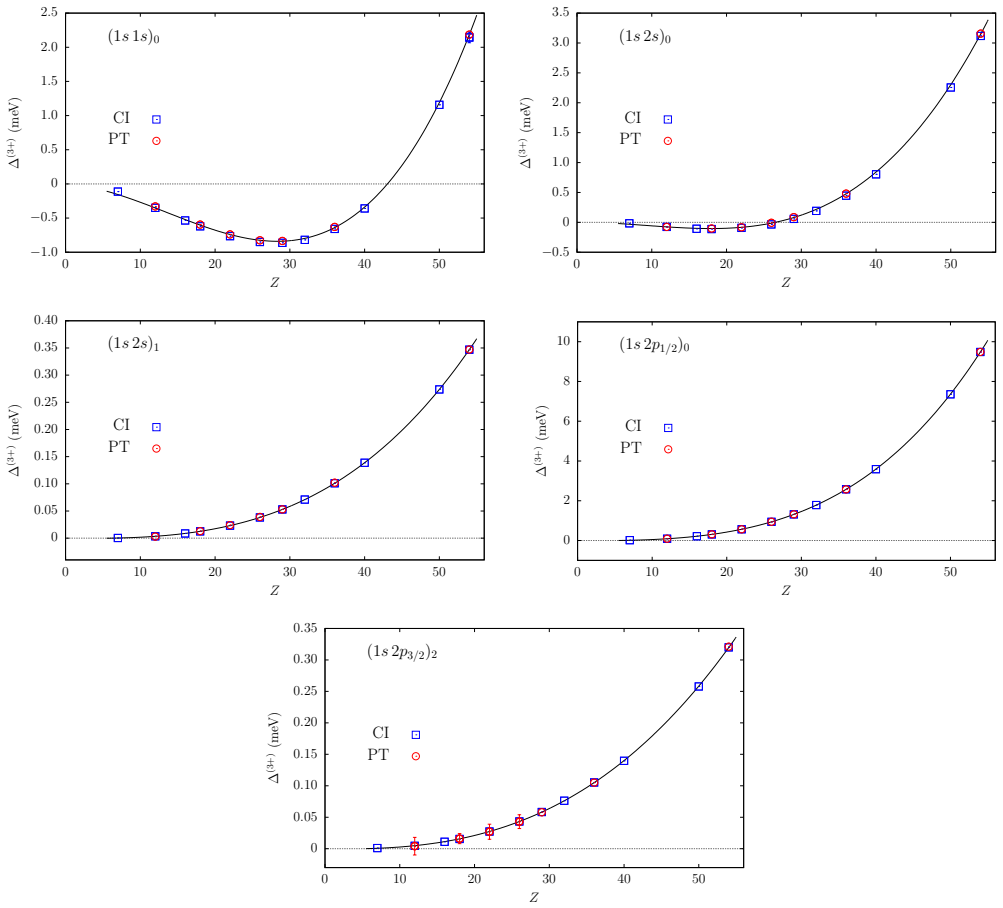
- [Section III A, Tables III and IV] The uncertainty estimate E^(3+)_QED = E^(3+)_Breit * 2 E^(2)_QED / E^(2)_Breit is introduced without derivation, and the ground-state value of this estimate is reused for all excited states. While the reuse is conservative in direction, the scaling itself is a model assumption. The paper should justify this scaling more rigorously; the scatter of results over different screening potentials discussed in Section III B is a useful cross-check, but it is not presented as a quantitative alternative uncertainty. Without such a justification, the claimed uncertainties on the ionization and transition energies in Tables VII and VIII may be underestimated, particularly for the mixing configurations that depend on the less certain off-diagonal matrix element.
minor comments (4)
- [Section III A, text preceding Table I] The statement that the small discrepancy with Ref. [32] for the J=0 states 'is probably in the underestimation of the uncertainty of the calculations performed in Ref. [32]' is speculative; the authors should either provide supporting evidence or phrase this as a conjecture.
- [Section II A, Eqs. (19)-(23)] The use of a tilde over H to denote the sum of Eqs. (16)-(18) is introduced without explicit definition; a sentence clarifying that tilde-H^(2)_ik is defined by Eq. (22) would improve readability.
- [Abstract and Section IV] The phrase 'the most precise up-to-date theoretical predictions' is strong; it would be helpful to state explicitly that this claim refers to the particular set of states and ion charges considered, and that it depends on the uncertainty estimates discussed in the paper.
- [Table II caption] The caption lists 'off-diag.' with references to Eqs. (22) and (23), but does not note that both expressions omit the double-integration terms discussed in Section II A; a brief note would avoid confusion.
Circularity Check
No significant circularity: the QED correlation calculations are self-contained, use external constants and independent benchmarks, and the final transition energies are not fitted to the data they are compared with.
full rationale
The paper's derivation chain is self-contained against external benchmarks. First- and second-order interelectronic-interaction contributions are evaluated from TTGF QED formulas (Eqs. 16-18) using B-spline basis sets and numerical omega-integration; no target ionization or transition energy is fitted. The third- and higher-order correlation contributions are computed independently by CI and recursive PT, with only standard constants (CODATA 2014) and nuclear radii as inputs. The final energies are sums of these individual terms plus one-electron/screened QED, recoil, and nuclear-polarization contributions, and then compared with Artemyev et al. and with experiment; those comparisons are not used to adjust the results. The closest candidate, the heuristic E(3+)_QED uncertainty E_Breit^(3+) * 2 E_QED^(2)/E_Breit^(2), affects only the error budget, not the central prediction, so it cannot make the derivation circular. Likewise, the neglect of the double-integration terms in the off-diagonal TTGF formulas is an explicitly flagged higher-order approximation; it may be a completeness risk, but it does not reduce any predicted energy to an input. The self-citation to Ref. [58] provides the TTGF formalism and the statement that the omitted terms are higher order, but no uniqueness theorem or target value is imported from that citation. No equation is defined in terms of the quantity it is claimed to predict.
Assumptions & free parameters
free parameters (2)
- E(3+)_QED scaling multiplier =
2
- Ground-state uncertainty reuse factor for excited states =
1 (and scatter divided by 4)
assumptions (7)
- standard math Bound-state QED perturbation theory in the Furry picture is valid for high-Z heliumlike ions.
- standard math The two-time Green's function method provides the correct effective Hamiltonian H = P^{-1/2} K P^{-1/2} for quasi-degenerate levels.
- ad hoc to paper Extra double-integration terms in the TTGF off-diagonal formulas for quasi-degenerate levels can be neglected as higher-order QED.
- ad hoc to paper Replacing E_i^(0) and E_k^(0) with their average Ebar^(0)_ik in off-diagonal formulas changes results only at higher-order QED.
- ad hoc to paper The uncalculated higher-order QED contribution scales as E(3+)_Breit * 2 E(2)_QED / E(2)_Breit and the ground-state value applies to all states.
- domain assumption The Dirac-Coulomb-Breit Hamiltonian with positive-energy projectors defined by the same hD as the QED zeroth order describes higher-order correlation reliably.
- domain assumption Nuclear charge distributions are represented by the Fermi model with radii from Ref. [96].
Cite this review
Pith. "Pith review of QED calculation of electron-electron correlation effects in heliumlike ions." pith.science (2026). https://pith.science/paper/AUDO6YD6
@misc{pith2026190901021,
  author       = {Pith},
  title        = {Pith review of: QED calculation of electron-electron correlation effects in heliumlike ions},
  year         = {2026},
  howpublished = {\url{https://pith.science/paper/AUDO6YD6}},
  note         = {Machine review of arXiv:1909.01021}
}
abstract
Fully relativistic approach to evaluate the correlation effects in highly charged ions is presented. The interelectronic-interaction contributions of first and second orders in $1/Z$ are treated rigorously within the framework of bound-state quantum electrodynamics, whereas the calculations of the third- and higher-order contributions are based on the Dirac-Coulomb-Breit Hamiltonian. The developed approach allows one to deal with single as well as degenerate or quasi-degenerate states. We apply this approach to the calculations of the correlation contributions to the $n=1$ and $n=2$ energy levels in heliumlike ions. The obtained contributions are combined with the one-electron and screened QED corrections, nuclear recoil and nuclear polarization corrections to get the total theoretical predictions for the ionization and transition energies in high-$Z$ heliumlike ions.
Figures


Figures from the paper (3 more)


Reference graph
Works this paper leans on
-
[58]
O. Y. Andreev, L. N. Labzowsky, G. Plunien, and G. Soff, Phy s. Rev. A 69, 062505 (2004)
work page 2004
-
[1]
ld”) diagram, is divided naturally into the reducible (“red
· · ·ψ (x′ N ) ¯ψ (xN ) · · · ¯ψ (x1)|0⟩ ⏐ ⏐ ⏐ ⏐ ⏐x′0 1 =... =x′0 N ≡t′ x0 1=... =x0 N ≡t , (3) where ψ is the electron-positron field operator in the Heisenberg represen tation, ¯ψ = ψ †γ0, x = (x0, x), and T is the time-ordering operator. The perturbation theory for the t wo-time Green’s functionG is formulated by means of the transition to the interacti...
2014
-
[2]
St¨ ohlker, P
Th. St¨ ohlker, P. H. Mokler, F. Bosch, R. W. Dunford, F. Fr anzke, O. Klepper, C. Kozhuharov, T. Ludziejewski, F. Nolden, H. Reich, P. Rymuza, Z. Stachura , M. Steck, P. Swiat, and A. Warczak, Phys. Rev. Lett. 85, 3109 (2000)
2000
-
[3]
Gumberidze, Th
A. Gumberidze, Th. St¨ ohlker, D. Bana´ s, K. Beckert, P. B eller, H. F. Beyer, F. Bosch, S. Hag- mann, C. Kozhuharov, D. Liesen, F. Nolden, X. Ma, P. H. Mokler , M. Steck, D. Sierpowski, and S. Tashenov, Phys. Rev. Lett. 94, 223001 (2005)
2005
-
[4]
Schweppe, A
J. Schweppe, A. Belkacem, L. Blumenfeld, N. Claytor, B. F einberg, H. Gould, V. E. Kostroun, L. Levy, S. Misawa, J. R. Mowat, and M. H. Prior, Phys. Rev. Let t. 66, 1434 (1991)
1991
-
[5]
Beiersdorfer, A
P. Beiersdorfer, A. L. Osterheld, J. H. Scofield, J. R. Cre spo L´ opez-Urrutia, and K. Widmann, Phys. Rev. Lett. 80, 3022 (1998)
1998
-
[6]
Bosselmann, U
P. Bosselmann, U. Staude, D. Horn, K.-H. Schartner, F. Fo lkmann, A. E. Livingston, and P. H. Mok- ler, Phys. Rev. A 59, 1874 (1999)
1999
-
[7]
Brandau, C
C. Brandau, C. Kozhuharov, A. M¨ uller, W. Shi, S. Schippe rs, T. Bartsch, S. B¨ ohm, C. B¨ ohme, A. Hoffknecht, H. Knopp, N. Gr¨ un, W. Scheid, T. Steih, F. Bosch , B. Franzke, P. H. Mokler, F. Nolden, M. Steck, T. St¨ ohlker, and Z. Stachura, Phys. Rev . Lett. 91, 073202 (2003)
2003
Show all 111 references
-
[8]
Beiersdorfer, H
P. Beiersdorfer, H. Chen, D. B. Thorn, and E. Tr¨ abert, Ph ys. Rev. Lett. 95, 233003 (2005)
2005
-
[9]
Beiersdorfer, A
P. Beiersdorfer, A. L. Osterheld, and S. R. Elliott, Phys . Rev. A 58, 1944 (1998)
1998
-
[10]
Dragani´ c, J
I. Dragani´ c, J. R. Crespo L´ opez-Urrutia, R. DuBois, S. Fritzsche, V. M. Shabaev, R. Soria Orts, I. I. Tupitsyn, Y. Zou, and J. Ullrich, Phys. Rev. Lett. 91, 183001 (2003). 22
2003
-
[11]
Gumberidze, Th
A. Gumberidze, Th. St¨ ohlker, D. Bana´ s, K. Beckert, P. Beller, H. F. Beyer, F. Bosch, X. Cai, S. Hagmann, C. Kozhuharov, D. Liesen, F. Nolden, X. Ma, P. H. M okler, A. Orˇ si´ c-Muthig, M. Steck, D. Sierpowski, S. Tashenov, A. Warczak, and Y. Zou, Phys. Rev . Lett. 92, 2030...
2004
-
[12]
Trassinelli, S
M. Trassinelli, S. Boucard, D. S. Covita, D. Gotta, A. Hi rtl, P. Indelicato, ´E.-O. L. Bigot, J. M. F. dos Santos, L. M. Simons, L. Stingelin, J. F. C. A. Veloso, A. Wass er, and J. Zmeskal, J. Phys.: Conf. Ser. 58, 129 (2007)
2007
-
[13]
Trassinelli, A
M. Trassinelli, A. Kumar, H. F. Beyer, P. Indelicato, R. M¨ artin, R. Reuschl, Y. S. Kozhedub, C. Brandau, H. Br¨ auning, S. Geyer, A. Gumberidze, S. Hess, P . Jagodzinski, C. Kozhuharov, D. Liesen, U. Spillmann, S. Trotsenko, G. Weber, D. F. A. Wint ers, and Th. St¨ ohlker, E...
2009
-
[14]
Trassinelli, A
M. Trassinelli, A. Kumar, H. F. Beyer, P. Indelicato, R. M¨ artin, R. Reuschl, Y. S. Kozhedub, C. Brandau, H. Br¨ auning, S. Geyer, A. Gumberidze, S. Hess, P . Jagodzinski, C. Kozhuharov, D. Liesen, U. Spillmann, S. Trotsenko, G. Weber, D. F. A. Wint ers, and T. St¨ ohlker, Ph...
2011
-
[15]
M¨ ackel, R
V. M¨ ackel, R. Klawitter, G. Brenner, J. R. Crespo L´ opez-Urrutia, and J. Ullrich, Phys. Rev. Lett. 107, 143002 (2011)
2011
-
[16]
Bernhardt, C
D. Bernhardt, C. Brandau, Z. Harman, C. Kozhuharov, S. B ¨ ohm, F. Bosch, S. Fritzsche, J. Jacobi, S. Kieslich, H. Knopp, F. Nolden, W. Shi, Z. Stachura, M. Stec k, Th. St¨ ohlker, S. Schippers, and A. M¨ uller, J. Phys. B: At. Mol. Opt. Phys. 48, 144008 (2015)
2015
-
[17]
Kraft-Bermuth, V
S. Kraft-Bermuth, V. Andrianov, A. Bleile, A. Echler, P . Egelhof, P. Grabitz, S. Ilieva, O. Kiselev, C. Kilbourne, D. McCammon, J. P. Meier, and P. Scholz, J. Phys . B: At. Mol. Opt. Phys. 50, 055603 (2017)
2017
-
[18]
H. F. Beyer, T. Gassner, M. Trassinelli, R. Heß, U. Spill mann, D. Bana´ s, K.-H. Blumenhagen, F. Bosch, C. Brandau, W. Chen, C. Dimopoulou, E. F¨ orster, R. E. Grisenti, A. Gumberidze, S. Hag- mann, P.-M. Hillenbrand, P. Indelicato, P. Jagodzinski, T. K¨ ampfer, C. Kozhuharov...
2015
-
[19]
Hengstler, M
D. Hengstler, M. Keller, C. Sch¨ otz, J. Geist, M. Krantz , S. Kempf, L. Gastaldo, A. Fleischmann, T. Gassner, G. Weber, R. M¨ artin, Th. St¨ ohlker, and C. Enss, Phys. Scr. T166, 014054 (2015). 23
2015
-
[20]
Lestinsky, V
M. Lestinsky, V. Andrianov et al. , Eur. Phys. J. Spec. Top. 225, 797 (2016)
2016
-
[21]
J. Repp, C. B¨ ohm, J. R. Crespo L´ opez-Urrutia, A. D¨ orr , S. Eliseev, S. George, M. Goncharov, Y. N. Novikov, C. Roux, S. Sturm, S. Ulmer, and K. Blaum, Appl. Phys. B 107, 983 (2012)
2012
-
[22]
C. Roux, C. B¨ ohm, A. D¨ orr, S. Eliseev, S. George, M. Goncharov, Y. N. Novikov, J. Repp, S. Sturm, S. Ulmer, and K. Blaum, Appl. Phys. B 107, 997 (2012)
2012
-
[23]
V. A. Yerokhin and V. M. Shabaev, J. Phys. Chem. Ref. Data 44, 033103 (2015)
2015
-
[24]
V. A. Yerokhin, A. N. Artemyev, V. M. Shabaev, M. M. Sysak , O. M. Zherebtsov, and G. Soff, Phys. Rev. A 64, 032109 (2001)
2001
-
[25]
Y. S. Kozhedub, D. A. Glazov, A. N. Artemyev, N. S. Oreshk ina, V. M. Shabaev, I. I. Tupitsyn, A. V. Volotka, and G. Plunien, Phys. Rev. A 76, 012511 (2007)
2007
-
[26]
Y. S. Kozhedub, A. V. Volotka, A. N. Artemyev, D. A. Glazo v, G. Plunien, V. M. Shabaev, I. I. Tupitsyn, and Th. St¨ ohlker, Phys. Rev. A 81, 042513 (2010)
2010
-
[27]
Sapirstein and K
J. Sapirstein and K. T. Cheng, Phys. Rev. A 83, 012504 (2011)
2011
-
[28]
A. V. Malyshev, A. V. Volotka, D. A. Glazov, I. I. Tupitsy n, V. M. Shabaev, and G. Plunien, Phys. Rev. A 90, 062517 (2014)
2014
-
[29]
A. V. Malyshev, A. V. Volotka, D. A. Glazov, I. I. Tupitsy n, V. M. Shabaev, and G. Plunien, Phys. Rev. A 92, 012514 (2015)
2015
-
[30]
A. N. Artemyev, V. M. Shabaev, I. I. Tupitsyn, G. Plunien , and V. A. Yerokhin, Phys. Rev. Lett. 98, 173004 (2007)
2007
-
[31]
A. N. Artemyev, V. M. Shabaev, I. I. Tupitsyn, G. Plunien , A. Surzhykov, and S. Fritzsche, Phys. Rev. A 88, 032518 (2013)
2013
-
[32]
A. V. Malyshev, D. A. Glazov, A. V. Volotka, I. I. Tupitsy n, V. M. Shabaev, G. Plunien, and Th. St¨ ohlker, Phys. Rev. A 96, 022512 (2017)
2017
-
[33]
A. N. Artemyev, V. M. Shabaev, V. A. Yerokhin, G. Plunien , and G. Soff, Phys. Rev. A 71, 062104 (2005)
2005
-
[34]
C. T. Chantler, M. N. Kinnane, J. D. Gillaspy, L. T. Hudso n, A. T. Payne, L. F. Smale, A. Henins, J. M. Pomeroy, J. N. Tan, J. A. Kimpton, E. Takacs, and K. Makon yi, Phys. Rev. Lett. 109, 153001 (2012)
2012
-
[35]
C. T. Chantler, A. T. Payne, J. D. Gillaspy, L. T. Hudson, L. F. Smale, A. Henins, J. A. Kimpton, and E. Takacs, New J. Phys. 16, 123037 (2014). 24
2014
-
[36]
J. K. Rudolph, S. Bernitt, S. W. Epp, R. Steinbr¨ ugge, C. Beilmann, G. V. Brown, S. Eberle, A. Graf, Z. Harman, N. Hell, M. Leutenegger, A. M¨ uller, K. Schlage, H .-C. Wille, H. Yava¸ s, J. Ullrich, and J. R. Crespo L´ opez-Urrutia, Phys. Rev. Lett. 111, 103002 (2013)
2013
-
[37]
Schlesser, S
S. Schlesser, S. Boucard, D. S. Covita, J. M. F. dos Santo s, H. Fuhrmann, D. Gotta, A. Gruber, M. Hennebach, A. Hirtl, P. Indelicato, E.-O. Le Bigot, L. M. S imons, L. Stingelin, M. Trassinelli, J. F. C. A. Veloso, A. Wasser, and J. Zmeskal, Phys. Rev. A 88, 022503 (2013)
2013
-
[38]
Kubiˇ cek, P
K. Kubiˇ cek, P. H. Mokler, V. M¨ ackel, J. Ullrich, and J. R. Crespo L´ opez-Urrutia, Phys. Rev. A 90, 032508 (2014)
2014
-
[39]
Beiersdorfer and G
P. Beiersdorfer and G. V. Brown, Phys. Rev. A 91, 032514 (2015)
2015
-
[40]
S. W. Epp, R. Steinbr¨ ugge, S. Bernitt, J. K. Rudolph, C. Beilmann, H. Bekker, A. M¨ uller, O. O. Versolato, H.-C. Wille, H. Yava¸ s, J. Ullrich, and J. R. Crespo L´ opez-Urrutia, Phys. Rev. A 92, 020502(R) (2015)
2015
-
[41]
Machado, C
J. Machado, C. I. Szabo, J. P. Santos, P. Amaro, M. Guerra , A. Gumberidze, G. Bian, J. M. Isac, and P. Indelicato, Phys. Rev. A 97, 032517 (2018)
2018
-
[42]
S. W. Epp, Phys. Rev. Lett. 110, 159301 (2013)
2013
-
[43]
A. V. Malyshev, Y. S. Kozhedub, D. A. Glazov, I. I. Tupits yn, and V. M. Shabaev, Phys. Rev. A 99, 010501(R) (2019)
2019
-
[44]
G. W. Drake, Can. J. Phys. 66, 586 (1988)
1988
-
[45]
W. R. Johnson and J. Sapirstein, Phys. Rev. A 46, R2197 (1992)
1992
-
[46]
M. H. Chen, K. T. Cheng, and W. R. Johnson, Phys. Rev. A 47, 3692 (1993)
1993
-
[47]
D. R. Plante, W. R. Johnson, and J. Sapirstein, Phys. Rev . A 49, 3519 (1994)
1994
-
[48]
K. T. Cheng, M. H. Chen, W. R. Johnson, and J. Sapirstein, Phys. Rev. A 50, 247 (1994)
1994
-
[49]
Indelicato, Phys
P. Indelicato, Phys. Rev. A 51, 1132 (1995)
1995
-
[50]
K. T. Cheng and M. H. Chen, Phys. Rev. A 61, 044503 (2000)
2000
-
[51]
Watanabe and H
Y. Watanabe and H. Tatewaki, J. Chem. Phys. 123, 074322 (2005)
2005
-
[52]
S. A. Blundell, P. J. Mohr, W. R. Johnson, and J. Sapirste in, Phys. Rev. A 48, 2615 (1993)
1993
-
[53]
Lindgren, H
I. Lindgren, H. Persson, S. Salomonson, and L. Labzowsk y, Phys. Rev. A 51, 1167 (1995)
1995
-
[54]
P. J. Mohr and J. Sapirstein, Phys. Rev. A 62, 052501 (2000)
2000
-
[55]
O. Y. Andreev, L. N. Labzowsky, G. Plunien, and G. Soff, Phy s. Rev. A 64, 042513 (2001)
2001
-
[56]
˚ As´ en, S
B. ˚ As´ en, S. Salomonson, and I. Lindgren, Phys. Rev. A 65, 032516 (2002)
2002
-
[57]
O. Y. Andreev, L. N. Labzowsky, G. Plunien, and G. Soff, Phy s. Rev. A 67, 012503 (2003). 25
2003
-
[59]
V. M. Shabaev, Phys. Rep. 356, 119 (2002)
2002
-
[60]
W. H. Furry, Phys. Rev. 81, 115 (1951)
1951
-
[61]
P. J. Mohr, G. Plunien, and G. Soff, Phys. Rep. 293, 227 (1998)
1998
-
[62]
Lindgren, S
I. Lindgren, S. Salomonson, and B. ˚ As´ en, Phys. Rep.389, 161 (2004)
2004
-
[63]
O. Y. Andreev, L. N. Labzowsky, G. Plunien, and D. A. Solo vyev, Phys. Rep. 455, 135 (2008)
2008
-
[64]
D. A. Glazov, Y. S. Kozhedub, A. V. Maiorova, V. M. Shabae v, I. I. Tupitsyn, A. V. Volotka, C. Kozhuharov, G. Plunien, and Th. St¨ ohlker, Hyp. Interact . 199, 71 (2011)
2011
-
[65]
V. M. Shabaev, A. I. Bondarev, D. A. Glazov, M. Y. Kaygoro dov, Y. S. Kozhedub, I. A. Maltsev, A. V. Malyshev, R. V. Popov, I. I. Tupitsyn, and N. A. Zubova, H yp. Interact. 239, 60 (2018)
2018
-
[66]
V. M. Shabaev, J. Phys. B: At. Mol. Opt. Phys. 26, 4703 (1993)
1993
-
[67]
V. M. Shabaev, Phys. Rev. A 50, 4521 (1994)
1994
-
[68]
F. C. Sanders and C. W. Scherr, Phys. Rev. 181, 84 (1969)
1969
-
[69]
Aashamar, G
K. Aashamar, G. Lyslo, and J. Midtdal, J. Chem. Phys. 52, 3324 (1970)
1970
-
[70]
Sapirstein and K
J. Sapirstein and K. T. Cheng, Phys. Rev. A 64, 022502 (2001)
2001
-
[71]
Sapirstein and K
J. Sapirstein and K. T. Cheng, Phys. Rev. A 63, 032506 (2001)
2001
-
[72]
D. A. Glazov, A. V. Volotka, V. M. Shabaev, I. I. Tupitsyn , and G. Plunien, Phys. Lett. A 357, 330 (2006)
2006
-
[73]
V. A. Yerokhin, A. N. Artemyev, and V. M. Shabaev, Phys. R ev. A 75, 062501 (2007)
2007
-
[74]
A. V. Volotka, D. A. Glazov, V. M. Shabaev, I. I. Tupitsyn , and G. Plunien, Phys. Rev. Lett. 112, 253004 (2014)
2014
-
[75]
Sapirstein and K
J. Sapirstein and K. T. Cheng, Phys. Rev. A 91, 062508 (2015)
2015
-
[76]
I. A. Aleksandrov, D. A. Glazov, A. V. Malyshev, V. M. Sha baev, and I. I. Tupitsyn, Phys. Rev. A 98, 062521 (2018)
2018
-
[77]
Sapirstein and K
J. Sapirstein and K. T. Cheng, Phys. Rev. A 66, 042501 (2002)
2002
-
[78]
M. H. Chen, K. T. Cheng, W. R. Johnson, and J. Sapirstein, Phys. Rev. A 74, 042510 (2006)
2006
-
[79]
Sapirstein and K
J. Sapirstein and K. T. Cheng, Phys. Rev. A 67, 022512 (2003)
2003
-
[80]
Sapirstein and K
J. Sapirstein and K. T. Cheng, Phys. Rev. A 74, 042513 (2006)
2006
-
[81]
M. Y. Kaygorodov, Y. S. Kozhedub, I. I. Tupitsyn, A. V. Ma lyshev, D. A. Glazov, G. Plunien, and V. M. Shabaev, Phys. Rev. A 99, 032505 (2019). 26
2019
-
[82]
V. F. Bratzev, G. B. Deyneka, and I. I. Tupitsyn, Bull. Ac ad. Sci. USSR, Phys. Ser 41, 173 (1977), [Izv. Acad. Nauk SSSR, Ser. Fiz. 41, 2655 (1977)]
1977
-
[83]
I. I. Tupitsyn, V. M. Shabaev, J. R. Crespo L´ opez-Urrutia, I. Dragani´ c, R. Soria Orts, and J. Ullrich, Phys. Rev. A 68, 022511 (2003)
2003
-
[84]
D. A. Glazov, A. V. Malyshev, A. V. Volotka, V. M. Shabaev , I. I. Tupitsyn, and G. Plunien, Nucl. Instrum. Methods Phys. Res., Sect. B 408, 46 (2017)
2017
-
[85]
A. V. Malyshev, D. A. Glazov, A. V. Volotka, I. I. Tupitsy n, V. M. Shabaev, and G. Plunien, Nucl. Instrum. Methods Phys. Res., Sect. B 408, 103 (2017)
2017
-
[86]
A. S. Varentsova, V. A. Agababaev, D. A. Glazov, A. M. Vol chkova, A. V. Volotka, V. M. Shabaev, and G. Plunien, Phys. Rev. A 97, 043402 (2018)
2018
-
[87]
Arapoglou, A
I. Arapoglou, A. Egl, M. H¨ ocker, T. Sailer, B. Tu, A. Wei gel, R. Wolf, H. Cakir, V. A. Yerokhin, N. S. Oreshkina, V. A. Agababaev, A. V. Volotka, D. V. Zinenko , D. A. Glazov, Z. Harman, C. H. Keitel, S. Sturm, and K. Blaum, Phys. Rev. Lett. 122, 253001 (2019)
2019
-
[88]
D. A. Glazov, F. K¨ ohler-Langes, A. V. Volotka, F. Heiße , K. Blaum, G. Plunien, W. Quint, V. M. Shabaev, S. Sturm, and G. Werth, arXiv:1903.11609
1903 arXiv
-
[89]
V. M. Shabaev, D. A. Glazov, A. V. Malyshev, and I. I. Tupi tsyn, Phys. Rev. Lett. 119, 263001 (2017)
2017
-
[90]
V. M. Shabaev, D. A. Glazov, A. V. Malyshev, and I. I. Tupi tsyn, Phys. Rev. A 98, 032512 (2018)
2018
-
[91]
Kato, Prog
T. Kato, Prog. Theor. Phys. 4, 514 (1949); 5, 95 (1950); 5, 207 (1950)
1949
-
[92]
Bloch, Nucl
C. Bloch, Nucl. Phys. 6, 329 (1958)
1958
-
[93]
Kato, Perturbation Theory for Linear Operators , Springer-Verlag, Berlin, 1966
T. Kato, Perturbation Theory for Linear Operators , Springer-Verlag, Berlin, 1966
1966
-
[94]
Killingbeck, Rep
J. Killingbeck, Rep. Prog. Phys. 40, 963 (1977)
1977
-
[95]
Reed and B
M. Reed and B. Simon, Methods of Modern Mathematical Physics. IV Analysis of Opera tors, Academic Press, New York, 1978
1978
-
[96]
Brouder, G
C. Brouder, G. H. Duchamp, F. Patras, and G. Z. T´ oth, Int . J. Quantum Chem. 112, 2256 (2012)
2012
-
[97]
Angeli and K
I. Angeli and K. P. Marinova, At. Data Nucl. Data Tables 99, 69 (2013)
2013
-
[98]
P. J. Mohr, D. B. Newell, and B. N. Taylor, Rev. Mod. Phys. 88, 035009 (2016)
2016
-
[99]
Sapirstein and W
J. Sapirstein and W. R. Johnson, J. Phys. B: At. Mol. Opt. Phys. 29, 5213 (1996)
1996
-
[100]
V. M. Shabaev, I. I. Tupitsyn, V. A. Yerokhin, G. Plunien , and G. Soff, Phys. Rev. Lett. 93, 130405 (2004)
2004
-
[101]
V. A. Yerokhin and K. Pachucki, Phys. Rev. A 81, 022507 (2010). 27
2010
-
[102]
Y. S. Kozhedub, O. V. Andreev, V. M. Shabaev, I. I. Tupit syn, C. Brandau, C. Kozhuharov, G. Plunien, and T. St¨ ohlker, Phys. Rev. A 77, 032501 (2008)
2008
-
[103]
V. M. Shabaev, I. I. Tupitsyn, K. Pachucki, G. Plunien, and V. A. Yerokhin, Phys. Rev. A 72, 062105 (2005)
2005
-
[104]
A. V. Malyshev, R. V. Popov, V. M. Shabaev, and N. A. Zubo va, J. Phys. B: At. Mol. Opt. Phys. 51, 085001 (2018)
2018
-
[105]
Plunien, B
G. Plunien, B. M¨ uller, W. Greiner, and G. Soff, Phys. Rev . A 43, 5853 (1991)
1991
-
[106]
Plunien and G
G. Plunien and G. Soff, Phys. Rev. A 51, 1119 (1995), 53, 4614 (1996)
1995
-
[107]
A. V. Nefiodov, L. N. Labzowsky, G. Plunien, and G. Soff, Ph ys. Lett. A 222, 227 (1996)
1996
-
[108]
A. V. Volotka and G. Plunien, Phys. Rev. Lett. 113, 023002 (2014)
2014
-
[109]
V. M. Shabaev, I. I. Tupitsyn, and V. A. Yerokhin, Phys. Rev. A 88, 012513 (2013)
2013
-
[110]
V. M. Shabaev, I. I. Tupitsyn, and V. A. Yerokhin, Comp. Phys. Comm. 189, 175 (2015)
2015
-
[111]
off-diag
V. M. Shabaev, I. I. Tupitsyn, and V. A. Yerokhin, Comp. Phys. Comm. 223, 69 (2018). 28 TABLE I. Two-photon exchange correction to the binding ener gies of the n = 1 and n = 2 single states in He-like ions, in eV. Z (1s 1s)0 (1s 2s)0 (1s 2s)1 (1s 2p1/ 2)0 (1s 2p3/ 2)2 Ref. 18 ...
2018
Reviewed August 14, 2026 · model on record in the stance chip above.
Discussion (0). Continue with ORCID to comment.