REVIEW 4 major objections 5 minor 45 references
Into the Battlefield: Quantifying and Modeling Intra-community Conflicts in Online Discussion
T0 review · 4 major / 5 minor · reviewed 2026-08-14 · deepseek-v4-flash
Pith's one-line read Conflict between two online texts can be measured as a continuous number, and that number can forecast how much pushback a news article will get and whether two users will clash.
desk verdict A genuinely new continuous conflict measure for online discussions, validated against human ratings, but with an acknowledged lexical-overlap blind spot and a partly circular news-user regression. read the letter →
The pith
A machine-rendered reading of the paper's core claim, the machinery that carries it, and where it could break.
The reading
What carries the argument
The load-bearing object is the conflict factor $$c_f(D_1,D_2)=\sum_i \min(T_{D_1}[i],T_{D_2}[i],1)\,|T_{D_1}[i]-T_{D_2}[i]|,$$ where $T_D[i]$ is document $D$'s aggregate target-dependent sentiment (negative, neutral, or positive) toward corpus keyword $i$, and zero if the keyword does not appear in $D$. Target-dependent sentiment means sentiment attached to a specific term rather than to the whole passage; this is what lets two positive-sounding sentences about the same topic register as opposed. The factor does two jobs: averaged over comments it defines the news-user conflict score, and averaged over interaction histories it weights edges of the user engagement graph, so every prediction task in the paper is a function of this one quantity.
What would settle it
Apply the conflict factor to the paper's own example: two short sentences that plainly oppose each other but share no lexical target; the score is zero while human raters saw conflict. A systematic falsifier would build a test set of such paraphrase-antonym pairs with minimal word overlap and check whether the score's RMSE and MAP against human ratings degrade sharply relative to pairs that share targets.
Extended reading notes
Core claim
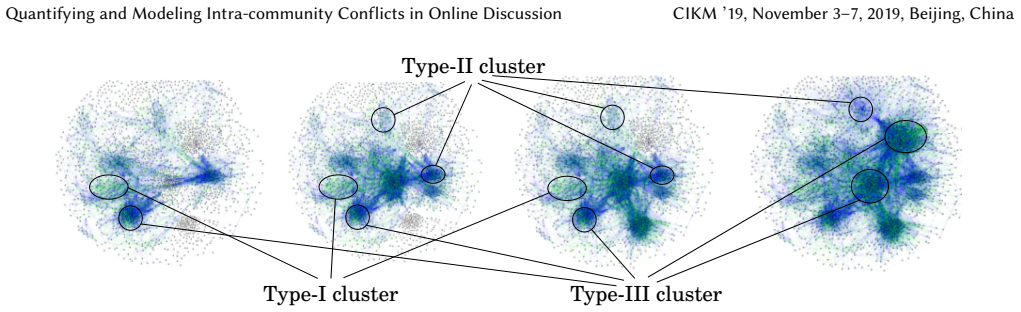
The central discovery is a pairwise, continuous conflict score computed from target-dependent sentiment vectors. For each document, a vector records its aggregate sentiment (negative, neutral, or positive) toward every corpus keyword that appears in it; the conflict between two documents is the sum over shared keywords of the sentiment difference, weighted by whether both mention the keyword. This turns argumentative opposition into a real-valued score that can rank how strongly a comment opposes a news article or another comment. The paper validates the score against human annotations and then uses it as the ground-truth label for two prediction tasks: regression of news-level audience conflict from article text, and binary classification of future user-user conflict from textual and network features, with a graph convolutional model handling pairs that have no prior interaction.
Load-bearing premise
The score only registers disagreement on words the two texts literally share, so statements that oppose each other in different words are scored as non-conflicting, and every downstream conflict label is built from that score.
Editorial extensions
If this is right
- If the score works as claimed, editors and news platforms could estimate the degree of argumentative backlash an article will attract before it is published, using only the article's wording.
- Moderation systems could rank user pairs by risk of future conflict from their engagement history, including pairs who have never directly interacted, since the graph convolutional model reaches an AUC of 0.69 on such cold-start pairs.
- Because engagement edges carry continuous conflict weights, future conflict prediction becomes a signed link prediction problem, and the same graph machinery can be reused for other signed-network tasks.
- Thread-level analyses suggest disagreements concentrate at depths 3-4 of a discussion tree, so interventions aimed at cooling conflict would be most effective in the middle tiers of a thread rather than at the top or bottom.
Reading between the lines
- A direct extension would relax the shared-keyword requirement in the conflict factor using entity linking or embedding similarity; the paper itself notes that paraphrased disagreement slips through, so this is the clearest place to raise the score's accuracy on short comments.
- The stronger performance of network features over text features in the user-pair experiments suggests conflict is largely a relationship property, not a message property; a testable consequence is that removing all comment text from the user-pair models would cost little accuracy.
- The conflict score could be aggregated over time and source to serve as an early-warning signal for coordinated outrage events, since temporal peaks align across outlets around the same news event.
Signed reviews
Editorial analysis
A structured set of objections, weighed in public.
Referee Report
Summary. The paper proposes a continuous-valued conflict score c_f(D1,D2) between two text documents, defined in Eq. (2) as a sum over terms shared by both documents of min(T_SD1[i], T_SD2[i], 1) |T_SD1[i] - T_SD2[i]|, where T_SD are target-dependent sentiment vectors. The score is validated against human annotations on news-comment and comment-comment pairs (RMSE 0.96 and 0.79 over [0,10], MAP 0.77 and 0.83), and is then used to define a news-level conflict score nc(N) and user-user edge weights w_ij for two prediction tasks: predicting the conflict a news article will receive from its audience, and predicting whether a future interaction between two users will be conflicting. For the first task, SVR achieves sMAPE 0.077; for the second, an SVM with all features achieves AUC 0.89, while a graph convolutional network achieves AUC 0.69 for user pairs with no previous interaction history. The paper also presents descriptive analyses of conflict dynamics, including temporal patterns across news sources, thread-depth effects, and cluster formation in the user engagement network.
Significance. If the proposed conflict measure is valid, the paper offers a scalable, continuous alternative to binary conflict modeling and supports a range of downstream prediction tasks on a large Reddit dataset. The manuscript has notable strengths: the conflict score is independently evaluated against manual annotations with reported inter-annotator agreement, it is compared with two existing baselines, and the prediction experiments are conducted on a substantial corpus (41k articles, 5.5M comments). The GCN formulation for cold-start user pairs is a useful design choice. However, the central claim depends on the adequacy of the lexical-overlap-based conflict score, and the paper itself acknowledges that semantically opposing texts with disjoint target terms are scored as non-conflicting. Because every downstream label is built from this score, this limitation is load-bearing rather than peripheral. The paper also leaves several experimental details underspecified, including the normalization of c_f and the threshold for binary conflict labels, which currently prevent the results from being reproduced or fully interpreted.
major comments (4)
- [Eq. (2), §7.1] The conflict factor in Eq. (2) is nonzero only for terms that occur in both documents, because of the min(T_SD1[i], T_SD2[i], 1) factor. Section 7.1 explicitly acknowledges that 'We do not support Democrats' and 'We support Hilary' are scored as non-conflicting due to lack of shared terms. Since Eqs. (3) and (4) aggregate this score into every news-level and user-level label used in Sections 7.2 and 7.3, this is not a peripheral edge case: all downstream results measure the model's ability to reproduce a lexical-overlap-weighted disagreement score, not conflict in general. The authors' rebuttal that 79% of comments exceed 50 words does not establish that conflicting pairs typically share target terms; please quantify the fraction of manually annotated conflict pairs with no shared targets, report RMSE and MAP on that subset, or extend the metric to handle semantically related targets.
- [§7.1, Tables 2 and 3] The normalization of c_f to the [0,10] interval is not specified, so the RMSE values in Table 2 and Table 3 cannot be reproduced or compared across models; report the exact mapping (e.g., min-max over what population) and state whether the same mapping is applied to the baselines. In the same section, the binary classification used for the AUC comparison in Table 3 requires a definition of the conflict/non-conflict label; state whether the cutoff is on the normalized score or on the human annotations, and what cutoff was used.
- [§7.3, Eq. (4)] The positive label in the user-user prediction task is defined as 'a conflicting engagement' within the next 24 hours, but no threshold on the continuous edge weight w_ij from Eq. (4) is given. Because c_f is continuous and can be small but nonzero, the reported AUCs in Table 5 depend on this undisclosed binarization; please state the threshold and assess sensitivity to it.
- [§5, §7.2] The news-user regression target nc(N) in Eq. (3) is computed from c_f(N,c), which uses the article's TD-sentiment vector T_SD(N); the first prediction feature listed in Section 5 is exactly this vector. The reported sMAPE therefore partly reflects the deterministic overlap between a feature and a component of the target rather than the ability to anticipate the comment-side conflict. Please report an ablation without the TD-sentiment feature (and, if feasible, predict the residual after the article's own sentiment contribution) to calibrate the 'prediction from article content' claim.
minor comments (5)
- [Section 1] Contribution (1) reports 'mean squared error' of 0.96 and 0.79, but Table 2 and Section 7.1 report RMSE; please clarify which quantity is being reported.
- [Eq. (2)] Equation (2) is written as a sum from i=0 to |T|; the indices should run from 1 to |T| (or be specified consistently with the 0-based notation used elsewhere).
- [Eq. (10)] Equation (10) has an off-by-one inconsistency in the summation bound: summing l=0 to N_k^i yields N_k^i+1 terms while dividing by N_k^i; please correct the index range.
- [Figure 3] The text says the absolute error rate decreases with comment length, but the described pattern (negative errors for short comments, positive errors for long comments) is a bias shift rather than a simple decrease in absolute error; please clarify whether signed or absolute error is plotted and define the y-axis.
- [Section 3] Footnote 2 states that the dataset is public, but no URL or access mechanism is provided; including the actual link would improve reproducibility.
Circularity Check
News-user conflict target is defined from the same TD-sentiment vector that is the top predictive feature, so the regression partially predicts its own input.
-
self definitional
[Section 5, Eq. 3 and feature list item (1)]
"c f(D1, D2) = |T|∑_{i=0} min(T SD1[i], T SD2[i], 1)|T SD1[i]− T SD2[i]| (2) ... nc(N) = 1/|C| ∑_{c∈C} c f(N , c) (3) ... (1) TD-sentiment vector, entity-wise sentiment expressed in the news, as we compute T SD in Eq. 1."
By Eq. 2, when the first document is a news article N, every c f(N,c) is a function of the article's TD-sentiment vector T SD_N. Eq. 3 then defines the regression target nc(N) as an average over comments of a function whose first argument is exactly the vector supplied as feature (1). A model can recover the article-stance component of the label directly from its input without observing any comment; the only unobserved part is the comment-sentiment distribution. The high importance of the TD-sentiment feature in Fig. 4 is thus a constructional coupling between the target definition and the feature set, not a purely empirical discovery about conflict drivers.
full rationale
The central conflict metric has independent grounding: Eq. 2 is validated against manually annotated news-comment and comment-comment pairs (Section 3, Table 2) and compared against two external baselines (Table 3). The MTTDSC sentiment model (ref [20]) is a self-citation since Tanmoy Chakraborty is a co-author, but it is trained on independent manually annotated datasets and used as a component rather than as evidence for the conflict metric; the Dutta et al. baseline (ref [11]) is also only a comparison system. The one genuine circularity is in the news-user prediction task: nc(N) in Eq. 3 is defined as an average of c f(N,c), and c f in Eq. 2 is a function of the news TD-sentiment vector, which is itself feature (1) of the regressors. This makes the article-stance component of the label part of the input by construction, although the comment-sentiment distribution is unobserved and must be estimated, so the task is not wholly tautological. The inter-user prediction task is temporal and does not exhibit the same definitional overlap. Overall, the metric itself is independently supported, but the news-user regression carries a partial self-definitional coupling, giving a moderate circularity score rather than a clean self-contained verdict.
Assumptions & free parameters
free parameters (5)
- subgraph distance threshold d_max =
100
- subgraph node cap =
5000
- keyword selection quantile =
top 60% by tf-idf
- number of GCN layers =
3
- conflict label threshold
assumptions (5)
- domain assumption MTTDSC target-dependent sentiment predictions are accurate enough for conflict quantification.
- domain assumption Argumentative conflict is reducible to opposite sentiment toward shared lexical targets.
- domain assumption Human annotator ratings on a random sample are a valid ground truth for the continuous conflict score.
- domain assumption Reddit r/news discussions are representative of online news discussion communities.
- domain assumption Enclosing subgraphs with d_max=100 and node cap 5000 preserve the signal needed for link prediction.
invented entities (1)
-
Conflict factor cf(D1,D2)
independent evidence
Cite this review
Pith. "Pith review of Into the Battlefield: Quantifying and Modeling Intra-community Conflicts in Online Discussion." pith.science (2026). https://pith.science/paper/ZEBFGCRT
@misc{pith2026190901200,
  author       = {Pith},
  title        = {Pith review of: Into the Battlefield: Quantifying and Modeling Intra-community Conflicts in Online Discussion},
  year         = {2026},
  howpublished = {\url{https://pith.science/paper/ZEBFGCRT}},
  note         = {Machine review of arXiv:1909.01200}
}
read the original abstract
In this work, we present a novel quantification of conflict in online discussion. Unlike previous studies on conflict dynamics, which model conflict as a binary phenomenon, our measure is continuous-valued, which we validate with manually annotated ratings. We address a two-way prediction task. Firstly, we predict the probable degree of conflict a news article will face from its audience. We employ multiple machine learning frameworks for this task using various features extracted from news articles. Secondly, given a pair of users and their interaction history, we predict if their future engagement will result in a conflict. We fuse textual and network-based features together using a support vector machine which achieves an AUC of 0.89. Moreover, we implement a graph convolutional model which exploits engagement histories of users to predict whether a pair of users who never met each other before will have a conflicting interaction, with an AUC of 0.69. We perform our studies on a massive discussion dataset crawled from the Reddit news community, containing over 41k news articles and 5.5 million comments. Apart from the prediction tasks, our studies offer interesting insights on the conflict dynamics -- how users form clusters based on conflicting engagements, how different is the temporal nature of conflict over different online news forums, how is contribution of different language based features to induce conflict, etc. In short, our study paves the way towards new methods of exploration and modeling of conflict dynamics inside online discussion communities.
Figures


Figures from the paper (5 more)



Reference graph
Works this paper leans on
-
[1]
Luca Maria Aiello, Alain Barrat, Rossano Schifanella, Ciro Cattuto, Benjamin Markines, and Filippo Menczer. 2012. Friendship prediction and homophily in social media. ACM Transactions on the Web (TWEB) 6, 2 (2012), 9–29
work page 2012
-
[2]
Mathieu Bastian, Sebastien Heymann, and Mathieu Jacomy. 2009. Gephi: an open source software for exploring and manipulating networks. In ICWSM. 11–20
work page 2009
-
[3]
Rianne van den Berg, Thomas N Kipf, and Max Welling. 2017. Graph convolu- tional matrix completion. arXiv preprint arXiv:1706.02263 (2017)
arXiv 2017
-
[4]
Carl-Hugo Björnsson. 1983. Readability of newspapers in 11 languages. Reading Research Quarterly (1983), 480–497
work page 1983
-
[5]
Catherine A Bliss, Morgan R Frank, Christopher M Danforth, and Peter Sheridan Dodds. 2014. An evolutionary algorithm approach to link prediction in dynamic social networks. Journal of Computational Science 5, 5 (2014), 750–764
work page 2014
-
[6]
Erik Cambria, Soujanya Poria, Devamanyu Hazarika, and Kenneth Kwok. 2018. SenticNet 5: Discovering conceptual primitives for sentiment analysis by means of context embeddings. In AAAI. 1–10
work page 2018
-
[7]
Michael D Conover, Jacob Ratkiewicz, Matthew Francisco, Bruno Gonçalves, Filippo Menczer, and Alessandro Flammini. 2011. Political polarization on twitter. In ICWSM. 1–10
work page 2011
-
[8]
Peter A Cramer. 2011. Controversy as news discourse . Vol. 19. Springer Science & Business Media
work page 2011
Show all 45 references
-
[9]
Michaël Defferrard, Xavier Bresson, and Pierre Vandergheynst. 2016. Convolu- tional neural networks on graphs with fast localized spectral filtering. In NIPS. 3844–3852
2016
-
[10]
Li Dong, Furu Wei, Chuanqi Tan, Duyu Tang, Ming Zhou, and Ke Xu. 2014. Adaptive recursive neural network for target-dependent twitter sentiment classi- fication. In ACL, Vol. 2. 49–54
2014
-
[11]
Subhabrata Dutta, Tanmoy Chakraborty, and Dipankar Das. 2019. How did the discussion go: Discourse act classification in social media conversations. In Linking and Mining Heterogeneous and Multi-view Data . Springer, 137–160
2019
-
[12]
Kelwin Fernandes, Pedro Vinagre, and Paulo Cortez. 2015. A proactive intelli- gent decision support system for predicting the popularity of online news. In Portuguese Conference on Artificial Intelligence . Springer, 535–546
2015
-
[13]
Joseph L Fleiss. 1971. Measuring nominal scale agreement among many raters. Psychological bulletin 76, 5 (1971), 378
1971
-
[14]
Thomas MJ Fruchterman and Edward M Reingold. 1991. Graph drawing by force- directed placement. Software: Practice and experience 21, 11 (1991), 1129–1164
1991
-
[15]
Kiran Garimella, Gianmarco De Francisci Morales, Aristides Gionis, and Michael Mathioudakis. 2018. Quantifying controversy on social media. ACM Transactions on Social Computing 1, 1 (2018), 3
2018
-
[16]
Venkata Rama Kiran Garimella and Ingmar Weber. 2017. A long-term analysis of polarization on Twitter. In ICWSM. 1–10
2017
-
[17]
Eric Gilbert and Karrie Karahalios. 2009. Predicting tie strength with social media. In SIGCHI. ACM, 211–220
2009
-
[18]
Pedro Calais Guerra, Wagner Meira Jr, Claire Cardie, and Robert Kleinberg
-
[19]
Robert Gunning. 1969. The fog index after twenty years. Journal of Business Communication 6, 2 (1969), 3–13
1969
-
[20]
Divam Gupta, Kushagra Singh, Soumen Chakrabarti, and Tanmoy Chakraborty
-
[21]
Julie Kauffman, Aristotelis Kittas, Laura Bennett, and Sophia Tsoka. 2014. Dy- CoNet: a Gephi plugin for community detection in dynamic complex networks. PloS one 9, 7 (2014), e101357
2014
-
[22]
Yaser Keneshloo, Shuguang Wang, Eui-Hong Han, and Naren Ramakrishnan
-
[23]
Thomas N Kipf and Max Welling. 2016. Semi-supervised classification with graph convolutional networks. arXiv preprint arXiv:1609.02907 (2016)
2016 arXiv
-
[24]
Subrahmanian
Srijan Kumar, Justin Cheng, Jure Leskovec, and V.S. Subrahmanian. 2017. An Army of Me: Sockpuppets in Online Discussion Communities. In WWW. 857– 866
2017
-
[25]
Srijan Kumar, William L Hamilton, Jure Leskovec, and Dan Jurafsky. 2018. Com- munity interaction and conflict on the web. In WWW. International World Wide Web Conferences Steering Committee, 933–943
2018
-
[26]
David Liben-Nowell and Jon Kleinberg. 2007. The link-prediction problem for social networks. Journal of the American society for information science and technology 58, 7 (2007), 1019–1031
2007
-
[27]
Michal Lukasik, PK Srijith, Duy Vu, Kalina Bontcheva, Arkaitz Zubiaga, and Trevor Cohn. 2016. Hawkes processes for continuous time sequence classification: an application to rumour stance classification in twitter. In ACL, Vol. 2. 393–398
2016
-
[28]
Marian Meyers. 1994. Defining Homosexuality: News Coverage of theRepeal the Ban’Controversy. Discourse & Society 5, 3 (1994), 321–344
1994
-
[29]
Saif Mohammad, Svetlana Kiritchenko, Parinaz Sobhani, Xiaodan Zhu, and Colin Cherry. 2016. Semeval-2016 task 6: Detecting stance in tweets. InSemEval. 31–41
2016
-
[30]
Reed E Nelson. 1989. The strength of strong ties: Social networks and intergroup conflict in organizations. Academy of Management Journal 32, 2 (1989), 377–401
1989
-
[31]
Alicja Piotrkowicz, Vania Dimitrova, Jahna Otterbacher, and Katja Markert. 2017. Headlines matter: Using headlines to predict the popularity of news articles on twitter and facebook. In ICWSM. 1–10
2017
-
[32]
Georgios Rizos, Symeon Papadopoulos, and Yiannis Kompatsiaris. 2016. Pre- dicting news popularity by mining online discussions. In WWW. International World Wide Web Conferences Steering Committee, 737–742
2016
-
[33]
Sara Rosenthal and Kathy McKeown. 2015. I couldn’t agree more: The role of conversational structure in agreement and disagreement detection in online discussions. In Proceedings of the 16th Annual Meeting of the Special Interest Group on Discourse and Dialogue . 168–177
2015
-
[34]
Niek J Sanders. 2011. Sanders-twitter sentiment corpus. Sanders Analytics LLC 242 (2011)
2011
-
[35]
Robert Speer and Joshua Chin. 2016. An ensemble method to produce high-quality word embeddings. arXiv preprint arXiv:1604.01692 (2016)
2016 arXiv
-
[36]
Bo Wang, Maria Liakata, Arkaitz Zubiaga, and Rob Procter. 2017. Tdparse: Multi- target-specific sentiment recognition on twitter. In EMNLP. 483–493
2017
-
[37]
Peng Wang, BaoWen Xu, YuRong Wu, and XiaoYu Zhou. 2015. Link prediction in social networks: the state-of-the-art. Science China Information Sciences 58, 1 (2015), 1–38
2015
-
[38]
Bo Wu and Haiying Shen. 2015. Analyzing and predicting news popularity on Twitter. International Journal of Information Management 35, 6 (2015), 702–711
2015
-
[39]
Wayne W Zachary. 1977. An information flow model for conflict and fission in small groups. Journal of anthropological research 33, 4 (1977), 452–473
1977
-
[40]
Amy Zhang, Bryan Culbertson, and Praveen Paritosh. 2017. Characterizing online discussion using coarse discourse sequences. (2017)
2017
-
[41]
Muhan Zhang and Yixin Chen. 2018. Link prediction based on graph neural networks. In NIPS. 5165–5175
2018
-
[42]
Arkaitz Zubiaga, Elena Kochkina, Maria Liakata, Rob Procter, Michal Lukasik, Kalina Bontcheva, Trevor Cohn, and Isabelle Augenstein. 2018. Discourse-aware rumour stance classification in social media using sequential classifiers. Informa- tion Processing & Management 54, 2 (20...
2018
-
[2013]
In ICWSM
A measure of polarization on social media networks based on community boundaries. In ICWSM. 1–10
-
[2016]
Predicting the popularity of news articles. In SDM. SIAM, 441–449
-
[2019]
arXiv preprint arXiv:1902.02930 (2019)
Multi-task Learning for Target-dependent Sentiment Classification. arXiv preprint arXiv:1902.02930 (2019)
2019 arXiv
Reviewed August 14, 2026 · model on record in the stance chip above.
Discussion (0). Continue with ORCID to comment.