REVIEW 4 major objections 5 minor 24 references
Clean, Robust Alkali Sources by Intercalation within Highly-Oriented Pyrolytic Graphite
T0 review · 4 major / 5 minor · reviewed 2026-08-14 · deepseek-v4-flash
Pith's one-line read Intercalating rubidium into layered graphite creates an alkali vapor dispenser that holds about ten times more rubidium, needs less than a quarter of the heating power, and emits less than half the waste gas of commercial chromate salt…
desk verdict A useful engineering paper on a new alkali source architecture; the central claims are mostly supported but the heating-power advantage is inferred from temperature, not measured. read the letter →
The pith
A machine-rendered reading of the paper's core claim, the machinery that carries it, and where it could break.
The reading
What carries the argument
The central object is the IHOPG: a slab of highly-oriented pyrolytic graphite whose graphene layers are forced apart by rubidium atoms absorbed between them, made by heating HOPG in rubidium vapor under rough vacuum for about 48 hours. Intercalation is the load-bearing mechanism; it stores roughly one milligram of rubidium per cubic millimeter, lets the source release vapor at 125 to 160 degrees Celsius, and leaves the interlayer rubidium protected from rapid air reaction once surface rubidium is removed. The other mechanism is the getter chemistry 2Rb + 2H2O -> 2RbOH + H2, which explains why chamber pressure can fall when the IHOPG is heated, and which the authors use to correct their residual-gas measurements and infer the true waste-gas output.
What would settle it
Measure the output of an IHOPG and a chromate dispenser in a chamber whose walls do not absorb rubidium, with water vapor removed, and compare residual-gas partial pressures at equal rubidium fluorescence; if the IHOPG's corrected pressure rise is not below half the chromate's, the central purity claim fails.
Extended reading notes
Core claim
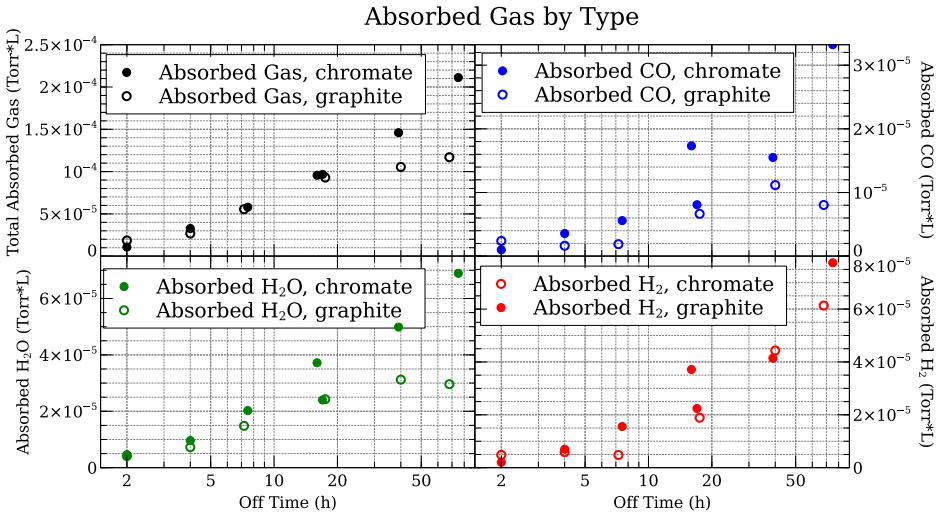
On the paper's own terms, the discovery is that rubidium intercalated into HOPG is a practical, high-capacity, low-power source of clean rubidium vapor. Compared with commercial chromate salt dispensers, the IHOPG dispensers described here store on the order of 100 mg of rubidium in a volume similar to a standard 30 mm dispenser, activate at 125 to 160 degrees Celsius rather than about 500 degrees Celsius, require less than one-fourth the heating power, and increase chamber background pressure by less than half as much as the chromate dispensers at the same rubidium output. In a chamber with background water vapor, rubidium from the IHOPG acts as a getter, and correcting for the reaction 2Rb + 2H2O -> 2RbOH + H2 leaves the IHOPG's waste-gas output near zero. The authors further report that surface-rubidium removal and a brief temperature step above activation let an IHOPG survive more than ninety minutes of air exposure, and that IHOPG dispensers collect less adsorbed gas than chromate dispensers after long idle periods.
Load-bearing premise
The load-bearing premise is that rubidium vapor is completely absorbed by the chamber walls before it reaches the gas detector, and that the entire pressure drop seen when the IHOPG is heated comes from rubidium reacting with water vapor to form rubidium hydroxide and hydrogen; if either is false, the claim of emitting less than half as many impurities is not established.
Editorial extensions
If this is right
- A cold-atom apparatus could run for months on a single IHOPG charge, since a small HOPG sample swells to hold roughly 100 to 220 mg of rubidium.
- The lower activation temperature means less sympathetic heating of chamber walls, so less water and other adsorbed gas is released during operation.
- The smaller waste-gas load reduces pump strain and background-pressure rise, which should help magnetic-trap lifetimes; the paper reports a measured lifetime improvement from about 2 seconds to 5 seconds after switching from a chromate dispenser.
- Because cesium, potassium, and lithium also intercalate into HOPG, the same architecture should extend to those alkalis, though the authors note higher temperatures will likely be needed.
- After about 24 hours at room temperature the IHOPG stops accumulating waste gas except hydrogen, unlike the chromate dispenser, so long idle periods become less problematic.
Reading between the lines
- If the same intercalation works for cesium, IHOPG-style sources could serve compact atomic clocks and quantum sensors that currently rely on larger ovens or chromate dispensers; the paper notes the thermodynamic similarity but does not demonstrate a cesium dispenser.
- The room-temperature hydrogen gettering of Rb-intercalated graphite suggests an IHOPG could double as a passive hydrogen pump in an ultra-high-vacuum system while it supplies alkali atoms, a combined function the paper mentions but does not quantify.
- A natural next experiment would be to measure dispenser lifetime and activation-temperature drift as a function of remaining rubidium, which would let users predict when a source is nearing depletion; the paper reports one depletion rate at 250 degrees Celsius but no end-of-life curve.
- For space or portable systems, the lower heat and gas load might remove the need for differential pumping between the source and the science chamber, an implication the authors state as a motivation but do not test.
Editorial analysis
A structured set of objections, weighed in public.
Referee Report
Summary. This paper reports the fabrication, characterization, and use of rubidium vapor dispensers based on rubidium-intercalated highly-oriented pyrolytic graphite (IHOPG). The authors describe a method to intercalate HOPG with Rb, a post-processing protocol that allows 90+ minutes of atmospheric exposure, and two comparisons against commercial rubidium chromate dispensers: a steady-state output comparison (waste-gas purity) and a gas-absorption comparison after room-temperature holds. The paper claims that IHOPG dispensers hold an order of magnitude more rubidium in a similar volume, require less than one-fourth the heating power, and emit less than one-half as many impurities, with activation temperatures of 125–160 °C. The authors also report successful integration of IHOPG dispensers into MOT and BEC apparatuses.
Significance. If the headline quantitative claims are substantiated, IHOPG dispensers would be a genuinely useful alternative to commercial chromate dispensers for cold-atom experiments, particularly for compact or space-based systems where long life and low contaminant load matter. The paper's strengths include a detailed and reproducible fabrication recipe, direct side-by-side RGA comparisons, explicit treatment of rubidium's water-vapor gettering effect, and real-world evidence of integration into operating cold-atom systems (including an improved magnetic-trap lifetime). However, as written, the central quantitative comparisons in the abstract and conclusions are not all directly supported by the data presented: the power claim has no associated measurement, the capacity claim rests on total mass gain rather than usable dispensed mass, and the purity claim relies on assumptions with no uncertainty quantification. These gaps are addressable and do not appear to invalidate the qualitative architecture.
major comments (4)
- [Abstract; Section I; Section VI] The abstract and conclusions claim that IHOPG dispensers 'require less than one-fourth the heating power' than commercial chromate dispensers, but no electrical or thermal power measurement is reported anywhere in Sections II-IV. Only activation temperatures (125-160 °C versus roughly 500 °C) are given, and temperature is not power: the steady-state power needed depends on surface area, emissivity, mounting, and the thermal environment, and the IHOPG swells by a factor of 2-3, changing its thermal characteristics. This quantitative claim should either be supported by direct power measurements for both dispensers under comparable conditions, or removed and replaced with a claim about activation temperature.
- [Section IV, Eq. (4) and Figs. 2-4] The 'less than one-half as many impurities' claim rests on two assumptions: that rubidium vapor is entirely attenuated by chamber walls and never reaches the RGA, and that the pressure decrease observed during IHOPG heating is fully accounted for by 2Rb + 2H2O -> 2RbOH + H2. The water-vapor correction uses 'best estimates' for mass-filter/ion-gauge sensitivity differences and the 17 AMU/e peak ratio, but no error bars or sensitivity analysis are provided. The authors should quantify how the corrected IHOPG data in Fig. 4 shift under plausible variations of these factors, and report whether the 'less than one-half' conclusion survives.
- [Section II and Section II A] The capacity comparison is based on measured mass gain of 100-220 mg for a 110 mg HOPG sample, but this mass gain includes rubidium deposited on the surface that is later removed in the handling step of Section II A. No measurement of the usable rubidium inventory after surface removal is reported, so the claim of an order-of-magnitude capacity improvement over commercial dispensers is not yet demonstrated. A depletion measurement starting after surface-Rb removal, or a mass-loss measurement over the full dispensing lifetime, would establish usable capacity.
- [Section V] The gas-absorption comparison shows a difference between the two dispensers at long room-temperature hold times, but the authors state that the fraction of the effect attributable to the dispenser rather than to sympathetically heated chamber walls is 'difficult to determine.' Since the comparison is intended to distinguish the dispensers' own absorption behavior, the claim that IHOPG attracts less waste gas needs a control experiment or an explicit accounting of the wall contribution.
minor comments (5)
- [Abstract] There is a typo: 'may also be be made' should read 'may also be made'; additionally, the abstract lists cesium and potassium as demonstrated intercalants, while the text also includes lithium, so the abstract should be made consistent.
- [Section III] The RGA section reports a total pressure of 1.3×10^-8 Torr while the sum of the mass-spectrometer peaks is 9×10^-9 Torr, a 30% discrepancy; this calibration offset should be stated explicitly and propagated as an uncertainty into the pressure-change comparisons.
- [Section II] The claim that processed IHOPGs can be handled in air for 90 minutes or more 'with no visible changes' would benefit from a quantitative success criterion, such as subsequent activation and emission behavior or a measured rubidium-loss rate during exposure.
- [Section IV] The sentence about the molasses contribution reads awkwardly: 'this overestimate leads to additional fluorescence from the slowed atoms that was less than that from the rest of the thermal distribution by about three orders of magnitude' should be reworded to clarify that the slowed-atom contribution is negligible.
- [Section II A] The sentence 'Samples with this coating have still been used to load a MOT' refers to Ref. 18 but provides no quantitative performance data; adding a brief statement about any observed degradation would be helpful.
Circularity Check
No significant circularity: the paper's comparative claims rest on direct measurements against an external commercial benchmark, not on self-referential definitions or fitted inputs.
full rationale
The central claims—capacity, impurity output, and activation temperature—are supported by direct experimental measurements described in Sections II, IV, and V, with comparisons made against commercial chromate dispensers rather than against the paper's own model. The capacity claim is based on measured mass gain of HOPG samples (100–220 mg rubidium for a 110 mg HOPG) versus a commercial specification of ~10 mg for a 30 mm dispenser. The impurity comparison is based on RGA total-pressure measurements, with a stated chemical correction for the rubidium-water reaction (2Rb + 2H2O → 2RbOH + H2); this correction uses a known reaction stoichiometry and measured sensitivity differences, not parameters fitted to force the desired result. No fitted parameter is renamed as a prediction, and no quantity is defined in terms of the conclusion. The only self-citation of note, Ref. 18 (Imhof et al., Phys. Rev. A 96, 033636), is used as supporting evidence that an IHOPG dispenser has successfully loaded a grating MOT; it is not load-bearing for the quantitative comparisons in this paper, which stand on their own data (Figures 2, 4, and 5). The abstract's claim of 'less than one-fourth the heating power' is not supported by a direct power measurement anywhere in the paper—only activation temperatures are reported—but that is an evidentiary gap or an overstatement, not a circularity. The paper does not derive its conclusions from its own assumptions by construction; therefore, the circularity score is 0.
Assumptions & free parameters
assumptions (3)
- domain assumption Rubidium vapor is strongly attenuated by the chamber walls and never reaches the RGA in measurable concentrations.
- domain assumption The pressure decrease observed during IHOPG heating is fully captured by the reaction 2Rb + 2H2O -> 2RbOH + H2, so adding back the lost water vapor (with measured sensitivity corrections) yields the true waste-gas pressure.
- domain assumption The mass gain measured after intercalation corresponds to rubidium that is available for dispensing after the surface-rubidium removal step.
Cite this review
Pith. "Pith review of Clean, Robust Alkali Sources by Intercalation within Highly-Oriented Pyrolytic Graphite." pith.science (2026). https://pith.science/paper/6YGK24H7
@misc{pith2026190901426,
  author       = {Pith},
  title        = {Pith review of: Clean, Robust Alkali Sources by Intercalation within Highly-Oriented Pyrolytic Graphite},
  year         = {2026},
  howpublished = {\url{https://pith.science/paper/6YGK24H7}},
  note         = {Machine review of arXiv:1909.01426}
}
read the original abstract
We report the fabrication, characterization, and use of rubidium vapor dispensers based on highly-oriented pyrolytic graphite (HOPG) intercalated with metallic rubidium. Compared to commercial chromate salt dispensers, these intercalated HOPG (IHOPG) dispensers hold an order of magnitude more rubidium in a similar volume, require less than one-fourth the heating power, and emit less than one-half as many impurities. Appropriate processing permits exposure of the IHOPG to atmosphere for over ninety minutes without any adverse effects. Intercalation of cesium and potassium into HOPG have also been demonstrated in the literature, which suggests that IHOPG dispensers may also be be made for those metals.
Figures


Figures from the paper (3 more)


Reference graph
Works this paper leans on
-
[1]
author author Y. J. \ Lin , author A. R. \ Perry , author R. L. \ Compton , author I. B. \ Spielman , \ and\ author J. V. \ Porto ,\ 10.1103/PhysRevA.79.063631 journal journal Phys. Rev. A \ volume 79 ,\ pages 063631 ( year 2009 ) NoStop
-
[2]
author author M. R. \ Walkiewicz , author P. J. \ Fox , \ and\ author R. E. \ Scholten ,\ 10.1063/1.1288261 journal journal Rev. Sci. Instrum. \ volume 71 ,\ pages 3342 ( year 2000 ) NoStop
-
[3]
author author SAES Getters ,\ https://www.saesgetters.com/sites/default/files/AMD Brochure \_ 0.pdf title Alkali Metal Dispensers , \ howpublished https://www.saesgetters.com/sites/default/files/AMD Brochure_0.pdf ( year 2007 ) NoStop
work page 2007
-
[4]
note Various commercial equipment, instruments, and materials, as well as their suppliers are identified in this paper to foster understanding and reproducibility. These identifications do not imply endorsement by the Air Force Research Laboratory, or that other materials are unsuited to these purposes. Stop
-
[5]
author author J. Fortagh , author A. Grossmann , author T. W. \ H \" a nsch , \ and\ author C. Zimmermann ,\ 10.1063/1.369018 journal journal J. Appl. Phys. \ volume 84 ,\ pages 6499 ( year 1998 ) NoStop
doi:10.1063/1.369018 1998
-
[6]
author author W. R \" u dorff \ and\ author H. Schulz ,\ 10.1002/zaac.19402450203 journal journal Z. Anorg. Allg. Chem. \ volume 245 ,\ pages 121 ( year 1940 ) NoStop
-
[7]
author author R. C. \ Croft \ and\ author R. G. \ Thomas ,\ http://dx.doi.org/10.1038/168032c0 journal journal Nature \ volume 168 ,\ pages 32 ( year 1951 ) NoStop
-
[8]
author author S. R. \ Jefferts , author J. Shirley , author T. E. \ Parker , author T. P. \ Heavner , author D. M. \ Meekhof , author C. Nelson , author F. Levi , author G. Costanzo , author A. De Marchi , author R. Drullinger , author L. Hollberg , author W. D. \ Lee , \ and\ author F. L. \ Walls ,\ @noop journal journal Metrologia \ volume 39 ,\ pages 3...
work page 2002
Show all 24 references
-
[9]
Levi , author L
author author F. Levi , author L. Lorini , author D. Calonico , \ and\ author A. Godone ,\ 10.1109/TIM.2003.811684 journal journal IEEE Trans. Instrum. Meas. \ volume 52 ,\ pages 267 ( year 2003 ) NoStop
2003
-
[10]
author author J. A. \ Baumann , author D. G. \ Brock , author M. A. \ Kuck , \ and\ author G. K. \ Miller ,\ https://encrypted.google.com/patents/EP0130803A2?cl=un title Graphite intercalated alkali metal vapour sources , \ howpublished European Patent 0130803A2 ( year 1985 ) NoStop
1985
-
[11]
Jungblut \ and\ author E
author author B. Jungblut \ and\ author E. Hoinkis ,\ 10.1103/PhysRevB.40.10810 journal journal Phys. Rev. B \ volume 40 ,\ pages 10810 ( year 1989 ) NoStop
1989 doi
-
[12]
author author F. J. \ Salzano \ and\ author S. Aronson ,\ 10.1063/1.1696444 journal journal J. Chem. Phys. \ volume 43 ,\ pages 149 ( year 1965 ) NoStop
1965 doi
-
[13]
author author F. J. \ Salzano ,\ 10.1063/1.1727536 journal journal J. Chem. Phys. \ volume 45 ,\ pages 4551 ( year 1966 ) NoStop
1966 doi
-
[14]
Aronson , author F
author author S. Aronson , author F. J. \ Salzano , \ and\ author D. Bellafiore ,\ 10.1063/1.1669840 journal journal J. Chem. Phys. \ volume 49 ,\ pages 434 ( year 1968 ) NoStop
1968 doi
-
[15]
Asher ,\ 10.1016/0022-1902(59)80118-4 journal journal J
author author R. Asher ,\ 10.1016/0022-1902(59)80118-4 journal journal J. Inorg.Nucl. Chem. \ volume 10 ,\ pages 238 ( year 1959 ) NoStop
1902 doi
-
[16]
Imhof , author B
author author E. Imhof , author B. K. \ Stuhl , author B. Kasch , author B. Kroese , author S. E. \ Olson , \ and\ author M. B. \ Squires ,\ @noop journal journal Phys. Rev. A \ volume 96 ,\ pages 033636 ( year 2017 ) NoStop
2017
-
[17]
Ohler , author M
author author M. Ohler , author M. del Rio , author A. Tuffanelli , author M. Gambaccini , author A. Taibi , author A. Fantini , \ and\ author G. Pareschi ,\ 10.1107/S0021889800005975 journal journal J. Appl. Crystallogr. \ volume 33 ,\ pages 1023 ( year 2000 ) NoStop
-
[18]
Bremer, F.J
author author H. Bremer, F.J. and Bleichert ,\ in\ @noop booktitle Concise Encyclopedia of Materials Characterization ,\ editor edited by\ editor E. Cahn, R.W. and Lifshitz \ ( publisher Pergamon Press, Inc. ,\ year 1993 )\ p.\ pages 165 NoStop
1993
-
[19]
Stout, G.H
author author L. Stout, G.H. and Jensen ,\ @noop title X-ray structure determination: a practical guide \ ( publisher Macmillan ,\ address New York ,\ year 1968 )\ p. pages 24 NoStop
1968
-
[20]
Ichimura \ and\ author M
author author K. Ichimura \ and\ author M. Sano ,\ 10.1116/1.578185 journal journal J. Vac. Sci. Technol., A \ volume 10 ,\ pages 543 ( year 1992 ) NoStop
1992 doi
-
[21]
Wieman , author G
author author C. Wieman , author G. Flowers , \ and\ author S. Gilbert ,\ 10.1119/1.18072 journal journal Am. J. Phys. \ volume 63 ,\ pages 317 ( year 1995 ) NoStop
1995 doi
-
[22]
author author C. C. \ Nshii , author M. Vangeleyn , author J. P. \ Cotter , author P. Griffin , author E. A. \ Hinds , author C. N. \ Ironside , author P. See , author A. G. \ Sinclair , author E. Riis , \ and\ author A. S. \ Arnold ,\ @noop journal journal Nat. Nanotechnol. \...
2013
-
[23]
Vangeleyn , author P
author author M. Vangeleyn , author P. F. \ Griffin , author E. Riis , \ and\ author A. S. \ Arnold ,\ @noop journal journal Opt. Lett. \ volume 35 ,\ pages 3453 ( year 2010 ) NoStop
2010
-
[24]
Esteve ,\ @noop journal journal Nat
author author J. Esteve ,\ @noop journal journal Nat. Nanotechnol. \ volume 8 ,\ pages 317 ( year 2013 ) NoStop
2013
Reviewed August 14, 2026 · model on record in the stance chip above.
Discussion (0). Continue with ORCID to comment.