REVIEW 3 major objections 5 minor 21 references
Towards Gradual Checking of Reference Capabilities
T0 review · 3 major / 5 minor · reviewed 2026-08-14 · deepseek-v4-flash
Pith's one-line read This work-in-progress paper claims that reference capabilities for data-race freedom can be layered onto an untyped actor language, with unannotated code falling back to a dynamic '?' capability, so safety can be adopted incrementally.
desk verdict The paper's runtime semantics does not prevent data races: moving an object nullifies it in the store but not in the active expression, so a sender can call methods on a moved object after a send. read the letter →
The pith
A machine-rendered reading of the paper's core claim, the machinery that carries it, and where it could break.
The reading
What carries the argument
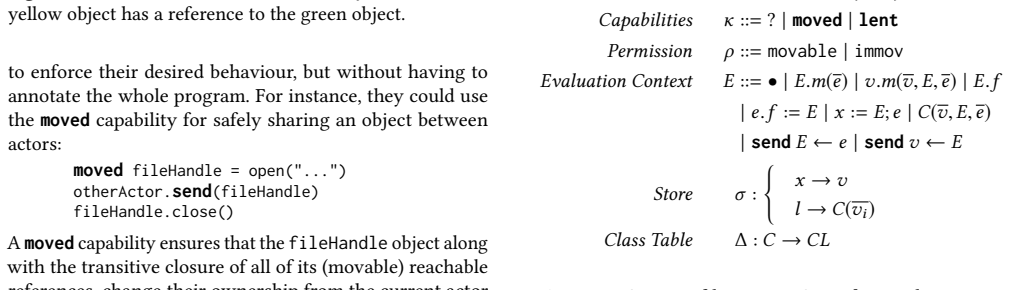
The load-bearing machinery is the pair of graph traversals called the reachable object graph (rog) and the movable reachable object graph (mrog), together with the store update of Definition 3.1. When a `moved` value is sent or spawned, the runtime computes the transitive closure of movable locations, treats that whole closure as owned by the receiving actor, and for every location not in the closure overwrites fields that point into it with an error marker, and likewise replaces local variables whose values point into the moved graph. This erasure operation is what the paper relies on to turn any later access to a moved object into an error instead of a data race.
What would settle it
Run a small actor program where the sender, after a `moved` send, still holds a reference to the sent object and uses it to read or write a field; if the runtime returns a value from the moved object instead of raising an error, the data-race guarantee is violated. A systematic version is to instrument the store so every access to an error-marked location is logged and search for any reachable alias that survives a move.
Extended reading notes
Core claim
On the paper's own terms, the discovery is that gradual reference capabilities are coherent: by adding a dynamic capability `?` for unannotated references, a runtime can check `moved` (transfer the transitive closure of an object to another actor, erasing all references into that graph) and `lent` (borrow a reference but forbid its transmission) as they are used, while leaving the rest of the program unannotated. Definitions 3.1 through 3.4 define how the store changes when a value is used under a capability: the reachable object graph and the movable reachable object graph determine which locations must be moved, and every variable or field reaching into that graph is replaced with an error value. The stated conclusion is that the runtime semantics of Figure 3 prevents data races, and that this capability discipline is orthogonal to the typing discipline.
Load-bearing premise
The safety claim rests on the assumption that the runtime's erasure step, replacing every variable and field reference that points into the moved object graph with an error marker, actually catches every alias that could reach the moved objects; the paper states this without a proof and explicitly allows the sender to keep a reference to a moved object.
Editorial extensions
If this is right
- Existing unannotated actor programs can add `moved` and `lent` annotations incrementally, because unannotated references degrade to the dynamic `?` capability instead of failing to type-check.
- A `moved` send transfers ownership of the object and its whole movable reachable graph, so the sending actor cannot later use that data without hitting a runtime error.
- A `lent` reference can be used locally but cannot be sent to another actor, so a runtime check stops borrowed data from escaping its owning actor.
- Linear capabilities with destructive reads are rejected by the design, because removing a `lin` annotation changes program behaviour and breaks the gradual guarantee.
- The same capability machinery can be layered onto gradually typed languages, since the authors argue capabilities are orthogonal to the typing discipline.
Reading between the lines
- A natural next step the paper leaves open is a static type system for these capabilities; until that exists, the runtime is the only check and the erasure invariant that makes moves safe is unproven.
- If the erasure rule is made precise, one could mechanically test the data-race guarantee by instrumenting the store to track every reachable alias and checking that no alias into a moved graph remains after a send.
- The design suggests a practical migration tool: a linter could estimate the reachable object graph at each send site and suggest which capability annotation to add, letting programmers adopt capabilities in order of risk.
Signed reviews
Editorial analysis
A structured set of objections, weighed in public.
Referee Report
Summary. This work-in-progress paper proposes a gradual reference capability system for an untyped actor calculus. The authors define a small-step semantics for an object-oriented language with capabilities `moved`, `lent`, and the dynamic `?`, and they claim that the runtime semantics prevents data races. The paper also discusses design goals, including the gradual guarantee, and compares with related work on gradual typing and ownership. The central technical contribution is the formalization in Definitions 3.1-3.4 and Figure 3, which is intended to make capability enforcement dynamic when static annotations are absent.
Significance. If the proposed semantics were sound, the paper would make a useful contribution: it would show that data-race safety can be introduced incrementally into an untyped actor language, with unannotated code degrading to the dynamic `?` capability. The paper is self-contained, starts from scratch in its definitions, and does not rely on fitted parameters or circular derivations. However, the main claimed result—that the runtime semantics prevents data races—is undermined by a concrete counterexample. Because the data-race freedom claim is the paper's headline and is stated in both Section 1 and the Conclusion, the counterexample is load-bearing and must be resolved before the paper can be accepted. The underlying idea is interesting and the paper's exploration of gradual guarantee issues (e.g., the discussion of linear capabilities in Section 4) shows good motivation, but the formal semantics needs substantial revision.
major comments (3)
- [Section 3, Definition 3.1 and Figure 3 (E-Send)] The claimed data-race freedom is false for the semantics as given. Let actor A have σ(x) = movable l and consider the expression x.m(send B←x), where m is a mutating method. Reducing the receiver and then the argument via E-Send yields σ′(x) = Error and enqueues movable l at actor B, but the continuation in A becomes (movable l).m(Unit). Since l is in the moved graph, σ′(l) = σ(l), so E-MethodCall in A can still look up l and execute the mutating method, while B also has access to l. This is a data race. The definition of `moved movable l(σ)` modifies only the store (variables and fields), not the active expression; no rule in Figure 3 invalidates expression-level occurrences of a moved location. Footnote 1's claim that the sender 'does not make use of it' is therefore not enforced. To restore the data-race freedom claim, the semantics must be changed to purge or invalidate moved locations from the current expression, or to check location ownership at each access.
- [Section 3, Definition 3.1] The defining condition of `moved movable l(σ)` is malformed. The text reads '∀l′, x, a : m = mrogσ(l)', which does not parse as a well-formed predicate: the variable m is introduced on the right-hand side of the equality inside the quantifier, and the quantifier has no attached body. The intended meaning appears to be that m is defined as mrogσ(l) and then for all l′, x, a in the store the subsequent case split applies, but this needs a precise rewrite. Additionally, the case for σ′(x) only nullifies variables whose direct value is a location in m; the interaction with variables that refer to non-moved objects containing pointers into m is handled only through field patching, and the expression-level problem from the previous comment remains unaddressed.
- [Figure 3, E-NewClass] E-NewClass applies a single capability κ to the entire value tuple: it uses `κv(σ)` and `C(κ(v))`. However, class declarations in Figure 2 have per-field capabilities (f:κ), and the accompanying text says 'casting the argument values to the class to the corresponding field capabilities'. The rule as printed does not specify which field capability is applied to which argument, which makes the semantics of field capabilities ambiguous or incorrect. The rule should be parameterized per field, e.g., `κ_i v_i(σ)` for each field f_i.
minor comments (5)
- [Figure 3, E-Receive] The E-Receive rule is typographically confusing: the conclusion writes `a7→v E[v]`, which appears to leave the consumed message v in the queue. The intended rule should presumably remove v from the queue and keep the remainder, i.e., `a7→v′ E[v]`.
- [Definitions 3.2 and 3.3] The symbol 'Ø' is used where a set union appears to be intended in the recursive definitions of rog and mrog; using a standard union symbol with appropriate indexing would improve readability.
- [Section 2, first paragraph] The sentence 'A moved capability ensures that the fileHandle object along with the transitive closure of all of its (movable) reachable references, change their ownership' has a subject-verb agreement error and should be reworded.
- [Figure 2] The list of meta-variables says 'C, m, f, x, and t' but the following sentence describes 'actor ids' without naming the meta-variable; the displayed list should be corrected to include 'a' instead of 't'.
- [Section 5, last paragraph] The statement that 'gradual reference capabilities seem to be orthogonal to gradual typing' is presented as a belief, not a result. If the paper claims orthogonality as a contribution, it should be stated as a conjecture or given a formal statement and proof; otherwise, it should be explicitly labeled as a design hypothesis.
Circularity Check
No circular derivation: the gradual-capability semantics is defined from scratch, with no fitted inputs, no renamed predictions, and no load-bearing self-citation chain.
full rationale
The paper's central contribution is a runtime semantics for an untyped actor calculus with moved and lent capabilities, expressed through Definitions 3.1–3.4 and the rules of Figure 3. These definitions are presented directly as first-principles formal machinery rather than derived from a fitted parameter or from a prior result whose content is assumed. Definition 3.1 modifies the store when a value is used as a moved capability; Definitions 3.2–3.3 define reachable object graphs; Definition 3.4 casts values between capabilities. None of these are defined in terms of the data-race-freedom property they are claimed to support, so there is no self-definitional circularity. The paper does cite prior capability-based work by overlapping authors (e.g., Encore [6,7]) and Fennell and Thiemann [11] on linearity and gradual typing, but these citations are used as inspiration or comparison, not as the justification for the paper's own safety claim. The claims that gradual reference capabilities are 'orthogonal to gradual typing' are explicitly hedged as beliefs ('we believe'), not established by importing the result from the cited work. The most substantive concern flagged in the manuscript is a possible soundness gap: Definition 3.1 uninitialises store entries pointing into a moved object graph, but the reduction rules and evaluation contexts are not accompanied by a preservation invariant showing that no live expression occurrence of a moved location remains in the sending actor. That is a correctness or proof-obligation issue, not a circularity issue: the semantics is not defined in terms of the conclusion, and no derived quantity is fed back as an input. There are no fitted parameters, no benchmark-derived predictions, and no uniqueness theorem imported from the authors' own prior work to force the design. Under the review instructions, the honest finding is therefore no significant circularity, score 0.
Assumptions & free parameters
assumptions (4)
- standard math Small-step contextual reduction with evaluation contexts is a faithful model of the language's runtime.
- domain assumption The runtime can annotate every stored reference with a permission (movable or immovable) and invalidate references with an Error value.
- domain assumption Arbitrary interleaving of actor executions is the intended concurrency model.
- ad hoc to paper Removing a capability annotation should not change program behavior (gradual guarantee) and this property can be extended to capabilities.
invented entities (2)
-
moved capability
-
lent capability
Cite this review
Pith. "Pith review of Towards Gradual Checking of Reference Capabilities." pith.science (2026). https://pith.science/paper/FI6H6WWB
@misc{pith2026190901465,
  author       = {Pith},
  title        = {Pith review of: Towards Gradual Checking of Reference Capabilities},
  year         = {2026},
  howpublished = {\url{https://pith.science/paper/FI6H6WWB}},
  note         = {Machine review of arXiv:1909.01465}
}
read the original abstract
Concurrent and parallel programming is difficult due to the presence of memory side-effects, which may introduce data races. Type qualifiers, such as reference capabilities, can remove data races by restricting sharing of mutable data. Unfortunately, reference capability languages are an all-in or nothing game, i.e., all the types must be annotated with reference capabilities. In this work in progress, we propose to mix the ideas from the reference capability literature with gradual typing, leading to gradual reference capabilities.
Figures


Reference graph
Works this paper leans on
-
[1]
2019. Transferable Interface. https://developer.mozilla.org/en- US/docs/Web/API/Transferable
work page 2019
-
[2]
Hagit Attiya and Roy Friedman. 1996. Limitations of Fast Consistency Conditions for Distributed Shared Memories. Inf. Process. Lett. 57, 5 (1996), 243–248. https://doi.org/10.1016/0020-0190(96)00007-5
-
[3]
Newton, Simon Peyton Jones, and Arnaud Spiwack
Jean-Philippe Bernardy, Mathieu Boespflug, Ryan R. Newton, Simon Peyton Jones, and Arnaud Spiwack. 2018. Linear Haskell: practical linearity in a higher-order polymorphic language. PACMPL 2, POPL (2018), 5:1–5:29. https://doi.org/10.1145/3158093
doi:10.1145/3158093 2018
- [4]
-
[5]
John Boyland, James Noble, and William Retert. 2001. Capabilities for Sharing: A Generalisation of Uniqueness and Read-Only. In ECOOP 2001 - Object-Oriented Programming, 15th European Conference, Bu- dapest, Hungary, June 18-22, 2001, Proceedings (Lecture Notes in Com- puter Science) , Jørgen Lindskov Knudsen (Ed.), Vol. 2072. Springer, 2–27. https://doi....
-
[6]
Stephan Brandauer, Elias Castegren, Dave Clarke, Kiko Fernandez- Reyes, Einar Broch Johnsen, Ka I Pun, Silvia Lizeth Tapia Tarifa, Tobias Wrigstad, and Albert Mingkun Yang. 2015. Parallel Objects for Multi- cores: A Glimpse at the Parallel Language Encore. InFormal Methods for Multicore Programming - 15th International School on Formal Methods for the Des...
work page 2015
-
[7]
Elias Castegren and Tobias Wrigstad. 2016. Reference Capabilities for Concurrency Control. In 30th European Conference on Object- Oriented Programming, ECOOP 2016, July 18-22, 2016, Rome, Italy (LIPIcs), Shriram Krishnamurthi and Benjamin S. Lerner (Eds.), Vol. 56. Schloss Dagstuhl - Leibniz-Zentrum fuer Informatik, 5:1–5:26. https: //doi.org/10.4230/LIPI...
-
[8]
Elias Castegren and Tobias Wrigstad. 2017. Relaxed Linear References for Lock-free Data Structures. In 31st European Conference on Object- Oriented Programming, ECOOP 2017, June 19-23, 2017, Barcelona, Spain (LIPIcs), Peter Müller (Ed.), Vol. 74. Schloss Dagstuhl - Leibniz-Zentrum fuer Informatik, 6:1–6:32. https://doi.org/10.4230/LIPIcs.ECOOP.2017. 6
Show all 21 references
-
[9]
Sylvan Clebsch, Sophia Drossopoulou, Sebastian Blessing, and Andy McNeil. 2015. Deny capabilities for safe, fast actors. In Proceedings of the 5th International Workshop on Programming Based on Actors, Agents, and Decentralized Control, AGERE! 2015, Pittsburgh, PA, USA, Octobe...
2015
-
[10]
Erik Ernst (Ed.). 2007. ECOOP 2007 - Object-Oriented Programming, 21st European Conference, Berlin, Germany, July 30 - August 3, 2007, Proceedings. Lecture Notes in Computer Science, Vol. 4609. Springer. https://doi.org/10.1007/978-3-540-73589-2
2007 doi
-
[11]
Luminous Fennell and Peter Thiemann. 2012. The Blame Theorem for a Linear Lambda Calculus with Type Dynamic. In Trends in Functional Programming - 13th International Symposium, TFP 2012, St. Andrews, UK, June 12-14, 2012, Revised Selected Papers (Lecture Notes in Com- puter Sc...
2012 doi
-
[12]
Robert Bruce Findler and Matthias Felleisen. 2013. ICFP 2002: Contracts for higher-order functions. SIGPLAN Notices 48, 4S (2013), 34–45. https://doi.org/10.1145/2502508.2502521
2013
-
[13]
Gordon, Matthew J
Colin S. Gordon, Matthew J. Parkinson, Jared Parsons, Aleks Bromfield, and Joe Duffy. 2012. Uniqueness and reference immutability for safe parallelism. In Proceedings of the 27th Annual ACM SIGPLAN Conference on Object-Oriented Programming, Systems, Languages, and Applications...
2012
-
[14]
Henry M Levy. 2014. Capability-based computer systems. Digital Press
2014
-
[15]
Peterson
Gary L. Peterson. 1981. Myths About the Mutual Exclusion Prob- lem. Inf. Process. Lett. 12, 3 (1981), 115–116. https://doi.org/10.1016/ 0020-0190(81)90106-X
1981
-
[16]
Ilya Sergey and Dave Clarke. 2012. Gradual Ownership Types. In Programming Languages and Systems - 21st European Symposium on Programming, ESOP 2012, Held as Part of the European Joint Conferences on Theory and Practice of Software, ETAPS 2012, Tallinn, Estonia, March 24 - Apr...
2012
-
[17]
Siek and Walid Taha
Jeremy G. Siek and Walid Taha. 2007. Gradual Typing for Objects, See [10], 2–27. https://doi.org/10.1007/978-3-540-73589-2_2
2007 doi
-
[18]
Siek, Michael M
Jeremy G. Siek, Michael M. Vitousek, Matteo Cimini, and John Tang Boyland. 2015. Refined Criteria for Gradual Typing. In 1st Summit on Advances in Programming Languages, SNAPL 2015, May 3-6, 2015, Asilomar, California, USA (LIPIcs), Thomas Ball, Rastislav Bodík, Shri- ram Kris...
2015 doi
-
[19]
Sam Tobin-Hochstadt and Matthias Felleisen. 2006. Interlanguage migration: from scripts to programs. In Companion to the 21th Annual ACM SIGPLAN Conference on Object-Oriented Programming, Systems, Languages, and Applications, OOPSLA 2006, October 22-26, 2006, Port- land, Orego...
2006
-
[20]
Wright and Matthias Felleisen
Andrew K. Wright and Matthias Felleisen. 1994. A Syntactic Approach to Type Soundness. Inf. Comput. 115, 1 (1994), 38–94. https://doi.org/ 10.1006/inco.1994.1093 5
1994
-
[2012]
In ACM Symposium on New Ideas in Programming and Reflections on Software, Onward! 2012, part of SPLASH ’12, Tucson, AZ, USA, October 21-26, 2012 , Gary T
Grace: the absence of (inessential) difficulty. In ACM Symposium on New Ideas in Programming and Reflections on Software, Onward! 2012, part of SPLASH ’12, Tucson, AZ, USA, October 21-26, 2012 , Gary T. Leavens and Jonathan Edwards (Eds.). ACM, 85–98. https://doi.org/ 10.1145/...
2012
Reviewed August 14, 2026 · model on record in the stance chip above.
Discussion (0). Continue with ORCID to comment.