REVIEW 3 major objections 5 minor 42 references
High-order gas-kinetic scheme with three-dimensional WENO reconstruction for the Euler and Navier-Stokes solutions
T0 review · 3 major / 5 minor · reviewed 2026-08-14 · deepseek-v4-flash
Pith's one-line read The paper claims that a WENO-AO reconstruction combining one quadratic big-stencil polynomial with 24 linear sub-stencils at fixed positive weights, fed into a two-stage fourth-order gas-kinetic scheme, gives a third-order finite-volume…
desk verdict A genuinely useful 3D WENO-AO/HGKS extension with clean third-order inviscid convergence; the Navier-Stokes order claim needs a viscous convergence test before I'd take it as established. read the letter →
The pith
A machine-rendered reading of the paper's core claim, the machinery that carries it, and where it could break.
The reading
What carries the argument
The load-bearing object is the WENO-AO combination formula P̃0(xG) = ω0($γ0^{{-1}}$P0(xG) − ∑_{m=1}^{24}(γm/γ0)Pm(xG)) + ∑_{m=1}^{24}ωmPm(xG), built from a 19-cell big stencil (the 3×3×3 block minus its eight corner cells) supporting a quadratic polynomial P0 and 24 five-cell sub-stencils supporting linear polynomials Pm. The linear weights γm are fixed positive constants summing to one, and the nonlinear weights ωm = γm(1 + τ/(βm + ε)) with τ = ∑|β0 − βm|/24 convert the combination into a shock-detecting selector. This reconstruction replaces the classical per-quadrature-point linear-weight solves; the gas-kinetic flux then reads reconstructed point values and slopes directly off the same polynomials at each Gaussian quadrature point per face, and the two-stage fourth-order time stepping needs only the flux and its temporal derivative at each cell interface.
What would settle it
Perform a three-dimensional viscous convergence test—for example, the same density-perturbation advection with Re = 100 viscosity or a manufactured Navier-Stokes solution with a smooth source term—and record the observed L1 order on nested meshes. If the order saturates near two rather than three, the third-order Navier-Stokes claim is false. A direct check of the mechanism: measure the error of the reconstructed slopes ∂P̃0/∂x at a Gaussian quadrature point on smooth data; the viscous flux inherits its order from those slopes, which must be second-order accurate for a third-order flux.
Extended reading notes
Core claim
On the paper's own terms, the central discovery is that a WENO-AO reconstruction with one quadratic big-stencil polynomial and 24 linear sub-stencil polynomials, combined with fixed positive linear weights γ0 = 1 − 24Γ and γm = Γ (Γ = 0.0025) that are independent of local mesh topology, attains third-order point-value accuracy for three-dimensional Euler and Navier-Stokes solutions provided the nonlinear weights satisfy ωm = γm(1 + O(h)). The accuracy mechanism is the separation of smoothness-indicator scales: the quadratic indicator carries an O(|Ω|^{2/3}) error while the linear indicators carry O(|Ω|^{1/3}), so the parameter τ defined by averaging the 24 differences |β0 − βm| yields the required first-order deviation. Coupled with the two-stage fourth-order gas-kinetic scheme, the method shows third-order convergence on uniform, non-coplanar, and moving hexahedral meshes, reproduces Sod, blast-wave, spherical-Sod, and Sedov shock profiles, matches Taylor-Green vortex and isotropic-turbulence reference data up to turbulent Mach number 1.2, and preserves the geometric conservation law to machine precision on moving meshes.
Load-bearing premise
The Navier-Stokes accuracy claim assumes the spatial slopes built from the least-squares linear sub-stencil polynomials are accurate enough for a third-order viscous flux, an assumption the paper does not test since its convergence study covers an inviscid case only.
Editorial extensions
If this is right
- On uniform, non-coplanar, and moving hexahedral meshes, the smooth advection test converges at approximately third order, with measured L1 orders between 2.85 and 3.00 across the meshes tested.
- Fixed positive linear weights with γ0 = 1 − 24Γ and γm = Γ avoid the negative and topology-dependent weights of classical 3D WENO, eliminating per-quadrature-point linear-system solves and improving efficiency, especially for moving meshes.
- The scheme resolves strong shocks—Sod, Woodward-Collella blast wave, spherical Sod, and Sedov—without spurious oscillation, and the Mach 5 and Mach 8 sphere test shows no carbuncle phenomenon.
- On moving meshes, the uniform-flow test holds L1 errors near 10^{-14}, meaning the geometric conservation law is satisfied to machine precision.
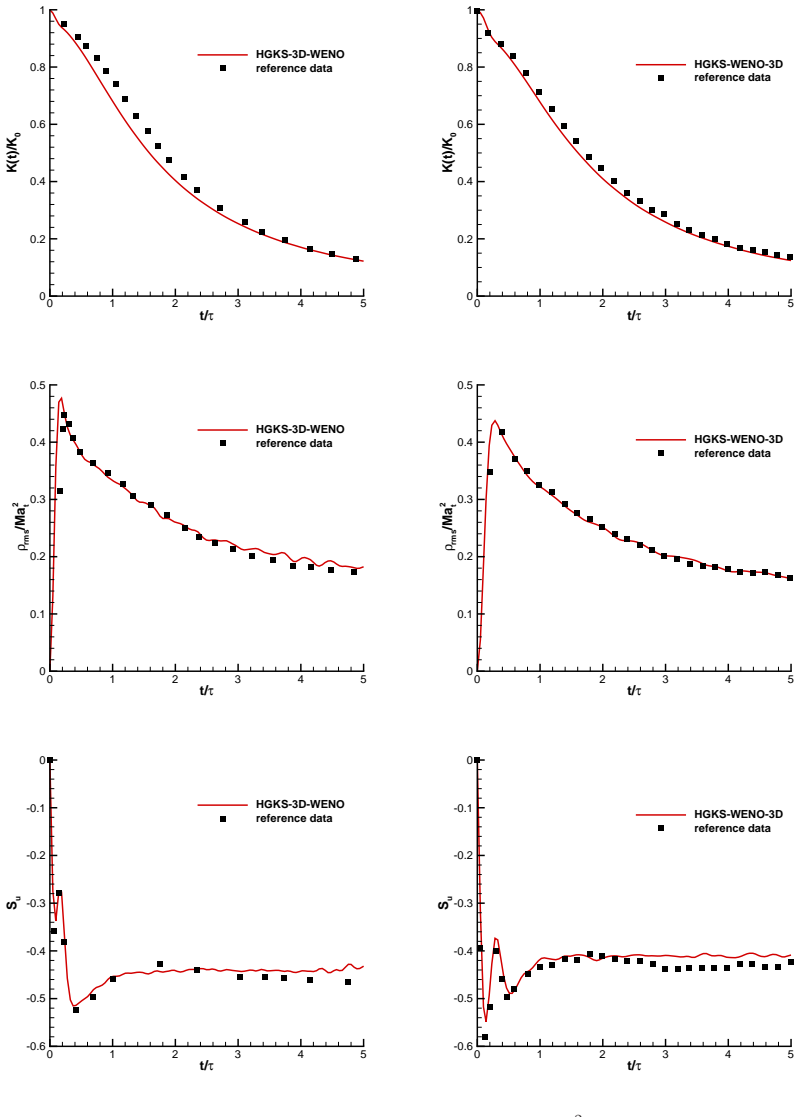
- The scheme reproduces reference kinetic-energy and dissipation histories for the Taylor-Green vortex at Re = 280 and for compressible isotropic turbulence at turbulent Mach numbers 0.3 to 1.2, including the supersonic regime.
Reading between the lines
- The topology-independent fixed weights suggest the reconstruction transfers to unstructured hexahedral meshes without re-deriving weights; the paper names this as future work, and that transfer is the natural test of the construction's main selling point.
- Because the accuracy analysis proves third-order point-value reconstruction but the viscous flux depends on reconstructed slopes from first-order-accurate linear sub-stencils, a viscous manufactured-solution test would settle whether the Navier-Stokes claim holds; the paper contains no such test.
- The parameter τ, chosen as a 24-term average of |β0 − βm|, may behave differently near critical points where the solution gradient vanishes; whether third-order accuracy survives there—the classical WENO critical-point problem—is left untested.
Signed reviews
Editorial analysis
A structured set of objections, weighed in public.
Referee Report
Summary. The paper develops a three-dimensional finite-volume WENO-AO reconstruction for high-order gas-kinetic schemes (HGKS). The reconstruction uses one quadratic big-stencil polynomial and 24 linear sub-stencil polynomials with fixed positive linear weights, avoiding topology-dependent and possibly negative linear weights at the quadrature points of a hexahedron. The resulting scheme is coupled with the two-stage fourth-order gas-kinetic solver and is extended to moving meshes through a trilinear parameterization of hexahedra. The authors claim third-order accuracy for both the Euler and Navier-Stokes equations, robustness for strong discontinuities, and exact preservation of the geometric conservation law on moving meshes. Numerical evidence includes inviscid three-dimensional advection convergence tests on uniform, non-coplanar, and moving meshes, geometric conservation-law tests to machine precision, Riemann and Sedov problems, a hypersonic sphere impingement test, and qualitative comparisons for the Taylor-Green vortex and compressible isotropic turbulence.
Significance. The WENO-AO construction is a genuine efficiency improvement: the linear weights are fixed positive numbers independent of the local mesh topology, and the scheme avoids solving weight systems at 24 quadrature points. The inviscid convergence tests in Tables 1-3 are clean and credible, and the moving-mesh geometric conservation-law results in Table 4 are a strong positive feature. However, the claimed third-order accuracy for the Navier-Stokes equations is not established by the evidence presented: the accuracy analysis in Section 2 concerns point values only, and the viscous tests in Sections 4.6 and 4.7 are single-resolution qualitative comparisons. This is a load-bearing gap because the viscous flux in the gas distribution function depends on reconstructed slopes whose accuracy is neither analyzed nor tested.
major comments (3)
- [Section 2, Eq. (15)] The accuracy analysis in Section 2 establishes only that the reconstructed point value tilde-P_0(x_G) is third-order under the assumed weight condition (6). The spatial derivatives of tilde-P_0, defined immediately after Eq. (5), are used in the gas distribution function (15) through the coefficients a_l and a_r, and these coefficients enter the viscous flux through the tau = mu/p term. The 24 linear sub-stencil polynomials P_m are one-sided least-squares fits, so their individual gradients are only first-order accurate for general smooth data. No Taylor analysis or numerical experiment shows that the WENO combination raises the slope accuracy to the level needed for a third-order viscous flux. Consequently, the abstract and conclusion's claim of third-order accuracy for Navier-Stokes solutions is not supported. A viscous convergence study on multiple meshes, for example with a manufactured solution, and preferably a short Taylor analysis of the reconstructed slopes, should be added.
- [Eq. (6), Section 2] The sufficient condition omega_m = gamma_m(1 + O(h^k)) with k = 1 is stated as an assumption rather than proved. The Taylor expansions of the smoothness indicators beta_m are given only to leading order, and no argument is supplied for points where the leading gradient term of Q vanishes; at such critical points the order k in (6) could in principle degrade. The inviscid advection tests suggest the condition holds for point values, but the same condition is needed for the reconstructed slopes that enter Eq. (15). The authors should either prove (6) under appropriate smoothness assumptions or provide a numerical verification that includes critical points.
- [Sections 4.6-4.7] The Taylor-Green vortex and compressible isotropic turbulence tests are single-resolution comparisons with reference data: the TGV computation uses 192^3 cells and the turbulence computation uses 128^3 cells, and neither reports errors or observed order on a sequence of meshes. These tests demonstrate qualitative agreement and robustness, but they cannot verify the order of accuracy of the Navier-Stokes discretization. A grid-refinement study for a viscous flow with a known or manufactured solution is necessary to support the central third-order claim for viscous flows.
minor comments (5)
- [Section 3, after Eq. (7)] There are two typos: 'can ba obtained' should read 'can be obtained', and in Section 2 the phrase 'smooth indicator' should read 'smoothness indicator'.
- [Section 4.2] In the geometric conservation-law paragraph, 'the above moment of computational mesh' should presumably be 'the above motion of the computational mesh'.
- [Eq. (3)] The symbols omega_m and omega_m are used both for the unnormalized and the normalized nonlinear weights, which is confusing; please use a tilde or a superscript for the normalized quantity.
- [Figures 7-10] The scheme name is written inconsistently as 'HGKS-3D-WENO' in Figure 7 and as 'HGKS-WENO-3D' in Figures 9 and 10; please make the notation uniform.
- [References] References [27] and [30] appear to be the same preprint with different version labels; please unify them and cite the published version if available.
Circularity Check
No significant circularity: the WENO-AO accuracy argument is a self-contained Taylor-expansion derivation, and the numerical claims are checked against exact and reference solutions.
full rationale
The paper's central claim is that a 3D finite-volume gas-kinetic scheme with WENO-AO reconstruction is third-order accurate for smooth Euler flows and robust for discontinuities. The accuracy argument in Section 2 is not circular: it constructs a big-stencil quadratic polynomial and 24 sub-stencil linear polynomials, defines nonlinear weights from smoothness indicators, and proves via Taylor expansion that the reconstructed point values are third-order provided the weights satisfy omega_m = gamma_m(1+O(h)), which the preceding expansion of beta_m and tau establishes. No fitted parameter is later renamed as a prediction; the only constants, such as Gamma = 0.0025 and CFL = 0.35, are fixed and are not tuned to the convergence tables. The convergence tests in Tables 1-3 compare against the exact advection solution on uniform, non-coplanar, and moving meshes, while the shock and turbulence tests are compared with exact or reference data or with a WENO-Z scheme, so the validation is independent of the derivation. The paper does cite prior GKS and WENO-AO work, including by the same authors, but those citations supply standard evolution-model and reconstruction ingredients and are not used to forbid alternatives; the fourth-order two-stage time discretization is a cited external framework, and the present spatial reconstruction is separately tested. The absence of a viscous convergence study means that the statement of third-order accuracy for Navier-Stokes solutions is not fully demonstrated, but that is an evidentiary gap rather than a circular reduction: the Navier-Stokes flux is not fitted to the DNS reference data. No step in the paper defines its output in terms of its input, fits a parameter and then calls the result a prediction, or imports an unverified uniqueness theorem from prior work. Therefore no circularity is found.
Assumptions & free parameters
free parameters (3)
- sub-stencil linear weight Gamma =
0.0025
- inviscid collision-time parameters epsilon and C =
epsilon=0.01, C=1
- CFL number =
0.35
assumptions (4)
- domain assumption The BGK equation with the BGK collision operator is an adequate description of Euler and Navier-Stokes flows in the continuum limit via Chapman-Enskog expansion.
- standard math The two-stage fourth-order temporal discretization is fourth-order accurate for hyperbolic conservation laws.
- standard math Least-squares polynomial reconstruction over the chosen stencils yields pointwise errors O(h^3) for the quadratic and O(h^2) for the linear polynomials for smooth data.
- ad hoc to paper The nonlinear weights satisfy omega_m = gamma_m (1 + O(h)) uniformly in smooth regions, including near critical points where gradients vanish.
Cite this review
Pith. "Pith review of High-order gas-kinetic scheme with three-dimensional WENO reconstruction for the Euler and Navier-Stokes solutions." pith.science (2026). https://pith.science/paper/DCBGF4M6
@misc{pith2026190901580,
  author       = {Pith},
  title        = {Pith review of: High-order gas-kinetic scheme with three-dimensional WENO reconstruction for the Euler and Navier-Stokes solutions},
  year         = {2026},
  howpublished = {\url{https://pith.science/paper/DCBGF4M6}},
  note         = {Machine review of arXiv:1909.01580}
}
read the original abstract
In this paper, a simple and efficient third-order weighted essentially non-oscillatory (WENO) reconstruction is developed for three-dimensional flows, in which the idea of two-dimensional WENO-AO scheme on unstructured meshes \cite{WENO-ao-3} is adopted. In the classical finite volume type WENO schemes, the linear weights for the candidate stencils are obtained by solving linear systems at Gaussian quadrature points of cell interface. For the three-dimensional scheme, such operations at twenty-four Gaussian quadrature points of a hexahedron would reduce the efficiency greatly, especially for the moving-mesh computation. Another drawback of classical WENO schemes is the appearance of negative weights with irregular local topology, which affect the robustness of spatial reconstruction. In such three-dimensional WENO-AO scheme, a simple strategy of selecting big stencil and sub-stencils for reconstruction is proposed. With the reconstructed quadratic polynomial from big stencil and linear polynomials from sub-stencils, the linear weights are chosen as positive numbers with the requirement that their sum equals one and be independent of local mesh topology. With such WENO reconstruction, a high-order gas-kinetic scheme (HGKS) is developed for both three-dimensional inviscid and viscous flows. Taken the grid velocity into account, the scheme is extended into the moving-mesh computation as well. Numerical results are provided to illustrate the good performance of such new finite volume WENO schemes. In the future, such WENO reconstruction will be extended to the unstructured meshes.
Figures


Figures from the paper (8 more)




Reference graph
Works this paper leans on
-
[1]
R. Abgrall, On essentially non-oscillatory schemes on unstructur ed meshes: Analysis and implementa- tion, J. Comput. Phys. 114 (1994) 45-58
work page 1994
-
[2]
D.S. Balsara, S. Garain, C.W. Shu. An efficient class of WENO scheme s with adaptive order. Journal of Computational Physics, 326 (2016) 780C804
work page 2016
-
[3]
M. Ben-Artzi, J. Li, Hyperbolic conservation laws: Riemann invaria nts and the generalized Riemann problem, Numerische Mathematik. 106 (2007) 369-425
work page 2007
-
[4]
P.L. Bhatnagar, E.P. Gross, M. Krook, A Model for Collision Proce sses in Gases I: Small Amplitude Processes in Charged and Neutral One-Component Systems, Phy s. Rev. 94 (1954) 511-525
work page 1954
- [5]
-
[6]
J. R. Bull, A. Jameson, Simulation of the compressible Taylor-Gree n vortex using high-order flux reconstruction schemes, AIAA 2014-3210
work page 2014
-
[7]
G.Y. Cao, L. Pan, K. Xu, Three dimensional high-order gas-kinet ic scheme for supersonic isotropic turbulence I: criterion for direct numerical simulation, Computers & Fluids 192 (2019) 104273
work page 2019
-
[8]
S. Chapman, T.G. Cowling, The Mathematical theory of non-unifo rm gases, third edition, Cambridge University Press, (1990)
work page 1990
Show all 42 references
-
[9]
Cockburn, C.W
B. Cockburn, C.W. Shu, TVB Runge-Kutta local projection disco ntinuous Galerkin finite element method for conservation laws II: general framework, Mathemat ics of Computation, 52 (1989) 411-435
1989
-
[10]
Cockburn, C.W
B. Cockburn, C.W. Shu, The Runge-Kutta discontinuous Galerk in method for conservation laws V: multidimensional systems, J. Comput. Phys. 141 (1998) 199-224
1998
-
[11]
Dumbser, M
M. Dumbser, M. Kaser, Arbitrary high order non-oscillatory fin ite volume schemes on unstructured meshes for linear hyperbolic systems, J. Comput. Phys. 221 (2007 ) 693C723
2007
-
[12]
Debonis, Solutions of the Taylor-Green vortex problem using high-resolution explicit finite difference methods, AIAA Paper (2013) 2013-0382
J. Debonis, Solutions of the Taylor-Green vortex problem using high-resolution explicit finite difference methods, AIAA Paper (2013) 2013-0382
2013
-
[13]
Z.F. Du, J.Q. Li, A Hermite WENO reconstruction for fourth orde r temporal accurate schemes based on the GRP solver for hyperbolic conservation laws, J. Comput. Phy s. 355 (2018) 385-396
2018
-
[14]
Gottlieb, C.W
S. Gottlieb, C.W. Shu, Total variation diminishing Runge-Tutta sc hemes, Mathematics of computation, 67 (1998) 73-85
1998
-
[15]
Harten, B
A. Harten, B. Engquist, S. Osher and S. R. Chakravarthy, Un iformly high order accurate essentially non-oscillatory schemes, III. J. Comput. Phys. 71 (1987) 231-3 03
1987
-
[16]
A. K. Henrick, T. D. Aslam, J. M. Powers, Mapped weighted esse ntially non-oscillatory schemes: achieving optimal order near critical points, J. Comput. Phys. 207 (2005) 542-567
2005
-
[17]
C. Hu, C.W. Shu, Weighted essentially non-oscillatory schemes on triangular meshes, J. Comput. Phys. 150 (1999) 97-127
1999
-
[18]
X. Ji, L. Pan, W. Shyy, K. Xu, A compact fourth-order gas-kin etic scheme for the Euler and Navier- Stokes equations, J. Comput. Phys. 372 (2018) 446-472
2018
-
[19]
X. Ji, K. Xu, Performance Enhancement for High-order Gas-k inetic Scheme Based on WENO-adaptive- order Reconstruction, arXiv:1905.08489v1
1905 arXiv
-
[20]
Jiang, C
G.S. Jiang, C. W. Shu, Efficient implementation of weighted ENO sch emes, J. Comput. Phys. 126 (1996) 202-228
1996
-
[21]
Kamm, F.X
J.R. Kamm, F.X. Timmes, On efficient generation of numerically robu st Sedov solutions, Technical Report LA-UR-07-2849, Los Alamos National Laboratory, (2007 )
2007
-
[22]
Lele, Compact finite difference schemes with spectral-like re solution, J
S.K. Lele, Compact finite difference schemes with spectral-like re solution, J. Comput. Phys. 103 (1992) 16-42
1992
-
[23]
J.Q. Li, Z.F. Du, A two-stage fourth order time-accurate discr etization for Lax-Wendroff type flow solvers I. hyperbolic conservation laws, SIAM J. Sci. Computing, 38 (2016) 3046-3069
2016
-
[24]
Q.B. Li, K. Xu, S. Fu, A high-order gas-kinetic Navier-Stokes flo w solver, J. Comput. Phys. 229 (2010) 6715-6731
2010
-
[25]
X.D. Liu, S. Osher, T. Chan, Weighted essentially non-oscillatory schemes, J. Comput. Phys. 115 (1994) 200-212. 28
1994
-
[26]
Liu, H.Z
N. Liu, H.Z. Tang, A high-order accurate gas-kinetic scheme fo r one- and two-dimensional flow simu- lation, Commun. Comput. Phys. 15 (2014) 911-943
2014
-
[28]
L. Pan, K. Xu, Q.B. Li, J.Q. Li, An efficient and accurate two-stag e fourth-order gas-kinetic scheme for the Navier-Stokes equations, J. Comput. Phys. 326 (2016), 197-221
2016
-
[29]
L. Pan, K. Xu, Two-stage fourth-order gas-kinetic scheme f or three-dimensional Euler and Navier- Stokes solutions, Int. J. Comput. Fluid Dynamics, 32 (2018) 395-4 11
2018
-
[30]
Pan, F.X
L. Pan, F.X. Zhao, K. Xu, High-order ALE gas-kinetic scheme wit h unstructured WENO reconstruc- tion, arXiv:1905.07837v1
1905 arXiv
-
[31]
Samtaney, D.I
R. Samtaney, D.I. Pullin, B. Kosovic, Direct numerical simulation o f decaying compressible turbulence and shocklet statistics. Physiscs of Fluids 13 (2001) 1415-1430
2001
-
[32]
J. Shi, C. Hu, C.W. Shu, A technique of treating negative weights in WENO schemes, J. Comput. Phys. 175 (2002) 108-127
2002
-
[33]
C.W. Shu, S. Osher, Efficient implementation of essentially nonosc illatory shock-capturing schemes II, J. Comput. Phys. 83 (1989) 32-78
1989
-
[34]
Thomas, C
P. Thomas, C. Lombard, Geometric conservation law and its app lication to flow computations on moving grids, AIAA J. 17 (1979) 1030-1037
1979
-
[35]
Toro, Riemann Solvers and Numerical Methods for Fluid Dyna mics, Third Edition, Springer (2009)
E.F. Toro, Riemann Solvers and Numerical Methods for Fluid Dyna mics, Third Edition, Springer (2009)
2009
-
[36]
L. Wang, W. K. Anderson, T. Erwin, S. Kapadia, High-order disc ontinuous Galerkin method for computation of turbulent flows, AIAA Journal 53 (2015) 1157-11 71
2015
-
[37]
Wang, L.P
J.C. Wang, L.P. Wang, Z.L. Xiao, Y. Shi, S.Y. Chen, A hybrid numeric al simulation of isotropic compressible turbulence, J. Comput. Phys. 229 (2010) 5257-527 9
2010
-
[38]
Xu, Direct modeling for computational fluid dynamics: constr uction and application of unfied gas kinetic schemes, World Scientific (2015)
K. Xu, Direct modeling for computational fluid dynamics: constr uction and application of unfied gas kinetic schemes, World Scientific (2015)
2015
-
[39]
Xu, A gas-kinetic BGK scheme for the Navier-Stokes equatio ns and its connection with artificial dissipation and Godunov method, J
K. Xu, A gas-kinetic BGK scheme for the Navier-Stokes equatio ns and its connection with artificial dissipation and Godunov method, J. Comput. Phys. 171 (2001) 289 -335
2001
-
[40]
F.X. Zhao, L. Pan, S.H. Wang, Weighted essentially non-oscillator y scheme on unstructured quadrilat- eral and triangular meshes for hyperbolic conservation laws, J. Co mput. Phys. 374 (2018) 605-624
2018
-
[41]
F.X. Zhao, X. Ji, W. Shyy, K. Xu, Compact higher-order gas-kin etic schemes with spectral-like resolu- tion for compressible flow simulations, Advances in Aerodynamics 1:13 (2019)
2019
-
[42]
Zhu, J.X
J. Zhu, J.X. Qiu, A new fifth order finite difference weno scheme f or solving hyperbolic conservation laws. J. Comput. Phys. 318 (2016) 110-121
2016
-
[43]
Zhu, J.X
J. Zhu, J.X. Qiu, New finite volume weighted essentially non-oscillat ory scheme on triangular meshes, SIAM J. Sci. Computing, 40 (2018) 903-928. 29
2018
Reviewed August 14, 2026 · model on record in the stance chip above.
Discussion (0). Continue with ORCID to comment.