REVIEW 3 major objections 6 minor 92 references
Post-Starburst Galaxies in SDSS-IV MaNGA
T0 review · 3 major / 6 minor · reviewed 2026-08-14 · deepseek-v4-flash
Pith's one-line read Central and ring post-starburst galaxies are two distinct quenching outcomes, not one sequence.
desk verdict A genuinely new IFU-based census of post-starburst regions, with a plausible but not yet fully secured claim that central and ring-like PSB galaxies represent different quenching mechanisms. read the letter →
The pith
A machine-rendered reading of the paper's core claim, the machinery that carries it, and where it could break.
The reading
What carries the argument
The load-bearing tool is a region-by-region selection box in the plane of $H\delta_{\rm A}$ absorption against $\mathrm{H}\alpha$ emission equivalent width, built from Bruzual & Charlot (2003) toy models with an exponentially declining starburst truncated on a 300 Myr e-folding timescale (following Wild et al. 2010). A region is called post-starburst if $H\delta_{\rm A} > 3$ Å, $W(\mathrm{H}\alpha) < 10$ Å, and $\log W(\mathrm{H}\alpha) < 0.23\,H\delta_{\rm A} - 0.46$. This boundary lets the survey find post-starburst regions over the full galaxy area, which is what makes the ring-like class visible. The authors pair this with radial gradient fitting of $D_n(4000)$, $H\delta_{\rm A}$, and $W(\mathrm{H}\alpha)$, plus mass-weighted ages and $v/\sigma$ profiles, compared against control galaxies matched in stellar mass and global $D_n(4000)$.
What would settle it
Re-run the classification with a grid of toy models that vary the burst mass fraction (1 to 50 percent), dust attenuation (up to about one magnitude), and pre-burst star formation histories; if the central-versus-ring split and the reported differences in stellar age and rotation support ($v/\sigma$) survive these variations, the two-mechanism conclusion holds up, while large shifts would show the distinction is an artifact of the chosen post-starburst boundary.
Extended reading notes
Core claim
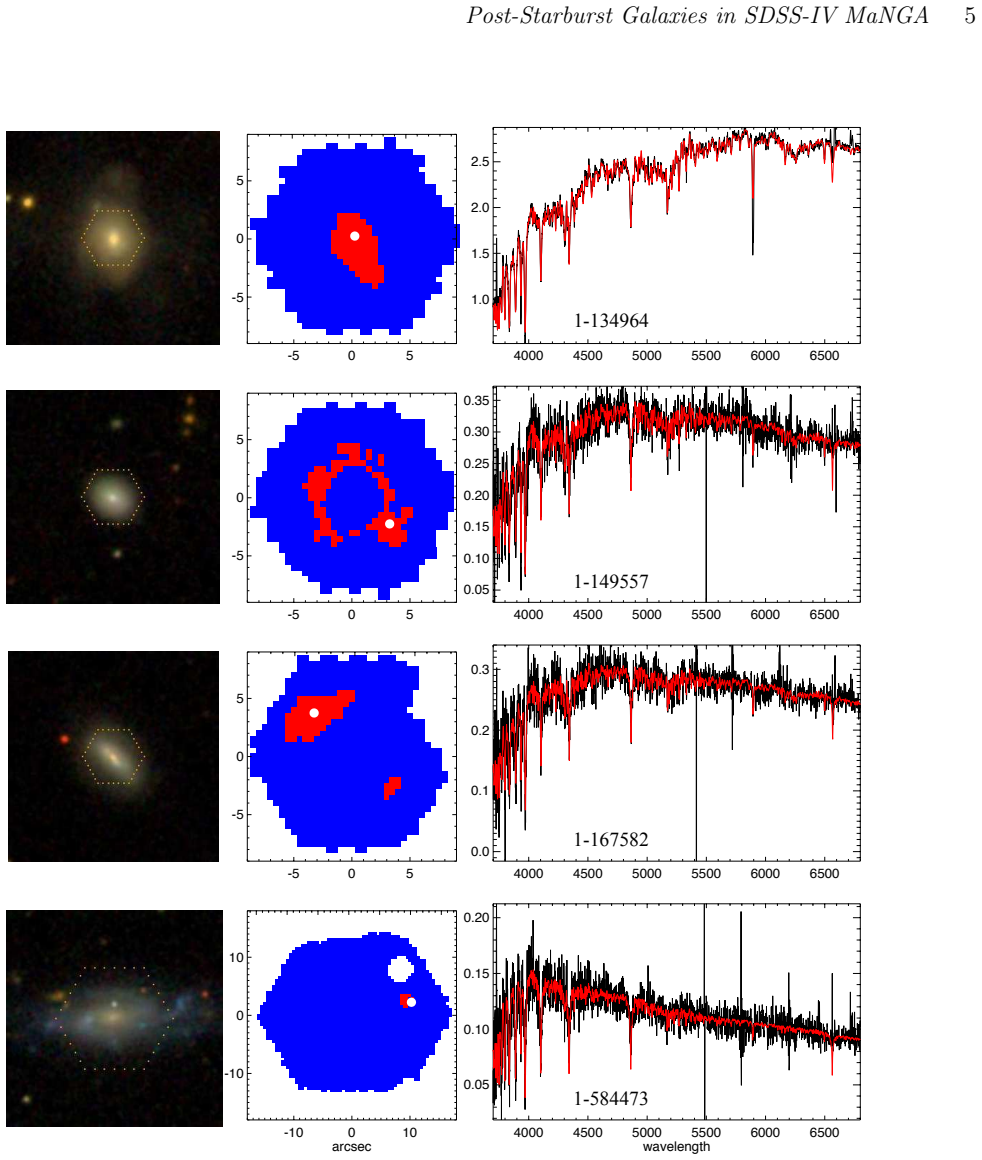
The central claim is contained in summary item (iv): the different radial profiles in mass-weighted age and stellar $v/\sigma$ indicate that central and ring-like post-starburst galaxies are not simply different evolutionary stages of the same event. CPSB galaxies are presented as the product of a significant disruptive event: they have suppressed star formation across the bulge and disk, a rapid recent decline in the center, younger mass-weighted ages throughout the galaxy, and lower stellar $v/\sigma$ than their controls, consistent with a merger having stirred the stars. RPSB galaxies, by contrast, show strong Balmer absorption only in their outer regions, an ongoing central starburst on top of an old central population, and $v/\sigma$ matching their controls; the paper attributes them to disruption of gas fuelling to the outer regions. The paper further reports that about half of both samples show misaligned gas, bars, or tidal features, and that the existence of ring and irregular PSBs is direct evidence that an active galactic nucleus is not required to rapidly quench a starburst.
Load-bearing premise
Everything rests on the way each small region of a galaxy is classified as post-starburst or not, using a boundary drawn from a simplified model of a 300-million-year starburst decline; the paper itself warns this boundary is only indicative, so if real galaxies have different burst mass fractions, dust, or older populations, regions will be misclassified and the central-versus-ring distinction built from them could be an artifact.
Editorial extensions
If this is right
- The discovery of ring-like and irregular post-starburst regions shows that an active galactic nucleus is not necessary to shut off a starburst quickly enough to leave strong Balmer absorption.
- Because the mass-weighted ages and stellar $v/\sigma$ of CPSBs and RPSBs differ at all radii, the two populations cannot be connected by secular evolution, so quenching models must include at least two pathways.
- The high incidence of misaligned gas, bars, and tidal features in both samples indicates that gas inflows triggered by interactions or internal structure are central to producing post-starburst features.
- Within the RPSB class, the two observed patterns in the $H\delta_{\rm A}$–$W(\mathrm{H}\alpha)$ plane (global shutdown vs outer-first quenching) imply multiple quenching mechanisms operate even within this single class, possibly including strangulation and ram-pressure stripping.
- Galaxy-wide spectral mapping of the type MaNGA provides recovers post-starburst regions that single-fibre surveys miss, changing the measured incidence of post-starburst phenomena in the local universe.
Reading between the lines
- If the two mechanisms are as distinct as claimed, the comparable numbers of CPSBs (31) and RPSBs (37) in this sample suggest that disruption of gas supply to the outskirts may be nearly as common as merger-driven quenching in producing post-starburst features at $z \approx 0$ — a point the paper's census makes possible but does not itself state.
- A testable extension follows from the 'frosting' picture of RPSB centers: those galaxies should have a substantial reservoir of molecular gas in their inner regions but little in the outer disk, so CO or dust continuum mapping at sub-kiloparsec resolution could confirm or reject the proposed gas-supply disruption.
- The toy-model boundary could be replaced by an empirical calibration using the very regions the paper maps, for example by fitting the observed $H\delta_{\rm A}$–$W(\mathrm{H}\alpha)$ distribution of all MaNGA regions and setting the post-starburst cut as a percentile of the star-forming locus; this would test whether the two-class structure survives a data-driven definition.
Signed reviews
Editorial analysis
A structured set of objections, weighed in public.
Referee Report
Summary. The paper presents a MaNGA IFU search for post-starburst (PSB) regions across 4633 galaxies in MPL-6, identifying 360 galaxies with PSB spaxels and classifying them into 31 central (CPSB), 37 ring-like (RPSB), and 292 irregular (IPSB). The authors compare the CPSB and RPSB samples to control galaxies matched in stellar mass and global Dn4000 and report that CPSBs show galaxy-wide suppression of star formation, central rapid quenching, younger mass-weighted ages across the galaxy, and lower stellar v/σ than controls, while RPSBs show outer-region quenching with ongoing central star formation and mass-weighted ages and v/σ consistent with controls. They conclude that CPSBs and RPSBs are not different evolutionary stages of a single event but arise from different mechanisms: a significant disruptive event for CPSBs and disruption of gas fuelling to the outer regions for RPSBs.
Significance. If the conclusions hold, this is a valuable observational contribution: it is one of the first spatially resolved IFU censuses of PSB regions across complete galaxies, introduces a new RPSB population, and uses mass-weighted ages and kinematics to argue against a single time-ordered CPSB-RPSB sequence. The sample tables and maps are a useful resource for the community, and the control-comparison approach is a strength. The main limitations are the model-dependent PSB spaxel boundary and the partly selection-defined nature of the RPSB class; these issues need to be addressed by robustness tests before the distinct-mechanism conclusion is fully secure.
major comments (3)
- [Section 2.3, Figs 7 and 9] The PSB spaxel selection boundary is taken from a Bruzual and Charlot toy model with a 300 Myr truncation e-folding time, and the text states that the models 'should be taken as indicative only' because previous star formation history, burst mass fraction, and dust content affect the true evolution. Because the CPSB/RPSB/IPSB classification is literally the spatial pattern of spaxels passing this cut, the central claim in Summary item (iv) is only as secure as this boundary. No test of alternative boundaries is presented; for example, a spaxel with HδA=4 Å and W(Hα)=8 Å (log W=0.90) fails the condition log W(Hα)<0.23×HδA−0.46, although such a spaxel could be a genuine PSB if the truncation e-folding time is longer than 300 Myr. I request a robustness test repeating the selection with e.g. HδA>4 Å and W(Hα)<5 Å, or with toy-model tracks at 100 and 500 Myr, and showing that the CPSB-RPSB differences in mass-weighted age and v/σ in Figs 7 and 9 survive.
- [Section 3.2 (text after Fig 6)] The RPSB class is defined by strong central W(Hα) and the absence of central PSB spaxels, so finding that RPSBs have ongoing central star formation and outer quenching is partly a restatement of the selection. The paper itself notes that 'It is the differing radial gradients that lead to the different classifications,' which means that the radial-gradient evidence in Dn4000, HδA, and W(Hα) cannot independently support the two-mechanism conclusion. The independent evidence lies in mass-weighted age and v/σ profiles; currently these are presented only with 30th-to-70th percentile error bars (Figs 7 and 9), and no significance test is given. Please add bootstrap or Kolmogorov-Smirnov tests comparing CPSB vs RPSB and each PSB sample vs its control, and state explicitly which conclusions remain after removing the selection-defined differences.
- [Section 2.4 and Section 3.2] The control samples are matched only in stellar mass and global Dn4000, and the authors acknowledge that Dn4000 increases following a shutdown of star formation, so the match is imperfect. The claims that CPSBs have suppressed star formation 'throughout their bulge and disk' and that RPSBs differ from their controls in all three spectral indices (Fig 6) depend on this matching. Please report the residual differences in stellar mass and Dn4000 between each PSB sample and its controls, and test sensitivity to matching on an additional parameter such as dust-corrected Hα-based star formation rate or specific star formation rate; at minimum, show that the radial-gradient differences are not driven by residual control mismatch.
minor comments (6)
- [Section 2.3] There is a typo: 'we find 31 CPBs' should read '31 CPSBs'.
- [Section 3.2] The text contains 'Tpye I' which should be 'Type I', and Table 2 contains 'migalign' which should be 'misaligned'.
- [Figure 8 caption and Section 3.2] The 'red dashed line' referred to in the text is not clearly identified in the figure or caption, and the criteria defining 'Type I' and 'Type II' RPSBs should be stated explicitly in the caption rather than only in the text.
- [Section 2.3] The visual classification into CPSB, RPSB, and IPSB is described only qualitatively; for reproducibility, please define 'ring-like' operationally (for example, PSB spaxels forming a contiguous annulus with no central PSB spaxels) or provide the classification maps for all objects as an appendix.
- [Figures 6, 7, and 9] Please clarify whether the median and percentile radial profiles are computed over galaxies with equal weight per galaxy or over individual spaxels; this affects the interpretation of the error bars and the reported gradient slopes.
- [Tables 1 and 2] Please state units for log M* and Dn4000 in the table captions; the values appear to be log10(M*/M_sun) and the Dn4000 index, but this is not spelled out.
Circularity Check
CPSB/RPSB radial-gradient dichotomy is partly built into the W(Hα)/HδA selection, but the different-mechanism conclusion retains independent grounding in mass-weighted age and v/σ.
-
self definitional
[Section 3.2 (Stellar populations); selection criteria defined in Section 2.3]
"It is the differing radial gradients that lead to the different classifications of central or ring-like PSB: the CPSBs are typically only classified as PSBs in the centre, as their Balmer absorption weakens with radius, whereas the RPSBs are not classified as PSBs in the centre due to their strong central W(Hα). This shows that while the CPSBs have suppressed star formation throughout their bulge and disk, and clear evidence of rapid quenching (i.e."
The CPSB and RPSB classes are defined by the spatial pattern of spaxels passing the Section 2.3 PSB cut (HδA>3 Å, W(Hα)<10 Å, log W(Hα)<0.23×HδA−0.46). That cut directly requires weak Hα emission and strong Balmer absorption in selected regions. A ring-like class is therefore, by construction, a galaxy whose centre fails the low-W(Hα) criterion while its outer regions pass it. The paper's own sentence concedes that the radial gradients in HδA and W(Hα) lead to the different classifications. Consequently the summary finding that RPSBs show ongoing central star formation and outer quenching is partly a restatement of the sample definition rather than an independent measurement.
full rationale
Most of the analysis is self-contained: the MaNGA DAP measurements, control samples matched in stellar mass and global Dn4000, and the Pipe3D mass-weighted ages and v/σ profiles are independent of the PSB spaxel classification. The central claim that CPSBs and RPSBs are not simply different evolutionary stages rests primarily on mass-weighted age and stellar v/σ, which are not used in the selection, so that conclusion is not forced by construction. The partially circular element is the descriptive result that RPSBs have suppressed star formation in their outer regions and ongoing central star formation, since the ring-like classification is itself defined by the spatial distribution of spaxels selected on HδA and W(Hα); Section 3.2 explicitly acknowledges that the differing radial gradients lead to the different classifications. The PSB selection boundary is admittedly model-dependent: Section 2.3 states 'Clearly the toy models should be taken as indicative only, with the previous star formation history, burst mass fraction and dust content of the galaxy playing a role in the true evolution of these spectral measurements.' No robustness test against alternative boundaries is presented, which is a genuine limitation on the sample split but not, by itself, a circular reduction. The minor self-citation to Wild et al. (2010) for the 300 Myr e-folding time is likewise not load-bearing in a circular way, because that timescale is an externally measured input that the paper openly treats as indicative. Overall, the distinct-mechanism interpretation has independent support, while one supporting radial-gradient result is partially definitional.
Assumptions & free parameters
free parameters (3)
- PSB spaxel selection thresholds =
HδA > 3 Å; W(Hα) < 10 Å; log W(Hα) < 0.23 HδA - 0.46; ≥6 contiguous spaxels; S/N > 10
- Toy model truncation e-folding time =
300 Myr (also 50, 100, 150, 200 Myr shown)
- Control sample matching criteria =
10 controls per PSB matched in stellar mass and global Dn4000; matching tolerance not stated
assumptions (4)
- domain assumption BC03 stellar population models with a Chabrier IMF and the Hunter and Elmegreen Hα prescription produce realistic HδA versus W(Hα) tracks for recently quenched starbursts.
- domain assumption MaNGA DAP spectral fits and Pipe3D age estimates give accurate stellar ages, velocities, velocity dispersions, and emission-line measurements for the selected spaxels.
- domain assumption Control galaxies matched on stellar mass and global Dn4000 are plausible progenitors of the PSB galaxies before the quenching event.
- domain assumption Visual inspection of MaNGA maps and Legacy Survey images reliably separates CPSB, RPSB, and IPSB, and reliably identifies bars, tidal tails, and interaction features.
Cite this review
Pith. "Pith review of Post-Starburst Galaxies in SDSS-IV MaNGA." pith.science (2026). https://pith.science/paper/7KT567XD
@misc{pith2026190901658,
  author       = {Pith},
  title        = {Pith review of: Post-Starburst Galaxies in SDSS-IV MaNGA},
  year         = {2026},
  howpublished = {\url{https://pith.science/paper/7KT567XD}},
  note         = {Machine review of arXiv:1909.01658}
}
abstract
Post-starburst galaxies, identified by their unusually strong Balmer absorption lines and weaker than average emission lines, have traditionally been selected based on their central stellar populations. Here we identify 360 galaxies with post-starburst regions from the MaNGA integral field survey and classify these galaxies into three types: 31 galaxies with central post-starburst regions (CPSB), 37 galaxies with off-center ring-like post-starburst regions (RPSB) and 292 galaxies with irregular post-starburst regions (IPSB). Focussing on the CPSB and RPSB samples, and comparing their radial gradients in D$_n$4000, H$\delta_{\rm A}$ and W(H$\alpha$) to control samples, we find that while the CPSBs have suppressed star formation throughout their bulge and disk, and clear evidence of rapid decline of star formation in the central regions, the RPSBs only show clear evidence of recently rapidly suppressed star formation in their outer regions and an ongoing central starburst. The radial profiles in mass-weighted age and stellar $v/\sigma$ indicate that CPSBs and RPSBs are not simply different evolutionary stages of the same event, rather that CPSB galaxies are caused by a significant disruptive event, while RPSB galaxies are caused by disruption of gas fuelling to the outer regions. Compared to the control samples, both CPSB and RPSB galaxies show a higher fraction of interactions/mergers, misaligned gas or bars that might be the cause of the gas inflows and subsequent quenching.
Figures


Figures from the paper (7 more)


Reference graph
Works this paper leans on
-
[1]
write newline
" write newline "" before.all 'output.state := FUNCTION fin.entry write newline FUNCTION new.block output.state before.all = 'skip after.block 'output.state := if FUNCTION new.sentence output.state after.block = 'skip output.state before.all = 'skip after.sentence 'output.state := if if FUNCTION not #0 #1 if FUNCTION and 'skip pop #0 if FUNCTION or pop #1...
-
[2]
L., Appleton P
Alatalo K., Cales S. L., Appleton P. N., Kewley L. J., Lacy M., Lisenfeld U., Nyland K., Rich J. A., 2014, , 794, L13
2014
-
[3]
L., Rich J
Alatalo K., Cales S. L., Rich J. A., Appleton P. N., Kewley L. J., Lacy M., Lanz L., Medling A. M., et al. 2016a, , 224, 38
-
[4]
N., Ardila F., Cales S
Alatalo K., Lisenfeld U., Lanz L., Appleton P. N., Ardila F., Cales S. L., Kewley L. J., Lacy M., et al. 2016b, , 827, 106
-
[5]
K., Glazebrook K., Brinkmann J., Ivezi \'c Z ., Lupton R
Baldry I. K., Glazebrook K., Brinkmann J., Ivezi \'c Z ., Lupton R. H., Nichol R. C., Szalay A. S., 2004, , 600, 681
2004
-
[6]
A., Phillips M
Baldwin J. A., Phillips M. M., Terlevich R., 1981, , 93, 5
1981
-
[7]
L., Miller C., Nichol R., Zabludoff A., Goto T., 2005, , 360, 587
Balogh M. L., Miller C., Nichol R., Zabludoff A., Goto T., 2005, , 360, 587
2005
-
[8]
F., Wolf C., Meisenheimer K., Rix H.-W., Borch A., Dye S., Kleinheinrich M., Wisotzki L
Bell E. F., Wolf C., Meisenheimer K., Rix H.-W., Borch A., Dye S., Kleinheinrich M., Wisotzki L. e. a., 2004, , 608, 752
2004
Show all 92 references
-
[9]
R., Bershady M
Blanton M. R., Bershady M. A., Abolfathi B., Albareti F. D., Allende Prieto C., Almeida A., Alonso-Garc \' a J., Anders F. e. a., 2017, , 154, 28
2017
-
[10]
Brinchmann J., Charlot S., White S. D. M., Tremonti C., Kauffmann G., Heckman T., Brinkmann J., 2004, , 351, 1151
2004
-
[11]
Brown M. J. I., Dey A., Jannuzi B. T., Brand K., Benson A. J., Brodwin M., Croton D. J., Eisenhardt P. R., 2007, , 654, 858
2007
-
[12]
Bruzual G., Charlot S., 2003, , 344, 1000
2003
-
[13]
G., 1983, , 273, 105
Bruzual A. G., 1983, , 273, 105
1983
-
[14]
A., Law D
Bundy K., Bershady M. A., Law D. R., Yan R., Drory N., MacDonald N., Wake D. A., Cherinka B., et al. 2015, , 798, 7
2015
-
[15]
L., Brotherton M
Cales S. L., Brotherton M. S., 2015, , 449, 2374
2015
-
[16]
Cappellari M., Copin Y., 2003, , 342, 345
2003
-
[17]
Cappellari M., Emsellem E., 2004, , 116, 138
2004
-
[18]
Chabrier G., 2003, , 115, 763
2003
-
[19]
D., Lin L., Mo H., Parker L
Chown R., Li C., Athanassoula E., Li N., Wilson C. D., Lin L., Mo H., Parker L. C. e. a., 2019, , 484, 5192
2019
-
[20]
E., 1983, , 270, 7
Dressler A., Gunn J. E., 1983, , 270, 7
1983
-
[21]
M., Butcher H., Couch W
Dressler A., Smail I., Poggianti B. M., Butcher H., Couch W. J., Ellis R. S., Oemler Jr. A., 1999, , 122, 51
1999
-
[22]
A., Bundy K., Gunn J., Law D
Drory N., MacDonald N., Bershady M. A., Bundy K., Gunn J., Law D. R., Smith M., Stoll R., et al. 2015, , 149, 77
2015
-
[23]
L., de Zeeuw P
Emsellem E., Cappellari M., Krajnovi \'c D., van de Ven G., Bacon R., Bureau M., Davies R. L., de Zeeuw P. T., et al. 2007, , 379, 401
2007
-
[24]
Fischer J.-L., Dom \' nguez S \'a nchez H., Bernardi M., 2019, , 483, 2057
2019
-
[25]
D., Yang Y., Zabludoff A., Narayanan D., Shirley Y., Walter F., Smith J.-D., Tremonti C
French K. D., Yang Y., Zabludoff A., Narayanan D., Shirley Y., Walter F., Smith J.-D., Tremonti C. A., 2015, , 801, 1
2015
-
[26]
Goto T., 2005, , 357, 937
2005
-
[27]
Goto T., 2007a, , 381, 187
-
[28]
Goto T., 2007b, , 377, 1222
-
[29]
C., Okamura S., Sekiguchi M., Miller C
Goto T., Nichol R. C., Okamura S., Sekiguchi M., Miller C. J., Bernardi M., Hopkins A., Tremonti C., et al. 2003, , 55, 771
2003
-
[30]
L., 2003, , 346, 601
Goto T., Yamauchi C., Fujita Y., Okamura S., Sekiguchi M., Smail I., Bernardi M., Gomez P. L., 2003, , 346, 601
2003
-
[31]
E., Siegmund W
Gunn J. E., Siegmund W. A., Mannery E. J., Owen R. E., Hull C. L., Leger R. F., Carey L. N., Knapp G. R., et al. 2006, , 131, 2332
2006
-
[32]
G., Mountain C
Hawarden T. G., Mountain C. M., Leggett S. K., Puxley P. J., 1986, , 221, 41P
1986
-
[33]
D., Canalizo G., 2015, , 799, 59
Hiner K. D., Canalizo G., 2015, , 799, 59
2015
-
[34]
W., Masjedi M., Berlind A
Hogg D. W., Masjedi M., Berlind A. A., Blanton M. R., Quintero A. D., Brinkmann J., 2006, , 650, 763
2006
-
[35]
F., Hernquist L., Cox T
Hopkins P. F., Hernquist L., Cox T. J., Di Matteo T., Robertson B., Springel V., 2006, , 163, 1
2006
-
[36]
A., Elmegreen B
Hunter D. A., Elmegreen B. G., 2004, , 128, 2170
2004
-
[37]
Jin S.-W., Gu Q., Huang S., Shi Y., Feng L.-L., 2014, , 787, 63
2014
-
[38]
M., Tremonti C., Brinchmann J., Charlot S., White S
Kauffmann G., Heckman T. M., Tremonti C., Brinchmann J., Charlot S., White S. D. M., Ridgway S. E., Brinkmann J., Fukugita M., Hall P. B., 2003, , 346, 1055
2003
-
[39]
A., Silk J., Sarzi M., 2007, , 382, 960
Kaviraj S., Kirkby L. A., Silk J., Sarzi M., 2007, , 382, 960
2007
-
[40]
J., Dopita M
Kewley L. J., Dopita M. A., Sutherland R. S., Heisler C. A., Trevena J., 2001, , 556, 121
2001
-
[41]
D., Lemaux B
Kocevski D. D., Lemaux B. C., Lubin L. M., Shapley A. E., Gal R. R., Squires G. K., 2011, , 737, L38
2011
-
[42]
T., Copin Y., 2006, , 366, 787
Krajnovi \'c D., Cappellari M., de Zeeuw P. T., Copin Y., 2006, , 366, 787
2006
-
[43]
Lagos C. d. P., 2018, arXiv e-prints
2018
-
[44]
R., Cherinka B., Yan R., Andrews B
Law D. R., Cherinka B., Yan R., Andrews B. H., Bershady M. A., Bizyaev D., Blanc G. A., Blanton M. R. e. a., 2016, , 152, 83
2016
-
[45]
R., Yan R., Bershady M
Law D. R., Yan R., Bershady M. A., Bundy K., Cherinka B., Drory N., MacDonald N., S \'a nchez-Gallego J. R.i e. a., 2015, , 150, 19
2015
-
[46]
C., Jian H.-Y., Koo D
Lin L., Cooper M. C., Jian H.-Y., Koo D. C., Patton D. R., Yan R., Willmer C. N. A., Coil A. L., Chiueh T., Croton D. J., 2010, , 718, 1158
2010
-
[47]
Lin L., Li C., He Y., Xiao T., Wang E., 2017, , 838, 105
2017
-
[48]
T., Almaini O., Wild V., Hatch N
Maltby D. T., Almaini O., Wild V., Hatch N. A., Hartley W. G., Simpson C., Rowlands K., Socolovsky M., 2018, , 480, 381
2018
-
[49]
C., Wyder T
Martin D. C., Wyder T. K., Schiminovich D., Barlow T. A., Forster K., Friedman P. G., Morrissey P., Neff S. G. e. a., 2007, , 173, 342
2007
-
[50]
M., Moretti A., Fritz J., Gullieuszik M., Fasano G., 2019, , 482, 881
Paccagnella A., Vulcani B., Poggianti B. M., Moretti A., Fritz J., Gullieuszik M., Fasano G., 2019, , 482, 881
2019
-
[51]
M., McAlpine S., Trayford J
Pawlik M. M., McAlpine S., Trayford J. W., Wild V., Bower R., Crain R. A., Schaller M., Schaye J., 2019, Nature Astronomy
2019
-
[52]
M., Taj Aldeen L., Wild V., Mendez-Abreu J., Lah \'e n N., Johansson P
Pawlik M. M., Taj Aldeen L., Wild V., Mendez-Abreu J., Lah \'e n N., Johansson P. H., Jimenez N., Lucas W., et al. 2018, ArXiv e-prints
2018
-
[53]
M., Wild V., Walcher C
Pawlik M. M., Wild V., Walcher C. J., Johansson P. H., Villforth C., Rowlands K., Mendez-Abreu J., Hewlett T., 2016, , 456, 3032
2016
-
[54]
M., Smail I., Dressler A., Couch W
Poggianti B. M., Smail I., Dressler A., Couch W. J., Barger A. J., Butcher H., Ellis R. S., Oemler Jr. A., 1999, , 518, 576
1999
-
[55]
M., Wu H., 2000, , 529, 157
Poggianti B. M., Wu H., 2000, , 529, 157
2000
-
[56]
B., Couch W
Pracy M. B., Couch W. J., Kuntschner H., 2010, , 27, 360
2010
-
[57]
B., Croom S., Sadler E., Couch W
Pracy M. B., Croom S., Sadler E., Couch W. J., Kuntschner H., Bekki K., Owers M. S., Zwaan M., Turner J., Bergmann M., 2013, , 432, 3131
2013
-
[58]
B., Owers M
Pracy M. B., Owers M. S., Zwaan M., Couch W., Kuntschner H., Croom S. M., Sadler E. M., 2014, , 443, 388
2014
-
[59]
D., Hogg D
Quintero A. D., Hogg D. W., Blanton M. R., Schlegel D. J., Eisenstein D. J., Gunn J. E., Brinkmann J., Fukugita M., Glazebrook K., Goto T., 2004, , 602, 190
2004
-
[60]
P., Hopkins A
Rowlands K., Wild V., Bourne N., Bremer M., Brough S., Driver S. P., Hopkins A. M., Owers M. S., Phillipps S., Pimbblet K., Sansom A. E., Wang L., Alpaslan M., Bland-Hawthorn J., Colless M., Holwerda B. W., Taylor E. N., 2018, , 473, 1168
2018
-
[61]
Rowlands K., Wild V., Nesvadba N., Sibthorpe B., Mortier A., Lehnert M., da Cunha E., 2015, , 448, 258
2015
-
[62]
F., P \'e rez E., S \'a nchez-Bl \'a zquez P., Garc \' a-Benito R., Ibarra-Mede H
S \'a nchez S. F., P \'e rez E., S \'a nchez-Bl \'a zquez P., Garc \' a-Benito R., Ibarra-Mede H. J., Gonz \'a lez J. J., Rosales-Ortega F. F., S \'a nchez-Menguiano L., et al. 2016b, , 52, 171
-
[63]
F., P \'e rez E., S \'a nchez-Bl \'a zquez P., Gonz \'a lez J
S \'a nchez S. F., P \'e rez E., S \'a nchez-Bl \'a zquez P., Gonz \'a lez J. J., Ros \'a lez-Ortega F. F., Cano-D \' az M., L \'o pez-Cob \'a C., Marino R. A., et al. 2016a, , 52, 21
-
[64]
F., Jim \'e nez-Vicente J., Cardiel N., Cenarro A
S \'a nchez-Bl \'a zquez P., Peletier R. F., Jim \'e nez-Vicente J., Cardiel N., Cenarro A. J., Falc \'o n-Barroso J., Gorgas J., Selam S., Vazdekis A., 2006, , 371, 703
2006
-
[65]
H., Tremonti C
Sell P. H., Tremonti C. A., Hickox R. C., Diamond-Stanic A. M., Moustakas J., Coil A., Williams A., Rudnick G., et al. 2014, , 441, 3417
2014
-
[66]
A., Gunn J
Smee S. A., Gunn J. E., Uomoto A., Roe N., Schlegel D., Rockosi C. M., Carr M. A., Leger F., et al. 2013, , 146, 32
2013
-
[67]
A., Wild V., Maltby D
Socolovsky M., Almaini O., Hatch N. A., Wild V., Maltby D. T., Hartley W. G., Simpson C., 2018, , 476, 1242
2018
-
[68]
M., Papadopoulos P
Swinbank A. M., Papadopoulos P. P., Cox P., Krips M., Ivison R. J., Smail I., Thomson A. P., Neri R., et al. 2011, , 742, 11
2011
-
[69]
H., Franx M., Illingworth G., Kelson D
Tran K.-V. H., Franx M., Illingworth G., Kelson D. D., van Dokkum P., 2003, , 599, 865
2003
-
[70]
H., Franx M., Illingworth G
Tran K.-V. H., Franx M., Illingworth G. D., van Dokkum P., Kelson D. D., Magee D., 2004, , 609, 683
2004
-
[71]
A., Heckman T
Tremonti C. A., Heckman T. M., Kauffmann G., Brinchmann J., Charlot S., White S. D. M., Seibert M., Peng E. W., Schlegel D. J., et al. 2004, , 613, 898
2004
-
[72]
A., Moustakas J., Diamond-Stanic A
Tremonti C. A., Moustakas J., Diamond-Stanic A. M., 2007, , 663, L77
2007
-
[73]
von der Linden A., Wild V., Kauffmann G., White S. D. M., Weinmann S., 2010, , 404, 1231
2010
-
[74]
A., Bundy K., Diamond-Stanic A
Wake D. A., Bundy K., Diamond-Stanic A. M., Yan R., Blanton M. R., Bershady M. A., S \'a nchez-Gallego J. R., Drory N., et al. 2017, , 154, 86
2017
-
[75]
Wild V., Almaini O., Dunlop J., Simpson C., Rowlands K., Bowler R., Maltby D., McLure R., 2016, , 463, 832
2016
-
[76]
Wild V., Heckman T., Charlot S., 2010, , 405, 933
2010
-
[77]
Wild V., Kauffmann G., Heckman T., Charlot S., Lemson G., Brinchmann J., Reichard T., Pasquali A., 2007, , 381, 543
2007
-
[78]
J., Johansson P
Wild V., Walcher C. J., Johansson P. H., Tresse L., Charlot S., Pollo A., Le F \`e vre O., de Ravel L., 2009, , 395, 144
2009
-
[79]
I., Schawinski K., Kaviraj S., Masters K
Wong O. I., Schawinski K., Kaviraj S., Masters K. L., Nichol R. C., Lintott C., Keel W. C., Darg D., et al. 2012, , 420, 1684
2012
-
[80]
M., Gonzalez J
Worthey G., Faber S. M., Gonzalez J. J., Burstein D., 1994, , 94, 687
1994
-
[81]
L., 1997, , 111, 377
Worthey G., Ottaviani D. L., 1997, , 111, 377
1997
-
[82]
Yamauchi C., Yagi M., Goto T., 2008, , 390, 383
2008
-
[83]
R., Bershady M
Yan R., Bundy K., Law D. R., Bershady M. A., Andrews B., Cherinka B., Diamond-Stanic A. M., Drory N., et al. 2016, , 152, 197
2016
-
[84]
A., Faber S
Yan R., Newman J. A., Faber S. M., Coil A. L., Cooper M. C., Davis M., Weiner B. J., Gerke B. F., Koo D. C., 2009, , 398, 735
2009
-
[85]
A., Faber S
Yan R., Newman J. A., Faber S. M., Konidaris N., Koo D., Davis M., 2006, , 648, 281
2006
-
[86]
A., Law D
Yan R., Tremonti C., Bershady M. A., Law D. R., Schlegel D. J., Bundy K., Drory N., MacDonald N., et al. 2016, , 151, 8
2016
-
[87]
A., Zabludoff A
Yang Y., Tremonti C. A., Zabludoff A. I., Zaritsky D., 2006, , 646, L33
2006
-
[88]
I., Zaritsky D., Lauer T
Yang Y., Zabludoff A. I., Zaritsky D., Lauer T. R., Mihos J. C., 2004, , 607, 258
2004
-
[89]
I., Zaritsky D., Mihos J
Yang Y., Zabludoff A. I., Zaritsky D., Mihos J. C., 2008, , 688, 945
2008
-
[90]
M., Faber S
Yesuf H. M., Faber S. M., Trump J. R., Koo D. C., Fang J. J., Liu F. S., Wild V., Hayward C. C., 2014, , 792, 84
2014
-
[91]
G., Adelman J., Anderson Jr
York D. G., Adelman J., Anderson Jr. J. E., Anderson S. F., Annis J., Bahcall N. A., Bakken J. A., Barkhouser R. e. a., 2000, , 120, 1579
2000
-
[92]
I., Zaritsky D., Lin H., Tucker D., Hashimoto Y., Shectman S
Zabludoff A. I., Zaritsky D., Lin H., Tucker D., Hashimoto Y., Shectman S. A., Oemler A., Kirshner R. P., 1996, , 466, 104
1996
Reviewed August 14, 2026 · model on record in the stance chip above.
Discussion (0). Continue with ORCID to comment.