REVIEW 5 major objections 5 minor 15 references
Cyclic Symmetry of Riemann Tensor in Fuzzy Graph Theory
T0 review · 5 major / 5 minor · reviewed 2026-08-14 · deepseek-v4-flash
Pith's one-line read The paper claims that a four-vertex graph with one fixed vertex and three permuting vertices on a K3 obeys the Riemann tensor's algebraic identities, including the cyclic Bianchi identity and the block form of the 6×6 curvature matrix.
desk verdict A naming exercise: the cyclic symmetry is assumed in Definition 1.13, so the main theorem is circular and the fuzzy Petrov section inherits the tensor result rather than deriving it. read the letter →
The pith
A machine-rendered reading of the paper's core claim, the machinery that carries it, and where it could break.
The reading
What carries the argument
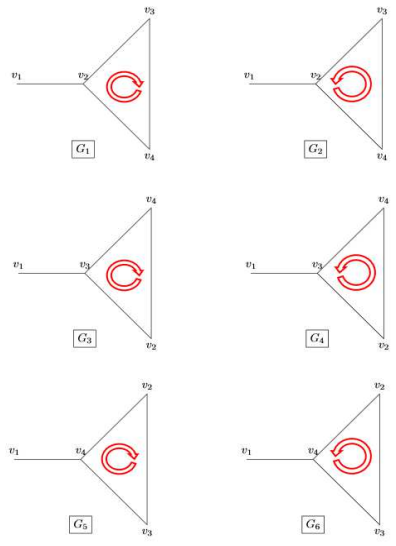
The central object is the graph $G(i,k,l,m)$: one fixed vertex (the index $i$), connected to just one of three permuting vertices that span a $K_3$, with the orientation of the triangle's cycle fixing the sign; fuzzified by membership $\sigma(v_1)=1$ and $\sigma(v_2)=\sigma(v_3)=\sigma(v_4)=1/3$. The argument also relies on the Levi-Civita graph $\epsilon(i,x,y)$, which returns $+1$, $-1$, or $0$ according to whether $(i,x,y)$ is an even, odd, or repeated permutation, and on expressing a fuzzy graph as a union $\epsilon(i,x,x)\cup G(x,\cdot,\cdot)$. This union operation carries the work: it is what converts graph objects into the additive algebra of the curvature matrix and produces the claimed reduction $\sigma'(v_2)=\sigma(v_2)/3=1/9$.
What would settle it
Equation (22) evaluates $G(i,k,k,l)$ and $G(i,m,l,m)$, which use repeated index labels, while Definition 2.2 only defines fuzzy graphs with distinct permuting vertices $v_2,v_3,v_4$. Checking whether repeated-label graphs are well-defined under the sign and cycle rules—and if not, the claimed null trace of block $B$ has no computable content—would settle the claim.
Extended reading notes
Core claim
The central claim is that the graph $G(i,k,l,m)$ built in Definition 1.10 obeys the same algebraic symmetries as the Riemann tensor. With vertex $v_1=i$ fixed and $k,l,m$ permuting among the three positions of a triangle, the six graphs $G_{iklm}, G_{ikml}, G_{ilmk}, G_{ilkm}, G_{imkl}, G_{imlk}$ come in three sign pairs, so the cyclic symmetrization vanishes: $G_{i(klm)}=0$ (Theorem 1.1). The paper further claims that the matrix of graphs indexed by antisymmetric pairs $u_1=ik,\dots,u_6=lm$ is symmetric by the union operation, that it has $n^2(n^2-1)/12 = 20$ independent components, and that in the fuzzy version the trace of the $B$ block is null when graphs are written as $G(i,x,x)=\epsilon(i,x,x)\cup G(x,\cdot,\cdot)$. This lets the paper identify fuzzy matrices $\Psi,\Sigma,\Lambda$ with the blocks $A,-B^T,C$ of the curvature matrix and close with the proposal that this constructs a fuzzy analog of the Petrov–Penrose classification.
Load-bearing premise
The central claim stands on the assumption that the graph operations of union, cycle direction, and vertex membership can be read as the plus, minus, and zero of tensor algebra; if that identification fails, the analog has no content.
Editorial extensions
If this is right
- If the analogy holds, the six graphs $G_1,\dots,G_6$ play the role of the 20 independent Riemann components, giving a purely combinatorial count of curvature degrees of freedom.
- The fuzzy matrices $\Psi,\Sigma,\Lambda$ inherit the curvature block relations $\Psi_{\alpha\beta}=-\Lambda_{\alpha\beta}$ and $\Sigma_{\alpha\beta}=\Sigma_{\beta\alpha}$ under the Ricci-flatness condition.
- The fuzzy analogue yields a graph-theoretic stand-in for the trace-null $B$ block, so the algebraic reduction $M_I^K=(A\,B;\,-B^T\,C)$ holds in the graph setting.
- The complex tensor $\Omega_{\alpha\beta}=\Psi_{\alpha\beta}+i\Sigma_{\alpha\beta}$ has traceless complex eigenvalues obeying $\lambda_{(1)}+\lambda_{(2)}+\lambda_{(3)}=0$, so the graph analog inherits the eigenvalue-counting that defines Petrov types I, II, D, III, N, and O.
Reading between the lines
- The authors do not construct a graph that actually distinguishes Petrov types; the paper stops at the algebraic block level. A natural extension is to define graph invariants, such as algebraic multiplicity of a spectrum, that would mark the six Petrov classes separately.
- Since the sign assignment in Definition 1.10 is parity of cycle traversals in a $K_3$, the construction might generalize to higher-dimensional Riemann tensors by replacing the triangle with a $K_\alpha$ and the cyclic identity with the full Bianchi-paired index sets; the paper's Theorem 1.7 sketches this but does not test it.
- The claimed membership reduction $\sigma'(v_2)=\sigma(v_2)/3$ treats graph union as if it were arithmetic multiplication; if one instead defines union as maximum membership, the numbers change, so the analogy depends on a nonstandard union semantics that could be made explicit and tested on other fuzzy graph invariants.
Signed reviews
Editorial analysis
A structured set of objections, weighed in public.
Referee Report
Summary. The paper defines a graph-theoretic and fuzzy graph-theoretic analog of the Riemann tensor on a four-vertex set, with one fixed vertex and the three remaining vertices spanning a K3 whose cycle direction assigns a sign. It claims that the resulting graphs satisfy the algebraic symmetries of the Riemann tensor, in particular the cyclic (Bianchi) identity, and that the corresponding 6x6 matrix of graphs reproduces the block structure of the curvature matrix. Section 3 fuzzifies the construction with vertex memberships and a Levi-Civita graph analog; Section 4 introduces matrices Psi, Sigma, Lambda and claims to recover the null trace of the B block, the symmetries A=A^T and C=C^T, and ultimately a fuzzy analog of the Petrov-Penrose classification. The central theorems are Theorem 1.1 (cyclic identity), Theorem 1.4 (symmetry of the 6x6 matrix), and Theorem 2.3 (membership reduction under union with a Levi-Civita graph), with Section 4 resting on these results.
Significance. If the construction worked, it would give a novel combinatorial encoding of the algebraic identities of the Riemann tensor and a fuzzy Petrov-Penrose classification, with possible pedagogical value. The paper's strengths are its explicit enumeration of six oriented graphs, the concrete 6x6 matrix of Eq. (11), and the ambition to connect fuzzy graph theory to curvature algebra. However, the central identity is assumed rather than derived, the graph-to-tensor dictionary is under-specified, and the Section 4 conclusions inherit the tensor identities rather than being established by the graph formalism. The paper does not provide machine-checked proofs or reproducible code, and the main claims are not falsifiable in their current form because the graph operations used in the proofs are not defined.
major comments (5)
- [Sec. 2, Def. 1.13 and Thm. 1.1] The cyclic identity that the paper claims to prove is assumed in Definition 1.13: Eq. (8) states 2[Gik(lm)+Gil(mk)+Gim(kl)] = 0 as part of the definition. Theorem 1.1 then announces Gi(klm)=0 and gives as proof the line Gi(klm)=1/3![Giklm+Gilmk+Gimkl] and the assertion that the bracket vanishes. The factor 3! in the line 3![Giklm+Gilmk+Gimkl] = 0 does not produce the vanishing; the proof simply restates the defining condition. No argument from Definition 1.10 shows that the bracket is zero, so Theorem 1.1 is circular.
- [Sec. 2, Defs. 1.10-1.11 and Thm. 1.1] Independently of the circularity, the cancellation in Eq. (10) is not available. Definition 1.10(c) assigns the sign of each graph by the cycle direction of the K3, and Definition 1.11 identifies G1, G3, G5 as the clockwise variants of the three cyclic arrangements (v2,v3,v4), (v3,v4,v2), (v4,v2,v3). Thus Giklm, Gilmk, and Gimkl are all clockwise graphs and carry the same sign; their sum is three copies of the same oriented graph, not zero. Theorem 1.1 therefore fails on its own terms.
- [Sec. 3, Def. 2.5 and Thm. 2.3] Definition 2.5 defines the Levi-Civita graph analog by assigning +1, -1, or 0 according to permutation parity and index repetition, which is a relabeling of the Levi-Civita symbol rather than a derivation from the fuzzy graph structure. This is not itself an error, but the paper then uses the symbol as if it had proven properties of graphs. Worse, the third line of Eq. (17) sets the value to 0 when x=y, whereas Theorem 2.3 uses epsilon(i,k,k) as a nonzero ingredient in the union that produces the loop; this is an internal contradiction.
- [Sec. 3, Thm. 2.3 and Sec. 4, Eq. (22)] The paper relies on a graph union operation that is never defined. Theorem 1.4 writes G(i,k,i,l)=G(i,k) union G(i,l) and treats the union as self-evidently symmetric and additive in the indices, but no definition of union for the four-index graphs is given, and a union of two two-index subgraphs does not determine the four-index ordering on the left. Eq. (22) then evaluates G(i,k,k,l), G(i,l,k,m), and G(i,m,l,m), which are not defined by Definition 2.2 because the vertex set has distinct labels v1,v2,v3,v4. The claimed null trace of B is therefore an assertion about undefined objects. Similarly, the reduction sigma'(v2)=sigma(v2)/3=1/9 in Theorem 2.3 is asserted without a definition of fuzzy union; standard fuzzy union would not produce this value.
- [Sec. 4, Eqs. (19)-(24)] The Petrov-Penrose analog is not derived from the graph construction. The nullity of Tr B, the symmetries A=A^T and C=C^T, and the relations Psi_alpha_beta = -Lambda_alpha_beta are imported from the tensor Riemann identities; the graph-side statements in Eqs. (22)-(23) either use the undefined repeated-label graphs or simply declare that the fuzzy union reproduces the tensor expression. Consequently, the classification claim in Section 5 does not follow from the preceding definitions once the defects in Definitions 1.13 and 2.5 and Theorem 2.3 are removed.
minor comments (5)
- [Throughout] Typographical errors include Riem ann, Pentrov, Kretchmann (should be Kretschmann), and Erds (should be Erdos).
- [Eq. (12)] The term n!/(n-4!4!) is malformed; presumably n!/(4!(n-4)!) or the equivalent binomial expression was intended, and the counting proof should be rechecked in that case.
- [Def. 1.12] Definition 1.12 uses T both as a generic function and as the graph name; the relation between G_{iklm} and G(i,k,l,m) should be stated explicitly, especially because Eq. (22) later permutes and repeats labels.
- [Sec. 2, Def. 1.11] The sign convention in Definition 1.11 depends on Figure 2, which is not fully described in the text; the clockwise/counterclockwise assignment for each arrangement should be given combinatorially rather than by appeal to a figure.
- [Sec. 4, Eq. (21)] Equation (21) writes Tr B = epsilon^{011}R_{123}+...; the index placement is inconsistent and the lowering of indices is not shown, so the equality is not transparent.
Circularity Check
Cyclic (Bianchi) identity is assumed in Definition 1.13, the Levi-Civita graph encodes its own null trace, and the fuzzy Petrov matrices are defined as relabeled tensor blocks.
-
self definitional
[Definition 1.13, Eq. (8); Theorem 1.1, Eqs. (9)–(10)]
"Let Gik(lm) = 1/2! (Giklm − Gikml) such that 2[Gik(lm) + Gil(mk) + Gim(kl)] = 0 (8) ... Theorem 1.1. Three permuting indices, by definition 1.10, condenses six graphs to three graphs and thus, Gi(klm) = 0. Proof ... Gi(klm) = 1/3! [Giklm + Gilmk + Gimkl] ... and thus, 3! [Giklm + Gilmk + Gimkl] = 0 or Gi(klm) = 0."
The Bianchi/cyclic identity is not obtained from Definition 1.10. It is inserted as the defining condition of Gik(lm) in Eq. (8), and Theorem 1.1 simply restates that condition. Under Definition 1.10 the sign of a graph is set by the cycle direction, so the three terms displayed in Eq. (10) are G1, G3, G5, all clockwise variants carrying the same sign. Their sum is 3G, not 0. The vanishing of the cyclic sum is therefore assumed rather than proved; the later block-matrix and Petrov claims inherit this assumption.
-
self definitional
[Definition 2.5, Eq. (17); Section 4, Eq. (22)]
"(−1)m ǫ(i,x,y) = +1 if (i,x,y) is (v1,x,y), (x,y,v1), or (y,v1,x); −1 if ...; 0 if v1 = x, or x = y, or y = v1; m = 0 for loops ... T r B = G(i,k,k,l) + G(i,l,k,m) + G(i,m,l,m) = ǫ(i,k,k) ∪ G(k,m,l) + ǫ(i,l,l) ∪ G(l,k,m) + ǫ(i,m,m) ∪ G(m,l,m) = 0."
The null trace of the B block is written into the Levi-Civita graph: ǫ(i,x,x) is defined to be 0 whenever x = y. Each summand in Eq. (22) contains a repeated index in the ǫ factor (i,k,k), (i,l,l), (i,m,m), so the '= 0' is true by Definition 2.5, not by any property of graph union or fuzzy graphs. The fuzzy graph comparison to the Riemann 6×6 matrix thus uses the tensor identity as an input in the definition of its graph analog.
1 more flagged steps
-
renaming known result
[Section 4, Eqs. (23)–(31)]
"Ψ αβ = R0α 0β = G(i, α, i, β); Σ αβ = 1/2 ǫαγδ Rγδ 0β = 1/2 ǫ(α, v1, v2) ∪ G(v1, v2, i, β); Λ αβ = 1/4 ǫαγδ ǫβµν Rγδµν = 1/4 ǫ(α, v1, v2) ∪ ǫ(β, v3, v4) ∪ G(v1, v2, v3, v4) ... Comparing this matrix to the 6 × 6 form obtained previously, we find that Ψ αβ = A ... Σ αβ = −BT ... Λ αβ = C."
The fuzzy matrices are defined entry-by-entry to equal the corresponding entries of the Riemann tensor's 6×6 block decomposition, with graph labels attached via ǫ and G. Saying that the fuzzy analog has the same block structure (A = A^T, C = C^T, B = 0, and the Petrov-type eigenvalue equation in Eq. (32)) is therefore a relabeling of the known tensor classification, not a derivation from graph-theoretic axioms. If the graphs have no independent algebraic law fixing these identities, the classification content is imported from the tensor side.
full rationale
The central claim of the paper—that a graph built by Definition 1.10 satisfies the Riemann tensor's cyclic identity and therefore supports a fuzzy Petrov–Penrose classification—is not derived from graph structure. Theorem 1.1 depends on Eq. (8), which is placed as a condition inside Definition 1.13; absent that condition, the three cyclic graphs in Eq. (10) all have the same sign under the paper's own sign rule and their sum does not vanish. Similarly, the null trace of the B block in Eq. (22) is forced by Definition 2.5, where the Levi-Civita graph is declared to be zero for repeated indices. Finally, the fuzzy Ψ, Σ, Λ matrices in Section 4 are defined term-by-term to match the Riemann tensor's known 6×6 block entries, so the observed block symmetries and the eigenvalue classification are imported from the tensor side rather than predicted by fuzzy graph theory. These are not cases of legitimate self-citation or external benchmarks; they are equations whose conclusions are built into their definitions. The paper also contains unsupported steps such as arbitrary membership reduction in Theorem 2.3 and undefined repeated-index graphs in Eq. (22), but the core circularity is the assumed cyclic identity and the definitionally imposed null trace. Score 8 reflects that the principal physical/mathematical claim is forced by definitional choices, though some graph-theoretic preliminaries (e.g., K3 edge counts) are independently valid.
Assumptions & free parameters
free parameters (2)
- Vertex membership values σ =
σ(v1)=1, σ(v2)=σ(v3)=σ(v4)=1/3
- Loop membership reduction factor α =
σ'(v2)=σ(v2)/3=1/9 (with α=3)
assumptions (6)
- ad hoc to paper A four-vertex graph with one fixed vertex, a K3 among the remaining three, and sign set by cycle direction is an 'analog' of the Riemann tensor (Definition 1.10, Definition 2.2).
- ad hoc to paper The cyclic identity for graphs: 2[Gik(lm)+Gil(mk)+Gim(kl)]=0 (Definition 1.13, eq. 8).
- ad hoc to paper The Levi-Civita graph analog ε(v1,x,y) takes values +1, -1, 0 according to permutation parity and repeated indices (Definition 2.5).
- domain assumption Graph union commutes and behaves like tensor addition for pairing indices (Theorem 1.4).
- domain assumption Petrov classification facts: 6×6 pair matrix, block form (A B; −B^T C), Tr B=0 in vacuum, and eigenvalue classification into types I, II, D, III, N, O (Section 4).
- standard math Standard fuzzy graph definitions (fuzzy subset, complete fuzzy graph, strong arcs) from Refs. [4,5,6,11,12,13].
invented entities (3)
-
Riemann graph G_iklm and fuzzy graph G(i,k,l,m)
-
Levi-Civita graph analog ε(v1,x,y)
-
Union-with-epsilon loop membership reduction
Cite this review
Pith. "Pith review of Cyclic Symmetry of Riemann Tensor in Fuzzy Graph Theory." pith.science (2026). https://pith.science/paper/P2CKGZWG
@misc{pith2026190902656,
  author       = {Pith},
  title        = {Pith review of: Cyclic Symmetry of Riemann Tensor in Fuzzy Graph Theory},
  year         = {2026},
  howpublished = {\url{https://pith.science/paper/P2CKGZWG}},
  note         = {Machine review of arXiv:1909.02656}
}
read the original abstract
In this paper, we define a graph-theoretic analog for the Riemann tensor and analyze properties of the cyclic symmetry. We have developed a fuzzy graph-theoretic analog of the Riemann tensor and have analyzed its properties. We have also shown how the fuzzy analog satisfies the properties of the 6X6 matrix of the Riemann tensor by expressing it as a union of the fuzzy complete graph formed by the permuting vertex set and a Levi-Civita graph analog. We have concluded the paper with a brief discussion on the similarities between the properties of the fuzzy graphical analog and the Riemann tensor and how it can be a plausible analogous model for the Petrov-Penrose classification.
Figures

Reference graph
Works this paper leans on
-
[1]
Hawking, S. W., & Ellis, G. F. R. (1973). The large scale st ructure of space-time (Vol. 1). Cambridge university press
work page 1973
-
[2]
Naveen Balaji Umasankar (2019) Relativistically Speak ing: An Introduction to Gen- eral Relativity, 1 edn., US: Amazon
work page 2019
-
[3]
Misner, C. W., Thorne, K. S., & Wheeler, J. A. (2017). Grav itation. Princeton University Press. 11
work page 2017
-
[4]
G., Sivasankar, S., & Palanivel, K
Karunambigai, M. G., Sivasankar, S., & Palanivel, K. (20 17). Secure domination in fuzzy graphs and intuitionistic fuzzy graphs. Annals of F uzzy Mathematics and Informatics, 14(4), 419-43
-
[5]
Mordeson, J. N., & Nair, P. S. (2012). Fuzzy graphs and fuz zy hypergraphs (Vol. 46). Physica
work page 2012
-
[6]
Somasundaram, A., & Somasundaram, S. (1998). Dominatio n in fuzzy graphs–I. Pattern Recognition Letters, 19(9), 787-791
work page 1998
-
[7]
Spivak, M. D. (1970). A comprehensive introduction to di fferential geometry. Publish or perish
work page 1970
-
[8]
Choquet-Bruhat, Y. (2009). General relativity and the E instein equations. Oxford University Press
work page 2009
Show all 15 references
-
[9]
Rosenfeld, A. (1975). Fuzzy graphs. In Fuzzy sets and the ir applications to cognitive and decision processes (pp. 77-95). Academic Press
1975
-
[10]
Zadeh, L. A. (1965). Fuzzy sets. Information and contro l, 8(3), 338-353
1965
-
[11]
S., & Vijayakumar, A
Sunitha, M. S., & Vijayakumar, A. (2002). Complement of a fuzzy graph. Indian Journal of pure and applied Mathematics, 33(9), 1451-1464
2002
-
[12]
Al-Hawary, T. (2011). Complete fuzzy graphs. Internat ional J. Math. Combin, 4, 26-34
2011
-
[13]
Geodesies in fuzzy graphs
Bhutani, Kiran R., and Azriel Rosenfeld. "Geodesies in fuzzy graphs." Electronic Notes in Discrete Mathematics 15 (2003): 49-52
2003
-
[14]
Erds, P., & Rényi, A. (1960). On the evolution of random g raphs. Publ. Math. Inst. Hungar. Acad. Sci, 5, 17-61
1960
-
[15]
W., Hedetniemi, S
Haynes, T. W., Hedetniemi, S. T., & Slater, P. J. (1998). Fundamentals of Domi- nation in Graphs. 1998. 12
1998
Reviewed August 14, 2026 · model on record in the stance chip above.
Discussion (0). Continue with ORCID to comment.