Hidden invariance of last passage percolation and directed polymers
Pith reviewed 2026-05-24 15:25 UTC · model grok-4.3
The pith
Integrable last passage percolation and directed polymer models gain shift and rearrangement invariances from RSK structure and decoupling.
A machine-rendered reading of the paper's core claim, the machinery that carries it, and where it could break.
Core claim
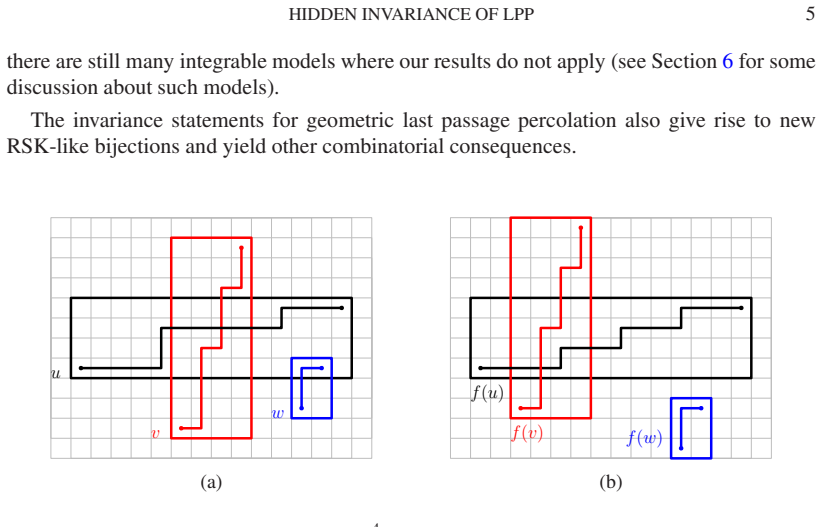
When last passage percolation and directed polymer models on Z^2 possess an integrable structure coming from the RSK correspondence or the geometric RSK correspondence, their basic invariances under translation and reflection combine with a decoupling property to produce a rich collection of additional symmetries, including shift and rearrangement invariance statements for last passage times, geodesic locations, disjointness probabilities, polymer partition functions, and quenched polymer measures; the same framework also yields scrambled RSK correspondences and an RSK correspondence for moon polyominoes, and the results extend to the KPZ equation and the Airy sheet.
What carries the argument
The RSK correspondence (or geometric RSK correspondence) together with the decoupling property, which together extend the model's basic translation and reflection invariances into shift and rearrangement invariances.
If this is right
- Last passage times remain unchanged in distribution under permitted shifts and rearrangements of the underlying weights.
- Geodesic locations and disjointness probabilities are invariant under the same operations.
- Polymer partition functions and quenched polymer measures inherit corresponding shift and rearrangement invariances.
- The symmetries persist in the scaling limits given by the KPZ equation and the Airy sheet.
- Scrambled versions of the RSK correspondence exist and an RSK correspondence can be defined for moon polyominoes.
Where Pith is reading between the lines
- The rearrangement invariances could be used to reduce certain path-counting or probability calculations to equivalent problems on simpler weight configurations.
- The same combination of basic invariances and decoupling may apply to other integrable lattice models that admit RSK-type bijections, such as certain tiling or matching problems.
- In the continuum, the hidden invariances might translate into previously unrecognized symmetries of the directed landscape or the KPZ fixed point that are not visible from the usual translation and reflection properties alone.
Load-bearing premise
The models must possess an integrable structure from the RSK or geometric RSK correspondence and must satisfy a decoupling property.
What would settle it
Compute the distribution of last passage times in geometric last passage percolation before and after a specific weight rearrangement permitted by the claimed invariance and check whether the distributions match exactly.
Figures



read the original abstract
Last passage percolation and directed polymer models on $\mathbb Z^2$ are invariant under translation and certain reflections. When these models have an integrable structure coming from either the RSK correspondence or the geometric RSK correspondence (e.g. geometric last passage percolation or the log-gamma polymer), we show that these basic invariances can be combined with a decoupling property to yield a rich new set of symmetries. Among other results, we prove shift and rearrangement invariance statements for last passage times, geodesic locations, disjointness probabilities, polymer partition functions, and quenched polymer measures. We also use our framework to find `scrambled' versions of the classical RSK correspondence, and to find an RSK correspondence for moon polyominoes. The results extend to limiting models, including the KPZ equation and the Airy sheet.
Editorial analysis
A structured set of objections, weighed in public.
Referee Report
Summary. The manuscript shows that last passage percolation and directed polymer models on Z^2 possessing integrable structure from the RSK or geometric RSK correspondence (e.g., geometric LPP or log-gamma polymer) combine their basic translation and reflection invariances with a decoupling property to produce new shift and rearrangement symmetries. These apply to last passage times, geodesic locations, disjointness probabilities, polymer partition functions, and quenched measures. The framework also yields scrambled RSK correspondences, an RSK correspondence for moon polyominoes, and extensions to the KPZ equation and Airy sheet limits.
Significance. If the decoupling property is established as stated, the results supply a systematic way to generate new invariances from standard RSK properties, strengthening the toolkit for exact computations and limit theorems in integrable polymer models. The extension to KPZ/Airy objects and the construction of scrambled correspondences are notable strengths.
minor comments (3)
- §1: The decoupling property is introduced as an input; a self-contained statement of its precise hypotheses (including the class of models to which it applies) would improve readability before the main theorems.
- §3, Definition 3.2: Notation for the scrambled RSK map could be clarified by explicitly contrasting it with the classical RSK correspondence in a short table or diagram.
- §5: The extension to the Airy sheet is stated at a high level; adding a brief remark on how the decoupling passes to the limit would help readers track the argument.
Simulated Author's Rebuttal
We thank the referee for the positive and accurate summary of our work, as well as the recommendation for minor revision. No specific major comments appear in the report.
Circularity Check
Derivation self-contained using external RSK and decoupling inputs
full rationale
The paper takes standard translation/reflection invariances and a decoupling property as given inputs for models with RSK or geometric RSK structure, then derives new shift/rearrangement symmetries for last passage times, geodesics, partition functions, and measures. No step reduces a claimed result to a fitted parameter, self-definition, or self-citation chain; the decoupling property is an independent assumption whose consequences are derived rather than presupposed. The framework is therefore not equivalent to its inputs by construction.
Axiom & Free-Parameter Ledger
axioms (1)
- domain assumption Models with RSK or geometric RSK structure possess a decoupling property that can be combined with translation and reflection invariances
Reference graph
Works this paper leans on
-
[1]
The continuum directed random polymer
Tom Alberts, Konstantin Khanin, and Jeremy Quastel. The continuum directed random polymer. Journal of Statistical Physics , 154(1-2):305–326, 2014
work page 2014
-
[2]
The intermediate disorder regime for directed polymers in d imension 1 + 1
Tom Alberts, Konstantin Khanin, and Jeremy Quastel. The intermediate disorder regime for directed polymers in d imension 1 + 1. The Annals of Probability , 42(3):1212–1256, 2014
work page 2014
-
[3]
Littelmann paths and Brownian paths
Philippe Biane, Philippe Bougerol, and Neil O’Connell. Littelmann paths and Brownian paths. Duke Mathematical Journal, 130(1):127–167, 2005
work page 2005
-
[4]
The geometric Burge correspondence and the partition funct ion of polymer replicas
Elia Bisi, Neil O’Connell, and Nikos Zygouras. The geometric Burge correspondence and the partition funct ion of polymer replicas. arXiv preprint arXiv:2001.09145, 2020
-
[5]
Color-position symmetry in interacting particle systems
Alexei Borodin and Alexey Bufetov. Color-position symmetry in interacting particle systems. arXiv preprint arXiv:1905.04692, 2019
work page internal anchor Pith review Pith/arXiv arXiv 1905
-
[6]
Lectures on integrable probability
Alexei Borodin and V adim Gorin. Lectures on integrable probability. Probability and statistical physics in St. Petersburg, 91(155-214), 2016
work page 2016
-
[7]
Shift-invariance for vertex models and polymers
Alexei Borodin, V adim Gorin, and Michael Wheeler. Shift-invariance for vertex models and polymers. arXiv preprint arXiv:1912.02957, 2019
-
[8]
Integrable probability: From representation theory to Mac donald processes
Alexei Borodin and Leonid Petrov. Integrable probability: From representation theory to Mac donald processes. Probability Surveys, 11:1–58, 2014. HIDDEN INV ARIANCE OF LPP 43
work page 2014
-
[9]
Nearest neighbor markov dynamics on Macdonald processes
Alexei Borodin and Leonid Petrov. Nearest neighbor markov dynamics on Macdonald processes. Advances in Mathematics, 300:71–155, 2016
work page 2016
-
[10]
Coloured stochastic vertex models and their spectral theory
Alexei Borodin and Michael Wheeler. Coloured stochastic vertex models and their spectral theor y. arXiv preprint arXiv:1808.01866, 2018
work page internal anchor Pith review Pith/arXiv arXiv 2018
-
[11]
Alexey Bufetov and Konstantin Matveev. Hall–Littlewood RSK field. Selecta Mathematica, 24(5):4839–4884, 2018
work page 2018
-
[12]
Four correspondences between graphs and generalized Young tableaux
William H Burge. Four correspondences between graphs and generalized Young tableaux. Journal of Combinatorial Theory, Series A , 17(1):12–30, 1974
work page 1974
-
[13]
Reconstruction of L-convex polyominoes
Giusi Castiglione and Antonio Restivo. Reconstruction of L-convex polyominoes. Electronic Notes in Discrete Mathematics , 12:290–301, 2003
work page 2003
-
[14]
Busemann functions and equilibrium measures in last passag e percolation models
Eric Cator and Leandro Pimentel. Busemann functions and equilibrium measures in last passag e percolation models. Probability Theory and Related Fields , 154(1-2):89–125, 2012
work page 2012
-
[15]
The Kardar–Parisi–Zhang equation and universality class
Ivan Corwin. The Kardar–Parisi–Zhang equation and universality class. Random matrices: Theory and applications , 1(01):1130001, 2012
work page 2012
-
[16]
Invariance of polymer partition functions under the geomet ric RSK correspondence
Ivan Corwin. Invariance of polymer partition functions under the geomet ric RSK correspondence. arXiv preprint arXiv:2001.01867, 2020
-
[17]
Brownian Gibbs property for Airy line ensembles
Ivan Corwin and Alan Hammond. Brownian Gibbs property for Airy line ensembles. Inventiones mathematicae, 195(2):441–508, 2014
work page 2014
-
[18]
Ivan Corwin and Mihai Nica. Intermediate disorder directed polymers and the multi-lay er extension of the stochastic heat equation. Electronic Journal of Probability, 22, 2017
work page 2017
-
[19]
Tropical combinatorics and Whittaker functions
Ivan Corwin, Neil O’Connell, Timo Seppäläinen, and Nik olaos Zygouras. Tropical combinatorics and Whittaker functions. Duke Mathematical Journal, 163(3):513–563, 2014
work page 2014
-
[20]
The strict-weak lattice polymer
Ivan Corwin, Timo Seppäläinen, and Hao Shen. The strict-weak lattice polymer. Journal of Statistical Physics , 160(4):1027–1053, 2015
work page 2015
-
[21]
Uniform convergence to the Airy line ensemble
Duncan Dauvergne, Mihai Nica, and Bálint Virág. Uniform convergence to the Airy line ensemble. arXiv preprint arXiv:1907.10160, 2019
-
[22]
Duncan Dauvergne, Janosch Ortmann, and Bálint Virág. The directed landscape. arXiv:1812.00309, 2018
-
[23]
Symmetries of stochastic colored vertex models
Pavel Galashin. Symmetries of stochastic colored vertex models. arXiv preprint arXiv:2003.06330, 2020
-
[24]
Minuscule reverse plane partitions via quiver representat ions
Alexander Garver, Rebecca Patrias, and Hugh Thomas. Minuscule reverse plane partitions via quiver representat ions. arXiv preprint arXiv:1812.08345, 2018
-
[25]
Binomial determinants, paths, and hook length formulae
Ira Gessel and Gérard Viennot. Binomial determinants, paths, and hook length formulae. Advances in mathematics, 58(3):300–321, 1985
work page 1985
-
[26]
An extension of Schensted’s theorem
Curtis Greene. An extension of Schensted’s theorem. Advances in Mathematics, 14(2):254–265, 1974
work page 1974
-
[27]
Shape fluctuations and random matrices
Kurt Johansson. Shape fluctuations and random matrices. Communications in Mathematical Physics , 209(2):437–476, 2000
work page 2000
-
[28]
Discrete orthogonal polynomial ensembles and the Plancher el measure
Kurt Johansson. Discrete orthogonal polynomial ensembles and the Plancher el measure. Annals of Mathematics, 153(1):259–296, 2001. 44
work page 2001
-
[29]
Discrete polynuclear growth and determinantal processes
Kurt Johansson. Discrete polynuclear growth and determinantal processes. Communications in Mathematical Physics , 242(1-2):277–329, 2003
work page 2003
-
[30]
Generalized triangulations and diagonal-free subsets of s tack polyominoes
Jakob Jonsson. Generalized triangulations and diagonal-free subsets of s tack polyominoes. J. Comb. Theory, Ser . A, 112(1):117–142, 2005
work page 2005
-
[31]
Samuel Karlin and James McGregor. Coincidence probabilities. Pacific Journal of Mathematics, 9(4):1141–1164, 1959
work page 1959
-
[32]
Introduction to tropical combinatorics
Anatol Kirillov. Introduction to tropical combinatorics. In Physics and combinatorics, pages 82–150. World Scientific, 2001
work page 2001
-
[33]
Growth diagrams, and increasing and decreasing chains in fil lings of Ferrers shapes
Christian Krattenthaler. Growth diagrams, and increasing and decreasing chains in fil lings of Ferrers shapes. Advances in Applied Mathematics , 37(3):404–431, 2006
work page 2006
-
[34]
On the vector representations of induced matroids
Bernt Lindström. On the vector representations of induced matroids. Bulletin of the London Mathematical Society , 5(1):85–90, 1973
work page 1973
-
[35]
Konstantin Matetski, Jeremy Quastel, and Daniel Remen ik. The KPZ fixed point. arXiv:1701.00018, 2016
-
[36]
q-randomized Robinson–Schensted–Knuth correspondences a nd random polymers
Konstantin Matveev and Leonid Petrov. q-randomized Robinson–Schensted–Knuth correspondences a nd random polymers. Annales de l’Institut Henri Poincaré D , 4(1):1–123, 2016
work page 2016
-
[37]
Tropical Robinson-Schensted-Knuth correspondence and bi rational Weyl group actions
Masatoshi Noumi, Yasuhiko Yamada, et al. Tropical Robinson-Schensted-Knuth correspondence and bi rational Weyl group actions. In Representation Theory of Algebraic Groups and Quantum Groups, pages 371–442. Mathematical Society of Japan, 2004
work page 2004
-
[38]
Conditioned random walks and the rsk correspondence
Neil O’Connell. Conditioned random walks and the rsk correspondence. Journal of Physics A: Mathematical and General , 36(12):3049, 2003
work page 2003
-
[39]
Tracy-Widom asymptotics for a random polymer model with gam ma-distributed weights
Neil O’Connell and Janosch Ortmann. Tracy-Widom asymptotics for a random polymer model with gam ma-distributed weights. Electronic Journal of Probability, 20, 2015
work page 2015
-
[40]
Brownian analogues of Burke’s theorem
Neil O’Connell and Marc Y or. Brownian analogues of Burke’s theorem. Stochastic processes and their applications , 96(2):285–304, 2001
work page 2001
-
[41]
Geometric RSK correspondence, Whittaker functions and sym metrized random polymers
Neil O’Connell, Timo Seppäläinen, and Nikos Zygouras. Geometric RSK correspondence, Whittaker functions and sym metrized random polymers. Inventiones mathematicae, 197(2):361–416, 2014
work page 2014
-
[42]
A multi-layer extension of the stochastic heat equation
Neil O’Connell and Jon Warren. A multi-layer extension of the stochastic heat equation. Communications in Mathematical Physics , 341(1):1–33, 2016
work page 2016
-
[43]
A q-Robinson-Schensted-Knuth algorithm and a q-polymer
Y uchen Pei. A q-Robinson-Schensted-Knuth algorithm and a q-polymer. The Electronic Journal of Combinatorics , pages P4–6, 2017
work page 2017
-
[44]
Duality between coalescence times and exit points in last-p assage percolation models
Leandro PR Pimentel. Duality between coalescence times and exit points in last-p assage percolation models. The Annals of Probability , 44(5):3187–3206, 2016
work page 2016
-
[45]
Scale invariance of the PNG droplet and the Airy process
Michael Prähofer and Herbert Spohn. Scale invariance of the PNG droplet and the Airy process. Journal of Statistical Physics , 108(5-6):1071–1106, 2002
work page 2002
-
[46]
Jeremy Quastel. Introduction to KPZ. Current Developments in Mathematics, 2011(1), 2011
work page 2011
-
[47]
The surprising mathematics of longest increasing subseque nces, volume 4
Dan Romik. The surprising mathematics of longest increasing subseque nces, volume 4. Cambridge University Press, 2015. HIDDEN INV ARIANCE OF LPP 45
work page 2015
-
[48]
Increasing and decreasing sequences in fillings of moon poly ominoes
Martin Rubey. Increasing and decreasing sequences in fillings of moon poly ominoes. Advances in Applied Mathematics , 47(1):57–87, 2011
work page 2011
-
[49]
Bruce E Sagan. The symmetric group: representations, combinatorial algo rithms, and symmetric functions , volume 203. Springer Science & Business Media, 2013
work page 2013
-
[50]
Exact limiting shape for a simplified model of first-passage p ercolation on the plane
Timo Seppäläinen. Exact limiting shape for a simplified model of first-passage p ercolation on the plane. Annals of probability, pages 1232–1250, 1998
work page 1998
-
[51]
Scaling for a one-dimensional directed polymer with bounda ry conditions
Timo Seppäläinen. Scaling for a one-dimensional directed polymer with bounda ry conditions. The Annals of Probability , 40(1):19–73, 2012
work page 2012
-
[52]
Some algebraic structures in the KPZ universality
Nikos Zygouras. Some algebraic structures in the KPZ universality. arXiv preprint arXiv:1812.07204, 2018
discussion (0)
Sign in with ORCID, Apple, or X to comment. Anyone can read and Pith papers without signing in.