Lowest order stabilization free Virtual Element Method for the 2D Poisson equation
Pith reviewed 2026-05-24 13:29 UTC · model grok-4.3
The pith
The first-order Enlarged Enhancement Virtual Element Method solves the 2D Poisson equation with bilinear forms that require no stabilization term.
A machine-rendered reading of the paper's core claim, the machinery that carries it, and where it could break.
Core claim
The E²VEM allows the definition of bilinear forms that do not require a stabilization term, thanks to the exploitation of higher order polynomial projections made computable by suitably enlarging the enhancement property of local virtual spaces. The polynomial degree of local projections is chosen based on the number of vertices of each polygon. Proof of well-posedness and optimal order a priori error estimates are provided.
What carries the argument
Enlarged enhancement property of local virtual spaces, which renders higher-order polynomial projections computable from the degrees of freedom and thereby removes the need for stabilization.
If this is right
- The discrete problem is well-posed once the projection degree is chosen from the number of vertices.
- Optimal-order a priori error estimates hold in the energy norm and in L2.
- Numerical convergence rates on both convex and non-convex meshes match the theoretical predictions.
- No stabilization parameter needs to be selected or tuned.
Where Pith is reading between the lines
- The same enlargement strategy could be applied to other linear elliptic problems to obtain stabilization-free schemes.
- Implementation cost may decrease because the code no longer needs to assemble or tune a stabilization term.
- The vertex-dependent degree rule suggests a possible route to adaptive choice of local polynomial spaces on highly irregular meshes.
Load-bearing premise
The enlargement of the enhancement property together with the vertex-count rule for projection degree makes the required higher-order projections computable without stabilization.
What would settle it
A computation on a mesh containing polygons with varying numbers of sides that produces either a singular discrete system or convergence rates below the predicted optimal order when the vertex-based projection degrees are used.
Figures
read the original abstract
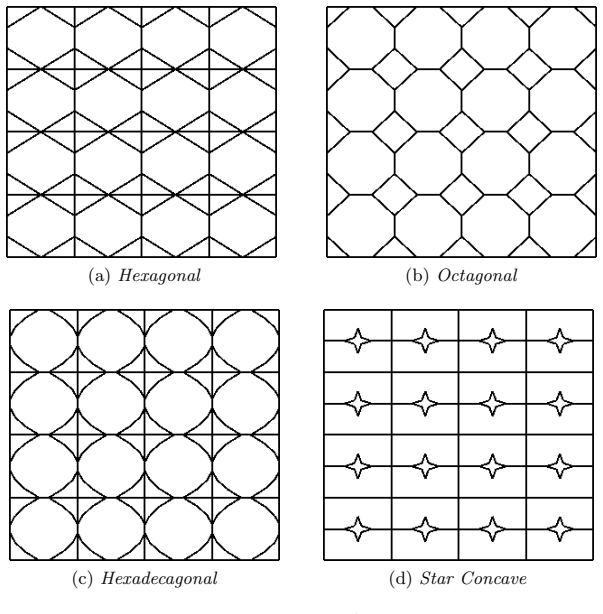
We introduce and analyse the first order Enlarged Enhancement Virtual Element Method (E$^2$VEM) for the Poisson problem. The method allows the definition of bilinear forms that do not require a stabilization term, thanks to the exploitation of higher order polynomial projections that are made computable by suitably enlarging the enhancement (from which comes the prefix of the name E$^2$) property of local virtual spaces. The polynomial degree of local projections is chosen based on the number of vertices of each polygon. We provide a proof of well-posedness and optimal order a priori error estimates. Numerical tests on convex and non-convex polygonal meshes confirm the criterium for well-posedness and the theoretical convergence rates.
Editorial analysis
A structured set of objections, weighed in public.
Referee Report
Summary. The manuscript introduces the first-order Enlarged Enhancement Virtual Element Method (E²VEM) for the 2D Poisson equation. It constructs stabilization-free bilinear forms by enlarging the enhancement property of local virtual spaces, making higher-order polynomial projections computable; the projection degree is selected according to the number of vertices per polygon. Well-posedness and optimal-order a priori error estimates are proved, with numerical tests on convex and non-convex meshes used to confirm the well-posedness criterion and convergence rates.
Significance. If the central claims hold, the work supplies an explicit stabilization-free construction for lowest-order VEM on general polygonal meshes together with a well-posedness proof and optimal a priori estimates. These elements constitute a concrete technical contribution to the VEM literature; the provision of both analysis and supporting numerical experiments on non-convex meshes strengthens the result.
minor comments (3)
- [Abstract] Abstract: the phrase 'confirm the criterium for well-posedness' is imprecise; the abstract should state the explicit well-posedness criterion that is being verified.
- [§3] The dependence of the local projection degree on the number of vertices is central to the construction; a short table or explicit formula in §3 would improve readability.
- [Introduction] Notation for the enlarged enhancement spaces and the associated projection operators could be introduced with a brief comparison to standard VEM spaces already in the introduction.
Simulated Author's Rebuttal
We thank the referee for the positive summary, significance assessment, and recommendation of minor revision. No specific major comments were listed in the report, so we have no points to address point-by-point at this stage.
Circularity Check
No significant circularity; derivation is self-contained construction plus independent analysis
full rationale
The paper defines the E²VEM via an explicit enlargement of the local virtual space enhancement property, selects the projection degree as a function of polygon vertices, and then supplies a separate well-posedness proof together with optimal-order a priori error estimates. These steps are presented as direct mathematical constructions and external analysis rather than reductions of a fitted quantity or a self-citation chain back to the target result. Numerical experiments are described only as confirmation of the already-proven criterion. No load-bearing step equates a claimed prediction or uniqueness result to its own input by construction.
Axiom & Free-Parameter Ledger
free parameters (1)
- Polynomial degree selection rule
axioms (1)
- domain assumption Enlargement of the enhancement property renders higher-order polynomial projections computable without stabilization
Reference graph
Works this paper leans on
-
[1]
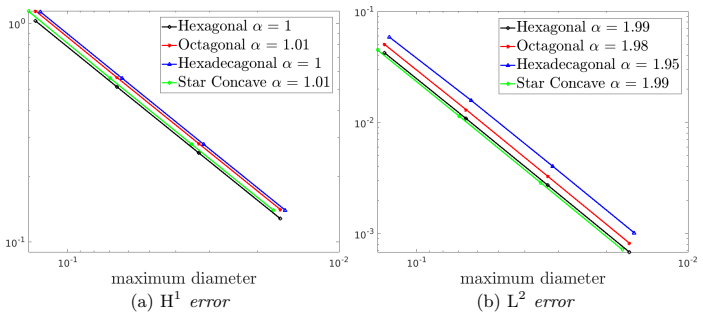
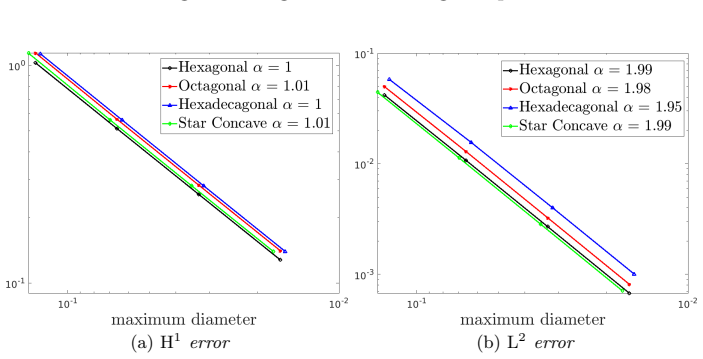
B. Ahmad, A. Alsaedi, F. Brezzi, L. D. Marini, and A. Russo. Equiva- lent projectors for virtual element methods. Computers & Mathematics with Applications, 66:376–391, September 2013. 25 (a) H1 error (b) L2 error Figure 2: Logarithmic convergence plots (a) H1 error (b) L2 error Figure 3: Logarithmic convergence plots for diffusion-reaction model
work page 2013
-
[2]
P. F. Antonietti, S. Berrone, A. Borio, A. D’Auria, M. Verani, and S. Weisser. Anisotropic a posteriori error estimate for the virtual ele- ment method. IMA Journal of Numerical Analysis , 02 2021
work page 2021
-
[3]
P. F. Antonietti, L. Mascotto, and M. Verani. A multigrid algorithm for the p-version of the virtual element method. ESAIM: Mathematical Modelling and Numerical Analysis , 52:337–364, 03 2017
work page 2017
-
[4]
I. Babuˇ ska, E. G. Podnos, and G. J. Rodin. New fictitious domain methods: formulation and analysis. Mathematical Models and Methods in Applied Sciences, 15(10):1575–1594, 2005
work page 2005
-
[5]
L. Beir˜ ao da Veiga, F. Brezzi, A. Cangiani, G. Manzini, L. D. Marini, and A. Russo. Basic principles of virtual element methods. Mathemat- ical Models and Methods in Applied Sciences , 23(01):199–214, 2013. 26
work page 2013
-
[6]
L. Beir˜ ao da Veiga, F. Brezzi, L. D. Marini, and A. Russo. Virtual element methods for general second order elliptic problems on polyg- onal meshes. Mathematical Models and Methods in Applied Sciences , 26(04):729–750, 2015
work page 2015
-
[7]
L. Beir˜ ao da Veiga, F. Brezzi, L. D. Marini, and A. Russo. Mixed virtual element methods for general second order elliptic problems on polygo- nal meshes. ESAIM: Mathematical Modelling and Numerical Analysis , 50(3):727–747, 2016
work page 2016
-
[8]
L. Beir˜ ao da Veiga, K. Lipnikov, and G. Manzini. The mimetic finite difference method for elliptic problems . Ms&A Modeling, simulation and applications 11. Springer, Cham, 2014
work page 2014
-
[9]
L. Beir˜ ao da Veiga, C. Lovadina, and D. Mora. A virtual element method for elastic and inelastic problems on polytope meshes. Com- puter Methods in Applied Mechanics and Engineering , 295:327–346, 2015
work page 2015
-
[10]
L. Beir˜ ao da Veiga, C. Lovadina, and A. Russo. Stability analysis for the virtual element method. Mathematical Models and Methods in Applied Sciences, 27(13):2557–2594, 2017
work page 2017
-
[11]
L. Beir˜ ao da Veiga and G. Manzini. Residual a posteriori error esti- mation for the virtual element method for elliptic problems. ESAIM: M2AN, 49(2):577–599, 2015
work page 2015
-
[12]
M. F. Benedetto, S. Berrone, and A. Borio. The Virtual Element Method for underground flow simulations in fractured media. In Ad- vances in Discretization Methods, volume 12 of SEMA SIMAI Springer Series, pages 167–186. Springer International Publishing, Switzerland, 2016
work page 2016
-
[13]
M. F. Benedetto, S. Berrone, A. Borio, S. Pieraccini, and S. Scial` o. A hybrid mortar virtual element method for discrete fracture network simulations. J. Comput. Phys. , 306:148–166, 2016
work page 2016
-
[14]
M. F. Benedetto, S. Berrone, A. Borio, S. Pieraccini, and S. Scial` o. Or- der preserving SUPG stabilization for the virtual element formulation of advection-diffusion problems. Comput. Methods Appl. Mech. Engrg., 311:18 – 40, 2016
work page 2016
-
[15]
M. F. Benedetto, S. Berrone, and S. Scial` o. A globally conforming method for solving flow in discrete fracture networks using the virtual element method. Finite Elem. Anal. Des. , 109:23–36, 2016. 27
work page 2016
-
[16]
S. Berrone and A. Borio. A residual a posteriori error estimate for the virtual element method. Mathematical Models and Methods in Applied Sciences, 27(08):1423–1458, 2017
work page 2017
-
[17]
S. Berrone, A. Borio, and G. Manzini. SUPG stabilization for the nonconforming virtual element method for advection–diffusion–reaction equations. Computer Methods in Applied Mechanics and Engineering , 340:500 – 529, 2018
work page 2018
-
[18]
S. Berrone, A. Borio, and F. Marcon. Comparison of standard and sta- bilization free virtual elements on anisotropic elliptic problems. Applied Mathematics Letters, 129:107971, 2022
work page 2022
-
[19]
S. Berrone, S. Pieraccini, and S. Scial` o. On simulations of discrete frac- ture network flows with an optimization-based extended finite element method. SIAM J. Sci. Comput. , 35(2):A908–A935, 2013
work page 2013
-
[20]
S. Berrone, S. Pieraccini, and S. Scial` o. A PDE-constrained optimiza- tion formulation for discrete fracture network flows.SIAM J. Sci. Com- put., 35(2):B487–B510, 2013
work page 2013
-
[21]
S. Berrone, S. Pieraccini, and S. Scial` o. An optimization approach for large scale simulations of discrete fracture network flows. J. Comput. Phys., 256:838–853, 2014
work page 2014
-
[22]
D. Boffi, F. Brezzi, and M. Fortin. Approximation of Saddle Point Problems, chapter 5, pages 265–335. Springer Berlin Heidelberg, Berlin, Heidelberg, 2013
work page 2013
-
[23]
S. C. Brenner and L. Sung. Virtual element methods on meshes with small edges or faces. Mathematical Models and Methods in Applied Sciences, 28(07):1291–1336, 2018
work page 2018
- [24]
-
[25]
F. Brezzi and L. D. Marini. Virtual element methods for plate bending problems. Computer Methods in Applied Mechanics and Engineering , 253:455–462, 2013
work page 2013
- [26]
-
[27]
A. Cangiani, E. H. Georgoulis, T. Pryer, and O. J. Sutton. A posteriori error estimates for the virtual element method. Numerische Mathe- matik, 137(4):857–893, Dec 2017. 28
work page 2017
-
[28]
A. Cangiani, G. Manzini, and O. J. Sutton. Conforming and noncon- forming virtual element methods for elliptic problems. IMA Journal of Numerical Analysis, 37(3):1317–1354, 08 2016
work page 2016
-
[29]
L. Desiderio, S. Falletta, and L. Scuderi. A virtual element method coupled with a boundary integral non reflecting condition for 2d exte- rior helmholtz problems. Computers & Mathematics with Applications , 84:296–313, 2021
work page 2021
-
[30]
D. A. Di Pietro and A. Ern. Mathematical Aspects of Discontinuous Galerkin Methods. Springer Berlin Heidelberg, Berlin, Heidelberg, 2012
work page 2012
-
[31]
D. A. Di Pietro and A. Ern. A hybrid high-order locking-free method for linear elasticity on general meshes. Computer Methods in Applied Mechanics and Engineering, 283:1–21, 2015
work page 2015
-
[32]
D. A. Di Pietro and A. Ern. Hybrid high-order methods for variable- diffusion problems on general meshes. Comptes Rendus Mathematique, 353(1):31–34, 2015
work page 2015
-
[33]
D. A. Di Pietro, A. Ern, and S. Lemaire. An arbitrary-order and compact-stencil discretization of diffusion on general meshes based on local reconstruction operators. Computational Methods in Applied Mathematics, 14(4):461–472, 2014
work page 2014
-
[34]
J. Droniou, R. Eymard, T. Gallou et, C. Guichard, and R. Herbin. The Gradient Discretisation Method . Math´ ematiques et Applications. Springer, Cham, 2018
work page 2018
-
[35]
J. Droniou, R. Eymard, T. Gallou et, and R. Herbin. Gradient Schemes: a generic framework for the discretisation of linear, nonlinear and nonlo- cal elliptic and parabolic equations. Mathematical Models and Methods in Applied Sciences, 23(13):2395–2432, 2013
work page 2013
-
[36]
R. Glowinski, T.-W. Pan, and J. Periaux. A fictitious domain method for Dirichlet problem and applications. Computer Methods in Applied Mechanics and Engineering, 111(3):283–303, 1994
work page 1994
-
[37]
J. S Hesthaven and T. Warburton. Nodal Discontinuous Galerkin meth- ods: algorithms, analysis, and applications . Texts in applied mathemat- ics 54. Springer Science & Business Media, New York, 2008
work page 2008
-
[38]
B. Hudobivnik, F. Aldakheel, and P. Wriggers. A low order 3D virtual element formulation for finite elasto–plastic deformations. Computa- tional Mechanics, 63:253–269, 02 2019
work page 2019
- [39]
-
[40]
C. S. Peskin. The immersed boundary method. Acta Numerica , 11:479–517, 2002
work page 2002
- [41]
-
[42]
T. Strouboulis, I. Babuˇ ska, and K. Copps. The design and analysis of the Generalized Finite Element Method. Computer Methods in Applied Mechanics and Engineering, 181(1):43–69, 2000
work page 2000
-
[43]
T. Strouboulis, K. Copps, and I. Babuˇ ska. The generalized finite el- ement method: an example of its implementation and illustration of its performance. International Journal for Numerical Methods in En- gineering, 47(8):1401–1417, 2000
work page 2000
-
[44]
T. Strouboulis, K. Copps, and I. Babuˇ ska. The generalized finite ele- ment method. Computer Methods in Applied Mechanics and Engineer- ing, 190(32):4081–4193, 2001
work page 2001
-
[45]
N. Sukumar and A. Tabarraei. Conforming polygonal finite ele- ments. International Journal for Numerical Methods in Engineering , 61(12):2045–2066, 2004
work page 2045
-
[46]
V. Tishkin, A. A. Samarskii, A. P. Favorskii, and M. Shashkov. Opera- tional finite-difference schemes. Differential Equations, 17:854–862, 07 1981
work page 1981
-
[47]
G. Vacca. Virtual element methods for hyperbolic problems on polyg- onal meshes. Computers & Mathematics with Applications , 74(5):882 – 898, 2017. SI: SDS2016 – Methods for PDEs
work page 2017
-
[48]
G. Vacca and L. Beir˜ ao da Veiga. Virtual element methods for parabolic problems on polygonal meshes. Numerical Methods for Partial Differ- ential Equations, 31(6):2110–2134, 2015. A Supplementary materials A.1 Proof of Lemma 4 In order to show the proof, we have to present a preliminary result. Lemma 9. Let ¯q∈RQ(E). Then ∃C > 0, independent of hE, such ...
work page 2015
discussion (0)
Sign in with ORCID, Apple, or X to comment. Anyone can read and Pith papers without signing in.