Non-Equilibrium Steady States and Quantum Chaos in a three-site Driven-Dissipative Bose-Hubbard Chains base on Self-Consistent Mean-Field Approach
Pith reviewed 2026-05-24 13:06 UTC · model grok-4.3
The pith
Self-consistent mean-field analysis shows parametric instabilities trigger chaos in a driven-dissipative Bose-Hubbard chain, with the out-of-time-order correlator exhibiting rapid exponential growth as a signature of information scrambling.
A machine-rendered reading of the paper's core claim, the machinery that carries it, and where it could break.
Core claim
By closing the nonlinear master equation at the single-site level with the self-consistent Gutzwiller mean-field ansatz and iterating to the non-equilibrium steady state, the authors find that drive-induced coherence produces parametric instabilities that drive a transition into a chaotic regime. In that regime the out-of-time-order correlator exhibits rapid exponential growth and saturation, providing a direct signature of information scrambling within the open driven-dissipative system.
What carries the argument
The self-consistent Gutzwiller mean-field ansatz that reduces the many-body master equation to a closed nonlinear equation for local coherent amplitudes and is solved iteratively to obtain the non-equilibrium steady state and the out-of-time-order correlator.
If this is right
- Parametric instabilities arising from drive-induced coherence trigger the transition from the quasilinear to the chaotic regime.
- In the strong-coupling regime the out-of-time-order correlator exhibits rapid exponential growth followed by saturation.
- The observed out-of-time-order correlator behavior constitutes a signature of information scrambling in an open quantum system.
- The Picard-iteration framework supplies an efficient route to many-body correlations in larger photonic lattices.
Where Pith is reading between the lines
- The same mean-field closure could be applied to chains or lattices too large for exact diagonalization to map the boundaries of the chaotic regime.
- The identified instability threshold may set practical limits on coherence or information storage in driven photonic devices.
- Analogous parametric instabilities and scrambling signatures may appear in other driven-dissipative platforms such as circuit-QED arrays or Rydberg gases.
Load-bearing premise
The self-consistent Gutzwiller mean-field ansatz remains quantitatively accurate for the onset of parametric instabilities and the out-of-time-order correlator growth rate even when strong Kerr nonlinearity is present.
What would settle it
An exact numerical integration of the three-site master equation that fails to display the predicted exponential out-of-time-order correlator growth inside the strong-coupling chaotic regime would falsify the central claim.
Figures
read the original abstract
We investigate the non-equilibrium dynamics and steady-state properties of a driven-dissipative Bose-Hubbard chain using a self-consistent Gutzwiller mean-field (GMF) approach. By employing a robust Picard iteration scheme, we solve the non-linear master equation for the non-equilibrium steady state (NESS) in the presence of strong Kerr nonlinearity. We identify two distinct dynamical regimes governed by the interplay between coherent drive, dissipation, and interaction: a regular quasilinear regime and a chaotic regime. Linear stability analysis reveals that the transition to the chaotic regime is triggered by parametric instabilities arising from the drive-induced coherence. Furthermore, we characterize the onset of quantum chaos by calculating the out-of-time-order correlator (OTOC). Our results show that in the strong coupling regime, the OTOC exhibits rapid exponential growth and saturation, providing a clear signature of information scrambling in this open quantum system. The proposed numerical framework offers an efficient pathway to explore many-body correlations in larger photonic lattices.
Editorial analysis
A structured set of objections, weighed in public.
Referee Report
Summary. The manuscript investigates the non-equilibrium steady states of a three-site driven-dissipative Bose-Hubbard chain via a self-consistent Gutzwiller mean-field (GMF) closure of the nonlinear master equation, solved with a Picard iteration scheme. It identifies a regular quasilinear regime and a chaotic regime, with the transition diagnosed by linear stability analysis of the NESS fixed point; the chaotic regime is further characterized by out-of-time-order correlators (OTOCs) that exhibit rapid exponential growth and saturation under strong Kerr nonlinearity, interpreted as a signature of information scrambling in the open system.
Significance. If the GMF results remain quantitatively reliable beyond the factorization approximation, the work supplies an efficient numerical route to map parametric instabilities and scrambling diagnostics in small driven-dissipative photonic lattices. The explicit use of a Picard scheme for the nonlinear steady-state problem is a concrete technical contribution that could be reused for larger chains.
major comments (3)
- [Abstract] Abstract and the OTOC section: the reported rapid exponential growth of the OTOC is computed entirely inside the product-state GMF closure; because the same factorization is used both to obtain the NESS and to evolve the commutator, the growth rate may be an artifact of discarded inter-site entanglement and number fluctuations once the Kerr term U becomes comparable to the drive and hopping.
- [Linear stability analysis] Linear stability analysis paragraph: the parametric instabilities that define the chaotic regime are identified from the Jacobian of the mean-field equations; no external benchmark (exact diagonalization for N=3, or comparison to truncated Wigner or other beyond-mean-field methods) is provided to confirm that the instability threshold survives when the ansatz is relaxed.
- [Self-consistent GMF approach] The self-consistent GMF closure: the master equation is closed at the single-site level by factorizing the density matrix across the three sites; this truncation is load-bearing for the central claim that OTOC growth signals quantum chaos, yet the manuscript supplies neither convergence checks with respect to cluster size nor error estimates on the Picard iterates under strong nonlinearity.
minor comments (2)
- [Title] The title contains the grammatical error 'base on' instead of 'based on'.
- [Abstract] Notation for the drive amplitude, dissipation rate, and Kerr coefficient should be introduced once with explicit symbols rather than left implicit in the abstract.
Simulated Author's Rebuttal
We thank the referee for the careful reading and constructive criticism. We address each major comment point by point below, indicating where the manuscript will be revised.
read point-by-point responses
-
Referee: [Abstract] Abstract and the OTOC section: the reported rapid exponential growth of the OTOC is computed entirely inside the product-state GMF closure; because the same factorization is used both to obtain the NESS and to evolve the commutator, the growth rate may be an artifact of discarded inter-site entanglement and number fluctuations once the Kerr term U becomes comparable to the drive and hopping.
Authors: We agree that the OTOC is evolved under the same single-site factorization used to obtain the NESS. This is by design of the GMF ansatz, so the reported growth rate is a property of the closed mean-field dynamics rather than a claim about the full quantum many-body evolution. We will revise the abstract and the OTOC section to state explicitly that the exponential growth and saturation constitute a mean-field signature of scrambling and to note the possible influence of neglected entanglement and fluctuations. This addition will qualify the interpretation without changing the technical results. revision: partial
-
Referee: [Linear stability analysis] Linear stability analysis paragraph: the parametric instabilities that define the chaotic regime are identified from the Jacobian of the mean-field equations; no external benchmark (exact diagonalization for N=3, or comparison to truncated Wigner or other beyond-mean-field methods) is provided to confirm that the instability threshold survives when the ansatz is relaxed.
Authors: The linear stability analysis is performed directly on the Jacobian of the GMF equations, which is the appropriate diagnostic inside the approximation. Exact diagonalization of the driven-dissipative Lindblad equation for three sites with strong Kerr nonlinearity is numerically demanding, and the manuscript does not contain such benchmarks. We will add an explicit statement in the linear-stability section acknowledging that the identified threshold is specific to the product-state closure and that its survival beyond mean field remains an open question. revision: partial
-
Referee: [Self-consistent GMF approach] The self-consistent GMF closure: the master equation is closed at the single-site level by factorizing the density matrix across the three sites; this truncation is load-bearing for the central claim that OTOC growth signals quantum chaos, yet the manuscript supplies neither convergence checks with respect to cluster size nor error estimates on the Picard iterates under strong nonlinearity.
Authors: Because the approach is strictly single-site Gutzwiller, cluster-size convergence is not applicable within the present ansatz; a multi-site cluster calculation would constitute a different method. For the Picard iteration we will expand the methods section with explicit convergence tolerances, residual norms, and iteration counts for representative points in the strong-nonlinearity regime, thereby supplying the requested error estimates on the NESS solutions. revision: yes
Circularity Check
No significant circularity; OTOC growth computed forward from GMF equations
full rationale
The paper solves the nonlinear master equation via self-consistent GMF and Picard iteration to obtain the NESS, performs linear stability analysis on the resulting fixed point to identify the chaotic regime, and then evaluates the OTOC on the same mean-field dynamics. None of these steps reduces the reported OTOC exponential growth to a fitted parameter or to the input ansatz by construction; the growth rate is an output of the forward integration under the factorization approximation. No self-citation is invoked as a load-bearing uniqueness theorem, and no parameter is fitted to a data subset then relabeled as a prediction. The derivation chain is therefore self-contained within the stated mean-field closure.
Axiom & Free-Parameter Ledger
axioms (1)
- domain assumption Gutzwiller mean-field ansatz closes the master equation at the single-site level while still capturing drive-induced parametric instabilities
Forward citations
Cited by 1 Pith paper
-
Emergent Wigner-Dyson Statistics and Self-Attention-Based Prediction in Driven Bose-Hubbard Chains
A replica-inspired algorithm with Gaussian self-attention predicts many-body spectra in driven Bose-Hubbard chains and reports statistics intermediate between GSE and GUE depending on U/J.
Reference graph
Works this paper leans on
-
[1]
Zero-bias anomaly in finite-size systems[J]
Kamenev A, Gefen Y. Zero-bias anomaly in finite-size systems[J]. P hysical Review B, 1996, 54(8): 5428
work page 1996
-
[2]
Fermi Surface Reconstruction without Symmetry Breaking[J]
Gazit S, Assaad F F, Sachdev S. Fermi Surface Reconstruction without Symmetry Breaking[J]. Physical Review X, 2020, 10(4): 041057
work page 2020
-
[3]
Notes on the complex Sachdev-Y e-Kitaev model[J]
Gu Y, Kitaev A, Sachdev S, et al. Notes on the complex Sachdev-Y e-Kitaev model[J]. Journal of High Energy Physics, 2020, 2020(2): 1-74
work page 2020
-
[4]
Solvable model for a dynamical quantum ph ase transition from fast to slow scram- bling[J]
Banerjee S, Altman E. Solvable model for a dynamical quantum ph ase transition from fast to slow scram- bling[J]. Physical Review B, 2017, 95(13): 134302
work page 2017
-
[5]
Continuous-time quant um Monte Carlo method for fermions[J]
Rubtsov A N, Savkin V V, Lichtenstein A I. Continuous-time quant um Monte Carlo method for fermions[J]. Physical Review B, 2005, 72(3): 035122
work page 2005
-
[6]
Leo P.. Kadanoff, Baym G. Quantum Statistical Mechanics: Green ’s Function Methods in Equilibrium and Nonequilibrium Problems[M]. Benjamin-Cummings Publishing Company, 19 62
-
[7]
Deviations from Fermi-liquid behavior above T c in 2D short coherence length superconductors[J]
Trivedi N, Randeria M. Deviations from Fermi-liquid behavior above T c in 2D short coherence length superconductors[J]. Physical review letters, 1995, 75(2): 312
work page 1995
-
[8]
Many-body Majorana-like zer o modes without gauge symmetry breaking[J]
Vadimov V, Hyart T, Lado J L, et al. Many-body Majorana-like zer o modes without gauge symmetry breaking[J]. Physical Review Research, 2021, 3(2): 023002
work page 2021
-
[9]
Nonlinear electric response of chiral topological superconductors[J]
Lee M, Lopez R. Nonlinear electric response of chiral topological superconductors[J]. New Journal of Physics, 2021, 23(4): 043009
work page 2021
-
[10]
Quantum advantage in the c harging process of Sachdev-Ye-Kitaev batteries[J]
Rossini D, Andolina G M, Rosa D, et al. Quantum advantage in the c harging process of Sachdev-Ye-Kitaev batteries[J]. Physical Review Letters, 2020, 125(23): 236402
work page 2020
-
[11]
Sachdev-Ye-Kitaev s uperconductivity: Quantum Kuramoto and generalized Richardson models[J]
Wang H, Chudnovskiy A L, Gorsky A, et al. Sachdev-Ye-Kitaev s uperconductivity: Quantum Kuramoto and generalized Richardson models[J]. Physical Review Research, 20 20, 2(3): 033025
-
[12]
Wu C H. Electronic properties of the Dirac and Weyl systems with first-and higher-order dispersion in non-Fermi-liquid picture[J]. Physics Letters A, 2019, 383(31): 125 876. 31
work page 2019
-
[13]
Sachdev-Ye-Kitaev non-Fer mi-liquid correlations in nanoscopic quantum transport[J]
Altland A, Bagrets D, Kamenev A. Sachdev-Ye-Kitaev non-Fer mi-liquid correlations in nanoscopic quantum transport[J]. Physical review letters, 2019, 123(22): 226801
work page 2019
-
[16]
Traversable wormhole and Hawking-Page transition in coupled complex SYK models[J]
Sahoo S, Lantagne-Hurtubise ´ e, Plugge S, et al. Traversable wormhole and Hawking-Page transition in coupled complex SYK models[J]. Physical Review Research, 2020, 2(4 ): 043049
work page 2020
-
[17]
Linear-in-t resistivity in dilute metals: a Fer mi liquid perspective[J]
Hwang E H, Sarma S D. Linear-in-t resistivity in dilute metals: a Fer mi liquid perspective[J]. Physical Review B, 2019, 99(8): 085105
work page 2019
-
[18]
Non-Fermi liquid behavior and excitonic c ondensation in an incoherent semimetal[J]
Jose G, Seo K, Uchoa B. Non-Fermi liquid behavior and excitonic c ondensation in an incoherent semimetal[J]. arXiv preprint arXiv:2103.12110, 2021
-
[19]
Theory of a continuous Mott transition in two dimensio ns[J]
Senthil T. Theory of a continuous Mott transition in two dimensio ns[J]. Physical Review B, 2008, 78(4): 045109
work page 2008
-
[20]
Kruchkov A, Patel A A, Kim P, et al. Thermoelectric power of Sac hdev-Ye-Kitaev islands: Probing Bekenstein-Hawking entropy in quantum matter experiments[J]. Ph ysical Review B, 2020, 101(20): 205148
work page 2020
-
[21]
Xu C. Gapless bosonic excitation without symmetry breaking: An algebraic spin liquid with soft gravi- tons[J]. Physical Review B, 2006, 74(22): 224433
work page 2006
-
[22]
Esterlis I, Schmalian J. Cooper pairing of incoherent electrons: An electron-phonon version of the Sachdev- Ye-Kitaev model[J]. Physical Review B, 2019, 100(11): 115132
work page 2019
-
[24]
Slope invariant T-linear resistivity f rom local self-energy[J]
Cha P, Patel A A, Gull E, et al. Slope invariant T-linear resistivity f rom local self-energy[J]. Physical Review Research, 2020, 2(3): 033434
work page 2020
-
[26]
Electronic properties of the boson mode in a three-point fermion loop[J]
Wu C H. Electronic properties of the boson mode in a three-point fermion loop[J]. arXiv preprint arXiv:2011.11803, 2020
-
[27]
Translationally invariant n on-fermi-liquid metals with critical fermi surfaces: Solvable models[J]
Chowdhury D, Werman Y, Berg E, et al. Translationally invariant n on-fermi-liquid metals with critical fermi surfaces: Solvable models[J]. Physical Review X, 2018, 8(3): 031024
work page 2018
-
[28]
Scratching the Bose surface[J]
Sachdev S. Scratching the Bose surface[J]. Nature, 2002, 41 8(6899): 739-740
work page 2002
-
[29]
Ring exchange, the exc iton Bose liquid, and bosonization in two dimensions[J]
Paramekanti A, Balents L, Fisher M P A. Ring exchange, the exc iton Bose liquid, and bosonization in two dimensions[J]. Physical Review B, 2002, 66(5): 054526
work page 2002
-
[30]
Spontaneous brea king of U (1) symmetry in coupled complex SYK models[J]
Klebanov I R, Milekhin A, Tarnopolsky G, et al. Spontaneous brea king of U (1) symmetry in coupled complex SYK models[J]. Journal of High Energy Physics, 2020, 2020( 11): 1-29
work page 2020
-
[31]
Emerging SYK physics in polaron system[J]
Wu C H. Emerging SYK physics in polaron system[J]. arXiv preprint a rXiv:2106.15095, 2021. 32 0.0 0.2 0.4 0.6 0.8 1.0 0
-
[32]
× 10-14 B Δb=0.1 Δb=1 Δb=2 Δb=3 0.00 0.02 0.04 0.06 0.08 0.10 0
-
[33]
× 10-16 β ρB Δb=0.1 Δb=1 Δb=2 Δb=3 0.0 0.2 0.4 0.6 0.8 1.0 0
-
[34]
× 10-13 1.5 × 10⁻¹³ b ρB β=0.1 β=1 β=2 β=5 0.00 0.02 0.04 0.06 0.08 0.10 0
-
[35]
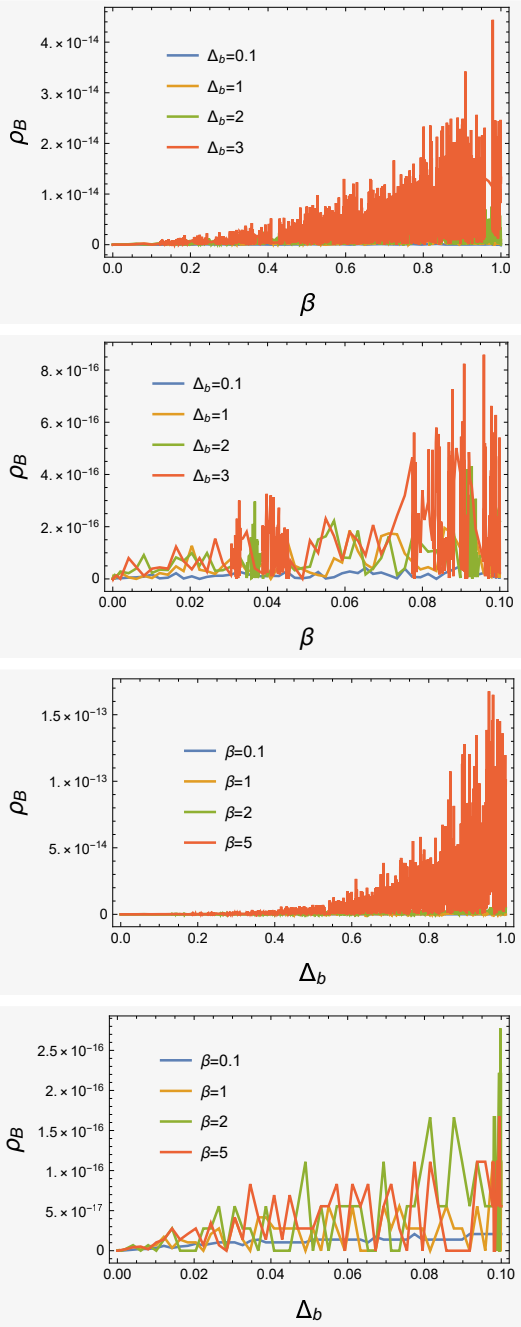
× 10-16 2.5 × 10⁻¹⁶ b ρB β=0.1 β=1 β=2 β=5 Figure 1: Bosonic spectral weight as a function of V0 at high temperature limit or as a function of β at different ∆b. 33 7 7 ¦ ¦F )/ Local SYK NFL max[T,½ ]<<½ c W/U=½ c<<max[T,½ ]<<U , >> ½ $ disordered FL ½ <T<½ c SU(2) V0=U/(2√2)<U <i º >≠0 <Q>≠0 (3/2)U>>½ >>T>>U without SU(2) V0=0 V0<<U V0>U VWDEOH JDSOHVV...
discussion (0)
Sign in with ORCID, Apple, or X to comment. Anyone can read and Pith papers without signing in.