Backward Euler method for the equations of motion arising in Oldroyd model of order one with nonsmooth initial data
Pith reviewed 2026-05-24 13:21 UTC · model grok-4.3
The pith
The backward Euler finite element method for the Oldroyd model achieves optimal L2 error estimates that are uniform in time for nonsmooth initial data under a uniqueness condition.
A machine-rendered reading of the paper's core claim, the machinery that carries it, and where it could break.
Core claim
For the 2D Oldroyd model of viscoelastic fluids of order one, the backward Euler method with finite element discretization in space yields discrete solutions that are bounded uniformly in time in the Dirichlet norm. Optimal a priori error estimates in the L2 norm are derived for nonsmooth initial data, and these estimates remain uniform in time when the uniqueness condition holds for the continuous problem.
What carries the argument
Backward Euler time discretization combined with finite element spatial discretization applied to the Oldroyd viscoelastic fluid equations.
If this is right
- The discrete solutions remain bounded in the Dirichlet norm uniformly in time.
- Optimal L2-norm error estimates are obtained for nonsmooth initial data.
- These error estimates are uniform in time under the uniqueness assumption.
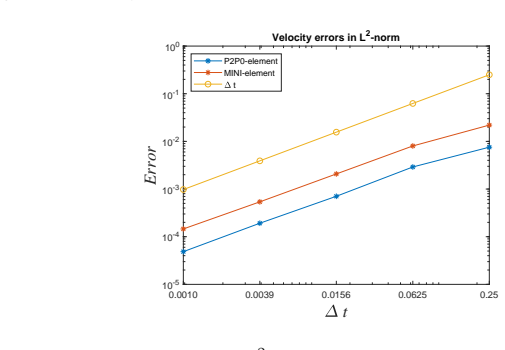
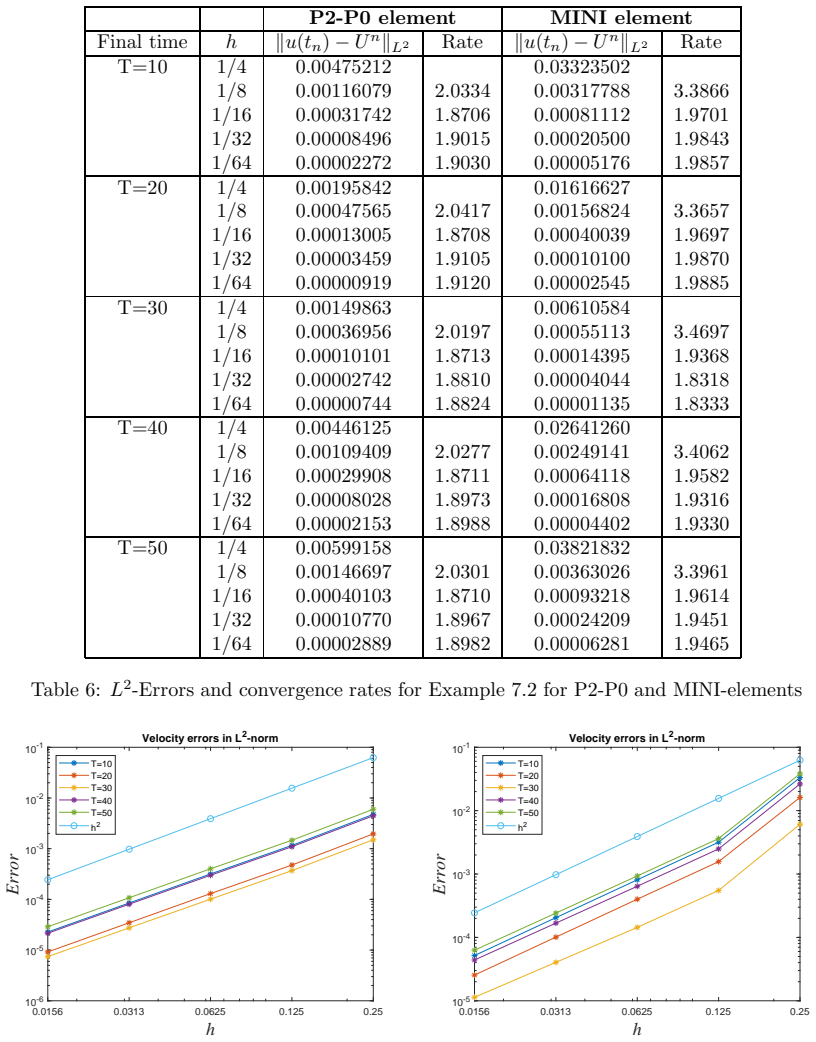
- Numerical results confirm the theoretical predictions.
Where Pith is reading between the lines
- The method could be applied to long-time integration of viscoelastic flows without accumulating errors over time.
- Similar uniform estimates might be possible for other time discretizations if they preserve the structure used here.
- Extensions to three dimensions would require establishing the uniqueness condition first.
Load-bearing premise
The continuous Oldroyd problem satisfies a uniqueness condition.
What would settle it
A numerical experiment where the L2 error grows without bound as time increases, for a case with nonsmooth initial data where uniqueness is known to hold.
Figures
read the original abstract
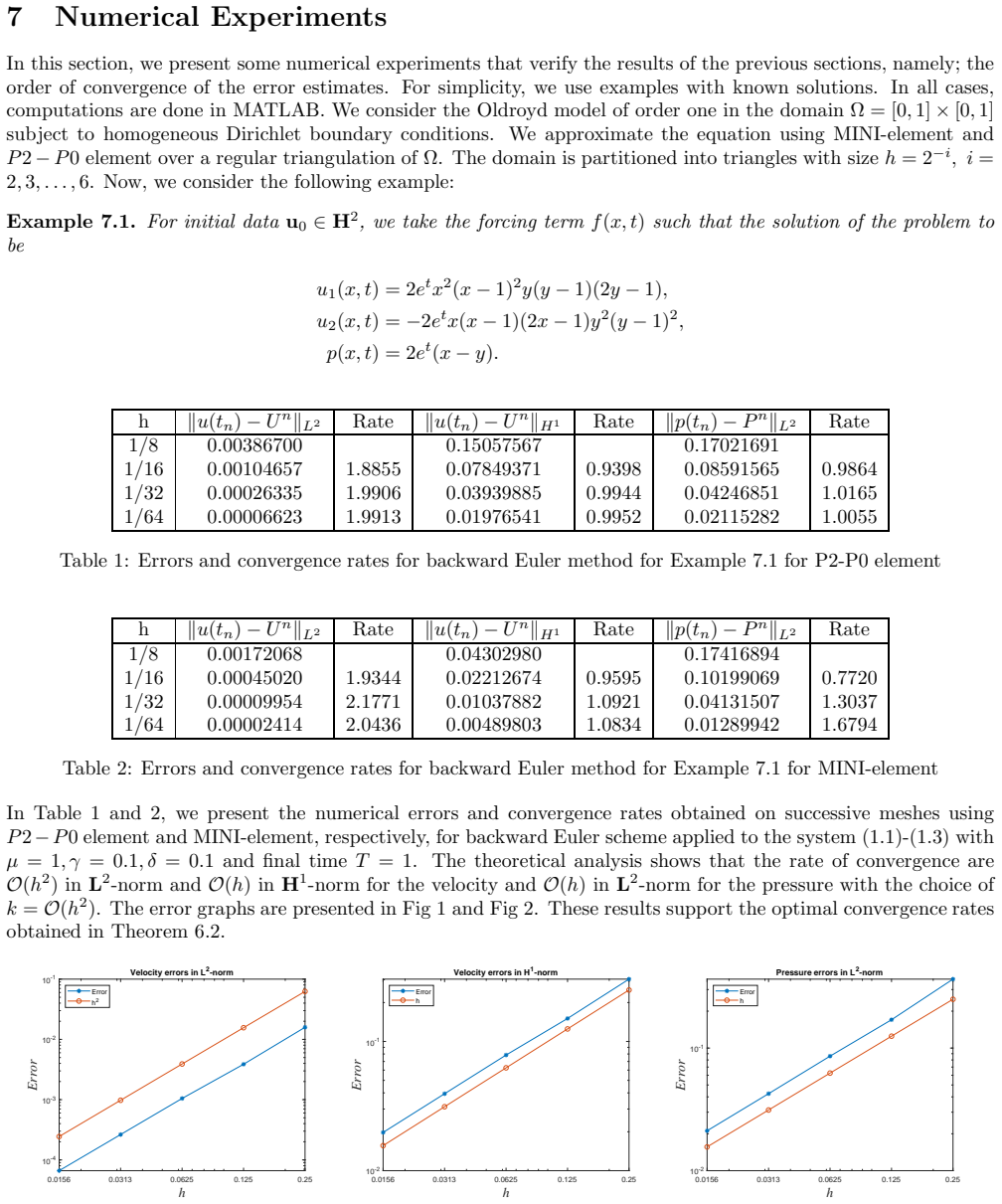
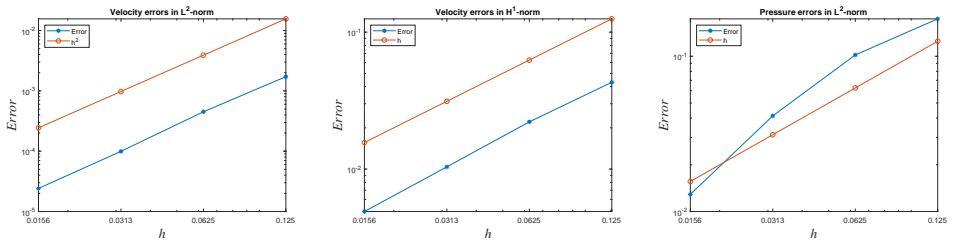
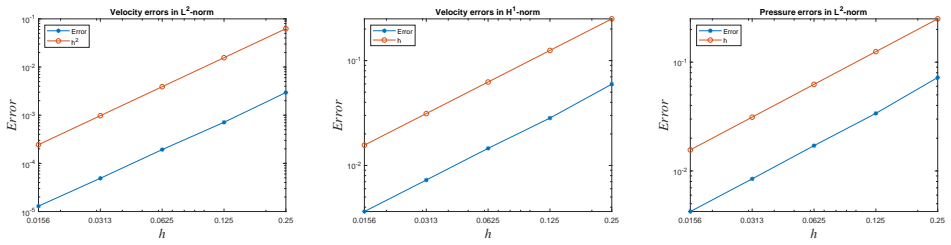
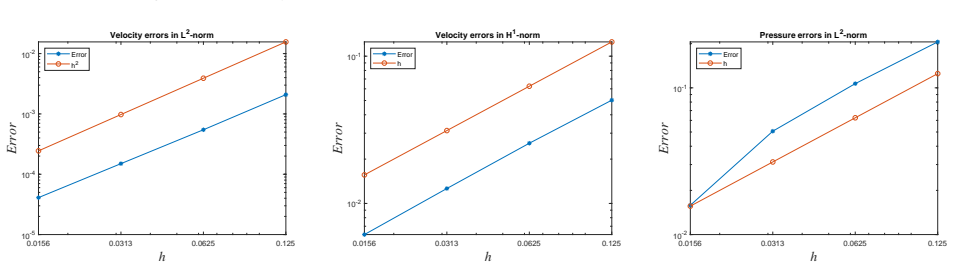
In this paper, a backward Euler method combined with finite element discretization in spatial direction is discussed for the equations of motion arising in the $2D$ Oldroyd model of viscoelastic fluids of order one with the forcing term independent of time or in $L^{\infty}$ in time. It is shown that the estimates of the discrete solution in Dirichlet norm is bounded uniformly in time. Optimal {\it a priori} error estimate in $\textbf{L}^2$-norm is derived for the discrete problem with non-smooth initial data. This estimate is shown to be uniform in time, under the assumption of uniqueness condition. Finally, we present some numerical results to validate our theoretical results.
Editorial analysis
A structured set of objections, weighed in public.
Referee Report
Summary. The manuscript analyzes a backward Euler finite-element discretization of the 2D Oldroyd model of order one. It proves that the discrete solution remains bounded uniformly in time in the Dirichlet norm when the forcing is time-independent or merely L^∞ in time. Under an additional uniqueness assumption on the continuous problem, it derives an optimal a priori L² error estimate that is also uniform in time, even for nonsmooth initial data, and supplies numerical experiments to illustrate the theory.
Significance. If the uniqueness condition can be justified for the stated data classes, the uniform-in-time L² error bound would constitute a useful advance in the numerical analysis of viscoelastic flows, extending existing results to nonsmooth data while controlling the growth of the error constant.
major comments (1)
- [Abstract] Abstract: The claim of a uniform-in-time optimal L² error estimate is obtained only after invoking an unproven uniqueness condition on the continuous Oldroyd system. No proof or reference is supplied showing that this condition holds for the 2-D model with L^∞-in-time forcing and nonsmooth initial data; without it the Gronwall argument produces a time-dependent factor that may grow, undermining the uniformity assertion.
Simulated Author's Rebuttal
We thank the referee for the careful reading and for highlighting the role of the uniqueness assumption. We respond to the major comment below.
read point-by-point responses
-
Referee: [Abstract] Abstract: The claim of a uniform-in-time optimal L² error estimate is obtained only after invoking an unproven uniqueness condition on the continuous Oldroyd system. No proof or reference is supplied showing that this condition holds for the 2-D model with L^∞-in-time forcing and nonsmooth initial data; without it the Gronwall argument produces a time-dependent factor that may grow, undermining the uniformity assertion.
Authors: We agree that the uniform-in-time L² error bound is conditional on the uniqueness assumption for the continuous problem. The manuscript already states this explicitly both in the abstract and in the body of the paper. Establishing uniqueness for the 2-D Oldroyd model of order one with merely L^∞-in-time forcing and nonsmooth initial data is a difficult open question in the analysis of viscoelastic flows and lies outside the scope of the present numerical-analysis work. Similar conditional error estimates under a uniqueness hypothesis appear in the literature on the Navier–Stokes equations and related viscoelastic models. Without the assumption the Gronwall factor may indeed grow, which is why the result is stated conditionally. We will revise the abstract to emphasize the conditional character more prominently. revision: yes
Circularity Check
No circularity; error estimates derived under explicit external assumption
full rationale
The provided abstract and description show a standard mathematical derivation of a priori L2 error estimates for a backward Euler FEM discretization of the 2D Oldroyd system. The uniform-in-time bound is obtained under an explicitly stated assumption of uniqueness for the continuous problem; this is a hypothesis, not a result derived inside the paper. No self-definitional steps, fitted inputs renamed as predictions, self-citation chains, or ansatzes appear in the text. The analysis is self-contained as a proof under stated conditions, consistent with the default expectation for theoretical papers.
Axiom & Free-Parameter Ledger
axioms (1)
- domain assumption Uniqueness condition for the continuous Oldroyd problem
Reference graph
Works this paper leans on
-
[1]
Abbaszadeh, M. & Dehghan, M. (2020) Investigation of the Oldroyd model as a generalized incompr essible Navier-Stokes equation via the interpolating stabilized element free Galerkin technique. Appl. Numer. Math. , 150, 274-294. 27 ❍ ❍ ❍ ❍ ❍h k 0.1 0.5 1 1.3 1/10 0.04066058 0.04013758 0.03994627 0.03431507 P2-P0 1/20 0.04060207 0.04007989 0.03988995 0.0342...
work page 2020
-
[2]
Akhmatov, M. M. & Oskolkov, A. P. (1989) On convergent difference schemes for the equations of mo tion of an Oldroyd fluid. J. Math. Sci. , 47, 2926–2933
work page 1989
-
[3]
Brezzi, F. & Fortin, M. (1991) Mixed and Hybrid finite element methods , Springer Series in Computational Mathematics 15. New York: Springer-Verlag
work page 1991
-
[4]
Bercovier, M. & Pironneau, O. (1979) Error estimates for finite element solution of the Stokes pr oblem in the primitive variables. Numer. Math. 33, 211–224
work page 1979
-
[5]
Girault, V. & Raviart, P. A. (1980) Finite element approximation of the Navier-Stokes equatio ns, Lecture Notes in Mathematics, 749. Berlin-New York: Springer-Verlag
work page 1980
-
[6]
Goswami, D. (2011) Finite element approximation to the equations of motion arisin g in Oldroyd viscoelastic model of order one. Ph.D. Thesis , Department of Mathematics, IIT Bombay
work page 2011
- [7]
-
[8]
Guo, Y. & He, Y. (2016) An efficient and accurate fully discrete finite element method for unsteady incompressible Oldroyd fluids with large time step. Internat. J. Numer. Methods Fluids , 80, 375–394. 28
work page 2016
-
[9]
& He, Y., (2018) On the Euler implicit/explicit iterative scheme for the stationa ry Oldroyd fluid
Guo, Y. & He, Y., (2018) On the Euler implicit/explicit iterative scheme for the stationa ry Oldroyd fluid. Numer. Meth. Partial Diff. Eqn. , 34, 906–937
work page 2018
- [10]
-
[11]
He, Y. & Li, K. (1998) Convergence and stability of finite element nonlinear Galerkin method for the Navier- Stokes equations. Numer. Math. , 79, 77–106
work page 1998
-
[12]
He, Y., Lin, Y., Shen, S. S. P., Sun, W. & Tait, R. (2003) Finite element approximation for the viscoelastic fluid motion problem. J. Comput. Appl. Math. , 155, 201–222
work page 2003
-
[13]
Heywood, J. G. & Rannacher, R. (1982) Finite element approximation of the nonstationary Navier-S tokes problem: I. Regularity of solutions and second order error estimat es for spatial discretization. SIAM J. Numer. Anal., 19, 275–311
work page 1982
-
[14]
Heywood, J. G. & Rannacher, R. (1990) Finite element approximation of the nonstationary Navier-S tokes problem: I. Error analysis for second-order time discretization. SIAM J. Numer. Anal. , 27, 353–384
work page 1990
-
[15]
Liu, C. & Si, Z. (2019) An incremental pressure correction finite element method for the time-dependent Oldroyd flows. Appl. Math. Comput. , 351, 99-115
work page 2019
-
[16]
Mohan, M.T. (2020) Deterministic and stochastic equations of motion arising in Old royd fluids of order one: existence, uniqueness, exponential stability and invariant measur es. Stochastic Anal. Appl. , 38, 1-61
work page 2020
-
[17]
Mohan, M.T. (2020) Well posedness, large deviations and ergodicity of the stoc hastic 2D Oldroyd model of order one. Stochastic Processes and their Applications , 130, 4513-4562
work page 2020
-
[18]
McLean, W. & Thom ´ ee, V. (1993) Numerical solution of an evolution equation with a positive typ e memory term. J. Austral. Math. Soc. Ser. B , 35, 23–70
work page 1993
-
[19]
Oldroyd, J. G. (1956) Non-Newtonian flow of liquids and solids. Rheology: Theory a nd Applications, Vol. I (F. R. Eirich, Ed.). New York: Academic Press, pp. 653–682
work page 1956
-
[20]
Pani, A. K. & Sinha, R. K. (1998) On the backward Euler method for time dependent parabolic integro- differential equations with nonsmooth initial data. J. Integral Equations Appl. , 10, 219–249
work page 1998
-
[21]
Pani, A. K. & Sinha, R. K. (1998) Quadrature based finite element approximations to time dep endent parabolic equations with nonsmooth initial data. Calcolo, 35, 225–248
work page 1998
-
[22]
Pani, A. K., Thom ´ ee, V. & W ahlbin, L. B. (1992) Numerical Methods for Hyperbolic and Parabolic Integro-Differential Equations. J. Integral Equations Appl. , 4, 533–584
work page 1992
-
[23]
Pani, A. K. & Yuan, J. Y. (2005) Semidiscrete finite element Galerkin approximations to the eq uations of motion arising in the Oldroyd model. IMA J. Numer. Anal. , 25, 750–782
work page 2005
-
[24]
Pani, A. K., Yuan, J. Y. & Damazio, P. (2006) On a linearized backward Euler method for the equations of motion arising in the Oldroyd fluids of order one. SIAM J. Numer. Anal. , 44, 804–825
work page 2006
-
[25]
Temam, R. (1984) Navier-Stokes Equations, Theory and Numerical Analysis , Studies in Mathematics and its Application 2, Third Edition. Amsterdam: North-Holland Publishing Co., pp. xii+526
work page 1984
-
[26]
Tone, F. & Wirosoetisno, D. (2006) On the long-time stability of the implicit Euler scheme for the two-dimensional Navier-Stokes equations. SIAM J. Numer. Anal. , 44, 29–40
work page 2006
-
[27]
Thom´ ee, V. & Zhang, N. Y. (1989) Error estimates for semidiscrete finite element methods fo r parabolic integro-differential equations. Math. Comp. , 53, 121–139
work page 1989
-
[28]
W ang, K., He, Y. & Shang, Y. (2010) Fully discrete finite element method for the viscoelastic fluid m otion equations. Disc. Cont. Dyn. Sys. Ser. B , 13, 665–684
work page 2010
-
[29]
Yang, Y., Lei, Y. & Si, Z. (2020) Unconditional stability and error estimates of the modified c haracteristics FEM for the time-dependent viscoelastic Oldroyd flows. Adv. Appl. Math. Mech. , 13, 311–332. 29
work page 2020
- [30]
- [31]
- [32]
- [33]
discussion (0)
Sign in with ORCID, Apple, or X to comment. Anyone can read and Pith papers without signing in.