Screening effect of plasma flow on the resonant magnetic perturbation penetration in tokamak based on two-fluid model
Pith reviewed 2026-05-24 13:34 UTC · model grok-4.3
The pith
Bootstrap current in two-fluid tokamak model produces a mode penetration threshold at zero rotation.
A machine-rendered reading of the paper's core claim, the machinery that carries it, and where it could break.
Core claim
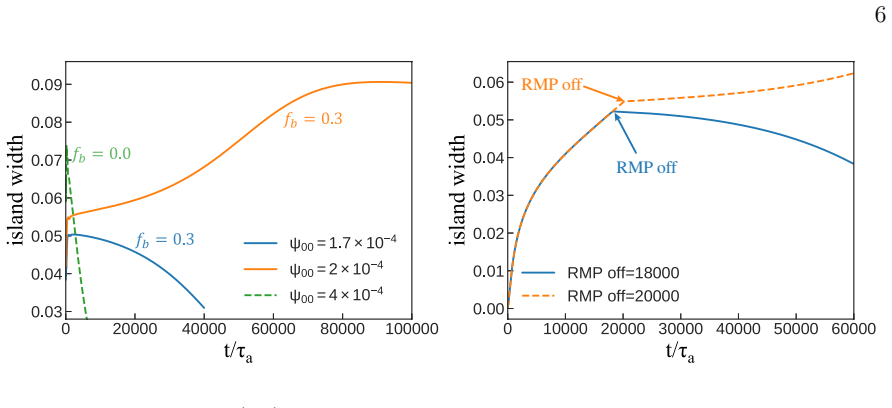
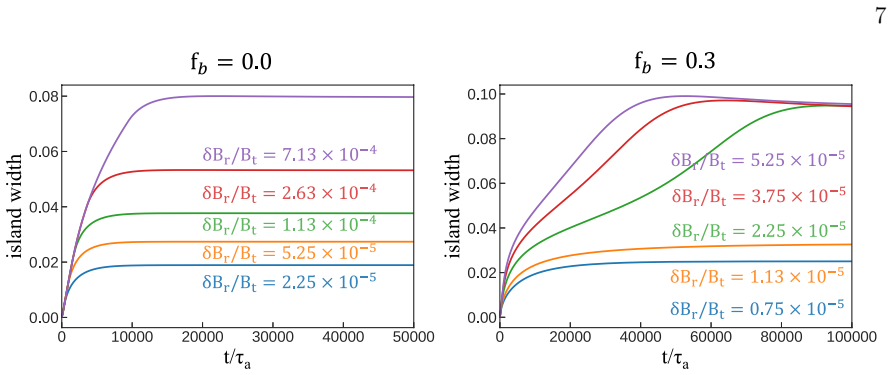
Taking into account the bootstrap current, a mode penetration like phenomenon is found, which is essentially different from the classical tearing mode model. It may provide a possible explanation for the finite mode penetration threshold at zero rotation detected in experiments. Numerical results show that a sufficiently large diamagnetic drift flow can drive a strong stabilizing effect on the neoclassical tearing mode. An oscillation phenomenon of island width is discovered due to the negative feedback regulation of pressure on the magnetic island.
What carries the argument
Two-fluid four-field equations in the MDC code, with bootstrap current and separate treatment of E×B and diamagnetic flows.
Load-bearing premise
The two-fluid four-field equations and their numerical implementation capture bootstrap current, parallel and perpendicular transport, and the distinct effects of the two flows without dominant missing physics.
What would settle it
Run the same initial-value simulation with bootstrap current artificially removed and check whether the finite penetration threshold at zero rotation disappears.
Figures



read the original abstract
Numerical simulation on the resonant magnetic perturbation penetration is carried out by the newly-updated initial value code MDC (MHD@Dalian Code). Based on a set of two-fluid four-field equations, the bootstrap current, parallel and perpendicular transport effects are included appropriately. Taking into account the bootstrap current, a mode penetration like phenomenon is found, which is essentially different from the classical tearing mode model. It may provide a possible explanation for the finite mode penetration threshold at zero rotation detected in experiments. To reveal the influence of diamagnetic drift flow on the mode penetration process, $\bf E\times B$ drift flow and diamagnetic drift flow are separately applied to compare their effects. Numerical results show that, a sufficiently large diamagnetic drift flow can drive a strong stabilizing effect on the neoclassical tearing mode. Furthermore, an oscillation phenomenon of island width is discovered. By analyzing in depth, it is found that, this oscillation phenomenon is due to the negative feedback regulation of pressure on the magnetic island. This physical mechanism is verified again by key parameter scanning.
Editorial analysis
A structured set of objections, weighed in public.
Referee Report
Summary. The manuscript reports numerical simulations of resonant magnetic perturbation (RMP) penetration in tokamaks using the updated MDC initial-value code based on two-fluid four-field equations. Bootstrap current, parallel and perpendicular transport are included. The central results are a mode-penetration-like phenomenon driven by bootstrap current (distinct from classical tearing modes and potentially explaining finite experimental thresholds at zero rotation), a stabilizing effect from sufficiently large diamagnetic drift flow, and an oscillation in island width attributed to negative pressure feedback on the island, confirmed via parameter scanning. E×B and diamagnetic flows are applied separately for comparison.
Significance. If the bootstrap-current implementation and resulting threshold are shown to be robust, the work could supply a fluid-level mechanism for rotation-independent RMP penetration thresholds seen in experiments and clarify the separate screening roles of E×B versus diamagnetic flows. The reported pressure-island oscillation adds a concrete nonlinear regulation process whose generality could be tested further.
major comments (3)
- [Numerical results / bootstrap-current implementation] The claim that bootstrap current produces a distinct mode-penetration threshold at zero rotation (abstract and numerical-results section) rests on the MDC implementation of the bootstrap term inside the four-field system. No grid-convergence study, time-step convergence, or artificial-viscosity scan is described, nor is any comparison presented against the analytic Rutherford or Glasser–Greene–Johnson thresholds. This is load-bearing: a singular-layer discretization artifact could generate an artificial threshold that vanishes upon refinement or removal of the bootstrap term.
- [Model equations] The two-fluid four-field model is asserted to capture bootstrap current, parallel transport, and the separate E×B versus diamagnetic flows 'appropriately,' yet the precise form of the parallel Ohm’s law or current-evolution equation (including the pressure-gradient drive and any neoclassical closure) is not given. Without this, it is impossible to judge whether the reported zero-rotation threshold is a physical neoclassical effect or a consequence of the chosen fluid closure.
- [Oscillation phenomenon / parameter scanning] The oscillation of island width is attributed to negative pressure feedback and said to be verified by key parameter scanning. However, the manuscript provides neither quantitative diagnostics (e.g., cross-correlation between local pressure and island width, or growth-rate dependence on the pressure-gradient drive) nor the scanned parameter ranges, leaving the causal mechanism under-supported relative to the strength of the claim.
minor comments (1)
- [Abstract] The abstract states that 'key parameter scanning' verifies the pressure-feedback mechanism, but the ranges, resolution, and specific parameters varied (flow speed, resistivity, bootstrap coefficient, etc.) are not listed, reducing reproducibility.
Simulated Author's Rebuttal
We thank the referee for the careful reading and constructive comments. We address each major comment below and agree that the manuscript will benefit from added details on numerics, equations, and diagnostics.
read point-by-point responses
-
Referee: [Numerical results / bootstrap-current implementation] The claim that bootstrap current produces a distinct mode-penetration threshold at zero rotation (abstract and numerical-results section) rests on the MDC implementation of the bootstrap term inside the four-field system. No grid-convergence study, time-step convergence, or artificial-viscosity scan is described, nor is any comparison presented against the analytic Rutherford or Glasser–Greene–Johnson thresholds. This is load-bearing: a singular-layer discretization artifact could generate an artificial threshold that vanishes upon refinement or removal of the bootstrap term.
Authors: We agree that convergence studies and analytic comparisons were not reported. In the revised manuscript we will add grid-convergence and time-step convergence tests, an artificial-viscosity scan, and a direct comparison of the observed threshold against the Rutherford and Glasser–Greene–Johnson regimes. We will also show that the threshold disappears when the bootstrap term is switched off, confirming it is not a discretization artifact. revision: yes
-
Referee: [Model equations] The two-fluid four-field model is asserted to capture bootstrap current, parallel transport, and the separate E×B versus diamagnetic flows 'appropriately,' yet the precise form of the parallel Ohm’s law or current-evolution equation (including the pressure-gradient drive and any neoclassical closure) is not given. Without this, it is impossible to judge whether the reported zero-rotation threshold is a physical neoclassical effect or a consequence of the chosen fluid closure.
Authors: The manuscript omitted the explicit equation set for brevity. The revised version will include the full two-fluid four-field system, with the parallel Ohm’s law and current-evolution equation written out, showing the bootstrap-current drive term and the neoclassical closure employed. This will make clear that the zero-rotation threshold arises from the standard neoclassical bootstrap term rather than an ad-hoc closure. revision: yes
-
Referee: [Oscillation phenomenon / parameter scanning] The oscillation of island width is attributed to negative pressure feedback and said to be verified by key parameter scanning. However, the manuscript provides neither quantitative diagnostics (e.g., cross-correlation between local pressure and island width, or growth-rate dependence on the pressure-gradient drive) nor the scanned parameter ranges, leaving the causal mechanism under-supported relative to the strength of the claim.
Authors: We accept that quantitative support for the pressure-feedback mechanism is insufficient. The revision will report the scanned parameter ranges and add diagnostics including the cross-correlation between local pressure and island width together with the dependence of oscillation amplitude on the pressure-gradient drive, thereby strengthening the causal link. revision: yes
Circularity Check
No circularity: results are direct outputs of time-dependent simulation with standard inputs
full rationale
The paper reports numerical initial-value simulations in the MDC code using two-fluid four-field equations. Bootstrap current, flows, and transport terms are introduced as standard inputs drawn from plasma theory rather than fitted to the reported thresholds or oscillations. The mode-penetration-like phenomenon and island-width oscillations emerge as simulation outputs; no step in the provided abstract or description reduces a central claim to a self-definition, a fitted parameter renamed as prediction, or a self-citation chain. The derivation chain is therefore self-contained against external benchmarks.
Axiom & Free-Parameter Ledger
axioms (1)
- domain assumption The two-fluid four-field equations appropriately model the relevant tokamak physics including bootstrap current and transport.
Lean theorems connected to this paper
-
IndisputableMonolith/Cost/FunctionalEquation.leanwashburn_uniqueness_aczel unclear?
unclearRelation between the paper passage and the cited Recognition theorem.
Based on a set of two-fluid four-field equations, the bootstrap current, parallel and perpendicular transport effects are included appropriately. ... jb = −A√ε/Bθp′(r)
-
IndisputableMonolith/Foundation/RealityFromDistinction.leanreality_from_one_distinction unclear?
unclearRelation between the paper passage and the cited Recognition theorem.
a mode penetration like phenomenon is found, which is essentially different from the classical tearing mode model
What do these tags mean?
- matches
- The paper's claim is directly supported by a theorem in the formal canon.
- supports
- The theorem supports part of the paper's argument, but the paper may add assumptions or extra steps.
- extends
- The paper goes beyond the formal theorem; the theorem is a base layer rather than the whole result.
- uses
- The paper appears to rely on the theorem as machinery.
- contradicts
- The paper's claim conflicts with a theorem or certificate in the canon.
- unclear
- Pith found a possible connection, but the passage is too broad, indirect, or ambiguous to say the theorem truly supports the claim.
Reference graph
Works this paper leans on
-
[1]
Furth H P, Killeen J and Rosenbluth M N 1963 The Physics of Fluids 6 459–484 ( Preprint https://aip.scitation.org/doi/pdf/10.1063/1.1706761) URL https://aip.scitation. org/doi/abs/10.1063/1.1706761
-
[2]
org/doi/pdf/10.1063/1.1694232) URL https://aip.scitation.org/doi/abs/10.1063/1
Rutherford P H 1973 The Physics of Fluids 16 1903–1908 ( Preprint https://aip.scitation. org/doi/pdf/10.1063/1.1694232) URL https://aip.scitation.org/doi/abs/10.1063/1. 1694232
-
[3]
Carrera R, Hazeltine R D and Kotschenreuther M 1986 The Physics of Fluids 29 899–902 (Preprint https://aip.scitation.org/doi/pdf/10.1063/1.865682) URL https://aip.scitation. org/doi/abs/10.1063/1.865682
-
[4]
Bard´ oczi L, Rhodes T L, Ba˜ n´ on Navarro A, Sung C, Carter T A, La Haye R J, McKee G R, Petty C C, Chrystal C and Jenko F 2017 Physics of Plasmas 24 056106 ( Preprint https://doi.org/10.1063/1.4977533) URL https://doi.org/10.1063/1.4977533
-
[5]
Wang Z X, Wei L and Yu F 2015 Nuclear Fusion 55 043005 URL https://doi.org/10.1088% 2F0029-5515%2F55%2F4%2F043005
work page 2015
-
[6]
Zhang W, Ma Z W, Zhu J and Zhang H W 2019 Plasma Physics and Controlled Fusion 61 075002 URL https://doi.org/10.1088%2F1361-6587%2Fab16ae
work page 2019
-
[8]
Sauter O, Henderson M A, Ramponi G, Zohm H and Zucca C 2010 Plasma Physics and Controlled Fusion 52 025002 URL https://doi.org/10.1088%2F0741-3335%2F52%2F2%2F025002
work page 2010
-
[9]
Maraschek M 2012 Nuclear Fusion 52 074007 URL https://doi.org/10.1088%2F0029-5515% 2F52%2F7%2F074007 15
work page 2012
-
[10]
Hender T, Fitzpatrick R, Morris A, Carolan P, Durst R, Edlington T, Ferreira J, Fielding S, Haynes P, Hugill J, Jenkins I, Haye R L, Parham B, Robinson D, Todd T, Valovic M and Vayakis G 1992 Nuclear Fusion 32 2091–2117 URL https://doi.org/10.1088%2F0029-5515% 2F32%2F12%2Fi02
work page 1992
-
[11]
org/10.1063/1.3100236) URL https://doi.org/10.1063/1.3100236
Yu Q, G¨ unter S and Finken K H 2009 Physics of Plasmas 16 042301 ( Preprint https://doi. org/10.1063/1.3100236) URL https://doi.org/10.1063/1.3100236
-
[12]
Buttery R, Benedetti M D, Gates D, Gribov Y, Hender T, Haye R L, Leahy P, Leuer J, Morris A, Santagiustina A, Scoville J, Tubbing B, Team J, Team C D R and Team D D 1999 Nuclear Fusion 39 1827–1835 URL https://doi.org/10.1088/0029-5515/39/11y/323
-
[14]
Logan N, Zhu C, Park J K, Yang S and Hu Q 2021 Nuclear Fusion 61 076010 URL https: //doi.org/10.1088/1741-4326/abff05
-
[15]
Nave M and Wesson J 1990 Nuclear Fusion 30 2575–2583 URL https://doi.org/10.1088/ 0029-5515/30/12/011
work page 1990
-
[16]
Lu S S, Ma Z W, Zhang H W and Liu Y 2020 Plasma Physics and Controlled Fusion 62 125005 URL https://doi.org/10.1088/1361-6587/abbcc4
-
[17]
Wang H, Wang Z, Ding Y and Rao B 2015 Plasma Science and Technology 17 539–544 URL https://doi.org/10.1088/1009-0630/17/7/03
-
[18]
Wolf R, Biel W, Bock M D, Finken K, G¨ unter S, Hogeweij G, Jachmich S, Jakubowski M, Jaspers R, Krmer-Flecken A, Koslowski H, Lehnen M, Liang Y, Unterberg B, Varshney S, von Hellermann M, Yu Q, Zimmermann O, Abdullaev S, Donn´ e A, Samm U, Schweer B, Tokar M, Westerhof E and the TEXTOR Team 2005 Nuclear Fusion 45 1700–1707 URL https://doi.org/10.1088/002...
-
[19]
Choi W, La Haye R J, Lanctot M J, Olofsson K E, Strait E J, Sweeney R and Volpe F A 2018 Nuclear Fusion 58 aaa6e3 ISSN 17414326 URL https://doi.org/10.1088/1741-4326/aaa6e3
-
[20]
Tang W, Wang Z X, Wei L, Wang J and Lu S 2020 Nuclear Fusion 60 026015 URL https: //doi.org/10.1088/1741-4326/ab61d5
-
[21]
Nelson A O, Logan N C, Choi W, Strait E J and Kolemen E 2020 Plasma Physics and Controlled Fusion 62 094002 URL https://doi.org/10.1088/1361-6587/ab9b3b
-
[23]
Yu Q and G¨ unter S 2008Nuclear Fusion 48 065004 URL https://doi.org/10.1088/0029-5515/ 48/6/065004
-
[24]
Cole A J, Hegna C C and Callen J D 2007 Phys. Rev. Lett. 99(6) 065001 URL https: //link.aps.org/doi/10.1103/PhysRevLett.99.065001
-
[25]
Wang J, Wang Z X and Wei L 2015 Physics of Plasmas 22 092122 (Preprint https://doi.org/ 10.1063/1.4931067) URL https://doi.org/10.1063/1.4931067
-
[26]
Beidler M T, Callen J D, Hegna C C and Sovinec C R 2018Physics of Plasmas 25 082507 (Preprint https://doi.org/10.1063/1.5046076) URL https://doi.org/10.1063/1.5046076
-
[27]
Zhang H W, Lin X, Ma Z W, Zhang W and Bagwell T E 2021 Plasma Physics and Controlled Fusion 63 035011 URL https://doi.org/10.1088/1361-6587/abd304
-
[28]
Becoulet M, Orain F, Maget P, Mellet N, Garbet X, Nardon E, Huysmans G, Casper T, Loarte A, Cahyna P, Smolyakov A, Waelbroeck F, Schaffer M, Evans T E, Liang Y, Schmitz O, Beurskens M, Rozhansky V and Kaveeva E 2012 Nuclear Fusion 52 054003 URL http: //doi.org/10.1088/0029-5515/52/5/054003
-
[29]
Yu Q, G¨ unter S and Lackner K 2018Nuclear Fusion 58 054003 URL https://doi.org/10.1088% 2F1741-4326%2Faab2fb
-
[32]
Yu Q, G¨ unter S and Lackner K 2021Nuclear Fusion 61 036040 URL https://doi.org/10.1088/ 1741-4326/abd197
-
[33]
Hu Q, Logan N, Park J K, Paz-Soldan C, Nazikian R and Yu Q 2020 Nuclear Fusion 60 076006 URL https://doi.org/10.1088/1741-4326/ab8b79
-
[34]
Bock M D, Classen I, Busch C, Jaspers R, Koslowski H and and B U 2008 Nuclear Fusion 48 015007 URL https://doi.org/10.1088/0029-5515/48/1/015007
-
[35]
org/0029-5515/56/i=10/a=106015?key=crossref.51a4d6ebf40ee4461b4ad0b15ca7f588
Wei L, Wang Z X, Wang J and Yang X 2016Nuclear Fusion 56 106015 URL http://stacks.iop. org/0029-5515/56/i=10/a=106015?key=crossref.51a4d6ebf40ee4461b4ad0b15ca7f588
-
[36]
org/0029-5515/57/i=4/a=046007?key=crossref.6d879fa2ab17585f1e3b54ac2dcce45b
Wang J, Wang Z X, Wei L and Liu Y 2017 Nuclear Fusion 57 046007 URL http://stacks.iop. org/0029-5515/57/i=4/a=046007?key=crossref.6d879fa2ab17585f1e3b54ac2dcce45b
work page 2017
-
[37]
Liu T, Wang Z X, Wang J and Wei L 2018 Nuclear Fusion 58 076026 URL https://doi.org/ 10.1088%2F1741-4326%2Faac527
work page 2018
-
[38]
iop.org/10.1088/1741-4326/ab3000
Ye C, Wang Z X, Wei L and Hu Z Q 2019 Nuclear Fusion 59 096044 URL http://iopscience. iop.org/10.1088/1741-4326/ab3000
-
[39]
Han M, Wang Z X, Dong J and Du H 2017 Nuclear Fusion 57 046019 URL https://doi.org/ 10.1088/1741-4326/aa5d02
-
[40]
Hazeltine R D, Kotschenreuther M and Morrison P J 1985 The Physics of Fluids 28 2466– 2477 ( Preprint https://aip.scitation.org/doi/pdf/10.1063/1.865255) URL https:// aip.scitation.org/doi/abs/10.1063/1.865255
-
[41]
Bickerton R J, Connor J W and Taylor J B 1971 Nature Physical Science 229 110–112 URL https://doi.org/10.1038/physci229110a0
-
[42]
Kikuchi Y, De Bock M F M, Finken K H, Jakubowski M, Jaspers R, Koslowski H R, Kraemer- Flecken A, Lehnen M, Liang Y, Matsunaga G, Reiser D, Wolf R C and Zimmermann O (TEXTOR-team) 2006 Phys. Rev. Lett. 97(8) 085003 URL https://link.aps.org/doi/10. 1103/PhysRevLett.97.085003
work page 2006
-
[43]
Hu Q, Yu Q, Rao B, Ding Y, Hu X and Zhuang G 2012 Nuclear Fusion 52 083011 URL http://doi.org/10.1088/0029-5515/52/8/083011
-
[44]
Tang W, Wei L, Wang Z, Wang J, Liu T and Zheng S 2019 Plasma Science and Technology 21 065103 URL https://doi.org/10.1088%2F2058-6272%2Fab0a18
work page 2019
-
[45]
The Journal of Chemical Physics 132(21), 214102 (2010)
Fitzpatrick R 1998 Physics of Plasmas 5 3325–3341 ( Preprint https://doi.org/10.1063/1. 873000) URL https://doi.org/10.1063/1.873000
work page doi:10.1063/1 1998
-
[46]
Gates D A and Delgado-Aparicio L 2012 Phys. Rev. Lett. 108(16) 165004 URL https://link. aps.org/doi/10.1103/PhysRevLett.108.165004
discussion (0)
Sign in with ORCID, Apple, or X to comment. Anyone can read and Pith papers without signing in.