An Improved Incremental Singular Value Decomposition and New Error Bounds
Pith reviewed 2026-05-24 12:41 UTC · model grok-4.3
The pith
Restructured incremental SVD preserves exact-arithmetic output while sharpening the operator-norm truncation bound to sqrt(n) tol and making orthogonality loss independent of stream length n under a probabilistic rounding model.
A machine-rendered reading of the paper's core claim, the machinery that carries it, and where it could break.
Core claim
By accumulating rank-preserving orthogonal factors implicitly and applying them only in batches of size equal to the numerical rank, the restructured incremental SVD produces the same exact-arithmetic output as the standard algorithm while allowing a forward-error analysis that replaces the previous n tol operator-norm truncation bound with sqrt(n) tol and renders the loss of orthogonality in the left singular basis independent of the total number of updates n under the standard probabilistic model of rounding errors.
What carries the argument
Implicit accumulation of rank-preserving updates followed by batch application of the resulting orthogonal factors, which replaces per-column large-matrix multiplications with r such multiplications where r is the numerical rank.
If this is right
- Truncation error in the operator norm is bounded by sqrt(n) tol instead of n tol.
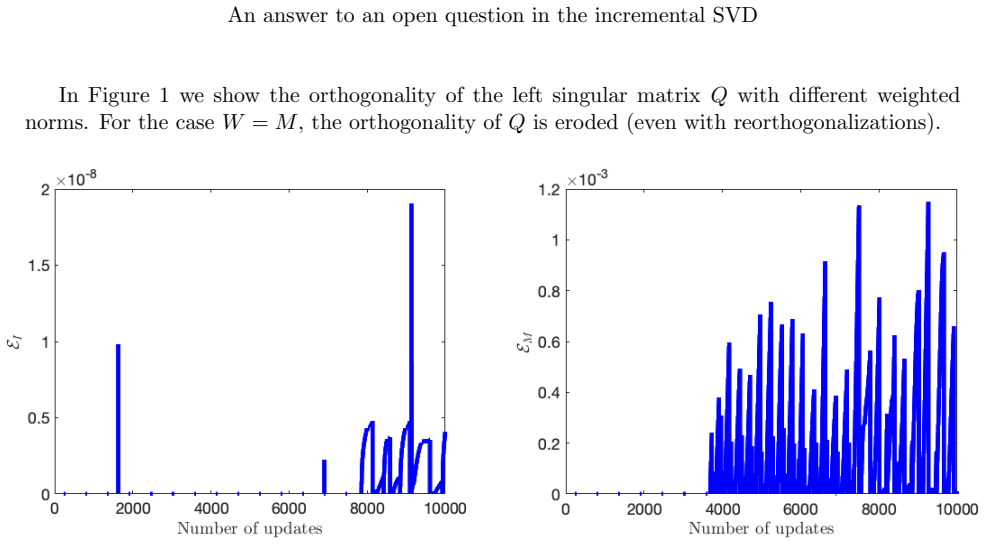
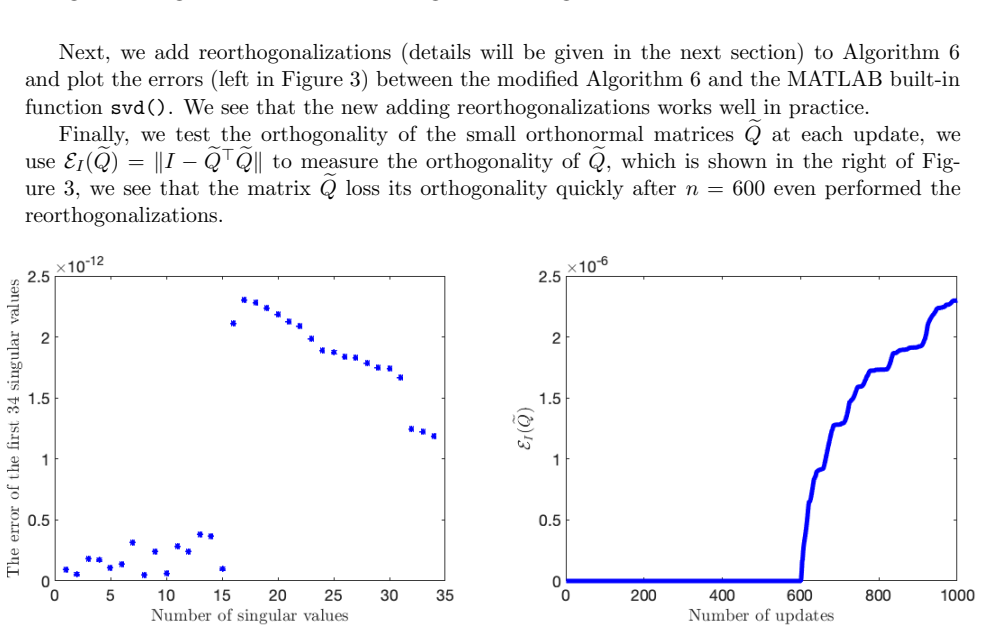
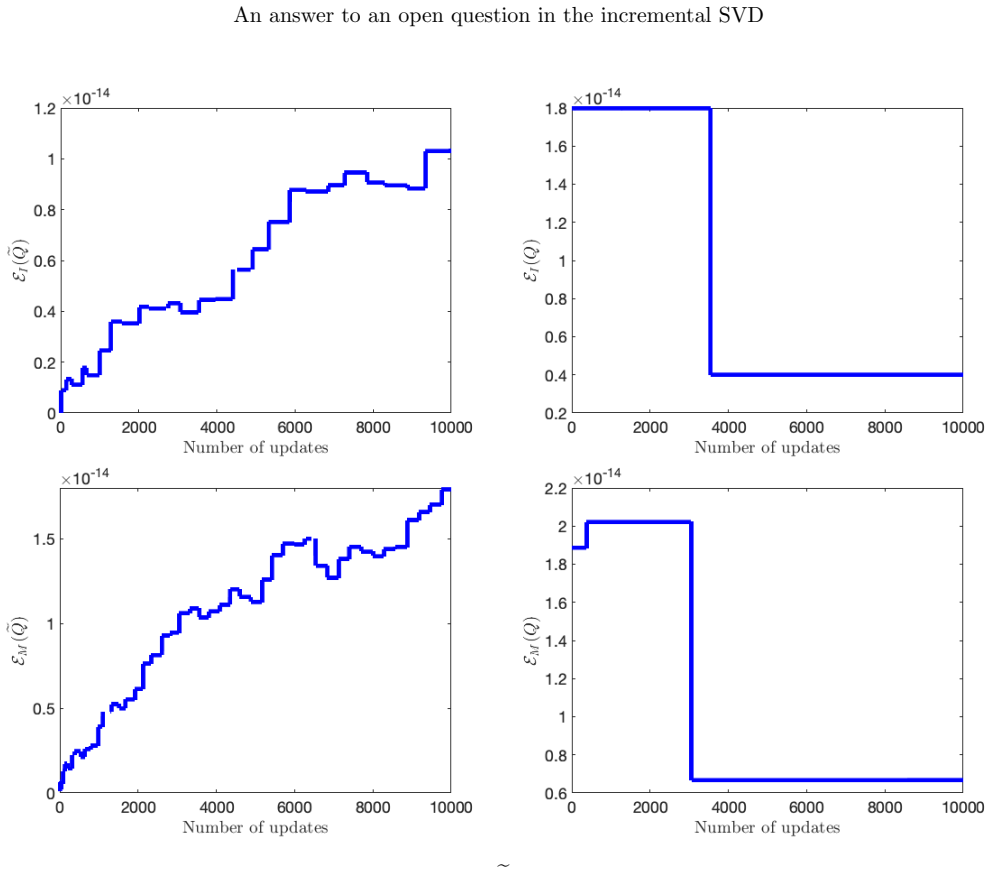
- Orthogonality of the left factor is preserved up to a term independent of the number of incoming columns.
- Reorthogonalization is required only r times rather than n times.
- Run time improves by factors between 4.5 and 34 relative to earlier incremental SVD implementations.
Where Pith is reading between the lines
- The batching technique could be applied to other streaming matrix factorizations such as incremental QR or eigenvalue updates.
- In applications with very long data streams the method would allow the basis to be maintained for larger n without periodic full reorthogonalization.
- The constructive example attaining the sqrt(n) bound suggests that further sharpening may require additional assumptions on the incoming data.
- Hardware-specific rounding behavior outside the probabilistic model could be checked by repeating the orthogonality measurements on fixed-point or low-precision arithmetic.
Load-bearing premise
The claimed independence of orthogonality loss from stream length n rests on the assumption that floating-point rounding errors follow the standard probabilistic model.
What would settle it
A long-stream experiment in which the measured loss of orthogonality in the computed left factor grows linearly with n rather than remaining bounded independently of n.
Figures
read the original abstract
The incremental singular value decomposition (SVD) updates a truncated SVD as new columns arrive, replacing a single large SVD with a sequence of small ones. In floating-point arithmetic, each update multiplies the running singular basis by a small orthogonal factor, and the accumulated product loses orthogonality unless the basis is reorthogonalized periodically. How often this reorthogonalization is needed has been an open question; we answer it by restructuring the algorithm so that rank-preserving updates are accumulated implicitly and applied in batches, reducing the number of large orthogonal multiplications from $n$, the stream length, to $r$, the numerical rank. We prove that this restructuring preserves the exact-arithmetic output of the original algorithm and establish two forward-error bounds. First, we sharpen the existing operator-norm truncation bound from $n\,\texttt{tol}$ to $\sqrt{n}\,\texttt{tol}$, and show the new rate is attained on a constructive example. Second, under a standard probabilistic rounding-error model, we prove that the loss of orthogonality of the computed left factor is independent of the stream length $n$ and depends on $m$, the length of each incoming column, only through a single $\sqrt{m}$ factor. Numerical experiments confirm both bounds and demonstrate that the proposed algorithm runs $4.5\times$ to $34\times$ faster than its closest competitors.
Editorial analysis
A structured set of objections, weighed in public.
Referee Report
Summary. The manuscript presents a restructured incremental SVD algorithm that accumulates rank-preserving updates implicitly and applies them in batches, reducing the number of large orthogonal multiplications from the stream length n to the numerical rank r. It proves that the restructuring preserves the exact-arithmetic output of the original algorithm, sharpens the operator-norm truncation bound from n tol to sqrt(n) tol (attained on a constructive example), and under a standard probabilistic rounding-error model proves that the loss of orthogonality of the computed left factor is independent of n (depending on column length m only through a sqrt(m) factor). Numerical experiments confirm the bounds and report speedups of 4.5x to 34x over competitors.
Significance. If the derivations hold, the work resolves an open question on reorthogonalization frequency for incremental SVD by delivering both a practical restructuring and sharpened theoretical guarantees, including a constructive example attaining the new truncation rate and an n-independent orthogonality bound. These results, together with the reported computational gains, would strengthen the theoretical and practical foundations of streaming SVD methods in numerical linear algebra.
major comments (1)
- [Forward-error analysis section (orthogonality bound)] Forward-error analysis section (orthogonality bound): The claimed independence of orthogonality loss from stream length n is derived entirely under a standard probabilistic rounding-error model applied to the batched orthogonal multiplications. The manuscript does not derive the required statistical independence of rounding errors for the specific sequence of rank-preserving updates or demonstrate applicability of the model beyond invocation; if the model fails to hold, the n-independence does not follow. This assumption is load-bearing for the central practical guarantee.
minor comments (2)
- [Truncation bound section] The constructive example attaining the sqrt(n) tol bound is referenced in the abstract but its explicit construction and verification would benefit from a dedicated subsection or appendix to allow direct reproduction.
- [Introduction] Notation for the numerical rank r and the tolerance tol should be defined at first use in the main text rather than only in the abstract.
Simulated Author's Rebuttal
We thank the referee for the careful reading, the positive assessment of the work's significance, and the recommendation for major revision. We respond to the single major comment below.
read point-by-point responses
-
Referee: Forward-error analysis section (orthogonality bound): The claimed independence of orthogonality loss from stream length n is derived entirely under a standard probabilistic rounding-error model applied to the batched orthogonal multiplications. The manuscript does not derive the required statistical independence of rounding errors for the specific sequence of rank-preserving updates or demonstrate applicability of the model beyond invocation; if the model fails to hold, the n-independence does not follow. This assumption is load-bearing for the central practical guarantee.
Authors: We agree that the manuscript invokes the standard probabilistic rounding-error model for the batched orthogonal multiplications without deriving statistical independence of the rounding errors specifically for the sequence of rank-preserving updates. This model is a standard assumption in the literature on rounding-error analysis of orthogonal transformations (as used, for example, in analyses of Householder QR and related SVD methods), and the batched updates consist of the same class of operations. Nevertheless, the referee is correct that the manuscript does not explicitly demonstrate applicability to this particular sequence. To address the concern, we will revise the forward-error analysis section to include a short paragraph clarifying the applicability of the model, with citations to the relevant literature on the probabilistic model. This is a clarification rather than a new derivation. revision: partial
Circularity Check
No circularity; derivations are independent of inputs
full rationale
The paper restructures the incremental SVD algorithm, proves exact-arithmetic equivalence by direct construction, and derives sharpened truncation and orthogonality bounds from the restructured operations plus a standard external probabilistic rounding-error model. No load-bearing step reduces by definition, fitted-parameter renaming, or self-citation chain to the paper's own inputs or outputs; the n-independence claim is conditional on the model rather than tautological. The analysis is self-contained against external benchmarks and exhibits none of the enumerated circularity patterns.
Axiom & Free-Parameter Ledger
axioms (1)
- domain assumption Standard probabilistic model for rounding errors in floating-point arithmetic
Forward citations
Cited by 1 Pith paper
-
An efficient and memory free algorithm for subdiffusion equation using incremental singular value decomposition
Presents an ISVD-based memory-efficient solver for subdiffusion equations with error analysis and numerical validation against direct and fast methods.
Reference graph
Works this paper leans on
-
[1]
C. Bach, D. Ceglia, L. Song, and F. Duddeck , Randomized low-rank approximation methods for projection-based model order reduction of large nonlinear dynamical problems , Internat. J. Numer. Methods Engrg., 118 (2019), pp. 209–241, https://doi.org/10.1002/ nme.6009
work page 2019
-
[2]
M. W. Berry , Large-scale sparse singular value computations , The International Journal of Supercomputing Applications, 6 (1992), pp. 13–49. 22 An answer to an open question in the incremental SVD
work page 1992
-
[3]
M. Brand , Incremental singular value decomposition of uncertain data with missing values , in European Conference on Computer Vision, Springer, 2002, pp. 707–720
work page 2002
-
[4]
M. Brand , Fast low-rank modifications of the thin singular value decomposition , Linear Al- gebra Appl., 415 (2006), pp. 20–30, https://doi.org/10.1016/j.laa.2005.07.021
-
[5]
H. F areed and J. R. Singler , A note on incremental POD algorithms for continuous time data, Appl. Numer. Math., 144 (2019), pp. 223–233, https://doi.org/10.1016/j.apnum. 2019.04.020
-
[6]
H. F areed and J. R. Singler , Error analysis of an incremental proper orthogonal decom- position algorithm for PDE simulation data , J. Comput. Appl. Math., 368 (2020), pp. 112525, 14, https://doi.org/10.1016/j.cam.2019.112525
-
[7]
H. F areed, J. R. Singler, Y. Zhang, and J. Shen , Incremental proper orthogonal decomposition for PDE simulation data , Comput. Math. Appl., 75 (2018), pp. 1942–1960, https://doi.org/10.1016/j.camwa.2017.09.012
-
[8]
M. Ghashami, E. Liberty, J. M. Phillips, and D. P. Woodruff , Frequent direc- tions: simple and deterministic matrix sketching , SIAM J. Comput., 45 (2016), pp. 1762–1792, https://doi.org/10.1137/15M1009718
-
[9]
Hwang, Cauchy’s interlace theorem for eigenvalues of Hermitian matrices, Amer
S.-G. Hwang, Cauchy’s interlace theorem for eigenvalues of Hermitian matrices, Amer. Math. Monthly, 111 (2004), pp. 157–159, https://doi.org/10.2307/4145217
-
[10]
M. A. Iwen and B. W. Ong , A distributed and incremental SVD algorithm for agglomerative data analysis on large networks , SIAM J. Matrix Anal. Appl., 37 (2016), pp. 1699–1718, https://doi.org/10.1137/16M1058467
-
[11]
L. Lin and Y. Tong , Low-rank representation of tensor network operators with long-range pairwise interactions, SIAM J. Sci. Comput., 43 (2021), pp. A164–A192, https://doi.org/ 10.1137/19M1287067
-
[12]
N. Mastronardi, E. E. Tyrtyshnikov, and P. V an Dooren , A fast algorithm for updat- ing and downsizing the dominant kernel principal components , SIAM J. Matrix Anal. Appl., 31 (2010), pp. 2376–2399, https://doi.org/10.1137/090774422
-
[13]
G. M. Oxberry, T. Kostova-V assilevska, W. Arrighi, and K. Chand , Limited- memory adaptive snapshot selection for proper orthogonal decomposition , Internat. J. Numer. Methods Engrg., 109 (2017), pp. 198–217, https://doi.org/10.1002/nme.5283. 23
discussion (0)
Sign in with ORCID, Apple, or X to comment. Anyone can read and Pith papers without signing in.