Circulation of a digital community currency
Pith reviewed 2026-05-24 11:33 UTC · model grok-4.3
The pith
Circulation in a community currency requires cycles in the transaction networks of localized sub-populations.
A machine-rendered reading of the paper's core claim, the machinery that carries it, and where it could break.
Core claim
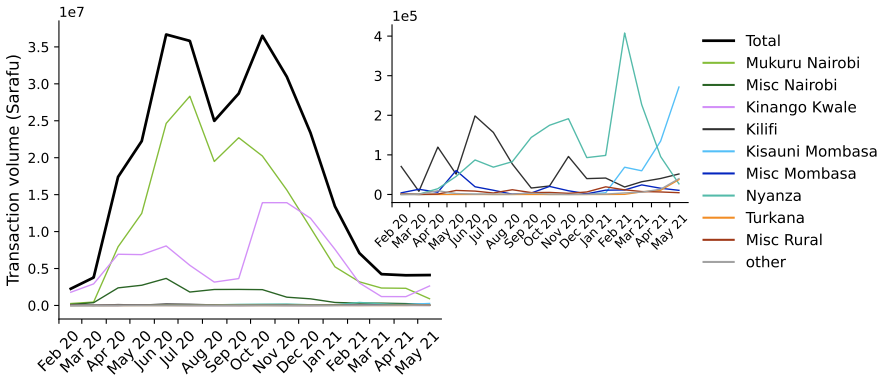
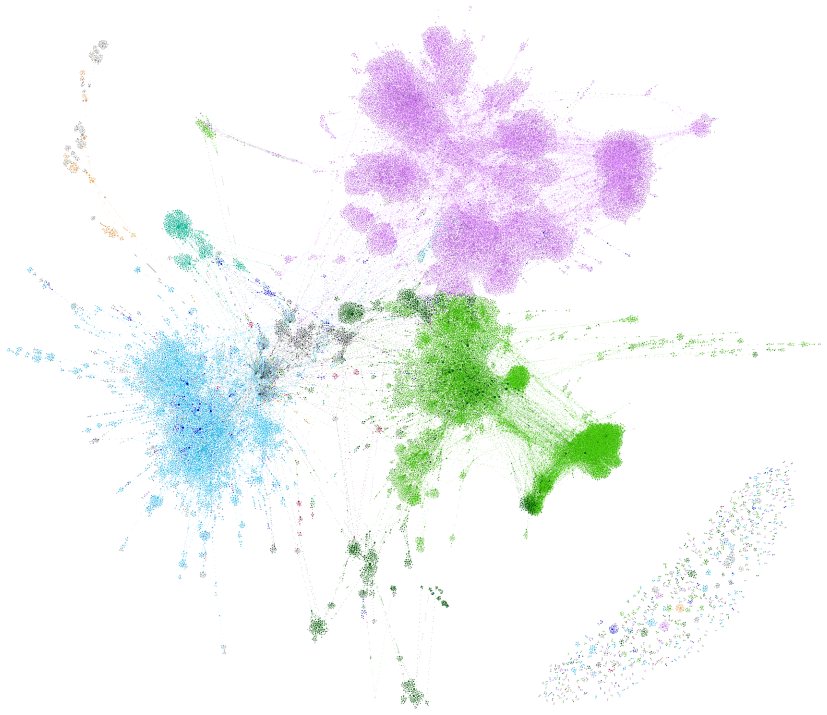
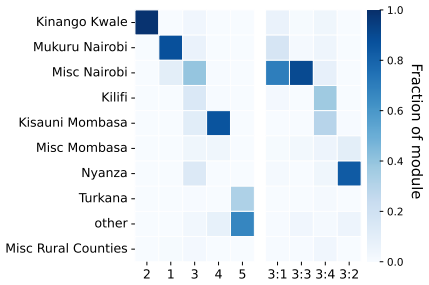
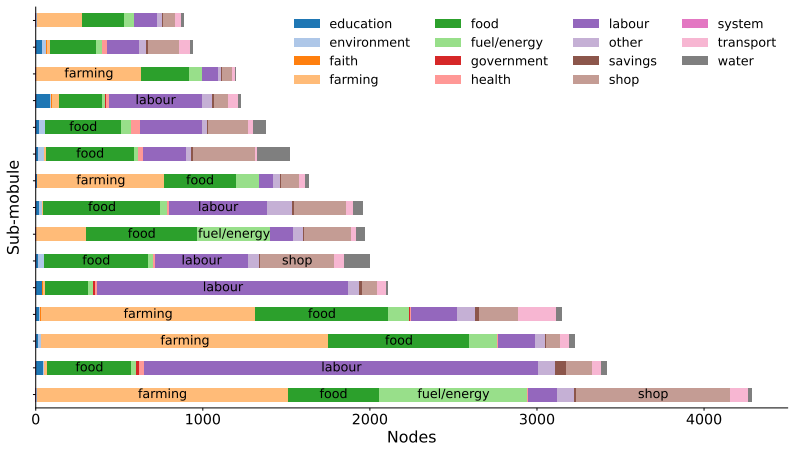
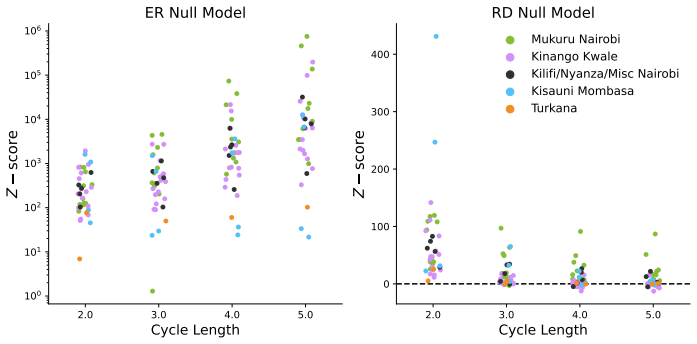
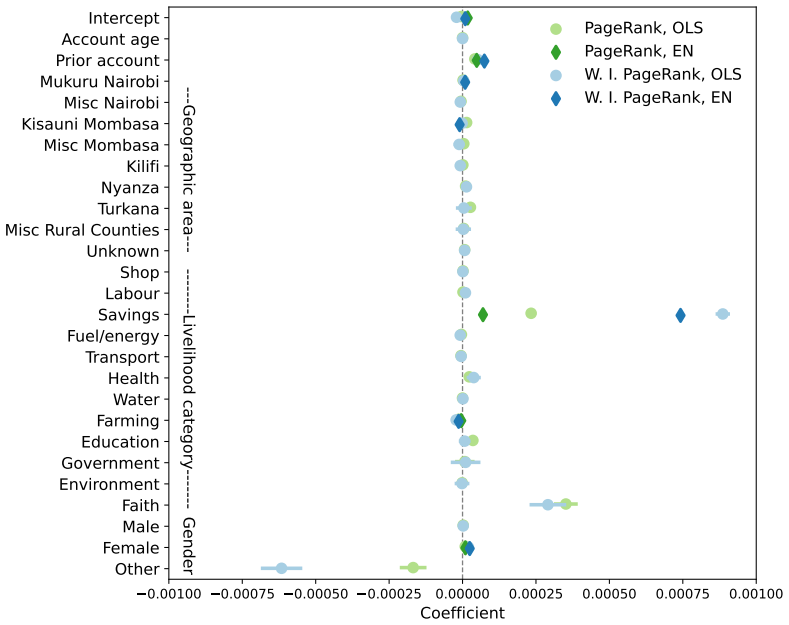
Representing its circulation as a network of monetary flow among the 40,000 Sarafu users reveals that circulation was highly modular, geographically localized, and occurring among users with diverse livelihoods. Across localized sub-populations, network cycle analysis supports the intuitive notion that circulation requires cycles. Moreover, the sub-networks underlying circulation are consistently degree disassortative and we find evidence of preferential attachment. Community-based institutions often take on the role of local hubs, and network centrality measures confirm the importance of early adopters and of women's participation.
What carries the argument
Network of monetary flows built from digital transaction records, analyzed for modularity, cycles, degree assortativity, preferential attachment, and centrality.
Load-bearing premise
The digital transaction records fully and accurately capture the relevant monetary flows without significant missing activity, platform-specific biases, or unrecorded cash exchanges that would alter the observed network structure and cycle statistics.
What would settle it
Finding a localized sub-population with substantial circulation whose transaction network lacks cycles, or showing that unrecorded cash exchanges substantially alter the observed cycle statistics or disassortativity.
Figures
read the original abstract
Circulation is the characteristic feature of successful currency systems, from community currencies to cryptocurrencies to national currencies. In this paper, we propose a network analysis approach especially suited for studying circulation given a system's digital transaction records. Sarafu is a digital community currency that was active in Kenya over a period that saw considerable economic disruption due to the COVID-19 pandemic. We represent its circulation as a network of monetary flow among the 40,000 Sarafu users. Network flow analysis reveals that circulation was highly modular, geographically localized, and occurring among users with diverse livelihoods. Across localized sub-populations, network cycle analysis supports the intuitive notion that circulation requires cycles. Moreover, the sub-networks underlying circulation are consistently degree disassortative and we find evidence of preferential attachment. Community-based institutions often take on the role of local hubs, and network centrality measures confirm the importance of early adopters and of women's participation. This work demonstrates that networks of monetary flow enable the study of circulation within currency systems at a striking level of detail, and our findings can be used to inform the development of community currencies in marginalized areas.
Editorial analysis
A structured set of objections, weighed in public.
Referee Report
Summary. The manuscript applies network analysis to digital transaction records from the Sarafu community currency in Kenya (approximately 40,000 users) to characterize monetary circulation. It models flows as a directed network, reports that circulation is highly modular and geographically localized among users with diverse livelihoods, uses cycle analysis on localized sub-populations to argue that circulation requires cycles, finds consistent degree disassortativity with evidence of preferential attachment, identifies community-based institutions as local hubs, and uses centrality measures to highlight the roles of early adopters and women's participation.
Significance. If the results are robust, the paper supplies a concrete, high-resolution empirical demonstration that network flow methods can quantify circulation properties in community currencies at scale. The cycle requirement finding and the disassortativity/preferential-attachment observations are falsifiable claims that could inform currency design in marginalized settings. The scale of the transaction dataset and the direct application of standard network metrics (modularity, cycles, degree correlations, centrality) are clear strengths.
major comments (1)
- [Data and Methods] Data and Methods section: All reported network properties (cycle counts, degree disassortativity, preferential attachment, hub rankings) rest on the assumption that the digital transaction records capture the relevant monetary flows without significant missing activity. No quantitative bounds, sensitivity tests, or discussion of potential missing edges (cash transactions, other platforms, or unreported activity) are provided; moderate fractions of unobserved flows would alter the complement graph and could change the observed cycle statistics and centrality rankings.
Simulated Author's Rebuttal
We thank the referee for their positive summary and constructive major comment. We address the point below and will revise the manuscript to incorporate additional discussion of data limitations.
read point-by-point responses
-
Referee: [Data and Methods] Data and Methods section: All reported network properties (cycle counts, degree disassortativity, preferential attachment, hub rankings) rest on the assumption that the digital transaction records capture the relevant monetary flows without significant missing activity. No quantitative bounds, sensitivity tests, or discussion of potential missing edges (cash transactions, other platforms, or unreported activity) are provided; moderate fractions of unobserved flows would alter the complement graph and could change the observed cycle statistics and centrality rankings.
Authors: We agree that the analysis relies exclusively on the observed digital transaction records from the Sarafu platform. These records directly capture the monetary flows of the community currency under study. We cannot provide quantitative bounds on unobserved flows (cash or other platforms) because no such data are available to us. We will revise the manuscript by adding an explicit paragraph in the Data and Methods section that states the scope of the data, acknowledges the assumption of completeness for digital flows, and discusses qualitatively how moderate missing edges could affect cycle counts and centrality rankings. This addition increases transparency while preserving the focus on the digital circulation that the dataset actually records. revision: yes
- Quantitative bounds or sensitivity tests on the fraction of missing monetary flows cannot be supplied, as this would require unavailable data on cash transactions and other unreported activity.
Circularity Check
Purely empirical network analysis; no derivations reduce to inputs
full rationale
The paper conducts standard network analysis (modularity, cycle detection, degree correlations, preferential attachment, centrality) on an external transaction dataset of 40,000 users. All reported statistics are computed directly from the observed graph without any fitted parameters, self-referential definitions, or predictions that collapse to the input data by construction. No load-bearing self-citations or uniqueness theorems appear in the provided text. The work is self-contained empirical description of the Sarafu network and does not claim first-principles derivations.
Axiom & Free-Parameter Ledger
free parameters (1)
- Edge-definition thresholds and aggregation windows
axioms (1)
- domain assumption Digital transaction records capture the full set of monetary flows relevant to circulation
Reference graph
Works this paper leans on
-
[1]
Nakamura, E. & Steinsson, J. Identification in Macroeconomics. J. Econ. Perspectives 32, 59–86, DOI: https://doi.org/10. 1257/jep.32.3.59 (2018)
work page 2018
-
[2]
McNerney, J., Savoie, C., Caravelli, F., Carvalho, V . M. & Farmer, J. D. How production networks amplify economic growth. Proc. Natl. Acad. Sci. 119, e2106031118, DOI: https://doi.org/10.1073/pnas.2106031118 (2022)
-
[3]
Carvalho, V . M., Nirei, M., Saito, Y . & Tahbaz-Salehi, A. Supply Chain Disruptions: Evidence from the Great East Japan Earthquake. SSRN Scholarly Paper ID 2883800, Social Science Research Network, Rochester, NY (2016)
work page 2016
-
[4]
Acemoglu, D., Carvalho, V . M., Ozdaglar, A. & Tahbaz-Salehi, A. The Network Origins of Aggregate Fluctuations. Econometrica 80, 1977–2016, DOI: https://doi.org/10.3982/ECTA9623 (2012)
-
[5]
Adrian, T. & Mancini-Griffoli, T. The rise of digital money . No. no. 19/0018 in IMF FinTech notes (International Monetary Fund, Washington, D.C, 2019)
work page 2019
-
[6]
Fraˇnková, E., Fousek, J., Kala, L. & Labohý, J. Transaction network analysis for studying Local Exchange Trading Systems (LETS): Research potentials and limitations. Ecol. Econ. 107, 266–275, DOI: https://doi.org/10.1016/j.ecolecon. 2014.09.009 (2014)
-
[7]
Alessandretti, L., ElBahrawy, A., Aiello, L. M. & Baronchelli, A. Anticipating cryptocurrency prices using machine learning. Complexity 2018 (2018)
work page 2018
-
[8]
Aladangady, A. et al. From Transactions Data to Economic Statistics: Constructing Real-Time, High-Frequency, Geographic Measures of Consumer Spending. Big Data for 21st Century Econ. Stat. (2019)
work page 2019
-
[9]
Bouchaud, J.-P. Trades, Quotes and Prices: Financial Markets Under the Microscope (Cambridge University Press, Cambridge, UK ; New York, 2018), 1st edn
work page 2018
-
[10]
Mattsson, C. E. S. & Takes, F. W. Trajectories through temporal networks. Appl. Netw. Sci. 6, 1–31, DOI: https: //doi.org/10.1007/s41109-021-00374-7 (2021)
-
[11]
Bardoscia, M. et al. The physics of financial networks. Nat. Rev. Phys. 3, 490–507, DOI: https://doi.org/10.1038/ s42254-021-00322-5 (2021). 15/20
work page 2021
-
[12]
Carvalho, V . M.et al. Tracking the COVID-19 crisis with high-resolution transaction data. Royal Soc. Open Sci. 8, 210218, DOI: https://doi.org/10.1098/rsos.210218 (2021)
-
[13]
Complementary credit networks and macroeconomic stability: Switzerland’s Wirtschaftsring
Stodder, J. Complementary credit networks and macroeconomic stability: Switzerland’s Wirtschaftsring. J. Econ. Behav. & Organ. 72, 79–95, DOI: https://doi.org/10.1016/j.jebo.2009.06.002 (2009)
-
[14]
Complementary currencies in Japan today: History, originality and relevance
Lietaer, B. Complementary currencies in Japan today: History, originality and relevance. Int. J. Community Curr. Res. 8, 1–23, DOI: https://doi.org/10.15133/j.ijccr.2004.005 (2004)
-
[15]
Ussher, L., Ebert, L., Gómez, G. M. & Ruddick, W. O. Complementary Currencies for Humanitarian Aid. J. Risk Financial Manag. 14, 557, DOI: https://doi.org/10.3390/jrfm14110557 (2021)
-
[16]
The Woergl Experiment with Depreciating Money
Muralt, V . The Woergl Experiment with Depreciating Money. Annals Public Coop. Econ. 10, 48–57, DOI: https: //doi.org/10.1111/j.1467-8292.1934.tb00435.x (1934)
-
[17]
Kichiji, N. & Nishibe, M. Network Analyses of the Circulation Flow of Community Currency. Evol. Institutional Econ. Rev. 4, 267–300, DOI: https://doi.org/10.14441/eier.4.267 (2008)
-
[18]
Bitcoin: A Peer-to-Peer Electronic Cash System
Nakamoto, S. Bitcoin: A Peer-to-Peer Electronic Cash System. Tech. Rep., Manubot (2008)
work page 2008
-
[19]
Kondor, D., Pósfai, M., Csabai, I. & Vattay, G. Do the Rich Get Richer? An Empirical Analysis of the Bitcoin Transaction Network. PLOS ONE 9, e86197, DOI: https://doi.org/10.1371/journal.pone.0086197 (2014)
-
[20]
ElBahrawy, A., Alessandretti, L., Kandler, A., Pastor-Satorras, R. & Baronchelli, A. Evolutionary dynamics of the cryptocurrency market. Royal Soc. open science 4, 170623 (2017)
work page 2017
-
[21]
Iosifidis, G. et al. Cyclic motifs in the Sardex monetary network. Nat. Hum. Behav. 1, DOI: https://doi.org/10.1038/ s41562-018-0450-0 (2018)
work page 2018
- [22]
-
[23]
Ober, M., Katzenbeisser, S. & Hamacher, K. Structure and Anonymity of the Bitcoin Transaction Graph. Futur. Internet 5, 237–250, DOI: https://doi.org/10.3390/fi5020237 (2013)
-
[24]
Meiklejohn, S. et al. A fistful of Bitcoins: characterizing payments among men with no names. Commun. ACM 59, 86–93, DOI: https://doi.org/10.1145/2896384 (2016)
-
[25]
Zhang, Y ., Wang, J. & Luo, J. Heuristic-Based Address Clustering in Bitcoin.IEEE Access 8, 210582–210591, DOI: https://doi.org/10.1109/ACCESS.2020.3039570 (2020)
-
[26]
Emergence and structure of decentralised trade networks around dark web marketplaces
Nadini, M. Emergence and structure of decentralised trade networks around dark web marketplaces. Sci. Reports 9 (2022)
work page 2022
-
[27]
Mattsson, C. E. S., Criscione, T. & Ruddick, W. O. Sarafu Community Inclusion Currency, 2020-2021. Sci. Data 9, DOI: https://doi.org/10.1038/s41597-022-01539-4 (2022)
-
[28]
Ruddick, W. O. Eco-Pesa: An Evaluation of a Complementary Currency Programme in Kenya’s Informal Settlements. Int. J. Community Curr. Res. 15, 12, DOI: https://doi.org/10.15133/j.ijccr.2011.001 (2011)
-
[29]
Stodder, J. & Lietaer, B. The Macro-Stability of Swiss WIR-Bank Credits: Balance, Velocity, and Leverage. Comp. Econ. Stud. 58, 570–605, DOI: https://doi.org/10.1057/s41294-016-0001-5 (2016)
-
[30]
Economic Advantages of Community Currencies
Zeller, S. Economic Advantages of Community Currencies. J. Risk Financial Manag. 13, 271, DOI: https://doi.org/10. 3390/jrfm13110271 (2020)
work page 2020
-
[31]
Ruddick, W. O. Sarafu Community Inclusion Currency, 2020-2021, DOI: https://doi.org/10.5255/UKDA-SN-855142 (2021)
-
[32]
Rosvall, M. & Bergstrom, C. T. Maps of random walks on complex networks reveal community structure. Proc. Natl. Acad. Sci. 105, 1118–1123, DOI: https://doi.org/10.1073/pnas.0706851105 (2008)
-
[33]
Bohlin, L., Edler, D., Lancichinetti, A. & Rosvall, M. Community Detection and Visualization of Networks with the Map Equation Framework. In Ding, Y ., Rousseau, R. & Wolfram, D. (eds.)Measuring Scholarly Impact, 3–34, DOI: https://doi.org/10.1007/978-3-319-10377-8_1 (Springer International Publishing, Cham, 2014)
-
[34]
Fujiwara, Y . & Aoyama, H. Large-scale structure of a nation-wide production network.The Eur. Phys. J. B 77, 565–580, DOI: https://doi.org/10.1140/epjb/e2010-00275-2 (2010)
- [35]
-
[36]
Campajola, C., D’Errico, M. & Tessone, C. J. MicroVelocity: rethinking the Velocity of Money for digital currencies. arXiv:2201.13416 [physics, q-fin] (2022)
-
[37]
Fleischman, T., Dini, P. & Littera, G. Liquidity-Saving through Obligation-Clearing and Mutual Credit: An Effective Monetary Innovation for SMEs in Times of Crisis. J. Risk Financial Manag. 13, 295, DOI: https://doi.org/10.3390/ jrfm13120295 (2020)
work page 2020
-
[38]
Page, L., Brin, S., Motwani, R. & Winograd, T. The PageRank Citation Ranking: Bringing Order to the Web. Technical Report 1999-66, Stanford InfoLab (1999)
work page 1999
-
[39]
Mbogo, M. The impact of mobile payments on the success and growth of micro-business: The case of M-Pesa in Kenya. J. Lang. Technol. & Entrepreneurship Afr.2, 182–203 (2010)
work page 2010
-
[40]
Stuart, G. & Cohen, M. Cash In, Cash Out Kenya: The Role of M-PESA in the Lives of Low-Income People. The Financial Services Assesment project (Microfinance Opportunities, 2011)
work page 2011
- [41]
-
[42]
Suri, T. Mobile Money. Annu. Rev. Econ. 9, 497–520, DOI: https://doi.org/10.1146/annurev-economics-063016-103638 (2017)
-
[43]
Digital Access: The Future of Financial Inclusion in Africa
International Finance Corporation & Mastercard Foundation. Digital Access: The Future of Financial Inclusion in Africa. Tech. Rep., Partnership for Financial Inclusion (2018)
work page 2018
-
[44]
Baah, B. et al. State of the Industry Report on Mobile Money 2021. Industry Report, GSMA (2021)
work page 2021
-
[45]
Voucher Systems for Food Security: A Case Study on Kenya’s Sarafu-Credit
Marion, C. Voucher Systems for Food Security: A Case Study on Kenya’s Sarafu-Credit. Master’s thesis, University of Copenhagen, DOI: https://doi.org/10.13140/RG.2.2.26399.05282 (2018)
-
[46]
Bianconi, G., Gulbahce, N. & Motter, A. E. Local Structure of Directed Networks. Phys. Rev. Lett. 100, 118701, DOI: https://doi.org/10.1103/PhysRevLett.100.118701 (2008)
-
[47]
Avanzo, S. E. A relational analysis of sarafu network: emergence of a monetary ecosystem for the prosperity of the communities. Master’s thesis, University of Torino, Torino (2019)
work page 2019
-
[48]
Rasulova, S., Storchi, S., Karim, M., Moratti, M. & Johnson, S. Impact evaluation of FSD Kenya’s savings groups project. Tech. Rep., FSD Kenya (2017)
work page 2017
-
[49]
Barabási, A.-L. & Albert, R. Emergence of Scaling in Random Networks. Science 286, 509–512, DOI: https://doi.org/10. 1126/science.286.5439.509 (1999)
work page 1999
-
[50]
Network Science (Cambridge University Press, Cambridge, United Kingdom, 2016), 1st edition edn
Barabasi, A.-L. Network Science (Cambridge University Press, Cambridge, United Kingdom, 2016), 1st edition edn
work page 2016
-
[51]
Lynn, C. W., Holmes, C. M. & Palmer, S. E. Emergent scale-free networks, DOI: https://doi.org/10.48550/arXiv.2210. 06453 (2022)
-
[52]
Litvak, N., Scheinhardt, W. R. W. & V olkovich, Y . In-Degree and PageRank: Why Do They Follow Similar Power Laws? Internet Math. 4, 175–198, DOI: https://doi.org/10.1080/15427951.2007.10129293 (2007)
-
[53]
Fortunato, S., Boguñá, M., Flammini, A. & Menczer, F. Approximating PageRank from In-Degree. In Aiello, W., Broder, A., Janssen, J. & Milios, E. (eds.) Algorithms and Models for the Web-Graph, Lecture Notes in Computer Science, 59–71, DOI: https://doi.org/10.1007/978-3-540-78808-9_6 (Springer, Berlin, Heidelberg, 2008)
-
[54]
Ruddick, W. O., Richards, M. A. & Bendell, J. Complementary Currencies for Sustainable Development in Kenya: The Case of the Bangla-Pesa. Int. J. Community Curr. Res. 19, 13, DOI: https://doi.org/10.15133/j.ijccr.2015.003 (2015)
-
[55]
Mauldin, R. L. Local Currency for Community Development: Policy Barriers and Support. J. Community Pract. 23, 462–476, DOI: https://doi.org/10.1080/10705422.2015.1091420 (2015)
-
[56]
Fuders, F. Smarter Money for Smarter Cities: How Regional Currencies Can Help to Promote a Decentralised and Sustainable Regional Development. In Dick, E., Gaesing, K., Inkoom, D. & Kausel, T. (eds.) Decentralisation and Regional Development: Experiences and Lessons from Four Continents over Three Decades , Springer Geography, 155–185, DOI: https://doi.or...
-
[57]
Gómez, G. M. (ed.) Monetary Plurality in Local, Regional and Global Economies (Routledge, London, 2018)
work page 2018
-
[58]
Single-trajectory map equation
Kawamoto, T. Single-trajectory map equation. arXiv:2203.04044 [physics] (2022)
-
[59]
Blumenstock, J. E., Eagle, N. & Fafchamps, M. Airtime transfers and mobile communications: Evidence in the aftermath of natural disasters. J. Dev. Econ. 120, 157–181, DOI: https://doi.org/10.1016/j.jdeveco.2016.01.003 (2016). 17/20
-
[60]
Economides, N. & Jeziorski, P. Mobile Money in Tanzania. Mark. Sci. 36, 815–837, DOI: https://doi.org/10.1287/mksc. 2017.1027 (2017)
-
[61]
Soramäki, K., Bech, M. L., Arnold, J., Glass, R. J. & Beyeler, W. E. The topology of interbank payment flows. Phys. A: Stat. Mech. its Appl. 379, 317–333, DOI: https://doi.org/10.1016/j.physa.2006.11.093 (2007)
-
[62]
Iori, G., De Masi, G., Precup, O. V ., Gabbi, G. & Caldarelli, G. A network analysis of the Italian overnight money market. J. Econ. Dyn. Control. 32, 259–278, DOI: https://doi.org/10.1016/j.jedc.2007.01.032 (2008)
-
[63]
Kyriakopoulos, F., Thurner, S., Puhr, C. & Schmitz, S. W. Network and eigenvalue analysis of financial transaction networks. The Eur. Phys. J. B 71, 523, DOI: https://doi.org/10.1140/epjb/e2009-00255-7 (2009)
-
[64]
Bech, M. L. & Garratt, R. J. Illiquidity in the Interbank Payment System Following Wide-Scale Disruptions. J. Money, Credit. Bank. 44, 903–929, DOI: https://doi.org/10.1111/j.1538-4616.2012.00515.x (2012)
-
[65]
Barucca, P. & Lillo, F. The organization of the interbank network and how ECB unconventional measures affected the e-MID overnight market. Comput. Manag. Sci. 15, 33–53, DOI: https://doi.org/10.1007/s10287-017-0293-6 (2018)
-
[66]
Rubio, J., Barucca, P., Gage, G., Arroyo, J. & Morales-Resendiz, R. Classifying payment patterns with artificial neural networks: An autoencoder approach. Lat. Am. J. Cent. Bank. 1, 100013, DOI: https://doi.org/10.1016/j.latcb.2020.100013 (2020)
-
[67]
Bianchi, F., Bartolucci, F., Peluso, S. & Mira, A. Longitudinal networks of dyadic relationships using latent trajectories: evidence from the European interbank market. J. Royal Stat. Soc. Ser. C (Applied Stat. 69, 711–739, DOI: https: //doi.org/10.1111/rssc.12413 (2020)
-
[68]
Zanin, M., Papo, D., Romance, M., Criado, R. & Moral, S. The topology of card transaction money flows. Phys. A: Stat. Mech. its Appl. 462, 134–140, DOI: https://doi.org/10.1016/j.physa.2016.06.091 (2016)
-
[69]
Rendón de la Torre, S., Kalda, J., Kitt, R. & Engelbrecht, J. On the topologic structure of economic complex networks: Empirical evidence from large scale payment network of Estonia. Chaos, Solitons & Fractals 90, 18–27, DOI: https: //doi.org/10.1016/j.chaos.2016.01.018 (2016)
- [70]
-
[71]
Triepels, R., Daniels, H. & Heijmans, R. Detection and Explanation of Anomalous Payment Behavior in Real-Time Gross Settlement Systems. In Hammoudi, S., ´Smiałek, M., Camp, O. & Filipe, J. (eds.)Enterprise Information Systems, Lecture Notes in Business Information Processing, 145–161, DOI: https://doi.org/10.1007/978-3-319-93375-7_8 (Springer Internationa...
-
[72]
Sabetti, L. & Heijmans, R. Shallow or deep? Training an autoencoder to detect anomalous flows in a retail payment system. Lat. Am. J. Cent. Bank. 2, 100031, DOI: https://doi.org/10.1016/j.latcb.2021.100031 (2021)
-
[73]
Arévalo, F. et al. Identifying clusters of anomalous payments in the salvadorian payment system. Lat. Am. J. Cent. Bank. 3, 100050, DOI: https://doi.org/10.1016/j.latcb.2022.100050 (2022)
-
[74]
Central bank digital currencies: executive summary
Bank of Canada et al. Central bank digital currencies: executive summary. Tech. Rep., Bank for International Settlements (2021)
work page 2021
-
[75]
Saramäki, J. & Holme, P. Exploring temporal networks with greedy walks. The Eur. Phys. J. B 88, 334, DOI: https://doi.org/10.1140/epjb/e2015-60660-9 (2015)
-
[76]
LaRock, T., Scholtes, I. & Eliassi-Rad, T. Sequential motifs in observed walks. J. Complex Networks 10, cnac036, DOI: https://doi.org/10.1093/comnet/cnac036 (2022)
-
[77]
Mattsson, C. E. S., Luedtke, A. & Takes, F. W. Measuring the Velocity of Money, DOI: https://doi.org/10.48550/arXiv. 2209.01512 (2022)
work page internal anchor Pith review doi:10.48550/arxiv 2022
-
[78]
Lentz, H. H. K., Selhorst, T. & Sokolov, I. M. Unfolding Accessibility Provides a Macroscopic Approach to Temporal Networks. Phys. Rev. Lett. 110, 118701, DOI: https://doi.org/10.1103/PhysRevLett.110.118701 (2013)
-
[79]
Xu, J., Wickramarathne, T. L. & Chawla, N. V . Representing higher-order dependencies in networks. Sci. Adv. 2, e1600028, DOI: https://doi.org/10.1126/sciadv.1600028 (2016)
-
[80]
Nature Physics15(4), 313–320 (2019) https://doi
Lambiotte, R., Rosvall, M. & Scholtes, I. From networks to optimal higher-order models of complex systems. Nat. Phys. 1, DOI: https://doi.org/10.1038/s41567-019-0459-y (2019)
discussion (0)
Sign in with ORCID, Apple, or X to comment. Anyone can read and Pith papers without signing in.