REVIEW 3 major objections 2 minor 20 references
Adaptive Nonlinear MPC for Trajectory Tracking of An Overactuated Tiltrotor Hexacopter
T0 review · 3 major / 2 minor · reviewed 2026-05-24 · grok-4.3
Pith's one-line read L1 adaptive augmentation of nonlinear MPC enables precise 6-DOF trajectory tracking on an overactuated tiltrotor hexacopter despite model mismatch and disturbances.
desk verdict L1-augmented nonlinear MPC delivers clear sim gains on the tiltrotor but the cascade stability claim rests on an unexamined assumption. read the letter →
The pith
A machine-rendered reading of the paper's core claim, the machinery that carries it, and where it could break.
The reading
What carries the argument
Cascaded L1 adaptive controller that augments a nominal nonlinear MPC by estimating and compensating model-plant mismatch and disturbances.
What would settle it
A simulation or flight experiment in which the L1-MPC produces tracking errors no smaller than the non-adaptive MPC baseline or loses stability under realistic disturbance levels.
Extended reading notes
Core claim
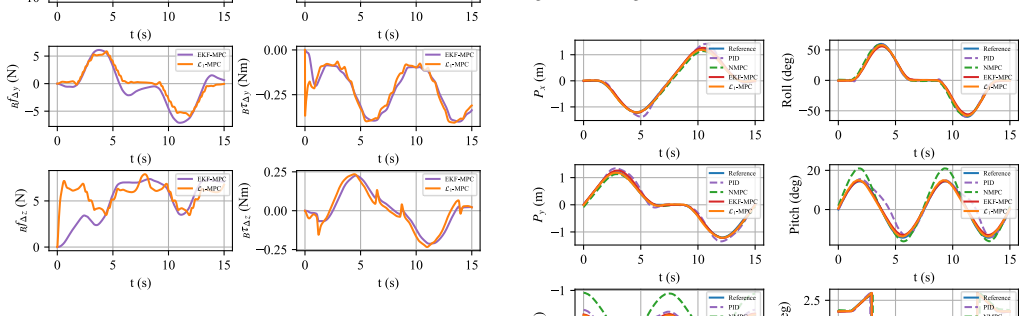
The L1-MPC adopts a cascaded system architecture in which a nominal MPC is followed and augmented by an L1 adaptive controller. This combination compensates for model uncertainties and external disturbances in real time, allowing accurate 6-DOF trajectory tracking where a non-adaptive MPC degrades significantly. Evaluation in numerical and PX4 software-in-the-loop Gazebo simulations shows the L1-MPC reduces tracking error by around 90 percent compared to non-adaptive MPC and outperforms EKF-MPC on error, estimation rate, and tuning effort.
Load-bearing premise
Model-plant mismatch and external disturbances remain within the class of uncertainties that the L1 adaptive element can estimate and compensate without destabilizing the underlying nominal MPC.
Editorial extensions
If this is right
- Tracking error on 6-DOF trajectories drops by around 90 percent relative to non-adaptive MPC under the tested mismatch conditions.
- Uncertainty estimation occurs at higher rates than in EKF-augmented MPC while requiring fewer tuning adjustments.
- The same cascaded structure supports both numerical simulation and PX4 software-in-the-loop testing with Gazebo.
- Open-source release of the PX4 firmware and Gazebo plugins allows direct replication on similar overactuated platforms.
Reading between the lines
- The cascaded L1-MPC design could transfer to other omnidirectional aerial vehicles that face comparable actuator-induced modeling difficulties.
- Extending the method beyond simulation to physical hardware flights would directly test the uncertainty-bound assumption.
- Because the approach builds on PX4 firmware, it may integrate more readily with existing drone control stacks than fully custom controllers.
Editorial analysis
A structured set of objections, weighed in public.
Referee Report
Summary. The paper proposes the L1-MPC, a cascaded adaptive nonlinear MPC architecture consisting of a nominal nonlinear MPC augmented by an L1 adaptive controller, for 6-DOF trajectory tracking of an overactuated tiltrotor hexacopter subject to model uncertainties and external disturbances. It reports simulation results (numerical and PX4 SITL with Gazebo) showing approximately 90% reduction in tracking error relative to non-adaptive MPC, together with lower tracking errors, higher uncertainty estimation rates, and reduced tuning effort compared with EKF-MPC and PID; the authors commit to open-sourcing the PX4 firmware and Gazebo plugins.
Significance. If the stability and performance claims hold under the stated uncertainty class, the work would provide a practical adaptive augmentation for nonlinear MPC on complex overactuated platforms where precise modeling is difficult. The commitment to release hardware-verified firmware and simulation plugins strengthens reproducibility.
major comments (3)
- [control architecture and stability discussion] The central claim that the cascaded L1-MPC remains stable and feasible under model-plant mismatch rests on an unproven assumption. The abstract and architecture description present a nominal MPC followed by L1 augmentation, yet no Lyapunov, ISS, or feasibility analysis is supplied to bound the uncertainty class or to show that the L1 low-pass filter and projection operator preserve the MPC constraint set and stability margins. This is load-bearing for the reported 90% error reduction in the presence of disturbances.
- [simulation results and comparative evaluation] The performance numbers (90% tracking-error reduction, comparative advantages over EKF-MPC) are presented without error bars, number of independent trials, or statistical significance tests. The evaluation section therefore leaves open whether the observed differences are robust or could be explained by particular disturbance realizations.
- [comparative evaluation] The claim of “higher uncertainty estimation rates” for L1-MPC versus EKF-MPC is not accompanied by a precise definition or metric (e.g., estimation error norm, convergence time, or frequency content). Without this, the comparative statement cannot be verified from the reported trajectories alone.
minor comments (2)
- [L1 adaptive controller description] Notation for the L1 adaptive element (low-pass filter cutoff, projection operator bounds) should be introduced with explicit equations rather than referenced only by name.
- [conclusion] The open-source repository link is given but the manuscript does not specify which exact controller parameters, disturbance profiles, and initial conditions are released, limiting immediate reproducibility.
Simulated Author's Rebuttal
We thank the referee for the constructive and detailed comments, which highlight important aspects for strengthening the manuscript. We address each major comment point-by-point below, indicating the revisions we will incorporate.
read point-by-point responses
-
Referee: [control architecture and stability discussion] The central claim that the cascaded L1-MPC remains stable and feasible under model-plant mismatch rests on an unproven assumption. The abstract and architecture description present a nominal MPC followed by L1 augmentation, yet no Lyapunov, ISS, or feasibility analysis is supplied to bound the uncertainty class or to show that the L1 low-pass filter and projection operator preserve the MPC constraint set and stability margins. This is load-bearing for the reported 90% error reduction in the presence of disturbances.
Authors: We agree that the manuscript would benefit from an explicit discussion of stability and feasibility under the assumed uncertainty class. The architecture relies on the separation between the nominal MPC and the L1 augmentation, where the L1 low-pass filter and projection operator are designed to ensure bounded estimation errors per existing L1 theory. In the revised version we will add a dedicated subsection outlining these properties, the uncertainty class considered, and how constraint satisfaction is preserved in the cascaded structure, while clearly stating any remaining assumptions and limitations of the analysis. revision: partial
-
Referee: [simulation results and comparative evaluation] The performance numbers (90% tracking-error reduction, comparative advantages over EKF-MPC) are presented without error bars, number of independent trials, or statistical significance tests. The evaluation section therefore leaves open whether the observed differences are robust or could be explained by particular disturbance realizations.
Authors: The referee is correct that statistical robustness measures are missing. The reported results were obtained from repeated simulation runs, but these details were not included. In the revision we will report the number of independent trials (at least 10 per scenario), include error bars on all performance metrics, and add statistical significance tests (e.g., paired t-tests) to support the comparative claims. revision: yes
-
Referee: [comparative evaluation] The claim of “higher uncertainty estimation rates” for L1-MPC versus EKF-MPC is not accompanied by a precise definition or metric (e.g., estimation error norm, convergence time, or frequency content). Without this, the comparative statement cannot be verified from the reported trajectories alone.
Authors: We agree that the phrase requires a clear, quantitative definition. In the revised manuscript we will define “uncertainty estimation rate” explicitly (e.g., as the L2-norm of the estimation error over time or the bandwidth of the uncertainty compensation signal) and recompute all comparative figures using this metric so that the claim can be directly verified from the data. revision: yes
Circularity Check
No significant circularity in derivation or performance claims
full rationale
The manuscript proposes a cascaded L1-adaptive nonlinear MPC architecture for hexacopter trajectory tracking and reports simulation-based performance gains (approximately 90% tracking-error reduction versus non-adaptive MPC). No equations, fitted parameters, or self-citations are presented that reduce the claimed error reduction, uncertainty estimation rates, or stability properties to a tautological redefinition of the inputs. The architecture is described as a standard nominal MPC augmented by an L1 element; performance numbers arise from explicit numerical and PX4/Gazebo simulations rather than from any self-definitional fit or imported uniqueness result. The central claims therefore remain independent of the reported outputs.
Assumptions & free parameters
assumptions (1)
- domain assumption Model uncertainties and external disturbances lie within the class of signals that the L1 adaptive controller can estimate and reject without destabilizing the nominal MPC.
Cite this review
Pith. "Pith review of Adaptive Nonlinear MPC for Trajectory Tracking of An Overactuated Tiltrotor Hexacopter." pith.science (2026). https://pith.science/paper/2211.06762
@misc{pith2026221106762,
  author       = {Pith},
  title        = {Pith review of: Adaptive Nonlinear MPC for Trajectory Tracking of An Overactuated Tiltrotor Hexacopter},
  year         = {2026},
  howpublished = {\url{https://pith.science/paper/2211.06762}},
  note         = {Machine review of arXiv:2211.06762}
}
abstract
Omnidirectional micro aerial vehicles (OMAVs) are more capable of doing environmentally interactive tasks due to their ability to exert full wrenches while maintaining stable poses. However, OMAVs often incorporate additional actuators and complex mechanical structures to achieve omnidirectionality. Obtaining precise mathematical models is difficult, and the mismatch between the model and the real physical system is not trivial. The large model-plant mismatch significantly degrades overall system performance if a non-adaptive model predictive controller (MPC) is used. This work presents the $\mathcal{L}_1$-MPC, an adaptive nonlinear model predictive controller for accurate 6-DOF trajectory tracking of an overactuated tiltrotor hexacopter in the presence of model uncertainties and external disturbances. The $\mathcal{L}_1$-MPC adopts a cascaded system architecture in which a nominal MPC is followed and augmented by an $\mathcal{L}_1$ adaptive controller. The proposed method is evaluated against the non-adaptive MPC, the EKF-MPC, and the PID method in both numerical and PX4 software-in-the-loop simulation with Gazebo. The $\mathcal{L}_1$-MPC reduces the tracking error by around 90% when compared to a non-adaptive MPC, and the $\mathcal{L}_1$-MPC has lower tracking errors, higher uncertainty estimation rates, and less tuning requirements over the EKF-MPC. We will make the implementations, including the hardware-verified PX4 firmware and Gazebo plugins, open-source at https://github.com/HITSZ-NRSL/omniHex.
Figures


Figures from the paper (7 more)


Reference graph
Works this paper leans on
-
[1]
Design of multirotor aerial vehicles: A taxonomy based on input allocation,
M. Hamandi, F. Usai, Q. Sabl ´e, N. Staub, M. Tognon, and A. Franchi, “Design of multirotor aerial vehicles: A taxonomy based on input allocation,” The International Journal of Robotics Research , vol. 40, no. 8-9, pp. 1015–1044, 2021
work page 2021
-
[2]
Control allocation of a tilting rotor hexacopter,
O. Elkhatib, “Control allocation of a tilting rotor hexacopter,” Bachelor Thesis, ETH Zurich, Zurich, 2017
work page 2017
-
[3]
The voliro omniorientational hexa- copter: An agile and maneuverable tiltable-rotor aerial vehicle,
M. Kamel, S. Verling, O. Elkhatib, C. Sprecher, P. Wulkop, Z. Taylor, R. Siegwart, and I. Gilitschenski, “The voliro omniorientational hexa- copter: An agile and maneuverable tiltable-rotor aerial vehicle,” IEEE Robotics & Automation Magazine , vol. 25, no. 4, pp. 34–44, 2018
work page 2018
-
[4]
Towards efficient full pose omnidirectionality with overactuated mavs,
K. Bodie, Z. Taylor, M. Kamel, and R. Siegwart, “Towards efficient full pose omnidirectionality with overactuated mavs,” in Proceedings of the 2018 International Symposium on Experimental Robotics , J. Xiao, T. Kr¨oger, and O. Khatib, Eds. Cham: Springer International Publishing, 2020, pp. 85–95
work page 2018
-
[5]
Design and optimal control of a tiltrotor micro-aerial vehicle for efficient omnidirectional flight,
M. Allenspach, K. Bodie, M. Brunner, L. Rinsoz, Z. Taylor, M. Kamel, R. Siegwart, and J. Nieto, “Design and optimal control of a tiltrotor micro-aerial vehicle for efficient omnidirectional flight,” The Interna- tional Journal of Robotics Research , vol. 39, no. 10-11, pp. 1305–1325, 2020
work page 2020
-
[6]
Learning dynamics for improving control of overactuated flying sys- tems,
W. Zhang, M. Brunner, L. Ott, M. Kamel, R. Siegwart, and J. Nieto, “Learning dynamics for improving control of overactuated flying sys- tems,” IEEE Robotics and Automation Letters , vol. 5, no. 4, pp. 5283– 5290, 2020
work page 2020
-
[7]
Trajectory tracking nonlinear model predictive control for an overactuated mav,
M. Brunner, K. Bodie, M. Kamel, M. Pantic, W. Zhang, J. Nieto, and R. Siegwart, “Trajectory tracking nonlinear model predictive control for an overactuated mav,” in 2020 IEEE International Conference on Robotics and Automation (ICRA) , 2020, pp. 5342–5348
work page 2020
-
[8]
Di- rect force and pose nmpc with multiple interaction modes for aerial push-and-slide operations,
L. Peric, M. Brunner, K. Bodie, M. Tognon, and R. Siegwart, “Di- rect force and pose nmpc with multiple interaction modes for aerial push-and-slide operations,” in 2021 IEEE International Conference on Robotics and Automation (ICRA) , 2021, pp. 131–137
work page 2021
Show all 20 references
-
[9]
Hovakimyan and C
N. Hovakimyan and C. Cao, L1 Adaptive Control Theory: Guaranteed Robustness with Fast Adaptation . USA: Society for Industrial and Applied Mathematics, 2010
2010
-
[10]
L1 adaptive controller for multi-input multi-output systems in the presence of nonlinear unmatched uncertainties,
E. Xargay, N. Hovakimyan, and C. Cao, “ L1 adaptive controller for multi-input multi-output systems in the presence of nonlinear unmatched uncertainties,” in Proceedings of the 2010 American Control Conference , 2010, pp. 874–879
2010
-
[11]
L1 adaptive con- troller for time-varying reference systems in the presence of unmodeled nonlinear dynamics,
E. Kharisov, N. Hovakimyan, J. Wang, and C. Cao, “ L1 adaptive con- troller for time-varying reference systems in the presence of unmodeled nonlinear dynamics,” in Proceedings of the 2010 American Control Conference, 2010, pp. 886–891
2010
-
[12]
L1 adaptive controller for mimo systems with unmatched uncertainties using modified piecewise constant adapta- tion law,
Z. Li and N. Hovakimyan, “ L1 adaptive controller for mimo systems with unmatched uncertainties using modified piecewise constant adapta- tion law,” in 2012 IEEE 51st IEEE Conference on Decision and Control (CDC), 2012, pp. 7303–7308
2012
-
[13]
Adaptive model predictive control for high-accuracy trajectory tracking in changing conditions,
K. Pereida and A. P. Schoellig, “Adaptive model predictive control for high-accuracy trajectory tracking in changing conditions,” in 2018 IEEE/RSJ International Conference on Intelligent Robots and Systems (IROS), 2018, pp. 7831–7837
2018
-
[14]
L1-adaptive mppi architecture for robust and agile control of multirotors,
J. Pravitra, K. A. Ackerman, C. Cao, N. Hovakimyan, and E. A. Theodorou, “L1-adaptive mppi architecture for robust and agile control of multirotors,” in 2020 IEEE/RSJ International Conference on Intelli- gent Robots and Systems (IROS) , 2020, pp. 7661–7666
2020
-
[15]
Performance, precision, and payloads: Adaptive nonlinear mpc for quadrotors,
D. Hanover, P. Foehn, S. Sun, E. Kaufmann, and D. Scaramuzza, “Performance, precision, and payloads: Adaptive nonlinear mpc for quadrotors,” IEEE Robotics and Automation Letters , vol. 7, pp. 690– 697, 2022
2022
-
[16]
Representing attitude: Euler angles, unit quaternions, and rotation vectors,
J. Diebel, “Representing attitude: Euler angles, unit quaternions, and rotation vectors,” Matrix, vol. 58, 01 2006
2006
-
[17]
Nonlinear quadrocopter at- titude control. technical report,
D. Brescianini, M. Hehn, and R. D’Andrea, “Nonlinear quadrocopter at- titude control. technical report,” Eidgen ¨ossische Technische Hochschule Z¨urich, Z ¨urich, Report, 2013
2013
-
[18]
Casadi: a software framework for nonlinear optimization and optimal control,
J. Andersson, J. Gillis, G. Horn, J. B. Rawlings, and M. Diehl, “Casadi: a software framework for nonlinear optimization and optimal control,” Mathematical Programming Computation , vol. 11, pp. 1–36, 2019
2019
-
[19]
acados—a modular open-source framework for fast embedded optimal control,
R. Verschueren, G. Frison, D. Kouzoupis, J. Frey, N. van Duijkeren, A. Zanelli, B. Novoselnik, T. Albin, R. Quirynen, and M. Diehl, “acados—a modular open-source framework for fast embedded optimal control,” Mathematical Programming Computation , vol. 14, pp. 147– 183, 2022
2022
-
[20]
Quan, Introduction to multicopter design and control
Q. Quan, Introduction to multicopter design and control . Springer, 2017
2017
Reviewed May 24, 2026 · model on record in the stance chip above.
Discussion (0). Sign in to comment.