Vertex Classification of Planar C-polygons
Pith reviewed 2026-05-24 10:28 UTC · model grok-4.3
The pith
A C-polygon from n homothets of a strictly convex domain with m singular points has between n and 2(n-1)+m singular boundary points.
A machine-rendered reading of the paper's core claim, the machinery that carries it, and where it could break.
Core claim
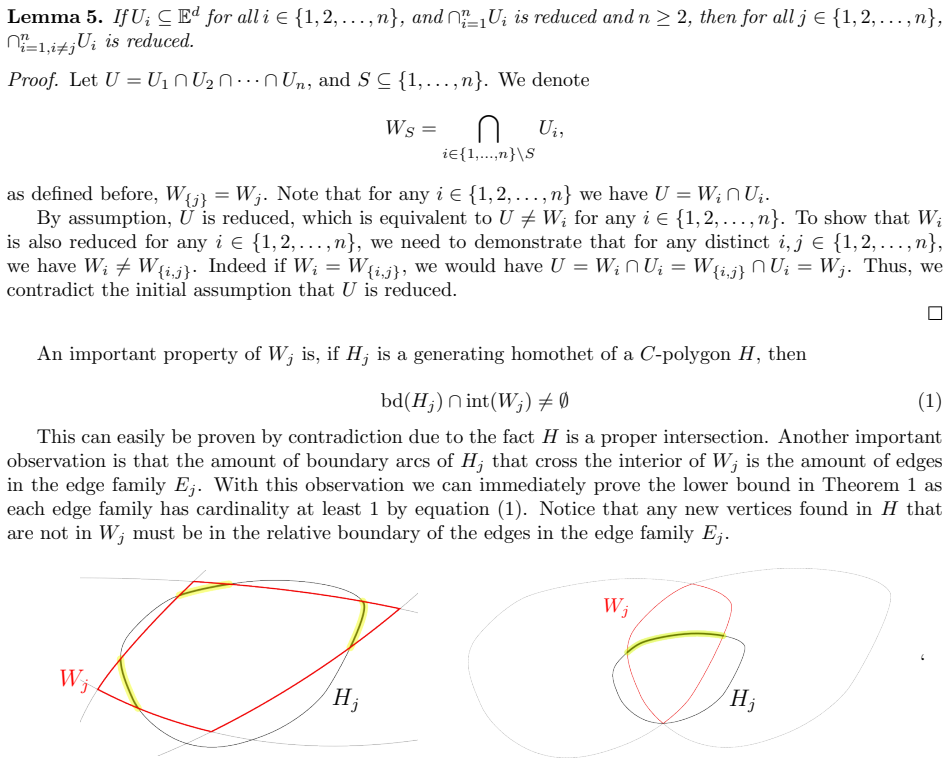
Given a convex domain C, a C-polygon is an intersection of n≥2 homothets of C. If the homothets are translates of C then we call the intersection a translative C-polygon. This paper proves that if C is a strictly convex domain with m singular boundary points, then the number of singular boundary points a C-polygon has is between n and 2(n-1)+m. For a translative C-polygon we show the number of singular boundary points is between n and n+m.
What carries the argument
The C-polygon as the intersection of n homothets of C, together with the count of its singular boundary points inherited from the homothets.
If this is right
- Every C-polygon has at least n singular boundary points.
- The maximum number of singular boundary points for general homothets is 2(n-1)+m.
- Translative C-polygons are limited to at most n+m singular boundary points.
- The bounds are expressed directly in terms of the number of homothets n and the singularities m of C.
Where Pith is reading between the lines
- The classification may help predict the number of corners when approximating convex sets by intersections of homothets.
- Similar counting arguments could apply to other operations such as unions of homothets.
- Explicit constructions achieving the upper bounds would confirm sharpness for specific choices of C.
Load-bearing premise
The domain C must be strictly convex.
What would settle it
A strictly convex C with m singular points together with a C-polygon whose boundary has either fewer than n or more than 2(n-1)+m singular points would disprove the stated bounds.
Figures



read the original abstract
Given a convex domain $C$, a $C$-polygon is an intersection of $n\geq 2$ homothets of $C$. If the homothets are translates of $C$ then we call the intersection a translative $C$-polygon. This paper proves that if $C$ is a strictly convex domain with $m$ singular boundary points, then the number of singular boundary points a $C$-polygon has is between $n$ and $2(n-1)+m$. For a translative $C$-polygon we show the number of singular boundary points is between $n$ and $n+m$.
Editorial analysis
A structured set of objections, weighed in public.
Referee Report
Summary. The manuscript defines a C-polygon as the intersection of n ≥ 2 homothets of a convex domain C (and a translative C-polygon when the homothets are translates). It proves that if C is strictly convex with m singular boundary points, then any C-polygon has between n and 2(n-1)+m singular boundary points; for translative C-polygons the number lies between n and n+m.
Significance. If the proofs are correct, the result supplies explicit combinatorial upper and lower bounds on the number of singular boundary points arising in intersections of homothets of a strictly convex set. This is a concrete contribution to the combinatorial geometry of convex curves; the paper supplies a self-contained proof of the stated bounds under the given hypotheses.
minor comments (3)
- [Introduction] §1 (or wherever the definition of 'singular boundary point' first appears): the term should be defined explicitly before the main theorems are stated, including whether it refers to points of non-differentiability, curvature discontinuities, or vertices of the boundary curve.
- [Abstract] The abstract and introduction should briefly indicate the main combinatorial argument (e.g., how each additional homothet contributes at most two new singular points) so that the origin of the factor 2(n-1) is transparent.
- Figure captions (if any) should explicitly label which curves are the boundaries of the homothets and which points are counted as singular.
Simulated Author's Rebuttal
We thank the referee for the careful reading and positive evaluation of our manuscript. The report recommends minor revision but lists no specific major comments. We are pleased that the contribution is viewed as concrete and self-contained under the stated hypotheses.
Circularity Check
No circularity; derivation self-contained
full rationale
The paper states combinatorial bounds on the number of singular boundary points of a C-polygon (intersection of n homothets of a strictly convex C with m singular points) and the translative case. These bounds (n to 2(n-1)+m, or n to n+m) are presented as direct consequences of the intersection definition and strict convexity, with no equations, fitted parameters, self-citations, or ansatzes referenced in the abstract or context. No load-bearing step reduces to its own inputs by construction; the counting argument is independent of the result itself.
Axiom & Free-Parameter Ledger
axioms (1)
- domain assumption C is strictly convex
Reference graph
Works this paper leans on
-
[1]
McMullen, On the upper-bound conjecture for convex polytopes, J
P. McMullen, On the upper-bound conjecture for convex polytopes, J. Combinat. Theorey, Ser.B. 10 (1971), 187–200
work page 1971
-
[2]
P. K. Agarwal, J. Pach, and M. Sharir, State of the Union (of Geometric Objects), Technical report, American Mathematical Society (2008)
work page 2008
-
[3]
K. Bezdek, Z. Langi, M Naszodi, and P. Papez, Ball-Polyhedra, Discrete Comput Geom 38 (2007), 201–230. Illya Ivanov Department of Mathematics and Statistics, University of Calgary, Canada E-mail: ilya.ivanov1@ucalgary.ca Cameron Strachan Department of Mathematics and Statistics, University of Calgary, Canada E-mail: braden.strachan@ucalgary.ca 11
work page 2007
discussion (0)
Sign in with ORCID, Apple, or X to comment. Anyone can read and Pith papers without signing in.