Spectrum of equivariant cohomology as a fixed point scheme
Pith reviewed 2026-05-24 10:25 UTC · model grok-4.3
The pith
The G-equivariant cohomology ring of a smooth projective variety with regular reductive group action is the coordinate ring of a regular fixed point scheme.
A machine-rendered reading of the paper's core claim, the machinery that carries it, and where it could break.
Core claim
When a complex reductive group G acts regularly on a smooth projective variety X, the complex G-equivariant cohomology ring of X is isomorphic to the coordinate ring of a certain regular fixed point scheme.
What carries the argument
The regular fixed point scheme, a geometric object whose coordinate ring realizes the equivariant cohomology under the regularity condition on the G-action.
If this is right
- The isomorphism holds for partial flag varieties.
- The isomorphism holds for smooth Schubert varieties.
- The isomorphism holds for Bott-Samelson varieties.
- A generalized fixed point scheme yields the same type of isomorphism for GKM spaces such as toric varieties.
Where Pith is reading between the lines
- The fixed point scheme may supply a uniform algebraic way to compute equivariant cohomology rings that were previously described only by generators and relations.
- The construction could extend to other cohomology theories or to actions that are not fully regular but satisfy weaker finiteness conditions.
- The result links equivariant cohomology directly to the geometry of schemes fixed by unipotent elements, suggesting new questions about the scheme's singularities or its relation to the variety X.
Load-bearing premise
The action of the complex reductive group G on X must be regular so that all regular unipotent elements act with finitely many fixed points.
What would settle it
For a concrete partial flag variety, explicitly compute both the G-equivariant cohomology ring and the coordinate ring of the associated regular fixed point scheme and check whether the two rings fail to be isomorphic.
Figures


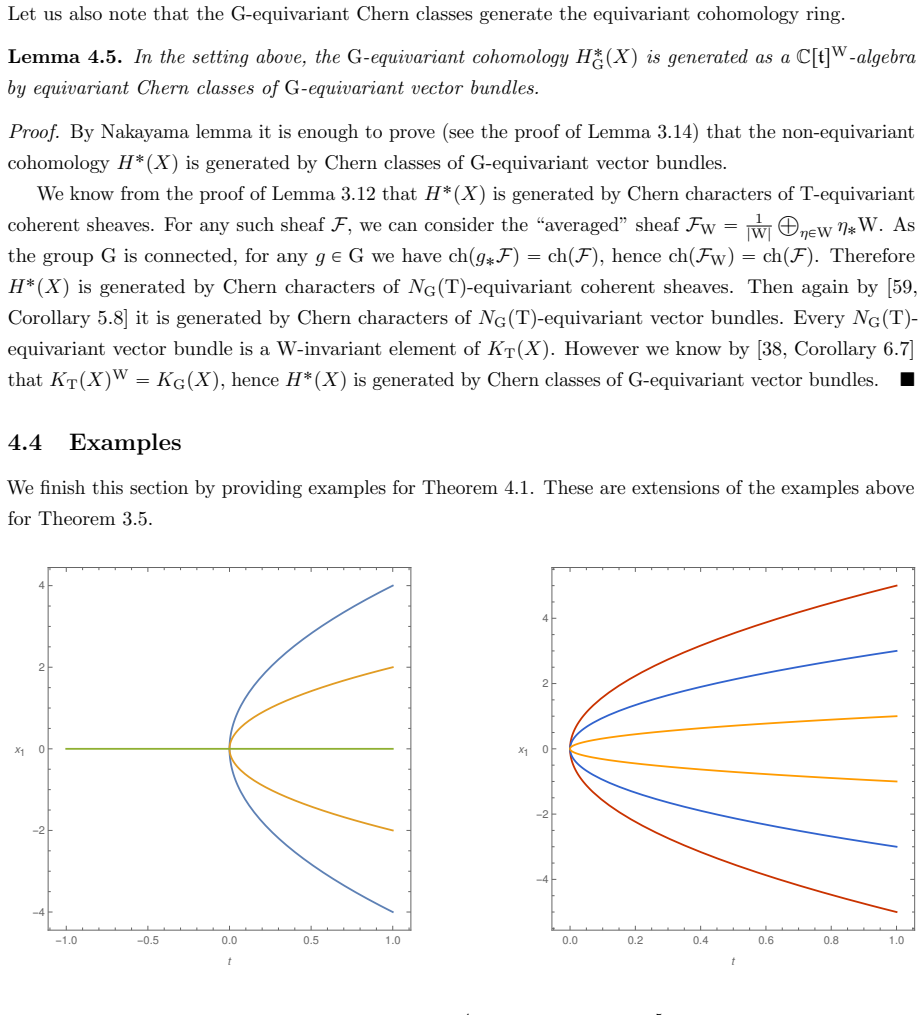

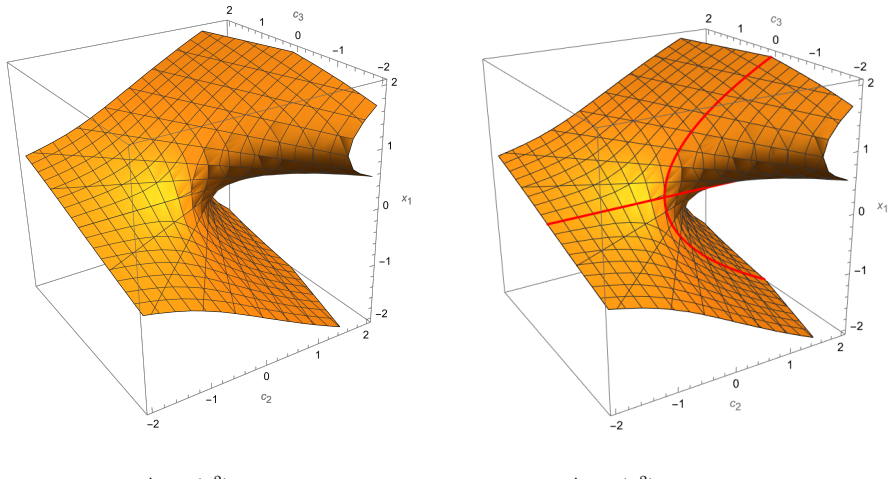

read the original abstract
An action of a complex reductive group $\mathrm G$ on a smooth projective variety $X$ is regular when all regular unipotent elements in $\mathrm G$ act with finitely many fixed points. Then the complex $\mathrm G$-equivariant cohomology ring of $X$ is isomorphic to the coordinate ring of a certain regular fixed point scheme. Examples include partial flag varieties, smooth Schubert varieties and Bott-Samelson varieties. We also show that a more general version of the fixed point scheme allows a generalisation to GKM spaces, such as toric varieties.
Editorial analysis
A structured set of objections, weighed in public.
Referee Report
Summary. The paper claims that if a complex reductive group G acts regularly on a smooth projective variety X (i.e., every regular unipotent element of G has finitely many fixed points), then the G-equivariant cohomology ring H_G^*(X; ℂ) is isomorphic to the coordinate ring of a certain regular fixed point scheme constructed from those fixed points. The result is illustrated on partial flag varieties, smooth Schubert varieties and Bott-Samelson varieties, and a more general version of the scheme is shown to recover the equivariant cohomology of GKM spaces such as toric varieties.
Significance. If the stated isomorphism holds, the work supplies an explicit algebraic-geometric model for equivariant cohomology rings in terms of functions on a scheme whose points are fixed by regular unipotents. The construction is compatible with the restriction maps and localization techniques already used in GKM theory, and the listed examples demonstrate that the regularity hypothesis is satisfied in several standard settings.
minor comments (3)
- [§2] §2: the precise functorial construction of the regular fixed point scheme (its ideal sheaf or its embedding into a product of projective spaces) should be stated before the main theorem is invoked.
- [Theorem 5.3] The proof of the isomorphism in the GKM case (Theorem 5.3) relies on a comparison of restriction maps; a short diagram or explicit description of the two maps being identified would improve readability.
- [§4] Notation for the coordinate ring of the scheme (e.g., whether it is written as ℂ[Z] or O(Z)) is not uniform across the examples in §4.
Simulated Author's Rebuttal
We thank the referee for the positive summary, significance assessment, and recommendation of minor revision. No specific major comments appear in the report.
Circularity Check
No significant circularity detected
full rationale
The paper states a theorem that, under the given regularity hypothesis on the G-action (regular unipotents have finitely many fixed points), the G-equivariant cohomology ring of X is isomorphic to the coordinate ring of an explicitly constructed regular fixed point scheme. This is a direct identification via restriction and localization maps, verified on concrete examples (partial flags, Schubert varieties, Bott-Samelson, GKM spaces). No equation or construction reduces by definition to its own output, no parameter is fitted and then relabeled as a prediction, and no load-bearing step rests on a self-citation whose content is itself unverified. The derivation is therefore self-contained as a standard algebraic-geometry argument.
Axiom & Free-Parameter Ledger
axioms (1)
- standard math Standard properties of equivariant cohomology rings for smooth projective varieties and schemes over complex numbers
invented entities (1)
-
regular fixed point scheme
no independent evidence
Lean theorems connected to this paper
-
IndisputableMonolith/Foundation/AbsoluteFloorClosure.leanabsolute_floor_iff_bare_distinguishability unclear?
unclearRelation between the paper passage and the cited Recognition theorem.
An action of a complex reductive group G on a smooth projective variety X is regular when all regular unipotent elements in G act with finitely many fixed points. Then the complex G-equivariant cohomology ring of X is isomorphic to the coordinate ring of a certain regular fixed point scheme.
-
IndisputableMonolith/Cost/FunctionalEquation.leanwashburn_uniqueness_aczel unclear?
unclearRelation between the paper passage and the cited Recognition theorem.
the zero scheme ZS ⊂ S × X of the vector field VS is reduced and affine and its coordinate ring, graded by the Cˆ-action above, is isomorphic as a graded ring Cr[ZS] ≅ H^*_H(X;C) over Cr[S] ≅ H^*_H
-
IndisputableMonolith/Foundation/ArithmeticFromLogic.leanLogicNat.equivNat unclear?
unclearRelation between the paper passage and the cited Recognition theorem.
Theorem 1.4. Suppose that a torus T acts on a smooth projective complex variety X with finitely many zero- and one-dimensional orbits. Then ... Cr[Zt] ≅ H^*_T(X;C) over Cr[t] ≅ H^*_T
What do these tags mean?
- matches
- The paper's claim is directly supported by a theorem in the formal canon.
- supports
- The theorem supports part of the paper's argument, but the paper may add assumptions or extra steps.
- extends
- The paper goes beyond the formal theorem; the theorem is a base layer rather than the whole result.
- uses
- The paper appears to rely on the theorem as machinery.
- contradicts
- The paper's claim conflicts with a theorem or certificate in the canon.
- unclear
- Pith found a possible connection, but the passage is too broad, indirect, or ambiguous to say the theorem truly supports the claim.
Reference graph
Works this paper leans on
-
[1]
Thesis, University of British Columbia, 1977
Ersan Akyildiz, Geometry of holomorphic vector fields and applications of Gm-actions to linear algebraic groups, Ph.D. Thesis, University of British Columbia, 1977
work page 1977
-
[2]
Ersan Akyildiz, A vector field with one zero on G{P , Proc. Amer. Math. Soc. 67 (1977), 32–34
work page 1977
-
[3]
E. Akyildiz and J. B. Carrell, Cohomology of projective varieties with regular SL2 action, Manuscripta Math. 58 (1987), 473–486
work page 1987
-
[4]
E. Akyildiz and J. B. Carrell, A generalization of the Kostant-Macdonald identity , Proc. Natl. Acad. Sci. USA 86 (1989), 3934–3937
work page 1989
-
[5]
E. Akyildiz, J. B. Carrell and D. I. Lieberman, Zeros of holomorphic vector fields on singular spaces and intersection rings of Schubert varieties , Compos. Math. 57 (1986), 237–248
work page 1986
-
[6]
E. Akyildiz, J. B. Carrell, D. I. Lieberman and A. J. Sommese, On the graded rings associated to holomorphic vector fields with exactly one zero . In Singularities, Part 1 , Proc. Sympos. Pure Math. 40, 55–56. Amer. Math. Soc., Providence, R.I., 1981
work page 1981
-
[7]
P. Baum and R. Bott, On the zeros of meromorphic vector-fields . In Essays on Topology and Related Topics (M´ emoires d´ edi´ es ` a Georges de Rham), 29–47. Springer, New York, 1970
work page 1970
-
[8]
D. J. Benson, Polynomial Invariants of Finite Groups , volume 190 of London Mathematical Society Lecture Note Series. Cambridge University Press, 1993
work page 1993
-
[9]
Bia lynicki-Birula,Some theorems on actions of algebraic groups , Ann
A. Bia lynicki-Birula,Some theorems on actions of algebraic groups , Ann. Math. 98 (1973), 480–497
work page 1973
-
[10]
Bia lynicki-Birula,On fixed points of torus actions on projective varieties , Bull
A. Bia lynicki-Birula,On fixed points of torus actions on projective varieties , Bull. Acad. Polon. Sci. S´ er. Sci. Math. Astronom. Phys.22 (1974), 1097–1101
work page 1974
-
[11]
Second Enlarged Edition, volume 126 of Graduate Texts in Mathematics
Armand Borel, Linear Algebraic Groups. Second Enlarged Edition, volume 126 of Graduate Texts in Mathematics. Springer-Verlag, 1991
work page 1991
-
[12]
Raoul Bott, Vector fields and characteristic numbers . Michigan Math. J. 14 (1967), 231–244
work page 1967
-
[13]
Raoul Bott and Hans Samelson, Applications of the theory of Morse to symmetric spaces , Amer. J. Math. 80 (1958), 964–1029
work page 1958
-
[14]
Nicolas Bourbaki, Lie Groups and Lie Algebras: Chapters 1–3 . Springer, 1989
work page 1989
-
[15]
In Pa- rameter Spaces, volume 36 of Banach Center Publications , 25–44
Michel Brion, Piecewise polynomial functions, convex polytopes and enumerative geometry . In Pa- rameter Spaces, volume 36 of Banach Center Publications , 25–44. Institute of Mathematics, Polish Academy of Sciences, 1996
work page 1996
-
[16]
Carrell, The equivariant cohomology ring of regular varieties , Michigan Math
Michel Brion and James B. Carrell, The equivariant cohomology ring of regular varieties , Michigan Math. J. 52 (2004), 189–203
work page 2004
-
[17]
J. B. Carrell, Torus actions and cohomology. In Algebraic quotients. Torus actions and cohomology. The adjoint representation and the adjoint action , volume 131 of Encyclopaedia of Mathematical Sciences, 83–158. Springer, Berlin, 2002
work page 2002
-
[18]
James B. Carrell, Deformation of the nilpotent zero scheme and the intersection ring of invariant subvarieties, J. reine. angew. Math. 460 (1995), 37–54. 57
work page 1995
-
[19]
J. B. Carrell and Kiumars Kaveh, On the equivariant cohomology of subvarieties of a B-regular variety, Transform. Groups 13 (2008), 495–505
work page 2008
-
[20]
J. B. Carrell and D. I. Liebermann, Vector fields and Chern numbers , Math. Ann. 225 (1977), 263–267
work page 1977
-
[21]
Tome III: Th´ eor` emes G´ en´ eraux sur les Alg` ebres de Lie
Claude Chevalley, Th´ eorie des Groupes de Lie. Tome III: Th´ eor` emes G´ en´ eraux sur les Alg` ebres de Lie. Volume IV of Publications de l’Institut Math´ ematique de l’Universit´ e de Nancago. Librairie Scientifique Hermann et Cie, 1955
work page 1955
-
[22]
Neil Chriss and Victor Ginzburg, Representation Theory and Complex Geometry . Birkh¨ auser, 1997
work page 1997
-
[23]
Cohen and Jan Draisma, From Lie algebras of vector fields to algebraic group actions
Arjeh M. Cohen and Jan Draisma, From Lie algebras of vector fields to algebraic group actions . Transform. Groups. 8 (2003), 51–68
work page 2003
-
[24]
Michel Demazure, D´ esingularisation des vari´ et´ es de Schubert g´ en´ eralis´ ees, Ann. Sci. ´Ecole Norm. Sup. 4 (1974), 53–88
work page 1974
-
[25]
D. ˇZ. Djokovi´ c and J.Malzan,Orbits of Nilpotent Matrices , Linear Algebra Appl. 32 (1980), 157–158
work page 1980
-
[26]
Volume 296 of London Mathematical Society Lecture Note Series
Igor Dolgachev, Lectures on Invariant Theory. Volume 296 of London Mathematical Society Lecture Note Series. Cambridge University Press, 2010
work page 2010
-
[27]
Volume 150 of Graduate Texts in Mathematics
David Eisenbud, Commutative Algebra, with a View Toward Algebraic Geometry . Volume 150 of Graduate Texts in Mathematics . Springer-Verlag, 1995
work page 1995
- [28]
-
[29]
Wee Liang Gan and Victor Ginzburg, Quantization of Slodowy slices , Int. Math. Res. Not. IMRN 5 (2002), 243–255
work page 2002
-
[30]
Victor Ginzburg, Principal nilpotent pairs in a semisimple Lie algebra 1 , Invent. math. 140 (2000), 511–561
work page 2000
-
[31]
Mark Goresky and Robert MacPherson, On the spectrum of the equivariant cohomology ring , Canad. J. Math. 62 (2010), no. 2, 262–283
work page 2010
-
[32]
Mark Goresky, Robert Kottwitz and Robert MacPherson, Equivariant cohomology, Koszul duality, and the localization theorem, Invent. math. 131 (1998), 25–83
work page 1998
-
[33]
Ulrich G¨ ortz and Torsten Wedhorn,Algebraic Geometry I: Schemes With Examples and Exercises . Vieweg+Teubner, 2010
work page 2010
-
[34]
Alexander Grothendieck and Jean Dieudonn´ e,´El´ ements de g´ eom´ etrie alg´ ebraique: III.´Etude coho- mologique des faisceaux coh´ erents, Premi` ere partie, Publ. Math. IH ´ES 11 (1961), 5–167
work page 1961
-
[35]
Alexander Grothendieck and Jean Dieudonn´ e,´El´ ements de g´ eom´ etrie alg´ ebraique: IV.´Etude locale des sch´ emas et des morphismes de sch´ emas, Troisi` eme partie, Publ. Math. IH ´ES 28 (1966), 5–255
work page 1966
-
[36]
H. C. Hansen, On cycles in flag manifolds , Math. Scand. 33 (1974), 269–274
work page 1974
-
[37]
Volume 133 of Graduate Texts in Mathematics
Joe Harris, Algebraic Geometry: A First Course . Volume 133 of Graduate Texts in Mathematics . Springer-Verlag, 1992. 58
work page 1992
-
[38]
Megumi Harada, Gregory D. Landweber and Reyer Sjamaar, Divided differences and the Weyl character formula in equivariant K-theory , Math. Res. Lett. 17 (2010), 507–527
work page 2010
-
[39]
Corrected eighth printing, volume 52 of Graduate Texts in Mathematics
Robin Hartshorne, Algebraic Geometry. Corrected eighth printing, volume 52 of Graduate Texts in Mathematics. Springer-Verlag, 1997
work page 1997
- [40]
-
[41]
Tam´ as Hausel,The Hitchin map as spectra of equivariant cohomology and Kirillov algebras (in preparation)
-
[42]
Tatsuyuki Hikita, An algebro-geometric realization of the cohomology ring of Hilbert scheme of points in the affine plane. Int. Math. Res. Not. IMRN 2017, no. 8, 2538–2561
work page 2017
-
[43]
Horrocks, Fixed point schemes of additive group actions , Topology 8 (1969), 233–242
G. Horrocks, Fixed point schemes of additive group actions , Topology 8 (1969), 233–242
work page 1969
-
[44]
Volume 85 of Ergebnisse der Mathematik und ihrer Grenzgebiete
Wu Yi Hsiang, Cohomology Theory of Topological Transformation Groups. Volume 85 of Ergebnisse der Mathematik und ihrer Grenzgebiete . Springer-Verlag, 1975
work page 1975
-
[45]
Humphreys, Introduction to Lie Algebras and Representation Theory
James E. Humphreys, Introduction to Lie Algebras and Representation Theory . Volume 9 of Graduate Texts in Mathematics. Springer-Verlag, 1972
work page 1972
-
[46]
Humphreys, Linear Algebraic Groups
James E. Humphreys, Linear Algebraic Groups. Corrected fourth printing, volume 21 of Graduate Texts in Mathematics. Springer-Verlag, 1995
work page 1995
- [47]
-
[48]
Bertram Kostant, Lie Group representations on polynomial rings , Amer. J. Math. 85 (1963), 327–404
work page 1963
-
[49]
Bertram Kostant, On Whittaker vectors and representation theory , Invent. Math. 48 (1978), 101–184
work page 1978
-
[50]
Shrawan Kumar and Claudio Procesi, An algebro-geometric realization of equivariant cohomology of some Springer fibers, J. Algebra. 368 (2012), 70–74
work page 2012
-
[51]
Jakub L¨ owit,private communication
-
[52]
Hideyuki Matsumura, Commutative Ring Theory. Translated by M. Reid. Ninth printing, volume 8 of Cambridge studies in advanced mathematics . Cambridge University Press, 2006
work page 2006
-
[53]
Alexander Merkurjev, Comparison of the equivariant and the standard K-theory of algebraic varieties. , St. Petersburg Math. J. 9 (1998), 815–850
work page 1998
-
[54]
J. S. Milne, Algebraic Groups: The Theory of Group Schemes of Finite Type over a Field . Volume 170 of Cambridge studies in advanced mathematics . Cambridge University Press, 2017
work page 2017
-
[55]
G. D. Mostow, Fully Reducible Subgroups of Algebraic Groups , Amer. J. Math. 78 (1956), 200–221
work page 1956
-
[56]
Parameswaran Sankaran and P. Vanchinathan, Small Resolutions of Schubert Varieties in Symplectic and Orthogonal Grassmannians, Publ. RIMS, Kyoto Univ. 30 (1994), 443–458
work page 1994
-
[57]
T. A. Springer, Linear Algebraic Groups. Second Edition, Springer, 1998
work page 1998
-
[58]
Robert Steinberg, Torsion in Reductive Groups. Adv. Math. 15 (1975), 63–92. 59
work page 1975
-
[59]
R. W. Thomason, XX. Algebraic K-Theory of Group Scheme Actions . In Algebraic Topology and Algebraic K-Theory, volume 113 of Annals of Mathematics Studies , 539–563. Princeton University Press, 2016
work page 2016
-
[60]
Matthieu Willems, Cohomologie et K-th´ eorie ´ equivariantes des vari´ et´ es de Bott–Samelson et des vari´ et´ es de drapeaux, Bull. Soc. Math. France 132 (2004), 569–589. 60
work page 2004
discussion (0)
Sign in with ORCID, Apple, or X to comment. Anyone can read and Pith papers without signing in.