Diffuse Maxwellian illumination for safe wide-field retinal Doppler holography
Pith reviewed 2026-05-24 10:09 UTC · model grok-4.3
The pith
Diffuse Maxwellian illumination widens the retinal field of view for Doppler holography without exceeding eye safety limits.
A machine-rendered reading of the paper's core claim, the machinery that carries it, and where it could break.
Core claim
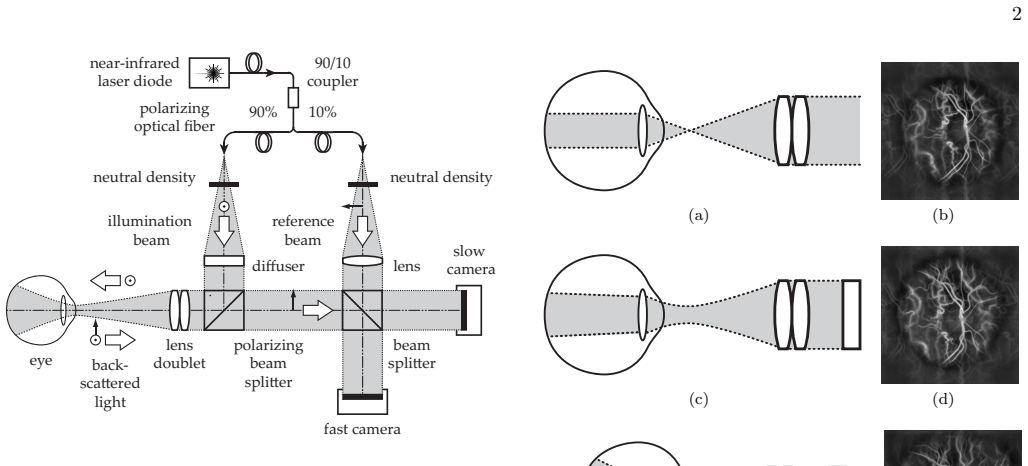
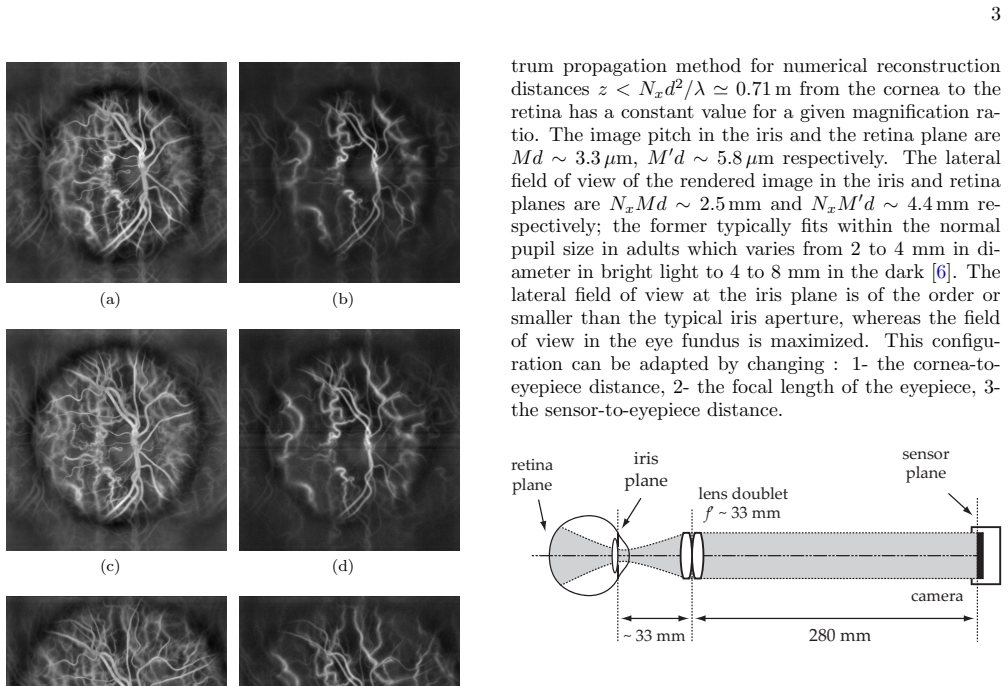
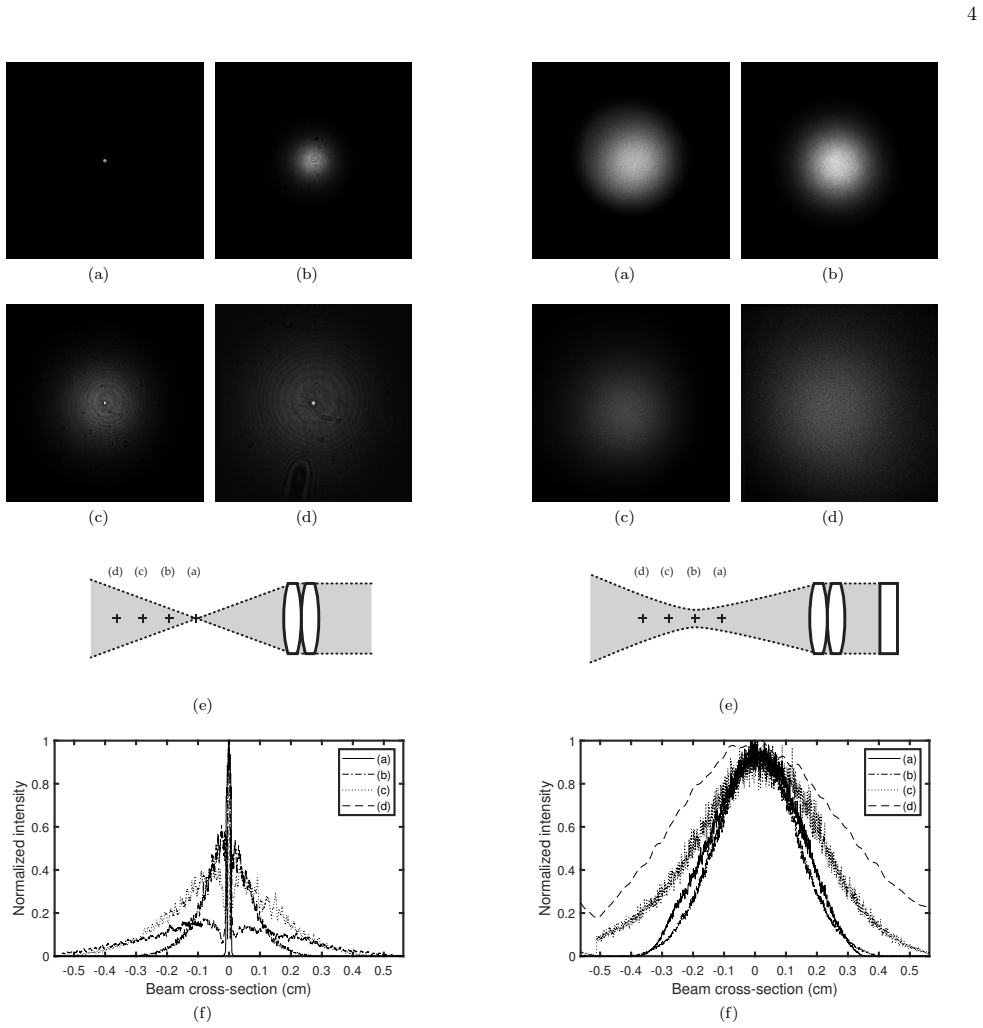
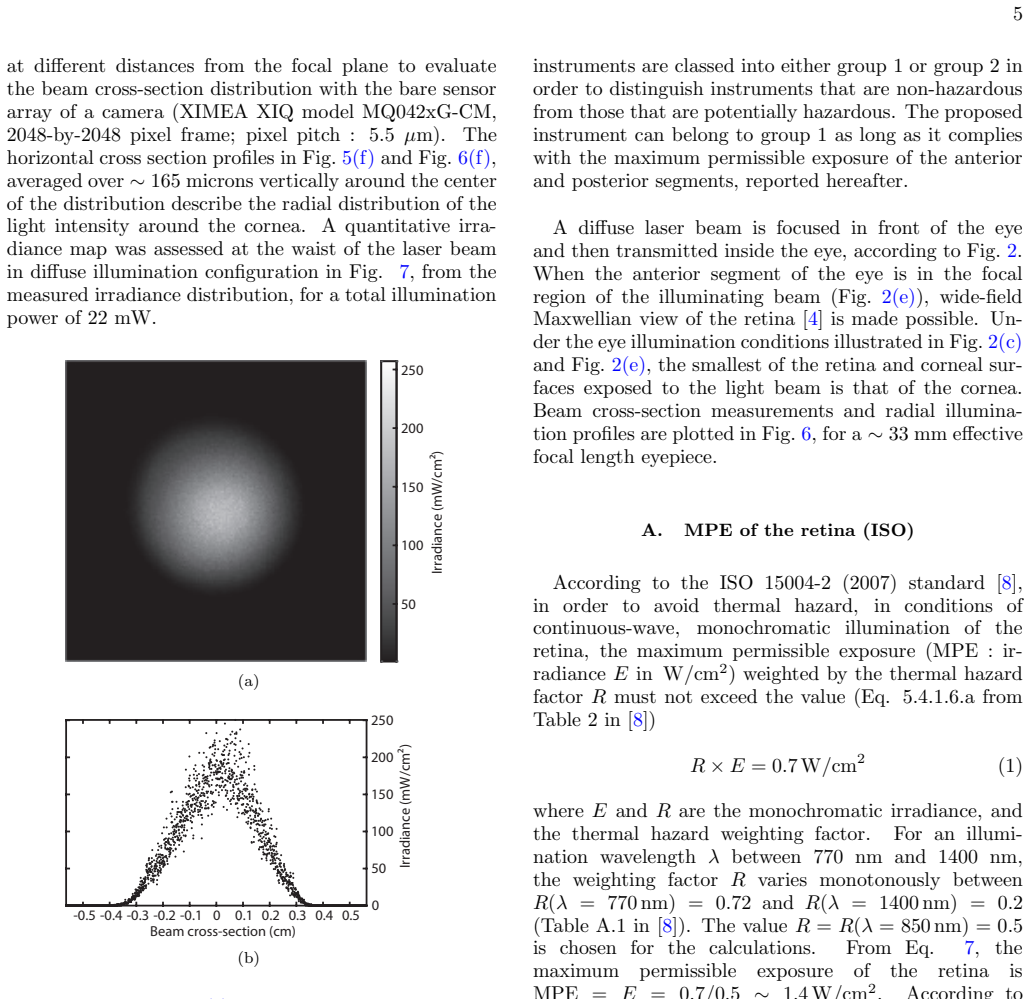
Diffuse Maxwellian illumination is produced by inserting an engineered diffuser into the illumination path, converting a spatially concentrated focus into an angularly diversified beam. This reduces anterior-segment irradiance, allows a shorter cornea-to-eyepiece distance, and thereby enlarges the digitally reconstructed retinal field of view while preserving coherent interferometric detection. Direct comparisons among focused non-diffuse, diffuse at fixed distance, and diffuse Maxwellian geometries confirm the expanded field of view together with maintained Doppler contrast in both broad and high-frequency fluctuation bands. Recommended operating power at 852 nm is fixed by the most binding
What carries the argument
Engineered diffuser that creates angular diversification of the illumination beam while preserving spatial and temporal coherence for Doppler holography.
If this is right
- Retinal field of view increases without forming a localized corneal hot spot.
- Doppler contrast remains usable in both broad and high-frequency fluctuation bands.
- Operating power is set by the strictest anterior-segment, iris, or retinal exposure limit from the cited standards.
- Non-mydriatic wide-field Doppler holography of the human retina is supported by the measured beam profiles.
Where Pith is reading between the lines
- The same diffuser approach could be tested in other coherence-based retinal techniques that currently use focused illumination.
- Larger fields of view may make spatial gradients in retinal blood flow easier to observe in a single acquisition.
- Lower peak irradiance at the cornea could reduce the need for pupil dilation in longer sessions.
Load-bearing premise
The diffuser's angular spread leaves enough coherence at the retina for interferometric Doppler signals to remain usable.
What would settle it
A quantitative measurement in which Doppler contrast in the diffuse Maxwellian geometry falls below the focused case at equal total power.
Figures

read the original abstract
We report a diffuse Maxwellian illumination scheme for wide-field retinal laser Doppler holography. Inserting an engineered diffuser in the illumination arm transforms a spatially concentrated near-infrared laser focus into an angularly diversified illumination pattern, thereby reducing local irradiance near the anterior segment while preserving coherent interferometric detection. This configuration allows the eyepiece to be positioned closer to the cornea, increasing the digitally reconstructed retinal field of view without producing a localized corneal hot spot. We compare three illumination geometries: focused non-diffuse illumination, diffuse illumination at the same cornea--eyepiece distance, and diffuse Maxwellian illumination. Diffuse Maxwellian illumination expands the retinal field of view while preserving Doppler contrast in broad and high-frequency fluctuation bands. Light-hazard assessment is limited to the current ophthalmic standards ISO 15004-2:2024 and ANSI Z80.36-2021. Based on measured beam profiles, the recommended operating power at 852 nm is set by the most restrictive relevant exposure condition among the assessed anterior-segment, iris, and retinal limits. These results support diffuse illumination as a practical route toward safer, non-mydriatic, wide-field Doppler holography of the human retina.
Editorial analysis
A structured set of objections, weighed in public.
Referee Report
Summary. The manuscript reports an experimental comparison of three illumination geometries for retinal laser Doppler holography at 852 nm: focused non-diffuse, diffuse at fixed cornea-eyepiece distance, and diffuse Maxwellian (engineered diffuser placed to diversify angles while allowing closer eyepiece positioning). It claims that diffuse Maxwellian illumination expands the digitally reconstructed retinal field of view, preserves Doppler contrast in broad and high-frequency bands, and permits safe operating power set by the most restrictive limits among anterior-segment, iris, and retinal exposure conditions in ISO 15004-2:2024 and ANSI Z80.36-2021, based on measured beam profiles.
Significance. If the preservation of interferometric Doppler contrast under diffuse Maxwellian illumination is quantitatively confirmed, the work would provide a practical route to safer wide-field retinal holography without mydriasis by mitigating localized anterior-segment irradiance. The direct mapping of measured profiles to current ophthalmic safety standards supplies actionable power limits and could influence instrument design for non-mydriatic clinical use.
major comments (2)
- [Abstract / Results] Abstract and Results section: the central claim that diffuse Maxwellian illumination 'preserves Doppler contrast in broad and high-frequency fluctuation bands' and 'preserving coherent interferometric detection' is supported only by qualitative description; no SNR ratios, visibility values, mutual coherence functions, error bars, or statistical tests comparing the three geometries are reported, leaving the load-bearing assumption that angular diversification leaves sufficient spatial/temporal coherence intact unquantified.
- [Results / Discussion] Results / Discussion: no side-by-side Doppler spectra, fluctuation-band power spectra, or direct focused-vs-diffuse contrast metrics are provided to demonstrate that the engineered diffuser does not introduce path-length jitter or degrade reference-scattered field overlap; this absence prevents assessment of whether the claimed FOV expansion comes at any cost to Doppler signal fidelity.
minor comments (2)
- [Methods / Figures] Figure captions and Methods should explicitly state the number of subjects/eyes, acquisition durations, and any averaging procedures used for the beam-profile measurements that set the power limits.
- [Results] The manuscript should clarify whether the reported field-of-view expansion is measured in degrees or pixels and include a quantitative comparison (e.g., area ratio) across the three geometries.
Simulated Author's Rebuttal
We thank the referee for the thorough review and for identifying the need for stronger quantitative support of our Doppler contrast claims. We address the two major comments point-by-point below. Both comments correctly note the absence of explicit numerical metrics in the current manuscript; we will incorporate the requested analyses in revision.
read point-by-point responses
-
Referee: [Abstract / Results] Abstract and Results section: the central claim that diffuse Maxwellian illumination 'preserves Doppler contrast in broad and high-frequency fluctuation bands' and 'preserving coherent interferometric detection' is supported only by qualitative description; no SNR ratios, visibility values, mutual coherence functions, error bars, or statistical tests comparing the three geometries are reported, leaving the load-bearing assumption that angular diversification leaves sufficient spatial/temporal coherence intact unquantified.
Authors: We agree that the manuscript presents the preservation of Doppler contrast primarily through qualitative description of the reconstructed holograms and fluctuation bands. No SNR ratios, visibility values, or statistical comparisons are reported. We will add quantitative metrics (SNR in broad and high-frequency bands, with error bars and direct comparisons across the three geometries) extracted from the existing datasets to the Results section and update the abstract accordingly. revision: yes
-
Referee: [Results / Discussion] Results / Discussion: no side-by-side Doppler spectra, fluctuation-band power spectra, or direct focused-vs-diffuse contrast metrics are provided to demonstrate that the engineered diffuser does not introduce path-length jitter or degrade reference-scattered field overlap; this absence prevents assessment of whether the claimed FOV expansion comes at any cost to Doppler signal fidelity.
Authors: We concur that side-by-side Doppler spectra and direct contrast metrics are necessary to evaluate potential degradation from the diffuser. The current manuscript does not include these. In revision we will insert comparative power spectra and contrast metrics (including any observed differences in high-frequency content) to allow direct assessment of signal fidelity across geometries. revision: yes
Circularity Check
No significant circularity; purely experimental comparison
full rationale
The manuscript reports experimental comparisons of three illumination geometries for retinal Doppler holography, using measured beam profiles to set operating power against external standards (ISO 15004-2:2024 and ANSI Z80.36-2021). No derivations, equations, fitted parameters renamed as predictions, or self-citation chains appear in the provided text. Central claims rest on direct observation of field-of-view expansion and Doppler contrast preservation rather than any internal reduction to inputs by construction. The coherence-preservation assumption is stated qualitatively but is not part of a mathematical derivation that loops back on itself; any evidentiary weakness belongs to correctness assessment, not circularity. This is the expected outcome for an experimental methods paper with no load-bearing theoretical steps.
Axiom & Free-Parameter Ledger
axioms (2)
- domain assumption Coherent interferometric detection remains viable under angularly diversified illumination
- domain assumption ISO 15004-2:2024 and ANSI Z80.36-2021 exposure limits are the appropriate and sufficient safety benchmarks
Reference graph
Works this paper leans on
-
[1]
Illumination of the cornea and crystalline lens According to Eq. 5.4.1.4 in table 2 of the ISO 15004- 2 (2007) standard [8], the irradiance must be evaluated by taking the average of the highest localized radiation power received on a disc 1 mm in diameter at the level of the cornea, i.e. an area of ∼ 7.9 × 10⁻³ cm2, and should not exceed E = 20 mW/cm2. T...
work page 2007
-
[2]
Convergent illumination of the anterior segment The maximum exposure limit for convergent illumina- tion of the anterior segment of the eye is given by Eq. 5.4.1.5 in table 2 of the ISO 15004-2 (2007) standard [8]. The maximum permissible irradiance must be evaluated by taking the unweighted average of the highest localized radiation power received on a d...
work page 2007
-
[3]
shall be used for all wavelengths VIII. AMERICAN SAFETY LIMITS ST ANDARDS 2021 The American standard ANSI Z136.8-2021 specifies fundamental requirements for optical radiation safety for ophthalmic instruments. In this updated version of the 2014 standards, it is not distinguished anymore points from extended optical sources. The MPEs for Group 1 continuou...
work page 2021
-
[4]
L. Puyo, M. Paques, M. Fink, J.-A. Sahel, and M. Atlan. In vivo laser doppler holography of the human retina. Biomedical Optics Express, 9(9):4113–4129, Sep 2018
work page 2018
-
[5]
Puyo, L´ eo, Cl´ ementine David, Rana Saad, Sami Saad, Josselin Gautier, Jos´ e Alain Sahel, Vincent Borderie, Michel Paques, and Michael Atlan. ”Laser Doppler holog- raphy of the anterior segment for blood flow imaging, eye tracking, and transparency assessment.” Biomedical op- tics express 12, no. 7 (2021): 4478-4495
work page 2021
-
[6]
L´ eo Puyo, Michel Paques, and Michael Atlan, Spatio- temporal filtering in laser Doppler holography for retinal blood flow imaging, Biomed. Opt. Express 11, 3274-3287 (2020)
work page 2020
-
[7]
Sliney, David, et al. ”Adjustment of guidelines for expo- sure of the eye to optical radiation from ocular instru- ments: statement from a task group of the International Commission on Non-Ionizing Radiation Protection (IC- NIRP).” Applied optics 44.11 (2005): 2162-2176. 10
work page 2005
-
[8]
Puyo, Leo, Loic Bellonnet-Mottet, Antoine Martin, Fran- cois Te, Michel Paques, and Michael Atlan. ”Real-time digital holography of the retina by principal component analysis.” arXiv preprint arXiv:2004.00923 (2020)
-
[9]
Robert H. Spector Clinical Methods: The History, Physical, and Laboratory Examina- tions 3rd edition, Chapter 58 : The pupils https://www.ncbi.nlm.nih.gov/books/NBK381/
-
[10]
Review of medi- cal physiology, volume 22
William F Ganong and Kim E Barrett. Review of medi- cal physiology, volume 22. McGraw-Hill Medical ˆ eNew York New York, 2005
work page 2005
-
[11]
AFNOR European Standard for Safe Use of Lasers ISO, 2007
work page 2007
-
[12]
Laser Institute of America American National Standard for Safe Use of Lasers ANSI Z136.1-2014
work page 2014
-
[13]
Laser Institute of America American National Stan- dard for Ophthalmics – Light Hazard Protection for Oph- thalmic Instruments Z80.36-2021
work page 2021
-
[14]
Egidijus Auksorius, Dawid Borycki, and Maciej Wo- jtkowski, ”Multimode fiber enables control of spatial coherence in Fourier-domain full-field optical coherence tomography for in vivo corneal imaging,” Opt. Lett. 46, 1413-1416 (2021)
work page 2021
discussion (0)
Sign in with ORCID, Apple, or X to comment. Anyone can read and Pith papers without signing in.