REVIEW 3 major objections 5 minor 36 references
Schedules and the Delta Conjecture
T0 review · 3 major / 5 minor · reviewed 2026-08-14 · deepseek-v4-flash
Pith's one-line read Marked parking functions of each ordered-set-partition type sum to a $t^{\operatorname{maj}}$ product of q-integers.
desk verdict Solid generalization of schedules to marked parking functions with a well-motivated candidate basis for SDR_n; the main theorem is likely correct, but Lemma 3.8 needs a real proof before publication. read the letter →
The pith
A machine-rendered reading of the paper's core claim, the machinery that carries it, and where it could break.
The reading
What carries the argument
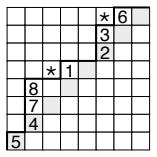
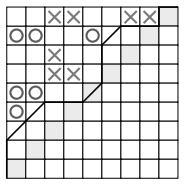
The central object is the ordered set partition schedule. From an ordered set partition $\Pi$ one forms a marked word $\tau^*(\Pi)$ whose runs correspond to diagonals of a parking function, marking every car that is not the leftmost element of its block; unmarked elements are block beginnings, so $\Pi$ can be recovered from $\tau^*(\Pi)$. For each car $c$, the schedule number $w_\Pi(c)$ counts the unmarked cars that would serve as insertion sites for $c$ during the insertion process, and the theorem packages those counts as the degrees of q-integers. The machinery that carries the argument is the pair of insertion algorithms together with Lemma 3.8: inserting a marked car into the $k$-diagonal creates exactly one new diagonal inversion per insertion site passed and none with cars to the right, which makes the dinv values of the new parking functions consecutive and turns the weighted sum over a whole insertion tree into a product of q-integers. The type map $\tau^*$ is what connects this tree structure to the $\Delta$ Conjecture's ordered set partitions.
What would settle it
Enumerate all ordered set partitions of $[n]$ for $n=5$ or $6$, generate every marked parking function of each type $\tau^*(\Pi)$, and compare the two sides of equation (3.5); any mismatch would show where the next-encounter rule of Insertion Algorithm 3.7 fails to produce the promised diagonal-inversion count.
Extended reading notes
Core claim
The central claim is Theorem 3.13: for every ordered set partition $\Pi$ of $[n]$, $$\sum_{\mathrm{MPF}\in \mathrm{MPF}(\Pi)} $t^{{\operatorname{area}}$(\mathrm{MPF})}$q^{{\operatorname{dinv}}$(\mathrm{MPF})}=$t^{{\operatorname{maj}}$(\tau(\Pi))}\prod_c [w_\Pi(c)]_q,$$ where the product runs over all cars in $\Pi$. The marked parking functions of a fixed type are generated by two insertion algorithms: unmarked cars are inserted by the classical schedule algorithm, and marked cars are inserted by a new rule that scans to the right until it meets a larger unmarked car in the next diagonal or a return of the path to the appropriate diagonal. A newly inserted marked car creates exactly one new diagonal inversion with each insertion site it passes, so its dinv values are consecutive integers and the entire insertion tree contributes one q-integer per car; the exponent of $t$ records the total area, $\operatorname{maj}(\tau(\Pi))$. The paper proves that the marked permutations admitting an insertion tree are exactly the type words $\tau^*(\Pi)$ of ordered set partitions, so the marked parking functions decompose disjointly by schedule. From this it derives a conjectural Hilbert series for $\mathrm{SDR}_n$ and a candidate monomial basis $B_n$ whose x-, y-, and $\theta$-degrees are dinv, area, and marking count respectively.
Load-bearing premise
The factorization stands or falls on Lemma 3.8, the assertion that when a marked car is inserted it creates exactly one new diagonal inversion for each insertion site it moves past and none with cars to its right, so the dinv values are consecutive integers.
Editorial extensions
If this is right
- If Theorem 3.13 holds, the Hilbert series of $\mathrm{SDR}_n$ has the closed form of Conjecture 3.14: $\sum_\Pi z^{n-|\Pi|} t^{\operatorname{maj}(\tau(\Pi))}\prod_c [w_\Pi(c)]_q$ over ordered set partitions of $[n]$.
- The candidate set $B_n$ contains exactly one monomial per marked parking function, with $x$-degree equal to dinv, $y$-degree equal to area, and $\theta$-degree equal to the number of markings, so Conjecture 4.3 would turn the schedule formula into a genuine basis.
- Every marked parking function satisfies $\operatorname{area}+\operatorname{dinv}+\binom{k+1}{2}\le \binom{n}{2}$ (Theorem 4.7), yielding one direction of the nonempty-component inequality for $\mathrm{SDR}_n$ and, through the alternant bound, evidence for Conjecture 4.5.
- At $\theta$-degree $0$ the candidate basis matches the known monomial basis for $\mathrm{DR}_n$, and at $\theta$-degree $n-1$ it collapses to a one-dimensional sign representation, matching the conjectured character of $\mathrm{SDR}_n$.
- Computer checks show $B_n$ spans the homogeneous components for $n\le 4$ and for many components at $n=5$, so the basis conjecture is consistent in small cases.
Reading between the lines
- The insertion-tree proof of Theorem 3.13 is a natural place to attack the full Delta Conjecture: if the same factorization can be refined to track the full fundamental-quasisymmetric-function expansion rather than only the $h_n^1$ specialization, it would prove the valley version directly.
- The basis conjecture suggests a degeneration proof of $\mathrm{SDR}_n$'s freeness: ordering monomials by schedule numbers might show $B_n$ is a standard monomial basis, and the paper's note that no basis is currently known for the $t=0$ super-coinvariant ring makes this a concrete target.
- The injective cell map in Theorem 4.7 may be a bijection exactly on the tight cases of the degree inequality; if so, the boundary of Conjecture 4.5 would have a Catalan-like enumerator that could be tested by computing the number of marked parking functions with $\operatorname{area}+\operatorname{dinv}+\binom{k+1}{2}=\binom{n}{2}$.
Signed reviews
Editorial analysis
A structured set of objections, weighed in public.
Referee Report
Summary. The paper develops a marked-parking-function analogue of the Haglund–Loehr schedule formula. It introduces an insertion algorithm for marked cars (Algorithm 3.7), proves a factorization theorem (Theorem 3.13) for the weighted sum over marked parking functions of a given type τ*(Π), and uses this to conjecture a Hilbert series (Conjecture 3.14) and a monomial basis (Conjecture 4.3) for the super-diagonal coinvariant ring SDRn introduced by Zabrocki. The paper also proves several supporting results: a degree inequality for marked parking functions (Theorem 4.7), an existence result for all degrees satisfying the bound (Theorem 4.8), and a location theorem for the alternants of SDRn (Theorem 4.11), together with small-case computer checks.
Significance. If the main theorem is correct, it gives the first schedules formula for the Delta Conjecture side of the super-diagonal coinvariant story, and it provides a natural conjectural monomial basis for SDRn, extending the Carlsson–Oblomkov basis for DRn. The insertability characterization (Theorem 3.11), the degree inequalities, and the alternant computation are valuable contributions in their own right. The paper is honest about its conjectural steps and includes detailed proofs for Lemma 3.5, Theorem 3.11, and the degree inequalities, as well as explicit computer checks for n ≤ 4 and partial checks for n = 5. The connection to Schröder paths and Kronecker coefficients is elegant and adds independent interest.
major comments (3)
- [§3.2, Lemma 3.8 and Theorem 3.13] The proof of Lemma 3.8 is a sketch and does not establish the load-bearing geometric claim. The proof states that the new marked car c creates a diagonal inversion with the chosen insertion site and with all potential sites to its left, and none to its right, but this is asserted without proof. In particular, the algorithm's 'look to the right ... for the next time' rule could, in principle, send two different potential sites to the same final placement of c if no unmarked b' or path-return event occurs between them; the proof does not rule out such collisions. Likewise, the proof does not exclude an unmarked car s' < c in the k-diagonal lying between the chosen site and the final position of c, which would create an additional inversion not accounted for in the stated consecutive sequence dinv(MPF), dinv(MPF)+1, ..., dinv(MPF)+|Insert*(MPF,c,k)|-1. Since Theorem 3.13 multiplies the q-integer [w_Π(c)]_q over all cars and depends on these exact dinv increments, this gap is load-bearing. The authors should either provide a complete proof of Lemma 3.8 or replace it with a separately stated and fully proved geometric lemma.
- [§4.1, Theorem 4.8] Theorem 4.8 claims the existence of a marked parking function with arbitrary area a, dinv b, and c markings whenever a+b+binom(c+1,2) ≤ binom(n,2). The proof constructs MPF(a,c) with maximal dinv and then invokes Theorem 3.13 to obtain MPF(a,b,c) for every b in the feasible interval. This is conditional on the unproved part of Lemma 3.8; until Lemma 3.8 is repaired, Theorem 4.8 and Corollary 4.9 should be regarded as conditional. The paper should say so explicitly or prove Theorem 4.8 by a direct construction.
- [§3.3, Lemma 3.15 and Theorem 3.11] The sufficiency direction of Lemma 3.15 is not fully justified. In the final paragraph, the proof considers the leftmost car in the (k+1)-diagonal; if it is smaller than c, the proof says 'the car beneath it is also smaller than c, and again c has at least one insertion site.' But Insertion Algorithm 3.7 requires an unmarked car s < c in the k-diagonal as an insertion site, and the argument does not rule out the possibility that the car beneath the leftmost upper-diagonal car is marked. Similarly, the reverse direction of Theorem 3.11 ends with 'A moment’s thought shows...' rather than a precise argument. Because Theorem 3.11 is used to identify the domain MPF(Π) in Theorem 3.13, this proof should be completed.
minor comments (5)
- [§3.2, Definition 3.10 and the example after Definition 3.12] The placement of the marking stars in displayed marked permutations is inconsistent with the definition. For example, the text writes τ*(235|1679|48) = 2*3*56*7*9*14*8, but the definition 'mark every number which is not the left-most element of its block in τ(Π)' would give a different assignment of stars; the schedule-number computation that follows matches the definition, not the displayed string. Please correct the typesetting of the starred elements.
- [§3.2, after Definition 3.12] The sentence claiming 'we calculate wΠ(c) = 2 if c = 1, 7, 9 and wΠ(c) = 1 otherwise' is correct for the intended marked word, but only if the star positions are fixed. The example would be clearer with an explicit table showing the runs of τ*(Π) and the contribution to each schedule number.
- [§3.2, proof of Theorem 3.13] Theorem 3.13 is stated after 'All these observations lead us to the following theorem,' but no formal induction is written out. Since the proof depends on the precise iteration of Lemmas 3.5 and 3.8, including the role of the appended 0 and the schedule numbers, a short inductive argument would improve the paper's rigor.
- [§4.1, proof of Theorem 4.7] The proof that the maps φ and ψ are injective and have disjoint images is terse; the sentence 'no cell left of c1 and in the same diagonal can make a diagonal inversion with c2' is particularly compressed. A more formal argument, or a second illustrated example, would make the proof easier to verify.
- [References] The reference [HL05] is listed as 'Discete Math.'; it should be 'Discrete Math.'
Circularity Check
No significant circularity: the Delta schedule formula is derived from insertion algorithms and definitions, and the conjectural Hilbert-series and basis applications are explicitly labeled as conjectures.
full rationale
The central derivation (Theorem 3.13) does not assume the Delta Conjecture, the Shuffle Theorem, or any fitted data. It is proved by iterating Insertion Algorithms 3.3 and 3.7 through Lemmas 3.5 and 3.8, with schedule numbers wPi(c) defined independently in Definition 3.12 from the marked permutation tau*(Pi). The weighted sum over MPF(Pi) on the left of equation (3.5) and the q-integer product on the right are not equal by construction: the product is the bookkeeping consequence of the area and dinv changes asserted in the lemmas. The only load-bearing geometric content is Lemma 3.8's claim about consecutive dinv values; that claim is asserted rather than fully demonstrated, but an unproved or potentially flawed assertion is a correctness risk, not a circularity. Citations to [HRW18], [Zab19], [HL05], and [CO18] are motivational or contextual: the Delta Conjecture is not an input to Theorem 3.13, and the SDRn basis in Section 4 is presented as a conjecture, with supporting checks explicitly limited to small n. The paper is self-contained against external benchmarks and does not rename a known result as a new one.
Assumptions & free parameters
assumptions (5)
- standard math Shuffle Theorem (Carlsson-Mellit): ∇e_n equals the weighted parking function enumeration.
- standard math Haiman's theorem: Frob(DR_n;q,t) = ∇e_n.
- domain assumption Zabrocki's Conjecture 2.7: Frob(SDR_n;q,t,z) = sum_k z^k Δ'_{e_{n-k-1}} e_n.
- domain assumption Delta Conjecture valley version (HRW18), Equation (2.7).
- standard math Standard facts on Schur functions, the dual Cauchy identity, and Frobenius characteristics.
Cite this review
Pith. "Pith review of Schedules and the Delta Conjecture." pith.science (2026). https://pith.science/paper/22DY5I5N
@misc{pith2026190804732,
  author       = {Pith},
  title        = {Pith review of: Schedules and the Delta Conjecture},
  year         = {2026},
  howpublished = {\url{https://pith.science/paper/22DY5I5N}},
  note         = {Machine review of arXiv:1908.04732}
}
abstract
In a recent preprint, Carlsson and Oblomkov (2018) obtain a long sought after monomial basis for the ring $\operatorname{DR}_n$ of diagonal coinvariants. Their basis is closely related to the "schedules" formula for the Hilbert series of $\operatorname{DR}_n$ which was conjectured by the first author and Loehr (2005) and first proved by Carlsson and Mellit (2018), as a consequence of their proof of the famous Shuffle Conjecture. In this article we obtain a schedules formula for the combinatorial side of the Delta Conjecture, a conjecture introduced by the first author, Remmel and Wilson (2018) which contains the Shuffle Conjecture as a special case. Motivated by the Carlsson-Oblomkov basis for $\operatorname{DR}_n$ and our Delta schedules formula, we introduce a (conjectural) basis for the module $\operatorname{SDR}_n$ of super-diagonal coinvariants, an $S_n$ module generalizing $\operatorname{DR}_n$ introduced recently by Zabrocki (2019) which conjecturally corresponds to the Delta Conjecture.
Figures


Figures from the paper (9 more)



Reference graph
Works this paper leans on
-
[1]
E. Artin. Galois Theory . Notre Dame Mathematical Lectures. Notre Dame Ind., 1976. Reprint of the 1942 original
work page 1976
-
[2]
Harris, Rosa Orellana, Greta Panova, Anne Schilling, and Martha Yip
Georgia Benkart, Laura Colmenarejo, Pamela E. Harris, Rosa Orellana, Greta Panova, Anne Schilling, and Martha Yip. A minimaj-preserving crystal on ordered multiset partitions. Adv. Appl. Math. , 95:96--115, 2018
work page 2018
-
[3]
Christine Bessenrodt. Tensor products of representations of the symmetric groups and related groups , volume 1149 of RIMS Kokyuroku (Proceedings of Research Insititute for Mathematical Sciences) , pages 1--15. Shigeo Koshitani, 2000
work page 2000
-
[4]
F. Bergeron and A. M. Garsia. Science Fiction and Macdonald's Polynomials . CRM Proc. & Lecture Notes, Amer. Math. Soc. , 22:1--52, 1999
work page 1999
-
[5]
F. Bergeron, A. M. Garsia, M. Haiman, and G. Tesler. Identities and positivity conjectures for some remarkable operators in the theory of symmetric functions. Methods Appl. Anal. , 6(3):363--420, 1999
work page 1999
-
[6]
Kronecker coefficients for one hook shape
Jonah Blasiak. Kronecker coefficients for one hook shape . Sem. Lothar. Combin. , 77:1--40, 2016
work page 2016
-
[7]
A proof of the shuffle conjecture
Erik Carlsson and Anton Mellit. A proof of the shuffle conjecture. J. Amer. Math. Soc. , 31(3):661--697, 2018
2018
-
[8]
Affine S chubert calculus and double coinvariants
Erik Carlsson and Alexei Oblomkov. Affine S chubert calculus and double coinvariants. arXiv preprint 1801.09033, 2018
arXiv 2018
Show all 36 references
-
[9]
Egge, Jim Haglund, Kendra Kilpatrick, and Darla Kremer
Eric S. Egge, Jim Haglund, Kendra Kilpatrick, and Darla Kremer. A Schr\"oder generalization of Haglund's statistic on Catalan paths . Electron. J. Combin. , 10(1):16, 2003
2003
-
[10]
E. Egge, N. Loehr, and G. Warrington. From quasisymmetric expansions to Schur expansions via a modified inverse Kostka matrix . European J. Comin. , 31(8):390--394, 2010
2010
-
[11]
Young tableaux: with applications to representation theory and geometry , volume 35 of London Mathematical Society Student Texts
William Fulton. Young tableaux: with applications to representation theory and geometry , volume 35 of London Mathematical Society Student Texts . Cambridge University Press, 1997
1997
-
[12]
I. Gessel. Multipartite P-partitions and inner products of skew Schur functions . Contemp. Math. , 34:289--301, 1984
1984
-
[13]
A. M. Garsia and M. Haiman. A remarkable q,t -Catalan sequence and q -Lagrange inversion . J. Algebraic Combin. , 5(3):191--244, 1996
1996
-
[14]
A. M. Garsia and M. Haiman. Some Natural Bigraded S_n -Modules and q,t -Kostka Coefficients . Electron. J. Combin. , 3(2):561--620 (The Foata Festschrift, paper R24), 1996
1996
-
[15]
A Proof of the Functional Equation Conjecture
Adriano Garsia, Angela Hicks, and Guoce Xin. A Proof of the Functional Equation Conjecture . arXiv preprint 1806.03221, 2018
2018 arXiv
-
[16]
A note on passing from a quasi-symmetric function expansion to a Schur function expansion of a symmetric function
Adriano Garsia and Jeffrey Remmel. A note on passing from a quasi-symmetric function expansion to a Schur function expansion of a symmetric function . arXiv preprint 1802.09686, 2018
2018 arXiv
-
[17]
A. M. Garsia and D. Stanton. Group actions of S tanley- R eisner rings and invariants of permutation groups. Adv. in Math. , 51(2):107--201, 1984
1984
-
[18]
A proof of the q,t -Schr\"oder conjecture
Jim Haglund. A proof of the q,t -Schr\"oder conjecture . Int. Math. Res. Not. IMRN , 2004(11):525--560, 2004
2004
-
[19]
The q,t -Catalan Numbers and the Space of Diagonal Harmonics
James Haglund. The q,t -Catalan Numbers and the Space of Diagonal Harmonics . University Lecture Series. American Mathematical Society, 2007
2007
-
[20]
Mark D. Haiman. Conjectures on the quotient ring by diagonal invariants. J. Algebraic Combin. , 3(1):17--76, 1994
1994
-
[21]
M. Haiman. Vanishing theorems and character formulas for the Hilbert scheme of points in the plane . Invent. Math. , 149:371--407, 2001
2001
-
[22]
Haglund, M
J. Haglund, M. Haiman, N. Loehr, J. B. Remmel, and A. Ulyanov. A combinatorial formula for the character of the diagonal coinvariants . Duke Math. J. , 126:195--232, 2005
2005
-
[23]
Parking Function Polynomials and Their Relation to the Shuffle Conjecture
Angela Hicks. Parking Function Polynomials and Their Relation to the Shuffle Conjecture . PhD thesis, University of California, San Diego, 2013
2013
-
[24]
A conjectured combinatorial formula for the Hilbert series for diagonal harmonics
James Haglund and Nicholas Loehr. A conjectured combinatorial formula for the Hilbert series for diagonal harmonics . Discete Math. , 298(1-3):189--204, 2005
2005
-
[25]
Ordered set partitions, generalized coinvariant algebras, and the Delta Conjecture
James Haglund, Brendan Rhoades, and Mark Shimozono. Ordered set partitions, generalized coinvariant algebras, and the Delta Conjecture . Adv. Math. , 329:851--915, 2018
2018
-
[26]
The delta conjecture
James Haglund, Jeff Remmel, and Andrew Wilson. The delta conjecture. Trans. Amer. Math. Soc. , 370(6):4029--4057, 2018
2018
-
[27]
A. G. Konheim and B. Weiss. An occupancy discipline and applications. SIAM J. Appl. Math. , 14(6):1266--1274, 1966
1966
-
[28]
I. G. Macdonald. A new class of symmetric functions . Actes du 20e S\'eminaire Lotharingien , Publ. I.R.M.A. Strasbourg:131--171, 1988
1988
-
[29]
I. G. Macdonald. Symmetric functions and Hall polynomials . Oxford Mathematical Monographs, New York, 2nd edition edition, 1995
1995
-
[30]
Ordered set partition statistics and the Delta Conjecture
Brendan Rhoades. Ordered set partition statistics and the Delta Conjecture . J. Combin. Theory Ser. A , 154:172--217, 2018
2018
-
[31]
Brendon Rhoades and Andrew. T. Wilson. Vandermondes in superspace. arXiv preprint 1906.03315, 2019
1906 arXiv
-
[32]
E. Sergel. The Combinatorics of nabla pn and connections to the Rational Shuffle Conjecture . PhD thesis, University of California, San Diego, 2016
2016
-
[33]
A proof of the square paths conjecture
Emily Sergel. A proof of the square paths conjecture. J. Combin. Theory Ser. A , 152:363--379, 2017
2017
-
[34]
Richard P. Stanley. Invariants of finite groups and their applications to combinatorics. Bull. Amer. Math. Soc. , 1(3):475--511, 1979
1979
-
[35]
Some implications of a conjecture of Zabrocki to the action of S_n on polynomial differential forms
Nolan Wallach. Some implications of a conjecture of Zabrocki to the action of S_n on polynomial differential forms . arXiv preprint 1906.11787, 2019
1906 arXiv
-
[36]
A module for the D elta conjecture
Mike Zabrocki. A module for the D elta conjecture . arXiv preprint 1902.08966, 2019
1902 arXiv
Reviewed August 14, 2026 · model on record in the stance chip above.
Discussion (0). Continue with ORCID to comment.