REVIEW 2 major objections 2 minor 15 references
Neural networks for nonlinear regression with serially correlated disturbances: Evidence from cloud cover
T0 review · 2 major / 2 minor · reviewed 2026-06-26 · grok-4.3
Pith's one-line read Embedding ARMA error structures into feedforward neural networks yields more accurate cloud cover predictions than LSTM networks or linear models with serially correlated errors.
desk verdict The paper embeds ARMA error structures into feedforward nets as an alternative to lagged inputs for nonlinear time-series regression, with simulation recovery and robustness plus better Mediterranean cloud-cover forecasts than LSTM, but the real-data edge depends on the chosen orders matching an unknown DGP. read the letter →
The pith
A machine-rendered reading of the paper's core claim, the machinery that carries it, and where it could break.
The reading
What carries the argument
The feedforward neural network with embedded ARMA error dynamics, which separates the nonlinear regression function from an explicit parametric model of the serially correlated disturbances.
What would settle it
A replication study on an independent grid of cloud cover observations or another environmental time series showing that the proposed model's mean squared prediction error is not lower than that of an LSTM or a linear ARMA model would falsify the superiority claim.
Extended reading notes
Core claim
The central claim is that a feedforward neural network augmented with an ARMA specification for the disturbances models nonlinear mean functions and serial correlation in errors more effectively than either lagged-variable approaches or standard recurrent architectures, as evidenced by accurate recovery in simulations and superior out-of-sample forecasts for Mediterranean cloud cover, particularly in regions with pronounced nonlinearity.
Load-bearing premise
The selected ARMA orders and network architecture are sufficient to represent the true serial correlation and nonlinearity present in the data-generating process.
Editorial extensions
If this is right
- The model recovers regression functions of varying complexity and the underlying ARMA error dynamics across a range of sample sizes and signal-to-noise ratios.
- Predictive performance remains robust when lagged variables are omitted or the error dynamics are misspecified.
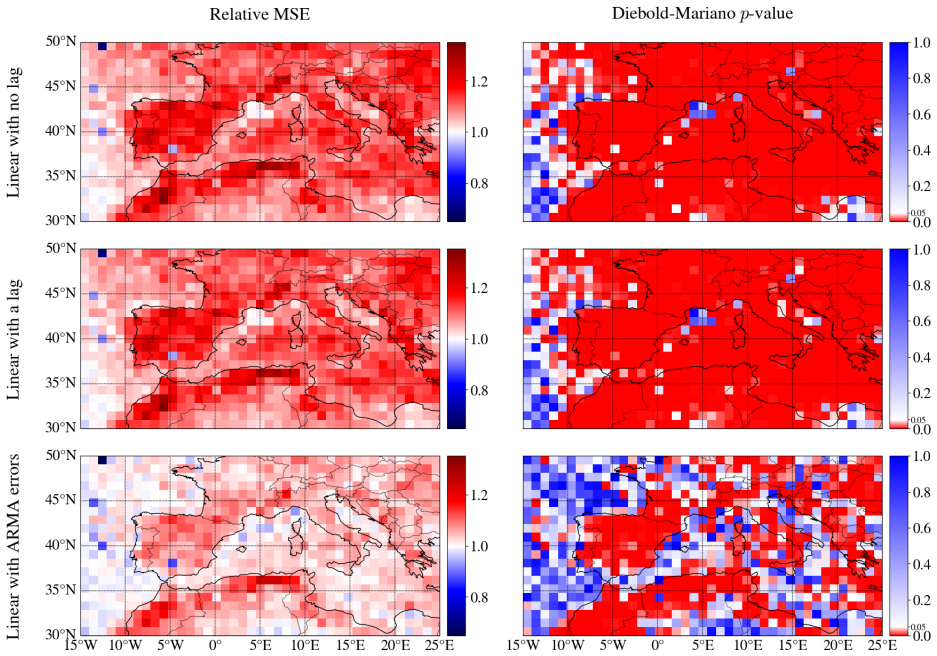
- Out-of-sample accuracy exceeds that of linear models with serially correlated errors and long short-term memory networks, with gains concentrated in mountain areas.
- The separation of nonlinear mean modeling from explicit error dynamics provides an alternative route to handling temporal dependence in regression settings.
Reading between the lines
- The same structure could be tested on other gridded environmental or economic series that exhibit both nonlinearity and autocorrelation to identify domains where the separation of mean and error components matters most.
- If the ARMA component can be estimated jointly with the network weights, the approach may offer a route to more interpretable neural network residuals in time series applications.
- Extending the framework to higher-order or seasonal ARMA specifications might further improve performance on data with periodic patterns, such as diurnal or annual cycles in cloud cover.
Editorial analysis
A structured set of objections, weighed in public.
Referee Report
Summary. The paper proposes a feedforward neural network that embeds ARMA error dynamics to model nonlinear regression with serially correlated disturbances, offering an alternative to explicit lagged-variable specifications. Simulations across varying time-series lengths and signal-to-noise ratios demonstrate accurate recovery of both the regression function and the error process, together with robustness to omitted lags and incorrect ARMA orders. In an empirical application to gridded cloud-cover data over the Mediterranean, the NN-ARMA model produces lower out-of-sample prediction errors than linear ARMA models and LSTM networks, with the largest gains reported in mountainous sub-regions.
Significance. If the reported predictive gains survive further scrutiny, the approach supplies a practical, parsimonious way to combine flexible nonlinearity with explicit serial-correlation modeling in econometric time-series applications. The cloud-cover exercise is a relevant test case for environmental econometrics and climate-impact studies, where both nonlinearity and temporal dependence are common. The simulation evidence of robustness to misspecification is a positive feature, though its value hinges on how closely the tested DGPs resemble the unknown cloud-cover process.
major comments (2)
- [Empirical application] Empirical section (cloud-cover application): the headline claim that NN-ARMA outperforms LSTM and linear ARMA rests on the adequacy of the chosen ARMA(p,q) orders and network depth/width for the unknown Mediterranean cloud-cover DGP. The manuscript should report (i) the exact procedure used to select p and q, (ii) the grid of architectures examined, and (iii) sensitivity checks that vary these choices; without such evidence the out-of-sample gains could be artifacts of specification rather than a general methodological improvement.
- [Simulation study] Simulation section: while robustness to omitted lags and wrong ARMA orders is asserted, the paper must clarify whether the Monte Carlo DGPs include features known to be present in cloud-cover series (long memory, regime shifts, or spatial-temporal interactions). If these features are absent from the simulation design, the reported robustness does not directly address the skeptic's concern about the real-data DGP.
minor comments (2)
- [Abstract] The abstract states that improvements are 'particularly pronounced in mountain areas' but does not report the quantitative difference in RMSE or MAE between mountain and non-mountain grids; adding these numbers would strengthen the claim.
- [Model section] Notation for the embedded ARMA component should be made fully explicit (e.g., how the MA terms enter the network output layer) to facilitate replication.
Simulated Author's Rebuttal
We thank the referee for the constructive comments. We address each major point below and indicate where revisions will be made.
read point-by-point responses
-
Referee: [Empirical application] Empirical section (cloud-cover application): the headline claim that NN-ARMA outperforms LSTM and linear ARMA rests on the adequacy of the chosen ARMA(p,q) orders and network depth/width for the unknown Mediterranean cloud-cover DGP. The manuscript should report (i) the exact procedure used to select p and q, (ii) the grid of architectures examined, and (iii) sensitivity checks that vary these choices; without such evidence the out-of-sample gains could be artifacts of specification rather than a general methodological improvement.
Authors: We agree that these details are necessary to substantiate the empirical claims. The revised manuscript will add a dedicated subsection reporting (i) the ARMA order selection procedure, (ii) the full grid of network depths and widths that were examined, and (iii) sensitivity results across alternative choices. These additions will clarify that the reported gains are not driven by a single specification. revision: yes
-
Referee: [Simulation study] Simulation section: while robustness to omitted lags and wrong ARMA orders is asserted, the paper must clarify whether the Monte Carlo DGPs include features known to be present in cloud-cover series (long memory, regime shifts, or spatial-temporal interactions). If these features are absent from the simulation design, the reported robustness does not directly address the skeptic's concern about the real-data DGP.
Authors: The Monte Carlo design examines robustness specifically to omitted lags and incorrect ARMA orders under stationary processes. It does not incorporate long memory, regime shifts, or spatial-temporal interactions. We will revise the simulation section to state this scope explicitly and to note that the empirical application provides the relevant evidence for the more complex cloud-cover process. This distinction will be made clear without overstating the simulation results. revision: partial
Circularity Check
No circularity: model definition and empirical validation are independent of fitted inputs
full rationale
The paper defines a feedforward NN with embedded ARMA error structure as an explicit alternative to lagged-variable approaches. Simulations recover known DGPs under controlled misspecification; empirical results are out-of-sample predictive comparisons on Mediterranean cloud-cover grids against LSTM and linear ARMA baselines. No equations reduce to their own fitted parameters by construction, no self-citation chain supports a uniqueness claim, and no ansatz is smuggled via prior work. The central claim (superior predictive accuracy) rests on direct performance metrics rather than tautological re-labeling of inputs.
Assumptions & free parameters
Cite this review
Pith. "Pith review of Neural networks for nonlinear regression with serially correlated disturbances: Evidence from cloud cover." pith.science (2026). https://pith.science/paper/22UB2RD5
@misc{pith2026260622483,
  author       = {Pith},
  title        = {Pith review of: Neural networks for nonlinear regression with serially correlated disturbances: Evidence from cloud cover},
  year         = {2026},
  howpublished = {\url{https://pith.science/paper/22UB2RD5}},
  note         = {Machine review of arXiv:2606.22483}
}
read the original abstract
We propose a new treatment of nonlinear regression with serially correlated disturbances that incorporates autoregressive moving average structures into feedforward neural networks. The resulting model provides an alternative to modeling temporal dependence using lagged variables. In simulations, the proposed method accurately recovers regression functions of varying complexity and the underlying error dynamics across a range of time-series lengths and signal-to-noise ratios. Finite-sample properties and out-of-sample predictive performances are shown to be robust to model misspecification induced by omitted lagged variables and incorrect specification of the error dynamics. Cloud cover is an important factor in climate projections. In an empirical study of cloud cover prediction for a grid of locations within and around the Mediterranean Sea, our proposed model yields more accurate predictions than existing methods, including long short-term memory networks. Improvements are observed broadly and are particularly pronounced in mountain areas relative to linear models with serially correlated errors, consistent with the presence of stronger nonlinear effects in cloud composure in such regions.
Figures


Figures from the paper (8 more)



Reference graph
Works this paper leans on
-
[1]
Altman, N. S. (1990). Kernel smoothing of data with correlated errors.Journal of the American Statistical Association 85(411), 749–759. Athey, S. and G. W. Imbens (2019). Machine learning methods that economists should know about.Annual Review of Economics 11(Volume 11, 2019), 685–725. Bach, F. (2017). Breaking the curse of dimensionality with convex neur...
1990
-
[2]
Bengtsson, L. (2010). The global atmospheric water cycle.Environmental Research Letters 5(2), 025202. Bennedsen, M., E. Hillebrand, and S. Jensen (2023). A neural network approach to the environ- mental Kuznets curve.Energy Economics 126, 106985. Bony, S., B. Stevens, D. Frierson, C. Jakob, M. Kageyama, R. Pincus, T. Shepherd, S. Sherwood, A. Siebesma, M....
-
[3]
Jones, R. H. (1980). Maximum likelihood fitting of arma models to time series with missing observations.Technometrics 22, 389–395. Jozefowicz, R., W. Zaremba, and I. Sutskever (2015). An empirical exploration of recurrent network architectures. InProceedings of the 32nd International Conference on International Conference on Machine Learning - Volume 37, ...
work page Pith review arXiv 1980
-
[4]
26 Levinson, N. (1946). The wiener (root mean square) error criterion in filter design and prediction. Journal of Mathematics and Physics 25(1-4), 261–278. Li, Q. and J. Racine (2007).Nonparametric Econometrics: Theory and Practice. Princeton, NJ: Princeton University Press. Liu, H., I. Koren, O. Altaratz, and M. D. Chekroun (2023). Opposing trends of clo...
1946
-
[5]
Rumelhart, D. E., G. E. Hinton, and R. J. Williams (1986). Learning representations by back- propagating errors.Nature 323, 533–536. Schmetz, J., P. Pili, S. Tjemkes, D. Just, J. Kerkmann, S. Rota, and A. Ratier (2002). An introduction to meteosat second generation (msg).Bulletin of the American Meteorological Society 83(7), 977 –
1986
-
[6]
Schmidt-Hieber, J. (2020). Nonparametric regression using deep neural networks with ReLU acti- vation function.The Annals of Statistics 48(4), 1875 –
2020
-
[7]
Silverman, B. W. (1986).Density estimation for statistics and data analysis. London: Chapman and Hall. Slingo, J. M. (1987). The development and verification of a cloud prediction scheme for the ecmwf model.Quarterly Journal of the Royal Meteorological Society 113(477), 899–927. Smith, R. B. (1979). The influence of mountains on the atmosphere. Volume 21 ...
1986
-
[8]
Stephens, G. L., J. Li, M. Wild, C. A. Clayson, N. Loeb, S. Kato, T. L’Ecuyer, P. W. Stackhouse, M. Lebsock, and T. Andrews (2012). An update on earth’s energy balance in light of the latest global observations.Nature Geoscience 5(10), 691–696. Stevens, B. and S. Bony (2013). What are climate models missing?Science 340(6136), 1053–1054. Stone, C. J. (1982...
2012
Show all 15 references
-
[9]
Hicks, M
Svennevik, H., S. Hicks, M. Riegler, T. Storelvmo, and H. Hammer (2024). A dataset for predicting cloud cover over europe.Scientific Data 11(1),
2024
-
[10]
Medeiros, and G
Ter¨ asvirta, T., M. Medeiros, and G. Rech (2006). Building neural network models for time series: a statistical approach.Journal of Forecasting 25(1), 49–75. 28 Vo, T. T., L. Hu, L. Xue, and S. Chen (2025). Trends in cloud covers across conus (1980–2020). Journal of Climate 3...
2006
-
[11]
Watson, G. S. (1964). Smooth regression analysis.Sankhy¯ a: The Indian Journal of Statistics, Series A (1961-2002) 26(4), 359–372. White, H. (1989). Some Asymptotic Results for Learning in Single-Hidden-Layer Feedforward Networks.Neural Networks 2, 425–431. White, H. and I. Do...
1964
-
[12]
Zelinka, M. D., T. A. Myers, D. T. McCoy, S. Po-Chedley, P. M. Caldwell, P. Ceppi, S. A. Klein, and K. E. Taylor (2020). Causes of higher climate sensitivity in cmip6 models.Geophysical Research Letters 47(1), e2019GL085782. Zhang, G. (2003). Time series forecasting using a hy...
2020
-
[13]
stability condition
Thus,Ccan be obtained without assumptions on σ2. The coefficientsϕ tt equal the partial autocorrelations of the processu t at lagt; see Appendix B. 31 B Jones’ reparametrization We use the reparametrization technique of Jones (1980) to transform the constrained minimization pr...
1980
-
[14]
At lowr, the sinusoidal function is estimated fairly well provided the sample size is large enough
and neural network applications (Bennedsen et al., 2023). At lowr, the sinusoidal function is estimated fairly well provided the sample size is large enough. It generally requires a larger sample size than for the hump-shaped function. Corresponding to the surface estimates in...
2023
-
[15]
grey”, “blue
Our strategy for selectingpandqis based on the BIC. We also considered the AIC, but the dis- tribution of selected ARMA specifications was less concentrated and did not converge to the true specification asTincreased. Neural network architecture Figure C.17 shows the validatio...
1993
Reviewed June 26, 2026 · model on record in the stance chip above.
Discussion (0). Continue with ORCID to comment.